REVIEW 2 major objections 5 minor 2 references
Magnetic deflection of high-spin sodium dimers formed on helium nanodroplets
T0 review · 2 major / 5 minor · reviewed 2026-08-15 · deepseek-v4-flash
Pith's one-line read Sodium dimers on helium nanodroplets carry a 1.9 ± 0.3 μB magnetic moment, matching the 3Σ triplet state, and their spins align with the applied field.
desk verdict A clean, compact demonstration that Na2 dimers on helium nanodroplets are high-spin and spin-polarized, with a quantitative moment that is solid but rests a bit more than the paper lets on on the assumed droplet size distribution. read the letter →
The pith
A machine-rendered reading of the paper's core claim, the machinery that carries it, and where it could break.
The reading
What carries the argument
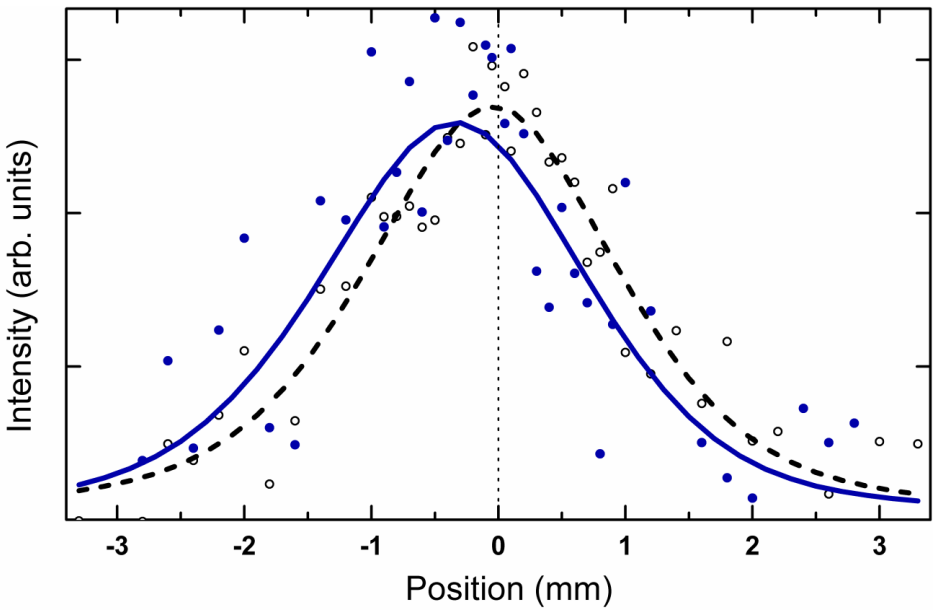
The central mechanism is magnetic Stern-Gerlach deflection of a nanodroplet beam through an inhomogeneous magnetic field, with the one-sided deflection profile fitted by a simulation that assumes a log-normal nanodroplet size distribution (mean ⟨n⟩ = 6000 atoms, width 0.9⟨n⟩) to extract the absolute magnetic moment. The one-sidedness of the profile is the key signature that the spin is fully oriented, and the paper suggests the spin thermalization proceeds through molecular spin-rotation coupling, since the helium matrix is nonmagnetic and vibrational spacings are too large to absorb the spin Zeeman energy. Supporting techniques include 29 eV electron-impact Penning ionization to pick out surface-bound alkali species and mass-selection of Na2+ at low pickup pressure to avoid larger clusters.
What would settle it
A concrete test is to repeat the deflection with droplets whose size distribution is independently characterized, for example by measuring the deflection of a reference dopant of known mass and moment, and to see whether the fitted Na2 moment stays at 1.9 ± 0.3 μB at different field gradients; if the inferred moment moves outside that band, or if multiple deflection peaks appear, the size-distribution assumption or the full spin-orientation claim would be falsified.
Extended reading notes
Core claim
The paper reports that the magnetic moment of Na2 on helium nanodroplets is non-zero and equals 2 μB within uncertainty, with the measured value μ = 1.9 ± 0.3 μB. This identifies the molecule as being in the metastable 3Σ spin-triplet state and makes the triplet population directly visible: the droplet beam is deflected by a 1.1 T field with a 330 T/m gradient. Because the observed deflection is one-sided rather than split into the MS = 0, ±1 components, the paper concludes that the dimer's spin has been thermalized by the droplet and fully oriented along the field, consistent with sub-microsecond spin relaxation previously inferred for alkali species on droplet surfaces. The absence of an undeflected component places a 5-10% upper limit on singlet S=0 Na2 in the beam.
Load-bearing premise
The load-bearing assumption is that the nanodroplet sizes in the beam follow the log-normal distribution with mean $\langle n\rangle=6000$ atoms and width $0.9\langle n\rangle$ used in the deflection simulation; if the true distribution is instead bimodal, as the 20% drop in deflected-beam intensity hints, the fitted magnetic moment could shift beyond its quoted uncertainty.
Editorial extensions
If this is right
- A non-zero magnetic moment is directly visible in the beam profile, so the triplet state of Na2 on helium nanodroplets no longer rests only on indirect spectroscopic inference.
- Because the spin is fully oriented by the field, the droplet beam delivers spin-aligned molecules, which could be exploited in collision or spectroscopy studies.
- The 5-10% singlet upper limit constrains formation dynamics of dimers on droplet surfaces and is consistent with energetic arguments that exothermic singlet formation ejects the dimer.
- The same magnetic deflection approach can be applied to larger alkali clusters and heteronuclear dimers to look for quartet and other high-spin states.
Reading between the lines
- Editorial inference: Because spin thermalization appears complete in under roughly 500 μs, one could use helium nanodroplets to prepare beams of spin-polarized molecules and map how the relaxation rate depends on field strength, droplet size, or alkali species.
- Editorial inference: The 20% drop in deflected-beam intensity noted in footnote 23 hints that the low-stagnation-pressure beam may be bimodal in droplet size; if so, the quoted uncertainty on μ could be optimistic, and an independent size-distribution measurement would strengthen the fitted value.
- Editorial inference: The same deflection technique could give model-free magnetic moments for quartet-state trimers or heteronuclear dimers, providing a check on spin multiplicities that currently rely on spectroscopy and pickup statistics.
Signed reviews
Editorial analysis
A structured set of objections, weighed in public.
Referee Report
Summary. The paper reports a magnetic Stern-Gerlach deflection experiment on a beam of sodium-doped helium nanodroplets. The measured beam profile shows a clear one-sided deflection of Na2-carrying droplets in an inhomogeneous magnetic field, and a simulation-based fit yields a magnetic moment of 1.9 ± 0.3 μB. The authors argue this value is consistent with 2 μB for the 3Σ spin-triplet state of Na2, and that the one-sided deflection indicates the electron spins are thermally relaxed to the lowest Zeeman sublevel at the 0.37 K droplet temperature. The central qualitative claim is that this provides a direct, transparent demonstration that alkali dimers on helium nanodroplets are predominantly in high-spin states.
Significance. The qualitative observation is convincing and valuable: a directly deflected doped-nanodroplet beam, with a one-sided profile and no undeflected component, provides strong model-independent evidence for a high-spin, magnetized Na2 species and for spin thermalization on the droplet. The paper honestly flags the main experimental and modeling caveats. However, the quantitative extraction of μ depends on a simulated forward model whose droplet-size distribution and calibration are not fully documented in the manuscript, and the paper itself notes a possible bimodal size distribution. Therefore the specific numerical agreement with 2 μB is not yet established at the claimed precision, even though the qualitative conclusion is robust.
major comments (2)
- [§4 (extraction of μ) and Footnote 23] The fitted value μ = 1.9 ± 0.3 μB rests on the assumed log-normal nanodroplet size distribution with mean <n> = 6000 atoms and width 0.9<n>, as stated in the paragraph following Fig. 1. Footnote 23 explicitly raises the possibility of a bimodal nanodroplet size distribution. The check reported there—rescaling the deflected intensity to the zero-field level—tests only the overall normalization, not the shape of the size distribution. Since the transverse deflection of a droplet scales inversely with droplet size, a bimodal or otherwise mis-specified size distribution can bias the fitted μ by more than the quoted uncertainty. The authors should provide a sensitivity analysis that refits the profile with a bimodal distribution and with <n> and the width varied within a plausible range, and report how μ changes. Without this, the quantitative agreement with 2 μB is not established beyond the model assumption.
- [§4 and Refs. 16-18] The simulation-fitting procedure is described only by references to two PhD theses (refs. 17 and 18) and to three earlier papers (refs. 16, 18, 23); the manuscript does not specify the forward model, the number of free parameters, or the fitting statistic. This matters because the central quantitative result is the output of that fit. The authors should either summarize the fitting procedure in the main text or include a detailed description in the Supplemental Material, so that the extraction of μ can be independently assessed and reproduced.
minor comments (5)
- [References (10) and (24)] References (10) and (24) are the same paper (Kristensen et al., Phys. Rev. Lett. 128, 093201); this duplication causes confusion, especially because ref. (24) is cited in a context where the Rb2 singlet fraction is discussed but the same paper is already cited as ref. (10) for the quantum-state-sensitive detection technique.
- [Spin relaxation time claim] The sentence 'This is consistent with the short, sub-microsecond spin relaxation time found25,26 for alkali dimers and trimers on nanodroplet surfaces' cites refs. 25 and 26, which from their titles concern potassium atoms, not dimers or trimers. Either the claim should be restricted to alkali atoms, or references to dimer/trimer spin relaxation should be provided.
- [Log-normal width description] The description of the log-normal droplet size distribution as having 'a full width of16 0.9<n>' is ambiguous; please specify whether this is a full width at half maximum, and how the width parameter is defined for the log-normal function.
- [Helium magnetism wording] The phrase 'the helium matrix itself is non-magnetic' is imprecise as a blanket statement; helium is diamagnetic. Please rephrase to avoid a physically inaccurate claim.
- [Figure 2 caption] The figure caption refers to 'a simulation fit of the deflection process' but the fitting procedure is not described in the text; please add a brief description or an explicit reference to the section or Supplemental Material where the simulation is explained.
Circularity Check
No significant circularity: the magnetic moment is a free parameter fitted to measured Stern-Gerlach profiles, and the droplet-size calibration is independent of the Na2 result.
full rationale
The paper's central quantitative claim (μ = 1.9 ± 0.3 μB) is obtained by fitting a beam-deflection simulation to measured in-field and zero-field profiles. Nothing in the fit constrains μ to 2 μB; the quoted value emerges from the data, and the agreement with the 3Σ value is a posteriori. The simulation inputs (beam velocity, magnet field/gradient, log-normal droplet-size distribution with mean <n>=6000 atoms) are calibrated by independent means: velocity by time-of-flight, field by the deflector design (ref 19), and droplet size by a FeCl2 reference deflection (ref 18/unpublished), which does not contain the target Na2 result. The spin-orientation inference (one-sided deflection) is a direct reading of the observed profile, not an input assumption. Footnote 23 flags a possible bimodal droplet-size distribution as a robustness caveat; while this could bias the fitted magnitude, it is a correctness/calibration concern, not a circular reduction, and the authors report that intensity rescaling leaves the fitted moment unchanged. Self-citations (refs 16–18) are method and calibration references, not unverified assertions that presuppose the paper's conclusion. Therefore no step in the derivation chain is equivalent, by construction, to its own input.
Assumptions & free parameters
free parameters (3)
- Dimer magnetic moment μ =
1.9 ± 0.3 μB
- Mean nanodroplet size <n> =
6000 atoms
- Nanodroplet size distribution width =
0.9<n> (log-normal)
assumptions (6)
- domain assumption Nanodroplet size distribution is log-normal with mean <n>=6000 and relative width 0.9.
- domain assumption The Na2+ signal originates from Na2 dimers attached to droplet surfaces, not from fragmentation of larger clusters or gas-phase molecules.
- domain assumption Penning ionization of surface species at 29 eV yields Na2+ without significant fragmentation of the dimer.
- standard math The magnetic deflection follows classical trajectories determined by μ_z dB/dz with known field strength (1.1 T) and gradient (330 T/m).
- domain assumption Spin equilibration to the lowest Zeeman sublevel is fast relative to the ~500 μs flight through the magnet.
- domain assumption A non-deflected central component in the two-population fit represents S=0 singlet dimers.
Cite this review
Pith. "Pith review of Magnetic deflection of high-spin sodium dimers formed on helium nanodroplets." pith.science (2026). https://pith.science/paper/LCMUQX7V
@misc{pith2026250510523,
  author       = {Pith},
  title        = {Pith review of: Magnetic deflection of high-spin sodium dimers formed on helium nanodroplets},
  year         = {2026},
  howpublished = {\url{https://pith.science/paper/LCMUQX7V}},
  note         = {Machine review of arXiv:2505.10523}
}
read the original abstract
Spectroscopic data on alkali-atom dimers residing on the surface of liquid helium nanodroplets have revealed that they are detected primarily in the weakly bound, metastable, spin-triplet state. Here, by measuring the magnetic Stern-Gerlach deflection of a sodium-doped nanodroplet beam, we transparently demonstrate the abundance of high-magnetic-moment dimers. Their electron spins thermalize with the cryogenic superfluid droplets and become fully oriented by the external magnetic field.
Figures
Reference graph
Works this paper leans on
-
[1]
(1) Stienkemeier, F.; Ernst, W. E.; Higgins, J.; Scoles, G. On the use of Liquid Helium Cluster Beams for the Preparation and Spectroscopy of the Triplet States of Alkali Dimers and Other Weakly Bound Complexes. J. Chem. Phys. 1995, 615-617. (2) Higgins, J.; Ernst, W.E.; Callegari, C.; Reho, J.; Stienkemeier, F.; Lehmann, K.K.; Scoles, G.; Gutowski, M. Sp...
work page 1995
-
[29]
H.; Kranabetter, L.; Schouder, C
(10) Kristensen, H. H.; Kranabetter, L.; Schouder, C. A.; Stapper, C.; Arlt, J.; Mudrich, M.; Stapelfeldt, H. Quantum-State-Sensitive Detection of Alkali Dimers on Helium Nanodroplets by Laser-Induced Coulomb Explosion. Phys. Rev. Lett. 2022, 128, 093201. (11) Kranabetter, L.; Kristensen, H. H.; Ghazaryan, A.; Schouder, C. A.; Chatterley, A. S.; Janssen, ...
work page 2022
Reviewed August 15, 2026 · model on record in the stance chip above.
Discussion (0). Continue with ORCID to comment.