REVIEW 3 major objections 5 minor 114 references
The Hitchhikers Guide to Production-ready Trustworthy Foundation Model powered Software (FMware)
T0 review · 3 major / 5 minor · reviewed 2026-08-15 · deepseek-v4-flash
Pith's one-line read FMware's scattered engineering pain points organize into one lifecycle, and a stage-by-stage action plan can move these systems from demos to trustworthy production.
desk verdict A well-organized tutorial survey that repackages the authors' own prior FMware work; useful for practitioners, but the 'systematic' catalogue misses adversarial security and the new-content claim needs clarifying. read the letter →
The pith
A machine-rendered reading of the paper's core claim, the machinery that carries it, and where it could break.
The reading
What carries the argument
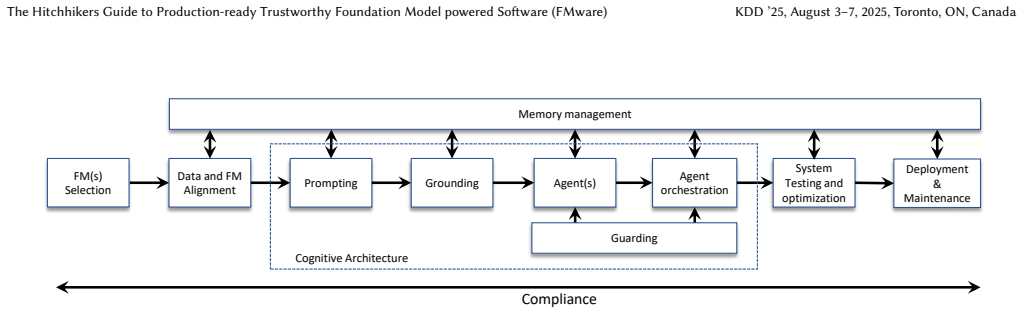
The central object is the FMware lifecycle (Figure 1): a structured view that runs from FM selection through data and model alignment, prompting, grounding, agents and agent orchestration, system testing and optimization, and deployment and maintenance, with guarding, memory management, and compliance as cross-cutting layers. The lifecycle does the argument's work by converting a scattered catalogue of pain points into a shared vocabulary and a stage-by-stage map. The action plan mirrors the lifecycle stage-for-stage, so each directive names the stage it repairs; this one-to-one mapping between challenge and remedy is what gives the roadmap its practical force.
What would settle it
Survey developers of FMware outside large enterprises—startups, open-source maintainers, public-sector teams—and check whether the engineering problems they report map onto the lifecycle stages and directives. A substantial cluster of reported challenges that fits no stage or has no directive would falsify the roadmap's coverage claim.
Extended reading notes
Core claim
On the paper's own terms, the contribution is the coherent organization itself. It claims that production-ready FMware has a distinct engineering identity: because model behavior changes with prompt wording, inference parameters, model updates, and input distributions, deterministic testing, observability, and compliance assumptions no longer hold. The survey assembles evidence for each lifecycle stage—ad hoc model selection among more than 1.4 million open-source models, brittle and non-portable prompts, hallucination-prone agent orchestration, AI judges correlating only moderately with human judgment (a reported 0.51), static guardrails that paraphrasing bypasses, and compliance tooling that does not span integrated FM components. It then claims these challenges are addressable through the action plan's directives, from semantic caching, prompt versioning, and structured retries to longer-range programs such as multi-level observability, FMwareBOM generation, and formal verification of compliance. A sympathetic reader takes away a structured map and a technology roadmap, not a proof that any single directive works.
Load-bearing premise
The roadmap depends on the curated catalogue of challenges being complete and representative enough to ground its directives; the paper does not show that a list built mainly from large-enterprise industrial experience covers startups, open-source projects, or low-resource deployments.
Editorial extensions
If this is right
- Teams can use the lifecycle as a pre-production checklist, making sure selection, alignment, prompting, grounding, orchestration, testing, observability, guarding, and compliance are each dealt with before release.
- Testing must shift from asserting exact outputs to evaluating behavior across distributions, using continuous evaluation pipelines, dependency-aware regression testing, and metamorphic relations derived from user feedback.
- Compliance needs FMware-wide artifacts: an FMwareBOM that extends SPDX 3.0 AI and dataset profiles to cover code, data, models, and agents, with automated license and regulatory checks.
- Observability has to become semantic—tracing reasoning paths, agent coordination, and drift—not just collecting latency and token metrics.
- Agent architecture should follow software-engineering discipline: single-responsibility components, permission models, structured human oversight, and controlled execution snapshots for reproducibility.
Reading between the lines
- If the lifecycle is a genuine map, it should pass a classification test: independent practitioners tagging the same set of FMware incidents should agree on which stage each incident belongs to; the paper does not run that validation.
- The directives mix ready-to-apply tactics with research-level programs, so a natural extension—left implicit—is a maturity ranking that lets teams sequence adoption from low-effort wins such as semantic caching and prompt version control toward harder items such as formal verification and multi-level observability.
- The reported 0.51 correlation for AI judges suggests an operational rule the paper does not state: treat LLM-as-judge as a triage filter that flags outputs for human review, not as a final oracle.
- The stage-by-stage structure invites a benchmark suite: each open problem could become a measurable task, such as prompt portability across model families or cache correctness after model updates.
Signed reviews
Editorial analysis
A structured set of objections, weighed in public.
Referee Report
Summary. The paper, written for a KDD 2025 tutorial, presents a survey and roadmap for building trustworthy, production-ready software systems that integrate foundation models as core components, which it terms FMware. It organizes the field into a lifecycle spanning FM selection, alignment, prompting, grounding, agents and orchestration, testing and optimization, observability, guarding, deployment, and cross-cutting concerns such as memory management and compliance. Drawing on industrial anecdotes and prior research, it argues that FMware engineering differs fundamentally from traditional software engineering, then proposes an action plan of directives organized by lifecycle stage. The central claims are that the paper systematically identifies the challenges of FMware and provides a technology roadmap for addressing them.
Significance. If the catalogue of challenges and the roadmap were comprehensive and well-validated, the paper would be a useful shared reference for both researchers and practitioners, synthesizing a fragmented literature and connecting it to concrete production concerns such as LinkedIn's extra four months of deployment effort, CodeCompose's model-sizing trade-offs, and ChatGPT's operating costs. The lifecycle framing and the emphasis on semantic observability, memory management, and compliance are timely and reflect real industrial experience. The paper is also honest about the immaturity of current practice, citing concrete evidence such as the moderate correlation of AI-as-judge evaluation with human judgment. However, the paper's contribution is qualitative and curated rather than systematically derived: none of the twenty-plus directives is empirically evaluated, and the catalogue is not benchmarked against an independently constructed taxonomy, so the roadmap's adequacy depends on the completeness of the authors' own challenge list.
major comments (3)
- [§3.5.1 Guarding; §2.7 Cross-cutting concerns; §4 Action Plan] The catalogue omits the entire class of adversarial-input security risks, most notably prompt injection, jailbreaks, indirect injection through retrieved or tool-returned content, data poisoning, and model supply-chain risks. The guarding discussion (§3.5.1) addresses output filtering, semantic filtering, false positives/negatives, and confidence estimation, but never considers that the inputs to an FMware system can be adversarial. Security is also absent from the cross-cutting concerns (§2.7), which list only Memory Management and Compliance, and the action plan (§4) contains no security directive. Because the paper's central claim in §1 is that it 'systematically identifies these challenges' and provides a production-readiness roadmap, this omission is load-bearing: teams following the roadmap would receive no guidance on what is widely regarded as one of the most critical production risk classes for LLM-based systems, corresponding to the top OWASP LLM risk. This should be remedied by adding a dedicated security subsection or cross-cutting concern, with corresponding directives, and by discussing the relationship between guarding and adversarial input robustness.
- [§1 Introduction; §2 FMware Lifecycle; §3 Challenges] The paper claims to 'systematically identify' the challenges of FMware, but it provides no survey methodology: no search strategy, inclusion/exclusion criteria, source selection process, or procedure for validating the representativeness of the challenge set. The catalogue appears to be heavily drawn from the authors' prior works [43], [76], [44], [57], and [30], and the paper does not compare its taxonomy with an independently derived one. This makes it impossible to assess whether the challenge list is comprehensive beyond the authors' large-enterprise industrial context, or whether the priority ordering of the roadmap would transfer to startups, open-source projects, low-resource deployments, or non-enterprise domains. The completeness of the catalogue is load-bearing for the roadmap claim, so the paper should either add a methodology subsection describing how the catalogue was assembled and validated, or soften the 'systematically identifies' claim to reflect the curated and experience-based nature of the survey.
- [§4 Action Plan] The action plan presents more than twenty directives (e.g., 'Multi-Prompt Architectures and Human-in-the-Loop Workflows', 'Automated FMwareBOM Generation and Formal Verification', 'Resource-Aware QA Framework and Smart Caching') without any evidence that these directives are effective, feasible, or prioritized relative to one another. The paper states that 'some directives can be somewhat readily applied to mitigate challenges, whereas others are research topics in themselves', but it does not say which are which, nor does it provide any case study, pilot, or empirical assessment. As a tutorial roadmap the proposals may be reasonable, but the manuscript's contribution framing in §1 — a roadmap for addressing the challenges — would be strengthened by explicitly marking each directive as validated practice, emerging practice, or open research, and by discussing any known limitations or trade-offs.
minor comments (5)
- [§1 Introduction] There is a grammatical slip in 'We then discuss key the challenges and present a critical overview' — 'key the' should be 'the key'.
- [§2.1, §2.2, §2.3] Several sentences use informal constructions, such as 'Below we discuss about the different stages' and 'we henceforth present an action plan'; the paper would benefit from a light language pass for consistency with a formal proceedings style.
- [Author block] The author list contains a formatting error: 'Gustavo A. Oliva1,2,,' has a doubled comma, and affiliation markers are inconsistently applied across the author list.
- [References] A few references are missing author or venue details, for example [79] lists 'RobBagby' as the author and [88] lists 'Unknown'; these should be completed for a camera-ready version.
- [Figure 1] The lifecycle figure uses the labels 'Agent(s)' and 'Agent orchestration' as separate boxes while the text in §2.3 discusses both under a single heading; the visual relationship between these boxes and the 'Guarding' and 'Memory management' boxes would be clearer if the figure legend explained the cross-cutting vs. sequential nature of the stages.
Circularity Check
No circular derivation found: the paper is a survey/tutorial that organizes existing evidence and cites the authors' prior work as background, not as the sole justification for its claims.
full rationale
This paper is a tutorial and survey, not a derivation with fitted parameters or predictive equations. Its central claims are that FMware poses distinctive engineering challenges and that those challenges can be organized into a lifecycle plus an action plan. Those claims are supported by external industrial and academic evidence (e.g., LinkedIn's deployment delays [2], Microsoft/GitHub validation costs [72], ChatGPT operating costs [7], Hugging Face model counts [32], and independently cited work on testing, alignment, RAG, agents, and compliance). The authors' own prior publications [43, 76] are cited where the paper explicitly builds on or condenses that previous catalogue and roadmap, which is normal attribution for a survey. Other same-group citations ([30], [44], [57]) appear as pointers to proposed tools in the roadmap; they do not function as a self-referential proof that the roadmap is correct. No equation or claim reduces by construction to its own input: the lifecycle is a proposed organizational framework, the challenges are curated from the literature and industrial reports, and the action plan is explicitly 'driven by the surveyed challenges' plus practical experience. Concerns about completeness (e.g., no dedicated prompt-injection or adversarial-security stage) and about the absence of a formal survey methodology are correctness or scope risks for the roadmap, but they are not circularity under the stated criteria. Accordingly, no circular step can be quoted, and the paper warrants a score of 0 for circularity.
Assumptions & free parameters
assumptions (4)
- domain assumption FMware is a categorically distinct class of software requiring engineering practices that differ fundamentally from traditional software development.
- domain assumption The curated challenge catalogue is comprehensive and representative across FMware contexts.
- domain assumption Cited industry anecdotes and statistics are accurate and generalizable (LinkedIn deployment delay, Microsoft/GitHub validation costs, ChatGPT $700k/day, AI-as-judge correlation 0.51).
- domain assumption Established software engineering principles (modularity, single responsibility, version control, formal verification) can be transferred to FMware.
invented entities (3)
-
FMware
-
FMwareBOM
-
Semantic observability
Cite this review
Pith. "Pith review of The Hitchhikers Guide to Production-ready Trustworthy Foundation Model powered Software (FMware)." pith.science (2026). https://pith.science/paper/6TTV6VKY
@misc{pith2026250510640,
  author       = {Pith},
  title        = {Pith review of: The Hitchhikers Guide to Production-ready Trustworthy Foundation Model powered Software (FMware)},
  year         = {2026},
  howpublished = {\url{https://pith.science/paper/6TTV6VKY}},
  note         = {Machine review of arXiv:2505.10640}
}
read the original abstract
Foundation Models (FMs) such as Large Language Models (LLMs) are reshaping the software industry by enabling FMware, systems that integrate these FMs as core components. In this KDD 2025 tutorial, we present a comprehensive exploration of FMware that combines a curated catalogue of challenges with real-world production concerns. We first discuss the state of research and practice in building FMware. We further examine the difficulties in selecting suitable models, aligning high-quality domain-specific data, engineering robust prompts, and orchestrating autonomous agents. We then address the complex journey from impressive demos to production-ready systems by outlining issues in system testing, optimization, deployment, and integration with legacy software. Drawing on our industrial experience and recent research in the area, we provide actionable insights and a technology roadmap for overcoming these challenges. Attendees will gain practical strategies to enable the creation of trustworthy FMware in the evolving technology landscape.
Figures
Reference graph
Works this paper leans on
-
[43]
Ahmed E. Hassan, Dayi Lin, Gopi Krishnan Rajbahadur, Keheliya Gallaba, Fil- ipe Roseiro Cogo, Boyuan Chen, Haoxiang Zhang, Kishanthan Thangarajah, Gustavo Oliva, Jiahuei (Justina) Lin, Wali Mohammad Abdullah, and Zhen Ming (Jack) Jiang. 2024. Rethinking Software Engineering in the Era of Foun- dation Models: A Curated Catalogue of Challenges in the Develo...
2024
-
[76]
Gopi Krishnan Rajbahadur, Gustavo A. Oliva, Dayi Lin, and Ahmed E. Hassan
-
[44]
Ahmed E. Hassan, Gustavo A. Oliva, Dayi Lin, Boyuan Chen, Zhen Ming, and Jiang. 2024. Towards AI-Native Software Engineering (SE 3.0): A Vision and a Challenge Roadmap. arXiv:2410.06107
arXiv 2024
-
[57]
Jiahuei Lin, Dayi Lin, Sky Zhang, and Ahmed E. Hassan. 2024. Engineering AI Judge Systems. arXiv:2411.17793 [cs.SE] https://arxiv.org/abs/2411.17793
arXiv 2024
-
[30]
Ximing Dong, Dayi Lin, Shaowei Wang, and Ahmed E Hassan. 2024. A Frame- work for Real-time Safeguarding the Text Generation of Large Language.arXiv preprint arXiv:2404.19048(2024)
arXiv 2024
-
[1]
Testing LLM-Based Applications: Strategy and Challenges — blog.scottlogic.com
2023. Testing LLM-Based Applications: Strategy and Challenges — blog.scottlogic.com. https://blog.scottlogic.com/2023/11/14/testing-LLM-based- applications-strategy-and-challenges.html. [Accessed 07-10-2024]
2023
-
[2]
Musings on Building a Generative AI Product — linkedin.com
2024. Musings on Building a Generative AI Product — linkedin.com. https://www.linkedin.com/blog/engineering/generative-ai/musings-on- building-a-generative-ai-product. [Accessed 08-10-2024]
2024
-
[3]
Copilot Internals
2025. Copilot Internals. https://thakkarparth007.github.io/copilot-explorer/ posts/copilot-internals last accessed: 2025-03-11
2025
Show all 114 references
-
[4]
LangSmith by LangChain
2025. LangSmith by LangChain. https://www.langchain.com/langsmith/ last accessed: 2025-03-11
2025
-
[5]
Traceloop
2025. Traceloop. https://www.traceloop.com/ last accessed: 2025-03-11
2025
-
[6]
Weights and Biases - Weave
2025. Weights and Biases - Weave. https://wandb.ai/site/weave/ last accessed: 2025-03-11
2025
-
[7]
Assad Abbas
Dr. Assad Abbas. 2024. The Financial Challenges of Leading in AI: A Look at OpenAI’s Operating Costs — unite.ai. https://www.unite.ai/the-financial- challenges-of-leading-in-ai-a-look-at-openais-operating-costs/. [Accessed 11-10-2024]
2024
-
[8]
Toufique Ahmed and Premkumar Devanbu. 2023. Better patching using LLM prompting, via Self-Consistency. In2023 38th IEEE/ACM International Conference on Automated Software Engineering (ASE). IEEE, 1742–1746
2023
-
[9]
Alon Albalak, Yanai Elazar, Sang Michael Xie, Shayne Longpre, Nathan Lambert, Xinyi Wang, Niklas Muennighoff, Bairu Hou, Liangming Pan, Haewon Jeong, et al. 2024. A survey on data selection for language models.arXiv preprint arXiv:2402.16827(2024)
2024 arXiv
-
[10]
Oluyemi Enoch Amujo and Shanchieh Jay Yang. 2024. How Good Is It? Evaluat- ing the Efficacy of Common versus Domain-Specific Prompts on Foundational Large Language Models.arXiv preprint arXiv:2407.11006(2024)
2024 arXiv
-
[11]
Anthropic. n.d.. All models overview - Anthropic. https://docs.anthropic.com/ en/docs/about-claude/models/all-models. Accessed: 2025-02-01
2025
-
[12]
Anthropic. n.d.. Claude 3.7 Sonnet and Claude Code. https://www.anthropic. com/news/claude-3-7-sonnet. Accessed: 2025-02-01
2025
-
[13]
Narges Ashtari, Ryan Mullins, Crystal Qian, James Wexler, Ian Tenney, and Mahima Pushkarna. 2023. From Discovery to Adoption: Understanding the ML Practitioners’ Interpretability Journey. InProceedings of the 2023 ACM Designing Interactive Systems Conference. 2304–2325
2023
-
[14]
Abhaya Asthana and Jack Olivieri. 2009. Quantifying software reliability and readiness. In2009 IEEE international workshop technical committee on communi- cations quality and reliability. IEEE, 1–6
2009
-
[15]
Suriya Ganesh Ayyamperumal and Limin Ge. 2024. Current state of LLM Risks and AI Guardrails.arXiv preprint arXiv:2406.12934(2024)
2024 arXiv
-
[16]
Bommasani, D.A Hudson, E
R. Bommasani, D.A Hudson, E. Adeli, Altman, et al. 2021. On the opportunities and risks of foundation models.arXiv preprint arXiv:2108.07258(2021)
2021 arXiv
-
[17]
Brajovic, N
D. Brajovic, N. Renner, V.P. Goebels, P. Wagner, B. Fresz, et al . 2023. Model Reporting for Certifiable AI: A Proposal from Merging EU Regulation into AI Development.arXiv preprint arXiv:2307.11525(2023)
2023 arXiv
-
[18]
Eric Breck, Shanqing Cai, Eric Nielsen, Michael Salib, and D Sculley. 2017. The ML test score: A rubric for ML production readiness and technical debt reduction. In2017 IEEE international conference on big data (big data). IEEE, 1123–1132
2017
-
[19]
Cramer, S
K.K Chang, M. Cramer, S. Soni, and D. Bamman. 2023. Speak, memory: An archaeology of books known to chatgpt/gpt-4.arXiv preprint arXiv:2305.00118 (2023)
2023 arXiv
-
[20]
Dong Chen, Shaoxin Lin, Muhan Zeng, Daoguang Zan, Jian-Gang Wang, An- ton Cheshkov, Jun Sun, Hao Yu, Guoliang Dong, Artem Aliev, et al . 2024. CodeR: Issue Resolving with Multi-Agent and Task Graphs.arXiv preprint arXiv:2406.01304(2024)
2024 arXiv
-
[21]
Guiming Hardy Chen, Shunian Chen, Ziche Liu, Feng Jiang, and Benyou Wang
-
[22]
Hung-Ting Chen, Michael JQ Zhang, and Eunsol Choi. 2022. Rich knowledge sources bring complex knowledge conflicts: Recalibrating models to reflect conflicting evidence.arXiv preprint arXiv:2210.13701(2022)
2022 arXiv
-
[23]
L. Chen, M. Zaharia, and J. Zou. 2023. How is ChatGPT’s behavior changing over time? arXiv:2307.09009 [cs.CL]
2023 arXiv
-
[24]
Xiang Chen, Chaoyang Gao, Chunyang Chen, Guangbei Zhang, and Yong Liu
-
[25]
Contractor, D
D. Contractor, D. McDuff, J.K. Haines, J. Lee, C. Hines, et al. 2022. Behavioral use licensing for responsible AI. InProceedings of the 2022 ACM Conference on Fairness, Accountability, and Transparency. 778–788
2022
-
[26]
Florin Cuconasu, Giovanni Trappolini, Federico Siciliano, Simone Filice, Cesare Campagnano, Yoelle Maarek, Nicola Tonellotto, and Fabrizio Silvestri. 2024. The power of noise: Redefining retrieval for rag systems. InProceedings of the 47th International ACM SIGIR Conference on...
2024
-
[27]
James Cusick. 2013. Architecture and Production Readiness Reviews in Practice. arXiv preprint arXiv:1305.2402(2013)
2013 arXiv
-
[28]
M. Deng, J. Wang, C.-P. Hsieh, Y. Wang, H. Guo, et al. 2022. RLPrompt: Opti- mizing Discrete Text Prompts with Reinforcement Learning. InProc. of Conf. on EMNLP. ACL, 3369–3391
2022
-
[29]
Hao Ding, Ziwei Fan, Ingo Guehring, Gaurav Gupta, Wooseok Ha, Jun Huan, Linbo Liu, Behrooz Omidvar-Tehrani, Shiqi Wang, and Hao Zhou. 2024. Rea- soning and Planning with Large Language Models in Code Development. In Proceedings of the 30th ACM SIGKDD Conference on Knowledge Di...
2024
-
[31]
L. Edwards. 2021. The EU AI Act: a summary of its significance and scope.AI (the EU AI Act)1 (2021)
2021
-
[32]
Hugging Face. n.d.. Models - Hugging Face. https://huggingface.co/models. Accessed: 2025-02-01
2025
-
[33]
Angela Fan, Beliz Gokkaya, Mark Harman, Mitya Lyubarskiy, Shubho Sengupta, Shin Yoo, and Jie M Zhang. 2023. Large language models for software engineer- ing: Survey and open problems. In2023 IEEE/ACM International Conference on Software Engineering: Future of Software Engineer...
2023
-
[34]
Chrisantha Fernando, Dylan Banarse, Henryk Michalewski, Simon Osindero, and Tim Rocktäschel. 2023. Promptbreeder: Self-Referential Self-Improvement Via Prompt Evolution. arXiv:2309.16797 [cs.CL] https://arxiv.org/abs/2309.16797
2023 arXiv
-
[35]
T. Gao, A. Fisch, and D. Chen. 2021. Making Pre-trained Language Models Better Few-shot Learners. InProc. of Annual Meeting of the ACL-IJCNLP. (ACL), 3816–3830
2021
-
[36]
I. Gim, G. Chen, S.S. Lee, N. Sarda, A. Khandelwal, et al . 2023. Prompt Cache: Modular Attention Reuse for Low-Latency Inference.arXiv preprint arXiv:2311.04934(2023)
2023 arXiv
-
[37]
Github. [n. d.]. GitHub Next | Copilot Workspace. https://githubnext.com/ projects/copilot-workspace/. Accessed 02-06-2024
2024
-
[38]
Grand View Research. 2023. Large Language Model Market Size, Share & Trends Analysis Report By Application (Customer Service, Content Generation), By Deployment, By Industry Vertical, By Region, And Segment Forecasts, 2024 -
2023
-
[39]
Grosse, J
R. Grosse, J. Bae, C. Anil, N. Elhage, A. Tamkin, et al . 2023. Studying large language model generalization with influence functions.arXiv preprint arXiv:2308.03296(2023)
2023 arXiv
-
[40]
Gunasekar, Y
S. Gunasekar, Y. Zhang, J. Aneja, C.C.T. Mendes, A. Del Giorno, et al . 2023. Textbooks Are All You Need.arXiv preprint arXiv:2306.11644(2023)
2023 arXiv
-
[41]
Taicheng Guo, Xiuying Chen, Yaqi Wang, Ruidi Chang, Shichao Pei, Nitesh V Chawla, Olaf Wiest, and Xiangliang Zhang. 2024. Large language model based multi-agents: A survey of progress and challenges.arXiv preprint arXiv:2402.01680(2024)
2024 arXiv
-
[42]
Tiezheng Guo, Qingwen Yang, Chen Wang, Yanyi Liu, Pan Li, Jiawei Tang, Dapeng Li, and Yingyou Wen. 2024. Knowledgenavigator: Leveraging large language models for enhanced reasoning over knowledge graph.Complex & Intelligent Systems10, 5 (2024), 7063–7076
2024
-
[45]
S. Hong, M. Zhuge, J. Chen, X. Zheng, Y. Cheng, et al. 2023. MetaGPT: Meta Pro- gramming for A Multi-Agent Collaborative Framework. arXiv:2308.00352 [cs.AI]
2023 arXiv
-
[46]
Xinyi Hou, Yanjie Zhao, Yue Liu, Zhou Yang, Kailong Wang, Li Li, Xiapu Luo, David Lo, John Grundy, and Haoyu Wang. 2024. Large language models for software engineering: A systematic literature review.ACM Transactions on Software Engineering and Methodology33, 8 (2024), 1–79
2024
-
[47]
Xu Huang, Weiwen Liu, Xiaolong Chen, Xingmei Wang, Hao Wang, Defu Lian, Yasheng Wang, Ruiming Tang, and Enhong Chen. 2024. Understanding the planning of LLM agents: A survey.arXiv preprint arXiv:2402.02716(2024)
2024 arXiv
-
[48]
Sablayrolles, A
A.Q Jiang, A. Sablayrolles, A. Mensch, C. Bamford, D.S. Chaplot, et al . 2023. Mistral 7B.arXiv preprint arXiv:2310.06825(2023)
2023 arXiv
-
[49]
Juyong Jiang, Fan Wang, Jiasi Shen, Sungju Kim, and Sunghun Kim. 2024. A Survey on Large Language Models for Code Generation.arXiv preprint arXiv:2406.00515(2024)
2024 arXiv
-
[50]
Haolin Jin, Linghan Huang, Haipeng Cai, Jun Yan, Bo Li, and Huaming Chen
-
[51]
Uday Kamath, Kevin Keenan, Garrett Somers, and Sarah Sorenson. 2024. LLMs in Production. InLarge Language Models: A Deep Dive: Bridging Theory and Practice. Springer, 315–373
2024
-
[52]
Ryo Kamoi, Sarkar Snigdha Sarathi Das, Renze Lou, Jihyun Janice Ahn, Yilun Zhao, Xiaoxin Lu, Nan Zhang, Yusen Zhang, Ranran Haoran Zhang, Su- jeeth Reddy Vummanthala, et al. 2024. Evaluating LLMs at Detecting Errors in LLM Responses.arXiv preprint arXiv:2404.03602(2024)
2024 arXiv
-
[53]
Joshi, Hanna Moazam, Heather Miller, Matei Zaharia, and Christopher Potts
Omar Khattab, Arnav Singhvi, Paridhi Maheshwari, Zhiyuan Zhang, Ke- shav Santhanam, Sri Vardhamanan, Saiful Haq, Ashutosh Sharma, Thomas T. Joshi, Hanna Moazam, Heather Miller, Matei Zaharia, and Christopher Potts
-
[54]
KDD ’25, August 3–7, 2025, Toronto, ON, Canada Vasilevski et al
From llms to llm-based agents for software engineering: A survey of current, challenges and future.arXiv preprint arXiv:2408.02479(2024). KDD ’25, August 3–7, 2025, Toronto, ON, Canada Vasilevski et al
2024 arXiv
-
[55]
Philippe Laban, Alexander R Fabbri, Caiming Xiong, and Chien-Sheng Wu. 2024. Summary of a haystack: A challenge to long-context llms and rag systems.arXiv preprint arXiv:2407.01370(2024)
2024 arXiv
-
[56]
Lewis, E
P. Lewis, E. Perez, A. Piktus, F. Petroni, V. Karpukhin, et al . 2020. Retrieval- Augmented Generation for Knowledge-Intensive NLP Tasks. InAdvances in Neural Information Processing Systems, H. Larochelle, M. Ranzato, R. Hadsell, M.F. Balcan, and H. Lin (Eds.), Vol. 33. Curran...
2020
-
[58]
DSPy: Compiling Declarative Language Model Calls into Self-Improving Pipelines.The Twelfth International Conference on Learning Representations
-
[59]
Woosuk Kwon, Zhuohan Li, Siyuan Zhuang, Ying Sheng, Lianmin Zheng, Cody Hao Yu, Joseph Gonzalez, Hao Zhang, and Ion Stoica. 2023. Efficient memory management for large language model serving with pagedattention. InProceedings of the 29th Symposium on Operating Systems Principl...
2023
-
[60]
Y. Liu, D. Iter, Yi. Xu, S. Wang, R. Xu, and C. Zhu. 2023. Gpteval: Nlg evaluation using gpt-4 with better human alignment.arXiv preprint arXiv:2303.16634 (2023)
2023 arXiv
-
[61]
Longpre, R
S. Longpre, R. Mahari, A. Chen, N. Obeng-Marnu, D. Sileo, et al. 2023. The Data Provenance Initiative: A Large Scale Audit of Dataset Licensing & Attribution in AI.arXiv preprint arXiv:2310.16787(2023)
2023 arXiv
-
[62]
Haipeng Luo, Qingfeng Sun, Can Xu, Pu Zhao, Qingwei Lin, Jianguang Lou, Shifeng Chen, Yansong Tang, and Weizhu Chen. 2024. Arena Learning: Build Data Flywheel for LLMs Post-training via Simulated Chatbot Arena.arXiv preprint arXiv:2407.10627(2024)
2024 arXiv
-
[63]
Nelson F Liu, Kevin Lin, John Hewitt, Ashwin Paranjape, Michele Bevilacqua, Fabio Petroni, and Percy Liang. 2024. Lost in the middle: How language models use long contexts.Transactions of the Association for Computational Linguistics 12 (2024), 157–173
2024
-
[64]
Ruibo Liu, Jerry Wei, Fangyu Liu, Chenglei Si, Yanzhe Zhang, Jinmeng Rao, Steven Zheng, Daiyi Peng, Diyi Yang, Denny Zhou, et al. 2024. Best practices and lessons learned on synthetic data for language models.arXiv preprint arXiv:2404.07503(2024)
2024 arXiv
-
[65]
Mozes, X
M. Mozes, X. He, B. Kleinberg, and L.D Griffin. 2023. Use of llms for illicit purposes: Threats, prevention measures, and vulnerabilities.arXiv preprint arXiv:2308.12833(2023)
2023 arXiv
-
[66]
Murali, C
V. Murali, C. Maddila, I. Ahmad, M. Bolin, D. Cheng, et al. 2023. CodeCompose: A Large-Scale Industrial Deployment of AI-assisted Code Authoring.arXiv preprint arXiv:2305.12050(2023)
2023 arXiv
-
[67]
Nadia Nahar, Christian Kästner, Jenna Butler, Chris Parnin, Thomas Zimmer- mann, and Christian Bird. 2024. Beyond the Comfort Zone: Emerging Solutions to Overcome Challenges in Integrating LLMs into Software Products.arXiv preprint arXiv:2410.12071(2024)
2024 arXiv
-
[68]
Wanqin Ma, Chenyang Yang, and Christian Kästner. 2024. (Why) Is My Prompt Getting Worse? Rethinking Regression Testing for Evolving LLM APIs. InPro- ceedings of the IEEE/ACM 3rd International Conference on AI Engineering-Software Engineering for AI. 166–171
2024
-
[69]
Microsoft. [n. d.]. microsoft/semantic-kernel: Integrate cutting-edge LLM technology quickly and easily into your apps. https://github.com/microsoft/ semantic-kernel. Accessed 01-30-2024
2024
-
[70]
OpenAI. n.d.. OpenAI o1 Hub | OpenAI. https://openai.com/o1/. Accessed: 2025-02-01
2025
-
[71]
Charles Packer, Vivian Fang, Shishir G Patil, Kevin Lin, Sarah Wooders, and Joseph E Gonzalez. 2023. Memgpt: Towards llms as operating systems.arXiv preprint arXiv:2310.08560(2023)
2023 arXiv
-
[72]
Parnin, G
C. Parnin, G. Soares, R. Pandita, S. Gulwani, J. Rich, et al . 2023. Build- ing Your Own Product Copilot: Challenges, Opportunities, and Needs. arXiv:2312.14231 [cs.SE]
2023 arXiv
-
[73]
OpenAI. n.d.. Hello GPT-4o | OpenAI. https://openai.com/index/hello-gpt-4o/. Accessed: 2025-02-01
2025
-
[74]
OpenAI. n.d.. Models - OpenAI API. https://platform.openai.com/docs/models. Accessed: 2025-02-01
2025
-
[75]
Baolin Peng, Michel Galley, Pengcheng He, Hao Cheng, Yujia Xie, Yu Hu, Qi- uyuan Huang, Lars Liden, Zhou Yu, Weizhu Chen, and Jianfeng Gao. 2023. Check Your Facts and Try Again: Improving Large Language Models with External Knowledge and Automated Feedback. arXiv:2302.12813 [c...
2023 arXiv
-
[77]
Sumedh Rasal and EJ Hauer. 2024. Navigating Complexity: Orchestrated Problem Solving with Multi-Agent LLMs.arXiv preprint arXiv:2402.16713(2024)
2024 arXiv
-
[78]
Parry, G.M
O. Parry, G.M. Kapfhammer, M. Hilton, and P. McMinn. 2022. Surveying the developer experience of flaky tests. InProc. of Int. Conf. on Softw. Eng.: Software Engineering in Practice. 253–262
2022
-
[79]
Venkatesh Balavadhani Parthasarathy, Ahtsham Zafar, Aafaq Khan, and Ar- salan Shahid. 2024. The Ultimate Guide to Fine-Tuning LLMs from Basics to Breakthroughs: An Exhaustive Review of Technologies, Research, Best Practices, Applied Research Challenges and Opportunities.arXiv ...
2024 arXiv
-
[80]
Antonio Sabbatella, Andrea Ponti, Ilaria Giordani, Antonio Candelieri, and Francesco Archetti. 2024. Prompt Optimization in Large Language Models. Mathematics12, 6 (2024), 929
2024
-
[81]
Kunal Sawarkar, Abhilasha Mangal, and Shivam Raj Solanki. 2024. Blended RAG: Improving RAG (Retriever-Augmented Generation) Accuracy with Semantic Search and Hybrid Query-Based Retrievers.arXiv preprint arXiv:2404.07220 (2024)
2024 arXiv
-
[82]
arXiv:2410.20791 [cs.SE] https://arxiv.org/abs/2410.20791
From Cool Demos to Production-Ready FMware: Core Challenges and a Technology Roadmap. arXiv:2410.20791 [cs.SE] https://arxiv.org/abs/2410.20791
-
[83]
Aizaz Sharif, Dusica Marijan, and Marius Liaaen. 2021. Deeporder: Deep learn- ing for test case prioritization in continuous integration testing. In2021 IEEE International Conference on Software Maintenance and Evolution (ICSME). IEEE, 525–534
2021
-
[84]
Traian Rebedea, Razvan Dinu, Makesh Sreedhar, Christopher Parisien, and Jonathan Cohen. 2023. Nemo guardrails: A toolkit for controllable and safe llm applications with programmable rails.arXiv preprint arXiv:2310.10501(2023)
2023 arXiv
-
[85]
RobBagby. [n. d.]. Retry Storm antipattern - Performance antipatterns for cloud apps — learn.microsoft.com. https://learn.microsoft.com/en-us/azure/ architecture/antipatterns/retry-storm/. [Accessed 07-10-2024]
2024
-
[86]
Strobelt, A
H. Strobelt, A. Webson, V. Sanh, B. Hoover, J. Beyer, et al. 2023. Interactive and Visual Prompt Engineering for Ad-hoc Task Adaptation with Large Language Models.IEEE Trans. on Visualization and Computer Graphics29, 1 (2023), 1146– 1156
2023
-
[87]
Aman Singh Thakur, Kartik Choudhary, Venkat Srinik Ramayapally, Sankaran Vaidyanathan, and Dieuwke Hupkes. 2024. Judging the Judges: Evaluating Align- ment and Vulnerabilities in LLMs-as-Judges.arXiv preprint arXiv:2406.12624 (2024)
2024 arXiv
-
[88]
Schoch, R
S. Schoch, R. Mishra, and Y. Ji. 2023. Data Selection for Fine-tuning Large Lan- guage Models Using Transferred Shapley Values.arXiv preprint arXiv:2306.10165 (2023)
2023 arXiv
-
[89]
Cangqing Wang, Yutian Yang, Ruisi Li, Dan Sun, Ruicong Cai, Yuzhu Zhang, and Chengqian Fu. 2024. Adapting llms for efficient context processing through soft prompt compression. InProceedings of the International Conference on Modeling, Natural Language Processing and Machine L...
2024
-
[90]
Tianhao Shen, Renren Jin, Yufei Huang, Chuang Liu, Weilong Dong, Zishan Guo, Xinwei Wu, Yan Liu, and Deyi Xiong. 2023. Large language model alignment: A survey.arXiv preprint arXiv:2309.15025(2023)
2023 arXiv
-
[91]
W. Shi, A. Ajith, M. Xia, Y. Huang, D. Liu, et al. 2023. Detecting pretraining data from large language models.arXiv preprint arXiv:2310.16789(2023)
2023 arXiv
-
[92]
Xin Wang, Yuwei Zhou, Hong Chen, and Wenwu Zhu. 2024. Curriculum Learn- ing: Theories, Approaches, Applications, Tools, and Future Directions in the Era of Large Language Models. InCompanion Proceedings of the ACM on Web Conference 2024. 1306–1310
2024
-
[93]
Yuntao Wang, Yanghe Pan, Miao Yan, Zhou Su, and Tom H Luan. 2023. A survey on ChatGPT: AI-generated contents, challenges, and solutions.IEEE Open Journal of the Computer Society(2023)
2023
-
[94]
Unknown. 2023. SPDX 3.0 Dataset Profile. https://spdx.github.io/spdx-spec/v3. 0/model/Dataset/Dataset/ Accessed: 2024-10-11
2023
-
[95]
OpenDataology workgroup. 2022. OpenDataology. https://github.com/ OpenDataology/. Accessed 02-07-2024
2022
-
[96]
Guanzhi Wang, Yuqi Xie, Yunfan Jiang, Ajay Mandlekar, Chaowei Xiao, Yuke Zhu, Linxi Fan, and Anima Anandkumar. 2023. Voyager: An open-ended embod- ied agent with large language models.arXiv preprint arXiv:2305.16291(2023)
2023 arXiv
-
[97]
Qiaosi Wang, Koustuv Saha, Eric Gregori, David Joyner, and Ashok Goel. 2021. Towards mutual theory of mind in human-ai interaction: How language reflects what students perceive about a virtual teaching assistant. InProceedings of the 2021 CHI conference on human factors in com...
2021
-
[98]
Yuchen Xia, Jiho Kim, Yuhan Chen, Haojie Ye, Souvik Kundu, Nishil Talati, et al. 2024. Understanding the Performance and Estimating the Cost of LLM The Hitchhikers Guide to Production-ready Trustworthy Foundation Model powered Software (FMware) KDD ’25, August 3–7, 2025, Toron...
2024 arXiv
-
[99]
Jian Xie, Kai Zhang, Jiangjie Chen, Renze Lou, and Yu Su. 2023. Adaptive chameleon or stubborn sloth: Revealing the behavior of large language models in knowledge conflicts.arXiv preprint arXiv:2305.13300(2023)
2023 arXiv
-
[100]
J. Wei, X. Wang, D. Schuurmans, M. Bosma, E. Chi, et al. 2022. Chain-of-thought prompting elicits reasoning in large language models.Advances in Neural Info Processing Systems(2022)
2022
-
[101]
Quanjun Zhang, Chunrong Fang, Yang Xie, Yaxin Zhang, Yun Yang, Weisong Sun, Shengcheng Yu, and Zhenyu Chen. 2023. A survey on large language models for software engineering.arXiv preprint arXiv:2312.15223(2023)
2023 arXiv
-
[102]
Q. Wu, G. Bansal, J. Zhang, Y. Wu, B. Li, E. Zhu, et al . 2023. Auto- Gen: Enabling Next-Gen LLM Applications via Multi-Agent Conversation. arXiv:2308.08155 [cs.AI]
2023 arXiv
-
[103]
Siye Wu, Jian Xie, Jiangjie Chen, Tinghui Zhu, Kai Zhang, and Yanghua Xiao
-
[104]
How Easily do Irrelevant Inputs Skew the Responses of Large Language Models?arXiv preprint arXiv:2404.03302(2024)
2024 arXiv
-
[105]
Yongchao Zhou, Andrei Ioan Muresanu, Ziwen Han, Keiran Paster, Silviu Pitis, Harris Chan, and Jimmy Ba. 2023. Large Language Models Are Human-Level Prompt Engineers. arXiv:2211.01910 [cs.LG] https://arxiv.org/abs/2211.01910
2023 arXiv
-
[106]
X. Zhu, J. Li, Y. Liu, C. Ma, and W. Wang. 2023. A survey on model compression for large language models.arXiv preprint arXiv:2308.07633(2023)
2023 arXiv
-
[107]
Eugene Yan, Bryan Bischof, Charles Frye, Hamel Husain, Jason Liu, and Shreya Shankar. [n. d.]. What We Learned from a Year of Building with LLMs (Part I) — oreilly.com. https://www.oreilly.com/radar/what-we-learned-from-a-year-of- building-with-llms-part-i/. [Accessed 04-10-2024]
2024
-
[109]
Zhimin Zhao, Abdul Ali Bangash, Filipe Roseiro Côgo, Bram Adams, and Ahmed E. Hassan. 2025. On the Workflows and Smells of Leaderboard Opera- tions (LBOps): An Exploratory Study of Foundation Model Leaderboards.IEEE Transactions on Software Engineering(2025), 1–18. doi:10.1109...
2025
-
[110]
C. Zhou, P. Liu, P. Xu, S. Iyer, J. Sun, et al. 2023. Lima: Less is more for alignment. arXiv preprint arXiv:2305.11206(2023)
2023 arXiv
-
[111]
Zhou, Y.E
W. Zhou, Y.E. Jiang, L. Li, J. Wu, T. Wang, et al. 2023. Agents: An Open-source Framework for Autonomous Language Agents. arXiv:2309.07870 [cs.CL]
2023 arXiv
-
[114]
Małgorzata Łazuka, Andreea Anghel, and Thomas Parnell. 2024. LLM-Pilot: Characterize and Optimize Performance of your LLM Inference Services. arXiv:2410.02425 https://arxiv.org/abs/2410.02425
2024 arXiv
-
[2024]
Humans or llms as the judge? a study on judgement biases.arXiv preprint arXiv:2402.10669(2024)
2024 arXiv
-
[2025]
An Empirical Study on Challenges for LLM Application Developers.ACM Transactions on Software Engineering and Methodology(2025)
2025
-
[2030]
https://www.grandviewresearch.com/industry-analysis/large-language- model-llm-market-report
Reviewed August 15, 2026 · model on record in the stance chip above.
Discussion (0). Continue with ORCID to comment.