REVIEW 3 major objections 5 minor 1 cited by
Personalized Robotic Object Rearrangement from Scene Context
T0 review · 3 major / 5 minor · reviewed 2026-08-15 · deepseek-v4-flash
Pith's one-line read The paper shows that a household robot can infer a user's organizational preferences from scene context alone, and that preserving multiple valid placements for each object produces better rearrangements than single-rule or single-context…
desk verdict A valuable new crowdsourced benchmark whose main comparative claim is underpowered by the statistics; the dataset itself justifies peer review. read the letter →
The pith
A machine-rendered reading of the paper's core claim, the machinery that carries it, and where it could break.
The reading
What carries the argument
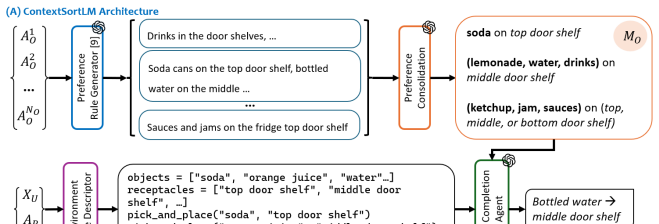
The load-bearing mechanism is ContextSortLM's meta-preference representation $M_O$, a JSON-style consolidation of rules extracted from the user's previously observed arrangements. Unlike a single textual rule list, $M_O$ preserves multiple valid placement locations for an object category, so flexible preferences are not lost. Placement itself is done by appending $M_O$ to a prompt that rewrites the current partial arrangement $A_P$ as Python-style pick-place commands and asking an LLM to complete the code. This structure is what lets the model reason jointly over prior and current scene context while avoiding the overgeneralization that occurs when an LLM compresses observations into one description.
What would settle it
An ablation where ContextSortLM collapses its JSON-style meta-preference into a single textual rule list and still matches its placement accuracy would show the representation is not load-bearing; conversely, a real-home study where ContextSortLM's placements are rated no closer to user preference than a single-context baseline would falsify the transfer claim.
Extended reading notes
Core claim
The central discovery is that explicitly representing the fact that a user may find several locations acceptable for the same object, rather than collapsing observations into one rule or one textual summary, lets an LLM-based rearrangement system place objects more faithfully in partially arranged environments. ContextSortLM first extracts placement rules from each observed arrangement, then consolidates them into a single JSON-style preference representation that keeps multiple valid surfaces per object. At test time it rewrites the current partial arrangement as pick-place code and asks the LLM to complete the program against this representation. In the PARSEC benchmark its placements match the target user's arrangements better than any compared model, and in a crowdsourced ranking of predictions by 108 raters it ranks among the top two in every environment category. The paper also establishes a benchmark-level finding: personalized rearrangement methods that integrate prior observations with the environment's current arrangement outperform methods relying on either source alone.
Load-bearing premise
The crowdsourced arrangements made by 72 online workers in simulated 2D scenes are a valid proxy for how real people organize their physical homes.
Editorial extensions
If this is right
- A robot using ContextSortLM can begin personalizing after a few passive observations, with no explicit user instructions.
- Household robots operating in already-occupied spaces benefit more from combining prior and current context than from either source alone.
- Designers of LLM-based rearrangement prompts should preserve multiple valid placements explicitly; flattening them into a single rule loses user alignment.
- PARSEC provides a standard comparison mode for future rearrangement models across different environment types.
- ContextSortLM's weakness in densely occupied scenes points toward hybrid designs that let learned policies resolve conflicts with the current environment.
Reading between the lines
- Editorial inference: Because PARSEC environments are simulated 2D layouts, the benchmark likely understates the role of 3D spatial cues such as reachability and visibility; a model that exploits those cues could outperform ContextSortLM's rankings in real homes.
- Editorial inference: The JSON-style meta-preference representation could generalize to other LLM tasks where multiple outputs are acceptable, such as mobile manipulation goal selection or human-in-the-loop planning.
- Editorial inference: The observation that human raters tolerate reasonable placement variations suggests future evaluations should measure 'any acceptable placement' as well as exact matches.
- Editorial inference: An active-learning extension that asks the user one targeted question only when ContextSortLM's valid placements conflict could close the gap in densely occupied environments without burdening the user.
Signed reviews
Editorial analysis
A structured set of objections, weighed in public.
Referee Report
Summary. The paper introduces PARSEC, a benchmark and dataset for personalized robotic object rearrangement in partially arranged scenes, together with ContextSortLM, a zero-shot LLM-based method that builds a JSON-style preference representation from prior arrangements and then places objects via code completion conditioned on the current partial arrangement. The dataset contains 110K rearrangement examples generated from 432 crowdsourced arrangements by 72 users across 15 environments and five organizational tasks. The authors compare ContextSortLM with six graph-based baselines using Placement Accuracy, Scene Edit Distance, and Incorrectly Grouped Objects, and complement this with a crowdsourced human study in which 108 raters rank predictions from four models. The main reported findings are that models using both prior and current scene context outperform single-context models, and that ContextSortLM achieves the highest Placement Accuracy and ranks among the top two in human rater preference across environment categories.
Significance. The paper provides a concrete, released benchmark and dataset for an under-served problem, and its zero-shot evaluation is an appropriate way to test generalization to unseen users and environments. The structured JSON preference representation for multiple valid placements is a sensible and potentially reusable design choice, and the human evaluation includes significance testing, which is a strength. The main limitation is that the computational comparison, which underpins the abstract's 'outperforms' claim, is reported without uncertainty quantification; the benchmark's external validity also rests on an unvalidated crowdsourcing proxy. If the authors add repeated runs and statistical intervals, and qualify the claims about real-world relevance, the paper would be a solid benchmark contribution.
major comments (3)
- [§VI.A, Table II] Placement Accuracy is reported as a single number per model and environment category with no error bars, standard deviation, confidence intervals, or statistical tests. Because the three leading models are stochastic LLMs using gpt-4-0613 and the paper does not state sampling temperature, number of repeated generations, or seed handling, the margins between ContextSortLM and APRICOT-NonInteractive (0.59 vs 0.53 average; 0.54 vs 0.50 in Uniform-1D) could plausibly be explained by sampling noise or fold selection. Since this table is the primary support for the abstract's statement that ContextSortLM 'outperforms other models,' that claim is currently not established. Please report repeated-run statistics and pairwise significance tests, or explicitly state deterministic decoding and show fold-level stability.
- [§IV and §VIII] The paper describes PARSEC as capturing 'real-world organizational habits,' but the data come from 72 Prolific workers arranging objects in simulated 2D environments, and no evidence is provided that these crowdsourced arrangements correspond to how people organize physical homes. This assumption underlies every conclusion drawn from the PARSEC evaluation and should be explicitly validated, or the claims about real-world relevance should be qualified in the abstract and discussion.
- [§VII.A, Table III] The human evaluation, while statistically analyzed, is small (36 examples, 3 raters each) and its results are more mixed than the abstract suggests: APRICOT-NonInteractive has a higher alignment score than ContextSortLM in Uniform-1D (45.2% vs 40.5%) and Uniform-2D (43.2% vs 37.8%). The paper explains this through over-clustering, and the rank scores do support ContextSortLM being among the top two, but the text should more prominently acknowledge that the human evidence does not fully corroborate the computational superiority claim.
minor comments (5)
- [§IV, Dataset Generation] The sentence 'designated the other five as observed user arrangements ... generating C(5,2) pairs' is internally inconsistent: if all five other arrangements are used as the observed set, there is one observed set per target, not ten. Please clarify the generation protocol and report the exact number of distinct (AO, A*G) pairs before random omission of objects.
- [§IV, Figure 3] The text says real user arrangements exhibit lower within-user similarity scores (Si, Si) compared to rule-based arrangements (Uj, Uj), but earlier S1, S2 denote rule-based personas and U1–U5 denote real users; the labels appear to be swapped.
- [§VI, Experimental Setup] The procedure is described as k-fold cross-validation with 'one of five users per environment category' excluded per fold, but the number of folds k is never stated; please specify the exact fold construction.
- [§VII.A, Statistical Analysis] The phrase 'Bonferroni correction of α = 6' is unclear; normally one corrects α by dividing by the number of comparisons, so please state the number of pairwise tests and the resulting corrected significance threshold.
- [Table II] The columns for KnownEnv and NovelEnvCategory are identical for ContextSortLM, APRICOT-NonInteractive, and TidyBot-Random because these models are evaluated zero-shot; consider reporting these results once and stating explicitly that they are constant across the two conditions by construction.
Circularity Check
No significant circularity: ContextSortLM is evaluated zero-shot on held-out target arrangements against external baselines; the only self-citations (ConSOR metric/baseline) are not load-bearing.
full rationale
Walking the derivation chain: PARSEC examples are generated by holding out one of a user's six arrangements as target A*G and using the other five as prior observations AO; the target is never included in the model's input, so predicting A*G is not equivalent to reading it off AO. The paper states: 'we iteratively selected one arrangement as the target arrangement A*G=Ai and designated the other five as observed user arrangements AO={Aj|j≠i}'. ContextSortLM is not trained on PARSEC, and no parameter is fitted to the target arrangements; its JSON preference representation is built only from AO and AP, and the code-completion prompt appends MO to AP. The paper also states: 'ContextSortLM, APRICOT-NonInteractive, and TidyBot-Random are neither trained nor provided examples from this dataset and are always evaluated on unseen users and environments.' Thus the reported PA/SED/IGO values are genuine forward evaluations on held-out goals. The crowdsourced ranking study is third-party (108 raters; 36 examples), with counterbalanced order and statistical tests; this is independent evidence, though limited in scale. The only self-citations are the ConSOR baseline [6] and the SED metric borrowed from [6]; both are comparison or measurement tools, not premises that make the central claim true by construction. The paper also honestly lists limitations (dense-scene failures, sensitivity of MO to noise), which support the non-circular, empirical character of the evaluation. The skeptic's concern about missing error bars and significance tests for Table II is a statistical-correctness issue, not a circularity issue; the derivation chain itself is self-contained and does not reduce any prediction to its own inputs.
Assumptions & free parameters
assumptions (4)
- domain assumption LLM commonsense knowledge is reliable for inferring object grouping and placement preferences.
- domain assumption Crowdsourced arrangements from online workers reflect real user organizational preferences.
- domain assumption The three environment categories (Uniform-1D, Uniform-2D, Non-Uniform) capture the relevant difficulty of rearrangement tasks.
- domain assumption Online raters can reliably judge which arrangement best matches a target user's preferences.
Cite this review
Pith. "Pith review of Personalized Robotic Object Rearrangement from Scene Context." pith.science (2026). https://pith.science/paper/IBNEYUQP
@misc{pith2026250511108,
  author       = {Pith},
  title        = {Pith review of: Personalized Robotic Object Rearrangement from Scene Context},
  year         = {2026},
  howpublished = {\url{https://pith.science/paper/IBNEYUQP}},
  note         = {Machine review of arXiv:2505.11108}
}
read the original abstract
Object rearrangement is a key task for household robots requiring personalization without explicit instructions, meaningful object placement in environments occupied with objects, and generalization to unseen objects and new environments. To facilitate research addressing these challenges, we introduce PARSEC, an object rearrangement benchmark for learning user organizational preferences from observed scene context to place objects in a partially arranged environment. PARSEC is built upon a novel dataset of 110K rearrangement examples crowdsourced from 72 users, featuring 93 object categories and 15 environments. To better align with real-world organizational habits, we propose ContextSortLM, an LLM-based personalized rearrangement model that handles flexible user preferences by explicitly accounting for objects with multiple valid placement locations when placing items in partially arranged environments. We evaluate ContextSortLM and existing personalized rearrangement approaches on the PARSEC benchmark and complement these findings with a crowdsourced evaluation of 108 online raters ranking model predictions based on alignment with user preferences. Our results indicate that personalized rearrangement models leveraging multiple scene context sources perform better than models relying on a single context source. Moreover, ContextSortLM outperforms other models in placing objects to replicate the target user's arrangement and ranks among the top two in all three environment categories, as rated by online evaluators. Importantly, our evaluation highlights challenges associated with modeling environment semantics across different environment categories and provides recommendations for future work.
Figures


Figures from the paper (2 more)


Forward citations
Cited by 1 Pith paper
-
CubifyGS: Object-Centric 3D Gaussian Splatting for Lifelong Dynamic Scene Maintenance
CubifyGS maintains 3DGS maps under rigid object rearrangements via reusable Gaussian assets, explicit prune/retrieve/align operations, and event-triggered local optimization, outperforming baselines on a new dynamic b...
Reference graph
Works this paper leans on
-
[1]
Rearrangement: A challenge for embodied ai,
D. Batra, A. X. Chang, S. Chernova, A. J. Davison, J. Deng, V . Koltun, S. Levine, J. Malik, I. Mordatch, R. Mottaghi, et al., “Rearrangement: A challenge for embodied ai,” arXiv preprint arXiv:2011.01975, 2020
arXiv 2011
-
[2]
DegustaBot: Zero-Shot Visual Preference Estimation for Personalized Multi-Object Rearrangement
B. A. Newman, P. Gupta, K. Kitani, Y . Bisk, H. Admoni, and C. Pax- ton, “Degustabot: Zero-shot visual preference estimation for person- alized multi-object rearrangement,” arXiv preprint arXiv:2407.08876 , 2024
work page Pith review arXiv 2024
-
[3]
A simple approach for visual room rearrangement: 3d mapping and semantic search,
B. Trabucco, G. A. Sigurdsson, R. Piramuthu, G. S. Sukhatme, and R. Salakhutdinov, “A simple approach for visual room rearrangement: 3d mapping and semantic search,” in ICLR, 2022
work page 2022
-
[4]
Organizing objects by predicting user preferences through collaborative filtering,
N. Abdo, C. Stachniss, L. Spinello, and W. Burgard, “Organizing objects by predicting user preferences through collaborative filtering,” IJRR, 2016
work page 2016
-
[5]
Seeing the unseen: Visual common sense for semantic placement,
R. Ramrakhya, A. Kembhavi, D. Batra, Z. Kira, K.-H. Zeng, and L. Weihs, “Seeing the unseen: Visual common sense for semantic placement,” CVPR, 2024
work page 2024
-
[6]
ConSOR: A context- aware semantic object rearrangement framework for partially arranged scenes,
K. Ramachandruni, M. Zuo, and S. Chernova, “ConSOR: A context- aware semantic object rearrangement framework for partially arranged scenes,” in IEEE IROS, 2023
work page 2023
-
[7]
Learning user’s preferred household organization via collaborative filtering methods.,
S. Brawner and M. L. Littman, “Learning user’s preferred household organization via collaborative filtering methods.,” in IntRS@ RecSys , 2016
work page 2016
-
[8]
APRICOT: Active preference learning and constraint-aware task planning with LLMs,
H. Wang, N. Chin, G. Gonzalez-Pumariega, X. Sun, N. Sunkara, M. A. Pace, J. Bohg, and S. Choudhury, “APRICOT: Active preference learning and constraint-aware task planning with LLMs,” in CoRL, 2024
work page 2024
Show all 16 references
-
[9]
Tidybot: Personalized robot assistance with large language models,
J. Wu, R. Antonova, A. Kan, M. Lepert, A. Zeng, S. Song, J. Bohg, S. Rusinkiewicz, and T. Funkhouser, “Tidybot: Personalized robot assistance with large language models,” Autonomous Robots , 2023
2023
-
[10]
Housekeep: Tidying virtual households using commonsense reasoning,
Y . Kant, A. Ramachandran, S. Yenamandra, I. Gilitschenski, D. Batra, A. Szot, and H. Agrawal, “Housekeep: Tidying virtual households using commonsense reasoning,” in ECCV, 2022
2022
-
[11]
Unsupervised learning of multi- hypothesized pick-and-place task templates via crowdsourcing,
R. Toris, D. Kent, and S. Chernova, “Unsupervised learning of multi- hypothesized pick-and-place task templates via crowdsourcing,” in IEEE ICRA , 2015
2015
-
[12]
My house, my rules: Learning tidying preferences with graph neural networks,
I. Kapelyukh and E. Johns, “My house, my rules: Learning tidying preferences with graph neural networks,” in CoRL, 2022
2022
-
[13]
Bootstrapping linear models for fast online adaptation in human-agent collaboration,
B. A. Newman, C. Paxton, K. Kitani, and H. Admoni, “Bootstrapping linear models for fast online adaptation in human-agent collaboration,” in AAMAS, 2024
2024
-
[14]
Tidee: Tidying up novel rooms using visuo-semantic commonsense priors,
G. Sarch, Z. Fang, A. W. Harley, P. Schydlo, M. J. Tarr, S. Gupta, and K. Fragkiadaki, “Tidee: Tidying up novel rooms using visuo-semantic commonsense priors,” in ECCV, 2022
2022
-
[15]
Science in the age of large language models,
A. Birhane, A. Kasirzadeh, D. Leslie, and S. Wachter, “Science in the age of large language models,” Nature Reviews Physics , 2023
2023
-
[16]
Human object-similarity judgments reflect and tran- scend the primate-it object representation,
M. Mur, M. Meys, J. Bodurka, R. Goebel, P. A. Bandettini, and N. Kriegeskorte, “Human object-similarity judgments reflect and tran- scend the primate-it object representation,” Frontiers in psychology , 2013
2013
Reviewed August 15, 2026 · model on record in the stance chip above.
Discussion (0). Continue with ORCID to comment.