REVIEW 3 major objections 5 minor 58 references
Measuring the mechanical properties of asymmetric membranes in computer simulations -- new methods and insights
T0 review · 3 major / 5 minor · reviewed 2026-08-15 · deepseek-v4-flash
Pith's one-line read A Monte Carlo setup with two oppositely curved membrane arcs measures the non-local bending modulus and shows that leaflet asymmetry triggers buckling near the gel transition.
desk verdict A promising MC method for measuring spontaneous curvature and, in principle, the non-local bending modulus of asymmetric membranes, but the headline κnl rests on an unverified independence assumption and needs a benchmark. read the letter →
The pith
A machine-rendered reading of the paper's core claim, the machinery that carries it, and where it could break.
The reading
What carries the argument
The central object is the two-arc geometry: a periodically repeated box containing two cylindrical arcs of equal spanning angle and opposite curvatures $\pm c$, with a rejection rule that confines each lipid to its own leaflet and prevents escape. In the free-exchange version, lipids can diffuse between the arcs so the average curvature stays zero and the non-local term is constant; in the blocked-exchange version, each arc relaxes independently and the curvature free energy takes the form $(\kappa+\kappa_{\rm nl})(c-C^*)^2/2$. The logarithms of the sampled area and curvature distributions are fitted to these quadratic forms, and the fitted coefficients give the elastic moduli.
What would settle it
Measure $\kappa$ and $\kappa_{\rm nl}$ with the same two-arc protocol at several spanning angles; if the extracted moduli drift with arc length while the membrane stays fluid, the independent-segment assumption fails.
Extended reading notes
Core claim
On its own terms, the paper shows that Monte Carlo sampling restricted to a partially constrained configuration space—two cylindrical arcs of opposite curvature joined smoothly under periodic boundary conditions—can act as a mechanical balance for an asymmetric bilayer. Fitting the logarithms of the measured area and curvature distributions to quadratic free energies yields $K$, $\kappa$, the spontaneous curvature, and the non-local bending modulus $\kappa_{\rm nl}$, which is ordinarily invisible at fixed average curvature. In fluid membranes far from the liquid–gel transition, the extracted parameters obey the quadratic monolayer-additive theory: the bilayer bending modulus is the sum of the leaflet values, the spontaneous curvature grows linearly with the asymmetry parameter, and $\kappa_{\rm nl}$ is large compared with $\kappa$. Near the gel density the quadratic theory fails: the compressed leaflet phase-separates, the two arcs buckle to opposite curvatures, and the effective bending rigidity rises from about 12.5 to 18 $k_{\rm B}T$ across the transition.
Load-bearing premise
The two curved membrane segments are treated as independent quadratic springs whose area and curvature energies add, with no significant energy stored at the joints where the arcs meet.
Editorial extensions
If this is right
- A flat, periodically repeated bilayer can be used to measure the non-local bending modulus $\kappa_{\rm nl}$, which thermal-fluctuation spectra cannot determine.
- For fluid membranes away from the gel transition, the full set of elastic parameters—$K$, $\kappa$, spontaneous curvature, and $\kappa_{\rm nl}$—follows the quadratic monolayer-additive theory, with $K$ and $\kappa$ depending only weakly on leaflet asymmetry and the spontaneous curvature growing linearly with $\delta$.
- Near the gel transition, increasing asymmetry makes the compressed leaflet phase-separate and drives the two arcs to buckle to opposite curvatures, with the effective bending rigidity jumping from about 12.5 to 18 $k_{\rm B}T$.
- Phase separation in the compressed leaflet can induce density differences between the oppositely curved segments of the dilated liquid leaflet, demonstrating cross-leaflet mechanical coupling.
- The density–curvature buckling mechanism offers a physical route by which raft-like domains could generate local curvature changes in cellular membranes.
Reading between the lines
- The interface between the two arcs is never separately accounted for; a direct check would be to repeat the protocol with different spanning angles and see whether the extracted $\kappa$ and $\kappa_{\rm nl}$ stay constant.
- Because $\kappa_{\rm nl}$ turns out to be several times larger than $\kappa$, area-difference elasticity should dominate whenever a vesicle's overall curvature changes substantially, such as in budding or tether pulling; the same method could parameterize those continuum models.
- The curvature–density coupling mechanism may operate continuously in liquid-ordered raft domains surrounded by a disordered liquid matrix, not only at a first-order gel transition; this could be tested with coexisting-liquid simulations or composition gradients.
- Near the transition the fitted free energies are operational rather than true thermodynamic potentials, so effective bending rigidities extracted from one minimum should be interpreted with care and compared with single-segment measurements.
Signed reviews
Editorial analysis
A structured set of objections, weighed in public.
Referee Report
Summary. The paper presents Monte Carlo simulations of an ultra coarse-grained (Cooke-Deserno) lipid bilayer with unequal leaflet populations, using a two-arc geometry with opposite curvatures under periodic boundary conditions. A key methodological innovation is the use of rejection rules that prevent flip-flop and optionally prevent lipid exchange between the two arcs, allowing the system to sample constrained ensembles. From the Gaussian free energies obtained by fitting the distributions of area and curvature, the author extracts the area elasticity K, the local bending rigidity κ, and, in the no-exchange setting, the total bending rigidity κ_tot = κ + κ_nl and the spontaneous curvature C*. For fluid membranes (ε = 1.05 kBT) the symmetric validation gives κ = 7.0 ± 0.5 kBT, consistent with the earlier Fourier-spectrum value of 8 ± 1 kBT, and the asymmetric results agree with the quadratic monolayer-additive theory. Near the gel transition (ε = 1.3 kBT), increasing asymmetry triggers phase separation in the compressed leaflet, density variations in the dilated leaflet, and a buckling instability, with an abrupt rise in the effective bending rigidity. The paper claims that the method can measure the non-local bending modulus and spontaneous curvature, which are not accessible in standard simulations with periodic boundary conditions.
Significance. If the proposed method is valid, it would fill a real gap: the non-local bending modulus κ_nl is difficult to measure in simulations of periodic membranes, and a practical route to it would be valuable for studying vesicle processes such as budding and fusion. The paper also offers a plausible mechanism linking density asymmetry, gel-phase separation, and curvature instability, which is relevant to raft-forming membranes. Strengths of the work include the validation of the symmetric bending rigidity against published Fourier-spectrum data, the clean Gaussian fits used to extract elastic parameters, and the operational definition of an effective bending rigidity in the two-phase regime. However, the headline new observable κ_nl is not checked against any independent benchmark, and its extraction rests on assumptions about the independence of the two arcs and about the invariance of the local bending rigidity under the no-exchange constraint. The significance of the paper therefore hinges on whether these assumptions can be validated.
major comments (3)
- [Section III, Eq. (15) and Fig. 3] The measurement of κ_nl rests on treating the two cylindrical arcs as independent closed-vesicle-like replicas. In the periodic simulation box the two arcs have equal area and opposite curvature, so the global average curvature is identically zero and the non-local term in Eq. (8) is constant for the whole system. The additional curvature stiffness observed in the no-exchange setting must therefore come from the constraint that leaflet counts are fixed separately in each arc. Interpreting that stiffness as (κ + κ_nl)/2 per arc, as in Eq. (15), requires two conditions: (i) the seam energies at the two interfaces are negligible and independent of curvature, and (ii) the local bending rigidity under the no-exchange constraint equals the value measured with exchange. Neither condition is demonstrated. Since κ_nl ≈ 25.4 kBT is the paper's central new result and has no independent benchmark, this is a load-bearing gap. I recommend adding tests such as varying the box length or seam geometry, computing the seam energy as a function of c, or measuring κ_nl through an independent route, for example a closed vesicle with imposed area difference.
- [Section III, Figs. 2–3] The value κ_nl = κ_tot − κ is obtained by subtracting the local bending rigidity measured in the exchange setting (Fig. 2) from the total bending rigidity measured in the no-exchange setting (Fig. 3). The paper verifies that the area parameters A0 and K are similar in the two settings (Figs. 4 and 5), but it does not verify that the local bending rigidity is unchanged by the no-exchange constraint. A constraint-induced shift in the local κ would directly bias κ_nl by the same amount. This possibility should be checked, for instance by comparing results for systems of different sizes or by designing an independent way to isolate the local curvature response in the no-exchange ensemble.
- [Section V, after Fig. 10] The manuscript explicitly concedes that inter-leaflet and inter-segment coupling is non-negligible when the membrane is heterogeneous, stating that this coupling has been 'completely ignored thus far, both in sections II and V.' This admission is made for the phase-separated regime near the gel transition, but it raises a quantitative question for the fluid regime as well: how large is the same coupling at ε = 1.05 kBT, where Eqs. (10) and (15) are used to extract κ and κ_nl? A control calculation or an estimate of the neglected coupling in the fluid regime would substantially strengthen the central claim.
minor comments (5)
- [Section III, Eq. (10)] The statement that area and curvature are independent quadratic degrees of freedom is only approximate because the curvature term in Eq. (10) contains a factor A. The text should state explicitly that A is replaced by A0 and should estimate the size of the resulting A–c coupling.
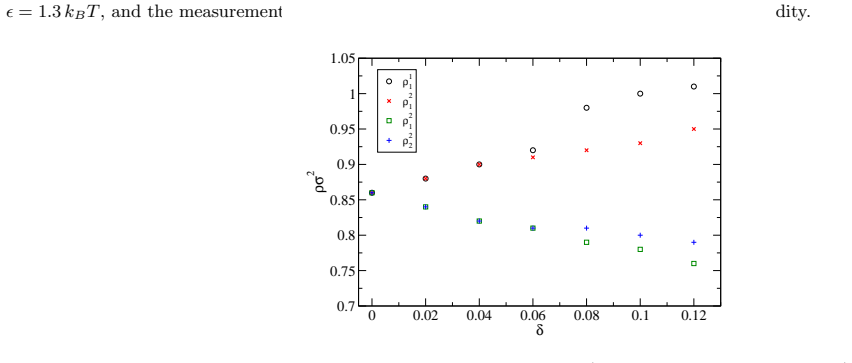
- [Fig. 10 and accompanying text] The notation for the densities in Fig. 10 appears to list ρ^2_1 twice; it should presumably be ρ^1_1, ρ^2_1, ρ^1_2, and ρ^2_2. Please correct this.
- [Section IV, Figs. 4–5] The comparison of the area elasticity modulus K between the exchange and no-exchange settings is described as 'fairly good agreement,' but no quantitative statement of the difference relative to the error bars is given. Please add this information.
- [Section V, Eq. (22)] The fit shown in Fig. 8(b) for δ = 0.10 is made to one minimum of the double-well free energy. Please state the fitting range and the criterion used to exclude the unstable branch between the two minima.
- [Throughout] There are several typographical errors, for example 'membran es' in the abstract and title area, and 'they can are joined smoothly' in Section III. These should be corrected before publication.
Circularity Check
No significant circularity: moduli are measured from simulated free-energy distributions, κ_nl is an excess stiffness obtained by subtraction, and theory comparisons are independent consistency tests.
full rationale
I reviewed the derivation chain from Eq. (1) through Eq. (22). The elastic parameters K, κ, and κ_tot are obtained by fitting Gaussian free-energy profiles (Eqs. (13)–(15)) to sampled distributions; these are measurements, not predictions forced by inputs. The non-local modulus is defined as the difference κ_tot − κ (Sec. III), i.e., the excess curvature stiffness in the no-exchange ensemble, which is the operational definition of κ_nl; no equation reduces to a fitted input. The comparison with theory in Sec. IV tests the predicted weak δ^2 dependence of bilayer moduli derived from monolayer additivity; the prediction is not an identity with the fitted values. The validation of κ against ref. [37] is a benchmark from an independent Fourier method, and the paper also quotes its own κ = 7.0 ± 0.5 k_B T, so the self-citation is corroborative, not load-bearing. The Sec. V admission that inter-leaflet coupling was ignored is a limitation on the near-gel modeling and on the independence-of-segments assumption behind Eq. (15); if the seam or constraint coupling is non-negligible the κ_nl estimate would be biased, but that is a modeling/accuracy concern, not a circular one. No circular step could be quoted and reduced to its input.
Assumptions & free parameters
assumptions (6)
- domain assumption The bilayer elastic free energy is the sum of the two monolayers' individual elastic free energies (Eq. 1).
- domain assumption Each monolayer energy is quadratic in area and curvature strains for the explored range (Eq. 1).
- standard math The parallel surface theorem gives Delta A = h times the integral of C dA (Eq. 7), with h constant and h much smaller than 1/c.
- domain assumption In the C=0 ensemble, the non-local bending term contributes only a constant (Section III, before Eq. (10)).
- ad hoc to paper The Monte Carlo rejection rules sample the correct constrained equilibrium distribution of an asymmetric bilayer with fixed leaflet counts.
- ad hoc to paper The two joined arcs are dynamically independent except for the imposed +/- c symmetry, and interface effects are negligible.
Cite this review
Pith. "Pith review of Measuring the mechanical properties of asymmetric membranes in computer simulations -- new methods and insights." pith.science (2026). https://pith.science/paper/7NF7R4Z6
@misc{pith2026250512033,
  author       = {Pith},
  title        = {Pith review of: Measuring the mechanical properties of asymmetric membranes in computer simulations -- new methods and insights},
  year         = {2026},
  howpublished = {\url{https://pith.science/paper/7NF7R4Z6}},
  note         = {Machine review of arXiv:2505.12033}
}
abstract
We present Monte Carlo simulations of an ultra coarse-grained lipid bilayer with different number of lipids on both leaflets. In the simulations, we employ a new method for measuring the elastic parameters of the membrane, including the area per lipid, area elasticity modulus, and bending rigidity. The method also allows to measure the spontaneous curvature and non-local bending modulus, which are not accessible by standard computer simulations with periodic boundary conditions. For membranes with lipid densities much smaller than the liquid to gel transition density, $\rho_g$, we find a very good agreement between the simulation results and the theory expressing the bilayer elastic free energy as the sum of quadratic free energies in the strains associated with the area density and the local curvature of the monolayers. The theory fails when the lipid area density (in the symmetric reference case) is only slightly smaller than $\rho_g$. Increasing the degree of asymmetry and changing the density of the condensed leaflet to a value larger than $\rho_g$, causes the layer to phase separate between regions with distinct densities which, in turn, may also induce density variations in the dilated liquid layer. Moreover, the phase separation may also trigger local curvature variations along the membrane, which can be attributed to the disparity between the values of the elastic parameters of the coexisting bilayer segments that are mechanically coupled. This mechanism leading to density-curvature variations and instabilities may play a role in cellular processes occurring in liquid-ordered raft domains that are surrounded by the disordered liquid matrix of the cell.
Figures


Figures from the paper (7 more)


Reference graph
Works this paper leans on
-
[1]
curved segments. The latter continues with the linear dependenc e on δ, characteristic of liquid membranes, while the former exhibits a discontinuity which is a signatu re of a gel transition. Quite remarkably, we observe that the phase separation occurring at the condense d layer, induces a density difference between the oppositely-curved segments of the ...
-
[2]
= K 2 2 (A2 2, 0 − A2 2). (19) Also, we must take into account the fact that the lipids can move bet ween the segments (despite of their low diffusivity), which imposes the following relationship between the relaxed areas: A1 1, 0/a1 1, 0 + A2 1, 0/a2 1, 0 = N+, (20) A1 2, 0/a1 2, 0 + A2 2, 0/a2 2, 0 = N− , (21) where aα i, 0 is the equilibrium area per li...
-
[3]
G. Pabst and S. Keller, Exploring membrane asymmetry and its effects on membrane proteins, Trends in Biochemical Sciences 49, 333 (2024)
work page 2024
-
[4]
M. Bogdanov, The power and challenge of lipid (a)symmetr y across the membrane and cell, Emerging Topics in Life Sciences 7, 1 (2023)
work page 2023
-
[5]
A. Verkleij, R. Zwaal, B. Roelofsen, P. Comfurius, D. Kas telijn, and L. van Deenen, The asymmetric distribution of phospholipids in the human red cell membrane. a combined stu dy using phospholipases and freeze-etch electron microsco py, Biochimica et Biophysica Acta (BBA) - Biomembranes 323, 178 (1973)
work page 1973
-
[6]
T. Fujimoto and I. Parmryd, Interleaflet coupling, pinni ng, and leaflet asymmetry—major players in plasma membrane nanodomain formation, Frontiers in Cell and Developmental Biology 4, 155 (1 (2017)
work page 2017
-
[7]
van Meer, Cellular lipidomics, The EMBO Journal 24, 3159 (2005)
G. van Meer, Cellular lipidomics, The EMBO Journal 24, 3159 (2005)
work page 2005
-
[8]
A. A. Mironov, A. Mironov, J. Derganc, and G. V. Beznousse nko, Membrane curvature, trans-membrane area asymmetry, budding, fission and organelle geometry, International Jou rnal of Molecular Sciences 21, 7594 (1 (2020)
work page 2020
Show all 58 references
-
[9]
R. G. Hanshaw and B. D. Smith, New reagents for phosphatid ylserine recognition and detection of apoptosis, Bioorganic Medicinal Chemistry 13, 5035 (2005), symposium-in-Print: Chemistry and Biology o f Natural Products
2005
-
[10]
M. S. Bretscher, Asymmetrical lipid bilayer structure f or biological membranes, Nature New Biology 236, 11 (1973)
1973
-
[11]
J. H. Lorent, K. R. Levental, L. Ganesan, G. Rivera-Longs worth, E. Sezgin, M. Doktorova, E. Lyman, and I. Levental, Plasma membranes are asymmetric in lipid unsaturation, pac king and protein shape, Nature Chemical Biology 16, 644–652 (2020)
2020
-
[12]
Krompers and H
M. Krompers and H. Heerklotz, A guide to your desired lip id-asymmetric vesicles, Membranes 13, 267 (1 (2023). 14
2023
-
[13]
London, Membrane structure–function insights from asymmetric lipid vesicles, Accounts of Chemical Research 52, 2382 (2019)
E. London, Membrane structure–function insights from asymmetric lipid vesicles, Accounts of Chemical Research 52, 2382 (2019)
2019
-
[14]
Doktorova, J
M. Doktorova, J. Symons, and I. Levental, Structural an d functional consequences of reversible lipid asymmetry in living membranes, Nature Chemical Biology 16, 1321–1330 (2020)
2020
-
[15]
Deserno, Biomembranes balance many types of leaflet a symmetries, Current Opinion in Structural Biology 87, 102832 (2024)
M. Deserno, Biomembranes balance many types of leaflet a symmetries, Current Opinion in Structural Biology 87, 102832 (2024)
2024
-
[16]
F. X. Contreras, L. Sanchez-Magraner, A. Alonso, and F. M. Goni, Transbilayer (¡i¿flip¡/i¿-¡i¿flop¡/i¿) lipid motion and lipid scrambling in membranes, FEBS Letters 584, 1779 (2010)
2010
-
[17]
T. G. Pomorski and A. K. Menon, Lipid somersaults: Uncov ering the mechanisms of protein-mediated lipid flipping, Progress in Lipid Research 64, 69 (2016)
2016
-
[18]
Shukla and T
S. Shukla and T. Baumgart, Enzymatic trans-bilayer lip id transport: Mechanisms, efficiencies, slippage, and membr ane curvature, Biochimica et Biophysica Acta (BBA) - Biomembra nes 1863, 183534 (2021)
2021
-
[19]
Devaux and R
P. Devaux and R. Morris, Transmembrane asymmetry and la teral domains in biological membranes, Traffic 5, 241 (2004)
2004
-
[20]
J. C. M. Holthuis, G. van Meer, and K. Huitema, Lipid micr odomains, lipid translocation and the organization of intr a- cellular membrane transport (review), Molecular Membrane Biology 20, 231 (2003)
2003
-
[21]
S. L. Foley, M. Varma, A. Hossein, and M. Deserno, Elasti c and thermodynamic consequences of lipid membrane asymmet ry, Emerging Topics in Life Sciences 7, 95 (2023)
2023
-
[22]
Sreekumari and R
A. Sreekumari and R. Lipowsky, Large stress asymmetrie s of lipid bilayers and nanovesicles generate lipid flip-flop s and bilayer instabilities, Soft Matter 18, 6066 (2022)
2022
-
[23]
Blumer, S
M. Blumer, S. Harris, M. Li, L. Martinez, M. Untereiner, P. N. Saeta, T. S. Carpenter, H. I. Ingolfsson, and W. F. D. Bennett, Simulations of asymmetric membranes illustrate c ooperative leaflet coupling and lipid adaptability, Fronti ers in Cell and Developmental Biology 8, 575 (2020)
2020
-
[24]
E. H. Chaisson, F. A. Heberle, and M. Doktorova, Buildin g asymmetric lipid bilayers for molecular dynamics simulat ions: What methods exist and how to choose one?, Membranes 13, 629 (1 (2023)
2023
-
[25]
I. R. Cooke and M. Deserno, Solvent-free model for self- assembling fluid bilayer membranes: Stabilization of the flu id phase based on broad attractive tail potentials, Journal of Chemical Physics 123, 224710 (2005)
2005
-
[26]
Foley and M
S. Foley and M. Deserno, Stabilizing leaflet asymmetry u nder differential stress in a highly coarse-grained lipid me mbrane model, Journal of Chemical Theory and Computation 16, 7195 (2020)
2020
-
[27]
Rozycki and R
B. Rozycki and R. Lipowsky, Spontaneous curvature of bi layer membranes from molecular simulations: Asymmetric li pid densities and asymmetric adsorption, Journal of Chemical P hysics 142, 054101 (2015)
2015
-
[28]
Hossein and M
A. Hossein and M. Deserno, Spontaneous curvature, diffe rential stress, and bending modulus of asymmetric lipid mem - branes, Biophysical Journal 118, 624 (2020)
2020
-
[29]
Takiue, Heterogeneity and deformation behavior of l ipid vesicles, Current Opinion in Colloid Interface Scienc e 62, 101646 (2022)
T. Takiue, Heterogeneity and deformation behavior of l ipid vesicles, Current Opinion in Colloid Interface Scienc e 62, 101646 (2022)
2022
-
[30]
Schick, Strongly correlated rafts in both leaves of a n asymmetric bilayer, Journal of Physical Chemistry B 122, 3251 (2018)
M. Schick, Strongly correlated rafts in both leaves of a n asymmetric bilayer, Journal of Physical Chemistry B 122, 3251 (2018)
2018
-
[31]
Svetina and B
S. Svetina and B. ˇZekˇ s, Elastic properties of closed bilayer membranes and t he shapes of giant phospholipid vesicles, in Handbook of Nonmedical Applications of Liposomes , edited by D. D. Lasic and Y. Barenholz (CRC Press, Boca Raton , USA, 1996) pp. 13–42
1996
-
[32]
Helfrich and M
W. Helfrich and M. Kozlov, Bending tensions and the bend ing rigidity of fluid membranes, Journal de Physique II 3, 287 (1993)
1993
-
[33]
Seifert, Configurations of fluid membranes and vesicl es, Advances in Physics 46, 13 (1997)
U. Seifert, Configurations of fluid membranes and vesicl es, Advances in Physics 46, 13 (1997)
1997
-
[34]
X. Bian, S. Litvinov, and P. Koumoutsakos, Bending mode ls of lipid bilayer membranes: Spontaneous curvature and area-difference elasticity, Computer Methods in Applied Me chanics and Engineering 359, 112758 (2020)
2020
-
[35]
Deserno, Fluid lipid membranes: From differential ge ometry to curvature stresses, Chemistry and Physics of Lipi ds 185, 11 (2015)
M. Deserno, Fluid lipid membranes: From differential ge ometry to curvature stresses, Chemistry and Physics of Lipi ds 185, 11 (2015)
2015
-
[36]
Svetina and B
S. Svetina and B. ˇZekˇ s, Nonlocal membrane bending: A reflection, the facts an d its relevance, Advances in Colloid and Interface Science 208, 189 (2014)
2014
-
[37]
R. E. Waugh, J. Song, S. Svetina, and B. ˇZekˇ s, Local and nonlocal curvature elasticity in bilayer m embranes by tether formation from lecithin vesicles, Biophysical Journal 61, 974 (1992)
1992
-
[38]
H. Wang, D. Hu, and P. Zhang, Measuring the spontaneous c urvature of bilayer membranes by molecular dynamics simulations, Communications in Computational Physics 13, 1093–1106 (2013)
2013
-
[39]
Farago, Mode excitation monte carlo simulations of m esoscopically large membranes, Journal of Chemical Physic s 128, 184105 (2008)
O. Farago, Mode excitation monte carlo simulations of m esoscopically large membranes, Journal of Chemical Physic s 128, 184105 (2008)
2008
-
[40]
Himbert, A
S. Himbert, A. D’Alessandro, S. M. Qadri, M. J. Majcher, T. Hoare, W. P. Sheffield, M. Nagao, J. F. Nagle, and M. C. Rheinst¨ adter, The bending rigidity of the red blood cell cy toplasmic membrane, PLOS ONE 17, 1 (2022)
2022
-
[41]
R. F. Vazquez, E. Ovalle-Garcia, A. Antillon, I. Ortega -Blake, L. S. Bakas, C. Munoz-Garay, and S. M. Mate, Asym- metric bilayers mimicking membrane ¡i¿rafts¡/i¿ prepared by lipid exchange: Nanoscale characterization using afm-f orce spectroscopy, Biochimica et Biophysica Act...
2021
-
[42]
S. L. Foley, A. Hossein, and M. Deserno, Fluid-gel coexi stence in lipid membranes under differential stress, Biophy sical Journal 121, 2997 (2022)
2022
-
[43]
Elani, S
Y. Elani, S. Purushothaman, P. J. Booth, J. M. Seddon, N. J. Brooks, R. V. Law, and O. Ces, Measurements of the effect of membrane asymmetry on the mechanical properties of lipid bilayers, Chemical Communications 51, 6976 (2015)
2015
-
[44]
Karamdad, R
K. Karamdad, R. V. Law, J. M. Seddon, N. J. Brooks, and O. C es, Studying the effects of asymmetry on the bending 15 rigidity of lipid membranes formed by microfluidics, Chemic al Communications 52, 5277 (2016)
2016
-
[45]
Sviridov and Y
D. Sviridov and Y. I. Miller, Biology of lipid rafts: Int roduction to the thematic review series, Journal of Lipid Research 61, 598 (2020)
2020
-
[46]
Kollmitzer, P
B. Kollmitzer, P. Heftberger, M. Rappolt, and G. Pabst, Monolayer spontaneous curvature of raft-forming membrane lipids, Soft Matter 9, 10877 (2013)
2013
-
[47]
Y.-S. Ryu, L. R. Jordan, N. J. Wittenberg, S. M. Kim, D. Yo o, C. Jeong, A. E. Warrington, M. Rodriguez, S.-H. Oh, and S.-D. Lee, Curvature elasticity-driven leaflet asymmetry a nd interleaflet raft coupling in supported membranes, Advan ced Materials Interfaces 5, 1801290 (2018)
2018
-
[48]
Simons and E
K. Simons and E. Ikonen, Functional rafts in cell membra nes, Nature 387, 569 (1997)
1997
-
[49]
G. W. Feigenson, Phase diagrams and lipid domains in mul ticomponent lipid bilayer mixtures, Biochimica et Biophys ica Acta (BBA) - Biomembranes 1788, 47 (2009)
2009
-
[50]
S. L. Veatch, O. Soubias, S. L. Keller, and K. Gawrisch, C ritical fluctuations in domain-forming lipid mixtures, Pro ceedings of the National Academy of Sciences 104, 17650 (2007)
2007
-
[51]
L. S. Hirst, P. Uppamoochikkal, and C. Lor, Phase separa tion and critical phenomena in biomimetic ternary lipid mix tures, Liquid Crystals 38, 1735 (2011)
2011
-
[52]
S. Goh, J. Amazon, and G. Feigenson, Toward a better raft model: Modulated phases in the four-component bilayer, dspc/dopc/popc/chol, Biophysical Journal 104, 853 (2013)
2013
-
[53]
Sarkar and O
T. Sarkar and O. Farago, A lattice model of ternary mixtu res of lipids and cholesterol with tunable domain sizes, Sof t Matter 19, 2417 (2023)
2023
-
[54]
Schick, Membrane heterogeneity: Manifestation of a curvature-induced microemulsion, Physical Review E 85, 031902 (2012)
M. Schick, Membrane heterogeneity: Manifestation of a curvature-induced microemulsion, Physical Review E 85, 031902 (2012)
2012
-
[55]
Meinhardt, R
S. Meinhardt, R. L. C. Vink, and F. Schmid, Monolayer cur vature stabilizes nanoscale raft domains in mixed lipid bil ayers, Proceedings of the National Academy of Sciences 110, 4476 (2013)
2013
-
[56]
I. D. Pogozheva, S. Tristram-Nagle, H. I. Mosberg, and A . L. Lomize, Structural adaptations of proteins to different biological membranes, Biochimica et Biophysica Acta (BBA) - Biomembranes 1828, 2592 (2013)
2013
-
[57]
G. J. Sch¨ utz and G. Pabst, The asymmetric plasma membra ne—a composite material combining different functionaliti es?, BioEssays 45, 2300116 (2023)
2023
-
[58]
Lu, C.-H
T. Lu, C.-H. Lee, and B. Anvari, Morphological characte ristics, hemoglobin content, and membrane mechanical prop erties of red blood cell delivery systems, ACS Applied Materials & I nterfaces 14, 18219 (2022)
2022
Reviewed August 15, 2026 · model on record in the stance chip above.
Discussion (0). Continue with ORCID to comment.