REVIEW 3 major objections 5 minor 51 references
ProMi: An Efficient Prototype-Mixture Baseline for Few-Shot Segmentation with Bounding-Box Annotations
T0 review · 3 major / 5 minor · reviewed 2026-08-15 · deepseek-v4-flash
Pith's one-line read ProMi, a training-free prototype-mixture classifier, beats prior bounding-box few-shot segmentation methods on PASCAL-5i, COCO-20i, and DINOv2 benchmarks.
desk verdict A clean, useful training-free baseline for bounding-box few-shot segmentation, but the SOTA claim over FSBBA rests on uncontrolled quoted means and needs a controlled re-run. read the letter →
The pith
A machine-rendered reading of the paper's core claim, the machinery that carries it, and where it could break.
The reading
What carries the argument
The load-bearing mechanism is the iterative prototype-mixture classifier in the latent space. It treats each spatial feature vector as a patch embedding, derives noisy patch labels by majority vote inside the bounding boxes, and then runs an alternating assignment-and-update procedure: assign every support feature to the nearest prototype by cosine similarity; recompute each background prototype as the mean of its assigned true-background features; add a new background prototype equal to the mean of features that are predicted foreground but actually background; and refine the foreground prototype on confident foreground features. A pixel in a query image is foreground exactly when the foreground prototype wins the cosine-similarity comparison.
What would settle it
Take a fixed support set and ground-truth masks, then run ProMi twice: once with patch labels derived from bounding boxes and once with patch labels derived from the true masks. If the clean-label version does not improve query mean IoU, the method's claimed handling of bounding-box noise is not doing the work; if it improves sharply, the box-noise handling is incomplete.
Extended reading notes
Core claim
The central discovery is that the background class, not the foreground, is the main obstacle when supervision comes from bounding boxes, and that a dynamic set of background prototypes solves it. Starting from one foreground and one background prototype computed as means of L2-normalized support features, ProMi alternates hard cosine-similarity assignment with prototype re-estimation, like a k-means and EM loop. Whenever a support feature that the box labels as background is currently assigned to the foreground prototype, that feature seeds a new background prototype, and the foreground prototype is re-estimated only from features that are both predicted foreground and box-labeled foreground. The loop stops when no such false positives remain or the prototype budget $K_{\max}$ is reached. In the paper's experiments, this yields the top mean IoU against FSBBA, RePRI, BD-CSPN, and SimpleShot across 1-, 5-, and 10-shot settings.
Load-bearing premise
The method assumes each spatial feature vector is the embedding of one distinct pixel patch, even though the ResNet-50 backbone's receptive fields overlap; if patch-level labels derived from bounding boxes mislabel mixed-content patches near object boundaries, the foreground and background prototypes inherit that noise and the accuracy gain could shrink.
Editorial extensions
If this is right
- On PASCAL-5i with bounding-box labels, ProMi reports 45.4 mean IoU in 1-shot and 54.2 in 10-shot, above the compared baselines, so box-only supervision can be sufficient for practical few-shot segmentation.
- On COCO-20i, ProMi's 10-shot mean IoU is 33.6 versus 25.7 for BD-CSPN and SimpleShot, showing the gain is larger on harder, more diverse backgrounds.
- With DINOv2 ViT-B/14 features and no base-class pre-training, ProMi improves by up to 4.5 mean-IoU points over BD-CSPN on PASCAL and by larger margins on COCO, indicating the method combines with frozen foundation features.
- The ablation attributes roughly 7 mean-IoU points (33.4 to 40.7 in 1-shot on PASCAL) to the background mixture and roughly 3 more (to 44.1) to foreground refinement, so both components carry the result.
- Because the classifier is training-free, its inference cost is small, which matters for mobile robots that must adapt on the fly.
Reading between the lines
- Beyond the paper: the same mixture idea could be applied to multi-class few-shot segmentation by giving each class its own background-mixture module, though the paper only demonstrates binary segmentation.
- Beyond the paper: because the update loop is a deterministic hard-EM variant, its fixed point depends on initialization; a testable extension is to restart from several initial foreground prototypes or to anneal the assignment to see whether the reported gains persist.
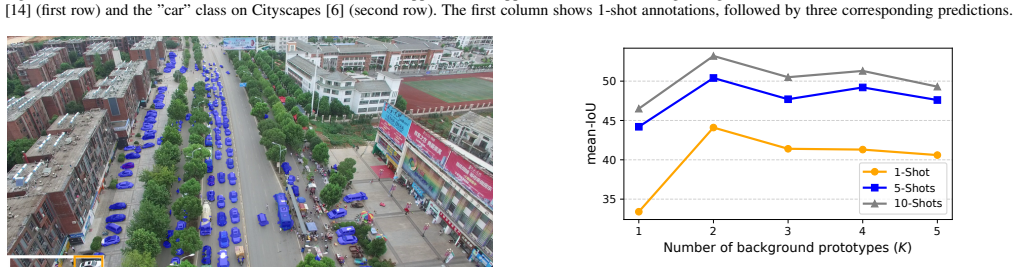
- Beyond the paper: the optimal background prototype count is tuned to $K_{\max}=2$ on PASCAL VOC, and the best K may shift with background diversity; an adaptive criterion based on support-set validation could generalize the method across datasets.
- Beyond the paper: ProMi could serve as a cheap, strong baseline for future weakly supervised few-shot segmentation methods, since it reaches competitive scores without any meta-training or learnable parameters.
Signed reviews
Editorial analysis
A structured set of objections, weighed in public.
Referee Report
Summary. The paper proposes ProMi, a training-free prototype-mixture method for few-shot binary segmentation using only bounding-box annotations. The method converts bounding boxes to noisy patch-level labels, initializes a foreground prototype and a background prototype, and then iteratively refines the foreground prototype and adds background prototypes to handle complex backgrounds and noisy positive labels. Inference classifies query feature vectors by cosine similarity to the prototype set, producing pixel-level binary masks. The method is evaluated on PASCAL-5i and COCO-20i in a bounding-box few-shot setting, with a DINOv2 foundation-model backbone, and qualitatively on SUIM, Cityscapes, and UA Vid for mobile robot applications. The authors report consistent mean-IoU improvements over FSBBA, RePRI, BD-CSPN, and SimpleShot, and they release code.
Significance. The task addressed here, few-shot segmentation with bounding-box annotations, is practically important because it reduces annotation cost in robotics and other applications. ProMi is simple, training-free in the sense of not requiring network fine-tuning, and computationally efficient, and the paper provides a precise algorithm specification and released code. If the reported gains are reproducible and the comparisons are controlled, this would be a useful baseline for the weakly-supervised few-shot segmentation community. The experiments also explore a modern DINOv2 feature extractor and include qualitative results on real-world robot datasets, which strengthens the applicability story. However, the significance of the claimed state-of-the-art result depends directly on the soundness of the comparison to prior work, particularly FSBBA, and on the selection of the hyperparameter K on evaluation data.
major comments (3)
- [Section V-B] The comparison with FSBBA, the only prior method designed for the same bounding-box few-shot segmentation task, is uncontrolled. The paper states: 'As the exact class splits are not reported in [11], we only compare against the mean over the 4 folds for the methods FSBBA-baseline and FSBBA reported in [11].' This means the reported gains (e.g., 45.4 vs. 42.4 in the 1-shot PASCAL-5i setting) could be due to differences in fold splits, support/query sampling, image resolution, or other protocol choices unrelated to the method. Additionally, no FSBBA numbers are reported on COCO-20i, so the claim that ProMi 'achieves the best results across different datasets' is not supported by a controlled comparison against the most relevant prior work. The authors should re-run FSBBA under their exact protocol or clearly qualify the comparison and report its limitations.
- [Section V-E] The hyperparameter K (the number of background prototypes) is chosen based on performance on PASCAL VOC 2012, which is the same dataset used for the main evaluation in Tables I and III. Figure 3 shows that K=2 is selected from the mean-IoU peak on this evaluation data, and the paper then uses this value in all other experiments. This is a form of tuning on the test set and can inflate reported results. To make the evaluation sound, the authors should select K using a validation split, or at least report sensitivity to K across folds and datasets.
- [Section V-A] The paper reports that scores are averaged over 5 independent runs ('each corresponding to a different seed from the set {0, 1, 2, 3, 4}') but does not report any variance or significance tests. Given the small margins between ProMi and FSBBA in Table I (e.g., 45.4 vs. 42.4 in 1-shot), it is impossible to assess whether the claimed improvements are statistically reliable. The central claim of 'significant gains' in the abstract is not supported without error bars or statistical tests. The authors should report standard deviations, confidence intervals, or pairwise significance tests.
minor comments (5)
- [Section V-B] The assumption that each 1D feature vector corresponds to a distinct pixel patch despite overlapping receptive fields is acknowledged but not discussed. Near object boundaries, patch-level labels derived from bounding boxes (Section IV-B) may mislabel mixed-content patches, which could bias the foreground prototype. The authors should discuss this limitation and its potential impact on the results.
- [Section IV-C] The notation in the iterative refinement is confusing because the prototype index (0 for foreground) and the class label (0 for background, 1 for foreground) are inverted. The footnote clarifies this, but the presentation could be improved by using separate symbols, such as 'F' and 'B' for prototype indices.
- [Section V-E] Figure 3 would be more informative if it included error bars or confidence intervals, especially since it is used to select the hyperparameter K.
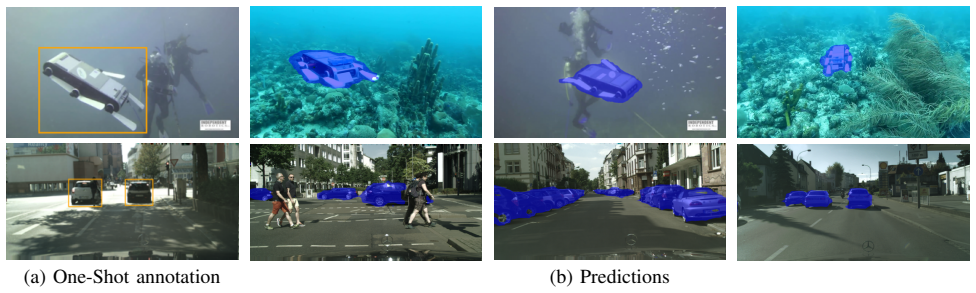
- [Section V-D] The qualitative experiments on mobile robot datasets rely on bounding-box annotations that were 'manually created for this purpose,' but the paper does not describe the annotation process or the number of support images used. Adding these details would help readers assess the applicability claims.
- [Abstract and Introduction] The term 'training-free' is used to describe the method, but ProMi performs iterative prototype refinement on the support set at inference time. The paper should clarify what is meant by 'training-free' (e.g., no additional network training or meta-learning) to avoid confusion.
Circularity Check
Choice of background-prototype count K is tuned on the same PASCAL VOC 2012 benchmark whose ProMi scores are then reported; no self-citation or definitional circularity elsewhere.
-
fitted input called prediction
[Section V-E, Figure 3, applied to Table III (PASCAL VOC 2012 + DINOv2 row)]
"Figure 3 shows the mean-IoU scores of ProMi on PASCAL VOC 2012 as a function of the number of background prototypes K. The performance peaks at K = 2, before slightly declining and stabilizing, suggesting that using two background prototypes best captures the background distribution variability without adding unnecessary complexity. Therefore, we used two background prototypes in all other experiments."
K is selected by maximizing mean-IoU on PASCAL VOC 2012 in Fig. 3, and Table III then reports ProMi's mean-IoU on the same PASCAL VOC 2012 benchmark for that K. The headline claim that ProMi 'consistently achieves the highest scores' on this benchmark is therefore not an independent out-of-sample prediction: the reported 1-shot/5-shot/10-shot numbers are the tuning-curve values at the chosen K, so the result is partly constructed by test-set selection. The circularity is partial because the PASCAL-5i/COCO-20i ResNet-50 results and the MS-COCO DINOv2 results reuse K=2 without tuning on those benchmarks, and no self-citations are involved.
full rationale
The core derivation in Sec. IV is self-contained: prototypes are computed as means of support-set feature vectors, refined by hard-label argmax assignment, and applied to query features through cosine similarity and argmax. No equation defines the target in terms of the prediction, and there are no self-citations in the reference list; the related-work and method sections rely on standard clustering/EM ideas and external baselines. The only circularity-adjacent step is the selection of K, the number of background prototypes. Section V-E chooses K by taking the peak of mean-IoU on PASCAL VOC 2012 (Fig. 3), and the same section's Table III reports ProMi's PASCAL VOC 2012 scores with that K, making those headline numbers in-sample selected values rather than an independent evaluation. This is a mild fitted-input issue, not a definitional collapse: the method's parameters on the other benchmarks are transferred rather than tuned there, so the central claim retains independent content. The uncontrolled comparison to FSBBA (quoted means with unreported class splits) is a correctness risk but not a circularity, and the overlapping-receptive-field assumption is an approximation, not a circular step.
Assumptions & free parameters
free parameters (1)
- Kmax (number of background prototypes) =
2
assumptions (4)
- domain assumption Pre-trained feature extractors (PSPNet/ResNet-50 or DINOv2) provide discriminative features for novel classes.
- domain assumption Each 1D feature vector corresponds to a distinct pixel patch, despite overlapping receptive fields in ResNet-50.
- domain assumption Bounding-box-derived patch labels are reliable enough that false positives can be identified via predicted-vs-noisy-label disagreement.
- domain assumption Cosine similarity to L2-normalized mean prototypes is a suitable metric for pixel-level classification.
Cite this review
Pith. "Pith review of ProMi: An Efficient Prototype-Mixture Baseline for Few-Shot Segmentation with Bounding-Box Annotations." pith.science (2026). https://pith.science/paper/3YLOVZ25
@misc{pith2026250512547,
  author       = {Pith},
  title        = {Pith review of: ProMi: An Efficient Prototype-Mixture Baseline for Few-Shot Segmentation with Bounding-Box Annotations},
  year         = {2026},
  howpublished = {\url{https://pith.science/paper/3YLOVZ25}},
  note         = {Machine review of arXiv:2505.12547}
}
read the original abstract
In robotics applications, few-shot segmentation is crucial because it allows robots to perform complex tasks with minimal training data, facilitating their adaptation to diverse, real-world environments. However, pixel-level annotations of even small amount of images is highly time-consuming and costly. In this paper, we present a novel few-shot binary segmentation method based on bounding-box annotations instead of pixel-level labels. We introduce, ProMi, an efficient prototype-mixture-based method that treats the background class as a mixture of distributions. Our approach is simple, training-free, and effective, accommodating coarse annotations with ease. Compared to existing baselines, ProMi achieves the best results across different datasets with significant gains, demonstrating its effectiveness. Furthermore, we present qualitative experiments tailored to real-world mobile robot tasks, demonstrating the applicability of our approach in such scenarios. Our code: https://github.com/ThalesGroup/promi.
Figures
Reference graph
Works this paper leans on
-
[11]
Learning few-shot segmentation from bounding box annotations
Byeolyi Han and Tae-Hyun Oh. Learning few-shot segmentation from bounding box annotations. In Proceedings of the IEEE/CVF Winter Conference on Applications of Computer Vision , pages 3750–3759, 2023
work page 2023
-
[1]
Malik Boudiaf, Hoel Kervadec, Ziko Imtiaz Masud, Pablo Piantanida, Ismail Ben Ayed, and Jose Dolz. Few-shot segmentation without meta-learning: A good transductive inference is all you need? In Proceedings of the IEEE/CVF conference on computer vision and pattern recognition, pages 13979–13988, 2021
work page 2021
-
[2]
Prototype as query for few shot semantic segmentation
Leilei Cao, Yibo Guo, Ye Yuan, and Qiangguo Jin. Prototype as query for few shot semantic segmentation. Complex & Intelligent Systems , pages 1–14, 2024
work page 2024
-
[3]
A closer look at few-shot classification
Wei-Yu Chen, Yen-Cheng Liu, Zsolt Kira, Yu-Chiang Wang, and Jia- Bin Huang. A closer look at few-shot classification. In International Conference on Learning Representations , 2019
work page 2019
-
[4]
Shot in the dark: Few-shot learning with no base-class labels
Zitian Chen, Subhransu Maji, and Erik Learned-Miller. Shot in the dark: Few-shot learning with no base-class labels. In 2021 IEEE/CVF Conference on Computer Vision and Pattern Recognition Workshops (CVPRW), pages 2662–2671, 2021
work page 2021
-
[5]
Yolo-world: Real-time open-vocabulary object detec- tion
Tianheng Cheng, Lin Song, Yixiao Ge, Wenyu Liu, Xinggang Wang, and Ying Shan. Yolo-world: Real-time open-vocabulary object detec- tion. In Proc. IEEE Conf. Computer Vision and Pattern Recognition (CVPR), 2024
work page 2024
-
[6]
The cityscapes dataset for semantic urban scene understanding
Marius Cordts, Mohamed Omran, Sebastian Ramos, Timo Rehfeld, Markus Enzweiler, Rodrigo Benenson, Uwe Franke, Stefan Roth, and Bernt Schiele. The cityscapes dataset for semantic urban scene understanding. In Proc. of the IEEE Conference on Computer Vision and Pattern Recognition (CVPR) , 2016
work page 2016
-
[7]
Maximum likelihood from incomplete data via the em algorithm
Arthur P Dempster, Nan M Laird, and Donald B Rubin. Maximum likelihood from incomplete data via the em algorithm. Journal of the royal statistical society: series B (methodological) , 39(1):1–22, 1977
work page 1977
Show all 51 references
-
[8]
An image is worth 16x16 words: Transformers for image recognition at scale
Alexey Dosovitskiy, Lucas Beyer, Alexander Kolesnikov, Dirk Weis- senborn, Xiaohua Zhai, Thomas Unterthiner, Mostafa Dehghani, Matthias Minderer, Georg Heigold, Sylvain Gelly, Jakob Uszkoreit, and Neil Houlsby. An image is worth 16x16 words: Transformers for image recognition ...
2021
-
[9]
The pascal visual object classes (voc) challenge
Mark Everingham, Luc Van Gool, Christopher KI Williams, John Winn, and Andrew Zisserman. The pascal visual object classes (voc) challenge. International journal of computer vision , 88:303–338, 2010
2010
-
[10]
Model-agnostic meta-learning for fast adaptation of deep networks
Chelsea Finn, Pieter Abbeel, and Sergey Levine. Model-agnostic meta-learning for fast adaptation of deep networks. In International conference on machine learning , pages 1126–1135. PMLR, 2017
2017
-
[12]
Delving deep into rectifiers: Surpassing human-level performance on imagenet classification
Kaiming He, Xiangyu Zhang, Shaoqing Ren, and Jian Sun. Delving deep into rectifiers: Surpassing human-level performance on imagenet classification. In 2015 IEEE International Conference on Computer Vision (ICCV), pages 1026–1034, 2015
2015
-
[13]
Deep residual learning for image recognition
Kaiming He, Xiangyu Zhang, Shaoqing Ren, and Jian Sun. Deep residual learning for image recognition. In Proceedings of the IEEE conference on computer vision and pattern recognition , pages 770– 778, 2016
2016
-
[14]
Semantic segmentation of underwater imagery: Dataset and bench- mark
Md Jahidul Islam, Chelsey Edge, Yuyang Xiao, Peigen Luo, Muntaqim Mehtaz, Christopher Morse, Sadman Sakib Enan, and Junaed Sattar. Semantic segmentation of underwater imagery: Dataset and bench- mark. In 2020 IEEE/RSJ International Conference on Intelligent Robots and Systems ...
2020
-
[15]
Distilling self-supervised vision transformers for weakly-supervised few-shot classification & segmentation
Dahyun Kang, Piotr Koniusz, Minsu Cho, and Naila Murray. Distilling self-supervised vision transformers for weakly-supervised few-shot classification & segmentation. In Proceedings of the IEEE/CVF Con- ference on Computer Vision and Pattern Recognition , pages 19627– 19638, 2023
2023
-
[16]
Berg, Wan-Yen Lo, Piotr Doll ´ar, and Ross B
Alexander Kirillov, Eric Mintun, Nikhila Ravi, Hanzi Mao, Chloe Rol- land, Laura Gustafson, Tete Xiao, Spencer Whitehead, Alexander C. Berg, Wan-Yen Lo, Piotr Doll ´ar, and Ross B. Girshick. Segment anything. 2023 IEEE/CVF International Conference on Computer Vision (ICCV), pa...
2023
-
[17]
Imagenet classification with deep convolutional neural networks
Alex Krizhevsky, Ilya Sutskever, and Geoffrey E Hinton. Imagenet classification with deep convolutional neural networks. Advances in neural information processing systems , 25, 2012
2012
-
[18]
Beyond the prototype: Divide-and-conquer proxies for few-shot segmentation
Chunbo Lang, Binfei Tu, Gong Cheng, and Junwei Han. Beyond the prototype: Divide-and-conquer proxies for few-shot segmentation. arXiv preprint arXiv:2204.09903 , 2022
2022 arXiv
-
[19]
Mi- crosoft coco: Common objects in context
Tsung-Yi Lin, Michael Maire, Serge Belongie, James Hays, Pietro Perona, Deva Ramanan, Piotr Doll ´ar, and C Lawrence Zitnick. Mi- crosoft coco: Common objects in context. In Computer Vision–ECCV 2014: 13th European Conference, Zurich, Switzerland, September 6- 12, 2014, Procee...
2014
-
[20]
Dynamic prototype convolution network for few- shot semantic segmentation
Jie Liu, Yanqi Bao, Guo-Sen Xie, Huan Xiong, Jan-Jakob Sonke, and Efstratios Gavves. Dynamic prototype convolution network for few- shot semantic segmentation. In Proceedings of the IEEE/CVF Con- ference on Computer Vision and Pattern Recognition , pages 11553– 11562, 2022
2022
-
[21]
Prototype rectification for few-shot learning
Jinlu Liu, Liang Song, and Yongqiang Qin. Prototype rectification for few-shot learning. In Computer Vision–ECCV 2020: 16th European Conference, Glasgow, UK, August 23–28, 2020, Proceedings, Part I 16, pages 741–756. Springer, 2020
2020
-
[22]
Learning non-target knowledge for few-shot semantic seg- mentation
Yuanwei Liu, Nian Liu, Qinglong Cao, Xiwen Yao, Junwei Han, and Ling Shao. Learning non-target knowledge for few-shot semantic seg- mentation. In Proceedings of the IEEE/CVF conference on computer vision and pattern recognition , pages 11573–11582, 2022
2022
-
[23]
Intermediate prototype mining transformer for few-shot semantic segmentation
Yuanwei Liu, Nian Liu, Xiwen Yao, and Junwei Han. Intermediate prototype mining transformer for few-shot semantic segmentation. Advances in Neural Information Processing Systems , 35:38020–38031, 2022
2022
-
[24]
Least squares quantization in pcm
Stuart Lloyd. Least squares quantization in pcm. IEEE transactions on information theory , 28(2):129–137, 1982
1982
-
[25]
Uavid: A semantic segmentation dataset for uav imagery
Ye Lyu, George V osselman, Gui-Song Xia, Alper Yilmaz, and Michael Ying Yang. Uavid: A semantic segmentation dataset for uav imagery. ISPRS journal of photogrammetry and remote sensing , 165:108–119, 2020
2020
-
[26]
Some methods for classification and analysis of multivariate observations
James MacQueen. Some methods for classification and analysis of multivariate observations. In Proceedings of the Fifth Berkeley Symposium on Mathematical Statistics and Probability, V olume 1: Statistics, volume 5, pages 281–298. University of California press, 1967
1967
-
[27]
On the effectiveness of fine-tuning versus meta-reinforcement learning
Zhao Mandi, Pieter Abbeel, and Stephen James. On the effectiveness of fine-tuning versus meta-reinforcement learning. arXiv preprint arXiv:2206.03271, 2022
2022 arXiv
-
[28]
Ra ´ul Mur-Artal, J. M. M. Montiel, and Juan D. Tard ´os. Orb-slam: A versatile and accurate monocular slam system. IEEE Transactions on Robotics, 31(5):1147–1163, 2015
2015
-
[29]
Interclass prototype relation for few-shot segmen- tation
Atsuro Okazawa. Interclass prototype relation for few-shot segmen- tation. In European Conference on Computer Vision , pages 362–378. Springer, 2022
2022
-
[30]
Maxime Oquab, Timoth ´ee Darcet, Th ´eo Moutakanni, Huy V . V o, Marc Szafraniec, Vasil Khalidov, Pierre Fernandez, Daniel HAZIZA, Francisco Massa, Alaaeldin El-Nouby, Mido Assran, Nicolas Ballas, Wojciech Galuba, Russell Howes, Po-Yao Huang, Shang-Wen Li, Ishan Misra, Michael...
2024
-
[31]
In- telligent robotic perception systems
Cristiano Premebida, Rares Ambrus, and Zolt ´an-Csaba M ´arton. In- telligent robotic perception systems. Applications of Mobile Robots , 2018
2018
-
[32]
Weakly supervised one shot segmentation
Hasnain Raza, Mahdyar Ravanbakhsh, Tassilo Klein, and Moin Nabi. Weakly supervised one shot segmentation. In Proceedings of the IEEE/CVF International Conference on Computer Vision Workshops , pages 0–0, 2019
2019
-
[33]
You only look once: Unified, real-time object detection
Joseph Redmon, Santosh Divvala, Ross Girshick, and Ali Farhadi. You only look once: Unified, real-time object detection. In 2016 IEEE Conference on Computer Vision and Pattern Recognition (CVPR) , pages 779–788, 2016
2016
-
[34]
Girshick, and Jian Sun
Shaoqing Ren, Kaiming He, Ross B. Girshick, and Jian Sun. Faster r- cnn: Towards real-time object detection with region proposal networks. IEEE Transactions on Pattern Analysis and Machine Intelligence , 39:1137–1149, 2015
2015
-
[35]
Weakly supervised few-shot object segmentation using co-attention with visual and semantic embeddings
Mennatullah Siam, Naren Doraiswamy, Boris N Oreshkin, Hengshuai Yao, and Martin Jagersand. Weakly supervised few-shot object segmentation using co-attention with visual and semantic embeddings. arXiv preprint arXiv:2001.09540 , 2020
2001 arXiv
-
[36]
Very deep convolu- tional networks for large-scale image recognition
Karen Simonyan and Andrew Zisserman. Very deep convolu- tional networks for large-scale image recognition. arXiv preprint arXiv:1409.1556, 2014
2014 arXiv
-
[37]
Prototypical networks for few-shot learning
Jake Snell, Kevin Swersky, and Richard Zemel. Prototypical networks for few-shot learning. Advances in neural information processing systems, 30, 2017
2017
-
[38]
Learning to compare: Relation network for few-shot learning
Flood Sung, Yongxin Yang, Li Zhang, Tao Xiang, Philip HS Torr, and Timothy M Hospedales. Learning to compare: Relation network for few-shot learning. In Proceedings of the IEEE conference on computer vision and pattern recognition , pages 1199–1208, 2018
2018
-
[39]
Yonglong Tian, Yue Wang, Dilip Krishnan, Joshua B Tenenbaum, and Phillip Isola. Rethinking few-shot image classification: a good embed- ding is all you need? In Computer Vision–ECCV 2020: 16th European Conference, Glasgow, UK, August 23–28, 2020, Proceedings, Part XIV 16, page...
2020
-
[40]
Spin: Simultaneous perception interaction and naviga- tion
Shagun Uppal, Ananye Agarwal, Haoyu Xiong, Kenneth Shaw, and Deepak Pathak. Spin: Simultaneous perception interaction and naviga- tion. In Proceedings of the IEEE/CVF Conference on Computer Vision and Pattern Recognition (CVPR) , pages 18133–18142, June 2024
2024
-
[41]
Attention is all you need
Ashish Vaswani, Noam Shazeer, Niki Parmar, Jakob Uszkoreit, Llion Jones, Aidan N Gomez, Łukasz Kaiser, and Illia Polosukhin. Attention is all you need. Advances in neural information processing systems , 30, 2017
2017
-
[42]
Panet: Few-shot image semantic segmentation with prototype alignment
Kaixin Wang, Jun Hao Liew, Yingtian Zou, Daquan Zhou, and Jiashi Feng. Panet: Few-shot image semantic segmentation with prototype alignment. In proceedings of the IEEE/CVF international conference on computer vision , pages 9197–9206, 2019
2019
-
[43]
Simpleshot: Revisiting nearest-neighbor classification for few-shot learning
Yan Wang, Wei-Lun Chao, Kilian Q Weinberger, and Laurens Van Der Maaten. Simpleshot: Revisiting nearest-neighbor classification for few-shot learning. arXiv preprint arXiv:1911.04623 , 2019
1911 arXiv
-
[44]
Adaptive agent transformer for few-shot segmentation
Yuan Wang, Rui Sun, Zhe Zhang, and Tianzhu Zhang. Adaptive agent transformer for few-shot segmentation. In European Conference on Computer Vision, pages 36–52. Springer, 2022
2022
-
[45]
Prototype mixture models for few-shot semantic segmentation
Boyu Yang, Chang Liu, Bohao Li, Jianbin Jiao, and Qixiang Ye. Prototype mixture models for few-shot semantic segmentation. In Computer Vision–ECCV 2020: 16th European Conference, Glasgow, UK, August 23–28, 2020, Proceedings, Part VIII 16 , pages 763–778. Springer, 2020
2020
-
[46]
Self-guided and cross- guided learning for few-shot segmentation
Bingfeng Zhang, Jimin Xiao, and Terry Qin. Self-guided and cross- guided learning for few-shot segmentation. In Proceedings of the IEEE/CVF Conference on Computer Vision and Pattern Recognition , pages 8312–8321, 2021
2021
-
[47]
Canet: Class-agnostic segmentation networks with iterative refinement and attentive few-shot learning
Chi Zhang, Guosheng Lin, Fayao Liu, Rui Yao, and Chunhua Shen. Canet: Class-agnostic segmentation networks with iterative refinement and attentive few-shot learning. In Proceedings of the IEEE/CVF conference on computer vision and pattern recognition , pages 5217– 5226, 2019
2019
-
[48]
Mask matching transformer for few-shot segmentation
Gengwei Zhang, Shant Navasardyan, Ling Chen, Yao Zhao, Yunchao Wei, Humphrey Shi, et al. Mask matching transformer for few-shot segmentation. Advances in Neural Information Processing Systems , 35:823–836, 2022
2022
-
[49]
Feature- proxy transformer for few-shot segmentation
Jian-Wei Zhang, Yifan Sun, Yi Yang, and Wei Chen. Feature- proxy transformer for few-shot segmentation. Advances in neural information processing systems , 35:6575–6588, 2022
2022
-
[50]
Sg- one: Similarity guidance network for one-shot semantic segmentation
Xiaolin Zhang, Yunchao Wei, Yi Yang, and Thomas S Huang. Sg- one: Similarity guidance network for one-shot semantic segmentation. IEEE transactions on cybernetics , 50(9):3855–3865, 2020
2020
-
[51]
Pyramid scene parsing network
Hengshuang Zhao, Jianping Shi, Xiaojuan Qi, Xiaogang Wang, and Jiaya Jia. Pyramid scene parsing network. In Proceedings of the IEEE conference on computer vision and pattern recognition , pages 2881–2890, 2017
2017
Reviewed August 15, 2026 · model on record in the stance chip above.
Discussion (0). Continue with ORCID to comment.