REVIEW 4 major objections 5 minor 1 cited by
A Comprehensive Survey on Physical Risk Control in the Era of Foundation Model-enabled Robotics
T0 review · 4 major / 5 minor · reviewed 2026-08-15 · deepseek-v4-flash
Pith's one-line read This survey argues that physical-risk control for foundation-model-enabled robots is lopsided: most research targets the pre-deployment phase, while pre-incident mitigation, physical human-robot interaction, and foundation-model-specific…
desk verdict Useful three-phase taxonomy of robot safety, but the headline gap claims rest on a shaky categorization and no systematic lit review. read the letter →
The pith
A machine-rendered reading of the paper's core claim, the machinery that carries it, and where it could break.
The reading
What carries the argument
The analytical instrument is the three-phase lifespan taxonomy. It divides all surveyed approaches by when they act: pre-deployment (preventing risk while designing, training, and evaluating the system), pre-incident (guarding the deployed system in the moments before harm), and post-incident (recovering the robot, aiding the injured, and improving through human feedback). The taxonomy does the argument's work: by slotting each approach into one phase, it makes the relative emptiness of the pre-incident and post-incident categories visible, and that visible skew is the survey's main finding.
What would settle it
A systematic review with explicit inclusion criteria that counts papers by phase would settle the claim; finding that pre-incident or physical-interaction research is as abundant as pre-deployment work in comparable venues would directly contradict the survey's gap diagnosis.
Extended reading notes
Core claim
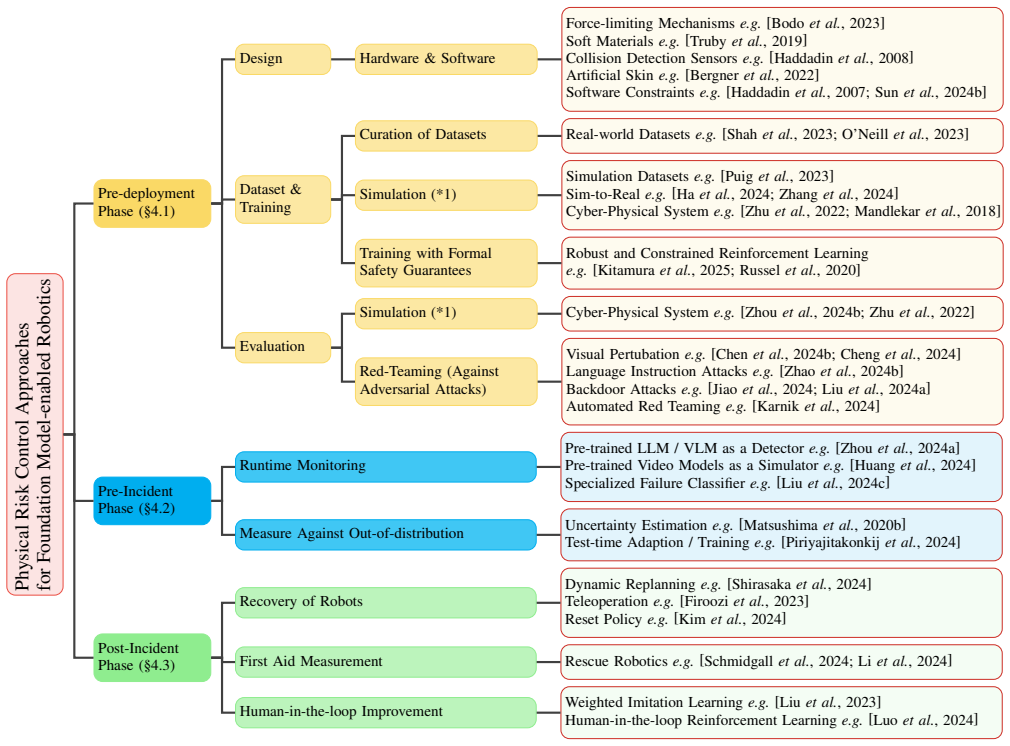
The survey's central claim is that physical-risk control for FMRs should be understood across the full lifespan, and that the field has largely failed to cover the latter two stretches. It classifies the literature into pre-deployment risk prevention (hardware and software safeguards, dataset curation, simulation, red-teaming, formal safety guarantees), pre-incident risk mitigation after deployment (runtime monitoring and out-of-distribution measures), and post-incident response (robot recovery, first aid, human-in-the-loop improvement). Surveying these bodies, it concludes that the pre-incident phase, research that assumes physical human-robot interaction, and foundation-model-specific issues each have much room for study. The paper frames this not as a claim that the surveyed techniques are ineffective, but as a map of where the field's attention is sparse relative to the risks of open-world deployment.
Load-bearing premise
The conclusions about which phases are under-studied rest on the assumption that the papers the survey chose to discuss are representative of the whole field, because the survey does not report a systematic search strategy or inclusion criteria.
Editorial extensions
If this is right
- If the field's attention is indeed concentrated before deployment, then robots entering homes and cafes will be best protected by training-time measures and least protected at the moment a hazard actually begins to unfold.
- The scarcity of research assuming physical contact with humans implies that results from simulated or fenced-off tests may not transfer to the close-proximity settings FMRs are expected to occupy.
- Post-incident recovery and first-aid capabilities are not add-ons; they are a third of the risk-control timeline and currently the thinnest part, so deployment plans should budget for failures that will still occur.
- Foundation-model-specific risks—training-data quality, physical-world understanding in language and vision models—need to be studied directly rather than inherited from classical robotics safety work.
- Technical control alone is not the endpoint: the paper argues that legislation, insurance, and ethical guidelines must accompany the engineering measures to handle the aftermath of physical damage.
Reading between the lines
- The taxonomy is a natural counting scheme: a bibliometric tabulation of papers per phase would turn the claimed gaps into measurable proportions, testing the survey's reading of the field.
- The pre-incident gap suggests a concrete research agenda: runtime monitors that predict imminent collisions or unsafe contacts—using video or vision-language models as early critics—could be the highest-leverage place to add new work.
- Because the survey deliberately imports non-foundation-model techniques as 'expected to be utilized,' the actual empirical evidence for FMR-specific safety may be even thinner than the taxonomy suggests.
- If FMRs are to act as first responders to the damage they cause, questions of liability, trust, and permission to touch an injured person will constrain the technical design; those social constraints are named but not developed.
Signed reviews
Editorial analysis
A structured set of objections, weighed in public.
Referee Report
Summary. This paper surveys robot-control approaches for mitigating physical risks in foundation-model-enabled robotics (FMRs). It organizes the robot lifetime into three phases—pre-deployment, pre-incident, and post-incident—and reviews hardware and software safety mechanisms, dataset curation, simulation, red-teaming, formal safety guarantees, runtime monitoring, out-of-distribution handling, robot recovery, first-aid measures, and human-in-the-loop improvement. From its organization of the literature, the paper concludes that pre-incident risk mitigation, research assuming physical interaction with humans, and foundation-model-specific safety issues are under-studied.
Significance. The proposed three-phase temporal taxonomy is a genuinely useful organizing device, and the paper draws attention to post-incident recovery and first-aid considerations that prior FMR surveys largely omit. It also usefully connects red-teaming and formal safety guarantees to robotics. However, the survey's central gap findings rest on a categorization scheme and a non-transparent literature selection, so the significance of those findings is not yet established. If the taxonomy were corrected and the selection made systematic, the survey could become a valuable reference for the community.
major comments (4)
- [§4.1, Hardware and Software for Safety] The taxonomy places runtime control mechanisms such as velocity/torque limits, virtual fences, fault monitoring, admittance control, and control-barrier-function safety [Ferraguti et al., 2022] under the pre-deployment phase, while §4.2 defines the pre-incident phase narrowly as runtime monitoring and out-of-distribution handling. Because these mechanisms operate after deployment and before an incident, the reported scarcity of pre-incident work is at least partly an artifact of this categorization; reclassifying these mechanisms as pre-incident would substantially weaken the headline gap claim made in the Abstract and §5.
- [Section 4 opening and Conclusion] The survey provides no search protocol, inclusion or exclusion criteria, or counts of papers per category, and it explicitly states that “some of the surveyed papers include studies that do not use foundation models.” Consequently, the paper's conclusions about sparsity of physical-interaction research and foundation-model-specific issues cannot be separated from the authors' selection and categorization choices. To support the gap claims, the authors should report the retrieval process, screening criteria, per-category counts, and a repeatable classification procedure.
- [§5, claim (ii)] The paper concludes that research assuming physical interaction with humans is under-studied, yet §4.1 cites a body of physical human-robot interaction safety work (e.g., [Haddadin et al., 2007; Haddadin et al., 2008; Sun et al., 2024b]) and §4.3 discusses human-in-the-loop methods. Without a clear definition of what counts as “physical interaction research” and a quantitative comparison of that research to other categories, this conclusion is not supported as stated.
- [§4.3 and Figure 3] The boundary between the pre-incident and post-incident phases is unclear for recovery mechanisms such as dynamic replanning [Shirasaka et al., 2024], teleoperation, and reset policies [Kim et al., 2024]. These mechanisms are also run-time safety functions that can act before any damage occurs. The authors should define the temporal boundary more precisely (for example, specifying that the post-incident phase begins only after physical damage has occurred), or explicitly acknowledge that the phases overlap for learning-based systems.
minor comments (5)
- [Figure 2 caption] The caption contains the typo “suvey” and should read “survey.”
- [§4.1] The paragraph ending “Together, these hardware and software measures… reliable and safe robotic deployment” repeats a nearly identical sentence twice; one copy should be removed.
- [§2.1] Several inline citations are duplicated, for example [La Valle, 2011; La Valle, 2011] and [Yamamoto et al., 2019; Zhu et al., 2019; Yamamoto et al., 2019; Hossain, 2023; Zhu et al., 2019]; these should be cleaned up.
- [§4.3] The heading “First Aid Measurement” should be “First Aid Measures.”
- [§4.2] The phrase “Test-time Adaption / Training” should be “Test-time Adaptation / Training.”
Circularity Check
No circularity: the survey's gap findings rest on a narrative taxonomy and corpus selection, not on definitions or self-citations; all cited own-works are illustrative examples.
full rationale
This is a narrative survey rather than a formal derivation, so the main circularity patterns (fitted parameters renamed as predictions, definitions that force the result, or uniqueness theorems imported from self-citations) do not apply. The three headline findings—that pre-incident risk mitigation, physical human interaction, and foundation-model-specific issues are under-studied—are inductive characterizations of the surveyed literature; they depend on the authors' taxonomy and paper selection, but no equation, fitted value, or cited theorem is used to derive them. Self-citations such as Kitamura et al. (2025), Matsushima et al. (2020a,b), and Shirasaka et al. (2024) are presented as concrete examples or as objects of critique, and the survey's conclusions do not rest on accepting those papers' results. The scope note at the start of Section 4, admitting that some non-foundation-model studies are included, is a selection caveat that affects representativeness but is not a circular step. The taxonomy's placement of reactive safety constraints (e.g., velocity/torque limits and admittance control) under the pre-deployment phase may shape the reported pre-incident gap, but that is a categorization judgment, not a definitional equivalence between the survey's input and output. Accordingly, no circular step can be quoted and exhibited, and the appropriate finding is no significant circularity.
Assumptions & free parameters
assumptions (3)
- domain assumption Foundation-model-enabled robots will be deployed in open worlds with close human proximity, making physical risk unavoidable.
- domain assumption The selected papers are representative of the relevant research landscape for FMR safety, despite non-systematic selection and the inclusion of non-FMR works.
- ad hoc to paper Physical safety for FMRs can be meaningfully decomposed into the three proposed phases (pre-deployment, pre-incident, post-incident).
Cite this review
Pith. "Pith review of A Comprehensive Survey on Physical Risk Control in the Era of Foundation Model-enabled Robotics." pith.science (2026). https://pith.science/paper/I5YIUG7Z
@misc{pith2026250512583,
  author       = {Pith},
  title        = {Pith review of: A Comprehensive Survey on Physical Risk Control in the Era of Foundation Model-enabled Robotics},
  year         = {2026},
  howpublished = {\url{https://pith.science/paper/I5YIUG7Z}},
  note         = {Machine review of arXiv:2505.12583}
}
read the original abstract
Recent Foundation Model-enabled robotics (FMRs) display greatly improved general-purpose skills, enabling more adaptable automation than conventional robotics. Their ability to handle diverse tasks thus creates new opportunities to replace human labor. However, unlike general foundation models, FMRs interact with the physical world, where their actions directly affect the safety of humans and surrounding objects, requiring careful deployment and control. Based on this proposition, our survey comprehensively summarizes robot control approaches to mitigate physical risks by covering all the lifespan of FMRs ranging from pre-deployment to post-accident stage. Specifically, we broadly divide the timeline into the following three phases: (1) pre-deployment phase, (2) pre-incident phase, and (3) post-incident phase. Throughout this survey, we find that there is much room to study (i) pre-incident risk mitigation strategies, (ii) research that assumes physical interaction with humans, and (iii) essential issues of foundation models themselves. We hope that this survey will be a milestone in providing a high-resolution analysis of the physical risks of FMRs and their control, contributing to the realization of a good human-robot relationship.
Figures


Forward citations
Cited by 1 Pith paper
-
Towards Trustworthy Embodied Intelligence: A Systems Framework and Graded Trustworthiness Levels
A four-layer systems framework and T0–T5 hierarchy for grading and maintaining bounded trustworthiness claims in embodied AI systems.
Reference graph
Works this paper leans on
-
[1]
Do as i can and not as i say: Grounding language in robotic affordances
Michael Ahn, Anthony Brohan, Noah Brown, Yevgen Chebotar, Omar Cortes, Byron David, Chelsea Finn, Chuyuan Fu, Keerthana Gopalakrishnan, Karol Hausman, Alex Herzog, Daniel Ho, Jasmine Hsu, Julian Ibarz, Brian Ichter, Alex Irpan, Eric Jang, Rosario Jauregui Ruano, Kyle Jeffrey, Sally Jesmonth, Nikhil Joshi, Ryan Julian, Dmitry Kalashnikov, Yuheng Kuang, Kua...
arXiv 2022
-
[2]
Constrained Markov Decision Processes , volume 7
Eitan Altman. Constrained Markov Decision Processes , volume 7. CRC Press, 1999
1999
-
[3]
Martin Arjovsky, Léon Bottou, Ishaan Gulrajani, and David Lopez-Paz. Invariant risk minimization. arXiv eprint 1907.02893 , 2020
arXiv 1907
-
[4]
Vivit: A video vision transformer
Anurag Arnab, Mostafa Dehghani, Georg Heigold, Chen Sun, Mario Lu c i \'c , and Cordelia Schmid. Vivit: A video vision transformer. In ICCV , pages 6836--6846, 2021
2021
-
[5]
wav2vec 2.0: A framework for self-supervised learning of speech representations
Alexei Baevski, Yuhao Zhou, Abdelrahman Mohamed, and Michael Auli. wav2vec 2.0: A framework for self-supervised learning of speech representations. In NeurIPS , volume 33, pages 12449--12460, 2020
2020
-
[6]
Robust model predictive control: a survey
Alberto Bemporad and Manfred Morari. Robust model predictive control: a survey. In Robustness in Identification and Control , pages 207--226. Springer, 2007
2007
-
[7]
Robust solutions of optimization problems affected by uncertain probabilities
Aharon Ben-Tal, Dick den Hertog, Anja De Waegenaere, Bertrand Melenberg, and Gijs Rennen. Robust solutions of optimization problems affected by uncertain probabilities. Management Science , 2012
2012
-
[8]
Neuromorphic principles for large-scale robot skin , pages 91--123
Florian Bergner, Emmanuel Dean-Leon, and Gordon Cheng. Neuromorphic principles for large-scale robot skin , pages 91--123. Institution of Engineering and Technology, January 2022
2022
Show all 109 references
-
[9]
_0 : A vision-language-action flow model for general robot control
Kevin Black, Noah Brown, Danny Driess, Adnan Esmail, Michael Equi, Chelsea Finn, Niccolo Fusai, Lachy Groom, Karol Hausman, Brian Ichter, et al. _0 : A vision-language-action flow model for general robot control. arXiv preprint arXiv:2410.24164 , 2024
-
[10]
Customized series elastic actuator for a safe and compliant human-robot interaction: Design and characterization
Giulia Bodo, Federico Tessari, Stefano Buccelli, Luca De Guglielmo, Gianluca Capitta, Matteo Laffranchi, and Lorenzo De Michieli. Customized series elastic actuator for a safe and compliant human-robot interaction: Design and characterization. In 2023 International Conference ...
2023
-
[11]
One policy to run them all: an end-to-end learning approach to multi-embodiment locomotion
Nico Bohlinger, Grzegorz Czechmanowski, Maciej Krupka, Piotr Kicki, Krzysztof Walas, Jan Peters, and Davide Tateo. One policy to run them all: an end-to-end learning approach to multi-embodiment locomotion. arXiv preprint arXiv:2409.06366 , 2024
2024
-
[12]
On the opportunities and risks of foundation models
Rishi Bommasani, Drew A Hudson, Ehsan Adeli, Russ Altman, Simran Arora, Sydney von Arx, Michael S Bernstein, Jeannette Bohg, Antoine Bosselut, Emma Brunskill, et al. On the opportunities and risks of foundation models. arXiv preprint arXiv:2108.07258 , 2021
2021 arXiv
-
[13]
Rt-1: Robotics transformer for real-world control at scale
Anthony Brohan, Noah Brown, Justice Carbajal, Yevgen Chebotar, Joseph Dabis, Chelsea Finn, Keerthana Gopalakrishnan, Karol Hausman, Alex Herzog, Jasmine Hsu, et al. Rt-1: Robotics transformer for real-world control at scale. arXiv preprint arXiv:2212.06817 , 2022
2022 arXiv
-
[14]
Combined task and motion planning for a dual-arm robot to use a suction cup tool
Hao Chen, Weiwei Wan, and Kensuke Harada. Combined task and motion planning for a dual-arm robot to use a suction cup tool. In Humanoids , pages 446--452. IEEE, 2019
2019
-
[15]
Automating robot failure recovery using vision-language models with optimized prompts, 2024
Hongyi Chen, Yunchao Yao, Ruixuan Liu, Changliu Liu, and Jeffrey Ichnowski. Automating robot failure recovery using vision-language models with optimized prompts, 2024
2024
-
[16]
Diffusion policy attacker: Crafting adversarial attacks for diffusion-based policies
Yipu Chen, Haotian Xue, and Yongxin Chen. Diffusion policy attacker: Crafting adversarial attacks for diffusion-based policies. arXiv preprint arXiv:2405.19424 , 2024
2024 arXiv
-
[17]
Manipulation facing threats: Evaluating physical vulnerabilities in end-to-end vision language action models
Hao Cheng, Erjia Xiao, Chengyuan Yu, Zhao Yao, Jiahang Cao, Qiang Zhang, Jiaxu Wang, Mengshu Sun, Kaidi Xu, Jindong Gu, et al. Manipulation facing threats: Evaluating physical vulnerabilities in end-to-end vision language action models. arXiv preprint arXiv:2409.13174 , 2024
2024
-
[18]
How deep learning sees the world: A survey on adversarial attacks & defenses
Joana C Costa, Tiago Roxo, Hugo Proen c a, and Pedro RM In \'a cio. How deep learning sees the world: A survey on adversarial attacks & defenses. IEEE Access , 2024
2024
-
[19]
The current state and future outlook of rescue robotics
Jeffrey Delmerico, Stefano Mintchev, Alessandro Giusti, Boris Gromov, Kamilo Melo, Tomislav Horvat, Cesar Cadena, Marco Hutter, Auke Ijspeert, Dario Floreano, et al. The current state and future outlook of rescue robotics. Journal of Field Robotics , 36(7):1171--1191, 2019
2019
-
[20]
BERT : Pre-training of deep bidirectional transformers for language understanding
Jacob Devlin, Ming-Wei Chang, Kenton Lee, and Kristina Toutanova. BERT : Pre-training of deep bidirectional transformers for language understanding. In NAACL-HLT , pages 4171--4186, 2019
2019
-
[21]
An image is worth 16x16 words: Transformers for image recognition at scale
Alexey Dosovitskiy, Lucas Beyer, Alexander Kolesnikov, Dirk Weissenborn, Xiaohua Zhai, Thomas Unterthiner, Mostafa Dehghani, Matthias Minderer, Georg Heigold, Sylvain Gelly, Jakob Uszkoreit, and Neil Houlsby. An image is worth 16x16 words: Transformers for image recognition at...
2021
-
[22]
Analysis of feedback systems with structured uncertainties
John Doyle. Analysis of feedback systems with structured uncertainties. In IEE Proceedings D-Control Theory and Applications , 1982
1982
-
[23]
Learning models with uniform performance via distributionally robust optimization
John Duchi and Hongseok Namkoong. Learning models with uniform performance via distributionally robust optimization. arXiv eprint 1810.08750 , 2020
2020 arXiv
-
[24]
Towards the safety of human-in-the-loop robotics: Challenges and opportunities for safety assurance of robotic co-workers'
Kerstin Eder, Chris Harper, and Ute Leonards. Towards the safety of human-in-the-loop robotics: Challenges and opportunities for safety assurance of robotic co-workers'. In RO-MAN , pages 660--665. IEEE, 2014
2014
-
[25]
Video prediction models as rewards for reinforcement learning
Alejandro Escontrela, Ademi Adeniji, Wilson Yan, Ajay Jain, Xue Bin Peng, Ken Goldberg, Youngwoon Lee, Danijar Hafner, and Pieter Abbeel. Video prediction models as rewards for reinforcement learning. NeurIPS , 2023
2023
-
[26]
Leave no trace: Learning to reset for safe and autonomous reinforcement learning
Benjamin Eysenbach, Shixiang Gu, Julian Ibarz, and Sergey Levine. Leave no trace: Learning to reset for safe and autonomous reinforcement learning. In ICLR , 2018
2018
-
[27]
Rh20t: A robotic dataset for learning diverse skills in one-shot
Hao-Shu Fang, Hongjie Fang, Zhenyu Tang, Jirong Liu, Junbo Wang, Haoyi Zhu, and Cewu Lu. Rh20t: A robotic dataset for learning diverse skills in one-shot. In RSS 2023 Workshop on Learning for Task and Motion Planning , 2023
2023
-
[28]
Safety and efficiency in robotics: The control barrier functions approach
Federica Ferraguti, Chiara Talignani Landi, Andrew Singletary, Hsien-Chung Lin, Aaron Ames, Cristian Secchi, and Marcello Bonf \`e . Safety and efficiency in robotics: The control barrier functions approach. IEEE Robotics & Automation Magazine , pages 139--151, 2022
2022
-
[29]
Foundation models in robotics: Applications, challenges, and the future
Roya Firoozi, Johnathan Tucker, Stephen Tian, Anirudha Majumdar, Jiankai Sun, Weiyu Liu, Yuke Zhu, Shuran Song, Ashish Kapoor, Karol Hausman, et al. Foundation models in robotics: Applications, challenges, and the future. IJRR , page 02783649241281508, 2023
2023
-
[30]
Large language models to the rescue: Deadlock resolution in multi-robot systems
Kunal Garg, Jacob Arkin, Songyuan Zhang, Nicholas Roy, and Chuchu Fan. Large language models to the rescue: Deadlock resolution in multi-robot systems. arXiv preprint arXiv:2404.06413 , 2024
2024 arXiv
-
[31]
Conditional neural processes
Marta Garnelo, Dan Rosenbaum, Christopher Maddison, Tiago Ramalho, David Saxton, Murray Shanahan, Yee Whye Teh, Danilo Rezende, and SM Ali Eslami. Conditional neural processes. In ICML , pages 1704--1713. PMLR, 2018
2018
-
[32]
Neural processes
Marta Garnelo, Jonathan Schwarz, Dan Rosenbaum, Fabio Viola, Danilo J Rezende, SM Eslami, and Yee Whye Teh. Neural processes. arXiv preprint arXiv:1807.01622 , 2018
2018 arXiv
-
[33]
Genesis: A universal and generative physics engine for robotics and beyond, December 2024
Genesis-Authors. Genesis: A universal and generative physics engine for robotics and beyond, December 2024
2024
-
[34]
Safety-critical advanced robots: A survey
Jérémie Guiochet, Mathilde Machin, and Hélène Waeselynck. Safety-critical advanced robots: A survey. Robotics and Autonomous Systems , 94:43--52, 2017
2017
-
[35]
Umi on legs: Making manipulation policies mobile with manipulation-centric whole-body controllers
Huy Ha, Yihuai Gao, Zipeng Fu, Jie Tan, and Shuran Song. Umi on legs: Making manipulation policies mobile with manipulation-centric whole-body controllers. arXiv preprint arXiv:2407.10353 , 2024
2024 arXiv
-
[36]
Safety evaluation of physical human-robot interaction via crash-testing
Sami Haddadin, Alin Albu-Sch \"a ffer, and Gerd Hirzinger. Safety evaluation of physical human-robot interaction via crash-testing. In Robotics: Science and systems , pages 217--224, 2007
2007
-
[37]
Collision detection and reaction: A contribution to safe physical human-robot interaction
Sami Haddadin, Alin Albu-Schaffer, Alessandro De Luca, and Gerd Hirzinger. Collision detection and reaction: A contribution to safe physical human-robot interaction. In IROS , pages 3356--3363. IEEE, 2008
2008
-
[38]
Hierarchical policy blending as inference for reactive robot control
Kay Hansel, Julen Urain, Jan Peters, and Georgia Chalvatzaki. Hierarchical policy blending as inference for reactive robot control. In ICRA , pages 10181--10188, 2023
2023
-
[39]
Autonomous delivery robots: A literature review
Mokter Hossain. Autonomous delivery robots: A literature review. IEEE Engineering Management Review , 51(4):77--89, 2023
2023
-
[40]
Toward general-purpose robots via foundation models: A survey and meta-analysis
Yafei Hu, Quanting Xie, Vidhi Jain, Jonathan Francis, Jay Patrikar, Nikhil Keetha, Seungchan Kim, Yaqi Xie, Tianyi Zhang, Hao-Shu Fang, et al. Toward general-purpose robots via foundation models: A survey and meta-analysis. arXiv preprint arXiv:2312.08782 , 2023
2023 arXiv
-
[41]
Diffusion reward: Learning rewards via conditional video diffusion
Tao Huang, Guangqi Jiang, Yanjie Ze, and Huazhe Xu. Diffusion reward: Learning rewards via conditional video diffusion. In ECCV , pages 478--495. Springer, 2024
2024
-
[42]
Huck, Martin Kaiser, Constantin Cronrath, Bengt Lennartson, Torsten Kröger, and Tamim Asfour
Tom P. Huck, Martin Kaiser, Constantin Cronrath, Bengt Lennartson, Torsten Kröger, and Tamim Asfour. Reinforcement learning for safety testing: Lessons from a mobile robot case study, 2023
2023
-
[43]
Exploring backdoor attacks against large language model-based decision making
Ruochen Jiao, Shaoyuan Xie, Justin Yue, Takami Sato, Lixu Wang, Yixuan Wang, Qi Alfred Chen, and Qi Zhu. Exploring backdoor attacks against large language model-based decision making. arXiv preprint arXiv:2405.20774 , 2024
2024 arXiv
-
[44]
Recognition of heat-induced food state changes by time-series use of vision-language model for cooking robot
Naoaki Kanazawa, Kento Kawaharazuka, Yoshiki Obinata, Kei Okada, and Masayuki Inaba. Recognition of heat-induced food state changes by time-series use of vision-language model for cooking robot. In ICoIAS , 2023
2023
-
[45]
Emerging trends in realistic robotic simulations: A comprehensive systematic literature review
Seyed Mohamad Kargar, Borislav Yordanov, Carlo Harvey, and Ali Asadipour. Emerging trends in realistic robotic simulations: A comprehensive systematic literature review. IEEE Access , 12:191264--191287, 2024
2024
-
[46]
Embodied red teaming for auditing robotic foundation models
Sathwik Karnik, Zhang-Wei Hong, Nishant Abhangi, Yen-Chen Lin, Tsun-Hsuan Wang, and Pulkit Agrawal. Embodied red teaming for auditing robotic foundation models. arXiv preprint arXiv:2411.18676 , 2024
2024 arXiv
-
[47]
Gen2sim: Scaling up robot learning in simulation with generative models
Pushkal Katara, Zhou Xian, and Katerina Fragkiadaki. Gen2sim: Scaling up robot learning in simulation with generative models. In ICRA , pages 6672--6679. IEEE, 2024
2024
-
[48]
Droid: A large-scale in-the-wild robot manipulation dataset
Alexander Khazatsky, Karl Pertsch, Suraj Nair, Ashwin Balakrishna, Sudeep Dasari, Siddharth Karamcheti, Soroush Nasiriany, Mohan Kumar Srirama, Lawrence Yunliang Chen, Kirsty Ellis, et al. Droid: A large-scale in-the-wild robot manipulation dataset. arXiv preprint arXiv:2403.1...
2024 arXiv
-
[49]
Sample-efficient and safe deep reinforcement learning via reset deep ensemble agents
Woojun Kim, Yongjae Shin, Jongeui Park, and Youngchul Sung. Sample-efficient and safe deep reinforcement learning via reset deep ensemble agents. NeurIPS , 36, 2024
2024
-
[50]
Auto-encoding variational bayes
Diederik P Kingma. Auto-encoding variational bayes. arXiv preprint arXiv:1312.6114 , 2013
2013 arXiv
-
[51]
Near-Optimal Policy Identification in Robust Constrained Markov Decision Processes via Epigraph Form
Toshinori Kitamura, Tadashi Kozuno, Wataru Kumagai, Kenta Hoshino, Yohei Hosoe, Kazumi Kasaura, Masashi Hamaya, Paavo Parmas, and Yutaka Matsuo. Near-Optimal Policy Identification in Robust Constrained Markov Decision Processes via Epigraph Form . In ICLR , 2025
2025
-
[52]
Ai2-thor: An interactive 3d environment for visual ai
Eric Kolve, Roozbeh Mottaghi, Winson Han, Eli VanderBilt, Luca Weihs, Alvaro Herrasti, Matt Deitke, Kiana Ehsani, Daniel Gordon, Yuke Zhu, et al. Ai2-thor: An interactive 3d environment for visual ai. arXiv preprint arXiv:1712.05474 , 2017
2017 arXiv
-
[53]
La Valle
Steven M. La Valle. Motion planning. IEEE Robotics & Automation Magazine , 18(2):108--118, 2011
2011
-
[54]
Spring-clutch: A safe torque limiter based on a spring and cam mechanism with the ability to reinitialize its position
Woosub Lee, Junho Choi, and Sungchul Kang. Spring-clutch: A safe torque limiter based on a spring and cam mechanism with the ability to reinitialize its position. In IROS , pages 5140--5145, 2009
2009
-
[55]
Robot-assisted pedestrian evacuation in fire scenarios based on deep reinforcement learning
Chuan-Yao Li, Fan Zhang, and Liang Chen. Robot-assisted pedestrian evacuation in fire scenarios based on deep reinforcement learning. Chinese Journal of Physics , 92:494--531, 2024
2024
-
[56]
Code as policies: Language model programs for embodied control
Jacky Liang, Wenlong Huang, Fei Xia, Peng Xu, Karol Hausman, Brian Ichter, Pete Florence, and Andy Zeng. Code as policies: Language model programs for embodied control. In ICRA , pages 9493--9500. IEEE, 2023
2023
-
[57]
Against the achilles’ heel: A survey on red teaming for generative models
Lizhi Lin, Honglin Mu, Zenan Zhai, Minghan Wang, Yuxia Wang, Renxi Wang, Junjie Gao, Yixuan Zhang, Wanxiang Che, Timothy Baldwin, et al. Against the achilles’ heel: A survey on red teaming for generative models. corr abs/2404.00629 (2024), 2024
2024 arXiv
-
[58]
Robot learning on the job: Human-in-the-loop autonomy and learning during deployment
Huihan Liu, Soroush Nasiriany, Lance Zhang, Zhiyao Bao, and Yuke Zhu. Robot learning on the job: Human-in-the-loop autonomy and learning during deployment. In Robotics: Science and Systems (RSS) , 2023
2023
-
[59]
Compromising embodied agents with contextual backdoor attacks
Aishan Liu, Yuguang Zhou, Xianglong Liu, Tianyuan Zhang, Siyuan Liang, Jiakai Wang, Yanjun Pu, Tianlin Li, Junqi Zhang, Wenbo Zhou, et al. Compromising embodied agents with contextual backdoor attacks. arXiv preprint arXiv:2408.02882 , 2024
2024 arXiv
-
[60]
Enhancing the llm-based robot manipulation through human-robot collaboration
Haokun Liu, Yaonan Zhu, Kenji Kato, Atsushi Tsukahara, Izumi Kondo, Tadayoshi Aoyama, and Yasuhisa Hasegawa. Enhancing the llm-based robot manipulation through human-robot collaboration. RA-L , 9(8):6904--6911, 2024
2024
-
[61]
Model-based runtime monitoring with interactive imitation learning
Huihan Liu, Shivin Dass, Roberto Martín-Martín, and Yuke Zhu. Model-based runtime monitoring with interactive imitation learning. In ICRA , 2024
2024
-
[62]
Multi-task interactive robot fleet learning with visual world models, 2024
Huihan Liu, Yu Zhang, Vaarij Betala, Evan Zhang, James Liu, Crystal Ding, and Yuke Zhu. Multi-task interactive robot fleet learning with visual world models, 2024
2024
-
[63]
Poex: Policy executable embodied ai jailbreak attacks
Xuancun Lu, Zhengxian Huang, Xinfeng Li, Wenyuan Xu, et al. Poex: Policy executable embodied ai jailbreak attacks. arXiv preprint arXiv:2412.16633 , 2024
2024 arXiv
-
[64]
Precise and dexterous robotic manipulation via human-in-the-loop reinforcement learning, 2024
Jianlan Luo, Charles Xu, Jeffrey Wu, and Sergey Levine. Precise and dexterous robotic manipulation via human-in-the-loop reinforcement learning, 2024
2024
-
[65]
Learning ambidextrous robot grasping policies
Jeffrey Mahler, Matthew Matl, Vishal Satish, Michael Danielczuk, Bill DeRose, Stephen McKinley, and Ken Goldberg. Learning ambidextrous robot grasping policies. Science Robotics , 4(26):eaau4984, 2019
2019
-
[66]
Roboturk: A crowdsourcing platform for robotic skill learning through imitation
Ajay Mandlekar, Yuke Zhu, Animesh Garg, Jonathan Booher, Max Spero, Albert Tung, Julian Gao, John Emmons, Anchit Gupta, Emre Orbay, et al. Roboturk: A crowdsourcing platform for robotic skill learning through imitation. In CoRL , pages 879--893. PMLR, 2018
2018
-
[67]
Robust Constrained Reinforcement Learning for Continuous Control with Model Misspecification
Daniel J Mankowitz, Dan A Calian, Rae Jeong, Cosmin Paduraru, Nicolas Heess, Sumanth Dathathri, Martin Riedmiller, and Timothy Mann. Robust Constrained Reinforcement Learning for Continuous Control with Model Misspecification . arXiv preprint arXiv:2010.10644 , 2020
2010 arXiv
-
[68]
Deployment-efficient reinforcement learning via model-based offline optimization
Tatsuya Matsushima, Hiroki Furuta, Yutaka Matsuo, Ofir Nachum, and Shixiang Gu. Deployment-efficient reinforcement learning via model-based offline optimization. arXiv preprint arXiv:2006.03647 , 2020
2006 arXiv
-
[69]
Modeling task uncertainty for safe meta-imitation learning
Tatsuya Matsushima, Naruya Kondo, Yusuke Iwasawa, Kaoru Nasuno, and Yutaka Matsuo. Modeling task uncertainty for safe meta-imitation learning. Frontiers in Robotics and AI , 7:606361, 2020
2020
-
[70]
Example application of iso/ts 15066 to a collaborative assembly scenario
Bj \"o rn Matthias and Thomas Reisinger. Example application of iso/ts 15066 to a collaborative assembly scenario. In Proceedings of ISR 2016: 47st international symposium on robotics , pages 1--5. VDE, 2016
2016
-
[71]
Orbit: A unified simulation framework for interactive robot learning environments
Mayank Mittal, Calvin Yu, Qinxi Yu, Jingzhou Liu, Nikita Rudin, David Hoeller, Jia Lin Yuan, Ritvik Singh, Yunrong Guo, Hammad Mazhar, Ajay Mandlekar, Buck Babich, Gavriel State, Marco Hutter, and Animesh Garg. Orbit: A unified simulation framework for interactive robot learni...
2023
-
[72]
Robust Reinforcement Learning: A Review of Foundations and Recent Advances
Janosch Moos, Kay Hansel, Hany Abdulsamad, Svenja Stark, Debora Clever, and Jan Peters. Robust Reinforcement Learning: A Review of Foundations and Recent Advances . Machine Learning and Knowledge Extraction , 4(1):276--315, 2022
2022
-
[73]
Integrating reinforcement learning with foundation models for autonomous robotics: Methods and perspectives
Angelo Moroncelli, Vishal Soni, Asad Ali Shahid, Marco Maccarini, Marco Forgione, Dario Piga, Blerina Spahiu, and Loris Roveda. Integrating reinforcement learning with foundation models for autonomous robotics: Methods and perspectives. arXiv preprint arXiv:2410.16411 , 2024
-
[74]
Open x-embodiment: Robotic learning datasets and rt-x models
Abby O'Neill, Abdul Rehman, Abhinav Gupta, Abhiram Maddukuri, Abhishek Gupta, Abhishek Padalkar, Abraham Lee, Acorn Pooley, Agrim Gupta, Ajay Mandlekar, et al. Open x-embodiment: Robotic learning datasets and rt-x models. arXiv preprint arXiv:2310.08864 , 2023
-
[75]
T4p: Test-time training of trajectory prediction via masked autoencoder and actor-specific token memory
Daehee Park, Jaeseok Jeong, Sung-Hoon Yoon, Jaewoo Jeong, and Kuk-Jin Yoon. T4p: Test-time training of trajectory prediction via masked autoencoder and actor-specific token memory. arXiv 2403.10052 , 2024
2024 arXiv
-
[76]
Causality
Judea Pearl. Causality . Cambridge University Press, 2009
2009
-
[77]
Causal inference using invariant prediction: identification and confidence intervals
Jonas Peters, Peter Bühlmann, and Nicolai Meinshausen. Causal inference using invariant prediction: identification and confidence intervals. arXiv eprint 1501.01332 , 2015
2015 arXiv
-
[78]
Tta-nav: Test-time adaptive reconstruction for point-goal navigation under visual corruptions
Maytus Piriyajitakonkij, Mingfei Sun, Mengmi Zhang, and Wei Pan. Tta-nav: Test-time adaptive reconstruction for point-goal navigation under visual corruptions. arXiv 2403.01977 , 2024
2024 arXiv
-
[79]
Habitat 3.0: A co-habitat for humans, avatars and robots
Xavier Puig, Eric Undersander, Andrew Szot, Mikael Dallaire Cote, Tsung-Yen Yang, Ruslan Partsey, Ruta Desai, Alexander William Clegg, Michal Hlavac, So Yeon Min, et al. Habitat 3.0: A co-habitat for humans, avatars and robots. arXiv preprint arXiv:2310.13724 , 2023
-
[80]
Eric Rohmer, Surya P. N. Singh, and Marc Freese. V-rep: A versatile and scalable robot simulation framework. In IROS , pages 1321--1326, 2013
2013
-
[81]
Robust Constrained-MDPs: Soft-Constrained Robust Policy Optimization under Model Uncertainty
Reazul Hasan Russel, Mouhacine Benosman, and Jeroen Van Baar. Robust Constrained-MDPs: Soft-Constrained Robust Policy Optimization under Model Uncertainty . arXiv preprint arXiv:2010.04870 , 2020
2010 arXiv
-
[82]
Dynamic movement primitives in robotics: A tutorial survey
Matteo Saveriano, Fares J Abu-Dakka, Alja z Kramberger, and Luka Peternel. Dynamic movement primitives in robotics: A tutorial survey. IJRR , 42(13):1133--1184, 2023
2023
-
[83]
General-purpose foundation models for increased autonomy in robot-assisted surgery
Samuel Schmidgall, Ji Woong Kim, Alan Kuntz, Ahmed Ezzat Ghazi, and Axel Krieger. General-purpose foundation models for increased autonomy in robot-assisted surgery. Nature Machine Intelligence , pages 1--9, 2024
2024
-
[84]
Gnm: A general navigation model to drive any robot
Dhruv Shah, Ajay Sridhar, Arjun Bhorkar, Noriaki Hirose, and Sergey Levine. Gnm: A general navigation model to drive any robot. In ICRA , pages 7226--7233, 2023
2023
-
[85]
Self-recovery prompting: Promptable general purpose service robot system with foundation models and self-recovery
Mimo Shirasaka, Tatsuya Matsushima, Soshi Tsunashima, Yuya Ikeda, Aoi Horo, So Ikoma, Chikaha Tsuji, Hikaru Wada, Tsunekazu Omija, Dai Komukai, et al. Self-recovery prompting: Promptable general purpose service robot system with foundation models and self-recovery. In ICRA , p...
2024
-
[86]
Variable grounding flexible limb tracking center of gravity for sit-to-stand transfer assistance
Sojiro Sugiura, Jayant Unde, Yaonan Zhu, and Yasuhisa Hasegawa. Variable grounding flexible limb tracking center of gravity for sit-to-stand transfer assistance. RA-L , 9(1):175--182, 2024
2024
-
[87]
Practical tracking control of linear motor via fractional-order sliding mode
Guanghui Sun, Ligang Wu, Zhian Kuang, Zhiqiang Ma, and Jianxing Liu. Practical tracking control of linear motor via fractional-order sliding mode. Automatica , 94:221--235, 2018
2018
-
[88]
Efros, and Morit Hardt
Yu Sun, Xiaolong Wang, Zhuang Liu, John Miller, Alexei A. Efros, and Morit Hardt. Test-time training with self-supervision for generalization under distribution shifts. arXiv 1909.13231 , 2020
1909 arXiv
-
[89]
Factorsim: Generative simulation via factorized representation
Fan-Yun Sun, SI Harini, Angela Yi, Yihan Zhou, Alex Zook, Jonathan Tremblay, Logan Cross, Jiajun Wu, and Nick Haber. Factorsim: Generative simulation via factorized representation. In NeurIPS , 2024
2024
-
[90]
A safety-focused admittance control approach for physical human–robot interaction with rigid multi-arm serial link exoskeletons
Jianwei Sun, Erik Harrison Kramer, and Jacob Rosen. A safety-focused admittance control approach for physical human–robot interaction with rigid multi-arm serial link exoskeletons. IEEE/ASME Transactions on Mechatronics , pages 1--12, 2024
2024
-
[91]
Reinforcement learning: An introduction
Richard S Sutton and Andrew G Barto. Reinforcement learning: An introduction . MIT press, 2018
2018
-
[92]
Truby, Robert K
Ryan L. Truby, Robert K. Katzschmann, Jennifer A. Lewis, and Daniela Rus. Soft robotic fingers with embedded ionogel sensors and discrete actuation modes for somatosensitive manipulation. In RoboSoft , pages 322--329, 2019
2019
-
[93]
Tent: Fully test-time adaptation by entropy minimization
Dequan Wang, Evan Shelhamer, Shaoteng Liu, Bruno Olshausen, and Trevor Darrell. Tent: Fully test-time adaptation by entropy minimization. arXiv 2006.10726 , 2021
2006 arXiv
-
[94]
Trojanrobot: Physical-world backdoor attacks against vlm-based robotic manipulation
Xianlong Wang, Hewen Pan, Hangtao Zhang, Minghui Li, Shengshan Hu, Ziqi Zhou, Lulu Xue, Peijin Guo, Yichen Wang, Wei Wan, et al. Trojanrobot: Physical-world backdoor attacks against vlm-based robotic manipulation. arXiv preprint arXiv:2411.11683 , 2024
2024
-
[95]
Robot learning in the era of foundation models: A survey
Xuan Xiao, Jiahang Liu, Zhipeng Wang, Yanmin Zhou, Yong Qi, Qian Cheng, Bin He, and Shuo Jiang. Robot learning in the era of foundation models: A survey. arXiv preprint arXiv:2311.14379 , 2023
2023 arXiv
-
[96]
Development of human support robot as the research platform of a domestic mobile manipulator
Takashi Yamamoto, Koji Terada, Akiyoshi Ochiai, Fuminori Saito, Yoshiaki Asahara, and Kazuto Murase. Development of human support robot as the research platform of a domestic mobile manipulator. ROBOMECH journal , 6(1):1--15, 2019
2019
-
[97]
Part to whole: Collaborative prompting for surgical instrument segmentation
Wenxi Yue, Jing Zhang, Kun Hu, Qiuxia Wu, Zongyuan Ge, Yong Xia, Jiebo Luo, and Zhiyong Wang. Part to whole: Collaborative prompting for surgical instrument segmentation. arXiv preprint arXiv:2312.14481 , 2023
2023 arXiv
-
[98]
Safety bounds in human robot interaction: A survey
Angeliki Zacharaki, Ioannis Kostavelis, Antonios Gasteratos, and Ioannis Dokas. Safety bounds in human robot interaction: A survey. Safety Science , 127:104667, 2020
2020
-
[99]
Feedback and optimal sensitivity: Model reference transformations, multiplicative seminorms, and approximate inverses
George Zames. Feedback and optimal sensitivity: Model reference transformations, multiplicative seminorms, and approximate inverses. IEEE Transactions on Automatic Control , 26(2):301--320, 1981
1981
-
[100]
Robotic control via embodied chain-of-thought reasoning
Micha Zawalski, William Chen, Karl Pertsch, Oier Mees, Chelsea Finn, and Sergey Levine. Robotic control via embodied chain-of-thought reasoning. arXiv preprint arXiv:2407.08693 , 2024
2024 arXiv
-
[101]
Learning agile locomotion on risky terrains
Chong Zhang, Nikita Rudin, David Hoeller, and Marco Hutter. Learning agile locomotion on risky terrains. In IROS , pages 11864--11871. IEEE, 2024
2024
-
[102]
Sim-to-real transfer in deep reinforcement learning for robotics: a survey
Wenshuai Zhao, Jorge Pe \ n a Queralta, and Tomi Westerlund. Sim-to-real transfer in deep reinforcement learning for robotics: a survey. In SSCI , pages 737--744. IEEE, 2020
2020
-
[103]
Transferable tactile transformers for representation learning across diverse sensors and tasks
Jialiang Zhao, Yuxiang Ma, Lirui Wang, and Edward H Adelson. Transferable tactile transformers for representation learning across diverse sensors and tasks. arXiv preprint arXiv:2406.13640 , 2024
2024 arXiv
-
[104]
Rethinking the intermediate features in adversarial attacks: Misleading robotic models via adversarial distillation
Ke Zhao, Huayang Huang, Miao Li, and Yu Wu. Rethinking the intermediate features in adversarial attacks: Misleading robotic models via adversarial distillation. arXiv preprint arXiv:2411.15222 , 2024
2024 arXiv
-
[105]
Code-as-monitor: Constraint-aware visual programming for reactive and proactive robotic failure detection
Enshen Zhou, Qi Su, Cheng Chi, Zhizheng Zhang, Zhongyuan Wang, Tiejun Huang, Lu Sheng, and He Wang. Code-as-monitor: Constraint-aware visual programming for reactive and proactive robotic failure detection. arXiv preprint arXiv:2412.04455 , 2024
2024 arXiv
-
[106]
Towards building ai-cps with nvidia isaac sim: An industrial benchmark and case study for robotics manipulation
Zhehua Zhou, Jiayang Song, Xuan Xie, Zhan Shu, Lei Ma, Dikai Liu, Jianxiong Yin, and Simon See. Towards building ai-cps with nvidia isaac sim: An industrial benchmark and case study for robotics manipulation. In ICSE-SEIP , page 263–274, 2024
2024
-
[107]
Development of sense of self-location based on somatosensory feedback from finger tips for extra robotic thumb control
Yaonan Zhu, Takayuki Ito, Tadayoshi Aoyama, and Yasuhisa Hasegawa. Development of sense of self-location based on somatosensory feedback from finger tips for extra robotic thumb control. Robomech Journal , 6:1--10, 2019
2019
-
[108]
Cutaneous feedback interface for teleoperated in-hand manipulation
Yaonan Zhu, Jacinto Colan, Tadayoshi Aoyama, and Yasuhisa Hasegawa. Cutaneous feedback interface for teleoperated in-hand manipulation. In IROS , pages 605--611, 2022
2022
-
[109]
write newline
" write newline "" before.all 'output.state := FUNCTION fin.entry add.period write newline FUNCTION new.block output.state before.all = 'skip after.block 'output.state := if FUNCTION new.sentence output.state after.block = 'skip output.state before.all = 'skip after.sentence '...
Reviewed August 15, 2026 · model on record in the stance chip above.
Discussion (0). Continue with ORCID to comment.