REVIEW 3 major objections 4 minor 3 cited by
Beyond-Diagonal RIS Prototype and Performance Evaluation
T0 review · 3 major / 4 minor · reviewed 2026-08-15 · deepseek-v4-flash
Pith's one-line read This paper reports the first experimental reflective beyond-diagonal RIS and shows that reconfigurable inter-element connections improve all four tested performance metrics.
desk verdict First reflective BD-RIS prototype is real, but every claimed performance gain is computed from an unvalidated model—no end-to-end channel is ever measured. read the letter →
The pith
A machine-rendered reading of the paper's core claim, the machinery that carries it, and where it could break.
The reading
What carries the argument
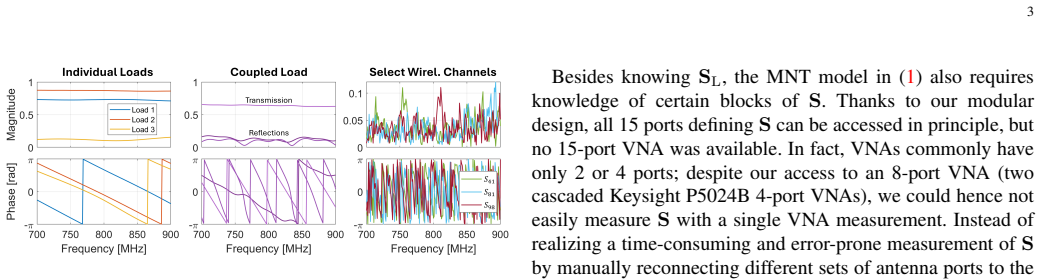
The load-bearing object is the multi-port network theory relation $$H = S_{RT} + S_{RS}($S_L^{{-1}}$ - S_{SS})^{-1}S_{ST},$$ which turns the static scattering matrix $S$ of the environment, together with the tunable load network scattering matrix $S_L$, into the end-to-end channel $H$. $S$ is estimated without a 15-port VNA using the Virtual VNA technique, which reconstructs the full matrix from measurements made through a subset of ports while the remaining ports are terminated by tunable and coupled loads. $S_L$ is obtained from direct one- and two-port VNA measurements of the PCB's loads; hardware constraints make $S_L$ tridiagonal and prevent simultaneous use of both adjacent couplings on one element. Because $S$ and $S_L$ are known, the paper enumerates all 12,970 realizable configurations and exhaustively optimizes each KPI.
What would settle it
Take one of the optimized load configurations reported for a specific frequency and TX/RX pair, measure the actual TX-to-RX scattering parameters with a calibrated VNA, and compare them with the values Eq. (1) predicts from the estimated $S$ and measured $S_L$; disagreement beyond the stated measurement uncertainty would show the reported gains are computational artifacts rather than realized channel improvements.
Extended reading notes
Core claim
The central claim is that a reflective BD-RIS with reconfigurable inter-element connections is practically realizable and that the connections are worth having. With the experimentally realized tridiagonal load network, all four considered KPIs improve over an open-circuit baseline, and the availability of coupled loads yields additional improvement over the same prototype used as a conventional diagonal RIS. The paper also establishes that hardware constraints shape the conclusions: reducing the three individual loads to two can either barely matter or cost notably, depending on which load is dropped, and the gap between BD-RIS and diagonal RIS widens sharply under the idealized continuously tunable, fully connected load matrices assumed in much theory. In this constrained prototype, ignoring mutual coupling during optimization barely changes the achieved KPIs, whereas under ideal hardware it can cut one KPI's gain nearly in half.
Load-bearing premise
The entire performance evaluation computes the end-to-end channel $H$ in software from an estimated static scattering matrix $S$ and a measured load scattering matrix $S_L$, so the reported gains depend on the accuracy of the multi-port network model and the Virtual VNA estimate of $S$.
Editorial extensions
If this is right
- Inter-element connections help in practice, but the size of the benefit depends strongly on the KPI: 50.3% improvement for one MIMO metric versus 1.7% for another.
- Hardware constraints substantially shrink the theoretical advantage of BD-RIS over diagonal RIS; ideal fully connected tunable loads show much larger gains and a larger BD-RIS versus D-RIS gap.
- The exact scattering properties of the available individual loads matter, not just their count, since dropping one reflective load hurts performance much more than dropping the absorptive load.
- Mutual-coupling-unaware optimization is nearly lossless for this constrained hardware but harmful under idealized hardware, so MC awareness matters most when the load network is nearly ideal.
- No notable BD-RIS versus interleaved BD-RIS difference appears in this eight-element prototype, leaving the predicted advantage of interleaving untested at this scale.
Reading between the lines
- Because no end-to-end channel is directly measured, the reported gains are model-based; a direct VNA measurement of $H$ for optimized configurations would test whether the modeled gains appear over the air.
- The same PCB that enables Virtual VNA characterization also acts as the BD-RIS itself, suggesting that tunable load networks can serve dual roles: measurement hardware in the lab and operational RIS hardware in deployment.
- The hardware constraint that a switch cannot simultaneously connect to both neighbors may be a central reason the coupled-load gains are modest; alternative topologies that allow simultaneous couplings could show larger gains.
- The strong KPI dependence suggests BD-RIS benefits should be reported as a distribution over KPIs and environments rather than as a single number.
Signed reviews
Editorial analysis
A structured set of objections, weighed in public.
Referee Report
Summary. The paper presents a reflective beyond-diagonal RIS (BD-RIS) prototype built by connecting eight commercial antennas to a PCB-realized tunable load network. The load network offers three individual loads per port and two switchable connections to adjacent ports, realizing a tridiagonal load scattering matrix. The static 15-port scattering matrix S of the rich-scattering environment is estimated with a Virtual VNA procedure, and the load network is characterized by direct VNA measurements of its individual and coupled loads. The end-to-end channel H is then computed for every feasible load configuration using the multiport network theory relation in Eq. (1). The authors exhaustively optimize four KPIs (SISO channel gain, interference-channel sum rate, low-SNR capacity, and high-SNR capacity) over the realizable configuration space, and benchmark the results against open-circuit, diagonal-RIS, ideal-hardware, 1-bit-load, interleaved-BD-RIS, and mutual-coupling-unaware baselines. They report that the coupled loads improve all four KPIs relative to the open-circuit benchmark, that hardware constraints strongly affect the achievable gains, and that mutual-coupling awareness matters little in the realized hardware but matters more under idealized assumptions.
Significance. If the reported results are trusted, this is a useful first hardware demonstration of a reflective BD-RIS architecture and a valuable study of how realistic hardware constraints—finite load sets, tridiagonal connectivity, and switch limitations—change conclusions drawn from idealized BD-RIS models. The strengths of the paper are its direct measurement of load characteristics, its use of exhaustive search over the full realizable configuration space, and its careful definition of several benchmarks that isolate the effect of inter-element connections. However, the central performance claims are entirely computed from the estimated static scattering matrix S and the measured load matrix S_L via Eq. (1); no end-to-end channel measurement for any realized configuration is reported. Because the optimizer selects configurations that maximize the model-predicted KPIs, unquantified modeling error could systematically bias the reported gains. The paper is therefore best viewed as a model-based performance evaluation anchored to component-level measurements, rather than as a direct experimental validation of the prototype's wireless performance.
major comments (3)
- [Sec. IV] The end-to-end channel H is never measured for any realized load configuration; it is computed from the estimated static matrix S and the measured load matrix S_L via Eq. (1). All four KPIs and the percentage improvements reported in Sec. IV-D therefore quantify the behavior of the MNT model, not of the physical prototype. Because the exhaustive search in Sec. IV-C specifically selects configurations that maximize these model-predicted KPIs, even a modest bias in Eq. (1) or in its inputs would be amplified into the claimed 24.5%, 50.3%, 13.8%, and 1.7% improvements and into the coupled-load advantage. The paper should report direct measurements of H (e.g., S-parameter measurements between TX and RX ports) for at least the OC, optimized D-RIS, and optimized BD-RIS configurations, and compare them with Eq. (1); without such a comparison, the abstract's statement that the performance evaluations 'validate that inter-element connections are beneficial' is not experimentally established.
- [Appendix] The Virtual VNA estimate of S is not validated. The gradient-descent procedure is described, but no convergence residual, no comparison with a direct measurement of any portion of S, and no uncertainty estimate is reported; the block-wise sign ambiguity is resolved with a single auxiliary measurement. Since S is a primary input to Eq. (1), any estimation error propagates into every computed H and into the optimized configuration selected by the exhaustive search. The authors should at least validate the estimated S by predicting a held-out set of the 900 measured configurations and reporting the prediction error, or by directly measuring a subset of S entries with the available 8-port VNA.
- [Sec. III] The assembled eight-port load network is assumed to be exactly characterized by isolated one-port and two-port VNA measurements of the individual and coupled loads. This neglects in-situ effects such as switch leakage, crosstalk between adjacent switch channels, and detuning introduced by the SMA connections and the PCB assembly. Because S_L is the second input to Eq. (1), an unmodeled difference between the assumed and actual S_L would change all computed channels and, consequently, the optimal configurations. The authors should validate S_L in situ, for example by measuring the assembled network directly or by including an S_L sensitivity test in the analysis.
minor comments (4)
- [Sec. IV-C] In the sentence beginning 'In total, there are', the summation symbol appears to be rendered as 'P' in the text; please correct the typography.
- [Fig. 3] The curves and points are averages over 201 frequency points and all TX/RX selections, but no measure of spread is provided; for the small differences in KPI 4 (1.7% vs. 1.5%), error bars or confidence intervals would help the reader judge whether the coupled-load advantage is meaningful.
- [Sec. I] The claim that this is the first experimental prototype should be reconciled with the fact that the tunable load network PCB was presented in [9]; the paper should state explicitly that the prototype is the integration of that PCB with the antenna array.
- [Sec. IV-D] The conclusion that mutual-coupling unawareness barely affects the KPIs in the experimental setup is presented without discussion of whether this is a consequence of the small array size, the specific load impedance values, or the static rich-scattering environment; a sentence of context would improve the paper.
Circularity Check
No circular reasoning identified: the reported gains are model-based predictions from independently measured S and S_L, not fits to the target KPIs.
full rationale
The derivation chain is: (i) the static scattering matrix S is estimated from 900 physical VNA measurements using the Virtual VNA gradient-descent procedure described in the Appendix; (ii) the load scattering matrices S_L for each realizable switch configuration are assembled from direct one-port and two-port VNA measurements of the individual and coupled loads, as stated in Sec. III; and (iii) the end-to-end channels H are computed with the stated multiport network theory formula Eq. (1), and then optimized by exhaustive search over discrete configurations or by quasi-Newton search over unitary S_L. No parameter is fitted to the four KPIs, and no KPI is defined in terms of the optimization outcome. The paper's own equations do not make the conclusion equivalent to an input: the claimed benefit of inter-element connections is a property of the computed optimization landscape, not a re-labelled fit. The main limitation is experimental rather than circular: H for realized configurations is never directly measured, so the quantitative gains depend on the accuracy of Eq. (1) and of the Virtual VNA estimate of S. That is a validity or correctness risk, not a circularity. Self-citations to the Virtual VNA work and to prior BD-RIS theory supply the measurement methodology and the architecture, but they are not invoked as an unverified uniqueness theorem to force the conclusion; the present paper reports fresh physical measurements and gives concrete estimation details, including the block-wise sign ambiguity resolution. Hence the appropriate finding is no significant circularity.
Assumptions & free parameters
assumptions (4)
- domain assumption The static environment is a passive, reciprocal, linear time-invariant network characterized by a scattering matrix S.
- standard math The end-to-end channel is given by the multiport network theory formula H = S_RT + S_RS (S_L^{-1} - S_SS)^{-1} S_ST (Eq. (1)).
- domain assumption The Virtual VNA procedure yields an accurate estimate of the 15-port scattering matrix S.
- ad hoc to paper For any switch configuration, the load network scattering matrix SL is exactly determined by direct VNA measurements of its individual and coupled loads.
Cite this review
Pith. "Pith review of Beyond-Diagonal RIS Prototype and Performance Evaluation." pith.science (2026). https://pith.science/paper/INVMD2C6
@misc{pith2026250513392,
  author       = {Pith},
  title        = {Pith review of: Beyond-Diagonal RIS Prototype and Performance Evaluation},
  year         = {2026},
  howpublished = {\url{https://pith.science/paper/INVMD2C6}},
  note         = {Machine review of arXiv:2505.13392}
}
read the original abstract
We present the first experimental prototype of a reflective beyond-diagonal reconfigurable intelligent surface (BD-RIS), i.e., a RIS with reconfigurable inter-element connections. Our BD-RIS consists of an antenna array whose ports are terminated by a tunable load network. The latter can terminate each antenna port with three distinct individual loads or connect it to an adjacent antenna port. Extensive performance evaluations in a rich-scattering environment validate that inter-element connections are beneficial. Moreover, we observe that our tunable load network's mentioned hardware constraints significantly influence, first, the achievable performance, second, the benefits of having inter-element connections, and, third, the importance of mutual-coupling awareness during optimization.
Figures


Forward citations
Cited by 3 Pith papers
-
Ambiguity-Aware Segmented Estimation of Mutual Coupling in Large RIS: Algorithm and Experimental Validation
A segmented estimation algorithm recovers the mutual-coupling parameters of a 100-element RIS and yields far more accurate channel predictions than MC-unaware models, though the optimization gains are moderate.
-
Wireless Multi-Port Sensing: Virtual-VNA-Enabled De-Embedding of an Over-the-Air Fixture
A backscatter-modulation method, built on the author's Virtual VNA techniques, wirelessly recovers the full scattering matrix of passive multi-port circuits in a complex radio environment, validated at 2.45 GHz.
-
Experimental Multiport-Network Parameter Estimation and Optimization for Multi-Bit RIS
A closed-form plus gradient-descent technique estimates multiport-network parameters for multi-bit RISs in unknown environments; experiments show mutual-coupling-aware models are far more accurate but not much better ...
Reference graph
Works this paper leans on
-
[1]
S. Shen, B. Clerckx, and R. Murch, “Modeling and architecture design of reconfigurable intelligent surfaces using scattering parameter network analysis,”IEEE Trans. Wirel. Commun., vol. 21, no. 2, pp. 1229–1243, 2021
work page 2021
-
[2]
Beyond diagonal reconfigurable intelligent surfaces with mutual coupling: Modeling and optimization,
H. Li, S. Shen, M. Nerini, M. Di Renzo, and B. Clerckx, “Beyond diagonal reconfigurable intelligent surfaces with mutual coupling: Modeling and optimization,”IEEE Commun. Lett., vol. 28, no. 4, pp. 937–941, 2024
work page 2024
-
[3]
The measurement and interpretation of antenna scattering,
D. King, “The measurement and interpretation of antenna scattering,” Proc. IRE, vol. 37, no. 7, pp. 770–777, 1949
work page 1949
-
[4]
P. del Hougne, “A physics-compliant diagonal representation for wireless channels parametrized by beyond-diagonal reconfigurable intelligent surfaces,”IEEE Trans. Wirel. Commun., 2025
work page 2025
-
[5]
Z. Ming, S. Shen, J. Rao, Z. Li, J. Zhang, C. Y . Chiu, and R. Murch, “A hybrid transmitting and reflecting beyond diagonal reconfigurable intelligent surface with independent beam control and power splitting,” arXiv:2504.09618, 2025
arXiv 2025
-
[6]
The application of multiport theory for MIMO RFID backscatter channel measurements,
E. Denicke, M. Henning, H. Rabe, and B. Geck, “The application of multiport theory for MIMO RFID backscatter channel measurements,” Proc. EuMC, pp. 522–525, 2012
work page 2012
-
[7]
P. del Hougne, “Virtual VNA 2.0: Ambiguity-free scattering matrix estimation by terminating not-directly-accessible ports with tunable and coupled loads,”IEEE Trans. Antennas Propag., 2025
work page 2025
-
[8]
——, “Virtual VNA 3.0: Unambiguous scattering matrix estimation for non-reciprocal systems by leveraging tunable and coupled loads,” arXiv:2503.07239, 2025
arXiv 2025
Show all 14 references
-
[9]
Scalable multiport antenna array characterization with PCB-realized tunable load network providing additional “virtual
J. Tapie and P. del Hougne, “Scalable multiport antenna array characterization with PCB-realized tunable load network providing additional “virtual” VNA ports,”arXiv:2503.16256, 2025
2025 arXiv
-
[10]
Beyond diagonal reconfigurable intelligent surfaces utilizing graph theory: Modeling, architecture design, and optimization,
M. Nerini, S. Shen, H. Li, and B. Clerckx, “Beyond diagonal reconfigurable intelligent surfaces utilizing graph theory: Modeling, architecture design, and optimization,”IEEE Trans. Wirel. Commun., vol. 23, no. 8, pp. 9972–9985, 2024
2024
-
[11]
Systematic physics-compliant analysis of over-the-air channel equalization in RIS- parametrized wireless networks-on-chip,
J. Tapie, H. Prod’homme, M. F. Imani, and P. del Hougne, “Systematic physics-compliant analysis of over-the-air channel equalization in RIS- parametrized wireless networks-on-chip,”IEEE J. Sel. Areas Commun., vol. 42, no. 8, pp. 2026–2038, 2024
2026
-
[12]
A rigorous technique for measuring the scattering matrix of a multiport device with a 2-port network analyzer,
J. C. Tippet and R. A. Speciale, “A rigorous technique for measuring the scattering matrix of a multiport device with a 2-port network analyzer,” IEEE Trans. Microw. Theory Tech., vol. 30, no. 5, pp. 661–666, 1982
1982
-
[13]
Static grouping strategy design for beyond diagonal reconfigurable intelligent surfaces,
M. Nerini, S. Shen, and B. Clerckx, “Static grouping strategy design for beyond diagonal reconfigurable intelligent surfaces,”IEEE Commun. Lett., vol. 28, no. 7, pp. 1708–1712, 2024
2024
-
[14]
Mutual coupling and unit cell aware optimization for reconfigurable intelligent surfaces,
X. Qian and M. Di Renzo, “Mutual coupling and unit cell aware optimization for reconfigurable intelligent surfaces,”IEEE Wirel. Commun. Lett., vol. 10, no. 6, pp. 1183–1187, 2021
2021
Reviewed August 15, 2026 · model on record in the stance chip above.
Discussion (0). Continue with ORCID to comment.