REVIEW 46 references
Photoproduction of heavy vector mesons in peripheral $PbPb$ collisions at the Large Hadron Collider
T0 review · reviewed 2026-08-07 · deepseek-v4-flash
Pith's one-line read Comprehensive model comparison predicts Upsilon production and cross-section ratios in peripheral PbPb collisions that future LHC data can use to discriminate among photon-flux and dipole models.
The pith
A machine-rendered reading of the paper's core claim, the machinery that carries it, and where it could break.
The reading
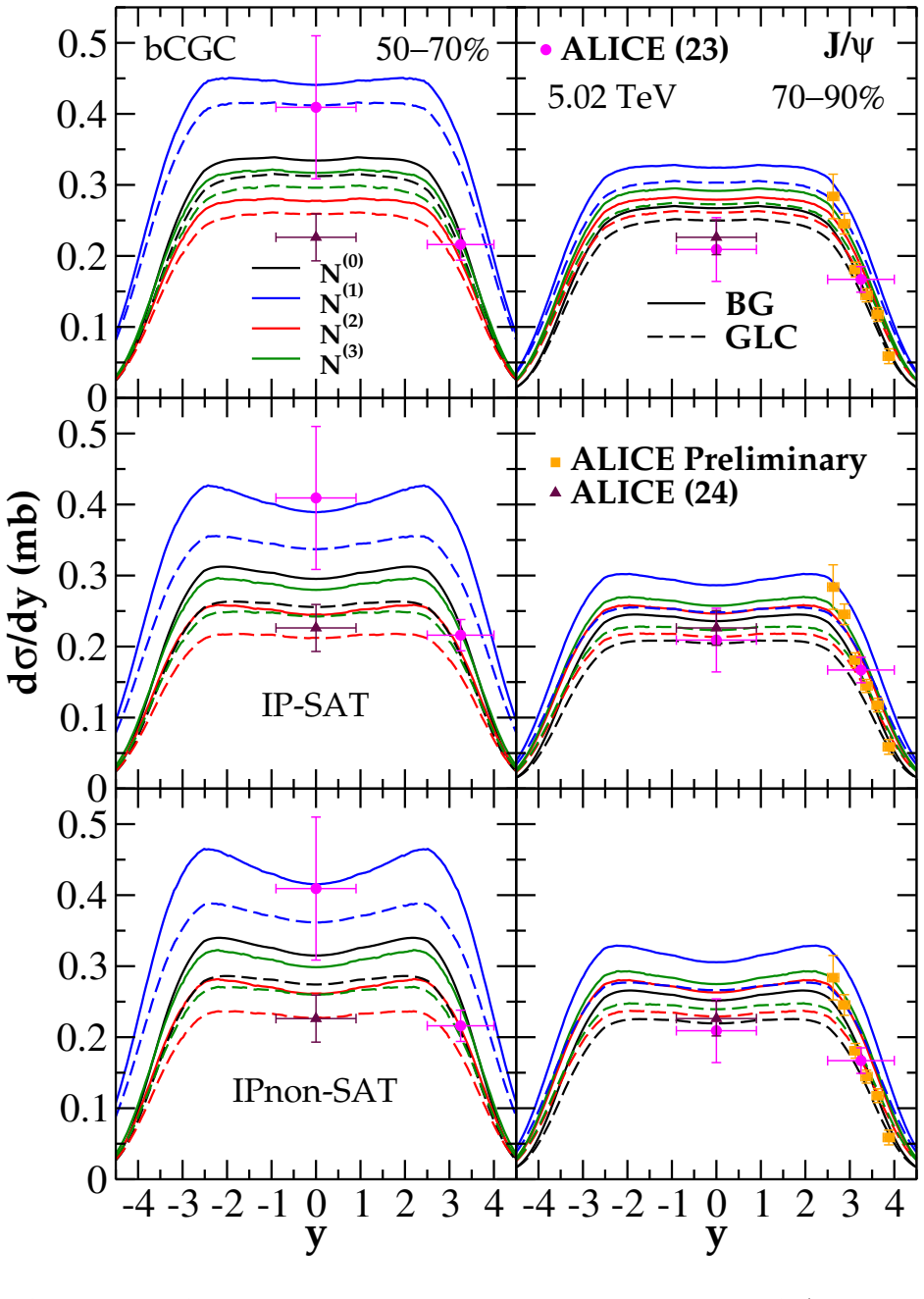
The authors take the standard equivalent photon approximation and change each of its ingredients: how the photon flux is modified when nuclei overlap, whether the photon-nucleus scattering amplitude uses only spectator nucleons or also the overlap region, which dipole-proton scattering model is used (bCGC, IP-SAT, or a linearized version), and which wave function describes the meson. They compute rapidity distributions for centralities 50-70% and 70-90% at 2.76 and 5.02 TeV.
The spread of predictions is large, sometimes a factor of 2 to 3, and the current ALICE data are not precise enough to single out one model. The paper therefore proposes ratios: Upsilon over J/Psi, and peripheral over ultraperipheral yields. These ratios vary significantly across models, so future measurements, especially of Upsilon, could tell which assumptions about the photon flux in peripheral collisions are correct.
Extended reading notes
Core claim
The simultaneous analysis of J/Psi and Upsilon production, and the corresponding ratios, in peripheral PbPb collisions will allow future LHC data to discriminate between different models of the effective nuclear photon flux, dipole-proton scattering amplitude, and overlap function. This is stated in the abstract and in Section III: a future experimental analysis of these ratios could be very useful to discriminate between the different approaches.
Load-bearing premise
The mapping between centrality and impact parameter, c = b^2/(4 R_A^2), together with the assumption in Eq. (22) that only spectator nucleons outside the overlap region act as the target. If a Glauber Monte Carlo mapping is used instead, the predictions shift significantly, as shown in Fig. 8, and the comparison with ALICE data could change. The paper explicitly acknowledges this sensitivity in Appendix B.
Editorial analysis
A structured set of objections, weighed in public.
Assumptions & free parameters
free parameters (5)
- bCGC saturation model parameters (N0, gamma_s, x0, lambda, BCGC) =
From HERA fit in Ref. [31], values not reproduced in the text
- IP-SAT parameters (Bp, Ag, lambda_g, C, mu0^2) =
Bp = 4 GeV^-2, other values from HERA fit in Ref. [35]
- IPnon-SAT gluon parameters =
Same as IP-SAT, Ref. [35]
- GLC wave function parameters (NT, R_T) =
Table I: J/Psi NT=1.4532, R_T^2=5.5175 (one of three mass choices); Upsilon NT=0.7654, R_T^2=1.9211
- BG wave function parameters =
From Refs. [35,40]
assumptions (8)
- domain assumption Equivalent photon approximation (EPA) is valid for peripheral heavy-ion collisions.
- standard math Wood-Saxon charge distribution describes the nuclear form factor.
- domain assumption Glauber-Gribov formalism gives the nuclear dipole amplitude.
- ad hoc to paper Centrality c maps to impact parameter b via c = b^2/(4R_A^2).
- ad hoc to paper Only spectator nucleons outside the overlap region act as target in Eq. (22).
- domain assumption QGP effects can be ignored for centralities above 50%.
- domain assumption The dipole-proton amplitudes (bCGC, IP-SAT, IPnon-SAT) are valid models for high-energy QCD.
- ad hoc to paper Effective photon flux models N(1)-N(3) with theta functions capture the geometry of peripheral collisions.
Cite this review
Pith. "Pith review of Photoproduction of heavy vector mesons in peripheral $PbPb$ collisions at the Large Hadron Collider." pith.science (2026). https://pith.science/paper/A6TPR7EZ
@misc{pith2026250514019,
  author       = {Pith},
  title        = {Pith review of: Photoproduction of heavy vector mesons in peripheral $PbPb$ collisions at the Large Hadron Collider},
  year         = {2026},
  howpublished = {\url{https://pith.science/paper/A6TPR7EZ}},
  note         = {Machine review of arXiv:2505.14019}
}
abstract
A comprehensive analysis of the photoproduction of $J/\Psi$ and $\Upsilon$ mesons in peripheral $PbPb$ collisions at the center - of - mass energies of the Large Hadron Collider (LHC) is performed, considering distinct assumptions for the modeling of the nuclear photon flux, photon - nucleus cross - section, overlap function and dipole - proton scattering amplitude. The comparison of these predictions with the ALICE data is also performed. Our results indicate that a detailed analysis of the production of both mesons will be very useful to improve the description of photon - induced processes in peripheral collisions.
Figures


Figures from the paper (5 more)


Reference graph
Works this paper leans on
-
[1]
In the equivalent photon approximation (EPA) [19], the associated cross - section, characterized by an impact parameter b, can be expressed in terms of the equivalent photon spectrum associated with one of the ions and by the production cross section that d escribed the interaction of the photon with the other ion. Considering that both ions can act as ph...
-
[2]
S. R. Klein, J. Nystrand, Phys. Rev. C 60, 014903 (1999)
1999
-
[3]
(17) The free parameters of this model are fixed by a fit of HERA data [35]
=Agx−λg(1−x)6. (17) The free parameters of this model are fixed by a fit of HERA data [35]. Finally, we will also consider a linearized version of the IP-SAT model, usually denoted IPnon-SAT model, which disregard these non-linear effects and has a dipole - proton scattering amplit ude given by [35] Np(x, r, b) = π2r2 2Nc αs(µ2) xg ( x,µ 2 0 + C r2 ) Tp(b) ....
-
[4]
C. A. Bertulani and G. Baur, Phys. Rep. 163, 299 (1988); F. Krauss, M. Greiner and G. Soff, Prog. Part. Nucl. Phys. 39, 503 (1997); C. A. Bertulani, S. R. Klein and J. Nystrand, Ann. Rev . Nucl. Part. Sci. 55, 271 (2005); V. P. Goncalves and M. V. T. Machado, J. Phys. G 32, 295 (2006); A. J. Baltz et al. , Phys. Rept. 458, 1 (2008); J. G. Contreras and J. ...
1988
-
[5]
S. R. Klein and H. Mantysaari, Nature Rev. Phys. 1, no.11, 662-674 (2019)
2019
-
[6]
V. P. Goncalves and C. A. Bertulani, Phys. Rev. C 65, 054905 (2002)
2002
-
[7]
Frankfurt, M
L. Frankfurt, M. Strikman and M. Zhalov, Phys. Lett. B 540, 220-226 (2002)
2002
-
[8]
Aaij et al
R. Aaij et al. [LHCb], Phys. Rev. C 105, no.3, L032201 (2022)
2022
Show all 46 references
-
[9]
Adam et al
J. Adam et al. [ALICE], Phys. Rev. Lett. 116, no.22, 222301 (2016)
2016
-
[10]
Adam et al
J. Adam et al. [STAR], Phys. Rev. Lett. 123, no.13, 132302 (2019)
2019
-
[11]
Biz´ e [ALICE], Phys
N. Biz´ e [ALICE], Phys. Proc. UPC 1, 18 (2024)
2024
-
[12]
Acharya et al
S. Acharya et al. [ALICE], Phys. Lett. B 846, 137467 (2023)
2023
-
[13]
has proposed two distinct approaches. The first one, con siders that the production of vector mesons only occurs inside the nuclear target, which is equiv alent to assume that N (1) A (ω,b ) = ∫ N (0) A (ω,b 1)θ(RB−b2) πR2 B d2b1 , (4) where the theta function ensures that the ...
-
[14]
Massacrier [ALICE], [arXiv:2407.09707 [nucl-ex]]
L. Massacrier [ALICE], [arXiv:2407.09707 [nucl-ex]]
-
[15]
Acharya et al
S. Acharya et al. [ALICE], [arXiv:2409.11940 [nucl-ex]]
-
[16]
K/suppress lusek-Gawenda and A
M. K/suppress lusek-Gawenda and A. Szczurek, Phys. Rev. C93, no.4, 044912 (2016)
2016
-
[17]
W. Zha, S. R. Klein, R. Ma, L. Ruan, T. Todoroki, Z. Tang, Z. Xu, C. Yang, Q. Yang and S. Yang, Phys. Rev. C 97, no.4, 044910 (2018)
2018
-
[18]
M. B. Gay Ducati and S. Martins, Phys. Rev. D 96, no.5, 056014 (2017)
2017
-
[19]
M. B. Gay Ducati and S. Martins, Phys. Rev. D 97, no.11, 116013 (2018)
2018
-
[20]
W. Shi, W. Zha and B. Chen, Phys. Lett. B 777, 399-405 (2018)
2018
-
[21]
W. Zha, L. Ruan, Z. Tang, Z. Xu and S. Yang, Phys. Lett. B 789, 238-242 (2019)
2019
-
[22]
V. M. Budnev, I. F. Ginzburg, G. V. Meledin and V. G. Serbo, Phy s. Rept. 15, 181 (1975)
1975
-
[23]
C. W. De Jager, H. De Vries and C. De Vries, Atom. Data Nucl. Dat a Tabl. 14, 479 (1974) Erratum: [Atom. Data Nucl. Data Tabl. 16, 580 (1975)]
1974
-
[24]
C. A. Bertulani and F. Navarra, Nucl. Phys. A 703, 861 (2002)
2002
-
[25]
B. Z. Kopeliovich, J. Nemchik, A. Schafer and A. V. Tarasov, Ph ys. Rev. C 65, 035201 (2002)
2002
-
[26]
Gelis, E
F. Gelis, E. Iancu, J. Jalilian-Marian and R. Venugopalan, Ann. Re v. Nucl. Part. Sci. 60, 463 (2010); H. Weigert, Prog. Part. Nucl. Phys. 55, 461 (2005); J. Jalilian-Marian and Y. V. Kovchegov, Prog. Part. Nucl. Phys. 56, 104 (2006); A. Morreale and F. Salazar, Universe 7, no...
2010
-
[27]
V. P. Gon¸ calves, M. V. T. Machado, B. D. Moreira, F. S. Navarra and G. S. dos Santos, Phys. Rev. D 96, no.9, 094027 (2017)
2017
-
[28]
R. J. Glauber, in Lecture in Theoretical Physics, Vol. 1, edited b y W. E. Brittin, L. G. Duham 20 (Interscience, New York, 1959)
1959
-
[29]
V. N. Gribov, Sov. Phys. JETP 29, 483 (1969); Sov. Phys. JETP 30, 709 (1970)
1969
-
[30]
A. H. Mueller, Nucl. Phys. B 335, 115 (1990)
1990
-
[31]
Armesto, Eur
N. Armesto, Eur. Phys. J. C 26, 35 (2013)
2013
-
[32]
Kowalski, L
H. Kowalski, L. Motyka and G. Watt, Phys. Rev. D 74, 074016 (2006)
2006
-
[33]
Watt and H
G. Watt and H. Kowalski, Phys. Rev. D 78, 014016 (2008)
2008
-
[34]
Y. P. Xie and X. Chen, Int. J. Mod. Phys. A 33, no.14n15, 1850086 (2018)
2018
-
[35]
Kowalski and D
H. Kowalski and D. Teaney, Phys. Rev. D 68, 114005 (2003)
2003
-
[36]
Kowalski, T
H. Kowalski, T. Lappi and R. Venugopalan, Phys. Rev. Lett. 100, 022303 (2008)
2008
-
[37]
A. H. Rezaeian, M. Siddikov, M. Van de Klundert and R. Venugopa lan, Phys. Rev. D 87, 034002 (2013)
2013
-
[38]
Mantysaari and P
H. Mantysaari and P. Zurita, Phys. Rev. D 98, 036002 (2018)
2018
-
[39]
Dosch, T
H.G. Dosch, T. Gousset, G. Kulzinger and H.J. Pirner, Phys. Rev . D55, 2602 (1997); G. Kulzinger, H.G. Dosch and H.J. Pirner, Eur. Phys. J. C7, 73 (1999)
1997
-
[40]
Nemchik, N
J. Nemchik, N. N. Nikolaev, E. Predazzi and B. G. Zakharov, Z. Phys. C 75, 71 (1997)
1997
-
[41]
J. R. Forshaw, R. Sandapen and G. Shaw, Phys. Rev. D 69, 094013 (2004)
2004
-
[42]
Navas et al
S. Navas et al. [Particle Data Group], Phys. Rev. D 110, no.3, 030001 (2024)
2024
-
[43]
Cepila, J
J. Cepila, J. G. Contreras and M. Vaculciak, Phys. Rev. D 111, no.5, 056002 (2025)
2025
-
[44]
Loizides, J
C. Loizides, J. Kamin and D. d’Enterria, Phys. Rev. C 97, no.5, 054910 (2018) [erratum: Phys. Rev. C 99, no.1, 019901 (2019)]
2018
-
[45]
M. A. Peredo and M. Hentschinski, Phys. Rev. D 109, no.1, 014032 (2024)
2024
-
[46]
Y. V. Kovchegov, H. Sun and Z. Tu, Phys. Rev. D 109, no.9, 094028 (2024) 21 0 0.1 0.2 0.3 0.4 0.5 N (0) N (1) N (2) N (3) ALICE (23) 0 0.1 0.2 0.3 0.4 0.5dσ/dy (mb) BG GLC -4 -3 -2 -1 0 1 2 3 4y 0 0.1 0.2 0.3 0.4 0.5 -4 -3 -2 -1 0 1 2 3 4y ALICE Preliminary ALICE (24) 50−70%bC...
2024
Reviewed August 7, 2026 · model on record in the stance chip above.
Discussion (0). Continue with ORCID to comment.