REVIEW 1 cited by
CSAGC-IDS: A Dual-Module Deep Learning Network Intrusion Detection Model for Complex and Imbalanced Data
T0 review · reviewed 2026-08-07 · deepseek-v4-flash
Pith's one-line read A dual-module intrusion detection model using GAN oversampling plus cost-sensitive attention CNN achieves 84.55% five-class and 91.09% binary accuracy on NSL-KDD.
The pith
A machine-rendered reading of the paper's core claim, the machinery that carries it, and where it could break.
The reading
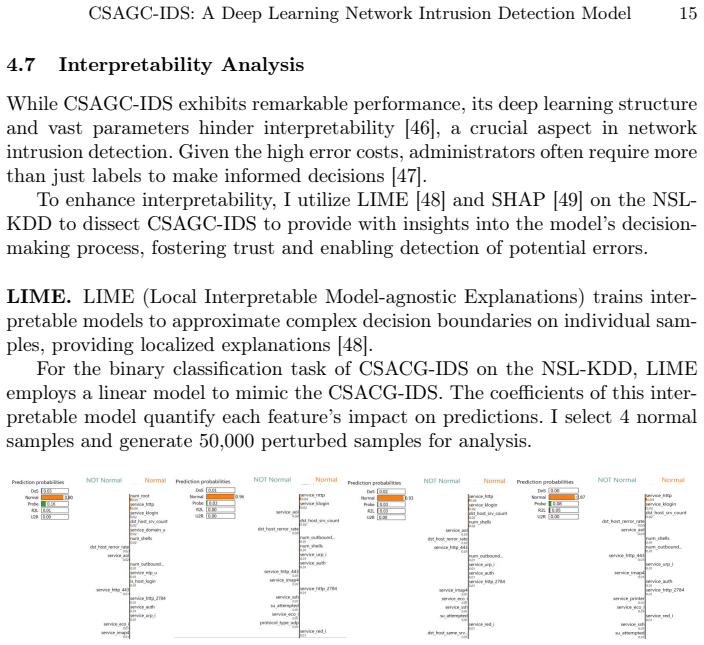
On the NSL-KDD benchmark, the full system reaches 84.55% accuracy and 84.52% F1 for five-class classification, and 91.09% accuracy and 92.04% F1 for binary normal-versus-attack classification. That is a small improvement over the best published results the authors compare against. The paper also applies SHAP and LIME to show which features, such as service_http or flag_REJ, push the model toward an attack label.
The main limitations are that the numbers come from a single experiment with no error bars, the code is not released, and the cost weights used to penalize rare classes are never reported. The dataset itself, NSL-KDD, is from 1999 and is considered an easy benchmark by modern standards.
Extended reading notes
Core claim
CSAGC-IDS achieves 84.55% accuracy and 84.52% F1 on five-class NSL-KDD classification and 91.09% accuracy and 92.04% F1 on binary classification, surpassing other comparative methods (Abstract, Section 4.6). The ablation study is said to 'unequivocally demonstrated the effectiveness' of the proposed enhancement (Section 4.5).
Load-bearing premise
The claimed gains of CSCA-CNN over the plain CNN (84.55% vs 80.96%) depend on the cost-sensitive weights w_i in Eq. (5), whose values are never reported and which were chosen without a described tuning procedure. If those weights were picked by looking at KDDTest+ accuracy, the improvement is a fitting artifact rather than a generalizable property; if they are arbitrary, the result is not reproducible. Additionally, the paper assumes the SC-CGAN-generated samples, validated only by downstream classifier accuracy, resemble the true KDDTest+ distribution closely enough to boost generalization.
Editorial analysis
A structured set of objections, weighed in public.
Assumptions & free parameters
free parameters (3)
- Cost-sensitive class weights w_i in Eq. (5) =
not reported
- Balance target count per class =
67,343
- GAN and classifier hyperparameters =
see Table 3: lr 0.001, 5e-6, 1e-4, 0.01; batch 128; epochs 30; noise dim 123; attention dim 30; squeeze ratio 8
assumptions (4)
- domain assumption NSL-KDD adequately represents network intrusion traffic
- domain assumption Classifier accuracy on the balanced training set is a valid measure of generated data quality
- domain assumption One-hot encoding followed by z-score standardization preserves the information needed for classification
- domain assumption The GAN training converged to a generator whose synthetic samples match the real conditional distribution
Cite this review
Pith. "Pith review of CSAGC-IDS: A Dual-Module Deep Learning Network Intrusion Detection Model for Complex and Imbalanced Data." pith.science (2026). https://pith.science/paper/OYJ2TH5G
@misc{pith2026250514027,
  author       = {Pith},
  title        = {Pith review of: CSAGC-IDS: A Dual-Module Deep Learning Network Intrusion Detection Model for Complex and Imbalanced Data},
  year         = {2026},
  howpublished = {\url{https://pith.science/paper/OYJ2TH5G}},
  note         = {Machine review of arXiv:2505.14027}
}
read the original abstract
As computer networks proliferate, the gravity of network intrusions has escalated, emphasizing the criticality of network intrusion detection systems for safeguarding security. While deep learning models have exhibited promising results in intrusion detection, they face challenges in managing high-dimensional, complex traffic patterns and imbalanced data categories. This paper presents CSAGC-IDS, a network intrusion detection model based on deep learning techniques. CSAGC-IDS integrates SC-CGAN, a self-attention-enhanced convolutional conditional generative adversarial network that generates high-quality data to mitigate class imbalance. Furthermore, CSAGC-IDS integrates CSCA-CNN, a convolutional neural network enhanced through cost sensitive learning and channel attention mechanism, to extract features from complex traffic data for precise detection. Experiments conducted on the NSL-KDD dataset. CSAGC-IDS achieves an accuracy of 84.55% and an F1-score of 84.52% in five-class classification task, and an accuracy of 91.09% and an F1 score of 92.04% in binary classification task.Furthermore, this paper provides an interpretability analysis of the proposed model, using SHAP and LIME to explain the decision-making mechanisms of the model.
Figures


Figures from the paper (8 more)




Forward citations
Cited by 1 Pith paper
-
$\text{C}^{2}\text{BNVAE}$: Dual-Conditional Deep Generation of Network Traffic Data for Network Intrusion Detection System Balancing
Adding class-specific batch normalization to a conditional variational autoencoder improves synthetic minority-class network traffic generation enough to nudge a Decision Tree NIDS F1-score from 72.74% to 78.19% on NSL-KDD.
Reference graph
Works this paper leans on
-
[1]
Survey of intrusion detection systems: techniques, datasets and challenges
Khraisat, A., Gondal, I., Vamplew, P., et al. Survey of intrusion detection systems: techniques, datasets and challenges. Cybersecurity,2(1), 22 (2019)
work page 2019
-
[2]
FIREMAN: a toolkit for firewall modeling and analysis
Yuan, L., Mai, J., Su, Z., et al. FIREMAN: a toolkit for firewall modeling and analysis. In: Proceedings of the 2006 IEEE Symposium on Security and Privacy. IEEE (2006)
work page 2006
-
[3]
LeCun,Y.,Bengio,Y.,Hinton,G.Deeplearning.Nature, 521(7553),436–444(2015)
work page 2015
-
[4]
A deep learning approach for network intrusion detection system
Javaid, A., Niyaz, Q., Sun, W., et al. A deep learning approach for network intrusion detection system. In: Proceedings of the 9th EAI International Conference on Bio- inspired Information and Communications Technologies. pp. 21–26 (2016)
work page 2016
-
[5]
He, H., Garcia, E. A. Learning from imbalanced data. IEEE Transactions on Knowl- edge & Data Engineering,20(9), 1263–1284 (2008)
work page 2008
-
[6]
Gupta, N., Jindal, V., Bedi, P. CSE-IDS: Using cost-sensitive deep learning and ensemble algorithms to handle class imbalance in network-based intrusion detection systems. Computers & Security,112, 102499 (2022)
work page 2022
-
[7]
A novel multi-module integrated intrusion detection system for high-dimensional imbalanced data
Cui, J., Zong, L., Xie, J., et al. A novel multi-module integrated intrusion detection system for high-dimensional imbalanced data. Applied Intelligence,53(1), 272–288 (2023)
work page 2023
-
[8]
Gradient-Based Learning Applied to Doc- ument Recognition
LeCun, Y., Bottou, L., Bengio, Y., et al. Gradient-Based Learning Applied to Doc- ument Recognition. Proceedings of the IEEE,86(11), 2278–2324 (1998)
work page 1998
Show all 52 references
-
[9]
Robust Detection for Network Intrusion of Industrial IoT Based on Multi-CNN Fusion
Li, Y., Xu, Y., Liu, Z., et al. Robust Detection for Network Intrusion of Industrial IoT Based on Multi-CNN Fusion. Measurement,154(2), 107450 (2019)
2019
-
[10]
A., Rizaner, A., Ulusoy, A
Shams, E. A., Rizaner, A., Ulusoy, A. H. A novel context-aware feature extraction method for convolutional neural network-based intrusion detection systems. Neural Computing and Applications,33(18), 13647–13665 (2021)
2021
-
[11]
A deep learning model for network intrusion detection with imbalanced data
Fu, Y., Du, Y., Cao, Z., et al. A deep learning model for network intrusion detection with imbalanced data. Electronics,11(6), 898 (2022)
2022
-
[12]
Long short-term memory
Hochreiter, S., Schmidhuber, J. Long short-term memory. Neural Computation, 9(8), 1735–1780 (1997)
1997
-
[13]
V., Bowyer, K
Chawla, N. V., Bowyer, K. W., Hall, L. O., et al. SMOTE: Synthetic Minority Over-sampling Technique. Journal of Artificial Intelligence Research,16(1), 321– 357 (2002)
2002
-
[14]
Network Intrusion Detection Combined Hybrid Sampling With Deep Hierarchical Network
Jiang, K., Wang, W., Wang, A., et al. Network Intrusion Detection Combined Hybrid Sampling With Deep Hierarchical Network. IEEE Access,8, 32464–32476 (2020)
2020
-
[15]
AESMOTE: Adversarial Reinforcement Learning With SMOTE for Anomaly Detection
Ma, X., Shi, W. AESMOTE: Adversarial Reinforcement Learning With SMOTE for Anomaly Detection. IEEE Transactions on Network Science and Engineering, 8(2), 943–956 (2021) 18 Yifan Zeng
2021
-
[16]
Generative Adversarial Nets
Goodfellow, I., Pouget-Abadie, J., Mirza, M., et al. Generative Adversarial Nets. In: Advances in Neural Information Processing Systems 27 (NIPS 2014), Montreal, Canada (2014)
2014
-
[17]
H., Park, K
Lee, J. H., Park, K. H. GAN-based imbalanced data intrusion detection system. Personal and Ubiquitous Computing,25(1), 121–128 (2021)
2021
-
[18]
Conditional Generative Adversarial Nets
Mirza, M., Osindero, S. Conditional Generative Adversarial Nets. arXiv preprint arXiv:1411.1784 (2014)
2014 arXiv
-
[19]
Effective data generation for imbalanced learning using Conditional Generative Adversarial Networks
Douzas, G., Bacao, F. Effective data generation for imbalanced learning using Conditional Generative Adversarial Networks. Expert Systems with Applications, 82, 74–86 (2017)
2017
-
[20]
Wasserstein generative adversarial networks
Arjovsky, M., Chintala, S., Bottou, L. Wasserstein generative adversarial networks. In: Proceedings of the 34th International Conference on Machine Learning (ICML 2017), Sydney, Australia (2017)
2017
-
[21]
Attention is all you need
Vaswani, A., Shazeer, N., Parmar, N., et al. Attention is all you need. In: Proceed- ings of the 31st International Conference on Neural Information Processing Systems (2017)
2017
-
[22]
B., Mann, B., Ryder, N., et al
Brown, T. B., Mann, B., Ryder, N., et al. Language models are few-shot learners. In: Proceedings of the NeurIPS (2020)
2020
-
[23]
Self-attention generative adversarial networks
Zhang, H., Goodfellow, I., Metaxas, D., et al. Self-attention generative adversarial networks. In: Proceedings of the 36th International Conference on Machine Learning (2019)
2019
-
[24]
Deep residual learning for image recognition
He, K., Zhang, X., Ren, S., et al. Deep residual learning for image recognition. In: Proceedings of the IEEE Conference on Computer Vision and Pattern Recognition (2016)
2016
-
[25]
Y., et al
Woo, S., Park, J., Lee, J. Y., et al. CBAM: Convolutional Block Attention Module. In: Proceedings of the 15th European Conference on Computer Vision (2018)
2018
-
[26]
A Detailed Analysis of the KDD CUP 99 Data Set
Tavallaee, M., Bagheri, E., Lu, W., et al. A Detailed Analysis of the KDD CUP 99 Data Set. In Proceedings of the 2009 IEEE Symposium on Computational Intel- ligence for Security and Defense Applications. Ottawa, ON, Canada, pp. 1-6 (2009)
2009
-
[27]
P., Ba, J
Kingma, D. P., Ba, J. Adam: A Method for Stochastic Optimization. arxiv preprint arxiv:1412.6980 (2014)
2014 arXiv
-
[28]
Y., Mao, B
Han, H., Wang, W. Y., Mao, B. H. Borderline-SMOTE: A New Over-Sampling Method in Imbalanced Data Sets Learning. In: Proceedings of the International Conference on Intelligent Computing (2005)
2005
-
[29]
Improving Imbalanced Learning Through a Heuris- tic Oversampling Method Based on K-means and SMOTE
Douzas, G., Bacao, F., Last, F. Improving Imbalanced Learning Through a Heuris- tic Oversampling Method Based on K-means and SMOTE. Information Sciences, 465, 1-20 (2018)
2018
-
[30]
M., Cooper, E
Nguyen, H. M., Cooper, E. W., Kamei, K. Borderline Over-sampling for Imbal- anced Data Classification. International Journal of Knowledge Engineering and Soft Data Paradigms (2009)
2009
-
[31]
P., Welling, M., Auto-Encoding Variational Bayes
Kingma, D. P., Welling, M., Auto-Encoding Variational Bayes. In: Proceedings of the 2nd International Conference on Learning Representations (ICLR 2014). Banff, Canada, April 14-16 (2014)
2014
-
[32]
Sohn, K., Yan, X., & Lee, H. (2015). Learning Structured Output Representation using Deep Conditional Generative Models. In: Advances in Neural Information Processing Systems 28 (NIPS 2015). Montreal, Canada, December 7-12, pp. 3483- 3491 (2015)
2015
-
[33]
J., Liu, B., Sheng, L., et al
Yin, G. J., Liu, B., Sheng, L., et al. Semantics disentangling for text-to-image gen- eration. In: Proceedings of the IEEE Conference on Computer Vision and Pattern Recognition (2019) CSAGC-IDS: A Deep Learning Network Intrusion Detection Model 19
2019
-
[34]
Laurens, V. D. M., Hinton, G. Visualizing Data using t-SNE. Journal of Machine Learning Research, 9(2605): 2579-2605 (2008)
2008
-
[35]
XGBoost: A Scalable Tree Boosting System
Chen, T., Guestrin, C. XGBoost: A Scalable Tree Boosting System. In Proceedings of the 22nd ACM SIGKDD International Conference on Knowledge Discovery and Data Mining. New York (2016)
2016
-
[36]
Intrusion detection system for NSL-KDD dataset using convo- lutional neural networks
Ding, Y., Zhai, Y. Intrusion detection system for NSL-KDD dataset using convo- lutional neural networks. In: Proceedings of the 2018 2nd International Conference on Computer Science and Artificial Intelligence. Shenzhen, China, pp. 81–85 (2018)
2018
-
[37]
F., Huang, C
Li, Z. F., Huang, C. H., Deng, S. H., et al. A Soft Actor-Critic Reinforcement Learning Algorithm for Network Intrusion Detection. Computers & Security,135: 103502 (2023)
2023
-
[38]
P., et al
Vinayakumar, R., Alazab, M., Soman, K. P., et al. Deep learning approach for intelligent intrusion detection system. IEEE Access,7, 41525–41550 (2019)
2019
-
[39]
Soft-computing-basedfalsealarmreductionforhierarchicaldataof intrusion detection system
Singh,P.,etal."Soft-computing-basedfalsealarmreductionforhierarchicaldataof intrusion detection system." International Journal of Distributed Sensor Networks. 15(10) (2019)
2019
-
[40]
Siam-IDS: Handling Class Imbalance Problem in Intrusion Detection Systems Using Siamese Neural Network
Bedi, P., Gupta, N., Jindal, V. Siam-IDS: Handling Class Imbalance Problem in Intrusion Detection Systems Using Siamese Neural Network. In: Proceedings of the Third International Conference on Computing and Network Communications, Trivandrum (2019)
2019
-
[41]
I-SiamIDS: An Improved Siam-IDS for Handling Class Imbalance in Network-Based Intrusion Detection Systems
Bedi, P., Gupta, N., Jindal, V. I-SiamIDS: An Improved Siam-IDS for Handling Class Imbalance in Network-Based Intrusion Detection Systems. Applied Intelli- gence, 51(2): 1133-1151 (2021)
2021
-
[42]
LIO-IDS: Handling Class Imbalance Using LSTM and Improved One-vs-One Technique in Intrusion Detection System
Gupta, N., Jindal, V., Bedi, P. LIO-IDS: Handling Class Imbalance Using LSTM and Improved One-vs-One Technique in Intrusion Detection System. Computer Net- works,192: 108076 (2021)
2021
-
[43]
S., Kumar, R., et al
Sethi, K., Rupesh, E. S., Kumar, R., et al. A Context-Aware Robust Intrusion De- tection System: A Reinforcement Learning-Based Approach. International Journal of Information Security,19(6): 657-678 (2020)
2020
-
[44]
Network Abnormal Traffic Detection Model Based on Semi-Supervised Deep Reinforcement Learning
Dong, S., Xia, Y., Peng, T. Network Abnormal Traffic Detection Model Based on Semi-Supervised Deep Reinforcement Learning. IEEE Transactions on Network and Service Management, 18(4): 4197-4212 (2021)
2021
-
[45]
Adversarial Environment Reinforce- ment Learning Algorithm for Intrusion Detection
Caminero, G., Lopez-Martin, M., Carro, B. Adversarial Environment Reinforce- ment Learning Algorithm for Intrusion Detection. Computer Networks,159: 96-109 (2019)
2019
-
[46]
Peeking Inside the Black-Box: A Survey on Explainable Artificial Intelligence (XAI)
Adadi, A., Berrada, M. Peeking Inside the Black-Box: A Survey on Explainable Artificial Intelligence (XAI). IEEE Access,6, 52138-52160 (2018)
2018
-
[47]
xNIDM: Explaining Deep Learning-based Net- work Intrusion Detection Systems for Active Intrusion Responses
Wei, F., Li, H.D., Zhao, Z.M., et al. xNIDM: Explaining Deep Learning-based Net- work Intrusion Detection Systems for Active Intrusion Responses. In: Proceedings of the 32nd USENIX Security Symposium (USENIX Security 2023). Anaheim, CA, USA (2023)
2023
-
[48]
Why Should I Trust You?
Ribeiro, M.T., Singh, S., Guestrin, C. "Why Should I Trust You?" Explaining the Predictions of Any Classifier. In: Proceedings of the 22nd ACM SIGKDD In- ternational Conference on Knowledge Discovery and Data Mining. pp. 1135-1144 (2016)
2016
-
[49]
A Unified Approach to Interpreting Model Predictions
Lundberg, S.M., Lee, S.I. A Unified Approach to Interpreting Model Predictions. In: Advances in Neural Information Processing Systems 30 (2017)
2017
-
[50]
A., Delas, J., Neal, C.,et al
Merzouk, M. A., Delas, J., Neal, C.,et al. Evading deep reinforcement learning- based network intrusion detection with adversarial attacks. In: Proceedings of the 17thInternationalConferenceonAvailability,ReliabilityandSecurity,pp.1-6(2022) 20 Yifan Zeng
2022
-
[51]
Distilling the knowledge in a neural network
Hinton, G., Vinyals, O., Dean, J. Distilling the knowledge in a neural network. arxiv preprint arxiv:1503.02531 (2015)
2015 arXiv
-
[52]
In: Proceedings of the IEEE conference on computer vision and pattern recognition, pp
Yim,J.,Joo,D.,Bae,J.,etal.Agiftfromknowledgedistillation:Fastoptimization, network minimization and transfer learning. In: Proceedings of the IEEE conference on computer vision and pattern recognition, pp. 4133-4141 (2017)
2017
Reviewed August 7, 2026 · model on record in the stance chip above.
Discussion (0). Continue with ORCID to comment.