REVIEW 3 major objections 5 minor 36 references
Attacks on Machine-Text Detectors Retain Stylistic Fingerprints
T0 review · 3 major / 5 minor · reviewed 2026-08-07 · deepseek-v4-flash
Pith's one-line read Machine text rewritten to imitate a specific author fools every tested detector on a single document, but not on several.
desk verdict New style-aware paraphrasing attack evades style detectors at N=1, but the abstract's multi-document recovery claim is not supported by the paper's own domain-specific results. read the letter →
The pith
A machine-rendered reading of the paper's core claim, the machinery that carries it, and where it could break.
The reading
What carries the argument
The load-bearing object is the style-aware paraphraser: a Mistral-7B model instruction-tuned to rewrite machine-generated paraphrases into the style of a target author using a few in-context exemplar pairs, and then preference-tuned with DPO against a detector trained to distinguish its own outputs from human text. The other half of the machinery is the stylistic feature space itself, authorship embeddings such as LUAR, CISR, and StyleDistance, which separate authors' writing styles and serve as the substrate for StyleDetect. The paraphraser is designed to close the gap in that space while also evading the surface-level features exploited by token-level detectors.
What would settle it
Test the paraphraser against a style detector built on a different representation, such as character n-gram stylometry or a transformer trained on function-word frequencies: if the detector reaches AUROC above 0.9 on single documents, the universality claim fails. Alternatively, train an attack that directly maximizes similarity to human exemplars in the LUAR embedding space, rather than through a general paraphraser, and check whether the human and machine distributions stay distinguishable at N=50; if they stay at chance, the multi-sample claim fails.
Extended reading notes
Core claim
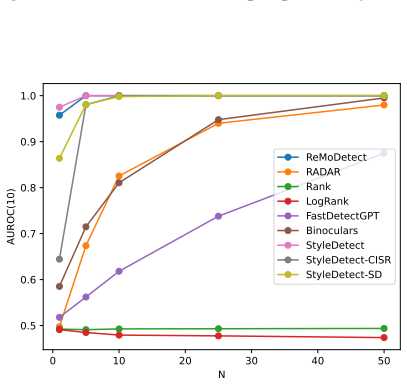
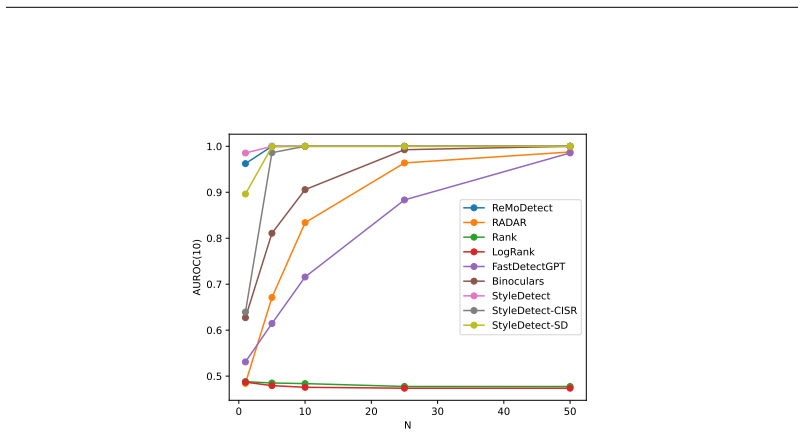
Optimizing a generator against surface-level detectors does not erase the underlying style; StyleDetect, which compares a sample's authorship embedding to machine-class exemplars, keeps AUROC near 0.95-0.98 for models tuned with DPO against FastDetectGPT, and even against StyleDetect itself. The paper's new attack, a Mistral-7B paraphraser fine-tuned first to map machine paraphrases back to a target author's originals and then optimized with DPO against a detector trained on its own outputs, closes the gap in stylistic feature space. At one sample, no detector among nine, including style-based variants using LUAR, CISR, and StyleDistance, exceeds chance performance; but with 5-50 samples, the best detector's AUROC(10) climbs, showing the distributions remain statistically distinct. The central claim is that single-document detection is unreliable, while multi-document detection restores a usable signal.
Load-bearing premise
The argument that style-based detectors are robust and that the new attack is universally effective assumes that the three style embeddings tested (LUAR, CISR, StyleDistance) stand in for all useful stylistic feature spaces, and that DPO is representative of the strongest optimization an adversary can use.
Editorial extensions
If this is right
- Single-document machine-text detection is not reliable; even detectors built on writing style can be evaded by a paraphrase that imitates a specific human author.
- Multi-document analysis restores detectability: for the strongest attack, the best AUROC(10) rises from near chance at N=1 to well above 0.8 as N reaches 10-50, supporting source-level rather than document-level decisions.
- Style-based detectors are robust against DPO-style optimization of the generator, but this robustness is not inherent: it disappears when the attacker also conditions on a target author's style.
- The attack transfers to unseen domains (Amazon, Blogs) without retraining, meaning domain diversity alone is not a defense.
- Token-level and style-level detectors are complementary: the former are easy to attack, the latter survive simple attacks but fall to style-aware imitation.
Reading between the lines
- An immediate defensive reading: if imitation succeeds from a handful of exemplars, verification systems should treat authorship claims as needing external grounding, not just stylistic similarity.
- The universality claim is bounded by the tested attack class; an attack that directly optimizes against the style embeddings, rather than through a general paraphraser, could behave differently, so the 'universal' should be read as 'across the detectors and optimizers tested here'.
- The multi-sample trend points to a concrete evaluation standard: report AUROC as a function of sample size, since a detector can look useless at N=1 yet be strong at N=50.
- If style imitation keeps improving as LLMs absorb more varied writing, the long-tail assumption, that low-resource author styles are hard to imitate, may erode over time.
Editorial analysis
A structured set of objections, weighed in public.
Referee Report
Summary. The paper studies the robustness of machine-text detectors to adversarial attacks, with a focus on stylistic features. It first shows that DPO-style optimization against zero-shot detectors such as FastDetectGPT does not degrade the performance of style-based detectors, and then introduces a style-aware paraphraser trained with supervised fine-tuning and DPO to mimic a target human author's style while evading detection. The method is evaluated on Reddit, Amazon, and Blogs against nine detectors, and the results indicate that at the single-document level the attack evades all detectors, but that detection performance improves with sample size in some settings. The paper concludes that reliable detection should move from single-document to multi-document analysis.
Significance. If the results are reproducible, the paper makes a valuable empirical contribution by introducing a strong new attack that closes the stylistic gap between machine and human text more effectively than prior paraphrasing baselines, and by demonstrating that style-based detectors are not inherently immune to optimization. The evaluation is broad in scope, covering three domains, nine detectors, multiple baselines, and ablations over key hyperparameters M, P, and the DPO stage. The main weaknesses are that the key multi-document recovery claim is not consistently supported across domains and is based on point estimates without uncertainty quantification, and the universality of the single-sample attack is not fully demonstrated at the per-detector level in all domains.
major comments (3)
- [Abstract and §5.1] The abstract states that 'as the number of samples available for detection grows, the human and machine distributions become distinguishable,' and the conclusion repeats that 'there is a point at which the distributions ... become separable, but it requires a large sample.' However, §5.1 reports that the proposed attack 'remains robust up to 50' on Reddit, and 'transfers well to Amazon,' with recovery observed only in the Blogs domain, where it 'becomes detectable with just 5 samples.' Thus the recovery claim is supported by only one of three domains, and the Blogs recovery occurs at a small sample size, contradicting the 'large sample' phrasing. The abstract and conclusion should be qualified by domain, or additional evidence of recovery in other domains should be provided.
- [§5.1, Figure 2] The AUROC(10) curves are reported as point estimates without confidence intervals or significance tests, and the figure plots the maximum AUROC(10) across nine detectors selected on the same test set. Consequently, the observed Blog recovery at N=5 and the flat Reddit/Amazon curves cannot be distinguished from noise, and the selection over detectors may inflate the apparent detectability. The paper should provide error bars or statistical comparisons across repeated test samples, and ideally a held-out procedure for selecting the detector whose curve is reported.
- [§5.1, Appendix Figures 7–14] The claim that the attack is 'universally effective across all detectors considered' is based on the maximum AUROC(10) curve, but the per-detector breakdown in the appendix is not clearly labeled by dataset. If Figures 7–14 are only for Reddit, the cross-domain universality of the attack against each individual detector is not demonstrated. Please clarify the dataset for each appendix figure, or provide per-detector results for Amazon and Blogs.
minor comments (5)
- [Table 1 caption] The word 'variatns' appears to be a typo for 'variants.'
- [§5.1] The sentence 'even in domains for which it was not trained (Amazon and Reddit)' is incorrect because Reddit is the training domain; it should say 'Amazon and Blogs.'
- [Appendix A] The captions for Figures 7–14 do not specify the dataset(s) shown; please add the dataset name to each caption.
- [§4.3] The inference procedure is described only briefly; please state the number of iterations and the candidate count used in the main evaluation for reproducibility.
- [Title] The title in the paper header ('Language Models Optimized to Fool Detectors Still Have a Distinct Style (and How to Change It)') differs from the arXiv title ('Attacks on Machine-Text Detectors Retain Stylistic Fingerprints'); please ensure consistency.
Circularity Check
No derivation-level circularity; the only notable issue is that Section 2's style-robustness claim is established with the authors' own StyleDetect detector.
-
self citation load bearing
[Section 2, paragraph after Table 1]
"When optimizing against StyleDetect, we observe no significant degradation in the performance of StyleDetect. These results suggest that the features indicative of writing style are distinct from those used by detectors that use features derived from the predicted conditional distributions."
The paper's Section 2 conclusion that 'the features indicative of writing style are distinct' and that style-based detectors are robust to DPO is based entirely on StyleDetect, a detector proposed by the same authors (Soto et al. 2024) and built on LUAR (Rivera-Soto et al. 2021), also from the same group. The 'stylistic feature space' is instantiated by the authors' own representation, so this result is an evaluation of a self-defined detector rather than an independent test of the general claim. The later StyleDetect-CISR and StyleDetect-SD results (Figure 2) are tested only against the new paraphrasing attack, not against DPO, so the Section 2 generalization to the stylistic feature space rests on the authors' own detector.
full rationale
This is an empirical paper rather than a derivation: no equation reduces to a fitted parameter, and no 'prediction' is equivalent to its input by construction. The DPO stage trains a detector on the system's own outputs, but that is a legitimate attack-training procedure, not a disguised prediction. The only circularity-adjacent issue is the Section 2 generalization from StyleDetect (the authors' own detector) to 'style-based detectors' more broadly; because the paper does not test DPO robustness against the independent CISR or StyleDistance style representations in that section, the general robustness claim leans on a self-citation chain. Separate from circularity, the abstract's unqualified claim that multi-document analysis makes human and machine distributions 'distinguishable again' is not fully supported by the paper's own Figure 2 results (Reddit and Amazon remain undetectable up to N=50, with recovery only in Blogs at N=5); this is a correctness/generalization concern, not a circularity.
Assumptions & free parameters
free parameters (6)
- M (target exemplars) =
16
- P (paraphrases per exemplar) =
5
- DPO beta =
5
- LoRA rank/alpha/dropout =
r=32, alpha=64, d=0.1
- Number of StyleDetect machine exemplars K =
100
- Iterative inference candidate count =
10
assumptions (4)
- domain assumption The style embeddings (LUAR, CISR, StyleDistance) capture author-specific writing style and are a valid feature space for detection.
- domain assumption DPO reliably optimizes LLMs toward the detector's humanness score.
- domain assumption The detectors evaluated (RADAR, ReMoDetect, Rank, LogRank, FastDetectGPT, Binoculars, StyleDetect variants) are representative of machine-text detectors.
- domain assumption The sample mean of detector scores is the appropriate aggregation for multi-document detection.
Cite this review
Pith. "Pith review of Attacks on Machine-Text Detectors Retain Stylistic Fingerprints." pith.science (2026). https://pith.science/paper/R2UWJLIK
@misc{pith2026250514608,
  author       = {Pith},
  title        = {Pith review of: Attacks on Machine-Text Detectors Retain Stylistic Fingerprints},
  year         = {2026},
  howpublished = {\url{https://pith.science/paper/R2UWJLIK}},
  note         = {Machine review of arXiv:2505.14608}
}
read the original abstract
Despite considerable progress in the development of machine-text detectors, the ease with which machine-text can be manipulated to evade detection has led to suggestions that the problem is inherently intractable. In this work, we investigate the limits of such evasion strategies. We demonstrate that while current attacks, ranging from prompt engineering to detector-guided optimization can effectively degrade performance of standard detectors, they fail to erase the underlying stylistic "fingerprints" of machine text. We show that few-shot detectors that utilize the stylistic feature space are robust to these evasion attempts, reliably detecting samples even from models explicitly tuned to prevent detection. This raises the question: does style represent a universal defense against machine-detection attacks? We demonstrate that the answer is "no'' by introducing a novel paraphrasing approach that simultaneously optimizes for undetectability and adherence to specific human styles. We show that unlike prior methods, this attack effectively evades all considered detectors, including those that utilize writing style. However, we find that this evasion is not absolute: as the number of documents available for analysis grows, the human and machine distributions become distinguishable again. Overall, our findings suggest that reliable machine-text detection requires moving beyond single-document analysis to multi-document analysis.
Figures


Figures from the paper (10 more)




Reference graph
Works this paper leans on
-
[3]
Aldan Creo and Shushanta Pudasaini
On the possibilities of ai-generated text detection.Preprint, arXiv:2304.04736. Aldan Creo and Shushanta Pudasaini
-
[5]
Spotting llms with binoculars: Zero-shot detection of machine-generated text.Preprint, arXiv:2401.12070. Julian Hazell
-
[6]
Zachary Horvitz, Ajay Patel, Chris Callison-Burch, Zhou Yu, and Kathleen McKeown
Spear phishing with large language models.Preprint, arXiv:2305.06972. Zachary Horvitz, Ajay Patel, Chris Callison-Burch, Zhou Yu, and Kathleen McKeown. 2024a. Paraguide: Guided diffusion paraphrasers for plug-and-play textual style transfer.Proceedings of the AAAI Conference on Artificial Intelligence, 38(16):18216–18224. Zachary Horvitz, Ajay Patel, Kani...
-
[8]
Daphne Ippolito, Daniel Duckworth, Chris Callison-Burch, and Douglas Eck
Radar: Robust ai-text detection via adversarial learning.Preprint, arXiv:2307.03838. Daphne Ippolito, Daniel Duckworth, Chris Callison-Burch, and Douglas Eck
-
[9]
A Deep Metric Learning Approach to Account Linking
A deep metric learning approach to account linking.CoRR, abs/2105.07263. Aleem Khan, Andrew Wang, Sophia Hager, and Nicholas Andrews
-
[10]
John Kirchenbauer, Jonas Geiping, Yuxin Wen, Jonathan Katz, Ian Miers, and Tom Goldstein
Learning to generate text in arbitrary writing styles.Preprint, arXiv:2312.17242. John Kirchenbauer, Jonas Geiping, Yuxin Wen, Jonathan Katz, Ian Miers, and Tom Goldstein
-
[11]
Ryuto Koike, Masahiro Kaneko, and Naoaki Okazaki
A watermark for large language models.Preprint, arXiv:2301.10226. Ryuto Koike, Masahiro Kaneko, and Naoaki Okazaki
-
[12]
Kalpesh Krishna, John Wieting, and Mohit Iyyer
Para- phrasing evades detectors of ai-generated text, but retrieval is an effective defense.Preprint, arXiv:2303.13408. Kalpesh Krishna, John Wieting, and Mohit Iyyer
Show all 36 references
-
[14]
Hyunseok Lee, Jihoon Tack, and Jinwoo Shin
Robust distortion- free watermarks for language models.Preprint, arXiv:2307.15593. Hyunseok Lee, Jihoon Tack, and Jinwoo Shin
-
[15]
Shuai Liu and Jonathan May
Authorship style transfer with policy optimization.Preprint, arXiv:2403.08043. Shuai Liu and Jonathan May
-
[16]
Preprint, arXiv:2406.11581
Style transfer with multi-iteration preference optimization. Preprint, arXiv:2406.11581. Ning Lu, Shengcai Liu, Rui He, Qi Wang, Yew-Soon Ong, and Ke Tang
-
[17]
Leland McInnes, John Healy, and James Melville
Large language models can be guided to evade ai-generated text detection.Preprint, arXiv:2305.10847. Leland McInnes, John Healy, and James Melville
-
[18]
Eric Mitchell, Yoonho Lee, Alexander Khazatsky, Christopher D
Umap: Uniform manifold approximation and projection for dimension reduction.Preprint, arXiv:1802.03426. Eric Mitchell, Yoonho Lee, Alexander Khazatsky, Christopher D. Manning, and Chelsea Finn
-
[19]
Jianmo Ni, Jiacheng Li, and Julian McAuley
Detectgpt: Zero-shot machine-generated text detection using probability curvature.Preprint, arXiv:2301.11305. Jianmo Ni, Jiacheng Li, and Julian McAuley
-
[21]
11 Ajay Patel, Jiacheng Zhu, Justin Qiu, Zachary Horvitz, Marianna Apidianaki, Kathleen McKeown, and Chris Callison-Burch
Low-resource authorship style transfer: Can non-famous authors be imitated?Preprint, arXiv:2212.08986. 11 Ajay Patel, Jiacheng Zhu, Justin Qiu, Zachary Horvitz, Marianna Apidianaki, Kathleen McKeown, and Chris Callison-Burch
-
[22]
Rafael Rafailov, Archit Sharma, Eric Mitchell, Stefano Ermon, Christopher D
Styledistance: Stronger content-independent style embeddings with synthetic parallel examples.Preprint, arXiv:2410.12757. Rafael Rafailov, Archit Sharma, Eric Mitchell, Stefano Ermon, Christopher D. Manning, and Chelsea Finn
-
[23]
Preprint, arXiv:2305.18290
Direct preference optimization: Your language model is secretly a reward model. Preprint, arXiv:2305.18290. Rafael A. Rivera-Soto, Olivia Elizabeth Miano, Juanita Ordonez, Barry Y . Chen, Aleem Khan, Marcus Bishop, and Nicholas Andrews
-
[24]
InProceedings of the 2021 Conference on Empirical Methods in Natural Language Processing, pages 913–919, Online and Punta Cana, Dominican Republic
Learning universal authorship representations. InProceedings of the 2021 Conference on Empirical Methods in Natural Language Processing, pages 913–919, Online and Punta Cana, Dominican Republic. Association for Computational Linguistics. Vinu Sankar Sadasivan, Aounon Kumar, Sr...
2021
-
[25]
Jonathan Schler, Moshe Koppel, Shlomo Argamon, and James W
Can ai-generated text be reliably detected?Preprint, arXiv:2303.11156. Jonathan Schler, Moshe Koppel, Shlomo Argamon, and James W. Pennebaker
-
[27]
Rafael Rivera Soto, Barry Chen, and Nicholas Andrews
Release strategies and the social impacts of language models.Preprint, arXiv:1908.09203. Rafael Rivera Soto, Barry Chen, and Nicholas Andrews
1908 arXiv
-
[28]
Rafael Rivera Soto, Kailin Koch, Aleem Khan, Barry Chen, Marcus Bishop, and Nicholas An- drews
Mitigating paraphrase attacks on machine-text detectors via paraphrase inversion.Preprint, arXiv:2410.21637. Rafael Rivera Soto, Kailin Koch, Aleem Khan, Barry Chen, Marcus Bishop, and Nicholas An- drews
-
[29]
Tianchun Wang, Yuanzhou Chen, Zichuan Liu, Zhanwen Chen, Haifeng Chen, Xiang Zhang, and Wei Cheng
Few-shot detection of machine-generated text using style representations.Preprint, arXiv:2401.06712. Tianchun Wang, Yuanzhou Chen, Zichuan Liu, Zhanwen Chen, Haifeng Chen, Xiang Zhang, and Wei Cheng
-
[30]
Anna Wegmann, Marijn Schraagen, and Dong Nguyen
Humanizing the machine: Proxy attacks to mislead llm detectors.Preprint, arXiv:2410.19230. Anna Wegmann, Marijn Schraagen, and Dong Nguyen
-
[32]
Finetuned language models are zero-shot learners.Preprint, arXiv:2109.01652. Laura Weidinger, Jonathan Uesato, Maribeth Rauh, Conor Griffin, Po-Sen Huang, John Mellor, Amelia Glaese, Myra Cheng, Borja Balle, Atoosa Kasirzadeh, Courtney Biles, Sasha Brown, Zac Kenton, Will Hawk...
-
[33]
InProceedings of the 2022 ACM Conference on Fairness, Accountability, and Transparency, FAccT ’22, page 214–229, New York, NY , USA
Taxonomy of risks posed by language models. InProceedings of the 2022 ACM Conference on Fairness, Accountability, and Transparency, FAccT ’22, page 214–229, New York, NY , USA. Association for Computing Machinery. Xianjun Yang, Wei Cheng, Yue Wu, Linda Petzold, William Yang Wa...
2022
-
[34]
12 A BREAKDOWN OFPERFORMANCE BYMETHOD, DATASET,ANDDETECTOR In this section, we break down the performance of all methods, evaluated on all datasets and detectors
Dna-gpt: Divergent n-gram analysis for training-free detection of gpt-generated text.Preprint, arXiv:2305.17359. 12 A BREAKDOWN OFPERFORMANCE BYMETHOD, DATASET,ANDDETECTOR In this section, we break down the performance of all methods, evaluated on all datasets and detectors. 0...
-
[35]
For the preference- tuning stage, we train our system with β= 5 , and a constant learning rate of 1e−6
for efficient fine-tuning, setting r= 32 , α= 64 , and d= 0.1 . For the preference- tuning stage, we train our system with β= 5 , and a constant learning rate of 1e−6. For Mistral-7B-DPO-FastDetectGPT, we setβ= 0.1. Compute ResourcesOur system is trained using 8 80Gb A100s for...
2021
-
[2006]
InComputational Approaches to Analyzing Weblogs, Papers from the 2006 AAAI Spring Symposium, Technical Report SS-06-03, Stanford, California, USA, March 27-29, 2006, pages 199–205
Effects of age and gender on blogging. InComputational Approaches to Analyzing Weblogs, Papers from the 2006 AAAI Spring Symposium, Technical Report SS-06-03, Stanford, California, USA, March 27-29, 2006, pages 199–205. AAAI. Irene Solaiman, Miles Brundage, Jack Clark, Amanda ...
2006
-
[2007]
To generate the paraphrases required to train our system, we prompt Mistral-7B to 5 paraphrases for each comment in the collection just described
to cluster the authors, sampling evenly across clusters until reaching 63,184 authors which was computationally tractable given our resources. To generate the paraphrases required to train our system, we prompt Mistral-7B to 5 paraphrases for each comment in the collection jus...
2019
-
[2019]
Justifying recommendations using distantly- labeled reviews and fine-grained aspects. InProceedings of the 2019 Conference on Empirical Methods in Natural Language Processing and the 9th International Joint Conference on Natural Language Processing (EMNLP-IJCNLP), pages 188–19...
2019
-
[2020]
Rohith Kuditipudi, John Thickstun, Tatsunori Hashimoto, and Percy Liang
Reformulating unsupervised style transfer as paraphrase generation.Preprint, arXiv:2010.05700. Rohith Kuditipudi, John Thickstun, Tatsunori Hashimoto, and Percy Liang
2010 arXiv
-
[2021]
10 Xiaomeng Hu, Pin-Yu Chen, and Tsung-Yi Ho
Lora: Low-rank adaptation of large language models.Preprint, arXiv:2106.09685. 10 Xiaomeng Hu, Pin-Yu Chen, and Tsung-Yi Ho
-
[2022]
Jason Wei, Maarten Bosma, Vincent Y
Same author or just same topic? towards content-independent style representations.Preprint, arXiv:2204.04907. Jason Wei, Maarten Bosma, Vincent Y . Zhao, Kelvin Guu, Adams Wei Yu, Brian Lester, Nan Du, Andrew M. Dai, and Quoc V . Le
-
[2023]
Souradip Chakraborty, Amrit Singh Bedi, Sicheng Zhu, Bang An, Dinesh Manocha, and Furong Huang
Evade chatgpt detectors via a single space.Preprint, arXiv:2307.02599. Souradip Chakraborty, Amrit Singh Bedi, Sicheng Zhu, Bang An, Dinesh Manocha, and Furong Huang
-
[2024]
Preprint, arXiv:2310.05130
Fast-detectgpt: Efficient zero-shot detection of machine-generated text via conditional probability curvature. Preprint, arXiv:2310.05130. Shuyang Cai and Wanyun Cui
-
[2025]
Brendan J
Silverspeak: Evading ai-generated text detectors using homoglyphs.Preprint, arXiv:2406.11239. Brendan J. Frey and Delbert Dueck
Reviewed August 7, 2026 · model on record in the stance chip above.
Discussion (0). Sign in to comment.