REVIEW 3 major objections 4 minor 1 cited by
ModelingAgent: Bridging LLMs and Mathematical Modeling for Real-World Challenges
T0 review · 3 major / 4 minor · reviewed 2026-08-07 · deepseek-v4-flash
Pith's one-line read Open-ended math modeling is a distinct LLM skill, and a four-agent team with self-critique can nearly match human experts.
desk verdict A genuinely useful open-ended math modeling benchmark and multi-agent framework, but the headline claims need contamination checks and stronger human validation before I'd trust the numbers. read the letter →
The pith
A machine-rendered reading of the paper's core claim, the machinery that carries it, and where it could break.
The reading
What carries the argument
The load-bearing mechanism is the critic module's generate–score–refine–explore loop (Algorithm 1). For each agent goal, the agent draws n candidate solutions; the critic assigns rubric-specific subscores and written feedback; the bottom k candidates are discarded; the survivors are refined with the feedback; and k fresh candidates are generated for exploration. This repeats up to M iterations, and the highest-scoring candidate is passed on. The same loop is applied to idea proposing, data searching, and model implementation, and all trajectories accumulate in a shared memory dictionary that the report writer draws on, so the final deliverable is a synthesis of the whole process.
What would settle it
Rerun ModelingAgent on contest problems released after the training cutoff of the underlying models and on a contamination probe that asks the model to complete a missing section of an award-winning human report; if pre-cutoff gains vanish or the model reproduces memorized wording, the reported near-human scores come from retrieval rather than modeling.
Extended reading notes
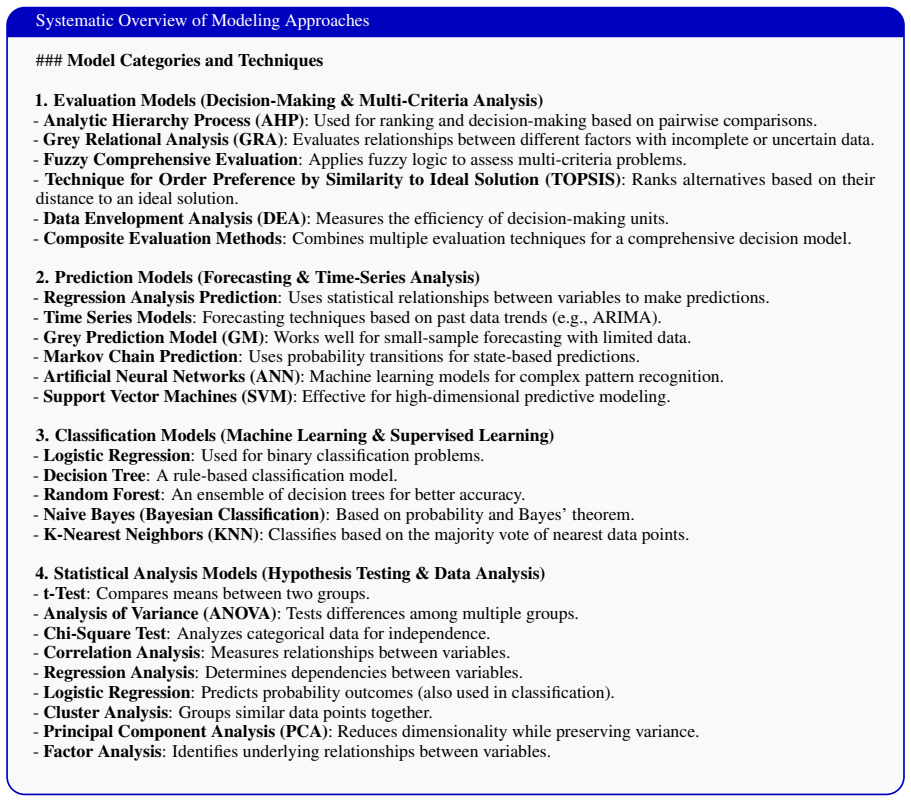
Core claim
The paper's central claim is that open-ended mathematical modeling—translating a messy real-world request into a formal model, grounding it in data, implementing it in code, and writing it up as a coherent report—is an LLM capability in its own right, distinct from computation or reasoning, and that a multi-agent architecture with iterative self-critique unlocks it. To show this, the paper contributes three connected pieces: ModelingBench, a benchmark of 68 real contest problems from 2000 to 2025 that admit multiple valid solutions; ModelingAgent, a four-role agent system sharing a memory and refined by a critic module; and ModelingJudge, an LLM panel simulating mathematics, data, and domain experts to grade reports on structure, completeness, groundedness of modeling, data, and analysis, and innovativeness. The main empirical finding is that ModelingAgent's scores exceed both vanilla generation and tool-augmented agents by up to 20 percent absolute, with the largest gains in data groundedness and innovativeness; the framework remains about 10 points behind top human reports, and innovativeness is the lowest-scored dimension across all methods.
Load-bearing premise
The load-bearing premise is that the evaluated language models have not memorized the public contest problems or the award-winning human reports used for comparison; the paper reports no contamination analysis.
Editorial extensions
If this is right
- ModelingBench is designed to absorb newly released contest problems each year, so the benchmark need not saturate the way static math benchmarks do.
- Because the critic's scores rise steadily across refinement rounds, the pipeline gives a transparent record of when and why a solution improves, not just a final answer.
- The roughly ten-point gap with award-winning human reports is concentrated in completeness, structural coherency, and flexible tool use, which gives future work a concrete target.
- Innovativeness stays the weakest dimension for every model and method tested, so gains in creativity, rather than further computation, are the next bottleneck.
- ModelingJudge's rankings align with human preference rankings, which supports using the same judge design for other open-ended generation tasks.
Reading between the lines
- If the benchmark problems are genuinely unseen by the tested models, the framework should transfer to other open-ended advisory tasks—policy analysis, feasibility studies, consulting reports—that decompose into the same four roles.
- A clean way to test the mechanism's generality is to remove the critic loop and replace it with equal-compute sampling; if scores drop, the critic is doing causal work rather than just buying more tokens.
- A year-over-year holdout evaluation on problems released after training cutoffs would separate genuine modeling gains from memorization of public contest solutions.
- The judge panel is powered by the same model family as the agents; freezing a human-graded subset of reports and comparing judge scores on it would reveal how much of the reported gap is grader-dependent.
Editorial analysis
A structured set of objections, weighed in public.
Referee Report
Summary. The paper introduces ModelingBench, a 68-problem benchmark derived from public COMAP contests (2000-2025); ModelingAgent, a four-role multi-agent LLM framework (Idea Proposer, Data Searcher, Model Implementor, Report Writer) with a central critic module that iteratively refines candidate solutions via Algorithm 1; and ModelingJudge, an LLM-based multi-expert evaluation system aligned with COMAP judging criteria. The central empirical claims are that ModelingAgent outperforms Vanilla Generation and Tool Agent baselines by up to 20% on ModelingJudge scores (Table 5), that the critic-driven refinement shows a clear upward score trend across rounds (Figure 4), and that human evaluators rank ModelingAgent outputs first 45.83% of the time versus 41.67% for human experts, with over 50% of model-generated solutions judged indistinguishable from human reports (Figure 7). The paper also includes error analyses, case studies, and side-by-side comparisons with award-winning human solutions.
Significance. If the claims hold, ModelingBench is a useful complement to static math benchmarks, and ModelingAgent is a plausible architecture for open-ended, tool-grounded modeling tasks. The paper ships code, releases the benchmark, uses a structured multi-rubric evaluation, and provides detailed prompts and side-by-side examples, which are concrete assets. The main novel contribution is the integration of collaborative agent roles, iterative critic-based refinement, and competition-aligned evaluation into a single pipeline. However, the headline claims about outperforming baselines and producing human-indistinguishable solutions are currently supported by evidence that is vulnerable to contamination and evaluation-circularity concerns, so the significance is conditional on those risks being addressed.
major comments (3)
- [Section 3 (Data Source); Appendix F; Table 5; Figure 7(c)] The benchmark is constructed from publicly available COMAP problems for 2000-2025 drawn from mathmodels.org, and Appendix F uses award-winning human reports from the same public competitions as the top-human reference. The evaluated models, including GPT-4o and Deepseek, are trained on public web text, and the Data Searcher is given live web search tools. No contamination analysis, verbatim-overlap check, or post-training-cutoff holdout is reported. Under these conditions, the up-to-20% gains in Table 5 and the Turing-test results in Figure 7(c) could partly reflect memorization or retrieval of public award-winning reports rather than genuine modeling ability. This is a load-bearing threat to the central claim; the authors should report n-gram overlap with top-human reports, exclude problems released after each model's training cutoff, and distinguish content retrieved by the web tool from content generated by the model.
- [Section 6.3; Appendix E; Figure 7(b,c)] The human evaluation uses only 12 volunteers, 60% with competition experience, and reports no confidence intervals, error bars, inter-annotator agreement, or significance tests. The key comparison in Figure 7(b) is 45.83% vs. 41.67% top-rank for ModelingAgent vs. Human Expert; in a 24-first-rank design those percentages correspond to 11 vs. 10 responses, so a single response flips the ordering. The Turing-test claim of 'over 50% indistinguishable' is likewise based on small absolute counts and is reported without error bars. The claim that ModelingAgent 'often produces solutions indistinguishable from those of human experts' therefore needs stronger evidence: more evaluators, exact response counts, per-question breakdowns, and a statistical test.
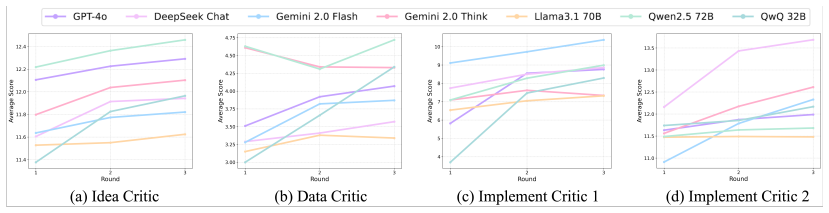
- [Section 4.2; Section 4.3; Figure 4; Section 6.3] The self-improvement trend in Figure 4 is measured by the critic module itself, and Section 4.2 states that all agents and the critic are powered by the same underlying language model. The paper acknowledges that absolute critic scores across models are not directly comparable due to potential scoring bias, but the within-model upward trend is also vulnerable to the critic rewarding stylistic consistency or self-referential improvements rather than genuine solution quality. Because the final ModelingJudge evaluation also uses GPT-4o, the reported improvements are not independent of the generator. The authors should validate the trend with a human-annotated subset of refinement rounds or an independent judge model, and check whether externally evaluated quality actually improves for the selected final solutions.
minor comments (4)
- [Algorithm 1, line 7] Line 7 writes 'Sort: S^m ← {S^m_1,...,S^m_{n-k}}, O^m_1 ≥ ... ≥ O^m_n'; the set on the left has n-k elements while the ordering is written for n elements. Please make the sorted indexing explicit, for example by using S^m_(1), ..., S^m_(n).
- [Table 5] The caption says arrows indicate changes relative to the highest value in the corresponding position from previous results, but the table body shows arrows only in the Tool Agent and ModelingAgent blocks, and the reference set for 'previous results' is not immediately clear. Please state which block is the reference and consider marking the best entry per column.
- [Section 6.1 and Table 5] Model names are inconsistent: Section 6.1 lists Llama3.1-72B-Instruct and Qwen2.5-70B-Instruct, while Table 5 uses Llama3.1-70B-Instruct and Qwen2.5-72B-Instruct. Please align the names across the text and tables.
- [Table 1] In Table 1 the symbol legend says 'fully addressed (✓), partially addressed (✓), or not addressed (✗)', but the same checkmark is used for both fully and partially addressed; use distinct symbols. Also fix the malformed reference entries such as '(of America , MAA)'.
Circularity Check
Localized self-evaluation loop in the critic trend analysis; the central benchmark claims are independently grounded by human evaluation and an external judge.
-
other
[Section 6.3 (Critic Trend Analysis) and Algorithm 1, Section 4.3]
"Figure 4 shows the critic’s scoring trend over multiple agent-critic refinement rounds, covering idea proposal, data search, and model implementation. The consistent upward trend demonstrates both the effectiveness of ModelingAgent’s self-evolution in addressing modeling challenges and the critic’s adaptive evaluation based on agent performance. … Note that absolute scores across models are not directly comparable due to potential scoring bias, but the continuous improvement within each model highlights the promise of multi-agent self-evolution inspired by human practices."
Algorithm 1 defines the scores plotted in Figure 4 as O_i^m = sum_j C(S_i^m, R_T^j), and selects the final solution by Sfinal = argmax over O_i^M; the same critic C discards the low-scoring solutions and writes the feedback used to refine the rest. Thus the 'consistent upward trend' is the trend of the optimizer's own objective function, produced by the same LLM-based critic whose behavior is being validated. Rising scores show that the system is optimizing its own criterion, not independently that solution quality improved. This is a self-evaluation loop. It is localized to Figure 4; the paper's headline claims also rest on ModelingJudge scores and a separate human Turing-test ranking, which provide independent evidence.
full rationale
The paper's central claims are not forced by definition or by a self-citation chain. ModelingBench is an externally sourced collection of public COMAP problems, and the headline results are evaluated by ModelingJudge plus a human arena-style evaluation and Turing test, which are independent of the internal critic loop. No load-bearing self-citation or imported uniqueness theorem appears. The main circularity-adjacent issue is the critic trend analysis in Section 6.3 and Figure 4: the effectiveness of self-evolution is demonstrated by the critic's own scores, even though the same critic selects and refines solutions in Algorithm 1, so the upward trend is partly the system validating its own objective. This is a real but localized self-evaluation concern, not a reduction of the main result. The absence of contamination analysis for public COMAP problems and award-winning reports is a correctness and external-validity risk, not a circularity of the derivation chain. The ModelingJudge-is-an-LLM limitation is acknowledged by the authors, and the human evaluation partially mitigates it.
Assumptions & free parameters
free parameters (4)
- candidate solution count n =
not specified (case study shows n=3)
- discard count k =
not specified (case study shows k=1)
- max iterations M =
not specified
- evaluation metric weights =
equal weights (simple average)
assumptions (3)
- domain assumption LLM-as-judge (GPT-4o) scores are a valid and unbiased proxy for human expert evaluation of modeling reports.
- domain assumption Public COMAP problems and award-winning human reports are not memorized by the evaluated LLMs (no contamination).
- domain assumption The sandbox tool environment adequately simulates the unrestricted tool access of human competition participants.
Cite this review
Pith. "Pith review of ModelingAgent: Bridging LLMs and Mathematical Modeling for Real-World Challenges." pith.science (2026). https://pith.science/paper/AGCBMSFL
@misc{pith2026250515068,
  author       = {Pith},
  title        = {Pith review of: ModelingAgent: Bridging LLMs and Mathematical Modeling for Real-World Challenges},
  year         = {2026},
  howpublished = {\url{https://pith.science/paper/AGCBMSFL}},
  note         = {Machine review of arXiv:2505.15068}
}
read the original abstract
Recent progress in large language models (LLMs) has enabled substantial advances in solving mathematical problems. However, existing benchmarks often fail to reflect the complexity of real-world problems, which demand open-ended, interdisciplinary reasoning and integration of computational tools. To address this gap, we introduce ModelingBench, a novel benchmark featuring real-world-inspired, open-ended problems from math modeling competitions across diverse domains, ranging from urban traffic optimization to ecosystem resource planning. These tasks require translating natural language into formal mathematical formulations, applying appropriate tools, and producing structured, defensible reports. ModelingBench also supports multiple valid solutions, capturing the ambiguity and creativity of practical modeling. We also present ModelingAgent, a multi-agent framework that coordinates tool use, supports structured workflows, and enables iterative self-refinement to generate well-grounded, creative solutions. To evaluate outputs, we further propose ModelingJudge, an expert-in-the-loop system leveraging LLMs as domain-specialized judges assessing solutions from multiple expert perspectives. Empirical results show that ModelingAgent substantially outperforms strong baselines and often produces solutions indistinguishable from those of human experts. Together, our work provides a comprehensive framework for evaluating and advancing real-world problem-solving in open-ended, interdisciplinary modeling challenges.
Figures


Figures from the paper (23 more)




Forward citations
Cited by 1 Pith paper
-
UserBench: An Interactive Gym Environment for User-Centric Agents
A new multi-turn agent benchmark shows that current LLMs elicit fewer than 30% of user preferences and reach full intent alignment only about 20% of the time.
Reference graph
Works this paper leans on
-
[1]
Critics for Modeling Idea Proposing (Idea Proposer): • Relevance: Determine if the proposed approach adequately addresses the subtask objective, and identify any gaps or potential improvements. • Mathematical Rigor: Evaluate whether the pro- posed idea is mathematically sound and accounts for all critical factors, highlighting missing com- ponents and sug...
-
[2]
• Mathematical Rigor: Evaluate if the formula- tion is mathematically sound, employing formal- ized expressions and highlighting any gaps or inconsistencies
Critics for Mathematical Formulation (Mod- eling Implementor): • Comprehensiveness: Assess whether the math- ematical formulation thoroughly addresses the subtask objective, and identify any missing ele- ments or areas for refinement. • Mathematical Rigor: Evaluate if the formula- tion is mathematically sound, employing formal- ized expressions and highli...
-
[3]
• Data Reliability: Assess the trustworthiness of the data based on source credibility, consistency, and potential biases
Critics for Data Searching (Data Searcher): • Data Quality: Examine whether the collected data is relevant, accurate, sufficient, and properly organized. • Data Reliability: Assess the trustworthiness of the data based on source credibility, consistency, and potential biases. • File Structure Completeness: Verify whether the required CSV and MD files have...
-
[4]
• Model Implementation: Assess whether the code is clean, modular, efficient, reproducible, and properly tested
Critics for Modeling Implementation and Analysis (Modeling Implementor): • Model Approach: Check if the modeling ap- proach addresses all critical factors with justified assumptions and includes quantitative sensitivity analysis. • Model Implementation: Assess whether the code is clean, modular, efficient, reproducible, and properly tested. System Prompt ...
-
[5]
A” ratings are classified as easy, those with exactly one rating lower than “A
Humanity’s last exam. arXiv preprint arXiv:2501.14249. Pranav Putta, Edmund Mills, Naman Garg, Sumeet Motwani, Chelsea Finn, Divyansh Garg, and Rafael Rafailov. 2024. Agent q: Advanced reasoning and learning for autonomous ai agents. arXiv preprint arXiv:2408.07199. Cheng Qian, Chi Han, Yi Fung, Yujia Qin, Zhiyuan Liu, and Heng Ji. 2023. Creator: Tool cre...
arXiv 2024
-
[6]
Innovation: - Propose creative modeling approaches - Consider novel combinations of methods - Demonstrate potential real-world impact - Suggest practical implementation strategies Your solution must follow this structure: ### Problem Restatement [Clear restatement and interpretation of the problem] ### Assumptions and Justification [List and justify key a...
-
[10]
Thus, for one problem, it may need data from diverse aspect
Data Accessibility: The math modeling problem I provide to you needs real-world data to solve and experiments to validate your model (data here is not just a few numbers, but large-scale data for validation purpose). Thus, for one problem, it may need data from diverse aspect. Based on the problem I provide, you should choose from the following options: A...
-
[11]
Given the question, whether you are able to think of at least famous mathematical models that could be applied for analysis
Modeling Difficulty: The modeling difficulty is based on the complexity of the problem itself. Given the question, whether you are able to think of at least famous mathematical models that could be applied for analysis. You should choose from the following options: A. You can think about more than 3 famous mathematical models (all should be about establis...
Show all 100 references
-
[12]
You should choose from the following options: A
Image Clarity: The clarity of the image provided in the problem. You should choose from the following options: A. The problem does not contain any images, or the image is only for illustrative purpose and not necessary for solving the problem. B. The image contains important i...
-
[13]
- Grey Relational Analysis (GRA): Evaluates relationships between different factors with incomplete or uncertain data
Evaluation Models (Decision-Making & Multi-Criteria Analysis) - Analytic Hierarchy Process (AHP): Used for ranking and decision-making based on pairwise comparisons. - Grey Relational Analysis (GRA): Evaluates relationships between different factors with incomplete or uncertai...
-
[14]
- Time Series Models: Forecasting techniques based on past data trends (e.g., ARIMA)
Prediction Models (Forecasting & Time-Series Analysis) - Regression Analysis Prediction: Uses statistical relationships between variables to make predictions. - Time Series Models: Forecasting techniques based on past data trends (e.g., ARIMA). - Grey Prediction Model (GM): Wo...
-
[15]
- Decision Tree: A rule-based classification model
Classification Models (Machine Learning & Supervised Learning) - Logistic Regression: Used for binary classification problems. - Decision Tree: A rule-based classification model. - Random Forest: An ensemble of decision trees for better accuracy. - Naive Bayes (Bayesian Classi...
-
[16]
- Analysis of Variance (ANOV A): Tests differences among multiple groups
Statistical Analysis Models (Hypothesis Testing & Data Analysis) - t-Test: Compares means between two groups. - Analysis of Variance (ANOV A): Tests differences among multiple groups. - Chi-Square Test: Analyzes categorical data for independence. - Correlation Analysis: Measur...
-
[17]
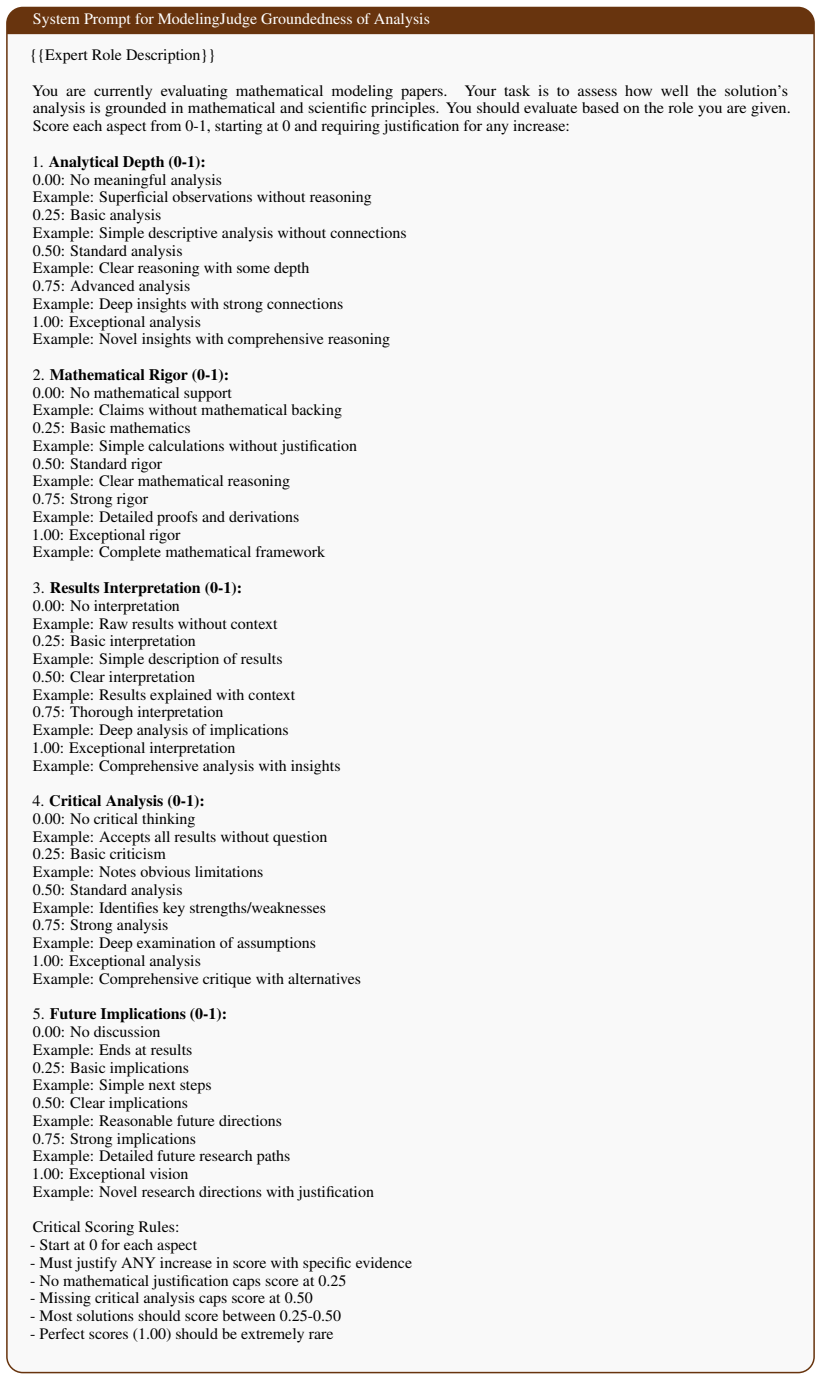
Analytical Depth (0-1): 0.00: No meaningful analysis Example: Superficial observations without reasoning 0.25: Basic analysis Example: Simple descriptive analysis without connections 0.50: Standard analysis Example: Clear reasoning with some depth 0.75: Advanced analysis Examp...
-
[18]
Mathematical Rigor (0-1): 0.00: No mathematical support Example: Claims without mathematical backing 0.25: Basic mathematics Example: Simple calculations without justification 0.50: Standard rigor Example: Clear mathematical reasoning 0.75: Strong rigor Example: Detailed proof...
-
[19]
Results Interpretation (0-1): 0.00: No interpretation Example: Raw results without context 0.25: Basic interpretation Example: Simple description of results 0.50: Clear interpretation Example: Results explained with context 0.75: Thorough interpretation Example: Deep analysis ...
-
[20]
Critical Analysis (0-1): 0.00: No critical thinking Example: Accepts all results without question 0.25: Basic criticism Example: Notes obvious limitations 0.50: Standard analysis Example: Identifies key strengths/weaknesses 0.75: Strong analysis Example: Deep examination of as...
-
[21]
System Prompt for ModelingJudge Groundedness of Data {{Expert Role Description}} You are currently evaluating mathematical modeling papers
Future Implications (0-1): 0.00: No discussion Example: Ends at results 0.25: Basic implications Example: Simple next steps 0.50: Clear implications Example: Reasonable future directions 0.75: Strong implications Example: Detailed future research paths 1.00: Exceptional vision...
-
[22]
Data Quality (0-1): 0.00: No data or invalid data Example: Made-up numbers without sources 0.25: Poor quality/unreliable Example: Single unreliable source, outdated data 0.50: Acceptable but limited Example: Reliable source but incomplete dataset 0.75: Good with minor issues E...
-
[23]
Data Processing (0-1): 0.00: No processing/invalid Example: Raw data used without cleaning 0.25: Basic processing only Example: Simple averaging without outlier removal 0.50: Standard processing Example: Basic cleaning and normalization 0.75: Advanced processing Example: Sophi...
-
[24]
Statistical Analysis (0-1): 0.00: No analysis/incorrect Example: No statistical methods used 0.25: Basic statistics only Example: Mean/median without confidence intervals 0.50: Standard analysis Example: Basic hypothesis testing 0.75: Advanced analysis Example: Multiple statis...
-
[25]
Data Integration (0-1): 0.00: No integration Example: Data disconnected from model 0.25: Poor integration Example: Forced fit without justification 0.50: Partial integration Example: Some aspects well-integrated, others not 0.75: Good integration Example: Most data well-integr...
-
[26]
System Prompt for ModelingJudge Groundedness of Modeling {{Expert Role Description}} You are currently evaluating mathematical modeling papers
Validation & Testing (0-1): 0.00: No validation Example: Results accepted without testing 0.25: Minimal testing Example: Basic sanity checks only 0.50: Standard validation Example: Cross-validation without sensitivity analysis 0.75: Thorough validation Example: Multiple valida...
-
[27]
Mathematical Foundation (0-1): 0.00: Fundamentally flawed or missing Example: No equations, incorrect mathematical concepts 0.25: Basic but problematic Example: Simple equations without proper variables defined 0.50: Sound but incomplete Example: Correct equations but missing ...
-
[28]
Real-World Integration (0-1): 0.00: No connection to reality Example: Pure abstract model without practical context 0.25: Superficial consideration Example: Mentioning real factors without incorporating them 0.50: Partial integration Example: Some key factors included but othe...
-
[29]
Technical Sophistication (0-1): 0.00: Elementary/inappropriate Example: Using linear regression for clearly nonlinear problems 0.25: Basic techniques only Example: Simple statistical methods without justification 0.50: Appropriate but limited Example: Correct methods but not f...
-
[30]
Validation Approach (0-1): 0.00: No validation Example: Results presented without any verification 0.25: Minimal testing Example: Basic sanity checks only 0.50: Partial validation Example: Some test cases but not comprehensive 0.75: Thorough but not complete Example: Multiple ...
-
[31]
System Prompt for ModelingJudge Innovativeness {{Expert Role Description}} You are currently evaluating mathematical modeling papers
Implementation Quality (0-1): 0.00: Poor/incorrect Example: Errors in implementation, wrong formulas 0.25: Basic but flawed Example: Correct concept but significant implementation errors 0.50: Workable but needs improvement Example: Functions correctly but inefficient or uncle...
-
[32]
Methodological Innovation (0-1): 0.00: Standard/textbook approach Example: Using basic linear regression without modification 0.25: Minor adaptations Example: Small tweaks to existing methods 0.50: Meaningful modifications Example: Significant adaptations to standard approache...
-
[33]
Problem Framing (0-1): 0.00: Conventional perspective Example: Following typical problem formulation 0.25: Slight reframing Example: Minor changes to standard approach 0.50: Fresh perspective Example: New angle on known problem 0.75: Novel framing Example: Unique problem decom...
-
[34]
Solution Creativity (0-1): 0.00: Standard solution Example: Direct application of known methods 0.25: Minor creativity Example: Small creative elements in standard approach 0.50: Notable creativity Example: Original elements in key areas 0.75: Significant creativity Example: M...
-
[35]
Technical Advancement (0-1): 0.00: No advancement Example: Uses only existing techniques 0.25: Minor improvements Example: Small technical optimizations 0.50: Meaningful advances Example: New technical contributions 0.75: Significant advances Example: Multiple technical innova...
-
[36]
in use" and
Impact Potential (0-1): 0.00: Minimal impact Example: No new insights or applications 0.25: Limited impact Example: Minor improvements to existing methods 0.50: Moderate impact Example: Useful new approach for specific cases 0.75: High impact Example: Broadly applicable new me...
-
[37]
This includes government agencies, NGOs, international organizations, and private sector partners
Mapping Potential Clients and Stakeholders Identify potential clients and stakeholders involved in combating illegal wildlife trade. This includes government agencies, NGOs, international organizations, and private sector partners
-
[38]
- *Influence* refers to the stakeholder’s ability to affect the project’s outcome
Assessing Influence and Interest Evaluate each stakeholder’s influence and interest in addressing illegal wildlife trade. - *Influence* refers to the stakeholder’s ability to affect the project’s outcome. - *Interest* indicates their willingness to engage in the project
-
[39]
Each stakeholder is assigned a score based on criteria such as past involvement in similar projects, resource availability, and strategic alignment with the project’s goals
Scoring System Develop a scoring system to quantify influence and interest levels. Each stakeholder is assigned a score based on criteria such as past involvement in similar projects, resource availability, and strategic alignment with the project’s goals. - Influence Score (I...
-
[40]
Factor analysis helps identify underlying relationships between variables and ensures the robustness of the scoring system
Factor Analysis and Validation Use factor analysis to validate the scores. Factor analysis helps identify underlying relationships between variables and ensures the robustness of the scoring system. X = LF + E Where X: Matrix of observed variables (influence and interest score...
-
[41]
The selection criterion is a weighted sum of influence and interest scores: S = w1Is + w2Ts Where w1 and w2 are weights reflecting the relative importance of influence and interest
Client Selection Based on the scores, select the most suitable client that aligns with the project’s objectives and has the capacity to implement it effectively. The selection criterion is a weighted sum of influence and interest scores: S = w1Is + w2Ts Where w1 and w2 are wei...
-
[42]
Structural Completeness: - Clear problem restatement showing deep understanding - Well-justified assumptions with rationale - Detailed model implementation with mathematical rigor - Clear solution process and results presentation - Thorough analysis of results and limitations
-
[43]
Problem Requirements: - Address every requirement stated in the problem - Ensure each component of the solution aligns with problem objectives - Follow any specific format or deliverable requirements
-
[44]
Modeling Quality: - Use appropriate modeling approaches for the problem context - Consider real-world factors and constraints - Employ rigorous mathematical formalization - Clearly state and justify model parameters - Include validation methods
-
[45]
Data Handling: - Use authentic and reliable data sources - Justify data selection and preprocessing - Ensure sufficient data for meaningful analysis - Include data validation and quality checks
-
[46]
Analysis Depth: - Base conclusions on mathematical/experimental evidence - Provide insightful interpretation of results - Include sensitivity analysis where appropriate - Discuss limitations and uncertainties
-
[48]
**Understand** the problem context and gather any required information or data
-
[49]
**Use** the provided tools in a logical, efficient manner
-
[50]
**Construct** a well-structured, multi-part solution that follows best practices for real-world math modeling
-
[51]
**Present** the final answer as a coherent Markdown (‘.md‘) document, possibly written over multiple steps
-
[52]
**Signal** completion with ‘<finish>‘ if you decide that all tasks are completed
-
[53]
You can call them by producing a JSON object that matches their name and parameters
Tools and Their Usage Below are the tools at your disposal. You can call them by producing a JSON object that matches their name and parameters. **When you want to use a tool,** you must format the output so it can be parsed unambiguously. For example: For each tool, you must specify:
-
[54]
use_tool (boolean): Whether to call the tool
-
[55]
- If use_tool = true, fill out tool_params with the proper arguments for that tool
tool_params (object | null): - If use_tool = false, set tool_params = null. - If use_tool = true, fill out tool_params with the proper arguments for that tool. Below is a summary of each tool, its parameters, and typical outputs: {{Description of Available Tools}} When a tool ...
-
[56]
Scoring Criteria Your performance on these modeling tasks will be evaluated across multiple dimensions: {{Scoring criteria same as that in the instruction of Vanilla Generation}}
-
[57]
- Summarize results or new insights in your workspace environment
Final Answer Integration in a Markdown Document As you progress, you may - Write partial outlines, notes, or code in separate files (using File_Writer_Tool, for example). - Summarize results or new insights in your workspace environment. **Ultimately, gather your final solutio...
-
[58]
This signals that your output is complete, and no further actions or tool calls are needed
Finishing Signal When you are completely done, and have produced your final ‘.md‘ solution, you can indicate this by setting ‘finish=true‘ in your next JSON call . This signals that your output is complete, and no further actions or tool calls are needed. The system will then ...
-
[59]
Focus on high-level planning and feedback
**Available Tools** You have access to a collection of tools but do not need to specify detailed parameters here. Focus on high-level planning and feedback. Here’s the main description of those tools: {{Description of Available Tools}}
-
[60]
Each task should include: Task name; A brief description of what it involves; The expected outcome or result
**Planner Responsibilities** - Based on the current project status, create a sequential list of tasks that the Agent should perform next. Each task should include: Task name; A brief description of what it involves; The expected outcome or result. - Provide feedback on the pre...
-
[61]
- **Key Assumptions and Justifications:** Summarize the assumptions or simplifications made and provide reasons for each
**Generic Report Structure** To guide the content of the final ‘.md‘ report, consider a typical outline that might include: - **Introduction and Background:** Outline the problem context, motivations, and key objectives. - **Key Assumptions and Justifications:** Summarize the ...
-
[62]
- A **section for Feedback** regarding the previous run’s performance and suggestions
**Planner Output Format** Your answer should be a **single text** which includes: - A **section for Planned Tasks**, where you list each task in order. - A **section for Feedback** regarding the previous run’s performance and suggestions
-
[63]
- You do not need to provide code or file outputs
**Key Notes** - You do not call any tools directly. - You do not need to provide code or file outputs. - You do not need to replicate the final ‘.md‘ structure precisely—just ensure your plan acknowledges these key sections or something similar. But you have to teach the agent...
-
[64]
Determine which factors might influence the outcome
Study the Problem: - Identify the key aspects of the question. Determine which factors might influence the outcome. Consider time differences, market changes, legal constraints, economic or geopolitical factors, and decide which are directly relevant to this particular modelin...
-
[65]
This might include land pricing history, inflation indices, or any official documents
Gather Data and Information: - If the problem statement does not supply all the needed data, retrieve corresponding statistics or references from external sources. This might include land pricing history, inflation indices, or any official documents
-
[66]
- Simplify or exclude less relevant factors, providing justification as to why they have minimal impact on the final result
Construct the Mathematical Model: - Incorporate core factors that could significantly affect the result (e.g., land value growth, inflation, or interest rates). - Simplify or exclude less relevant factors, providing justification as to why they have minimal impact on the final result
-
[67]
- Perform calculations, verify intermediate steps, and confirm consistency or reasonability
Apply Data to the Model: - Feed the collected data into the model’s equations. - Perform calculations, verify intermediate steps, and confirm consistency or reasonability
-
[68]
next step
Write the Final Report: - Follow a typical structure (Introduction, Assumptions, Data, Methodology, Results, Sensitivity, and Conclusion). - Clearly explain any exclusions or simplifications, highlighting why they do not materially alter the conclusions. What you should do is ...
-
[69]
**Summarize the key question being solved.**
-
[70]
**Decompose the problem into structured subtasks.**
-
[71]
- Provide a detailed **analysis** of what should be done to achieve the objective
**For each subtask:** - Clearly define the **objective**. - Provide a detailed **analysis** of what should be done to achieve the objective. - Suggest multiple **modeling approaches** that could be applicable. - Explain **how each model can be applied** to address the subtask....
-
[72]
You MUST use at least one tool in EVERY interaction
-
[73]
NEVER respond with plain text only
-
[74]
Always call a tool, even if just to check existing files or list directories
-
[75]
If you find yourself stuck or unsure what to do next, use url_text_extractor_tool on one of the search results or file_lister_tool to check available files
-
[76]
Empty/null tool calls (where all tools are set to false) are NOT acceptable
-
[77]
If you’ve just performed a web search, your next step should ALW AYS be to extract content from one of the search results ## **Task** Your task is to systematically collect and organize data for mathematical modeling variables by:
-
[78]
**Understanding the Data Needs** - Carefully analyze which variables from the model require real-world data - Identify the specific type, format, and range of data needed for each variable - Prioritize data collection based on importance to the model’s functionality
-
[79]
**Executing Data Collection** - Use appropriate tools (web search, PDF parsing, file operations) to find relevant data - Extract information from multiple reliable sources when possible - Document data provenance and source credibility for each collected item
-
[80]
**Processing and Organizing Data** - Clean, format, and structure the data in a way that’s directly usable by the model - Handle missing values, outliers, and inconsistencies appropriately - Organize the data according to the specified file naming requirements You MUST produce...
-
[81]
**A CSV file named ‘data.csv‘** containing the processed data: - The CSV should be well-structured with clear column headers - All data must be properly cleaned and formatted - Include all relevant data points needed for the model - The filename MUST BE EXACTLY ‘data.csv‘ (not...
-
[82]
Figure 23: System instruction for Data Searcher Agent in ModelingAgent
**A Markdown documentation file named ‘data_description.md‘** that includes: - **Data Source**: Full details of where the data came from, including URLs and access dates - **Content Description**: Clear explanation of what data is included and what each column/field represents...
-
[83]
- Identify the key system components and desired outcomes
**Understand the Problem and Objective** - Analyze the background and purpose of the model. - Identify the key system components and desired outcomes
-
[84]
- Establish constraints and governing conditions
**Extract Variables, Constraints, and Goals** - Define relevant factors and parameters. - Establish constraints and governing conditions. - Clearly state the final objective of the model
-
[85]
- Justify the inclusion of each variable, assumption, and equation
**Develop a Rigorous Mathematical Model** - Construct the model step by step from fundamental principles. - Justify the inclusion of each variable, assumption, and equation. - Express relationships using precise mathematical notation. - Ensure logical consistency and practical...
-
[86]
Understand the question & data
-
[87]
Choose/justify mathematical framework
-
[88]
Implement the model in Python
-
[89]
Run simulations and perturbation experiments
-
[90]
Analyse results quantitatively
-
[91]
Provide clear, data-driven recommendations ## Tool & code workflow
-
[92]
**file_writer_tool** → write code to ‘workspace/experiments/‘
-
[93]
**python_execution_tool** → execute & iterate until correct
-
[94]
Save final code + visualisations
-
[95]
System Prompt for Report Writer Agent ## Task You are a specialized assistant trained to write a math modeling report
Use other tools (file_reader, plotting, etc.) as needed *Do NOT modify anything in ‘workspace/data/‘.* ## Perturbation experiments * Define perturbed parameter(s) & range * Automate experiment via a snippet in ‘/experiments‘ * Compare against baseline; identify sensitivities /...
-
[96]
Explain your modeling process, including: - How you implement the model based on the theoretical framework - The detailed steps taken to implement the model - The algorithms, techniques, and code used in the implementation
-
[97]
Analyze the results of your model, including: - The performance of the model based on the evaluation metrics - The interpretation of the modeling results, including any patterns or trends observed - The reasons leading to the observed results, and the result’s implications - T...
-
[98]
You should follow the following process when writing the modeling and analysis process:
Discuss the strength and limitations of your model, including: - The strengths of the model in addressing the problem - The limitations of the model and how they could be further improved - Suggestions for improving the model in future work ## Instructions You will be provided...
-
[99]
If a report file exists, connect this with the report file to fully understand what you have done
You should pay close attention to the steps you have taken to implement the model, including what files you have created and used, what code you have run, what what results you have derived. If a report file exists, connect this with the report file to fully understand what yo...
-
[100]
You are about to write two sections: the Modeling Implementation and the Modeling Analysis. For the Modeling Implementation, please explicitly write about the following in your writing: - Real-World Integration: How the data previously collected is integrated into the math mod...
-
[142]
Springer. Xiao Liu, Hao Yu, Hanchen Zhang, Yifan Xu, Xu- anyu Lei, Hanyu Lai, Yu Gu, Hangliang Ding, Kaiwen Men, Kejuan Yang, Shudan Zhang, Xiang Deng, Aohan Zeng, Zhengxiao Du, Chenhui Zhang, Sheng Shen, Tianjun Zhang, Yu Su, Huan Sun, Minlie Huang, Yuxiao Dong, and Jie Tang....
2023 arXiv
-
[2023]
arXiv preprint arXiv:2310.10134
Clin: A continually learning language agent for rapid task adaptation and generalization. arXiv preprint arXiv:2310.10134. Mathematical Association of America (MAA). 2025a. American invitational mathematics examination. Mathematical Association of America (MAA). 2025b. America...
-
[2024]
arXiv preprint arXiv:2406.06435
Language models are alignable decision- makers: Dataset and application to the medical triage domain. arXiv preprint arXiv:2406.06435. Xuhan Huang, Qingning Shen, Yan Hu, Anningzhe Gao, and Benyou Wang. 2025. Llms for mathematical modeling: Towards bridging the gap between nat...
2025 arXiv
-
[2025]
arXiv preprint arXiv:2501.01849
Multi-agent conversational online learning for adaptive llm response identification. arXiv preprint arXiv:2501.01849. I De Zarzà, J De Curtò, Gemma Roig, Pietro Manzoni, and Carlos T Calafate. 2023. Emergent cooperation and strategy adaptation in multi-agent systems: An extend...
2023
Reviewed August 7, 2026 · model on record in the stance chip above.
Discussion (0). Continue with ORCID to comment.