REVIEW 3 major objections 6 minor 22 references
Data Augmentation and Resolution Enhancement using GANs and Diffusion Models for Tree Segmentation
T0 review · 3 major / 6 minor · reviewed 2026-08-07 · deepseek-v4-flash
Pith's one-line read The paper claims that upsampling low-resolution aerial images with a pix2pix GAN before training a transformer segmentation network improves tree-detection IoU by more than 50% over raw low-resolution input, without new manual annotations.
desk verdict The paper's headline claim of >50% IoU gain is contradicted by its own Table 9 (~33%), but the underlying pix2pix augmentation idea is useful and deserves a serious referee. read the letter →
The pith
A machine-rendered reading of the paper's core claim, the machinery that carries it, and where it could break.
The reading
What carries the argument
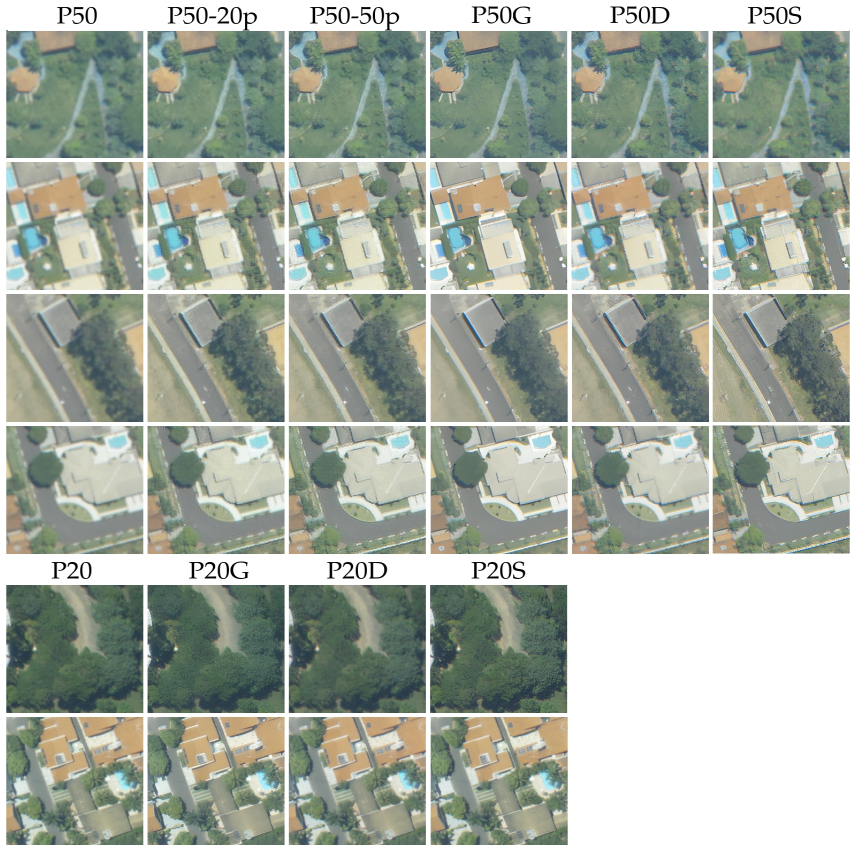
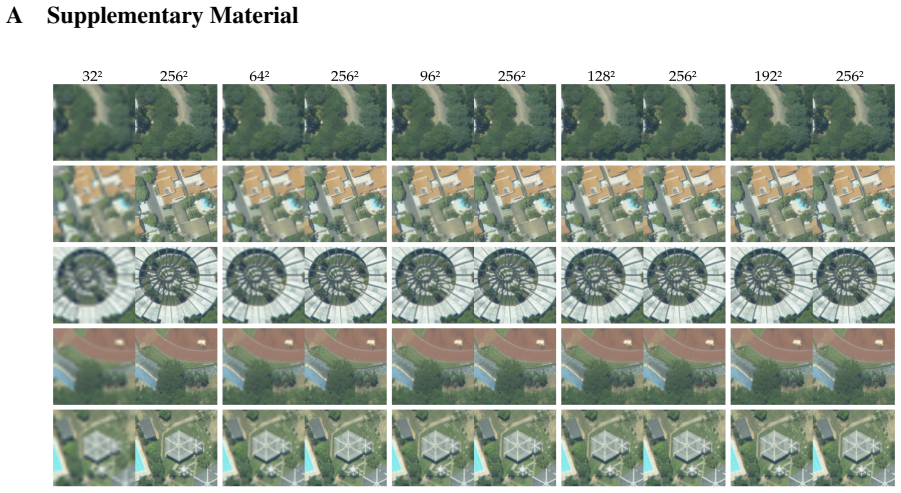
The central machinery is a resolution-harmonization pipeline: Lanczos upsampling of the coarse dataset to match object scale, patching into 256x256 tiles, and a pix2pix conditional GAN trained on synthetic pairs formed by downsampling and restoring resolution from the P20 and P50 images. The same pipeline is run with off-the-shelf Real-ESRGAN and Latent/Stable Diffusion super-resolution models for comparison. Because the pair relationship between datasets is approximate, the authors construct paired inputs by resizing originals down to several small scales and back, teaching pix2pix to restore semantic detail. Annotations are automatically resized with the images, yielding nine labeled samples per source image. SegFormer, a transformer-based semantic segmentation network, is the model that consumes the generated datasets.
What would settle it
Train SegFormer identically on real low-resolution aerial images captured by a sensor with coarser ground sample distance and on pix2pix-enhanced versions of those same images; if the enhancement does not raise tree IoU over the raw low-resolution baseline, the reported more-than-50% gain is specific to synthetic degradation rather than a general property of the pipeline.
Extended reading notes
Core claim
The paper's central claim is that a data-augmentation pipeline that harmonizes ground sample distance before training can close most of the resolution gap in tree segmentation without new human labels. Concretely, the P50 dataset (50 cm/pixel) is Lanczos-upsampled to match the object scale of the P20 dataset (20 cm/pixel), cut into nine 256x256 patches, and translated with two pix2pix models trained on synthetic paired low/high-resolution images; a separate branch applies off-the-shelf Real-ESRGAN and Latent/Stable Diffusion upscalers. Annotations are resized automatically to the new GSD, producing nine times more labeled samples for free. Evaluated with SegFormer, the pix2pix-translated images give the best cross-domain and low-resolution results, including a tree IoU of 67.80 versus 50.99 on 8x-degraded inputs, which the paper characterizes as an improvement of more than 50%.
Load-bearing premise
The automatically resized annotations remain valid on the generated images, meaning the pipeline preserves tree locations and shapes closely enough that label reuse does not introduce errors.
Editorial extensions
If this is right
- A model trained on pix2pix-enhanced low-resolution images can recover most of the tree-segmentation accuracy lost to 8x downsampling, without collecting new pixel labels.
- The same upsampling-then-translation recipe can be applied to arbitrary scaling factors, letting one annotated dataset be repurposed across sensors with different ground sample distances.
- Because the pix2pix models are trained on the target domain, they can outperform general super-resolution models for downstream segmentation even when those models produce visually sharper images.
- The auto-resized annotation pipeline removes the manual-labeling bottleneck for training at multiple GSDs, increasing the effective training set ninefold.
Reading between the lines
- If the automatically resized annotations misalign with the generated images, part of the reported IoU gain could be a label-reuse artifact; a study with human-corrected labels on the same generated images would separate resolution improvement from annotation effects.
- The same pipeline could transfer to other semantic classes such as buildings, roads, or water in aerial and satellite imagery, where annotation scarcity is similar.
- Because the paper degrades images synthetically, a natural next test is real low-resolution sensor data to see whether the pix2pix training pairs, built from synthetic degradation, transfer to real sensor blur and noise.
- The reported gain at 8x downsampling suggests the benefit grows as input resolution drops; testing at intermediate degradation levels would map the improvement curve and identify where enhancement stops paying off.
Editorial analysis
A structured set of objections, weighed in public.
Referee Report
Summary. The paper proposes a data augmentation and resolution enhancement pipeline for tree segmentation in aerial RGB imagery. The authors use two datasets, P20 (20 cm GSD) and P50 (50 cm GSD), and train a SegFormer segmentation model. To bridge the resolution gap, they upsample P50 images to match P20 ground sample distance, generate overlapping patches, and then apply one of several enhancement methods: pix2pix trained on artificially degraded image pairs, or off-the-shelf super-resolution models (Real-ESRGAN, Latent Diffusion, Stable Diffusion). The resulting synthetic images are used to train SegFormer, with annotations automatically resized for the new GSD. Experiments report cross-domain IoU for source-only and augmented training, plus a synthetic low-resolution experiment in which P20 images are degraded 8x and then enhanced by the same methods. The paper's central claim, repeated in the abstract, introduction, and conclusion, is that the pix2pix pipeline improves low-resolution tree segmentation IoU by more than 50%.
Significance. If the claimed improvement were accurate, the pipeline would be a practical low-annotation strategy for remote sensing segmentation: it reuses existing annotations, generates extra training data, and unifies GSD across acquisition conditions. The manuscript has useful ingredients: a clear experimental protocol, comparisons among several generative models, use of publicly available implementations, and an explicit acknowledgement of hardware limits for diffusion models. However, the headline quantitative claim is internally contradicted by the paper's own Table 9, and the low-resolution evaluation has a distribution-matching component that weakens the causal interpretation. The central claims need to be re-stated and re-validated before the paper can be considered sound.
major comments (3)
- [Abstract, Section 3.4, Conclusion] The claim of 'improvement of over 50% in IoU' for low-resolution images is contradicted by Table 9. The table shows P20→P20lr Trees IoU = 50.99 and P20→P20lp Trees IoU = 67.80, a relative improvement of (67.80 − 50.99)/50.99 ≈ 33.0%, not >50%. The Average IoU improves from 70.36 to 80.11, a relative gain of 13.9%. No number in Table 9 supports a >50% relative improvement. If the intended claim is that the gap to the high-resolution baseline (77.44) shrinks by about 63.5%, that is a different statement and should be stated precisely. Because this numerical claim appears in the abstract, introduction, and conclusion, the paper's headline result as written is unsupported by its own data.
- [Section 2.2.1 and Section 3.4] The low-resolution experiment is partly circular. The pix2pix model used to generate P20lp was trained on pairs derived from the P20 dataset itself (downsampled and upsampled P20 images), so its output maps the degraded P20 domain back to the original P20 distribution. Testing the P20-trained SegFormer on P20lp therefore measures, in part, how well pix2pix reproduces the training-domain appearance rather than how well the pipeline recovers tree semantics from truly low-resolution acquisition. To support the claim that the method improves real low-resolution imagery, the authors should evaluate on independently acquired low-resolution images, or at minimum on a held-out degradation protocol in which the pix2pix generator is trained on a separate subset and evaluated on a completely unseen degradation function.
- [Section 3.4 and Conclusion] The manuscript generalizes from a synthetic low-resolution test to 'scenarios where remote sensing images lack the necessary quality' without testing on actual low-resolution aerial images. The low-resolution dataset P20lr is created by resizing 256×256 images to 32×32, which is an 8x synthetic degradation; the subsequent enhancement results are measured on this synthetic input only. At minimum, the authors should explicitly state in the abstract and conclusion that the reported improvements are for simulated low-resolution inputs, and should discuss the risk that real low-resolution acquisition (with sensor noise, aliasing, and different atmospheric effects) may behave differently.
minor comments (6)
- [Section 2.2.1, Tables 2 and 5] Notation is inconsistent: 'P50-20p' and 'P50-20p' appear in tables while the text uses 'P 50 − 20p' with spaces; please standardize to one notation throughout.
- [Section 2.4] The description of the diffusion upscaling procedure is ambiguous: the text says 'outscale parameter of the pre-trained Diffusion models could not be adjusted to a value smaller than 4', but it is not clear which model (Latent Diffusion, Stable Diffusion, or both) this applies to, and the sentence 'divided our original images into 4 patches of 128 × 128' does not specify whether this is done before or after applying the model. Please clarify.
- [Section 3.4, Table 9] Table 9 reports results for pix2pix, Real-ESRGAN, and Latent Diffusion, but does not include a Stable Diffusion row (P20lS), even though Stable Diffusion is part of the proposed pipeline. Either add the result or state why it is omitted.
- [Section 3.3.2] The sentence 'our best results were achieved using a model trained with images from dataset P 50D to segment the test images from dataset P 20S, achieving an IoU of 67.79 for the Trees class' reports a result that is not shown in any table. Please add this configuration to the relevant table or remove the claim.
- [Section 3.4, Figure 10] When creating P20lr, the description says only 'we resized the original 256 × 256 images from the P 20 dataset to 32 × 32, decreasing their resolution by 8 times.' Please state whether any anti-aliasing filter was applied before downsampling, as this can substantially affect the difficulty of the super-resolution task.
- [References] Reference [19] is cited for 'Real-ESRGAN' but the reference is the ESRGAN paper by Wang et al. 2018. The Real-ESRGAN model is a different publication (Wang et al., 2021); please cite the correct source or adjust the text.
Circularity Check
No circularity found: the pipeline's evaluations are empirical and self-contained; the abstract's 'over 50%' claim is arithmetically inconsistent with Table 9, but that is a correctness issue, not a circular derivation.
full rationale
The paper's derivation chain is not circular. The pix2pix, Real-ESRGAN, and diffusion models are trained or applied to image-to-image translation and super-resolution tasks that are separate from the SegFormer segmentation training; the segmentation model is then evaluated on held-out images. In the low-resolution experiment, P20lp is generated by applying a pix2pix model (trained on degraded/original P20 pairs) to P20lr, and the improvement of the P20-trained SegFormer on P20lp over P20lr measures whether the translation restores P20-like structure. This is a direct evaluation of the proposed enhancement, not a quantity defined in terms of the segmentation result, and the generator could in principle distort semantics and hurt performance; no equation or fitted parameter is renamed as a prediction. The only self-citation ([5], Ferreira et al. 2019) supports a generic statement about labeling cost and is not load-bearing, so it does not raise the circularity score. The central claim that pix2pix 'improved IoU tree detection performance by more than 50% when compared to the low-resolution images' (Conclusion, echoed in the Abstract) is not supported by the paper's own Table 9: Trees IoU rises from 50.99 (P20→P20lr) to 67.80 (P20→P20lp), a relative increase of about 33%, not more than 50%; this is an internal arithmetic/consistency problem, not a circularity. Separate validity concerns about reusing original annotations for automatically resized or generated images are experimental assumptions, not circular steps.
Assumptions & free parameters
free parameters (4)
- Patches per upsampled image =
9
- pix2pix pair downsampling levels =
P20: 32, 64, 96, 128, 192 px; P50: 16, 32, 64, 96, 128 px
- Stable Diffusion prompt =
Enhance the resolution of this aerial city image without applying any filter
- Diffusion inference patch size =
128x128 input to 1024x1024 output, stitched from 4 patches
assumptions (3)
- domain assumption Upsampling a lower-resolution aerial image to the ground sample distance of a higher-resolution dataset preserves the validity of the original pixel annotations.
- domain assumption Pre-trained Real-ESRGAN, Latent Diffusion, and Stable Diffusion models, without fine-tuning, produce super-resolved images whose semantic content is accurate enough for segmentation training.
- domain assumption SegFormer trained on generated images transfers to the real target domain.
Cite this review
Pith. "Pith review of Data Augmentation and Resolution Enhancement using GANs and Diffusion Models for Tree Segmentation." pith.science (2026). https://pith.science/paper/YTBGLN54
@misc{pith2026250515077,
  author       = {Pith},
  title        = {Pith review of: Data Augmentation and Resolution Enhancement using GANs and Diffusion Models for Tree Segmentation},
  year         = {2026},
  howpublished = {\url{https://pith.science/paper/YTBGLN54}},
  note         = {Machine review of arXiv:2505.15077}
}
read the original abstract
Urban forests play a key role in enhancing environmental quality and supporting biodiversity in cities. Mapping and monitoring these green spaces are crucial for urban planning and conservation, yet accurately detecting trees is challenging due to complex landscapes and the variability in image resolution caused by different satellite sensors or UAV flight altitudes. While deep learning architectures have shown promise in addressing these challenges, their effectiveness remains strongly dependent on the availability of large and manually labeled datasets, which are often expensive and difficult to obtain in sufficient quantity. In this work, we propose a novel pipeline that integrates domain adaptation with GANs and Diffusion models to enhance the quality of low-resolution aerial images. Our proposed pipeline enhances low-resolution imagery while preserving semantic content, enabling effective tree segmentation without requiring large volumes of manually annotated data. Leveraging models such as pix2pix, Real-ESRGAN, Latent Diffusion, and Stable Diffusion, we generate realistic and structurally consistent synthetic samples that expand the training dataset and unify scale across domains. This approach not only improves the robustness of segmentation models across different acquisition conditions but also provides a scalable and replicable solution for remote sensing scenarios with scarce annotation resources. Experimental results demonstrated an improvement of over 50% in IoU for low-resolution images, highlighting the effectiveness of our method compared to traditional pipelines.
Figures


Figures from the paper (10 more)





Reference graph
Works this paper leans on
-
[1]
AdaTreeFormer: Few Shot Domain Adaptation for Tree Counting from a Single High-Resolution Image
Hamed Amini Amirkolaee, Miaojing Shi, Lianghua He, and Mark Mulligan. Adatreeformer: Few shot domain adaptation for tree counting from a single high-resolution image. arXiv preprint arXiv:2402.02956, 2024
work page Pith review arXiv 2024
-
[2]
Mirela Beloiu, Lucca Heinzmann, Nataliia Rehush, Arthur Gessler, and Verena C Griess. Individual tree-crown detection and species identification in heterogeneous forests using aerial rgb imagery and deep learning. Remote Sensing, 15(5):1463, 2023
work page 2023
-
[3]
Transformer for tree counting in aerial images
Guang Chen and Yi Shang. Transformer for tree counting in aerial images. Remote Sensing, 14(3):476, 2022
work page 2022
-
[4]
The cityscapes dataset for semantic urban scene understanding
Marius Cordts, Mohamed Omran, Sebastian Ramos, Timo Rehfeld, Markus Enzweiler, Rodrigo Benenson, Uwe Franke, Stefan Roth, and Bernt Schiele. The cityscapes dataset for semantic urban scene understanding. In Proceedings of the IEEE conference on computer vision and pattern recognition, pages 3213–3223, 2016
2016
-
[5]
Unsupervised deep learning and semi-automatic data labeling in weed discrimination
Alessandro dos Santos Ferreira, Daniel Matte Freitas, Gercina Gonçalves da Silva, Hemerson Pistori, and Marcelo Theophilo Folhes. Unsupervised deep learning and semi-automatic data labeling in weed discrimination. Computers and Electronics in Agriculture, 165:104963, 2019
work page 2019
-
[6]
Lanczos filtering in one and two dimensions
Claude E Duchon. Lanczos filtering in one and two dimensions. Journal of Applied Meteorology and Climatology, 18(8):1016–1022, 1979
work page 1979
-
[7]
Matheus Pinheiro Ferreira, Danilo Roberti Alves de Almeida, Daniel de Almeida Papa, Juliano Baldez Silva Minervino, Hudson Franklin Pessoa Veras, Arthur Formighieri, Caio Alexandre Nascimento Santos, Marcio 15 Aurélio Dantas Ferreira, Evandro Orfano Figueiredo, and Evandro José Linhares Ferreira. Individual tree detection and species classification of ama...
work page 2020
-
[8]
Muhammad Shakaib Iqbal, Hazrat Ali, Son N Tran, and Talha Iqbal. Coconut trees detection and segmentation in aerial imagery using mask region-based convolution neural network. IET Computer Vision, 15(6):428–439, 2021
work page 2021
Show all 22 references
-
[9]
Image-to-image translation with conditional adversarial networks
Phillip Isola, Jun-Yan Zhu, Tinghui Zhou, and Alexei A Efros. Image-to-image translation with conditional adversarial networks. In Proceedings of the IEEE conference on computer vision and pattern recognition, pages 1125–1134, 2017
2017
-
[10]
Deep neural network based date palm tree detection in drone imagery
Thani Jintasuttisak, Eran Edirisinghe, and Ali Elbattay. Deep neural network based date palm tree detection in drone imagery. Computers and Electronics in Agriculture, 192:106560, 2022
2022
-
[11]
Shadowsense: Unsupervised domain adaptation and feature fusion for shadow-agnostic tree crown detection from rgb-thermal drone imagery
Rudraksh Kapil, Seyed Mojtaba Marvasti-Zadeh, Nadir Erbilgin, and Nilanjan Ray. Shadowsense: Unsupervised domain adaptation and feature fusion for shadow-agnostic tree crown detection from rgb-thermal drone imagery. In Proceedings of the IEEE/CVF Winter Conference on Applicati...
2024
-
[12]
A deep learning network for individual tree segmentation in uav images with a coupled cspnet and attention mechanism
Lujin Lv, Xuejian Li, Fangjie Mao, Lv Zhou, Jie Xuan, Yinyin Zhao, Jiacong Yu, Meixuan Song, Lei Huang, and Huaqiang Du. A deep learning network for individual tree segmentation in uav images with a coupled cspnet and attention mechanism. Remote Sensing, 15(18):4420, 2023
2023
-
[13]
High-resolution image synthesis with latent diffusion models
Robin Rombach, Andreas Blattmann, Dominik Lorenz, Patrick Esser, and Björn Ommer. High-resolution image synthesis with latent diffusion models. In Proceedings of the IEEE/CVF conference on computer vision and pattern recognition, pages 10684–10695, 2022
2022
-
[14]
The definitive guide to ImageMagick
Michael Still. The definitive guide to ImageMagick. Apress, 2006
2006
-
[15]
Recent advances in domain adaptation for the classification of remote sensing data
Devis Tuia, Claudio Persello, and Lorenzo Bruzzone. Recent advances in domain adaptation for the classification of remote sensing data. arXiv preprint arXiv:2104.07778, 2021
2021 arXiv
-
[16]
Spatial pattern templates for recognition of objects with regular structure
Radim Tyleˇcek and Radim Šára. Spatial pattern templates for recognition of objects with regular structure. In Pattern Recognition: 35th German Conference, GCPR 2013, Saarbrücken, Germany, September 3-6, 2013. Proceedings 35, pages 364–374. Springer, 2013
2013
-
[17]
Implementing deep learning algorithms for urban tree detection and geolocation with high-resolution aerial, satellite, and ground-level images
Luisa Velasquez-Camacho, Maddi Etxegarai, and Sergio de Miguel. Implementing deep learning algorithms for urban tree detection and geolocation with high-resolution aerial, satellite, and ground-level images. Computers, Environment and Urban Systems, 105:102025, 2023
2023
-
[18]
Individual tree detection in large-scale urban environments using high-resolution multispectral imagery
Jonathan Ventura, Camille Pawlak, Milo Honsberger, Cameron Gonsalves, Julian Rice, Natalie LR Love, Skyler Han, Viet Nguyen, Keilana Sugano, Jacqueline Doremus, et al. Individual tree detection in large-scale urban environments using high-resolution multispectral imagery. Inte...
2024
-
[19]
Esrgan: Enhanced super-resolution generative adversarial networks
Xintao Wang, Ke Yu, Shixiang Wu, Jinjin Gu, Yihao Liu, Chao Dong, Yu Qiao, and Chen Change Loy. Esrgan: Enhanced super-resolution generative adversarial networks. In Proceedings of the European conference on computer vision (ECCV) workshops, pages 0–0, 2018
2018
-
[20]
Domain adaptive tree crown detection using high-resolution remote sensing images
Yisha Wang, Gang Yang, and Hao Lu. Domain adaptive tree crown detection using high-resolution remote sensing images. Journal of Applied Remote Sensing, 16(4):044505–044505, 2022
2022
-
[21]
Segformer: Simple and efficient design for semantic segmentation with transformers
Enze Xie, Wenhai Wang, Zhiding Yu, Anima Anandkumar, Jose M Alvarez, and Ping Luo. Segformer: Simple and efficient design for semantic segmentation with transformers. Advances in Neural Information Processing Systems, 34, 2021
2021
-
[22]
Cross-regional oil palm tree counting and detection via a multi-level attention domain adaptation network
Juepeng Zheng, Haohuan Fu, Weijia Li, Wenzhao Wu, Yi Zhao, Runmin Dong, and Le Yu. Cross-regional oil palm tree counting and detection via a multi-level attention domain adaptation network. ISPRS Journal of Photogrammetry and Remote Sensing, 167:154–177, 2020. 16 A Supplementa...
2020
Reviewed August 7, 2026 · model on record in the stance chip above.
Discussion (0). Continue with ORCID to comment.