Effect of Thermal Emission in Isotropic Scattering Atmospheres: An Invariant-Embedding Extension of Chandrasekhar's H(μ)-Function
Pith reviewed 2026-05-22 14:06 UTC · model grok-4.3
The pith
Thermal emission enters the source function as an invariant term to extend Chandrasekhar's H(mu) into a new redistribution function M(mu).
A machine-rendered reading of the paper's core claim, the machinery that carries it, and where it could break.
Core claim
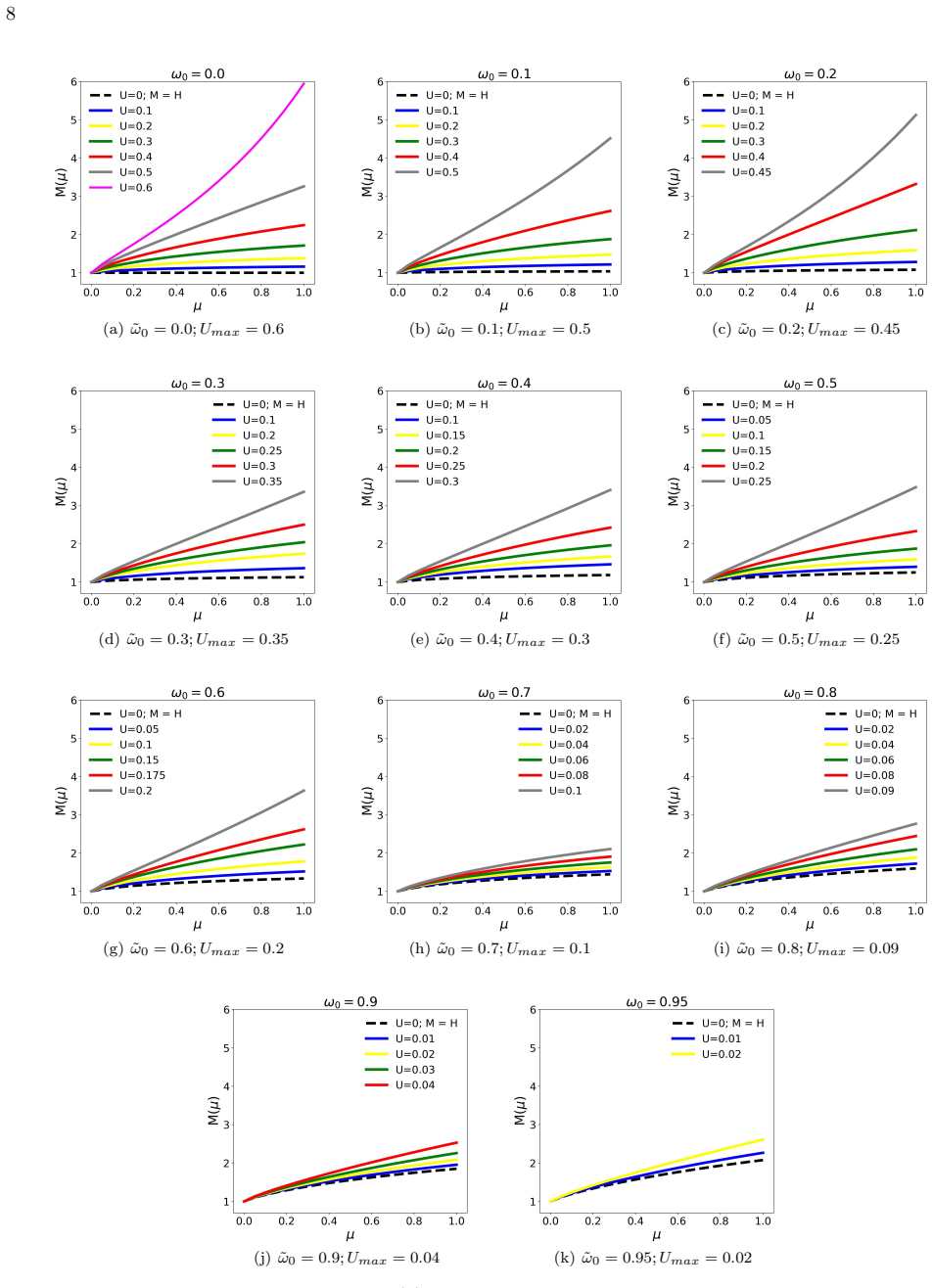
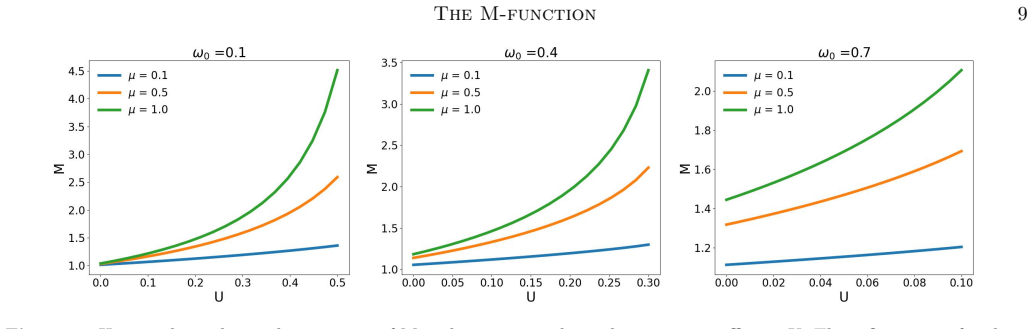
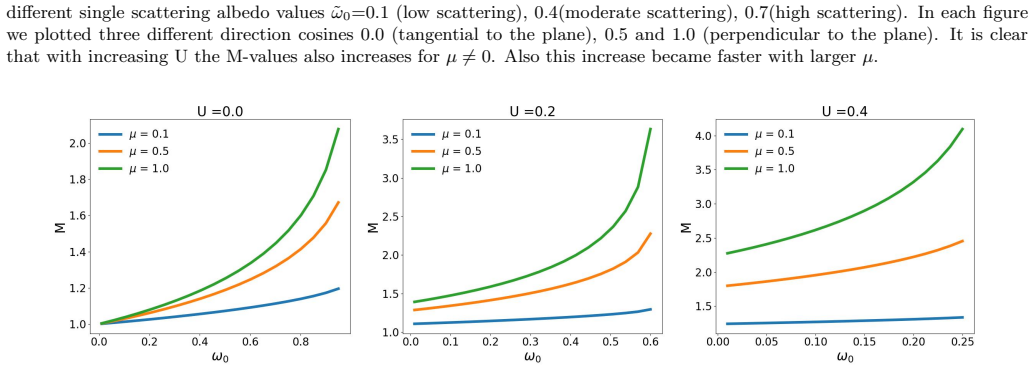
By embedding intrinsic thermal emission as an invariant contribution to the source function within the invariant-embedding formalism, a generalized angular redistribution function M(mu) is obtained. Its governing nonlinear integral equations are expressed in terms of mu, the thermal emission coefficient U(T)=B(T)/F, and the single-scattering albedo omega_0. These equations are solved numerically to high precision for mu in [0,1], U<0.7, and omega_0<1. In the limit of vanishing thermal emission the formulation recovers Chandrasekhar's classical H(mu) function.
What carries the argument
The generalized angular redistribution function M(mu,U,omega_0), which carries the thermal-emission contribution inside the invariant-embedding source function and replaces the classical H(mu) in the reflection problem.
If this is right
- Numerical tables of M(mu) allow direct calculation of both reflected and thermally emitted light from the same atmosphere.
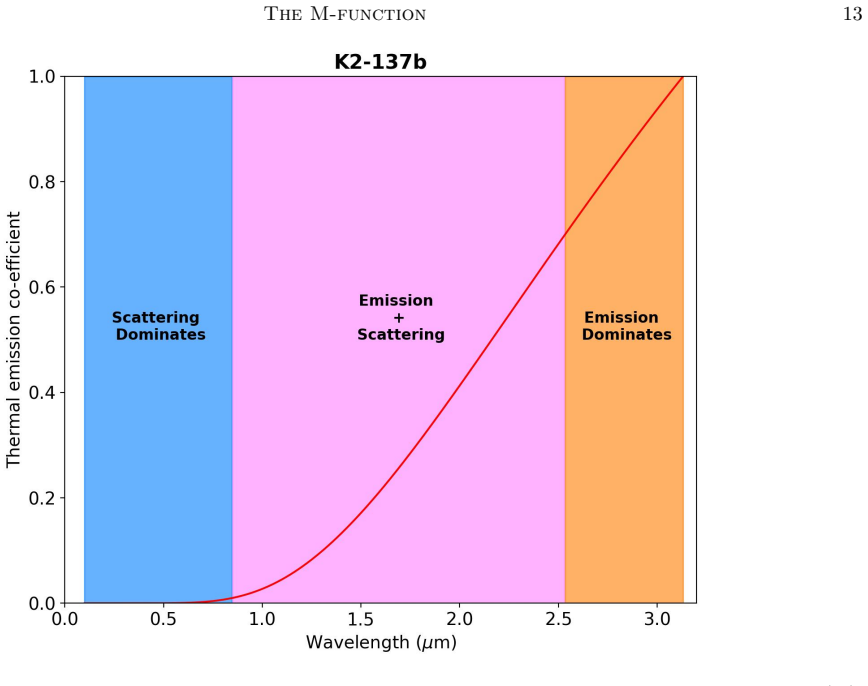
- The model applies to the ultra-short-period exoplanet K2-137b in the 0.85-2.5 micron band accessible to JWST, HST, and ARIEL.
- Re-radiated stellar energy is now included in the source function while preserving the invariant-embedding structure.
- When the thermal coefficient U is set to zero the equations and solutions revert exactly to Chandrasekhar's original H(mu).
Where Pith is reading between the lines
- The same embedding technique could be adapted to finite-thickness layers or mildly anisotropic phase functions for broader planetary modeling.
- Comparison of predicted spectra against JWST observations of ultra-hot Jupiters would provide a direct test of the numerical M(mu) values.
- The approach may link to other invariant-embedding solutions for non-plane-parallel geometries in stellar and planetary atmospheres.
Load-bearing premise
The atmosphere is semi-infinite, scattering is purely isotropic, and thermal emission can be added as a simple direction-independent term in the source function without changing the scattering phase function.
What would settle it
A direct measurement or Monte-Carlo simulation of the emergent intensity from a known semi-infinite isotropic-scattering layer with a calibrated constant thermal source that deviates systematically from the intensities computed using the solved M(mu) tables would falsify the extension.
Figures
read the original abstract
Chandrasekhar's H(mu)-function forms the foundation of radiative transfer theory for semi-infinite, isotropically scattering atmospheres under external illumination. However, the classical formulation does not account for thermal emission from internal heat sources, which is essential in many astrophysical environments, including hot Jupiters, brown dwarfs, and strongly irradiated exoplanets, where re-radiated stellar energy significantly alters the emergent intensity. To address this limitation, we extend Chandrasekhar's diffuse reflection framework by incorporating intrinsic thermal emission within the invariant-embedding formalism. In this approach, thermal emission enters as an embedded invariant contribution to the source function, leading to a generalized angular redistribution function M(mu). We derive the governing non-linear integral equations for M(mu) and express them in terms of the direction cosine mu, the thermal emission coefficient U(T)=B(T)/F, and the single-scattering albedo omega_0. High-precision numerical values of M(mu,U,omega_0) are computed for mu in [0,1], U<0.7, and omega_0<1 using a stable iterative scheme based on Gaussian quadrature. In the limit of vanishing thermal emission, the formulation reduces to Chandrasekhar's classical H(mu)-function, validating the approach. As an application, we consider the ultra-short-period exoplanet K2-137b and identify the wavelength range 0.85--2.5 micron where the model is most applicable, corresponding to the capabilities of JWST, HST, and ARIEL.
Editorial analysis
A structured set of objections, weighed in public.
Referee Report
Summary. The manuscript extends Chandrasekhar's H(μ)-function to incorporate thermal emission in semi-infinite isotropically scattering atmospheres using invariant-embedding. It introduces the generalized function M(μ, U, ω₀), derives the corresponding nonlinear integral equations, and computes numerical values via an iterative Gaussian quadrature scheme for μ ∈ [0,1], U < 0.7, ω₀ < 1. The formulation reduces to the classical H-function at U = 0 and is applied to the exoplanet K2-137b for identifying relevant wavelength ranges for JWST, HST, and ARIEL observations.
Significance. If the derivation holds, this provides a valuable tool for radiative transfer calculations in atmospheres with internal thermal sources, such as hot Jupiters and brown dwarfs. The consistency check with the U=0 limit and the focus on observable wavelength ranges for current and upcoming telescopes add to its potential utility in exoplanet atmosphere modeling.
major comments (2)
- [§2 (Derivation of the integral equations)] The embedding of thermal emission as a direction-independent term in the source function leading to the equations for M(μ) assumes U is constant with optical depth. This assumption is load-bearing for the invariance property. However, for the applications to hot Jupiters like K2-137b under radiative-convective equilibrium, the Planck function varies with τ, which would require additional integral terms coupling different depths in the governing equations for M(μ). The paper provides solutions only for fixed U < 0.7 without tests for depth-dependent U(τ).
- [Numerical implementation (abstract and §4)] The abstract states that high-precision numerical values are obtained via a stable iterative scheme, but lacks details on convergence criteria, error analysis, or comparisons with independent methods beyond the U=0 reduction. This undermines confidence in the accuracy of M(μ, U, ω₀) for U > 0.
minor comments (2)
- [Abstract] The definition U(T)=B(T)/F could be expanded to clarify if U is assumed constant or how it is computed from temperature structure.
- [Application section] The identification of the 0.85--2.5 micron range for K2-137b would benefit from a brief justification or reference to the atmospheric model used.
Simulated Author's Rebuttal
We thank the referee for the constructive and detailed comments, which help clarify the scope and limitations of our work. We respond to each major comment below and indicate the revisions we will make to the manuscript.
read point-by-point responses
-
Referee: [§2 (Derivation of the integral equations)] The embedding of thermal emission as a direction-independent term in the source function leading to the equations for M(μ) assumes U is constant with optical depth. This assumption is load-bearing for the invariance property. However, for the applications to hot Jupiters like K2-137b under radiative-convective equilibrium, the Planck function varies with τ, which would require additional integral terms coupling different depths in the governing equations for M(μ). The paper provides solutions only for fixed U < 0.7 without tests for depth-dependent U(τ).
Authors: We agree that the derivation assumes U is independent of optical depth; this constancy is required to maintain the invariance property central to the embedding method. For atmospheres in full radiative-convective equilibrium where the Planck function B(T(τ)) varies strongly with depth, the governing equations would indeed acquire additional depth-coupling integrals. Our formulation is therefore an approximation valid when thermal emission can be treated as roughly uniform over the relevant optical depths. In the revised manuscript we will add an explicit discussion of this assumption, its range of validity, and a note that depth-dependent U(τ) extensions are left for future work. We retain the constant-U solutions as the core contribution of the present paper. revision: partial
-
Referee: [Numerical implementation (abstract and §4)] The abstract states that high-precision numerical values are obtained via a stable iterative scheme, but lacks details on convergence criteria, error analysis, or comparisons with independent methods beyond the U=0 reduction. This undermines confidence in the accuracy of M(μ, U, ω₀) for U > 0.
Authors: We accept this criticism. The revised §4 will specify the convergence criterion (maximum relative change in M between iterations < 10^{-8}), the quadrature error bounds, and additional validation tests consisting of direct comparisons against numerical solutions of the underlying radiative-transfer equation for several (U, ω₀) pairs with U > 0. These additions will be reflected in an updated abstract as well. revision: yes
Circularity Check
No significant circularity; derivation extends Chandrasekhar via explicit additive term and solves resulting equations
full rationale
The paper begins with Chandrasekhar's established H(μ) for semi-infinite isotropic scattering and explicitly augments the invariant-embedding source function with a direction-independent thermal term U(T) = B(T)/F. This produces new nonlinear integral equations for the generalized redistribution function M(μ, U, ω₀). The equations are solved numerically by iteration with Gaussian quadrature, and the U = 0 limit recovers the classical H(μ) as an internal consistency check. No parameter is fitted to data and then relabeled a prediction, no load-bearing result rests on self-citation, and the governing equations are derived directly from the augmented source function rather than being tautological with the output. The depth-independent-U assumption is a modeling choice whose validity for hot Jupiters can be tested externally; it does not render the mathematical steps circular by construction.
Axiom & Free-Parameter Ledger
free parameters (2)
- U(T)
- omega_0
axioms (1)
- domain assumption Atmosphere is semi-infinite and scattering is isotropic
invented entities (1)
-
M(mu, U, omega_0)
no independent evidence
Lean theorems connected to this paper
-
IndisputableMonolith/Cost/FunctionalEquation.leanwashburn_uniqueness_aczel unclear?
unclearRelation between the paper passage and the cited Recognition theorem.
M(μ) = 1 + 2U(T)M(μ)μ log(1+1/μ) + (ω₀/2)μ M(μ) ∫ M(μ′)/(μ+μ′) dμ′ (Eq. 2); Theorems 1–2 on moments Aₙ and R
-
IndisputableMonolith/Foundation/RealityFromDistinction.leanreality_from_one_distinction unclear?
unclearRelation between the paper passage and the cited Recognition theorem.
Reduction to Chandrasekhar H(μ) when U→0; numerical values for U<0.7, ω₀<1
What do these tags mean?
- matches
- The paper's claim is directly supported by a theorem in the formal canon.
- supports
- The theorem supports part of the paper's argument, but the paper may add assumptions or extra steps.
- extends
- The paper goes beyond the formal theorem; the theorem is a base layer rather than the whole result.
- uses
- The paper appears to rely on the theorem as machinery.
- contradicts
- The paper's claim conflicts with a theorem or certificate in the canon.
- unclear
- Pith found a possible connection, but the passage is too broad, indirect, or ambiguous to say the theorem truly supports the claim.
Reference graph
Works this paper leans on
-
[1]
2021, Journal of Quantitative Spectroscopy and Radiative Transfer, 272, 107764
Anlı, F., & ¨Ozt¨ urk, H. 2021, Journal of Quantitative Spectroscopy and Radiative Transfer, 272, 107764
work page 2021
-
[2]
Batygin, K., & Stevenson, D. J. 2010, The Astrophysical Journal Letters, 714, L238
work page 2010
-
[3]
Bellman, R., Kagiwada, H., Kalaba, R., & Ueno, S. 1967, Icarus, 7, 365
work page 1967
-
[4]
1983, Astronomy and Astrophysics (ISSN 0004-6361), 126, 283
Bosma, P., & De Rooij, W. 1983, Astronomy and Astrophysics (ISSN 0004-6361), 126, 283
work page 1983
-
[5]
1947, The Astrophysical Journal, 105, 164 —
Chandrasekhar, S. 1947, The Astrophysical Journal, 105, 164 —. 1960, Radiative Transfer, Dover Books on Intermediate and Advanced Mathematics (Dover Publications). https://books.google.co.in/books?id=CK3HDRwCT5YC
work page 1947
-
[6]
Chandrasekhar, S., & Breen, F. H. 1947, The Astrophysical Journal, 106, 143 —. 1948, Astrophysical Journal, 107, 216
work page 1947
-
[7]
Das, R. N., & Bera, R. 2007, Numerical evaluation of Chandrasekhar’s H-function, its first and second differential coefficients, its pole and moments from the new form for plane parallel scattering atmosphere in radiative transfer, arXiv preprint arXiv:0711.3336
work page internal anchor Pith review Pith/arXiv arXiv 2007
-
[8]
Dubus, A., Devooght, J., & Dehaes, J.-C. 1986, Nuclear Instruments and Methods in Physics Research Section B: Beam Interactions with Materials and Atoms, 13, 623
work page 1986
-
[9]
2010, Astronomy & Astrophysics, 520, A27
Guillot, T. 2010, Astronomy & Astrophysics, 520, A27
work page 2010
-
[10]
Hansen, B. M. 2008, The Astrophysical Journal Supplement Series, 179, 484
work page 2008
-
[11]
Harris, C. R., Millman, K. J., van der Walt, S. J., et al. 2020, Nature, 585, 357–362, doi: 10.1038/s41586-020-2649-2
-
[12]
2015, Computer Physics Communications, 196, 416 —
Jablonski, A. 2015, Computer Physics Communications, 196, 416 —. 2019, Computer Physics Communications, 235, 489
work page 2015
-
[13]
Komacek, T. D., & Youdin, A. N. 2017, The Astrophysical Journal, 844, 94
work page 2017
-
[14]
2012, The Astrophysical Journal, 747, 25
Madhusudhan, N., & Burrows, A. 2012, The Astrophysical Journal, 747, 25
work page 2012
-
[15]
1978, Stellar atmospheres, San Francisco: WH Freeman
Mihalas, D. 1978, Stellar atmospheres, San Francisco: WH Freeman
work page 1978
-
[16]
2021, The Astrophysical Journal, 911, 126 —
Sengupta, S. 2021, The Astrophysical Journal, 911, 126 —. 2022, The Astrophysical Journal, 936, 139
work page 2021
-
[17]
2023, New Astronomy, 100, 101987
Sengupta, S., & Sengupta, S. 2023, New Astronomy, 100, 101987
work page 2023
-
[18]
2023, The Astrophysical Journal, 944, 155
Singla, M., Chakrabarty, A., & Sengupta, S. 2023, The Astrophysical Journal, 944, 155
work page 2023
-
[19]
2023, New Astronomy, 102, 102024
Singla, M., & Sengupta, S. 2023, New Astronomy, 102, 102024
work page 2023
-
[20]
2018, Monthly Notices of the Royal Astronomical Society, 474, 5523
Smith, A., Cabrera, J., Csizmadia, S., et al. 2018, Monthly Notices of the Royal Astronomical Society, 474, 5523
work page 2018
-
[21]
Tinetti, G., Encrenaz, T., & Coustenis, A. 2013, The Astronomy and Astrophysics Review, 21, 1 Vigan` o, D., Sengupta, S., Soriano-Guerrero, C., et al. 2025, Astronomy & Astrophysics, 701, A8
work page 2013
-
[22]
SciPy1.0: FundamentalalgorithmsforscientificcomputinginPython,
Virtanen, P., Gommers, R., Oliphant, T. E., et al. 2020, Nature Methods, 17, 261, doi: 10.1038/s41592-019-0686-2
discussion (0)
Sign in with ORCID, Apple, or X to comment. Anyone can read and Pith papers without signing in.