REVIEW 4 major objections 5 minor 1 cited by
Large Language Models as Computable Approximations to Solomonoff Induction
T0 review · 4 major / 5 minor · reviewed 2026-08-07 · deepseek-v4-flash
Pith's one-line read Training an LLM by loss minimization is a computable stand-in for Solomonoff induction, this paper argues.
desk verdict A definitional tautology presented as a theorem; the LLM's own distribution is re-derived by construction, and the practical heuristic is a known active-learning idea. read the letter →
The pith
A machine-rendered reading of the paper's core claim, the machinery that carries it, and where it could break.
The reading
What carries the argument
The load-bearing construction is a prefix program $f(x,s)=(n(x)^{(2)}, s^{(2)}, e(x)^{(2)})$ whose components are Elias-gamma coded so the program set is prefix-free and can run on a universal prefix Turing machine. The approximate prior $\tilde{M}(x)=\sum_s 2^{-\ell(f(x,s))}$ is a subset of the true Solomonoff prior, and the argument works by tracking how loss minimization compresses $e(x)^{(2)}$, the arithmetic-coded encoding of $x$; shorter encodings translate into shorter programs and hence larger weight in $\tilde{M}(x)$. The paper's encoding-length relation $|e(x_{1:t})^{(2)}|\approx 2t-\sum_{i=1}^{t}\log_2 P(x_i|x_{1:i-1})$ is the step that produces the $t^2/(4(t+1)^2)$ prefactor in the inference theorem.
What would settle it
Take a frozen LLM and an arithmetic coder driven by its next-token probabilities, record $|e(x_{1:t})|$ for many prefixes, and compare the difference $|e(x_{1:t})|-|e(x_{1:t+1})|$ with $-\log_2 P(x_{t+1}|x_{1:t})$; a mismatch, or the absence of the $2t$ term in the measured coding length, would directly refute the identity behind Theorem 3. A second check is to compare normalized rankings of candidate next tokens under $M$ and under $P_\theta$: if the prefactor cancels, the rankings must coincide, so any divergence would show the prefactor or the coding-length model is doing real work.
Extended reading notes
Core claim
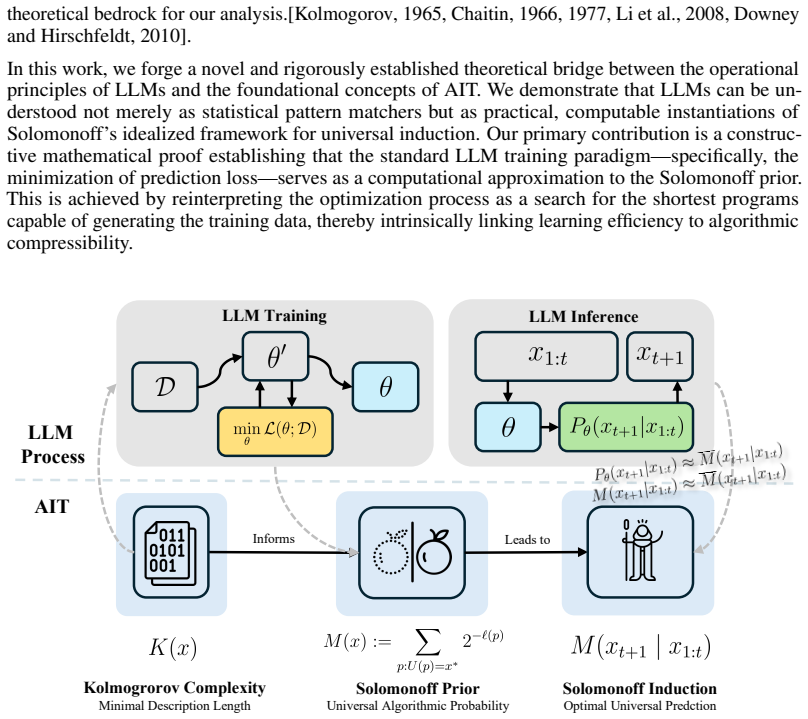
The paper's central claim is that the LLM training objective, read as a program-length optimization, constructs a computable semi-measure that sits inside the Solomonoff prior: every string $x$ is assigned probability $\tilde{M}(x)=\sum_{s}2^{-\ell(f(x,s))}$ over prefix-encoded programs built from model weights, decoding iterations, a seed, and the arithmetic-coded compression $e(x)^{(2)}$. Because the Solomonoff prior sums over all programs, $\tilde{M}(x)\le M(x)$, and the paper argues that lowering the training loss shortens $|e(x)^{(2)}|$, so the gap closes. The second theorem states that for a well-trained model, $M(x_{t+1}|x_{1:t})\approx \frac{t^2}{4(t+1)^2}P_\theta(x_{t+1}|x_{1:t})$ for large context length $t$, with the prefactor independent of the token and therefore removed by normalization. The paper presents this as the first formal bridge between LLM architectures and algorithmic information theory, and it uses the convergence bound for Solomonoff induction to explain why in-context examples, few-shot examples, more parameters, and longer inference horizons all help.
Load-bearing premise
The inference theorem assumes a specific arithmetic coding-length identity, $|e(x_{1:t})^{(2)}| \approx 2t - \sum_{i=1}^t \log_2 P(x_i|x_{1:i-1})$, in which the $2t$ term produces the $t^2/(4(t+1)^2)$ prefactor; if the identity fails, the prefactor is not as stated, and because the prefactor cancels on normalization the substantive claim rests entirely on the model's own next-token probabilities.
Editorial extensions
If this is right
- In-context learning is explained as the universal prior adapting to a computable target distribution: a carefully designed context makes $M(0|x_{1:t})$ track an arbitrary computable $\mu(0|x_{1:t})$.
- Few-shot examples accelerate convergence because they raise the weight of the target distribution in the error term of the Solomonoff convergence bound, so the model adapts with fewer tokens.
- Scaling parameters amounts to approximating the Solomonoff prior more precisely, while inference-time scaling (longer context, more decoding steps) increases $t$ and speeds convergence to the true distribution.
- Few-shot example selection should prefer low-confidence samples; in the paper's experiments this consistently beats high-confidence selection across SMS spam, emotion, and news classification, with the largest gains on smaller models.
- Because the prefactor in the inference theorem is token-independent, the operational prediction of the theorem is that normalized LLM next-token probabilities match normalized Solomonoff conditionals, so comparisons between tokens do not depend on the prefactor.
Reading between the lines
- If the prefactor truly cancels under normalization, the theorem's empirical content is the ratio identity $|e(x_{1:t})|-|e(x_{1:t+1})|=-\log_2 P(x_{t+1}|x_{1:t})$; a direct measurement of this identity on real LLMs would separate the proportionality claim from the choice of coding scheme.
- The low-confidence selection rule can be read as an active-learning acquisition function; one testable extension is whether iterating selection and fine-tuning on the chosen examples compounds the gains in a way ordinary random active learning does not.
- The framework suggests that any compression-based training objective that shortens the description length of the training data should inherit a similar approximation guarantee, so comparing decoder-only transformers, mixture-of-experts, and retrieval-augmented models under the same loss could reveal which architectural features matter beyond loss minimization.
- Because the convergence argument relies on the target distribution being computable, the paper leaves open whether naturally occurring language distributions are computable in the relevant sense; a testable probe is whether predictive error curves on real text follow the $K(\mu)$-dependent bound.
Editorial analysis
A structured set of objections, weighed in public.
Referee Report
Summary. The paper claims to establish a formal connection between large language models and Algorithmic Information Theory. It introduces an 'approximate Solomonoff prior' M̄(x) defined via programs built from an LLM's own arithmetic code, proves (Theorem 2) that LLM training minimizes the length of such programs and thereby approximates the Solomonoff prior, and proves (Theorem 3) that next-token prediction Pθ approximates Solomonoff induction with an asymptotic prefactor t²/(4(t+1)²). It then uses these results to explain in-context learning, few-shot learning, and scaling laws, and proposes a low-confidence few-shot example selection strategy, which it evaluates on three text-classification datasets.
Significance. If the central theorems were correct, the paper would offer a unifying theoretical framework for LLM behavior, which would be significant. The paper also contains a practically testable proposal: selecting low-confidence examples for few-shot prompting. However, as detailed below, the main theoretical result (Theorem 3) is definitionally circular because M̄ is constructed from the LLM's own distribution, and the asserted upper bound in Theorem 2 is not established. The empirical study, while suggestive, lacks statistical rigor. The paper does not, in its current form, deliver the claimed formal connection.
major comments (4)
- [Section 4.2, Eq. (8) and Theorem 3] The definition of M̄(x) in Eq. (8) sums over programs f(x,s) whose third component is e(x), an arithmetic code for x computed using the LLM's own probabilities Pθ. Consequently, M̄(x1:t+1)/M̄(x1:t) is, up to a token-independent factor, equal to 2^{-|e(x1:t+1)|+|e(x1:t)|}, which by the arithmetic coding identity is Pθ(xt+1|x1:t). This holds without any reference to the Solomonoff prior M. The theorem therefore shows that M̄'s conditional recovers Pθ by construction, not that Pθ approximates M. The nonstandard code-length formula |e(x1:t)| ≈ 2t − Σ log₂ P(xi|x1:i−1) in Eq. (18) is not derived from any standard arithmetic-coding result; standard arithmetic coding gives −Σ log₂ P(xi|x1:i−1) plus at most O(1) bits. Inserting the 2t term merely manufactures the specific prefactor t²/(4(t+1)²), which the authors concede cancels under normalization. Hence the substantial claim of the paper—that next-token prediction approximates Solomonoff induction—is not established.
- [Section 4.1, Theorem 2 and Lemma 4] The upper bound M̄(x) ≤ M(x) is asserted after constructing a new universal prefix Turing machine U_F. The proof of Lemma 4 claims the existence of a string s that is not a prefix of any program in F, based only on F being prefix-free; this does not follow from the Kraft inequality for infinite prefix-free sets. More importantly, even if U_F satisfies U_F(f) = U(f) for f ∈ F, the Solomonoff prior M in Eq. (3) is defined with respect to a fixed UTM U, not U_F. The invariance theorem only gives M_{U_F}(x) ≤ c · M_U(x) for some constant c depending on the machines, not the pointwise inequality with constant 1. Finally, the assertion that decreasing the LLM loss makes M̄ approach M is unquantified: no convergence rate, no bound on the approximation error, and no argument that the omitted programs in M are negligible. Theorem 2 as stated is therefore not proven.
- [Section 4.3 and 4.4] The explanation of few-shot learning and the derivation of the low-confidence selection criterion are not rigorous. Equation (19) bounds a sum over all contexts of squared prediction errors; it does not directly imply that adding specific in-context examples 'increases μ(x1:t)' and 'accelerates convergence' in the sense used here. The sample-selection heuristic in Section 4.4 is motivated by an analogy (larger difference between M(0|x1:t) and μ(0|x1:t) is beneficial) that is never tied quantitatively to the convergence theorem. Without a formal statement of how the error term at a particular context depends on the selected examples, the proposed strategy remains an intuitive heuristic rather than a consequence of the theory.
- [Section 5, Table 1] The experimental results are reported as single accuracies with no error bars, no standard deviations, and no multiple seeds or independent runs. The selection procedure (Algorithm 1) is greedy and deterministic with temperature 0, so the reported numbers may be sensitive to the order of the candidate pool and to the initial prompt; this variability is not assessed. Furthermore, there is no random-selection baseline, so the observed gains cannot be attributed to the specific 'low-confidence' criterion versus merely selecting a non-random subset. The claim that low-confidence selection 'consistently' improves performance is not supported by statistical evidence.
minor comments (5)
- [Figure 1 and Notation] The figure contains a typo ('Kolmogrorov'), and the notation is inconsistent: M is used both for the Solomonoff prior and for the model in Algorithm 1, and the overline distinguishing M̄ from M is easy to miss in the text. A unified notation table (Appendix C) is present, but the main text should adhere to it more consistently.
- [Equation (10)] Equation (10) writes |e(x)(2)| ≈ |e(x)(2)| + 2 log |e(x)(2)|, which is confusing because the same symbol e(x)(2) appears on both sides. The authors presumably intend to distinguish the Elias-gamma-coded version from the raw arithmetic code; this should be made explicit.
- [Section 4.2, Eq. (18)] The formula |e(x1:t)| ≈ 2t − Σ log₂ P(xi|x1:i−1) is stated without proof or citation. Since this formula is load-bearing for the prefactor in Theorem 3, it needs a derivation or a reference to a standard result. As it stands, the 2t term appears ad hoc.
- [Section 4.1] The paper cites Delétang et al. [2023] for the claim that minimizing training loss aligns with minimizing the arithmetic-code length |e(x)|. That reference establishes that language models can be used as compressors, but the specific equivalence asserted here is not proven in the manuscript.
- [Appendix A] The limitations section appropriately acknowledges that the connection is an approximation, but it does not mention the more fundamental issue that Theorem 3's quantity M̄ is defined in terms of the LLM's own code, which makes the theorem definitional rather than substantive. The authors should address this circularity explicitly.
Circularity Check
Theorem 3 is definitionally circular: Mbar is built from the LLM's own arithmetic code, so its conditional distribution is Pθ by construction, and the 2t code-length term only manufactures a prefactor that cancels.
-
self definitional
[Section 4.1 Eq. 5-8; Section 4.2 Eq. 9 and Eq. 17-18]
"the compression and encoding component uses the LLM in conjunction with arithmetic coding to losslessly compress the string x, resulting in a binary encoding e(x)(2) ... Next, we define the computable prior M (x) := ∞X s=1 2−ℓ(f (x,s))"
The program f(x,s) whose lengths define the approximate prior contains e(x), an arithmetic code of x produced with the LLM's own probabilities Pθ. Arithmetic coding gives 2^{−|e(x)|} ≈ Pθ(x) up to an O(1) factor, so Mbar(x) is, by construction, a slowly varying token-independent prefactor times Pθ(x). The conditional Mbar(x_{t+1}|x_{1:t}) = Mbar(x_{1:t+1})/Mbar(x_{1:t}) therefore recovers Pθ(x_{t+1}|x_{1:t}) exactly after normalization. Eq. 9 then labels this ratio 'M(xt+1|x1:t)', so Theorem 3's claimed approximation to Solomonoff induction is an identity built into the definitions, not an independent derivation.
-
other
[Section 4.2, Eq. 18]
"On the other hand, |e(x1:t)(2)| ≈ 2t − Pt i=1 log2 P (xi | x1:i−1), where P (xi | x1:i−1) is the LLM’s predicted probability for the next token."
Standard arithmetic coding with model Pθ has length |e(x_{1:t})| ≈ −Σ log2 P(x_i|x_{<i}); there is no 2t term. The inserted 2t is what produces the t²/(4(t+1)²) prefactor in Eq. 11, and the paper concedes this prefactor 'is a value independent of the token, it will automatically cancel out during normalization.' With the standard length formula the same ratio still yields Pθ(x_{t+1}|x_{1:t}). Hence Eq. 18 is a dressed-up identity Pθ≈Pθ, not an approximation to the Solomonoff prior M.
full rationale
The paper's central AIT bridge is definitionally circular. The approximate prior Mbar of Eq. 8 is a sum over programs f(x,s) whose executable content is e(x), the LLM's own arithmetic code for x; therefore Mbar is essentially the LLM's distribution Pθ times a slowly varying factor. Eq. 9 replaces the true Solomonoff prior M by Mbar before proof, and Theorem 3 forms the ratio of Mbar, so the derived conditional is Pθ(x_{t+1}|x_{1:t}) by construction. The nonstandard code-length formula with the 2t term in Eq. 18 is not the arithmetic coding length; it only injects the t²/(4(t+1)²) prefactor, which the authors admit cancels under normalization. The 'Mbar ≤ M' upper bound is obtained by building a new universal machine UF around the paper's own program set F, and the convergence of Mbar to M as loss decreases is asserted rather than quantified. The empirical few-shot selection study is independent and not circular, but it does not support the claimed formal identification of next-token prediction with Solomonoff induction. Score 9 because the central result is forced by definition.
Assumptions & free parameters
free parameters (2)
- 2t offset in arithmetic code length =
not fitted, chosen by hand
- number of few-shot examples K =
10
assumptions (5)
- standard math Solomonoff prior and Hutter's convergence theorem (Eq. 19) hold as stated
- domain assumption An LLM with fixed weights is a deterministic Turing machine and can be internalized into a universal Turing machine
- domain assumption Minimizing LLM loss is equivalent to minimizing arithmetic coding length
- ad hoc to paper The approximate prior Mbar is a sub-sum of the Solomonoff prior over the same universal Turing machine
- ad hoc to paper Low-confidence examples accelerate convergence to the target distribution
invented entities (1)
-
Approximate Solomonoff prior Mbar(x)
Cite this review
Pith. "Pith review of Large Language Models as Computable Approximations to Solomonoff Induction." pith.science (2026). https://pith.science/paper/4B7YWZ4H
@misc{pith2026250515784,
  author       = {Pith},
  title        = {Pith review of: Large Language Models as Computable Approximations to Solomonoff Induction},
  year         = {2026},
  howpublished = {\url{https://pith.science/paper/4B7YWZ4H}},
  note         = {Machine review of arXiv:2505.15784}
}
read the original abstract
The rapid advancement of large language models (LLMs) calls for a rigorous theoretical framework to explain their empirical success. While significant progress has been made in understanding LLM behaviors, existing theoretical frameworks remain fragmented in explaining emergent phenomena through a unified mathematical lens. We establish the first formal connection between LLM architectures and Algorithmic Information Theory (AIT) by proving two fundamental results: (1) the training process computationally approximates Solomonoff prior through loss minimization interpreted as program length optimization, and (2) next-token prediction implements approximate Solomonoff induction. We leverage AIT to provide a unified theoretical explanation for in-context learning, few-shot learning, and scaling laws. Furthermore, our theoretical insights lead to a principled method for few-shot example selection that prioritizes samples where models exhibit lower predictive confidence. We demonstrate through experiments on diverse text classification benchmarks that this strategy yields significant performance improvements, particularly for smaller model architectures, when compared to selecting high-confidence examples. Our framework bridges the gap between theoretical foundations and practical LLM behaviors, providing both explanatory power and actionable insights for future model development.
Figures
Forward citations
Cited by 1 Pith paper
-
Hierarchical Solomonoff Induction: An Unbounded Machine Learning Model
HSI, a hyperprior over all Solomonoff priors, is shown equivalent to Solomonoff Induction while enabling dataset-conditioned prediction and a training-set error bound.
Reference graph
Works this paper leans on
-
[2]
Tiago Almeida and Jos Hidalgo. SMS Spam Collection . UCI Machine Learning Repository, 2011. DOI : https://doi.org/10.24432/C5CC84
doi:10.24432/c5cc84 2011
-
[3]
Rethinking Semantic Parsing for Large Language Models: Enhancing LLM Performance with Semantic Hints
Kaikai An, Shuzheng Si, Helan Hu, Haozhe Zhao, Yuchi Wang, Qingyan Guo, and Baobao Chang. Rethinking semantic parsing for large language models: Enhancing llm performance with semantic hints. arXiv preprint arXiv:2409.14469, 2024 a
work page Pith review arXiv 2024
-
[4]
Kaikai An, Fangkai Yang, Liqun Li, Junting Lu, Sitao Cheng, Shuzheng Si, Lu Wang, Pu Zhao, Lele Cao, Qingwei Lin, et al. Thread: A logic-based data organization paradigm for how-to question answering with retrieval augmented generation. arXiv preprint arXiv:2406.13372, 2024 b
arXiv 2024
-
[5]
Ultraif: Advancing instruction following from the wild
Kaikai An, Li Sheng, Ganqu Cui, Shuzheng Si, Ning Ding, Yu Cheng, and Baobao Chang. Ultraif: Advancing instruction following from the wild. arXiv preprint arXiv:2502.04153, 2025
arXiv 2025
-
[6]
Context-dpo: Aligning language models for context-faithfulness
Baolong Bi, Shaohan Huang, Yiwei Wang, Tianchi Yang, Zihan Zhang, Haizhen Huang, Lingrui Mei, Junfeng Fang, Zehao Li, Furu Wei, et al. Context-dpo: Aligning language models for context-faithfulness. arXiv preprint arXiv:2412.15280, 2024 a
arXiv 2024
-
[7]
Decoding by contrasting knowledge: Enhancing llms' confidence on edited facts
Baolong Bi, Shenghua Liu, Lingrui Mei, Yiwei Wang, Pengliang Ji, and Xueqi Cheng. Decoding by contrasting knowledge: Enhancing llms' confidence on edited facts. arXiv preprint arXiv:2405.11613, 2024 b
arXiv 2024
-
[8]
Baolong Bi, Shenghua Liu, Yiwei Wang, Lingrui Mei, Junfeng Fang, Hongcheng Gao, Shiyu Ni, and Xueqi Cheng. Is factuality enhancement a free lunch for llms? better factuality can lead to worse context-faithfulness. arXiv preprint arXiv:2404.00216, 2024 c
arXiv 2024
-
[9]
Baolong Bi, Shenghua Liu, Yiwei Wang, Yilong Xu, Junfeng Fang, Lingrui Mei, and Xueqi Cheng. Parameters vs. context: Fine-grained control of knowledge reliance in language models. arXiv preprint arXiv:2503.15888, 2025
arXiv 2025
Show all 77 references
-
[10]
The description length of deep learning models
L \'e onard Blier and Yann Ollivier. The description length of deep learning models. Advances in Neural Information Processing Systems, 31, 2018
2018
-
[11]
A machine-independent theory of the complexity of recursive functions
Manuel Blum. A machine-independent theory of the complexity of recursive functions. J. ACM, 14 0 (2): 0 322–336, April 1967 a . ISSN 0004-5411. doi:10.1145/321386.321395. URL https://doi.org/10.1145/321386.321395
1967
-
[12]
On the size of machines
Manuel Blum. On the size of machines. Information and Control, 11 0 (3): 0 257--265, 1967 b . ISSN 0019-9958. doi:https://doi.org/10.1016/S0019-9958(67)90546-3. URL https://www.sciencedirect.com/science/article/pii/S0019995867905463
1967 doi
-
[13]
Tom B. Brown, Benjamin Mann, Nick Ryder, Melanie Subbiah, Jared Kaplan, Prafulla Dhariwal, Arvind Neelakantan, Pranav Shyam, Girish Sastry, Amanda Askell, Sandhini Agarwal, Ariel Herbert-Voss, Gretchen Krueger, Tom Henighan, Rewon Child, Aditya Ramesh, Daniel M. Ziegler, Jeffr...
2020 arXiv
-
[14]
On the length of programs for computing finite binary sequences
Gregory J Chaitin. On the length of programs for computing finite binary sequences. Journal of the ACM (JACM), 13 0 (4): 0 547--569, 1966
1966
-
[15]
Algorithmic information theory
Gregory J Chaitin. Algorithmic information theory. IBM journal of research and development, 21 0 (4): 0 350--359, 1977
1977
-
[16]
Kolmogorov's contributions to information theory and algorithmic complexity
Thomas M Cover, Peter Gacs, and Robert M Gray. Kolmogorov's contributions to information theory and algorithmic complexity. The annals of probability, 17 0 (3): 0 840--865, 1989
1989
-
[17]
DeepSeek-AI, Daya Guo, Dejian Yang, Haowei Zhang, Junxiao Song, Ruoyu Zhang, Runxin Xu, Qihao Zhu, Shirong Ma, Peiyi Wang, Xiao Bi, Xiaokang Zhang, Xingkai Yu, Yu Wu, Z. F. Wu, Zhibin Gou, Zhihong Shao, Zhuoshu Li, Ziyi Gao, Aixin Liu, Bing Xue, Bingxuan Wang, Bochao Wu, Bei F...
2025 arXiv
-
[18]
Zhang, Han Bao, Hanwei Xu, Haocheng Wang, Haowei Zhang, Honghui Ding, Huajian Xin, Huazuo Gao, Hui Li, and et al
DeepSeek-AI, Aixin Liu, Bei Feng, Bing Xue, Bingxuan Wang, Bochao Wu, Chengda Lu, Chenggang Zhao, Chengqi Deng, Chenyu Zhang, Chong Ruan, Damai Dai, Daya Guo, Dejian Yang, Deli Chen, Dongjie Ji, Erhang Li, Fangyun Lin, Fucong Dai, Fuli Luo, Guangbo Hao, Guanting Chen, Guowei L...
2025 arXiv
-
[20]
Language modeling is compression, 2024
Grégoire Delétang, Anian Ruoss, Paul-Ambroise Duquenne, Elliot Catt, Tim Genewein, Christopher Mattern, Jordi Grau-Moya, Li Kevin Wenliang, Matthew Aitchison, Laurent Orseau, Marcus Hutter, and Joel Veness. Language modeling is compression, 2024. URL https://arxiv.org/abs/2309.10668
2024 arXiv
-
[21]
Longdocurl: a comprehensive multimodal long document benchmark integrating understanding, reasoning, and locating
Chao Deng, Jiale Yuan, Pi Bu, Peijie Wang, Zhong-Zhi Li, Jian Xu, Xiao-Hui Li, Yuan Gao, Jun Song, Bo Zheng, et al. Longdocurl: a comprehensive multimodal long document benchmark integrating understanding, reasoning, and locating. arXiv preprint arXiv:2412.18424, 2024
2024 arXiv
-
[22]
A survey on in-context learning, 2024
Qingxiu Dong, Lei Li, Damai Dai, Ce Zheng, Jingyuan Ma, Rui Li, Heming Xia, Jingjing Xu, Zhiyong Wu, Tianyu Liu, Baobao Chang, Xu Sun, Lei Li, and Zhifang Sui. A survey on in-context learning, 2024. URL https://arxiv.org/abs/2301.00234
2024 arXiv
-
[23]
Algorithmic randomness and complexity
Rodney G Downey and Denis R Hirschfeldt. Algorithmic randomness and complexity. Springer Science & Business Media, 2010
2010
-
[24]
Universal artificial intelligence: Practical agents and fundamental challenges
Tom Everitt and Marcus Hutter. Universal artificial intelligence: Practical agents and fundamental challenges. Foundations of trusted autonomy, pages 15--46, 2018
2018
-
[25]
Innate reasoning is not enough: In-context learning enhances reasoning large language models with less overthinking, 2025
Yuyao Ge, Shenghua Liu, Yiwei Wang, Lingrui Mei, Lizhe Chen, Baolong Bi, and Xueqi Cheng. Innate reasoning is not enough: In-context learning enhances reasoning large language models with less overthinking, 2025. URL https://arxiv.org/abs/2503.19602
2025 arXiv
-
[26]
Patchscopes: A unifying framework for inspecting hidden representations of language models, 2024
Asma Ghandeharioun, Avi Caciularu, Adam Pearce, Lucas Dixon, and Mor Geva. Patchscopes: A unifying framework for inspecting hidden representations of language models, 2024. URL https://arxiv.org/abs/2401.06102
2024 arXiv
-
[27]
The llama 3 herd of models, 2024
Aaron Grattafiori, Abhimanyu Dubey, Abhinav Jauhri, Abhinav Pandey, Abhishek Kadian, Ahmad Al-Dahle, Aiesha Letman, Akhil Mathur, Alan Schelten, Alex Vaughan, Amy Yang, Angela Fan, Anirudh Goyal, Anthony Hartshorn, Aobo Yang, Archi Mitra, Archie Sravankumar, Artem Korenev, Art...
2024 arXiv
-
[28]
Learning universal predictors
Jordi Grau-Moya, Tim Genewein, Marcus Hutter, Laurent Orseau, Gr \'e goire Del \'e tang, Elliot Catt, Anian Ruoss, Li Kevin Wenliang, Christopher Mattern, and Matthew Aitchison. Learning universal predictors. arXiv preprint arXiv:2401.14953, 2024
2024 arXiv
-
[29]
Skywork open reasoner series
Jujie He, Jiacai Liu, Chris Yuhao Liu, Rui Yan, Chaojie Wang, Peng Cheng, Xiaoyu Zhang, Fuxiang Zhang, Jiacheng Xu, Wei Shen, Siyuan Li, Liang Zeng, Tianwen Wei, Cheng Cheng, Bo An, Yang Liu, and Yahui Zhou. Skywork open reasoner series. https://capricious-hydrogen-41c.notion....
2025
-
[30]
Execoder: Empowering large language models with executability representation for code translation
Minghua He, Fangkai Yang, Pu Zhao, Wenjie Yin, Yu Kang, Qingwei Lin, Saravan Rajmohan, Dongmei Zhang, and Qi Zhang. Execoder: Empowering large language models with executability representation for code translation. arXiv preprint arXiv:2501.18460, 2025 b
2025
-
[31]
Metagpt: Meta programming for multi-agent collaborative framework
Sirui Hong, Xiawu Zheng, Jonathan Chen, Yuheng Cheng, Ceyao Zhang, Zili Wang, Steven Ka Shing Yau, Zijuan Lin, Liyang Zhou, Chenyu Ran, et al. Metagpt: Meta programming for multi-agent collaborative framework. CoRR, abs/2308.00352, 2023
2023 arXiv
-
[32]
Language models as zero-shot planners: Extracting actionable knowledge for embodied agents, 2022
Wenlong Huang, Pieter Abbeel, Deepak Pathak, and Igor Mordatch. Language models as zero-shot planners: Extracting actionable knowledge for embodied agents, 2022. URL https://arxiv.org/abs/2201.07207
2022 arXiv
-
[33]
Universal artificial intelligence: Sequential decisions based on algorithmic probability
Marcus Hutter. Universal artificial intelligence: Sequential decisions based on algorithmic probability. Springer Science & Business Media, 2005
2005
-
[34]
Large language models are zero-shot reasoners
Takeshi Kojima, Shixiang Shane Gu, Machel Reid, Yutaka Matsuo, and Yusuke Iwasawa. Large language models are zero-shot reasoners. Advances in Neural Information Processing Systems, 35: 0 22199--22213, 2022
2022
-
[35]
Three approaches to the quantitative definition ofinformation’
Andrei N Kolmogorov. Three approaches to the quantitative definition ofinformation’. Problems of information transmission, 1 0 (1): 0 1--7, 1965
1965
-
[36]
An introduction to Kolmogorov complexity and its applications, volume 3
Ming Li, Paul Vit \'a nyi, et al. An introduction to Kolmogorov complexity and its applications, volume 3. Springer, 2008
2008
-
[37]
Lans: A layout-aware neural solver for plane geometry problem
Zhong-Zhi Li, Ming-Liang Zhang, Fei Yin, and Cheng-Lin Liu. Lans: A layout-aware neural solver for plane geometry problem. arXiv preprint arXiv:2311.16476, 2023
2023 arXiv
-
[38]
Cmmath: A chinese multi-modal math skill evaluation benchmark for foundation models
Zhong-Zhi Li, Ming-Liang Zhang, Fei Yin, Zhi-Long Ji, Jin-Feng Bai, Zhen-Ru Pan, Fan-Hu Zeng, Jian Xu, Jia-Xin Zhang, and Cheng-Lin Liu. Cmmath: A chinese multi-modal math skill evaluation benchmark for foundation models. arXiv preprint arXiv:2407.12023, 2024
2024 arXiv
-
[40]
From system 1 to system 2: A survey of reasoning large language models
Zhong-Zhi Li, Duzhen Zhang, Ming-Liang Zhang, Jiaxin Zhang, Zengyan Liu, Yuxuan Yao, Haotian Xu, Junhao Zheng, Pei-Jie Wang, Xiuyi Chen, et al. From system 1 to system 2: A survey of reasoning large language models. arXiv preprint arXiv:2502.17419, 2025 b
2025 arXiv
-
[41]
Axis: Efficient human-agent-computer interaction with api-first llm-based agents, 2025
Junting Lu, Zhiyang Zhang, Fangkai Yang, Jue Zhang, Lu Wang, Chao Du, Qingwei Lin, Saravan Rajmohan, Dongmei Zhang, and Qi Zhang. Axis: Efficient human-agent-computer interaction with api-first llm-based agents, 2025. URL https://arxiv.org/abs/2409.17140
2025 arXiv
-
[42]
Transformer-based image compression
Ming Lu, Peiyao Guo, Huiqing Shi, Chuntong Cao, and Zhan Ma. Transformer-based image compression. arXiv preprint arXiv:2111.06707, 2021
2021 arXiv
-
[43]
From understanding to utilization: A survey on explainability for large language models, 2024
Haoyan Luo and Lucia Specia. From understanding to utilization: A survey on explainability for large language models, 2024. URL https://arxiv.org/abs/2401.12874
2024 arXiv
-
[44]
Slang: New concept comprehension of large language models
Lingrui Mei, Shenghua Liu, Yiwei Wang, Baolong Bi, and Xueqi Chen. Slang: New concept comprehension of large language models. arXiv preprint arXiv:2401.12585, 2024 a
2024 arXiv
-
[45]
not aligned
Lingrui Mei, Shenghua Liu, Yiwei Wang, Baolong Bi, Jiayi Mao, and Xueqi Cheng. " not aligned" is not" malicious": Being careful about hallucinations of large language models' jailbreak. arXiv preprint arXiv:2406.11668, 2024 b
2024 arXiv
-
[46]
Hiddenguard: Fine-grained safe generation with specialized representation router
Lingrui Mei, Shenghua Liu, Yiwei Wang, Baolong Bi, Ruibin Yuan, and Xueqi Cheng. Hiddenguard: Fine-grained safe generation with specialized representation router. arXiv preprint arXiv:2410.02684, 2024 c
2024 arXiv
-
[47]
a1: Steep test-time scaling law via environment augmented generation, 2025
Lingrui Mei, Shenghua Liu, Yiwei Wang, Baolong Bi, Yuyao Ge, Jun Wan, Yurong Wu, and Xueqi Cheng. a1: Steep test-time scaling law via environment augmented generation, 2025. URL https://arxiv.org/abs/2504.14597
2025 arXiv
-
[48]
Locating and editing factual associations in gpt, 2023
Kevin Meng, David Bau, Alex Andonian, and Yonatan Belinkov. Locating and editing factual associations in gpt, 2023. URL https://arxiv.org/abs/2202.05262
2023 arXiv
-
[49]
Transformerlens
Neel Nanda and Joseph Bloom. Transformerlens. https://github.com/TransformerLensOrg/TransformerLens, 2022
2022
-
[50]
Gpt-4 technical report, 2024
OpenAI . Gpt-4 technical report, 2024. URL https://arxiv.org/abs/2303.08774
2024 arXiv
-
[51]
Introducing openai o1-preview
OpenAI. Introducing openai o1-preview. https://openai.com/index/introducing-openai-o1-preview/, 2024
2024
-
[52]
Instruction tuning with gpt-4
Baolin Peng, Chunyuan Li, Pengcheng He, Michel Galley, and Jianfeng Gao. Instruction tuning with gpt-4. arXiv preprint arXiv:2304.03277, 2023
2023 arXiv
-
[54]
A practical review of mechanistic interpretability for transformer-based language models, 2025
Daking Rai, Yilun Zhou, Shi Feng, Abulhair Saparov, and Ziyu Yao. A practical review of mechanistic interpretability for transformer-based language models, 2025. URL https://arxiv.org/abs/2407.02646
2025
-
[55]
CARER : Contextualized affect representations for emotion recognition
Elvis Saravia, Hsien-Chi Toby Liu, Yen-Hao Huang, Junlin Wu, and Yi-Shin Chen. CARER : Contextualized affect representations for emotion recognition. In Proceedings of the 2018 Conference on Empirical Methods in Natural Language Processing, pages 3687--3697, Brussels, Belgium,...
2018 doi
-
[57]
Deepseekmath: Pushing the limits of mathematical reasoning in open language models
Zhihong Shao, Peiyi Wang, Qihao Zhu, Runxin Xu, Junxiao Song, Mingchuan Zhang, YK Li, Yu Wu, and Daya Guo. Deepseekmath: Pushing the limits of mathematical reasoning in open language models. arXiv preprint arXiv:2402.03300, 2024 b
2024 arXiv
-
[58]
Scaling llm test-time compute optimally can be more effective than scaling model parameters, 2024
Charlie Snell, Jaehoon Lee, Kelvin Xu, and Aviral Kumar. Scaling llm test-time compute optimally can be more effective than scaling model parameters, 2024. URL https://arxiv.org/abs/2408.03314
2024 arXiv
-
[59]
A preliminary report on a general theory of inductive inference
Ray J Solomonoff. A preliminary report on a general theory of inductive inference. Citeseer, 1960
1960
-
[60]
A formal theory of inductive inference
Ray J Solomonoff. A formal theory of inductive inference. part i. Information and control, 7 0 (1): 0 1--22, 1964 a
1964
-
[61]
A formal theory of inductive inference
Ray J Solomonoff. A formal theory of inductive inference. part ii. Information and control, 7 0 (2): 0 224--254, 1964 b
1964
-
[62]
Kimi k1.5: Scaling reinforcement learning with llms, 2025
Kimi Team, Angang Du, Bofei Gao, Bowei Xing, Changjiu Jiang, Cheng Chen, Cheng Li, Chenjun Xiao, Chenzhuang Du, Chonghua Liao, Chuning Tang, Congcong Wang, Dehao Zhang, Enming Yuan, Enzhe Lu, Fengxiang Tang, Flood Sung, and et al. Kimi k1.5: Scaling reinforcement learning with...
2025 arXiv
-
[63]
Qwq: Reflect deeply on the boundaries of the unknown, November 2024
Qwen Team. Qwq: Reflect deeply on the boundaries of the unknown, November 2024. URL https://qwenlm.github.io/blog/qwq-32b-preview/
2024
-
[64]
On computable numbers, with an application to the entscheidungsproblem
Alan Mathison Turing et al. On computable numbers, with an application to the entscheidungsproblem. J. of Math, 58 0 (345-363): 0 5, 1936
1936
-
[65]
Solomonoff induction: A solution to the problem of the priors? 2012
Aron Vallinder. Solomonoff induction: A solution to the problem of the priors? 2012
2012
-
[66]
Unifying two types of scaling laws from the perspective of conditional kolmogorov complexity
Jun Wan. Unifying two types of scaling laws from the perspective of conditional kolmogorov complexity. arXiv preprint arXiv:2501.06802, 2025
2025 arXiv
-
[67]
Label words are anchors: An information flow perspective for understanding in-context learning, 2023
Lean Wang, Lei Li, Damai Dai, Deli Chen, Hao Zhou, Fandong Meng, Jie Zhou, and Xu Sun. Label words are anchors: An information flow perspective for understanding in-context learning, 2023. URL https://arxiv.org/abs/2305.14160
2023 arXiv
-
[68]
Large action models: From inception to implementation, 2025 a
Lu Wang, Fangkai Yang, Chaoyun Zhang, Junting Lu, Jiaxu Qian, Shilin He, Pu Zhao, Bo Qiao, Ray Huang, Si Qin, Qisheng Su, Jiayi Ye, Yudi Zhang, Jian-Guang Lou, Qingwei Lin, Saravan Rajmohan, Dongmei Zhang, and Qi Zhang. Large action models: From inception to implementation, 20...
2025 arXiv
-
[69]
Mv-math: Evaluating multimodal math reasoning in multi-visual contexts
Peijie Wang, Zhong-Zhi Li, Fei Yin, Xin Yang, Dekang Ran, and Cheng-Lin Liu. Mv-math: Evaluating multimodal math reasoning in multi-visual contexts. arXiv preprint arXiv:2502.20808, 2025 b
2025 arXiv
-
[70]
Chi, Tatsunori Hashimoto, Oriol Vinyals, Percy Liang, Jeff Dean, and William Fedus
Jason Wei, Yi Tay, Rishi Bommasani, Colin Raffel, Barret Zoph, Sebastian Borgeaud, Dani Yogatama, Maarten Bosma, Denny Zhou, Donald Metzler, Ed H. Chi, Tatsunori Hashimoto, Oriol Vinyals, Percy Liang, Jeff Dean, and William Fedus. Emergent abilities of large language models, 2...
2022 arXiv
-
[71]
Eva-kellm: A new benchmark for evaluating knowledge editing of llms, 2023
Suhang Wu, Minlong Peng, Yue Chen, Jinsong Su, and Mingming Sun. Eva-kellm: A new benchmark for evaluating knowledge editing of llms, 2023. URL https://arxiv.org/abs/2308.09954
2023 arXiv
-
[72]
Vulnerability of text-to-image models to prompt template stealing: A differential evolution approach
Yurong Wu, Fangwen Mu, Qiuhong Zhang, Jinjing Zhao, Xinrun Xu, Lingrui Mei, Yang Wu, Lin Shi, Junjie Wang, Zhiming Ding, et al. Vulnerability of text-to-image models to prompt template stealing: A differential evolution approach. arXiv preprint arXiv:2502.14285, 2025
2025 arXiv
-
[73]
Redstar: Does scaling long-cot data unlock better slow-reasoning systems? arXiv preprint arXiv:2501.11284, 2025
Haotian Xu, Xing Wu, Weinong Wang, Zhongzhi Li, Da Zheng, Boyuan Chen, Yi Hu, Shijia Kang, Jiaming Ji, Yingying Zhang, et al. Redstar: Does scaling long-cot data unlock better slow-reasoning systems? arXiv preprint arXiv:2501.11284, 2025
2025 arXiv
-
[74]
Qwen2.5 technical report
An Yang, Baosong Yang, Beichen Zhang, Binyuan Hui, Bo Zheng, Bowen Yu, Chengyuan Li, Dayiheng Liu, Fei Huang, Haoran Wei, Huan Lin, Jian Yang, Jianhong Tu, Jianwei Zhang, Jianxin Yang, Jiaxi Yang, Jingren Zhou, Junyang Lin, Kai Dang, Keming Lu, Keqin Bao, Kexin Yang, Le Yu, Me...
2024 arXiv
-
[75]
Make pixels dance: High-dynamic video generation
Yan Zeng, Guoqiang Wei, Jiani Zheng, Jiaxin Zou, Yang Wei, Yuchen Zhang, and Hang Li. Make pixels dance: High-dynamic video generation. In Proceedings of the IEEE/CVF Conference on Computer Vision and Pattern Recognition, pages 8850--8860, 2024 a
2024
-
[76]
Yan Zeng, Hanbo Zhang, Jiani Zheng, Jiangnan Xia, Guoqiang Wei, Yang Wei, Yuchen Zhang, Tao Kong, and Ruihua Song. What matters in training a gpt4-style language model with multimodal inputs? In Proceedings of the 2024 Conference of the North American Chapter of the Associatio...
2024
-
[77]
Geoeval: benchmark for evaluating llms and multi-modal models on geometry problem-solving
Jiaxin Zhang, Zhongzhi Li, Mingliang Zhang, Fei Yin, Chenglin Liu, and Yashar Moshfeghi. Geoeval: benchmark for evaluating llms and multi-modal models on geometry problem-solving. arXiv preprint arXiv:2402.10104, 2024 a
2024 arXiv
-
[78]
Fuse, reason and verify: Geometry problem solving with parsed clauses from diagram
Ming-Liang Zhang, Zhong-Zhi Li, Fei Yin, Liang Lin, and Cheng-Lin Liu. Fuse, reason and verify: Geometry problem solving with parsed clauses from diagram. arXiv preprint arXiv:2407.07327, 2024 b
2024 arXiv
-
[79]
Character-level convolutional networks for text classification
Xiang Zhang, Junbo Jake Zhao, and Yann LeCun. Character-level convolutional networks for text classification. In NIPS, 2015
2015
-
[80]
Distributed rule vectors is a key mechanism in large language models' in-context learning, 2024
Bowen Zheng, Ming Ma, Zhongqiao Lin, and Tianming Yang. Distributed rule vectors is a key mechanism in large language models' in-context learning, 2024. URL https://arxiv.org/abs/2406.16007
2024
-
[81]
Vem: Environment-free exploration for training gui agent with value environment model
Jiani Zheng, Lu Wang, Fangkai Yang, Chaoyun Zhang, Lingrui Mei, Wenjie Yin, Qingwei Lin, Dongmei Zhang, Saravan Rajmohan, and Qi Zhang. Vem: Environment-free exploration for training gui agent with value environment model. arXiv preprint arXiv:2502.18906, 2025
2025 arXiv
-
[82]
Trustrag: Enhancing robustness and trustworthiness in rag, 2025
Huichi Zhou, Kin-Hei Lee, Zhonghao Zhan, Yue Chen, Zhenhao Li, Zhaoyang Wang, Hamed Haddadi, and Emine Yilmaz. Trustrag: Enhancing robustness and trustworthiness in rag, 2025. URL https://arxiv.org/abs/2501.00879
2025 arXiv
Reviewed August 7, 2026 · model on record in the stance chip above.
Discussion (0). Sign in to comment.