REVIEW 4 major objections 5 minor 1 cited by
ViQAgent: Zero-Shot Video Question Answering via Agent with Open-Vocabulary Grounding Validation
T0 review · 4 major / 5 minor · reviewed 2026-08-07 · deepseek-v4-flash
Pith's one-line read ViQAgent claims zero-shot video question answering is improved by validating a VideoLLM's first-sight answer against an open-vocabulary object-detection timeline, and reports 80.4% on NExT-QA, 62.6% on iVQA, and 59.9% on ActivityNet-QA…
desk verdict Concrete agentic VideoQA system with plausible SOTA numbers, but the grounding-validation mechanism is not established as the cause; needs ablations and same-backbone baselines. read the letter →
The pith
A machine-rendered reading of the paper's core claim, the machinery that carries it, and where it could break.
The reading
What carries the argument
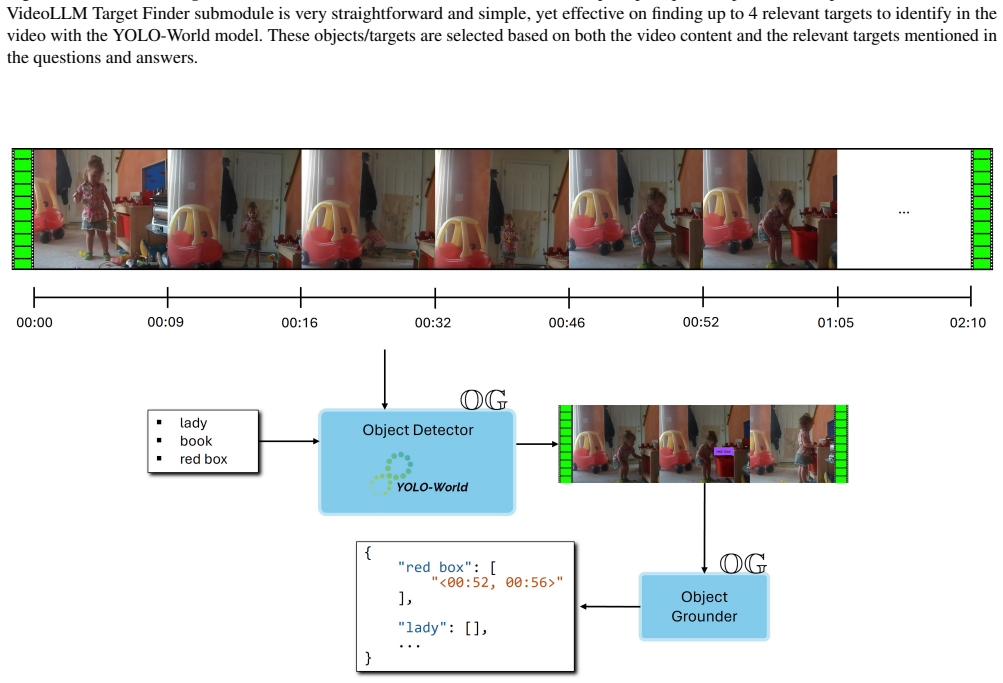
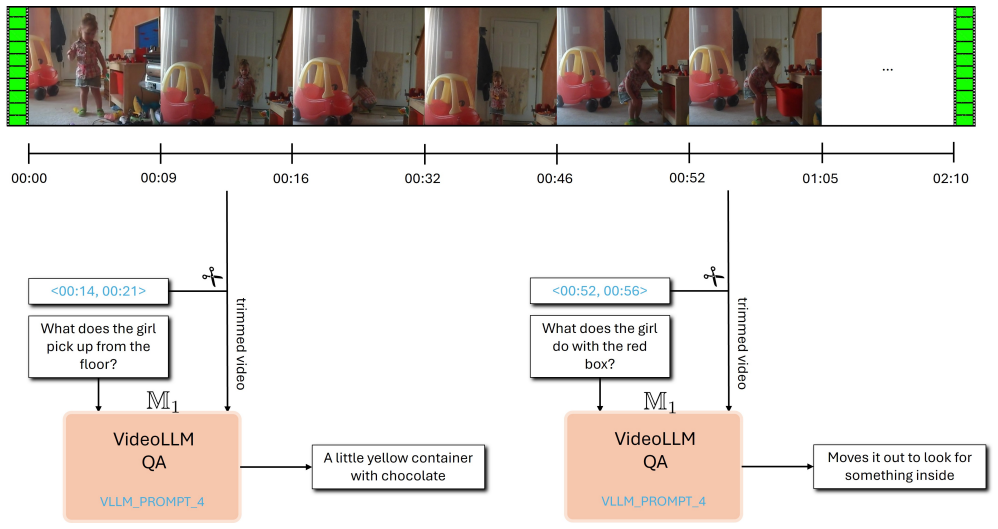
The load-bearing mechanism is the reconciliation loop between two grounding sources. The VideoLLM supplies one view: an initial answer, a set of open-vocabulary targets, and captioned timeframes of what happens when. YOLO-World, an open-vocabulary detector that finds objects named by arbitrary text rather than fixed classes, supplies the second view: a timeline of which targets are present in which frames. A chain-of-thought judge compares the two, produces a 'disagree' verdict with the specific timeframes where they conflict, and when disagreement is found a question generator writes up to three clarification questions addressed to the disputed interval; a VideoLLM answers those, and a final reasoner merges the original answer, the grounding data, and the clarifications into the response. This makes the first-sight answer checkable against an explicit perceptual record and lets the pipeline recover when the language model's temporal story does not match what the detector actually sees.
What would settle it
A decisive ablation on NExT-QA validation would replace the object-detection timeline with a stub that always reports 'no detections' and measure accuracy: if it does not drop materially from the reported 80.4%, the grounding-validation loop is not carrying the gain. A complementary check would compare questions where YOLO-World finds none of the video language model's named targets against the rest, to see whether the correction loop helps when the detector signal is empty.
Extended reading notes
Core claim
The central claim is that a zero-shot VideoQA system can reach a new state of the art by separating the narrative a video language model gives from the perceptual record an open-vocabulary object detector gives, and by refusing to finalize an answer until those two records are reconciled. ViQAgent implements this as M1 (first-sight answer, question-relevant targets, and captioned timeframes from a VideoLLM), OG (frame-by-frame detection and temporal aggregation of those targets with YOLO-World), and M2 (a chain-of-thought judge that flags disagreements, generates up to three clarification questions targeted at disputed timeframes, reruns them through the VideoLLM, and passes everything to a final reasoner). The paper reports 80.4% on NExT-QA validation, 62.6% on iVQA test, and 59.9% on ActivityNet-QA test, each above the best prior zero-shot or agentic result listed, and it interprets these numbers as evidence that object-level grounding validation, not fine-tuning, is what lets a VideoLLM answer complex temporal and causal questions reliably.
Load-bearing premise
The whole scheme depends on the object detector's timeline being truthful enough that a mismatch with the language model's first-sight answer tells the judge something real; if the detector routinely misses the named objects or invents appearances, the correction loop can wreck correct answers or bless wrong ones.
Editorial extensions
If this is right
- If the reported numbers hold, task-specific fine-tuning is not required to beat fine-tuned VideoQA models: the zero-shot pipeline's 80.4% on NExT-QA sits above the fine-tuned results listed in the paper.
- The framework transfers across answer formats without architectural change: the same three modules handle close-ended multiple-choice questions and open-ended answer generation.
- Because the final answer is assembled from timeframes, target-object timelines, and clarification answers, the output carries an audit trail that a user can inspect.
- An immediate practical consequence is that adding a new video domain only requires a dataset-specific subprompt and an updated target list from the video language model, since no module needs retraining.
Reading between the lines
- A natural next experiment the paper does not run is to ablate the clarification-question loop: if the judge simply corrected the first-sight answer from the object timeline alone, the accuracy difference would isolate how much of the gain comes from the second video-language-model look rather than from the detector signal.
- The same two-source reconciliation pattern, language-model narrative versus an explicit object-presence timeline, could be carried over to temporal action localization, video caption verification, or long-video fact-checking, though the paper does not test those tasks.
- Because the target list is itself generated by the VideoLLM, the pipeline inherits that model's naming failures; pairing target selection with a detector that can propose objects directly from the question might make the validation loop more robust on videos where the central object is small or unusual.
- The paper's own limitation note implies a testable boundary: when the relevant object is absent or undetectable, the object timeline is empty, and the judge must decide whether to trust or distrust the first-sight answer; conditioning accuracy on detector recall would map where the loop helps versus hurts.
Editorial analysis
A structured set of objections, weighed in public.
Referee Report
Summary. The paper presents ViQAgent, a zero-shot VideoQA agent that combines a VideoLLM-based analyzer (M1), an open-vocabulary object grounding module using YOLO-World (OG), and a chain-of-thought judge/reasoner (M2). The agent first obtains a preliminary answer, timeframes, and target objects from a VideoLLM; then grounds the targets in the video with YOLO-World to produce object timelines; then compares the two sources, and when discrepancies are found, generates clarification questions for the VideoLLM and produces a final answer. The authors report state-of-the-art zero-shot results on NExT-QA (80.4%), iVQA (62.6%), ActivityNet-QA (59.9%), and a partial EgoSchema evaluation, and provide code and detailed prompts.
Significance. If the reported gains were convincingly attributable to the proposed grounding-validation mechanism, this would be a meaningful contribution: it would demonstrate that open-vocabulary detection can serve as an independent check on VideoLLM answers and improve reliability in zero-shot VideoQA. The paper's strengths include a well-structured modular pipeline, public code, and detailed prompt/schema documentation that make the method easy to reproduce and extend. However, the current evidence does not establish that the grounding modules cause the reported improvements; the lack of ablations and same-backbone baselines means the headline gains may be entirely due to the underlying VideoLLM. The manuscript is therefore significant in potential but requires a substantial addition of attribution evidence.
major comments (4)
- [§4.3 / Tables 1-2] The central claim that grounding validation (OG + M2) improves accuracy is not established because no component ablation or same-backbone baseline is provided. Every baseline in Tables 1 and 2 uses a different underlying VideoLLM, while ViQAgent's M1 uses a Gemini-class VideoLLM (ref. [32]) that is presumably stronger than the backbones of MoReVQA, MotionEpic, etc. The 4.4% NExT-QA improvement over MotionEpic could therefore originate entirely in the VideoLLM, with the OG and M2 modules contributing nothing or even degrading accuracy. The authors should report: (a) M1-only accuracy (same VideoLLM, same prompt protocol, no OG/M2), (b) M1+OG without M2, (c) full ViQAgent, and (d) a same-backbone rerun of at least one strong baseline (e.g., MotionEpic or LLoVi) to calibrate the comparison. Without these, the paper's core explanatory claim is unsupported.
- [§4.2] The hyperparameters tau_c, tau_nms, and tau_t are tuned on a random, class-distributed subset of NExT-QA and then evaluated on the full NExT-QA validation split used for the headline result. This is a selection-on-the-test-benchmark protocol, even if the tuning set is a small subset, because the same benchmark is used for both tuning and final reporting. The paper should either report performance on a disjoint held-out split (or cross-validation), or tune on a different dataset and show that the chosen values transfer. Additionally, no error bars or variance estimates are given for any accuracy number; given the stochasticity acknowledged in Appendix D (even with temperature 0), the 4.4% margin over MotionEpic should be accompanied by a confidence interval or repeated-run statistics.
- [Appendix D / §3.3] The paper concedes in Appendix D that 'when the YOLO-World model cannot detect the object, confusion may arise' and asserts that the CoT judge (M2) mitigates this, but provides no quantitative evidence. The reader cannot tell how often targets are missed, how often M2 intervenes, how often it flips a correct first-sight answer to a wrong one, or whether M2's disagreement signal correlates with true errors. The reliability and 'grounding validation' claims require a decision-level analysis on a sample of each benchmark: report the fraction of samples with missing detections, the fraction of M2 clarifications, and the accuracy of M2 outputs conditioned on detection success versus failure. Without such statistics, the central mechanism of the paper is untested.
- [Algorithm 1] Algorithm 1's temporal-extraction pseudocode (lines 22-36) is internally inconsistent: the loop 'for d in D' iterates over the keys of the detection dictionary D, yet the body uses 'd[Ti]' indexing as if d were a per-frame detection list; the time variable t is incremented inside that loop, so it would advance multiple times per frame rather than once; and the initialization of TG[Ti][idx] as (t, 0) then overwriting [1] is ambiguous about the starting timestamp. This makes it impossible to reproduce the OG timeframes from the description alone. The pseudocode should be rewritten to explicitly show a per-frame loop over video frames, with detection results per target per frame, and a clear definition of the appearance-interval construction.
minor comments (5)
- [Table 3] The EgoSchema table is ambiguous: ViQAgent reports Acc=67.87 but no Subset Acc, while all baselines have both columns; it is unclear whether the 67.87 is on the 500-sample open-answer subset (which would be comparable to the baselines' Subset Acc column) or the full benchmark (which would not be comparable). Please clarify and add the missing Subset Acc for ViQAgent.
- [§4.2] The size and composition of the random tuning subset of NExT-QA are not specified; please state how many video-question pairs were used and how the class distribution was enforced.
- [Table 1 caption / §4.3] The caption says 'casual' rather than 'causal'; please fix the typo. Also, 'Vo T' in Section 4.3 should be 'VoT' (Video-of-Thought).
- [Abstract and Conclusion] The claim of a 'new state-of-the-art in VideoQA and Video Understanding' is stronger than the evidence, since the EgoSchema evaluation covers only 500 samples and is explicitly not considered a contribution; please temper the wording or clearly scope the claim to the three fully evaluated benchmarks.
- [§3.2] The module descriptions refer to 'VideoLLM' generally, while Algorithm 1 and Appendix B use VideoLLM1-4 and LLM1-3; a sentence in Section 3.2 or 3.5 identifying which model instance plays which role would improve reproducibility.
Circularity Check
NExT-QA headline is partly in-sample because grounding thresholds were tuned on a subset of the same benchmark; no derivation-level circularity and other benchmarks are independent.
-
fitted input called prediction
[Section 4.2 'Hyperparameter Tuning'; Table 1 (NExT-QA results)]
"To refine ViQAgent’s hyperparameters, we performed a series of simple modification studies on the NExT-QA dataset, specifically on each experiment’s small, randomly sampled, evenly class-distributed subset of videos."
The three thresholds that control the grounding module (τc, τnms, τt) were selected by experiments on a random subset of NExT-QA. The paper’s flagship result, 80.4% on NExT-QA in Table 1, is then reported on the full NExT-QA validation split — the same benchmark distribution used to choose the thresholds. The reported NExT-QA accuracy is therefore not an out-of-sample evaluation of the parameter choice; part of the claimed 4.4% gain over MotionEpic is absorbed by tuning on the target benchmark. This makes the NExT-QA headline partially a fitted result. The circularity is partial rather than total because iVQA and ActivityNet-QA were not used for tuning and provide independent evidence for the overall pipeline.
full rationale
There is no equation-level circularity in the ViQAgent derivation: the pipeline composes external components (Gemini-class VideoLLM, YOLO-World, separate LLM judges) and evaluates them against external benchmark ground truth. There is no self-citation chain, no imported uniqueness theorem, and no ansatz smuggled in via citation; the references to YOLO-World and Gemini are standard external systems. The only genuine circular element is in Sec. 4.2: the three OG thresholds are tuned on a random class-balanced subset of NExT-QA, and the same NExT-QA validation split is then used for the headline 80.4% number in Table 1. This makes the NExT-QA result partially in-sample and weakens the attribution of the gain to the method rather than to threshold selection. This is a fitted-input issue rather than a derivation-level reduction, and it is confined to the NExT-QA claim; iVQA and ActivityNet-QA were not used for tuning, so they independently support the general approach. The absence of a component ablation (M1 vs. M1+OG+M2) and the admitted YOLO-World failure mode in Appendix D are correctness risks, not circularity, and do not raise the score above 4.
Assumptions & free parameters
free parameters (5)
- tau_c (detection confidence threshold) =
0.05
- tau_nms (NMS IoU threshold) =
0.1
- tau_t (time threshold for object exit) =
1.5s
- max_targets =
4
- max_clarification_questions =
3
assumptions (4)
- domain assumption YOLO-World provides reliable open-vocabulary detection of arbitrary targets selected by a VideoLLM in low-resolution, high-motion video.
- domain assumption A VideoLLM can produce usable first-sight answers, captions, and target lists from a single pass over the whole video.
- domain assumption An LLM judge can reliably detect whether caption grounding and object timeline disagree, and can generate beneficial clarification questions.
- domain assumption Chain-of-Thought prompting improves answer accuracy in this setting.
Cite this review
Pith. "Pith review of ViQAgent: Zero-Shot Video Question Answering via Agent with Open-Vocabulary Grounding Validation." pith.science (2026). https://pith.science/paper/J7DS2B2G
@misc{pith2026250515928,
  author       = {Pith},
  title        = {Pith review of: ViQAgent: Zero-Shot Video Question Answering via Agent with Open-Vocabulary Grounding Validation},
  year         = {2026},
  howpublished = {\url{https://pith.science/paper/J7DS2B2G}},
  note         = {Machine review of arXiv:2505.15928}
}
read the original abstract
Recent advancements in Video Question Answering (VideoQA) have introduced LLM-based agents, modular frameworks, and procedural solutions, yielding promising results. These systems use dynamic agents and memory-based mechanisms to break down complex tasks and refine answers. However, significant improvements remain in tracking objects for grounding over time and decision-making based on reasoning to better align object references with language model outputs, as newer models get better at both tasks. This work presents an LLM-brained agent for zero-shot Video Question Answering (VideoQA) that combines a Chain-of-Thought framework with grounding reasoning alongside YOLO-World to enhance object tracking and alignment. This approach establishes a new state-of-the-art in VideoQA and Video Understanding, showing enhanced performance on NExT-QA, iVQA, and ActivityNet-QA benchmarks. Our framework also enables cross-checking of grounding timeframes, improving accuracy and providing valuable support for verification and increased output reliability across multiple video domains. The code is available at https://github.com/t-montes/viqagent.
Figures


Figures from the paper (7 more)




Forward citations
Cited by 1 Pith paper
-
A Cost-Aware, Paired Protocol for Auditing Dynamic Tool Synthesis in Agentic Video Question Answering
Introduces a cost-aware paired protocol with six outcome groups and applies it to Dynamic-SAGE versus SAGE, reporting 7.5-point accuracy gain, 28% fewer tool calls, but 34% higher token use.
Reference graph
Works this paper leans on
-
[32]
Gemini 1.5: Unlocking multimodal un- derstanding across millions of tokens of context, 2024
Gemini Team. Gemini 1.5: Unlocking multimodal un- derstanding across millions of tokens of context, 2024. 1, 3, 13
work page 2024
-
[1]
Pali-x: On scaling up a multilingual vision and language model, 2023
Xi Chen, Josip Djolonga, Piotr Padlewski, Basil Mustafa, Soravit Changpinyo, Jialin Wu, Car- los Riquelme Ruiz, Sebastian Goodman, Xiao Wang, Yi Tay, Siamak Shakeri, Mostafa Dehghani, Daniel Salz, Mario Lucic, Michael Tschannen, Arsha Nagrani, Hexiang Hu, Mandar Joshi, Bo Pang, Ceslee Mont- gomery, Paulina Pietrzyk, Marvin Ritter, AJ Piergio- vanni, Matth...
work page 2023
-
[2]
Pali: A jointly-scaled multilingual language-image model, 2023
Xi Chen, Xiao Wang, Soravit Changpinyo, AJ Piergio- vanni, Piotr Padlewski, Daniel Salz, Sebastian Good- man, Adam Grycner, Basil Mustafa, Lucas Beyer, Alexander Kolesnikov, Joan Puigcerver, Nan Ding, Keran Rong, Hassan Akbari, Gaurav Mishra, Lint- ing Xue, Ashish Thapliyal, James Bradbury, Weicheng Kuo, Mojtaba Seyedhosseini, Chao Jia, Burcu Karagol Ayan...
work page 2023
-
[3]
Yolo-world: Real- time open-vocabulary object detection
Tianheng Cheng, Lin Song, Yixiao Ge, Wenyu Liu, Xinggang Wang, and Ying Shan. Yolo-world: Real- time open-vocabulary object detection. In Proceed- ings of the IEEE/CVF Conference on Computer Vision and Pattern Recognition (CVPR), pages 16901–16911,
-
[4]
Rohan Choudhury, Koichiro Niinuma, Kris M. Kitani, and L´aszl´o A. Jeni. Zero-shot video question answering with procedural programs. CoRR, abs/2312.00937,
-
[5]
InstructBLIP: Towards general- purpose vision-language models with instruction tun- ing
Wenliang Dai, Junnan Li, Dongxu Li, Anthony Tiong, Junqi Zhao, Weisheng Wang, Boyang Li, Pascale Fung, and Steven Hoi. InstructBLIP: Towards general- purpose vision-language models with instruction tun- ing. In Thirty-seventh Conference on Neural Informa- tion Processing Systems, 2023. 12
work page 2023
-
[6]
Grounded question- answering in long egocentric videos
Shangzhe Di and Weidi Xie. Grounded question- answering in long egocentric videos. In Proceedings of the IEEE/CVF Conference on Computer Vision and Pat- tern Recognition (CVPR), pages 12934–12943, 2024. 1, 3, 4
work page 2024
-
[7]
Videoagent: A memory- augmented multimodal agent for video understanding
Yue Fan, Xiaojian Ma, Rujie Wu, Yuntao Du, Jiaqi Li, Zhi Gao, and Qing Li. Videoagent: A memory- augmented multimodal agent for video understanding. In Computer Vision – ECCV 2024, pages 75–92, Cham,
work page 2024
Show all 76 references
-
[8]
Video- of-thought: Step-by-step video reasoning from percep- tion to cognition
Hao Fei, Shengqiong Wu, Wei Ji, Hanwang Zhang, Meishan Zhang, Mong-Li Lee, and Wynne Hsu. Video- of-thought: Step-by-step video reasoning from percep- tion to cognition. In Forty-first International Confer- ence on Machine Learning, 2024. 1, 3, 8, 12
2024
-
[9]
As- sistgpt: A general multi-modal assistant that can plan, execute, inspect, and learn, 2023
Difei Gao, Lei Ji, Luowei Zhou, Kevin Qinghong Lin, Joya Chen, Zihan Fan, and Mike Zheng Shou. As- sistgpt: A general multi-modal assistant that can plan, execute, inspect, and learn, 2023. 12
2023
-
[10]
Context-guided spatio-temporal video ground- ing
Xin Gu, Heng Fan, Yan Huang, Tiejian Luo, and Libo Zhang. Context-guided spatio-temporal video ground- ing. In Proceedings of the IEEE/CVF Conference on Computer Vision and Pattern Recognition (CVPR), pages 18330–18339, 2024. 3, 4
2024
-
[11]
Albert Q. Jiang, Alexandre Sablayrolles, Antoine Roux, Arthur Mensch, Blanche Savary, Chris Bamford, De- vendra Singh Chaplot, Diego de las Casas, Emma Bou Hanna, Florian Bressand, Gianna Lengyel, Guillaume Bour, Guillaume Lample, L ´elio Renard Lavaud, Lu- cile Saulnier, Mari...
2024
-
[12]
Consistency and uncertainty: Identifying unreliable responses from black-box vision- language models for selective visual question answer- ing
Zaid Khan and Yun Fu. Consistency and uncertainty: Identifying unreliable responses from black-box vision- language models for selective visual question answer- ing. In Proceedings of the IEEE/CVF Conference on Computer Vision and Pattern Recognition (CVPR), pages 10854–10863,...
2024
-
[13]
Large language models are temporal and causal reasoners for video question an- swering
Dohwan Ko, Ji Lee, Woo-Young Kang, Byungseok Roh, and Hyunwoo Kim. Large language models are temporal and causal reasoners for video question an- swering. In Proceedings of the 2023 Conference on Empirical Methods in Natural Language Processing, pages 4300–4316, Singapore, 202...
2023
-
[14]
Blip-2: Bootstrapping language-image pre-training with frozen image encoders and large language models,
Junnan Li, Dongxu Li, Silvio Savarese, and Steven Hoi. Blip-2: Bootstrapping language-image pre-training with frozen image encoders and large language models,
-
[15]
Videochat: Chat-centric video understanding, 2024
KunChang Li, Yinan He, Yi Wang, Yizhuo Li, Wenhai Wang, Ping Luo, Yali Wang, Limin Wang, and Yu Qiao. Videochat: Chat-centric video understanding, 2024. 1, 3
2024
-
[16]
Mvbench: A compre- hensive multi-modal video understanding benchmark,
Kunchang Li, Yali Wang, Yinan He, Yizhuo Li, Yi Wang, Yi Liu, Zun Wang, Jilan Xu, Guo Chen, Ping Luo, Limin Wang, and Yu Qiao. Mvbench: A compre- hensive multi-modal video understanding benchmark,
-
[17]
Align and aggregate: Compositional reasoning with video alignment and answer aggregation for video 9 question-answering
Zhaohe Liao, Jiangtong Li, Li Niu, and Liqing Zhang. Align and aggregate: Compositional reasoning with video alignment and answer aggregation for video 9 question-answering. In 2024 IEEE/CVF Conference on Computer Vision and Pattern Recognition (CVPR), pages 13395–13404, 2024. 1, 3
2024
-
[18]
Leveraging YOLO-world and GPT-4v LMMs for zero-shot person detection and ac- tion recognition in drone imagery
Christian Limberg, Artur Gonc ¸alves, Bastien Rigault, and Helmut Prendinger. Leveraging YOLO-world and GPT-4v LMMs for zero-shot person detection and ac- tion recognition in drone imagery. In First Workshop on Vision-Language Models for Navigation and Ma- nipulation at ICRA 2...
2024
-
[19]
Video-llava: Learning united visual representation by alignment before projection,
Bin Lin, Yang Ye, Bin Zhu, Jiaxi Cui, Munan Ning, Peng Jin, and Li Yuan. Video-llava: Learning united visual representation by alignment before projection,
-
[20]
Vista-llama: Reducing hallucina- tion in video language models via equal distance to visual tokens
Fan Ma, Xiaojie Jin, Heng Wang, Yuchen Xian, Jiashi Feng, and Yi Yang. Vista-llama: Reducing hallucina- tion in video language models via equal distance to visual tokens. In Proceedings of the IEEE/CVF Con- ference on Computer Vision and Pattern Recognition (CVPR), pages 13151...
2024
-
[21]
Video-chatgpt: Towards detailed video understanding via large vision and lan- guage models, 2024
Muhammad Maaz, Hanoona Rasheed, Salman Khan, and Fahad Shahbaz Khan. Video-chatgpt: Towards detailed video understanding via large vision and lan- guage models, 2024. 1, 3, 12, 13
2024
-
[22]
Egoschema: A diagnostic benchmark for very long-form video language understanding
Karttikeya Mangalam, Raiymbek Akshulakov, and Ji- tendra Malik. Egoschema: A diagnostic benchmark for very long-form video language understanding. In Advances in Neural Information Processing Systems, pages 46212–46244. Curran Associates, Inc., 2023. 3, 7, 12
2023
-
[23]
Morevqa: Exploring mod- ular reasoning models for video question answering
Juhong Min, Shyamal Buch, Arsha Nagrani, Minsu Cho, and Cordelia Schmid. Morevqa: Exploring mod- ular reasoning models for video question answering. In Proceedings of the IEEE/CVF Conference on Com- puter Vision and Pattern Recognition (CVPR), pages 13235–13245, 2024. 1, 3, 4,...
2024
-
[24]
Compositional chain-of-thought prompt- ing for large multimodal models
Chancharik Mitra, Brandon Huang, Trevor Darrell, and Roei Herzig. Compositional chain-of-thought prompt- ing for large multimodal models. In Proceedings of the IEEE/CVF Conference on Computer Vision and Pat- tern Recognition (CVPR), pages 14420–14431, 2024. 1, 3
2024
-
[25]
Question- instructed visual descriptions for zero-shot video an- swering
David Mogrovejo and Thamar Solorio. Question- instructed visual descriptions for zero-shot video an- swering. In Findings of the Association for Com- putational Linguistics: ACL 2024, pages 9329–9339, Bangkok, Thailand, 2024. Association for Computa- tional Linguistics. 1, 3
2024
-
[26]
Gpt-4 technical report, 2024
OpenAI. Gpt-4 technical report, 2024. 1
2024
-
[27]
Sniffer: Multimodal large language model for explain- able out-of-context misinformation detection
Peng Qi, Zehong Yan, Wynne Hsu, and Mong Li Lee. Sniffer: Multimodal large language model for explain- able out-of-context misinformation detection. In Pro- ceedings of the IEEE/CVF Conference on Computer Vision and Pattern Recognition (CVPR), pages 13052– 13062, 2024. 1, 3
2024
-
[28]
TraveLER: A modular multi- LMM agent framework for video question-answering
Chuyi Shang, Amos You, Sanjay Subramanian, Trevor Darrell, and Roei Herzig. TraveLER: A modular multi- LMM agent framework for video question-answering. In Proceedings of the 2024 Conference on Empiri- cal Methods in Natural Language Processing, pages 9740–9766, Miami, Florida...
2024
-
[29]
Moviechat: From dense token to sparse memory for long video understanding
Enxin Song, Wenhao Chai, Guanhong Wang, Yucheng Zhang, Haoyang Zhou, Feiyang Wu, Haozhe Chi, Xun Guo, Tian Ye, Yanting Zhang, Yan Lu, Jenq-Neng Hwang, and Gaoang Wang. Moviechat: From dense token to sparse memory for long video understanding. In Proceedings of the IEEE/CVF Con...
2024
-
[30]
Vipergpt: Visual inference via python execution for reasoning
D´ıdac Sur ´ıs, Sachit Menon, and Carl V ondrick. Vipergpt: Visual inference via python execution for reasoning. In Proceedings of the IEEE/CVF Interna- tional Conference on Computer Vision (ICCV), pages 11888–11898, 2023. 12
2023
-
[31]
Video understanding with large language models: A survey, 2024
Yunlong Tang, Jing Bi, Siting Xu, Luchuan Song, Su- san Liang, Teng Wang, Daoan Zhang, Jie An, Jingyang Lin, Rongyi Zhu, Ali V osoughi, Chao Huang, Zeliang Zhang, Pinxin Liu, Mingqian Feng, Feng Zheng, Jian- guo Zhang, Ping Luo, Jiebo Luo, and Chenliang Xu. Video understanding...
2024
-
[33]
Vamos: Versatile action models for video understanding, 2024
Shijie Wang, Qi Zhao, Minh Quan Do, Nakul Agarwal, Kwonjoon Lee, and Chen Sun. Vamos: Versatile action models for video understanding, 2024. 12
2024
-
[34]
Videoagent: Long-form video understand- ing with large language model as agent
Xiaohan Wang, Yuhui Zhang, Orr Zohar, and Serena Yeung-Levy. Videoagent: Long-form video understand- ing with large language model as agent. In Com- puter Vision – ECCV 2024, pages 58–76, Cham, 2025. Springer Nature Switzerland. 1, 3, 8, 12
2024
-
[35]
Internvideo: General video foundation models via generative and discriminative learning, 2022
Yi Wang, Kunchang Li, Yizhuo Li, Yinan He, Bingkun Huang, Zhiyu Zhao, Hongjie Zhang, Jilan Xu, Yi Liu, Zun Wang, Sen Xing, Guo Chen, Junting Pan, Jiashuo Yu, Yali Wang, Limin Wang, and Yu Qiao. Internvideo: General video foundation models via generative and discriminative lear...
2022
-
[36]
VideoCoT: A video chain-of-thought dataset with active annotation tool
Yan Wang, Yawen Zeng, Jingsheng Zheng, Xiaofen Xing, Jin Xu, and Xiangmin Xu. VideoCoT: A video chain-of-thought dataset with active annotation tool. In Proceedings of the 3rd Workshop on Advances in Language and Vision Research (ALVR), pages 92–101, Bangkok, Thailand, 2024. A...
2024
-
[37]
Next-qa:next phase of question-answering to explaining temporal actions, 2021
Junbin Xiao, Xindi Shang, Angela Yao, and Tat-Seng Chua. Next-qa:next phase of question-answering to explaining temporal actions, 2021. 3, 6, 12
2021
-
[38]
Videoqa in the era of llms: An empirical study, 2024
Junbin Xiao, Nanxin Huang, Hangyu Qin, Dongyang Li, Yicong Li, Fengbin Zhu, Zhulin Tao, Jianxing Yu, Liang Lin, Tat-Seng Chua, and Angela Yao. Videoqa in the era of llms: An empirical study, 2024. 1, 3
2024
-
[39]
Can i trust your answer? visually grounded video question answering
Junbin Xiao, Angela Yao, Yicong Li, and Tat-Seng Chua. Can i trust your answer? visually grounded video question answering. In Proceedings of the IEEE/CVF Conference on Computer Vision and Pattern Recogni- tion (CVPR), pages 13204–13214, 2024. 1, 3, 4
2024
-
[40]
Retrieval-based video language model for efficient long video question answering, 2023
Jiaqi Xu, Cuiling Lan, Wenxuan Xie, Xuejin Chen, and Yan Lu. Retrieval-based video language model for efficient long video question answering, 2023. 1, 3
2023
-
[41]
Video- coca: Video-text modeling with zero-shot transfer from contrastive captioners, 2023
Shen Yan, Tao Zhu, Zirui Wang, Yuan Cao, Mi Zhang, Soham Ghosh, Yonghui Wu, and Jiahui Yu. Video- coca: Video-text modeling with zero-shot transfer from contrastive captioners, 2023. 12
2023
-
[42]
Zero-shot video question answer- ing via frozen bidirectional language models, 2022
Antoine Yang, Antoine Miech, Josef Sivic, Ivan Laptev, and Cordelia Schmid. Zero-shot video question answer- ing via frozen bidirectional language models, 2022. 12
2022
-
[43]
Learning to answer visual ques- tions from web videos, 2022
Antoine Yang, Antoine Miech, Josef Sivic, Ivan Laptev, and Cordelia Schmid. Learning to answer visual ques- tions from web videos, 2022. 3, 6, 12, 13
2022
-
[44]
Hitea: Hierarchical temporal-aware video-language pre-training
Qinghao Ye, Guohai Xu, Ming Yan, Haiyang Xu, Qi Qian, Ji Zhang, and Fei Huang. Hitea: Hierarchical temporal-aware video-language pre-training. In Pro- ceedings of the IEEE/CVF International Conference on Computer Vision (ICCV), pages 15405–15416, 2023. 8, 12
2023
-
[45]
Video question answering using clip-guided visual-text attention
Shuhong Ye, Weikai Kong, Chenglin Yao, Jianfeng Ren, and Xudong Jiang. Video question answering using clip-guided visual-text attention. In 2023 IEEE International Conference on Image Processing (ICIP), pages 81–85, 2023. 3
2023
-
[46]
Self-chained image-language model for video localization and question answering
Shoubin Yu, Jaemin Cho, Prateek Yadav, and Mohit Bansal. Self-chained image-language model for video localization and question answering. In Advances in Neural Information Processing Systems, pages 76749– 76771. Curran Associates, Inc., 2023. 8, 12
2023
-
[47]
Activitynet-qa: A dataset for understanding complex web videos via question answering, 2019
Zhou Yu, Dejing Xu, Jun Yu, Ting Yu, Zhou Zhao, Yueting Zhuang, and Dacheng Tao. Activitynet-qa: A dataset for understanding complex web videos via question answering, 2019. 3, 6, 12
2019
-
[48]
A simple llm framework for long-range video question- answering, 2024
Ce Zhang, Taixi Lu, Md Mohaiminul Islam, Ziyang Wang, Shoubin Yu, Mohit Bansal, and Gedas Bertasius. A simple llm framework for long-range video question- answering, 2024. 12
2024
-
[49]
Video-llama: An instruction-tuned audio-visual language model for video understanding, 2023
Hang Zhang, Xin Li, and Lidong Bing. Video-llama: An instruction-tuned audio-visual language model for video understanding, 2023. 1, 3
2023
-
[50]
Causal-cog: A causal-effect look at context generation for boosting multi-modal language models
Shitian Zhao, Zhuowan Li, Yadong Lu, Alan Yuille, and Yan Wang. Causal-cog: A causal-effect look at context generation for boosting multi-modal language models. In Proceedings of the IEEE/CVF Conference on Computer Vision and Pattern Recognition (CVPR), pages 13342–13351, 2024. 1, 3
2024
-
[51]
Video question answer- ing: Datasets, algorithms and challenges
Yaoyao Zhong, Wei Ji, Junbin Xiao, Yicong Li, Wei- hong Deng, and Tat-Seng Chua. Video question answer- ing: Datasets, algorithms and challenges. In Proceed- ings of the 2022 Conference on Empirical Methods in Natural Language Processing, pages 6439–6455, Abu Dhabi, United Ara...
2022
-
[53]
Restate or reframe the question for clarity
-
[54]
Consider key events, actions, or objects relevant to the question
-
[55]
If no options are given, logically derive an answer
If answer options are provided, assess each option in relation to the video’s content. If no options are given, logically derive an answer
-
[56]
"" Table 6. VideoLLM Analyzer Schema (VideoLLM1) Output Schema for VideoLLM Analyzer VLLM_SCHEMA_1 = {
Provide a clear and concise response based on your reasoning. You must provide the index of the selected answer or the answer itself, and a brief explanation of your reasoning. """ Table 6. VideoLLM Analyzer Schema (VideoLLM1) Output Schema for VideoLLM Analyzer VLLM_SCHEMA_1 ...
-
[57]
Carefully analyze the question and the video content to identify the key events or actions that are relevant to the question
-
[58]
Identify key events, actions, or transitions that represent meaningful changes or notable moments in the video
-
[59]
Break the video into distinct timeframes where these events occur
-
[60]
For each identified timeframe, provide a clear, detailed description of the action or scene in that segment
-
[61]
"" Table 8. VideoLLM Captioner Schema (VideoLLM2) Output Schema for VideoLLM Captioner VLLM_SCHEMA_2 = {
Ensure that each description is specific, concise, and accurately reflects the action within the timeframe. """ Table 8. VideoLLM Captioner Schema (VideoLLM2) Output Schema for VideoLLM Captioner VLLM_SCHEMA_2 = { "type": "object", "properties": { "timeframes": { "type": "arra...
-
[62]
Understand the question and its context within the video, along with any answer options provided
-
[63]
Ensure that these targets directly relate to the question
Focus on the most relevant objects or targets that are involved in the video’s key actions or scenes. Ensure that these targets directly relate to the question
-
[64]
Choose no more than 4 targets, ideally 3 or fewer. Consider only the objects that are clearly present and essential to answering the question, and that are not too complex to identify (not too large as well), but not too general for the particular video
-
[65]
Ensure that the targets are also directly related to the answer options, if provided
-
[66]
"" Table 10. VideoLLM Target Finder Schema (VideoLLM3) Output Schema for VideoLLM Target Finder VLLM_SCHEMA_3 = {
Provide a short list of targets, ensuring each description is clear and relevant (e.g., ’player in white outfit’, ’spoon’, etc.). """ Table 10. VideoLLM Target Finder Schema (VideoLLM3) Output Schema for VideoLLM Target Finder VLLM_SCHEMA_3 = { "type": "object", "properties": ...
-
[67]
**VideoLLM-extracted grounding captions **: These describe the key events and timeframes within the video (e.g., <<mm0:ss0,mm1:ss1>>: {description})
-
[68]
disagree
**YOLO object grounding **: This identifies the specific objects/targets and their appearances in different video timeframes. Your task is to analyze if there is any disagreement between the grounding information (both the captions and object grounding) and the reasoning for t...
-
[70]
"" Table 16. LLM Question Generator Schema (LLM2) Output Schema for LLM Question Generator LLM_SCHEMA_2 = {
A text explaining the set of discrepancies found in previous studies of the video. These indicate specific timeframes in the video where the grounding information does not align with the reasoning. These timeframes and the reasons for the discrepancies are provided. Your task ...
-
[71]
A question (and answer options if available) related to a video
-
[72]
This reasoning was done BEFORE knowing the grounding information, and clarification questions
An initial reasoning made for a possible answer, along with an explanation of why it was chosen. This reasoning was done BEFORE knowing the grounding information, and clarification questions
-
[73]
- **YOLO object grounding **: Objects/targets identified in the video and their corresponding appearing timeframes
The **grounding information **: - **VideoLLM grounding **: Timeframes and event descriptions from the video. - **YOLO object grounding **: Objects/targets identified in the video and their corresponding appearing timeframes
-
[74]
Your task is to:
A set of clarification questions asked about discrepancies in the grounding, and their responses. Your task is to:
-
[75]
Analyze all the provided information and reasoning
-
[76]
Select or provide the correct answer for the user question, based on the new clarifications from the questions and grounding data
-
[77]
"" Table 18. LLM Final Reasoner Schema (LLM3) Output Schema for LLM Final Reasoner LLM_SCHEMA_3 = {
Provide the final, most accurate specific answer, as well as a reasoning for it. Remember to stick to the information provided, and ensure that your answer is accurate and well-supported by the grounding information and reasoning provided. If none of the answer options are cor...
-
[2025]
1, 3, 8, 12
Springer Nature Switzerland. 1, 3, 8, 12
Reviewed August 7, 2026 · model on record in the stance chip above.
Discussion (0). Sign in to comment.