REVIEW 6 major objections 6 minor 18 references
Mesh-free sparse identification of nonlinear dynamics
T0 review · 6 major / 6 minor · reviewed 2026-08-07 · deepseek-v4-flash
Pith's one-line read A neural-network surrogate trained on arbitrarily placed sensors, combined with auto-differentiation and sparse regression, can recover the governing PDE from non-uniform space-time data, tolerating high noise and small sample sizes.
desk verdict A real algorithmic simplification—decoupled NN surrogate plus sparse regression—but undefined success criteria and contradictory tables make the headline numbers unverifiable as written. read the letter →
The pith
A machine-rendered reading of the paper's core claim, the machinery that carries it, and where it could break.
The reading
What carries the argument
The central object is the automatic-differentiation-derived candidate library: a dictionary of potential terms $\Theta$ built by differentiating the trained neural surrogate $f_\theta(x,t)$ with respect to its inputs. Auto-differentiation turns the surrogate into an analytic response surface from which spatial, temporal, and mixed derivatives at any scattered point are obtained without interpolation or grid construction. The sparse regression then selects the active terms from $\Theta$ by solving $\min_\Xi \|\partial_t \hat{u} - \Theta\Xi\|_2^2 + \lambda\|\Xi\|_1$ (or an $\ell_0$ variant), with ensemble resampling providing uncertainty quantification. This machinery is what removes the structured-grid requirement and lets the method operate on arbitrary sensor placements.
What would settle it
Train mesh-free SINDy on the Kuramoto–Sivashinsky equation with clean, densely sampled data; the paper states that the fourth-order derivative error from recursive auto-differentiation prevents recovery. If the pipeline still fails to identify the correct $u_{xxxx}$ term, the stated limitation holds; if a variant with stabilized high-order differentiation succeeds, the boundary of the method's claim changes.
Extended reading notes
Core claim
The central claim is that, by decoupling the neural-network data fit from the sparse regression, mesh-free SINDy can identify PDEs from unstructured data without the multi-stage training and hand-tuned loss weights of earlier neural-network-based discovery methods. The neural surrogate is trained only to match the observed states; derivatives are then obtained by auto-differentiation of that surrogate, which replaces finite-difference stencils that require a structured grid. The sparse regression is performed with bootstrap resampling (ensemble SINDy), which both selects the active terms and provides uncertainty estimates. The authors show consistent recovery of the correct equation structure and coefficients across four PDEs, and report that the limiting factor is the accuracy of recursive auto-differentiation for high-order derivatives, which prevents recovery of the Kuramoto–Sivashinsky equation.
Load-bearing premise
The method assumes that auto-differentiating the trained neural network yields accurate estimates of the true solution's spatial and temporal derivatives, including high-order ones; if the surrogate fits poorly or recursive differentiation amplifies error, the sparse regression is misled (the paper notes this is why Kuramoto–Sivashinsky fails).
Editorial extensions
If this is right
- PDE discovery no longer requires uniformly sampled grids; sensor data from arbitrary placements can be used directly.
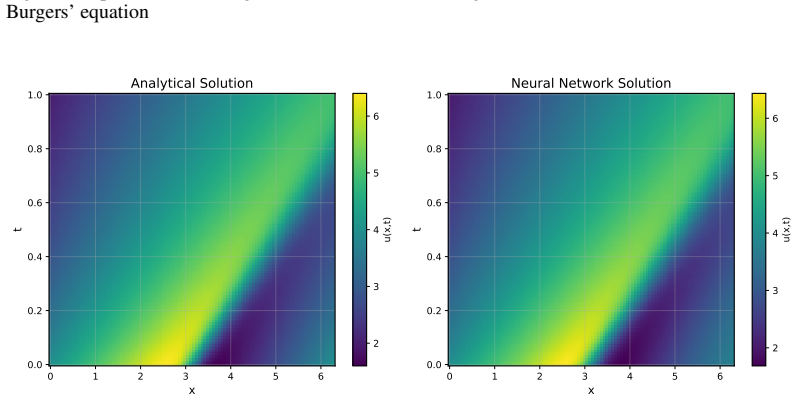
- The method remains accurate in low-data and high-noise regimes, recovering the Burgers equation with up to 75% noise at 5,000 samples and with 100 samples at 1% noise.
- Training takes under one minute and requires minimal hyperparameter tuning, making the approach practical for scientific data analysis.
- The bootstrap ensemble procedure provides uncertainty estimates on the discovered coefficients.
- Equations with fourth-order spatial derivatives, such as Kuramoto–Sivashinsky, are not currently recoverable because recursive auto-differentiation degrades the high-order derivative estimates.
Reading between the lines
- The decoupled, single-loss design suggests that the neural network need not be a perfect global fit; it only needs to be smooth enough for its derivatives to approximate the true dynamics, which may explain why small two-layer networks suffice.
- If higher-order automatic differentiation can be stabilized (for example, by hybrid finite-difference/AD estimates or by differentiating a smooth analytic fit), the method could extend to the Kuramoto–Sivashinsky equation and other fourth-order systems, which the paper identifies as the next hurdle.
- The same machinery should apply to identifying ordinary differential equations or stochastic differential equations from irregular time series, since the temporal derivative is equally available via auto-differentiation.
- A cautionary corollary: the success of the method hinges on the surrogate's derivative accuracy, so for data with very low signal-to-noise the fitted surface may smooth away genuine sharp features; users should check derivative errors rather than only state-reconstruction errors.
Editorial analysis
A structured set of objections, weighed in public.
Referee Report
Summary. The paper introduces mesh-free SINDy, an algorithm that fits a neural network surrogate to arbitrarily sampled spatio-temporal data, computes candidate PDE terms by automatic differentiation, and then performs sparse regression with ensemble SINDy to identify the governing equation. The authors report successful discovery for the Burgers, heat, Korteweg–De Vries, and 2D advection-diffusion equations under low sample counts and high noise, with training times under one minute, and they compare the method against previous PDE-identification approaches.
Significance. If the experimental claims are accurate, this is a valuable practical contribution: it relaxes the structured-grid requirement of classical SINDy and demonstrates that decoupling neural network training from sparse regression can be both fast and noise-robust. The paper also provides uncertainty quantification via bootstrapped ensemble SINDy and is candid about the failure of automatic differentiation for fourth-order derivatives. However, the absence of a defined success criterion and several contradictions between the text and the tables currently prevent verification of the central claims.
major comments (6)
- [Section 4, Appendix A.1] The success rates in Tables 1–5 are the central quantitative output of the paper, yet the manuscript nowhere defines what counts as a successful identification. Appendix A.1 lists five error metrics (EPDE, ENN, Edudt, ESINDy, Efield) but none is a threshold-based success criterion. Without a precise rule (for example, exact sparsity pattern plus a bounded relative coefficient error), the reported percentages are not falsifiable and the abstract's headline claims cannot be checked.
- [Table 6 vs. Section 4.1] Table 6 reports mesh-free SINDy with 100% noise, 100 samples, and 'High' success, but Table 2 shows 0.0% success for 100 samples at 75% noise and contains no 100% noise column. Section 5 also states that 'up to 100%' noise can be handled. Either Table 6 was generated under a different experimental protocol or the success metric is applied inconsistently; the paper must reconcile these numbers.
- [Section 4.3, Table 4] The text claims 'robust discovery under 1% noise using 2,000 samples with a 100% success rate' for the KdV equation, but Table 4 has no 1% noise column (its lowest noise level is 5%). Furthermore, Table 1 lists recovered KdV coefficients 5.38 and 0.84 against true values 6 and 1.00 as a successful case (1000 samples, 5% noise); if this passes the success criterion, the coefficient tolerance is very loose and needs to be stated explicitly.
- [Section 4.2, Tables 1 and 3] Section 4.2 states that 'the model can still successfully discover the heat equation with only 100 samples under a noisy environment,' but neither Table 1 nor Table 3 contains a 100-sample heat experiment; the smallest heat sample count is 500. This claim is either unsupported by the reported experiments or requires the missing 100-sample row to be added.
- [Section 4.4, Table 5] The text says the model 'can still successfully discover the advection-diffusion equation with only 500 samples up to 25% noise,' yet Table 5 reports 8.3% success at 500 samples with 25% noise. A 1-of-12 success rate is not 'successful discovery' in any colloquial sense, and the wording overstates the result.
- [Section 4, general] The paper never defines how noise is injected. 'Noise level' is varied from 1% to 100% in Tables 2–5, but no formula or generative model is given (e.g., additive Gaussian noise with standard deviation equal to a percentage of the signal's amplitude). This omission is essential for reproducibility and for interpreting the meaning of '100% noise' in Table 6 and Section 5.
minor comments (6)
- [Section 3, Algorithm 1] The word 'initalize' should be 'initialize'.
- [Section 3] The heading 'Mesh-free PDE dataPDEs' appears to be a formatting error and should be corrected.
- [Section 4.2] The phrase 'l0 regularization with l2 = 0.05' is ambiguous; if it means an L2 penalty on coefficients, it should be stated as such.
- [Section 4.5] The word 'additon' should be 'addition'.
- [Section 4.5, Table 6] The 'Tuning' column categories (Low/Medium/High) are undefined; a brief explanation is needed.
- [Figures 4 and 5] The axis label 'Rescaled epoch' is not explained; clarify how the training epochs are rescaled.
Circularity Check
No circularity: the discovered PDE is not an input to the neural-network training or sparse regression.
full rationale
The derivation chain is self-contained and benchmarked externally. Algorithm 1 trains a neural surrogate fθ solely to minimize the MSE between u(n) and fθ(x(n),t(n)) (steps 2–4), then computes ∂tû and the candidate dictionary Θ by automatic differentiation (steps 5–9), and finally performs sparse regression of ∂tû on Θ (step 10). The target PDE never enters the training loss or the regression objective; the ground-truth equations in Section 4 are used only to generate synthetic data and to score recovered coefficients in Tables 1–5. The component methods cited from the authors' prior work—SINDy [4] and E-SINDy [7]—are independently published algorithms whose status as tools does not make the central contribution circular. The paper's acknowledged limitation for fourth-order PDEs (Section 4.5) and the absence of an explicit definition of the 'Success' metric are reproducibility/correctness concerns, not cases where an output is equivalent to an input by construction. Similarly, the apparent inconsistency between Table 6 (100% noise, 100 samples) and Table 2 (0% at 75% noise, 100 samples) concerns experimental reporting and does not exhibit a reduction of a claimed result to its inputs. No load-bearing self-citation chain, no fitted parameter renamed as a prediction, and no self-definitional relation between the discovered equation and the inputs were found.
Assumptions & free parameters
free parameters (5)
- SINDy sparsity threshold =
0.14 for Burgers (per-equation values)
- Sparse regression L2 regularization =
0.05 for Burgers/heat/KdV, 0.0005 for advection-diffusion
- Neural network architecture and training hyperparameters =
e.g., 2x32 tanh for Burgers, 4x128 for heat, 4x30 for KdV, 8x60 for advection-diffusion; learning rates 5e-4 or 1e-3
- Candidate library terms =
interaction orders 2 or 3, specific term lists per equation
- Bootstrap subsample size m =
not specified
assumptions (5)
- domain assumption The neural network can accurately approximate the true PDE solution from scattered data points.
- domain assumption Automatic differentiation of the neural network gives accurate derivatives of the true solution, including high-order derivatives.
- domain assumption The true governing PDE is contained in the candidate library.
- ad hoc to paper Decoupling neural network training from sparse regression is a valid optimization strategy.
- standard math Ensemble SINDy provides asymptotically correct distributional estimates for the identified coefficients.
Cite this review
Pith. "Pith review of Mesh-free sparse identification of nonlinear dynamics." pith.science (2026). https://pith.science/paper/Z2CIXIJM
@misc{pith2026250516058,
  author       = {Pith},
  title        = {Pith review of: Mesh-free sparse identification of nonlinear dynamics},
  year         = {2026},
  howpublished = {\url{https://pith.science/paper/Z2CIXIJM}},
  note         = {Machine review of arXiv:2505.16058}
}
read the original abstract
Identifying the governing equations of a dynamical system is one of the most important tasks for scientific modeling. However, this procedure often requires high-quality spatio-temporal data uniformly sampled on structured grids. In this paper, we propose mesh-free SINDy, a novel algorithm which leverages the power of neural network approximation as well as auto-differentiation to identify governing equations from arbitrary sensor placements and non-uniform temporal data sampling. We show that mesh-free SINDy is robust to high noise levels and limited data while remaining computationally efficient. In our implementation, the training procedure is straight-forward and nearly free of hyperparameter tuning, making mesh-free SINDy widely applicable to many scientific and engineering problems. In the experiments, we demonstrate its effectiveness on a series of PDEs including the Burgers' equation, the heat equation, the Korteweg-De Vries equation and the 2D advection-diffusion equation. We conduct detailed numerical experiments on all datasets, varying the noise levels and number of samples, and we also compare our approach to previous state-of-the-art methods. It is noteworthy that, even in high-noise and low-data scenarios, mesh-free SINDy demonstrates robust PDE discovery, achieving successful identification with up to 75% noise for the Burgers' equation using 5,000 samples and with as few as 100 samples and 1% noise. All of this is achieved within a training time of under one minute.
Figures


Figures from the paper (9 more)




Reference graph
Works this paper leans on
-
[1]
H. Bateman. Some recent researches on the motion of fluids.Monthly Weather Review, 43(4):163–170, 1915
work page 1915
-
[2]
D. Bertsimas and W. Gurnee. Learning sparse nonlinear dynamics via mixed-integer optimiza- tion.Nonlinear Dynamics, 111(7):6585–6604, 2023
work page 2023
-
[3]
G.-J. Both, S. Choudhury, P. Sens, and R. Kusters. Deepmod: Deep learning for model discovery in noisy data.Journal of Computational Physics, 428:109985, 2021
work page 2021
-
[4]
S. L. Brunton, J. L. Proctor, and J. N. Kutz. Discovering governing equations from data by sparse identification of nonlinear dynamical systems.Proceedings of the national academy of sciences, 113(15):3932–3937, 2016
2016
-
[5]
J. M. Burgers. A mathematical model illustrating the theory of turbulence.Advances in applied mechanics, 1:171–199, 1948
1948
-
[6]
Z. Chen, Y . Liu, and H. Sun. Physics-informed learning of governing equations from scarce data.Nature Communications, 12(1), 2021
work page 2021
- [7]
-
[8]
L. Gao, U. Fasel, S. L. Brunton, and J. N. Kutz. Convergence of uncertainty estimates in ensemble and bayesian sparse model discovery.arXiv preprint arXiv:2301.12649, 2023
arXiv 2023
Show all 18 references
-
[9]
Gao and N
M. Gao and N. Kutz. Bayesian autoencoders for data-driven discovery of coordinates, governing equations and fundamental constants.Proceedings of the Royal Society A: Mathematical, Physical and Engineering Sciences, 480(2286), 2024
2024
-
[10]
V . Iyer, R. Nandakumar, A. Wang, S. B. Fuller, and S. Gollakota. Living iot: A flying wireless platform on live insects. InThe 25th Annual International Conference on Mobile Computing and Networking, pages 1–15, 2019
2019
-
[11]
Karczmarczuk
J. Karczmarczuk. Functional differentiation of computer programs.Higher-Order and Symbolic Computation, 14(1):35–57, 2001
2001
-
[12]
D. A. Messenger and D. M. Bortz. Weak sindy: Galerkin-based data-driven model selection. Multiscale Modeling & Simulation, 19(3):1474–1497, 2021. 10
2021
-
[13]
B. A. Pearlmutter and J. M. Siskind. Lazy multivariate higher-order forward-mode ad. InPro- ceedings of the 34th annual ACM SIGPLAN-SIGACT symposium on Principles of programming languages, POPL07, page 155–160. ACM, Jan. 2007
2007
-
[14]
R. W. Reynolds, N. A. Rayner, T. M. Smith, D. C. Stokes, and W. Wang. An improved in situ and satellite sst analysis for climate.Journal of climate, 15(13):1609–1625, 2002
2002
-
[15]
Rubanova, R
Y . Rubanova, R. T. Chen, and D. K. Duvenaud. Latent ordinary differential equations for irregularly-sampled time series.Advances in neural information processing systems, 32, 2019
2019
-
[16]
S. H. Rudy, S. L. Brunton, J. L. Proctor, and J. N. Kutz. Data-driven discovery of partial differential equations.Science advances, 3(4):e1602614, 2017
2017
-
[17]
D. E. Rumelhart, G. E. Hinton, R. J. Williams, et al. Learning internal representations by error propagation, 1985
1985
-
[18]
Stephany and C
R. Stephany and C. Earls. PDE-LEARN: Using deep learning to discover partial differential equations from noisy, limited data.Neural Networks, 174:106242, 2024. A Experimental details A.1 Error Metrics We evaluate our SINDy model using five complementary error metrics: • PDE Co...
2024
Reviewed August 7, 2026 · model on record in the stance chip above.
Discussion (0). Continue with ORCID to comment.