REVIEW 5 major objections 6 minor 35 references
Manipulating Elasto-Plastic Objects With 3D Occupancy and Learning-Based Predictive Control
T0 review · 5 major / 6 minor · reviewed 2026-08-07 · deepseek-v4-flash
Pith's one-line read This paper claims that dense 3D occupancy, learned dynamics, and predictive control let a robot shape plasticine into given goal shapes.
desk verdict Dense 3D occupancy plus learned MPC is a solid step for elasto-plastic manipulation, but the 'given goal shape' claim outruns what the representation and experiments support. read the letter →
The pith
A machine-rendered reading of the paper's core claim, the machinery that carries it, and where it could break.
The reading
What carries the argument
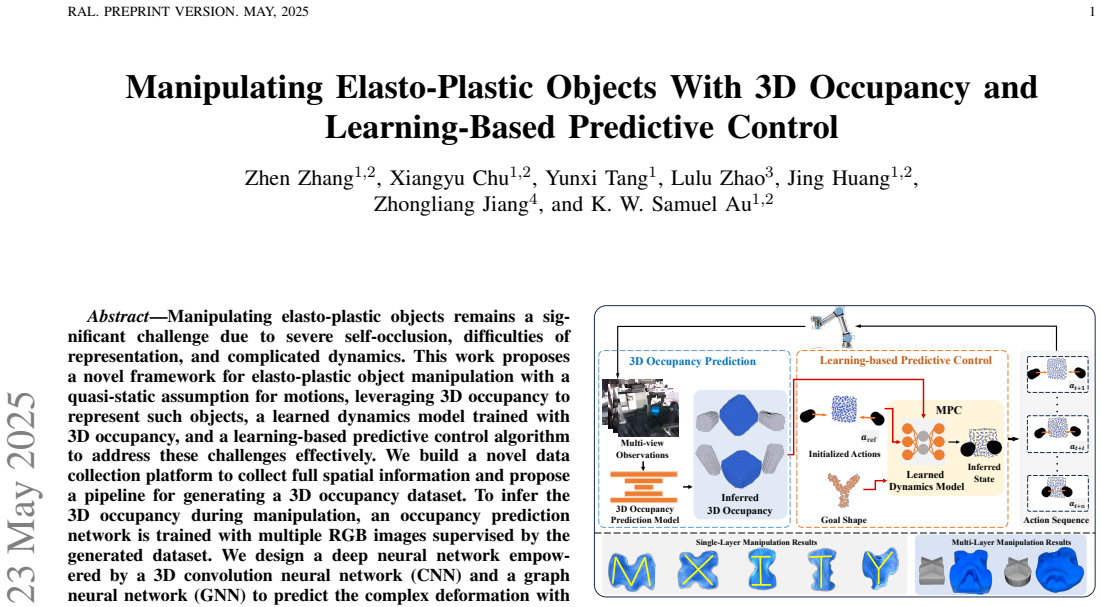
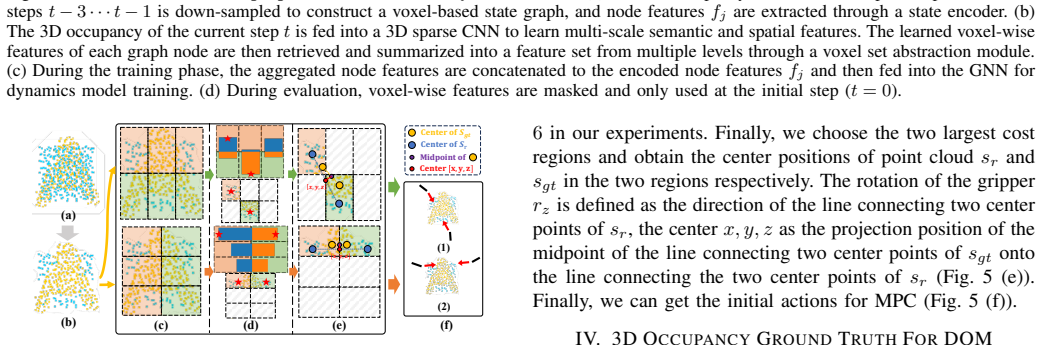
The central object is the dense 3D occupancy grid, a voxelized representation in which each voxel holds the probability that it is occupied by the plasticine, the gripper, or the operating plane. From this grid the pipeline keeps a sparse voxel state via farthest point sampling, forms a graph whose edges encode spatial and finger-object relations, and feeds the graph into a dynamics model that combines a 3D sparse CNN for multi-scale volumetric features with a graph neural network for node-state propagation. A shape-based action initialization module uses the geometric mismatch between the current and goal states to seed the MPC action sequence, and L-BFGS optimizes the actions against the learned dynamics model. The occupancy-prediction network, supervised by the offline-generated occupancy labels, supplies the inferred state that lets the whole loop run at test time from RGB images alone.
What would settle it
Run the framework on a task that forces a topological change, for example splitting one clay blob into two separate blobs or merging two blobs into one, and compare the reconstructed occupancy ground truth and the final shaped object against the goal; if the occupancy labels miss the split or merge, the learned dynamics and controller cannot plan it, and the general 'given goal shape' claim fails.
Extended reading notes
Core claim
On the paper's own terms, the central discovery is that the combination of a 3D-occupancy state representation, a 3D CNN-GNN dynamics model, and learning-based model predictive control successfully shapes elasto-plastic objects into given goal shapes. The authors report that their 3D-occupancy-based state representation beats patch-based and crop-based alternatives on Earth Mover's Distance, Density-aware Chamfer Distance, and Chamfer Distance, and that their dynamics model beats two GNN-only baselines on the same metrics. They further demonstrate in hardware that the framework can produce single-layer letters with varying symmetry, two-layer stamps with controlled height ratios, and shapes starting from different initial geometries, colors, and materials. The paper also presents the data-collection platform and pipeline, using cameras above and below a transparent plane followed by Poisson surface reconstruction and voxelization, that produce the dense 3D occupancy labels used to supervise the occupancy predictor.
Load-bearing premise
The load-bearing premise is that the 3D occupancy labels used to supervise the occupancy predictor and dynamics model are accurate, specifically that Poisson surface reconstruction, an algorithm that builds a watertight mesh from a point cloud, captures the plasticine's shape faithfully at every manipulation step; the authors themselves note that it struggles with fine topological changes such as splits and merges.
Editorial extensions
If this is right
- If the framework works as claimed, a deformable-object manipulation system can be built without real-time mesh reconstruction or particle-based simulation, using only RGB images and a learned occupancy representation.
- The reported gains over surface- and crop-based representations suggest that internal volumetric information helps learned dynamics models predict plastic deformation, so other volumetric manipulation tasks may benefit from dense occupancy states.
- Because the shape-based action initialization reportedly stabilizes the irreversible deformation process, the same initialization idea could be applied to other MPC-based deformable-object planners.
- The transparent-plane data collection pipeline, if accurate, provides a way to generate dense occupancy labels for training in other lab settings.
Reading between the lines
- We would infer that the framework's performance is tied to the transparent-plane setup: without bottom views, the occupancy labels degrade, so the claimed 'given goal shape' generality is most safely read as applying to instrumented environments with full spatial coverage.
- Because the authors note that Poisson surface reconstruction misses fine topological changes such as splits and merges, goal shapes that require separating or merging material are a plausible failure boundary for the current method.
- The shape-based initialization could be tested as a standalone module: pairing it with a weaker dynamics model would reveal how much of the planning success comes from initialization versus learned prediction.
- The occupancy representation may extend beyond plasticine to dough, clay, or foam-like materials, but the sim-to-real gap reported here suggests each new material needs fine-tuning on real data.
Editorial analysis
A structured set of objections, weighed in public.
Referee Report
Summary. The paper proposes a complete pipeline for manipulating elasto-plastic objects (plasticine) using a dense 3D occupancy representation. A multi-view RGB input is mapped to 3D occupancy by a prediction network; a 3D CNN-GNN model learns the quasi-static transition dynamics on a down-sampled voxel graph; and a model predictive controller with a shape-based action initialization plans pinch actions. The authors contribute a data-collection platform with a transparent plane for full spatial coverage and a pipeline that converts multi-view RGB-D into voxelized occupancy ground truth. Experiments in simulation and on a UR5e platform evaluate the representation, dynamics model, ablations, and several goal shapes (X, T, K, Y, M, two-layer stamps), with comparisons against RoboCraft and RoboCook and against human demonstrations.
Significance. If the reported claims are appropriately scoped, the framework is a useful step: the 3D occupancy representation and the 3D CNN-GNN dynamics model are evaluated with multiple geometric metrics, and the ablation studies isolate the contribution of the 3D CNN, the DCD loss, and the shape-based initialization. The transparent-plane data collection platform is a practical contribution for acquiring full spatial information. The main weaknesses are the mismatch between the universal 'given goal shape' claim and the acknowledged inability to represent topological changes, the absence of quantitative real-world evaluation, and the insufficiently controlled baseline comparison. The paper would be acceptable after these issues are addressed.
major comments (5)
- [Section VI, Abstract] The abstract and introduction state that the framework 'can successfully shape the elasto-plastic objects into a given goal shape,' but Section VI concedes that Poisson surface reconstruction (used to generate the occupancy ground truth in Section IV.D) 'struggles to capture fine topological changes such as splits and merges.' All demonstrated goals (X, T, K, Y, M, two-layer stamps) are reachable by pinching without any split or merge. Since the occupancy labels and the learned dynamics cannot represent topological transitions, the universal claim is not supported. Please either demonstrate a task that requires a split or merge, or explicitly restrict the claim to topology-preserving deformations.
- [Section V.B.3, Figures 9-12] The real-world manipulation results are presented only as photographs and qualitative statements such as 'closely resembling the goal shape.' There are no quantitative metrics (e.g., EMD, DCD, CD) computed on the real-world final states, no repeated trials with error bars, and no defined success criterion. To substantiate the claim of real-world verification, please provide objective measurements of the final shapes against the goal geometry, with mean and standard deviation over multiple trials.
- [Section V.B.2, Table II] The comparison with RoboCraft and RoboCook is not fully controlled. The baselines are trained for 100 epochs while the proposed model is trained for 24 epochs, and no significance tests are reported. The reported error bars overlap substantially (e.g., EMD for RoboCraft is 24.3±2.82 vs. 22.8±2.30 for ours; DCD is 27.3±2.30 vs. 25.3±1.52). Please match the training budget or explain the difference, and add significance testing (e.g., paired bootstrap or t-test) before claiming consistent superiority.
- [Section III.D, Section V.A] The model predictive control component is underspecified. The time horizon t, the number of L-BFGS iterations, the line-search or step-size settings, and the exact values of the parameter m in the shape-based initialization are not reported. Since MPC and the initialization module are central contributions, please provide an algorithm pseudocode and a parameter table to make the method reproducible.
- [Section IV.D, Section VI] The ground-truth occupancy is generated by Poisson surface reconstruction of RGB-D point clouds, and the authors acknowledge that this 'struggles to capture fine topological changes such as splits and merges.' Because both the occupancy prediction network and the dynamics model are trained on these labels, reconstruction errors (e.g., at thin structures, contacts, or near the transparent plane) propagate into the learned models. Please quantify the reconstruction accuracy against simulator ground truth where available and discuss the sensitivity of the downstream dynamics and MPC to these errors.
minor comments (6)
- [Equation (4)] The DCD formula uses undefined notation n_lambda_hat_y and n_lambda_hat_x; please define these quantities explicitly.
- [Section V.B.1] 'Averaged over 160 frames (i.e., four pinches)' is ambiguous; please specify the number of frames per pinch and how the 70/20 episode split is used.
- [Figure 8] The embedded quantitative table is difficult to read and appears to have rows and columns that may be misaligned; please enlarge the table and ensure the method labels match the legend.
- [Figure 12] The label 'Humancraft1' should be 'Human craft 1'.
- [Section V.A] Please clarify whether the real-world fine-tuning uses the same occupancy loss as the simulation training and how many real episodes are used for fine-tuning versus evaluation.
- [Section III.A] The phrase 'parallelled 2-finger gripper' should be 'parallel 2-finger gripper'.
Circularity Check
No significant circularity: learned components are evaluated on held-out data and against independent baselines, and the only self-citation is non-load-bearing.
full rationale
The derivation chain is self-contained. The 3D occupancy prediction network (Eq. 2) is supervised by the generated occupancy ground truth of Sec. IV, and Table I evaluates it on held-out simulator frames against that same ground truth; this is a standard supervised-learning protocol, not a fitted input renamed as a prediction. The dynamics model (Eq. 1, Sec. III-C) is trained with EMD/DCD/CD losses on collected transitions and compared against independent RoboCraft and RoboCook baselines (Table II); the metrics are externally computed geometric distances on held-out states, so no fitted parameter is reused as a prediction. The MPC objective in Sec. III-D uses the same loss as the dynamics training loss, but that is a control objective, not a circular derivation, and the shape-based action initialization is explicitly ablated in Fig. 13. The only self-citation is [31] (DOFS), used for data-collection platform details in Sec. IV-A, and it is not load-bearing for the central manipulation claim. Section VI's caveat that Poisson surface reconstruction struggles with splits and merges is a data-quality and generality limitation, not a case where an output reduces to an input. No equation or claim reduces by construction to its own inputs.
Assumptions & free parameters
free parameters (4)
- Total loss weights w1, w2, w3 =
w1=0.5, w2=0.4, w3=0.1
- DCD temperature alpha and density scale lambda =
alpha=500, lambda=0.5 (evaluation); alpha=20, lambda=0.1 (training)
- Downsampled state size k =
k=300
- Shape-based initialization region count m =
m in [3,6]
assumptions (5)
- domain assumption The deformation dynamics of the elasto-plastic object are quasi-static.
- domain assumption Poisson surface reconstruction from six RGB-D views yields meshes accurate enough for voxel occupancy ground truth.
- domain assumption The occupancy prediction network trained with occluded samples can infer occluded regions from four RGB cameras during deployment.
- domain assumption Gripper actions are limited to translation in x/y/z, rotation about z, and finger distance.
- domain assumption The learned dynamics model is differentiable and L-BFGS can optimize the action sequence effectively.
Cite this review
Pith. "Pith review of Manipulating Elasto-Plastic Objects With 3D Occupancy and Learning-Based Predictive Control." pith.science (2026). https://pith.science/paper/FSBUMVPD
@misc{pith2026250516249,
  author       = {Pith},
  title        = {Pith review of: Manipulating Elasto-Plastic Objects With 3D Occupancy and Learning-Based Predictive Control},
  year         = {2026},
  howpublished = {\url{https://pith.science/paper/FSBUMVPD}},
  note         = {Machine review of arXiv:2505.16249}
}
read the original abstract
Manipulating elasto-plastic objects remains a significant challenge due to severe self-occlusion, difficulties of representation, and complicated dynamics. This work proposes a novel framework for elasto-plastic object manipulation with a quasi-static assumption for motions, leveraging 3D occupancy to represent such objects, a learned dynamics model trained with 3D occupancy, and a learning-based predictive control algorithm to address these challenges effectively. We build a novel data collection platform to collect full spatial information and propose a pipeline for generating a 3D occupancy dataset. To infer the 3D occupancy during manipulation, an occupancy prediction network is trained with multiple RGB images supervised by the generated dataset. We design a deep neural network empowered by a 3D convolution neural network (CNN) and a graph neural network (GNN) to predict the complex deformation with the inferred 3D occupancy results. A learning-based predictive control algorithm is introduced to plan the robot actions, incorporating a novel shape-based action initialization module specifically designed to improve the planner efficiency. The proposed framework in this paper can successfully shape the elasto-plastic objects into a given goal shape and has been verified in various experiments both in simulation and the real world.
Figures


Figures from the paper (7 more)



Reference graph
Works this paper leans on
-
[1]
Learning foresightful dense visual affordance for de- formable object manipulation,
R. Wuet al., “Learning foresightful dense visual affordance for de- formable object manipulation,” inICCV, pp. 10947–10956, 2023
work page 2023
-
[2]
Foldsformer: Learning sequential multi-step cloth ma- nipulation with space-time attention,
K. Moet al., “Foldsformer: Learning sequential multi-step cloth ma- nipulation with space-time attention,”RAL, vol. 8, no. 2, pp. 760–767, 2022
work page 2022
-
[3]
Learning-based MPC with safety filter for constrained deformable linear object manipulation,
Y . Tanget al., “Learning-based MPC with safety filter for constrained deformable linear object manipulation,”RAL, 2024
work page 2024
-
[4]
RoboCraft: Learning to see, simulate, and shape elasto- plastic objects in 3D with graph networks,
H. Shiet al., “RoboCraft: Learning to see, simulate, and shape elasto- plastic objects in 3D with graph networks,”IJRR, vol. 43, no. 4, pp. 533–549, 2024
work page 2024
-
[5]
S. Chenet al., “DiffSRL: Learning dynamical state representation for deformable object manipulation with differentiable simulation,”RAL, vol. 7, no. 4, pp. 9533–9540, 2022
work page 2022
-
[6]
Learning closed-loop dough manipulation using a differ- entiable reset module,
C. Qiet al., “Learning closed-loop dough manipulation using a differ- entiable reset module,”RAL, vol. 7, no. 4, pp. 9857–9864, 2022
work page 2022
-
[7]
6-DoF GraspNet: Variational grasp generation for object manipulation,
A. Mousavianet al., “6-DoF GraspNet: Variational grasp generation for object manipulation,” inICCV, pp. 2901–2910, 2019
work page 2019
-
[8]
Realtime simulation of thin-shell deformable materials using CNN-based mesh embedding,
Q. Tanet al., “Realtime simulation of thin-shell deformable materials using CNN-based mesh embedding,”RAL, vol. 5, no. 2, pp. 2325–2332, 2020
work page 2020
Show all 35 references
-
[9]
Sim-to-real reinforcement learning for deformable object manipulation,
J. Mataset al., “Sim-to-real reinforcement learning for deformable object manipulation,” inCoRL, pp. 734–743, 2018
2018
-
[10]
Learning visual-based deformable object rearrangement with local graph neural networks,
Y . Denget al., “Learning visual-based deformable object rearrangement with local graph neural networks,”Complex & Intelligent Systems, vol. 9, no. 5, pp. 5923–5936, 2023
2023
-
[11]
Learning particle dynamics for manipulating rigid bodies, deformable objects, and fluids,
Y . Liet al., “Learning particle dynamics for manipulating rigid bodies, deformable objects, and fluids,”arXiv:1810.01566, 2018
2018 arXiv
-
[12]
DefGoalNet: Contextual goal learning from demonstra- tions for deformable object manipulation,
B. Thachet al., “DefGoalNet: Contextual goal learning from demonstra- tions for deformable object manipulation,”ICRA, pp. 3145–52, 2024
2024
-
[13]
DeformerNet: Learning bimanual manipulation of 3D deformable objects,
B. Thachet al., “DeformerNet: Learning bimanual manipulation of 3D deformable objects,”arXiv:2305.04449, 2023
2023 arXiv
-
[14]
SculptDiff: Learning robotic clay sculpting from humans with goal conditioned diffusion policy,
A. Bartschet al., “SculptDiff: Learning robotic clay sculpting from humans with goal conditioned diffusion policy,” inIROS, pp. 7307– 7314, 2024
2024
-
[15]
DeformNet: Latent space modeling and dynamics predic- tion for deformable object manipulation,
C. Liet al., “DeformNet: Latent space modeling and dynamics predic- tion for deformable object manipulation,”arXiv:2402.07648, 2024
2024 arXiv
-
[16]
The surprising effectiveness of linear models for visual foresight in object pile manipulation,
H. J. T. Suhet al., “The surprising effectiveness of linear models for visual foresight in object pile manipulation,” inAlgorithmic Foundations of Robotics XIV, pp. 347–363, 2021
2021
-
[17]
Neural field dynamics model for granular object piles manipulation,
S. Xueet al., “Neural field dynamics model for granular object piles manipulation,” inCoRL, pp. 2821–2837, 2023
2023
-
[18]
Dynamic-resolution model learning for object pile manipulation,
Y . Wanget al., “Dynamic-resolution model learning for object pile manipulation,”arXiv:2306.16700, 2023
2023 arXiv
-
[19]
Transporter networks: Rearranging the visual world for robotic manipulation,
A. Zenget al., “Transporter networks: Rearranging the visual world for robotic manipulation,” inCoRL, pp. 726–747, 2021
2021
-
[20]
Learning compositional Koopman operators for model- based control,
Y . Liet al., “Learning compositional Koopman operators for model- based control,”arXiv:1910.08264, 2019
1910 arXiv
-
[21]
RoboCook: Long-horizon elasto-plastic object manipula- tion with diverse tools,
H. Shiet al., “RoboCook: Long-horizon elasto-plastic object manipula- tion with diverse tools,”arXiv:2306.14447, 2023
2023 arXiv
-
[22]
Sculptbot: Pre-trained models for 3D deformable object manipulation,
A. Bartschet al., “Sculptbot: Pre-trained models for 3D deformable object manipulation,” inICRA, pp. 12548–12555, 2024
2024
-
[23]
Fast marching farthest point sampling,
C. Moenninget al., “Fast marching farthest point sampling,” Tech. Rep., University of Cambridge, Computer Laboratory, 2003
2003
-
[24]
Deep residual learning for image recognition,
K. Heet al., “Deep residual learning for image recognition,” inCVPR, pp. 770–778, 2016
2016
-
[25]
SurroundOcc: Multi-camera 3D occupancy prediction for autonomous driving,
Y . Weiet al., “SurroundOcc: Multi-camera 3D occupancy prediction for autonomous driving,” inICCV, pp. 21729–21740, 2023
2023
-
[26]
PV-RCNN: Point-voxel feature set abstraction for 3D object detection,
S. Shiet al., “PV-RCNN: Point-voxel feature set abstraction for 3D object detection,” inCVPR, pp. 10529–10538, 2020
2020
-
[27]
A metric for distributions with applications to image databases,
Y . Rubneret al., “A metric for distributions with applications to image databases,” inICCV, pp. 59–66, 1998
1998
-
[28]
Density-aware Chamfer Distance as a comprehensive metric for point cloud completion,
T. Wuet al., “Density-aware Chamfer Distance as a comprehensive metric for point cloud completion,”arXiv:2111.12702, 2021
2021 arXiv
-
[29]
Practical Methods of Optimization,
R. Fletcher, “Practical Methods of Optimization,” John Wiley & Sons, 2013
2013
-
[30]
PokeFlex: Towards a real-world dataset of deformable objects for robotic manipulation,
J. Obristet al., “PokeFlex: Towards a real-world dataset of deformable objects for robotic manipulation,”arXiv:2409.17124, 2024
2024 arXiv
-
[31]
DOFS: A real-world 3D deformable object dataset with full spatial information for dynamics model learning,
Z. Zhanget al., “DOFS: A real-world 3D deformable object dataset with full spatial information for dynamics model learning,” arXiv:2410.21758, 2024
2024 arXiv
-
[32]
A density-based algorithm for discovering clusters in large spatial databases with noise,
M. Esteret al., “A density-based algorithm for discovering clusters in large spatial databases with noise,” inProceedings of KDD, vol. 96, no. 34, pp. 226–231, 1996
1996
-
[33]
Poisson surface reconstruction,
M. Kazhdanet al., “Poisson surface reconstruction,” inProc. Eurograph- ics Symp. Geometry Processing (SGP), vol. 7, no. 4, 2006
2006
-
[34]
PlasticineLab: A soft-body manipulation benchmark with differentiable physics,
Z. Huanget al., “PlasticineLab: A soft-body manipulation benchmark with differentiable physics,”arXiv:2104.03311, 2021
2021 arXiv
-
[35]
Universal Manipulation Interface: In-the-wild robot teaching without in-the-wild robots,
C. Chiet al., “Universal Manipulation Interface: In-the-wild robot teaching without in-the-wild robots,”arXiv:2402.10329, 2024
2024 arXiv
Reviewed August 7, 2026 · model on record in the stance chip above.
Discussion (0). Sign in to comment.