REVIEW 4 major objections 5 minor 20 references
All You Need is "Leet": Evading Hate-speech Detection AI
T0 review · 4 major / 5 minor · reviewed 2026-08-07 · deepseek-v4-flash
Pith's one-line read Character tricks fool hate-speech AI on 86.8% of toxic tweets.
desk verdict Reasonably honest student replication of known hate-speech evasions, but the headline 86.8% is untraceable and the human check is a classroom poll. read the letter →
The pith
A machine-rendered reading of the paper's core claim, the machinery that carries it, and where it could break.
The reading
What carries the argument
The engine of the attack is a query-based word-importance scorer combined with a table of character substitutions. For a given tweet, the authors query Perspective once for a base toxicity, then once per word with that word deleted; the drop in score attributes a toxicity to each word, letting the attacker pick the most toxic token(s) to modify. The modification is either a leet-speak rewrite, mapping each English letter to a visually similar Cyrillic, Greek, Cherokee, or Latin Unicode character, or a whitespace/typographic edit such as replacing spaces with underscores, removing spaces, or inserting zero-width spaces. This machinery is what makes the attack black-box: it needs only toxicity scores, never gradients or model weights.
What would settle it
Have independent annotators label the original and perturbed tweets for hatefulness without knowing which is which. If a significant fraction of the tweets the detectors now pass are judged non-hateful, the 86.8% evasion figure is really content removal. A complementary computational check is to preprocess the perturbed tweets with Unicode normalization, mapping homoglyphs back to ASCII, and underscore-to-space tokenization before calling the APIs; if the category shift largely vanishes, the attack exploits a preprocessing gap rather than a fundamental model limitation.
Extended reading notes
Core claim
The paper claims that black-box hate-speech detection services can be evaded by character-level perturbations that leave the text human-readable and, in the authors' assessment, semantically unchanged. Using the Perspective API and the open-source HateSonar library as targets, it designs seven perturbations and measures how many tweets move from the toxic bucket to a non-toxic or unrecognized bucket. The best attack, a composite of underscore insertion and leet-speak Unicode substitution, shifts 86.8% of originally toxic tweets, while the paper's word-removal queries show which words to attack without ever seeing the model's internals. The authors also report that whitespace-manipulation attacks work well, which they interpret as evidence that the targeted models rely on whitespace-based tokenization.
Load-bearing premise
The load-bearing assumption is that the perturbed tweets still carry the same hateful meaning as the originals; the paper's only check of this is the unanimous opinion of classmates during a course presentation, not a controlled human study with independent annotators.
Editorial extensions
If this is right
- If the 86.8% evasion rate holds, current deployment of the tested moderation APIs is bypassable by attackers with no model knowledge and no rate-limit-breaking effort.
- The strong performance of underscore and whitespace edits indicates the target models tokenize on whitespace; retraining or re-tokenizing on additional separators would neutralize several of the attacks.
- The proposed defenses, namely inverse Unicode mapping, autocorrect, underscore-aware tokenization, zero-width-space stripping, and word-break reconstruction, would, if adopted, cover all seven perturbations presented.
- Because word importance for the HateSonar attack is borrowed from Perspective API scores, the attack's transferability to other detectors depends on the availability of a proxy scorer for finding toxic words.
Reading between the lines
- A controlled human-subject study measuring hatefulness preservation would either confirm or overturn the 86.8% claim; this is the obvious next experiment and the paper leaves it open.
- The attack class generalizes: any detector that relies on surface tokenization and does not normalize Unicode equivalents is vulnerable to the same homoglyph trick, so the finding plausibly extends beyond the two tested APIs to newer transformer-based moderators.
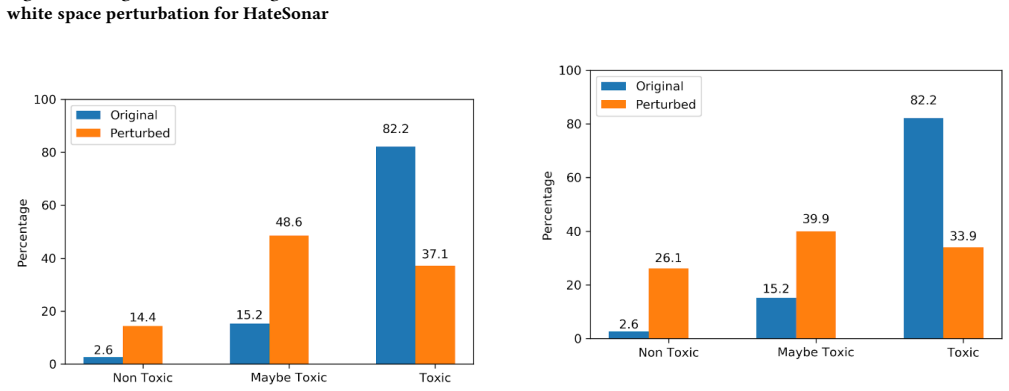
- Reporting the full post-perturbation toxicity distribution, rather than a single category-shift number, would show how much the headline rate depends on the chosen toxicity threshold of 0.66.
Editorial analysis
A structured set of objections, weighed in public.
Referee Report
Summary. This paper proposes black-box character-level perturbations—leet-speak substitution, typo insertion, underscore insertion, whitespace removal, zero-width-space insertion, and two composite attacks—to reduce the toxicity scores returned by the Perspective API and HateSonar. The authors evaluate on 20,705 tweets from the Mondal et al. dataset, report a mean change in toxicity and category shift scores, and claim an 86.8% evasion rate for their best attack against hateful text. They also sketch defenses such as Unicode normalization, auto-correct, tokenization changes, and word-break algorithms.
Significance. If the 86.8% evasion rate held while preserving the meaning of hate speech, the paper would provide a useful demonstration that commercial hate-speech detectors remain vulnerable to simple character-level perturbations under realistic black-box query access. Strengths include the clearly specified threat model, the public release of source code and data, and the inclusion of proposed defenses. However, as detailed below, the current evidence does not support the headline claim: the key result is not numerically traceable, the modified shift metric treats API failures as successful evasions, and semantic preservation rests on an informal classroom poll.
major comments (4)
- [Abstract; Section 3] The headline number 86.8% does not appear in the body of the paper. Section 3 and Figure 7 report the resulting shifts only as figures, with no numeric table, no per-attack breakdown, and no statement of which attack, which API, and which metric produce the 86.8% value. Without a traceable numeric results table, the central quantitative claim cannot be verified. Please report for every attack and both APIs the exact category shift, the percent of no-score responses, the mean toxicity change, and the sample size underlying each percentage.
- [Section 2.4.1] The modified category shift score is defined as the percentage of examples that moved from Toxic to any other category plus the percentage for which Perspective returned no score. This treats a refusal to score (Section 2.3.4) as an evasion. Since heavy perturbation is what triggers the refusal, the no-score cases are likely concentrated in the most perturbed inputs; counting them as evasions inflates the success measure and conflates detector failure with an adversarial success. The modified shift score should not be used as a primary evasion rate; report no-score percentage separately and, if an overall rate is needed, state explicitly that it includes API non-responses.
- [Sections 2.4.2 and 3] The semantic-preservation claim is load-bearing: without it, a toxicity drop indicates content destruction, not evasion. The only evidence offered is that peers in the authors' class unanimously agreed that displayed sentences retained their hateful meaning. This is not a substitute for a human evaluation: no number of raters, no sample size, no instructions, no inter-annotator agreement, and no baseline are reported. Because several perturbations (whitespace removal, underscore insertion, heavy leet substitution, and zero-width-space insertion) can make text difficult to parse, the authors need to show, with a documented human study, that readers recognize the perturbed text as hateful and as conveying the same message.
- [Section 3] No confidence intervals or significance tests are reported for any metric. With 20,705 examples, the shift percentages are statistics whose uncertainty should be stated; without this, statements such as "insertion of underscores and removal of white spaces achieves the best results" are not quantitatively substantiated. Similarly, the comparison between composite and homogeneous attacks in Section 3 is made without reported variances or pairwise tests.
minor comments (5)
- [Section 2.3.2; Section 5] For the HateSonar experiments, candidate toxic words are chosen using Perspective API word importance, as stated in Section 2.3.2. This is acknowledged as a limitation, but the text should make clear that the HateSonar results are therefore not a fully independent black-box attack on HateSonar; at minimum, include a comparison where HateSonar's own deletion-based scores are used, even if imperfect.
- [Section 2.3.1] Please use the standard spelling "GloVe" for the word embeddings, and fix the formatting of "Wikipedia'2014" and "Gigaword 5".
- [Section 2.3.3] The zero-width-space perturbation inserts five U+200B characters between each character of one word; the paper notes the resulting high edit distance, but it should clarify why five was chosen and whether the results are sensitive to that number.
- [Table 2] Some entries in the leet-speak mapping appear to have weak visual similarity to their targets (for example, 'D' mapped to Cherokee letter A). Please document the selection criteria for the mapping, since the perturbation's fidelity depends on the confusability of the glyphs.
- [Section 5] The limitations section contains the typo "in the uture"; please correct it.
Circularity Check
No circular derivation: the attack is a standard black-box query loop against independently queried APIs; the informal human-evaluation weakness affects validity, not circularity.
full rationale
The paper's central result is an empirical measurement, not a derivation from assumptions. The attack selects words using deletion-based toxicity deltas from the same Perspective API queried during evaluation (Section 2.3.2), which is the standard black-box attack loop: the adversary uses query access to identify salient tokens and then perturbs them. Success is measured by querying the same API after perturbation; this is a test of robustness, and the paper reports that many perturbations fail (e.g., typo insertion is worst), so the result is not forced by construction. The HateSonar arm borrows word-importance scores from Perspective (Sections 2.3.2 and 5), which is a cross-model transfer and is acknowledged as a limitation; it does not make the HateSonar evaluation equivalent to its input, since word choice from Perspective need not transfer and the HateSonar scores are independently queried. Semantic preservation is supported only by an informal classroom poll (Sections 2.4.2 and 3); while this is a serious validity concern for the 'minimal change in meaning' claim, it is not a circularity in the derivation chain. There are no load-bearing self-citations, no imported uniqueness theorems, and no fitted parameter renamed as a prediction. Hence score 0.
Assumptions & free parameters
free parameters (4)
- Perspective toxicity thresholds =
0.33 and 0.66
- HateSonar hatefulness rule =
'neither is not the highest class'
- Zero-width space insertion count =
5 per character
- Number of toxic words perturbed in typo attack =
2
assumptions (5)
- domain assumption Perspective API toxicity score is a stable proxy for hatefulness of a text.
- domain assumption The Mondal et al. dataset is representative of hate speech online.
- domain assumption The live APIs remain unchanged during the experiment window.
- standard math Levenshtein distance characterizes the amount of perturbation.
- ad hoc to paper The informal classroom peer evaluation is a valid measure of semantic preservation.
Cite this review
Pith. "Pith review of All You Need is "Leet": Evading Hate-speech Detection AI." pith.science (2026). https://pith.science/paper/A2JZXNIK
@misc{pith2026250516263,
  author       = {Pith},
  title        = {Pith review of: All You Need is "Leet": Evading Hate-speech Detection AI},
  year         = {2026},
  howpublished = {\url{https://pith.science/paper/A2JZXNIK}},
  note         = {Machine review of arXiv:2505.16263}
}
read the original abstract
Social media and online forums are increasingly becoming popular. Unfortunately, these platforms are being used for spreading hate speech. In this paper, we design black-box techniques to protect users from hate-speech on online platforms by generating perturbations that can fool state of the art deep learning based hate speech detection models thereby decreasing their efficiency. We also ensure a minimal change in the original meaning of hate-speech. Our best perturbation attack is successfully able to evade hate-speech detection for 86.8 % of hateful text.
Figures


Figures from the paper (15 more)




Reference graph
Works this paper leans on
-
[1]
A. Okeowo. 2017. Hate on the rise after Trump’s election. https://www. newyorker.com/, Last accessed on 2019-05-01
work page 2017
-
[2]
Unknown Author. 2019. Contribute to conversationai/unintended-ml-bias- analysis development by creating an account on GitHub. https:// github.com/conversationai/unintended-ml-bias-analysis original-date: 2017- 05-05T21:36:46Z
work page 2019
-
[3]
Minhao Cheng, Jinfeng Yi, Huan Zhang, Pin-Yu Chen, and Cho-Jui Hsieh. 2018. Seq2Sick: Evaluating the Robustness of Sequence-to-Sequence Models with Ad- versarial Examples. CoRR abs/1803.01128 (2018)
arXiv 2018
-
[4]
Thomas Davidson, Dana Warmsley, Michael W. Macy, and Ingmar Weber. 2017. Automated Hate Speech Detection and the Problem of Offensive Language.CoRR abs/1703.04009 (2017). arXiv:1703.04009 http://arxiv.org/abs/1703.04009
arXiv 2017
-
[5]
Kevin Eykholt, Ivan Evtimov, Earlence Fernandes, Bo Li, Amir Rahmati, Chaowei Xiao, Atul Prakash, Tadayoshi Kohno, and Dawn Xiaodong Song. 2017. Robust Physical-World Attacks on Deep Learning Models.. In Robust Physical-World Attacks on Deep Learning Models
work page 2017
-
[6]
Björn Gambäck and Utpal Kumar Sikdar. 2017. Using Convolutional Neural Networks to Classify Hate-Speech. InProceedings of the First Workshop on Abusive Language Online. Association for Computational Linguistics, Vancouver, BC, Canada, 85–90. https://doi.org/10.18653/v1/W17-3013
-
[7]
Tommi Gröndahl, Luca Pajola, Mika Juuti, Mauro Conti, and N Asokan. 2018. All You Need is "Love": Evading Hate-speech Detection. (08 2018)
work page 2018
-
[8]
Hossein Hosseini, Sreeram Kannan, Baosen Zhang, and Radha Poovendran. 2017. Deceiving Google’s Perspective API Built for Detecting Toxic Comments. CoRR abs/1702.08138 (2017)
arXiv 2017
Show all 20 references
-
[9]
Igini Galiardone, Danit Gal, Thiago Alves, and Gabriela Martinez. 2015. Counter- ing online hate speech . UNESCO Series on Internet Freedom
2015
-
[10]
Jessica Guynn. 2019. If you’ve been harassed online, you’re not alone. More than half of Americans say they’ve experienced hate. https://www.usatoday.com/story/news/2019/02/13/study-most-americans- have-been-targeted-hateful-speech-online/2846987002/
2019
-
[11]
Jinfeng Li, Shouling Ji, Tianyu Du, Bo Li, and Ting Wang. 2018. TextBugger: Generating Adversarial Text Against Real-world Applications. (12 2018). https: //doi.org/10.14722/ndss.2019.23138
2018
-
[12]
Google LLC. 2019. Perspective. https://www.perspectiveapi.com/#/
2019
-
[13]
Microsoft LLC. 2019. Content Moderator. https://azure.microsoft.com/en-us/ services/cognitive-services/content-moderator/
2019
-
[14]
Michael Gilleland. 2016. Levenshtein Distance, in Three Flavors. https://people.cs.pitt.edu/~kirk/cs1501/Pruhs/Spring2006/assignments/ editdistance/LevenshteinDistance.htm
2016
-
[15]
Mainack Mondal, Leandro A. A. Silva, and Fabricio Benevenuto. 2017. A Mea- surement Study of Hate Speech in Social Media. In Proceedings of the 28th ACM Conference on Hypertext and Social Media (HT ’17) . ACM
2017
-
[16]
Hiroki Nakayama. 2019. Hate Speech Detection Library for Python. Contribute to Hironsan/HateSonar development by creating an account on GitHub. https: //github.com/Hironsan/HateSonar original-date: 2018-01-26T12:03:06Z
2019
-
[17]
Berkay Celik, and Ananthram Swami
Nicolas Papernot, Patrick McDaniel, Ian Goodfellow, Somesh Jha, Z. Berkay Celik, and Ananthram Swami. 2016. Practical Black-Box Attacks against Deep Learning Systems using Adversarial Examples. (02 2016)
2016
-
[18]
PyPI. 2015. PyPI – the Python Package Index. https://pypi.org/
2015
-
[19]
Stephen Shankland. 2019. Facebook says its new AI can detect hate faster. https://www.cnet.com/news/ facebook-says-its-new-ai-tech-spots-hate-speech-faster/
2019
-
[20]
Wikipedia. 2019. Leet. https://en.wikipedia.org/w/index.php?title=Leet&oldid= 891628952 Page Version ID: 891628952. 7 APPENDIX Figure 9: Original and resulting toxicities for Leet speak per- turbation for Perspective API Figure 10: Original and resulting toxicities for Leet sp...
2019
Reviewed August 7, 2026 · model on record in the stance chip above.
Discussion (0). Continue with ORCID to comment.