REVIEW 4 major objections 6 minor 62 references
Steering Large Language Models for Machine Translation Personalization
T0 review · 4 major / 6 minor · reviewed 2026-08-07 · deepseek-v4-flash
Pith's one-line read Contrastive sparse-autoencoder steering matches example prompting for translator style.
desk verdict Solid empirical paper on SAE steering for literary MT personalization; the cross-method probe result is genuinely new, but the classifier-only evaluation makes the style claims conditional. read the letter →
The pith
A machine-rendered reading of the paper's core claim, the machinery that carries it, and where it could break.
The reading
What carries the argument
The load-bearing object is the contrastive SAE steering procedure applied at the model layer where style information peaks, around 95% probe accuracy in the middle of the network. It contrasts activations from source-plus-target-human-translation pairs against source-plus-default-MT pairs, encodes both through a sparse autoencoder, ranks the resulting latents by mutual information with the positive-versus-negative style label, and at inference time pushes active latents toward their expected value under the desired style while suppressing latents aligned with the default output, scaled by a steering coefficient alpha set to 5 in the main runs. The same SAE latents are then used in transfer probes: classifiers trained on prompted activations predict steered outcomes, showing the intervention targets the same representational subspace as in-context demonstrations.
What would settle it
Take the same held-out test paragraphs and have literary translation experts judge whether outputs the classifiers label as H1, H2, or MT actually match the corresponding translator's style; if expert agreement with the classifiers is near chance, the ranking of steering methods and the probe-transfer conclusion would not be established. A cheaper check would steer with latents selected from scrambled or random contrasts and see whether the style-flip rate stays the same.
Extended reading notes
Core claim
The central claim is that contrastive SAE steering conditions LLM translations toward a named human translator's style at a level comparable to multi-shot prompting with twenty demonstrations, without degrading COMET-estimated translation quality and at an inference cost that stays nearly flat as the number of style examples grows. The method encodes last-token activations from a style-relevant layer into sparse latents for both desired-style and default-MT inputs, ranks latents by mutual information with the style contrast, and during generation clips the selected latents toward their expected values scaled by a steering coefficient. A second result is mechanistic: binary probes trained exclusively on activations produced by multi-shot prompting can predict, from SAE-steered activations alone, whether the steering will flip the output's classified style. The authors read this as evidence that prompting and SAE steering modify the same internal layers, so the selected SAE latents act as internalized summaries of the demonstrations.
Load-bearing premise
Every style measurement, from the accuracy numbers to the choice of steering layer and the probe labels, rests on the assumption that the automatic classifiers used to label outputs as translator A, translator B, or machine-made are detecting genuine translator style rather than superficial wording cues; the paper reports no human validation of those labels.
Editorial extensions
If this is right
- Style conditioning comparable to 20-shot prompting is achievable with a short zero-shot prompt plus an activation intervention, so applications that cannot afford long prompts still get personalized output.
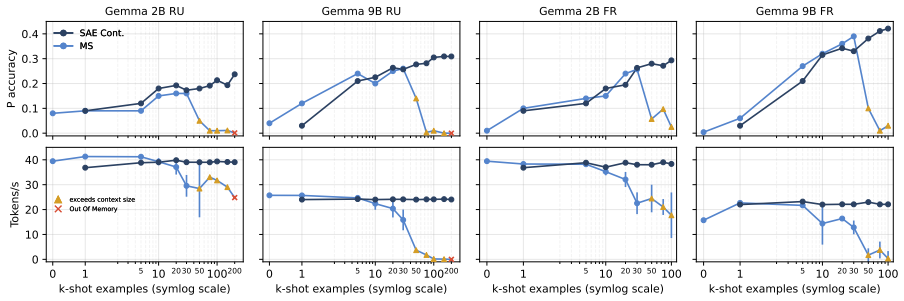
- Because steering cost does not grow with the number of demonstrations, personalization can exploit far more than a model's context window; the paper shows accuracy still improving at 50 to 200 examples where multi-shot prompting runs out of context and memory.
- The method preserves translation quality, with COMET scores for SAE steering matching or slightly exceeding the prompted baselines at moderate steering strength.
- Probing shows a shared mechanism, implying that interpretable SAE latents can stand in for opaque prompt demonstrations in future studies of how prompts condition generation.
- Smaller models gain at least as much as larger ones, pointing to affordable personalization on modest hardware.
Reading between the lines
- If the probe-transfer result generalizes, one could in principle compile an entire translator's corpus into a fixed set of SAE latents once, then apply that style to unlimited future translations with zero per-example inference overhead; the paper does not test this workflow end-to-end.
- The classifier-based ground truth is the main unvalidated link; a human annotation study of whether outputs classified as H1 or H2 actually read like the target translator would settle whether the relative rankings reflect real style rather than classifier artifacts.
- Contrasting one human translator against another rather than against default MT isolates purely translator-specific features; the paper's appendix finds comparable results with both contrasts, suggesting the translator-versus-translator contrast is a viable route to finer-grained style separation.
Editorial analysis
A structured set of objections, weighed in public.
Referee Report
Summary. The paper investigates personalizing LLM-based machine translation toward the style of a specific human literary translator, using few example translations. It first shows that XLM-R classifiers can distinguish between the two human translators (H1, H2) and default MT outputs across seven languages, and that multi-shot (MS) prompting improves classifier-based style accuracy. It then compares prompting baselines (zero-shot, zero-shot with explanation, multi-shot) with activation-steering baselines (ActAdd, ReFT) and a proposed contrastive SAE steering method (SAE Cont.) that upweights or downweights sparse autoencoder latents selected by mutual information. On a held-out PAR3 test set, SAE Cont. achieves style accuracy and Comet quality comparable to or better than MS prompting while keeping inference speed high and roughly constant as the number of demonstrations grows. Finally, linear probes trained on MS-conditioned activations predict whether SAE-steered activations will yield human-like outputs, which the authors interpret as evidence that MS prompting and SAE steering modify the same internal layers. The central claims are that contrastive SAE steering is an efficient and interpretable alternative to in-context personalization and that it acts via the same mechanism as prompting.
Significance. If the central claims hold, the paper makes a useful contribution: it extends SAE-based inference-time steering from synthetic or simple attribute tasks to a realistic, multilingual literary-translation personalization task on open models, and it proposes a concrete way to compare prompt-based and intervention-based conditioning. The scale of the evaluation—three models, seven languages, multiple novels—is a genuine strength, and the public code and dependence on open SAEs support reproducibility. The probe-generalization experiment in Section 5.2 is a clever cross-method check, because the probes are trained only on MS-conditioned activations and then applied to SAE-steered activations. However, the validity of every headline metric and of the layer-selection and probe-labeling steps rests on classifiers that have not been validated against human perception of translator style. The paper itself cites evidence that stylistic attribution is hard for humans, so the absence of any human calibration is a load-bearing gap. The reported differences between SAE Cont. and MS prompting are also numerically small and are not accompanied by variance or significance information.
major comments (4)
- [Sections 3.1, 3.3, 5.1] All style metrics (H, P, P_FLIP), the selection of style-relevant layers, the probe training labels, and the Table 5 probe generalization result are mediated by XLM-R classifiers trained on PAR3 H1/H2/MT labels. The paper provides no human validation of what these classifiers actually capture. Given the authors' own statement that stylistic attribution is notoriously difficult for human annotators, the classifiers could be detecting shallow artifacts such as punctuation patterns, sentence-length regularities, or register differences between professional human translations and instruction-tuned LLM output. Please add a human evaluation on a representative sample (e.g., forced-choice or Likert judgments of which translator a translation resembles, or of whether an output matches a target style) and report agreement between the classifiers and human judgments. In addition, please analyze whether classifier decisions are driven by surface cues, for example by reporting performance after removing or controlling for punctuation, length, and lexical-overlap features. Without such validation, the relative ranking of methods and the conclusion that SAE steering acts on the same layers as MS prompting may reflect classifier artifacts rather than genuine translator style.
- [Section 5.1, Figure 3, Table 4] The steering intensity alpha for SAE Cont. is selected by sweeping on what appears to be the same held-out test set that is then used for the main comparison in Table 4. The paper says 'we identify alpha = 5 as an appropriate steering intensity that balances personalization and fluency, and employ it in our main evaluation,' but the sweep in Figure 3 is averaged across the same translators and languages as Table 4. If alpha was tuned on the test set, the reported improvements of SAE Cont. over baselines are selection-biased. Please use a separate validation split for hyperparameter selection and report the test-set numbers obtained with a pre-fixed alpha, or report a sensitivity analysis showing that the conclusion is unchanged for a range of alpha values. This is a load-bearing issue because the central claim that SAE Cont. outperforms or matches MS prompting depends on the chosen operating point.
- [Table 4] The differences between SAE Cont. and MS prompting are small and, in some cases, not in the same direction across models. For example, Gemma 2 2B shows H = 0.39 vs 0.37 and P = 0.27 vs 0.24, but Llama 3.1 8B shows P = 0.31 for SAE Cont. versus 0.32 for MS. No confidence intervals, standard deviations, multiple runs, or significance tests are reported, and the per-language plots in Appendix B appear to show substantial variability. The paper's statement that 'SAE Cont. outperforms all other tested methods for the smaller Gemma 2 2B model' is therefore not statistically supported. Please provide variance estimates across at least three seeds or random demonstration subsets, and use a paired significance test or effect-size measure when comparing methods. If the differences are not significant, the conclusion should be softened to 'comparable performance with a computational-efficiency advantage.'
- [Section 5.2, Table 5] The probe-generalization experiment is a reasonable idea, but its interpretation as evidence for a shared mechanism between MS prompting and SAE steering is weakened by the fact that the probe labels and the evaluation of 'successful' versus 'unsuccessful' steering both derive from the same XLM-R classifier family. The probes are trained on MS-conditioned activations to predict the classifier's MT/Human label, and the SAE-steered examples are grouped by the same classifier's predictions. Thus the observed generalization may simply reflect that both prompting and SAE steering move activations along directions that this particular classifier is sensitive to, rather than demonstrating that the two interventions modify the same linguistically meaningful style representation. Please validate the probes on a classifier-independent behavioral outcome (for example, human judgments of style for a subset of steered outputs) or, at minimum, show that the probe-based predictions correlate with held-out human judgments. Without such a check, the 'internalized MS prompting' conclusion should be presented with more caution.
minor comments (6)
- [Appendix C] There is a typo in 'Additionly' that should read 'Additionally.'
- [Table 7] The H column is missing for the H_alpha-to-H_beta rows; either report the value or explain why H is not applicable for that contrast.
- [Table 8] The ZS-Exp M<->H and ZS-Exp H_alpha<->H_beta output rows are identical in the ZH->EN example; this looks like a copy-paste error and should be corrected or clarified.
- [References] The author name 'Voigt' is typeset as 'V oigt' in the reference list; please fix the spacing.
- [Section 4.3] The mutual information selection step refers to I(X_i, Y) but does not provide the formula or an explicit estimate method; please add a short equation or a precise reference to the implementation.
- [Algorithm 1] The pseudocode returns z_steer = alpha * sae.decode(x), but it is not clear how this replaces the original residual activation or whether alpha multiplies the full reconstruction or only the intervention delta; please clarify the exact intervention formula in the text.
Circularity Check
Style and shared-mechanism conclusions are looped through the same XLM-R classifier family used to select steering layers, supervise probes, and score all style metrics; the SAE-versus-MT efficiency and quality results retain independent content.
-
fitted input called prediction
[Section 3.3 (probe training) + Section 4.2/4.3 (layer choice) + Section 5.1 (metrics)]
"we train linear probes (Belinkov, 2022) using the last prompt token activations as input features to predict a binary class (MT or Human) and comparing it to the label the classifier (from Section 3.1) would assign to the resulting LLM translation. [...] For assessing style accuracy, we use the classifiers described in Section 3.1."
The probes that identify 'style-relevant' layers are supervised by the Section 3.1 classifier's own output, and the same classifier supplies every H/P/P_FLIP score in Table 4. ActAdd, ReFT, and SAE Cont. then intervene at these classifier-fitted layers ('We perform steering on the style-relevant layers identified in Section 3.3'; 'Activations are extracted ... from the most style-related layer, as identified in Section 3.3'). The evaluation yardstick is therefore built into the method's design: interventions are placed where the classifier's labels are most predictable and then scored with that same classifier. The loop is partial because SAE latent selection itself uses the actual H+/MT example texts rather than classifier outputs, so the rankings are not mathematically forced.
-
self definitional
[Section 5.2 (probe transfer test) + Section 3.3 (probe labels)]
"we use the probing classifiers introduced in Section 3.3, which were trained on MS-conditioned last prompt token activations for predicting the style of the resulting text. We categorize test examples in three groups: one in which steering flips the original classifier prediction to a human label, i.e. H1 or H2 (MT→H), and two in which prediction remains unchanged (MT→MT, H→H)."
The probes are trained to predict the Section 3.1 classifier's own labels, and the 'successful' versus 'unsuccessful' steering categories are defined by the same classifier's flips. Thus the claim that probes predict steering outcomes is literally a probe trained on classifier labels for MS-conditioned activations predicting classifier labels from SAE-steered activations. The transfer is genuine and not equationally forced, but the shared-mechanism conclusion is established only relative to that single classifier-dependent measure, not an independent ground truth.
full rationale
The paper's primary empirical comparison is not circular by construction: contrastive SAE steering selects latents via mutual information between SAE features and the true H+/MT example labels, and translation quality is assessed with the external Comet metric, while the efficiency comparison is a direct tok/s measurement. The circularity is concentrated in the style-evaluation loop: the same XLM-R classifiers are used to select the intervention layers, to supervise the probing classifiers, and to compute all H, P, and P_FLIP scores. If those classifiers track surface artifacts rather than perceived translator style, both the personalization rankings and the Layer 13/21 mechanistic conclusions would be undermined. This is a real partial circularity, but it is not a definitional reduction: no equation forces SAE steering outputs to satisfy the classifier, and the Section 5.2 probe test is a genuine cross-condition generalization from MS-trained probes to SAE-steered activations. Self-citations (Scalena et al., 2024) appear only for hyperparameter defaults and last-token activation choices, so they are not load-bearing. Overall, the central SAE-vs-MT result retains independent content, but the style and mechanism claims are partially closed around the same classifier family: score 4.
Assumptions & free parameters
free parameters (5)
- alpha (SAE Cont. steering intensity) =
5
- number of contrastive SAE latents selected =
40
- steering layer =
layer 13 (Gemma 2 2B), 21 (Gemma 2 9B), 19 (Llama 3.1 8B)
- ActAdd steering coefficient =
2
- ReFT hyperparameters =
rank 4, lora alpha 32, dropout 0.05, 100 epochs
assumptions (4)
- domain assumption Sparse autoencoders from GemmaScope and McGrath provide a faithful, steerable basis for style-relevant activations.
- domain assumption The last prompt token activation encodes the stylistic state of the model.
- domain assumption The PAR3 H1 and H2 translations represent stable, distinct translator styles.
- ad hoc to paper Classifier probabilities are a valid measure of style accuracy.
Cite this review
Pith. "Pith review of Steering Large Language Models for Machine Translation Personalization." pith.science (2026). https://pith.science/paper/GX4SGXFK
@misc{pith2026250516612,
  author       = {Pith},
  title        = {Pith review of: Steering Large Language Models for Machine Translation Personalization},
  year         = {2026},
  howpublished = {\url{https://pith.science/paper/GX4SGXFK}},
  note         = {Machine review of arXiv:2505.16612}
}
read the original abstract
Large language models have simplified the production of personalized translations reflecting predefined stylistic constraints. However, these systems still struggle when stylistic requirements are implicitly represented by a set of examples, such as texts produced by a specific human translator. In this work, we explore various strategies for personalizing automatically generated translations when few examples are available, with a focus on the challenging domain of literary translation. We begin by determining the feasibility of the task and how style information is encoded within model representations. Then, we evaluate various prompting strategies and inference-time interventions for steering model generations towards a personalized style, with a particular focus on contrastive steering with sparse autoencoder (SAE) latents to identify salient personalization properties. We demonstrate that contrastive SAE steering yields robust style conditioning and translation quality, resulting in higher inference-time computational efficiency than prompting approaches. We further examine the impact of steering on model activations, finding that layers encoding personalization properties are impacted similarly by prompting and SAE steering, suggesting a similar mechanism at play.
Figures


Figures from the paper (5 more)



Reference graph
Works this paper leans on
-
[1]
Andy Arditi, Oscar Obeso, Aaquib Syed, Daniel Paleka, Nina Panickssery, Wes Gurnee, and Neel Nanda. 2024. https://proceedings.neurips.cc/paper_files/paper/2024/file/f545448535dfde4f9786555403ab7c49-Paper-Conference.pdf Refusal in language models is mediated by a single direction . In Advances in Neural Information Processing Systems, volume 37, pages 1360...
work page 2024
-
[2]
Yonatan Belinkov. 2022. https://doi.org/10.1162/coli_a_00422 Probing classifiers: Promises, shortcomings, and advances . Computational Linguistics, 48(1):207--219
-
[3]
Nathaniel Berger, Stefan Riezler, Miriam Exel, and Matthias Huck. 2024. https://doi.org/10.18653/v1/2024.wmt-1.122 Post-edits are preferences too . In Proceedings of the Ninth Conference on Machine Translation, pages 1289--1300, Miami, Florida, USA. Association for Computational Linguistics
-
[4]
Eleftheria Briakou, Jiaming Luo, Colin Cherry, and Markus Freitag. 2024. https://doi.org/10.18653/v1/2024.wmt-1.123 Translating step-by-step: Decomposing the translation process for improved translation quality of long-form texts . In Proceedings of the Ninth Conference on Machine Translation, pages 1301--1317, Miami, Florida, USA. Association for Computa...
-
[5]
Sviatoslav Chalnev, Matthew Siu, and Arthur Conmy. 2024. http://arxiv.org/abs/2411.02193 Improving steering vectors by targeting sparse autoencoder features
arXiv 2024
-
[6]
David Chanin, Anthony Hunter, and Oana-Maria Camburu. 2024. https://doi.org/10.18653/v1/2024.naacl-long.85 Identifying linear relational concepts in large language models . In Proceedings of the 2024 Conference of the North American Chapter of the Association for Computational Linguistics: Human Language Technologies (Volume 1: Long Papers), pages 1524--1...
-
[7]
Alexis Conneau, Kartikay Khandelwal, Naman Goyal, Vishrav Chaudhary, Guillaume Wenzek, Francisco Guzm \'a n, Edouard Grave, Myle Ott, Luke Zettlemoyer, and Veselin Stoyanov. 2020. https://doi.org/10.18653/v1/2020.acl-main.747 Unsupervised cross-lingual representation learning at scale . In Proceedings of the 58th Annual Meeting of the Association for Comp...
-
[8]
Hoagy Cunningham, Aidan Ewart, Logan Riggs, Robert Huben, and Lee Sharkey. 2023. http://arxiv.org/abs/2309.08600 Sparse autoencoders find highly interpretable features in language models
arXiv 2023
Show all 62 references
-
[9]
Javier Ferrando, Oscar Obeso, Senthooran Rajamanoharan, and Neel Nanda. 2025. http://arxiv.org/abs/2411.14257 Do i know this entity? knowledge awareness and hallucinations in language models
2025 arXiv
-
[10]
Jaden Fiotto-Kaufman, Alexander R Loftus, Eric Todd, Jannik Brinkmann, Caden Juang, Koyena Pal, Can Rager, Aaron Mueller, Samuel Marks, Arnab Sen Sharma, Francesca Lucchetti, Michael Ripa, Adam Belfki, Nikhil Prakash, Sumeet Multani, Carla Brodley, Arjun Guha, Jonathan Bell, B...
2024 arXiv
-
[11]
Lucie Flekova, Jordan Carpenter, Salvatore Giorgi, Lyle Ungar, and Daniel Preo t iuc-Pietro. 2016. https://doi.org/10.18653/v1/P16-1080 Analyzing biases in human perception of user age and gender from text . In Proceedings of the 54th Annual Meeting of the Association for Comp...
2016 doi
-
[12]
Xavier Garcia and Orhan Firat. 2022. http://arxiv.org/abs/2202.11822 Using natural language prompts for machine translation
2022 arXiv
-
[13]
Ana Guerberof-Arenas and Antonio Toral. 2022. https://doi.org/https://doi.org/10.1075/ts.21025.gue Creativity in translation . Translation Spaces, 11(2):184--212
2022 doi
-
[14]
Roee Hendel, Mor Geva, and Amir Globerson. 2023. https://doi.org/10.18653/v1/2023.findings-emnlp.624 In-context learning creates task vectors . In Findings of the Association for Computational Linguistics: EMNLP 2023, pages 9318--9333, Singapore. Association for Computational ...
2023 doi
-
[15]
Marzena Karpinska and Mohit Iyyer. 2023. https://doi.org/10.18653/v1/2023.wmt-1.41 Large language models effectively leverage document-level context for literary translation, but critical errors persist . In Proceedings of the Eighth Conference on Machine Translation, pages 41...
2023 doi
-
[16]
Jihyeon Lee, Taehee Kim, Yunwon Tae, Cheonbok Park, and Jaegul Choo. 2023. https://doi.org/10.18653/v1/2023.findings-eacl.18 P e P e: Personalized post-editing model utilizing user-generated post-edits . In Findings of the Association for Computational Linguistics: EACL 2023, ...
2023 doi
-
[17]
Kenneth Li, Oam Patel, Fernanda Vi\' e gas, Hanspeter Pfister, and Martin Wattenberg. 2023. https://proceedings.neurips.cc/paper_files/paper/2023/file/81b8390039b7302c909cb769f8b6cd93-Paper-Conference.pdf Inference-time intervention: Eliciting truthful answers from a language ...
2023
-
[18]
Tom Lieberum, Senthooran Rajamanoharan, Arthur Conmy, Lewis Smith, Nicolas Sonnerat, Vikrant Varma, Janos Kramar, Anca Dragan, Rohin Shah, and Neel Nanda. 2024. https://doi.org/10.18653/v1/2024.blackboxnlp-1.19 Gemma scope: Open sparse autoencoders everywhere all at once on ge...
2024 doi
-
[19]
Huan Lin, Liang Yao, Baosong Yang, Dayiheng Liu, Haibo Zhang, Weihua Luo, Degen Huang, and Jinsong Su. 2021. https://doi.org/10.18653/v1/2021.acl-long.310 Towards user-driven neural machine translation . In Proceedings of the 59th Annual Meeting of the Association for Computat...
2021 doi
-
[20]
Xiaoming Liu, Zhaohan Zhang, Yichen Wang, Hang Pu, Yu Lan, and Chao Shen. 2023. https://doi.org/10.18653/v1/2023.emnlp-main.1005 C o C o: Coherence-enhanced machine-generated text detection under low resource with contrastive learning . In Proceedings of the 2023 Conference on...
2023 doi
-
[21]
Samuel Marks, Can Rager, Eric J Michaud, Yonatan Belinkov, David Bau, and Aaron Mueller. 2025. https://openreview.net/forum?id=I4e82CIDxv Sparse feature circuits: Discovering and editing interpretable causal graphs in language models . In The Thirteenth International Conferenc...
2025
-
[22]
Evgeny Matusov. 2019. https://aclanthology.org/W19-7302/ The challenges of using neural machine translation for literature . In Proceedings of the Qualities of Literary Machine Translation, pages 10--19, Dublin, Ireland. European Association for Machine Translation
2019
-
[23]
Thomas McGrath, Daniel Balsam, Myra Deng, and Eric Ho. 2024. https://www.goodfire.ai/papers/understanding-and-steering-llama-3 Understanding and steering llama 3 with sparse autoencoders
2024
-
[24]
Paul Michel and Graham Neubig. 2018. https://doi.org/10.18653/v1/P18-2050 Extreme adaptation for personalized neural machine translation . In Proceedings of the 56th Annual Meeting of the Association for Computational Linguistics (Volume 2: Short Papers), pages 312--318, Melbo...
2018 doi
-
[25]
Tomas Mikolov, Wen-tau Yih, and Geoffrey Zweig. 2013. https://aclanthology.org/N13-1090/ Linguistic regularities in continuous space word representations . In Proceedings of the 2013 Conference of the North A merican Chapter of the Association for Computational Linguistics: Hu...
2013
-
[26]
Joss Moorkens, Antonio Toral, Sheila Castilho, and Andy Way. 2018. https://doi.org/https://doi.org/10.1075/ts.18014.moo Translators’ perceptions of literary post-editing using statistical and neural machine translation . Translation Spaces, 7(2):240--262
2018 doi
-
[27]
Maria Nadejde, Anna Currey, Benjamin Hsu, Xing Niu, Marcello Federico, and Georgiana Dinu. 2022. https://doi.org/10.18653/v1/2022.findings-naacl.47 C o C o A - MT : A dataset and benchmark for contrastive controlled MT with application to formality . In Findings of the Associa...
2022 doi
-
[28]
Xing Niu, Marianna Martindale, and Marine Carpuat. 2017. https://doi.org/10.18653/v1/D17-1299 A study of style in machine translation: Controlling the formality of machine translation output . In Proceedings of the 2017 Conference on Empirical Methods in Natural Language Proce...
2017 doi
-
[29]
OpenAI. 2024. http://arxiv.org/abs/2303.08774 Gpt-4 technical report
2024 arXiv
-
[30]
Ella Rabinovich, Raj Nath Patel, Shachar Mirkin, Lucia Specia, and Shuly Wintner. 2017. https://aclanthology.org/E17-1101/ Personalized machine translation: Preserving original author traits . In Proceedings of the 15th Conference of the E uropean Chapter of the Association fo...
2017
-
[31]
Ricardo Rei, Craig Stewart, Ana C Farinha, and Alon Lavie. 2020. https://doi.org/10.18653/v1/2020.emnlp-main.213 COMET : A neural framework for MT evaluation . In Proceedings of the 2020 Conference on Empirical Methods in Natural Language Processing (EMNLP), pages 2685--2702, ...
2020 doi
-
[32]
Nina Rimsky, Nick Gabrieli, Julian Schulz, Meg Tong, Evan Hubinger, and Alexander Turner. 2024. https://doi.org/10.18653/v1/2024.acl-long.828 Steering llama 2 via contrastive activation addition . In Proceedings of the 62nd Annual Meeting of the Association for Computational L...
2024 doi
-
[33]
Gabriele Sarti, Phu Mon Htut, Xing Niu, Benjamin Hsu, Anna Currey, Georgiana Dinu, and Maria Nadejde. 2023. https://doi.org/10.18653/v1/2023.acl-short.126 RAMP : Retrieval and attribute-marking enhanced prompting for attribute-controlled translation . In Proceedings of the 61s...
2023 doi
-
[34]
Danielle Saunders and Bill Byrne. 2020. https://doi.org/10.18653/v1/2020.acl-main.690 Reducing gender bias in neural machine translation as a domain adaptation problem . In Proceedings of the 58th Annual Meeting of the Association for Computational Linguistics, pages 7724--773...
2020 doi
-
[35]
Daniel Scalena, Gabriele Sarti, and Malvina Nissim. 2024. https://doi.org/10.18653/v1/2024.blackboxnlp-1.34 Multi-property steering of large language models with dynamic activation composition . In Proceedings of the 7th BlackboxNLP Workshop: Analyzing and Interpreting Neural ...
2024 doi
-
[36]
Rico Sennrich, Barry Haddow, and Alexandra Birch. 2016. https://doi.org/10.18653/v1/N16-1005 Controlling politeness in neural machine translation via side constraints . In Proceedings of the 2016 Conference of the North A merican Chapter of the Association for Computational Li...
2016 doi
-
[37]
Gemma Team. 2024 a . http://arxiv.org/abs/2408.00118 Gemma 2: Improving open language models at a practical size
2024 arXiv
-
[38]
Llama Team. 2024 b . http://arxiv.org/abs/2407.21783 The llama 3 herd of models
2024 arXiv
-
[39]
Daniel Freeman, Theodore R
Adly Templeton, Tom Conerly, Jonathan Marcus, Jack Lindsey, Trenton Bricken, Brian Chen, Adam Pearce, Craig Citro, Emmanuel Ameisen, Andy Jones, Hoagy Cunningham, Nicholas L Turner, Callum McDougall, Monte MacDiarmid, C. Daniel Freeman, Theodore R. Sumers, Edward Rees, Joshua ...
2024
-
[40]
Katherine Thai, Marzena Karpinska, Kalpesh Krishna, Bill Ray, Moira Inghilleri, John Wieting, and Mohit Iyyer. 2022. https://doi.org/10.18653/v1/2022.emnlp-main.672 Exploring document-level literary machine translation with parallel paragraphs from world literature . In Procee...
2022 doi
-
[41]
Li, Arnab Sen Sharma, Aaron Mueller, Byron C
Eric Todd, Millicent L. Li, Arnab Sen Sharma, Aaron Mueller, Byron C. Wallace, and David Bau. 2024. https://openreview.net/forum?id=AwyxtyMwaG Function vectors in large language models . In Proceedings of the 2024 International Conference on Learning Representations. ArXiv:2310.15213
2024 arXiv
-
[42]
Antonio Toral and Andy Way. 2015. https://doi.org/10.3115/v1/W15-0714 Translating literary text between related languages using SMT . In Proceedings of the Fourth Workshop on Computational Linguistics for Literature, pages 123--132, Denver, Colorado, USA. Association for Compu...
2015 doi
-
[43]
Antonio Toral and Andy Way. 2018. https://doi.org/10.1007/978-3-319-91241-7_12 What Level of Quality Can Neural Machine Translation Attain on Literary Text? , pages 263--287. Springer International Publishing, Cham
2018 doi
-
[44]
Vazquez, Ulisse Mini, and Monte MacDiarmid
Alexander Matt Turner, Lisa Thiergart, Gavin Leech, David Udell, Juan J. Vazquez, Ulisse Mini, and Monte MacDiarmid. 2024. http://arxiv.org/abs/2308.10248 Steering language models with activation engineering
2024 arXiv
-
[45]
Eva Vanmassenhove, Christian Hardmeier, and Andy Way. 2018. https://doi.org/10.18653/v1/D18-1334 Getting gender right in neural machine translation . In Proceedings of the 2018 Conference on Empirical Methods in Natural Language Processing, pages 3003--3008, Brussels, Belgium....
2018 doi
-
[46]
Rob Voigt and Dan Jurafsky. 2012. https://aclanthology.org/W12-2503/ Towards a literary machine translation: The role of referential cohesion . In Proceedings of the NAACL - HLT 2012 Workshop on Computational Linguistics for Literature , pages 18--25, Montr \'e al, Canada. Ass...
2012
-
[47]
Longyue Wang, Siyou Liu, Chenyang Lyu, Wenxiang Jiao, Xing Wang, Jiahao Xu, Zhaopeng Tu, Yan Gu, Weiyu Chen, Minghao Wu, Liting Zhou, Philipp Koehn, Andy Way, and Yulin Yuan. 2024 a . https://doi.org/10.18653/v1/2024.wmt-1.58 Findings of the WMT 2024 shared task on discourse-l...
2024 doi
-
[48]
Longyue Wang, Chenyang Lyu, Tianbo Ji, Zhirui Zhang, Dian Yu, Shuming Shi, and Zhaopeng Tu. 2023 a . https://doi.org/10.18653/v1/2023.emnlp-main.1036 Document-level machine translation with large language models . In Proceedings of the 2023 Conference on Empirical Methods in N...
2023 doi
-
[49]
Longyue Wang, Zhaopeng Tu, Yan Gu, Siyou Liu, Dian Yu, Qingsong Ma, Chenyang Lyu, Liting Zhou, Chao-Hong Liu, Yufeng Ma, Weiyu Chen, Yvette Graham, Bonnie Webber, Philipp Koehn, Andy Way, Yulin Yuan, and Shuming Shi. 2023 b . https://doi.org/10.18653/v1/2023.wmt-1.3 Findings o...
2023 doi
-
[50]
Yue Wang, Cuong Hoang, and Marcello Federico. 2021. https://doi.org/10.18653/v1/2021.naacl-main.94 Towards modeling the style of translators in neural machine translation . In Proceedings of the 2021 Conference of the North American Chapter of the Association for Computational...
2021 doi
-
[51]
Yuxia Wang, Jonibek Mansurov, Petar Ivanov, Jinyan Su, Artem Shelmanov, Akim Tsvigun, Osama Mohammed Afzal, Tarek Mahmoud, Giovanni Puccetti, and Thomas Arnold. 2024 b . https://doi.org/10.18653/v1/2024.semeval-1.279 S em E val-2024 task 8: Multidomain, multimodel and multilin...
2024 doi
-
[52]
Yuxia Wang, Jonibek Mansurov, Petar Ivanov, Jinyan Su, Artem Shelmanov, Akim Tsvigun, Osama Mohammed Afzal, Tarek Mahmoud, Giovanni Puccetti, Thomas Arnold, Alham Aji, Nizar Habash, Iryna Gurevych, and Preslav Nakov. 2024 c . https://doi.org/10.18653/v1/2024.acl-long.218 M 4 G...
2024 doi
-
[53]
Minghao Wu, Jiahao Xu, Yulin Yuan, Gholamreza Haffari, Longyue Wang, Weihua Luo, and Kaifu Zhang. 2025 a . http://arxiv.org/abs/2405.11804 ( P erhaps) beyond human translation: Harnessing multi-agent collaboration for translating ultra-long literary texts
2025 arXiv
-
[54]
Manning, and Christopher Potts
Zhengxuan Wu, Aryaman Arora, Atticus Geiger, Zheng Wang, Jing Huang, Dan Jurafsky, Christopher D. Manning, and Christopher Potts. 2025 b . http://arxiv.org/abs/2501.17148 Axbench: Steering llms? even simple baselines outperform sparse autoencoders
2025 arXiv
-
[55]
Zhengxuan Wu, Aryaman Arora, Zheng Wang, Atticus Geiger, Dan Jurafsky, Christopher D Manning, and Christopher Potts. 2024. https://openreview.net/forum?id=fykjplMc0V Re FT : Representation finetuning for language models . In The Thirty-eighth Annual Conference on Neural Inform...
2024
-
[56]
Wu Youyou, Michal Kosinski, and David Stillwell. 2015. Computer-based personality judgments are more accurate than those made by humans. Proceedings of the National Academy of Sciences, 112(4):1036--1040
2015
-
[57]
Zeyu Yun, Yubei Chen, Bruno Olshausen, and Yann LeCun. 2021. https://doi.org/10.18653/v1/2021.deelio-1.1 Transformer visualization via dictionary learning: contextualized embedding as a linear superposition of transformer factors . In Proceedings of Deep Learning Inside Out (D...
2021 doi
-
[58]
Peng Zhang, Zhengqing Guan, Baoxi Liu, Xianghua (Sharon) Ding, Tun Lu, Hansu Gu, and Ning Gu. 2022. https://doi.org/10.1145/3555171 Building user-oriented personalized machine translator based on user-generated textual content . Proc. ACM Hum.-Comput. Interact., 6(CSCW2)
2022 doi
-
[59]
Yu Zhao, Alessio Devoto, Giwon Hong, Xiaotang Du, Aryo Pradipta Gema, Hongru Wang, Xuanli He, Kam-Fai Wong, and Pasquale Minervini. 2025. https://aclanthology.org/2025.naacl-long.264/ Steering knowledge selection behaviours in LLM s via SAE -based representation engineering . ...
2025
-
[60]
Byun, Zifan Wang, Alex Mallen, Steven Basart, Sanmi Koyejo, Dawn Song, Matt Fredrikson, J
Andy Zou, Long Phan, Sarah Chen, James Campbell, Phillip Guo, Richard Ren, Alexander Pan, Xuwang Yin, Mantas Mazeika, Ann-Kathrin Dombrowski, Shashwat Goel, Nathaniel Li, Michael J. Byun, Zifan Wang, Alex Mallen, Steven Basart, Sanmi Koyejo, Dawn Song, Matt Fredrikson, J. Zico...
2025 arXiv
-
[61]
URL: " 'urlintro :=
ENTRY address author booktitle chapter edition editor howpublished institution journal key month note number organization pages publisher school series title type volume year eprint doi pubmed url lastchecked label extra.label sort.label short.list INTEGERS output.state before...
-
[62]
write newline
" write newline "" before.all 'output.state := FUNCTION n.dashify 't := "" t empty not t #1 #1 substring "-" = t #1 #2 substring "--" = not "--" * t #2 global.max substring 't := t #1 #1 substring "-" = "-" * t #2 global.max substring 't := while if t #1 #1 substring * t #2 gl...
Reviewed August 7, 2026 · model on record in the stance chip above.
Discussion (0). Continue with ORCID to comment.