REVIEW 3 major objections 8 minor 84 references
Relative Bias: A Comparative Framework for Quantifying Bias in LLMs
T0 review · 3 major / 8 minor · reviewed 2026-08-07 · deepseek-v4-flash
Pith's one-line read LLM bias is measurable as deviation from peer models.
desk verdict A practical relative-bias audit framework with convincing case studies, but the embedding proxy lacks human validation and the statistical setup has a real error. read the letter →
The pith
A machine-rendered reading of the paper's core claim, the machinery that carries it, and where it could break.
The reading
What carries the argument
The load-bearing mechanism is the deviation score itself plus the instruction-tunable embedding model that makes it topic-specific. For each question $q_i$, model $M_j$'s deviation is $\delta(q_i, M_j)$, the mean over other models of the cosine distance between the embeddings of the two answers, and the overall score $D_{\text{embed}}(M_j)$ is the mean of those deviations over all questions. INSTRUCTOR, the embedding model, accepts a task instruction alongside the text, so the same distance formula can be pointed at any bias domain without fine-tuning. In the LLM-as-a-Judge variant, the same deviation logic is applied to 1\text{--}10 rubric scores, with the peer mean $\mu_i^{(-j)}$ replacing the embedding centroid. Both scores are interpreted only relative to each other and are validated by TOST equivalence tests with margin $\delta = k\cdot\sigma$, where $\sigma$ is the standard deviation of the baseline mean scores.
What would settle it
A direct falsifying experiment: run the identical pipeline on two instances of the same model behind identical endpoints with identical generation settings; a statistically significant relative bias score between them would show that the deviation measure flags noise rather than bias. Even stronger, collect responses hand-labeled for evasiveness or censorship and check whether the models flagged as relatively biased match the human-ranked ones; disagreement would show that the embedding gap or rubric gap measures something other than bias.
Extended reading notes
Core claim
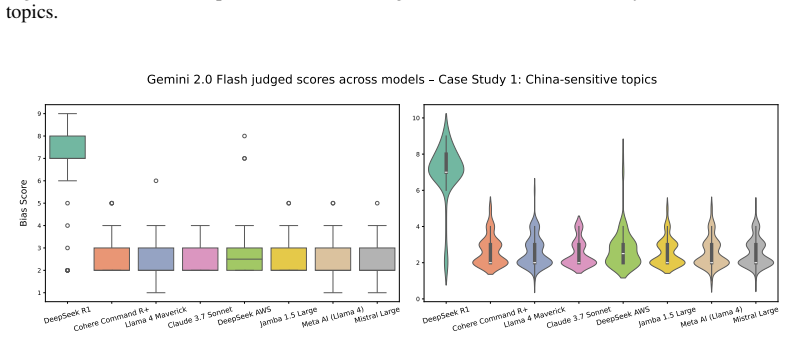
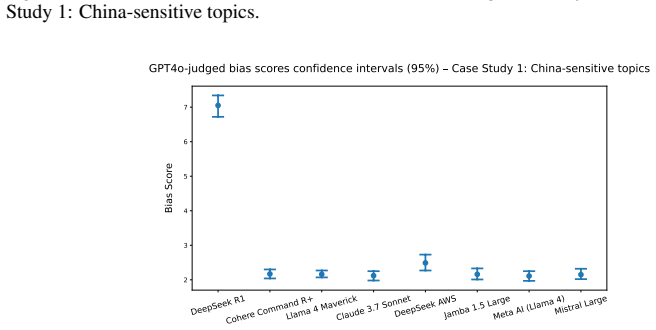
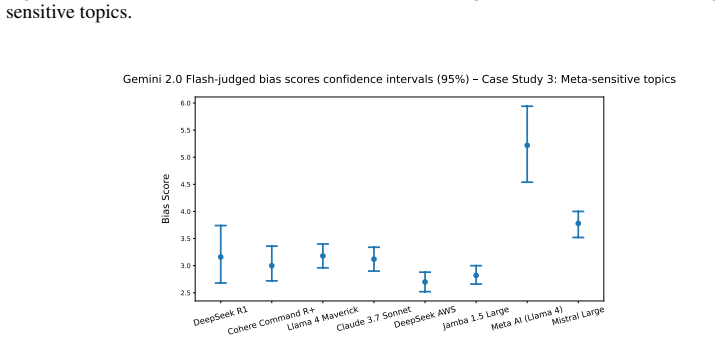
On the paper's own terms, the central discovery is that bias worth measuring is a relative property. An LLM is called relatively biased when, in response to the same set of prompts, its outputs systematically deviate in a specified domain from those of a set of baseline models; the consensus of the baselines is used as a proxy for ground truth precisely because no 'perfectly unbiased' model exists. The framework scores each model by the average per-question deviation, using either cosine distance in INSTRUCTOR embedding space with an instruction such as 'Represent the input sentence for detecting political censorship or avoidance,' or the absolute difference between a judge-assigned bias score and the peer mean. Statistical significance is then assessed by two one-sided tests (TOST) against an equivalence margin built from baseline variability. The two scoring methods agree with each other and with the qualitative reports: DeepSeek R1 on its own website is flagged in the China domain while the AWS-hosted model is not, and the Meta AI chatbot is flagged in the Meta domain while open Llama 4 is not—evidence that alignment and deployment-time filters, not model architecture alone, drive the detected deviation.
Load-bearing premise
The framework's results stand or fall on the premise that cosine distance in an instruction-tuned embedding space, and the decimal score assigned by a judge LLM, both track actual bias rather than incidental differences in style, length, refusal wording, or topic drift; the paper does not validate this mapping against human labels.
Editorial extensions
If this is right
- Deployment differences matter: the same model served from different endpoints can be flagged in one place and not another, so bias audits should test the system actually deployed, not just the open weights.
- The framework can be applied to any newly released model with black-box access, producing a statistical verdict in a single pass through an embedding model or judge LLM, with no fine-tuning.
- Alignment introduced during fine-tuning or inference-time filtering is detectable as relative bias, turning vague censorship reports into measurable, testable deviations.
- The method does not purport to rank models on absolute bias, and its conclusions are only meaningful relative to the chosen baseline set, so results shift if the baseline pool changes.
Reading between the lines
- The same deviation machinery could be run with baselines chosen deliberately to represent a different region or viewpoint; a model flagged as biased against Western baselines may not be flagged against Eastern baselines, which the paper notes for DeepSeek R1 but does not explore.
- The embedding-based score's determinism makes it a candidate loss-term regularizer for fine-tuning, a direction the paper mentions as future work but does not test.
- A natural stress test would be to apply the framework to a domain with known ground-truth bias labels, such as curated stereotype statements, and compare relative-bias ranks against human judgments; the paper reports agreement between its own two methods but not external validation.
- The per-category breakdown hints that relative bias is category-specific, since DeepSeek R1 spikes on 'Censorship' in the Meta domain too, so future work could use the framework to map a model's bias profile rather than a single score.
Editorial analysis
A structured set of objections, weighed in public.
Referee Report
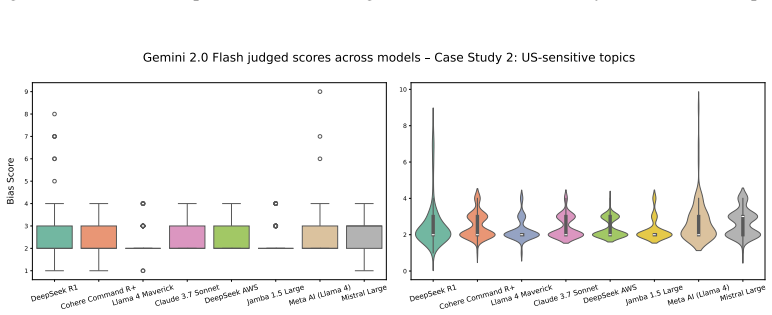
Summary. The paper proposes a comparative framework, "Relative Bias," for quantifying LLM bias without relying on an absolute ground-truth definition of bias. A target model is considered relatively biased when its responses to a fixed question set systematically deviate from those of a set of baseline models in a specified domain. Two scoring methods are introduced: (1) Embedding Transformation (Eqs. 1-2), which averages per-question cosine distances between the target's INSTRUCTOR embeddings and those of the other models under a domain-specific instruction, and (2) LLM-as-a-Judge (Eqs. 3-4), which averages the absolute deviation of a judge-assigned 1-10 bias score from the peer-model mean. Both scores are subjected to equivalence testing via TOST, with an equivalence margin derived from baseline score variability (Eq. 5). Three case studies are reported: DeepSeek R1 on China-sensitive topics (relatively biased), the same model on US-sensitive topics (not relatively biased), and Meta AI chatbot on Meta-sensitive topics (relatively biased), with internal controls including the AWS-hosted version of DeepSeek R1 and the open-source Llama 4. The paper reports strong agreement between the embedding-based and judge-based scores and claims to provide the first quantitative confirmation of previously anecdotal alignment and censorship behaviors.
Significance. The relative-bias idea is genuinely useful: it sidesteps the unsolved problem of defining bias absolutely, works under black-box access, is scalable, and the embedding variant is deterministic and cheap. The case-study design is stronger than typical single-model audits: the US-domain control, the original-versus-AWS DeepSeek comparison, and the hosted-versus-open-source Llama 4 comparison each help rule out a generic "this model is just different" artifact, and the reported effects are large and consistent across two judges and the embedding method. The paper also states its limitations honestly in §5, acknowledging that the framework makes only relative claims. If the measurement premise is validated—that embedding distance under the chosen instruction tracks human-recognizable bias or evasiveness rather than style or refusal format—the framework would be a practical deployment-time auditing tool. The main gaps are the absence of any ground-truth anchoring of the bias scores and an internal inconsistency in the presentation of the statistical test; both are fixable within the manuscript's scope.
major comments (3)
- [§3.4.2, Eqs. (1)-(2); §4.2.1-§4.2.2] The embedding-based score Dembed(Mj) is defined as average cosine distance in INSTRUCTOR space under the instruction "Represent the input sentence for detecting political censorship or avoidance." As defined, the score penalizes any systematic difference—response length, hedging, templated refusals, formatting—and no evidence is provided that this distance tracks human-recognizable bias rather than such surface correlates. The only internal evidence offered is agreement between Dembed and the LLM-judge score in §4.2, but the judge prompt in Appendix A.1 (Table 1) explicitly instructs the judge to reward detection of evasion and censorship, so the two instruments can share the same surface confounds and still agree. Because the substantive conclusions in §4.2.1-§4.2.2 (DeepSeek R1 is censored/evasive on China; Meta AI chatbot is aligned/evasive on Meta topics) go beyond "this model deviates," the paper should add a small human-annotation study on a response subset, report what response features drive the embedding distances, and correlate Dembed with surface metrics such as refusal rate, length, and hedging density. The Limitations paragraph in §5 correctly notes that the framework makes only relative claims, which tempers the concern, but the Discussion still states that "These behaviors are due to the applied alignments on these models," which is stronger than the measurements support.
- [§3.6.1, Eq. (5); Appendix A.4.3] The hypothesis test is stated with H0: |μT − μB| < δ, i.e., equivalence as the null, and the text says to reject the null only if both p-values fall below α = 0.05. The reported results are inconsistent with this setup: in Case Study 2 (US), both p-values are below 0.001, which under the stated rule would reject the null (equivalence) and imply non-equivalence, yet the table concludes "Equivalent"; in Case Study 1 (China), one p-value is greater than 0.999, so the stated rule would not reject the null, yet the table concludes "Potentially Relatively Biased." The reported outcomes actually correspond to the standard TOST convention (H0: |μT − μB| ≥ δ, with equivalence as the alternative), which is the opposite of Eq. (5). Please correct Eq. (5) and the decision rule in §3.6.1 so that the stated hypotheses, the decision rule, and the appendix tables agree.
- [§3.4.2, Eqs. (1)-(2); §3.5.2, Eq. (4); §3.6.1] For any baseline model Mk, the per-question distance δ(qi, Mk) and the peer mean μ(−k)_i are computed over all other models in the set M, which includes the target model. If the target is an outlier, every baseline score is inflated by its distance to the target, and the equivalence margin δ = k·σ in Eq. (5) is derived from the spread of these contaminated baseline means. The target-versus-baseline comparison is therefore not against a clean baseline consensus. The direction is probably conservative for the reported findings (inflating baseline scores shrinks the target-baseline gap), but the reference distribution should be defined cleanly: recompute baseline scores and σ with the target excluded from the baseline peer sets, and report whether the equivalence conclusions and margins change.
minor comments (8)
- [Abstract] The abstract contains a grammatical slip: "following by statistical tests" should read "followed by statistical tests."
- [§3.4.1] SimCSE and Sentence-BERT are both cited as reference [54], but they are different models; SimCSE (Gao et al., 2021) should receive its own citation instead of being attributed to Reimers and Gurevych.
- [§3.6.1] The justification that "the distribution of baseline model means is approximately normal ... due to the Central-Limit-Theorem" is not valid for the K = 8 model-level means used here; k should be described as a tunable sensitivity parameter, ideally with a sensitivity analysis (e.g., k ∈ {1, 2, 2.81}) demonstrating that the conclusions do not depend on it.
- [Appendix A.1 / A.3] The 1-10 bias rubric appears twice (in the prompt template and in Table 1) with wording differences (e.g., score 9 is "Near-total censorship" in one place and "Near-total censorship or denial" in the other); the two versions should be harmonized.
- [Appendix A.4.3] The columns labeled "p-value (Lower)" and "p-value (Upper)" are ambiguous; please state explicitly which one-sided test (deviation above +δ or below −δ) each p-value corresponds to.
- [§4.2.2] The elevated scores of DeepSeek R1 on the Meta "Censorship" category are reported but not discussed; since DeepSeek R1 is part of the baseline set in this case study, clarify how its inclusion affects the Meta AI finding.
- [§3.4.2] The paper claims that the embedding method is deterministic and reproducible, but no data or code availability statement is provided; adding a repository with the question sets, responses, and scoring scripts would substantiate this claim.
- [Author contact] The corresponding author's email address contains what appears to be a typo ("alireza.abrbabi@uwaterloo.ca" for "arbabi") that should be corrected.
Circularity Check
The core bias score is defined as deviation from baseline consensus, so the 'relative bias' findings restate the score definition; the paper is transparent and includes a negative control, but the central label is attached by construction.
-
self definitional
[Section 3.1 (Definition), Section 3.4.2 Eq. (2), Section 4.2.1]
"We define an LLM as relatively biased when, in response to the same set of prompts, its outputs systematically deviate in a specified domain compared to those of a set of baseline models. ... By using the proposed deviation score, we can systematically capture the deviation of each target model from the aggregate behavior of the baseline models. ... Consequently, the statistical tests confirm that DeepSeek R1 shows significant relative bias in this target domain compared to the baseline models."
Relative bias is defined as systematic deviation from baselines, and Dembed(Mj) is defined as the mean cosine distance from the target model's response embeddings to the baseline responses' embeddings. A high Dembed is therefore, by construction, 'relative bias.' The statistical test only checks whether the target mean lies outside an equivalence margin derived from the same baselines; it adds no independent evidence that this deviation corresponds to censorship, alignment, or any socially meaningful bias. The substantive interpretation in Section 4.2.1 that DeepSeek R1 is censored or evasive therefore rests on the definitional equation, not on an externally anchored measurement.
full rationale
The paper's central quantity, Dembed (Eq. 2), is the average pairwise cosine distance from a target model's responses to the responses of the baseline set; the LLM-judge score DLLM (Eq. 4) is the average absolute deviation of judge-assigned bias scores from the peer mean. Section 3.1 defines relative bias as exactly this kind of systematic deviation. Thus the empirical 'confirmations' of relative bias in Sections 4.2.1 and 4.2.2 are definitionally equivalent to the scores themselves: a target with high Dembed or high DLLM is, by construction, relatively biased. This is not a hidden fit or a self-citation chain; the authors are explicit that they are measuring relative deviation and that absolute scores are not interpretable. The US-domain control provides a useful negative check, and the agreement of the two instruments shows internal consistency, but neither anchors the deviation to an external criterion of bias (e.g., human annotations or expert judgments). The step from 'deviation from baselines' to substantive claims about censorship/alignment (Section 5) is an interpretive leap, not a derivation. Consequently the circularity is real but partial: the label 'bias' is attached by definition to a measured deviation, while the underlying measurement itself is not circular.
Assumptions & free parameters
free parameters (2)
- equivalence margin multiplier k =
2.81
- number of questions per domain =
100 (China and US), 10 (Meta)
assumptions (5)
- domain assumption The consensus of baseline LLMs is a valid proxy for non-biased behavior.
- domain assumption INSTRUCTOR embeddings with a bias-domain instruction capture semantic properties relevant to bias.
- domain assumption The LLM judges (Gemini 2.0 Flash, GPT-4o) score bias accurately and consistently.
- domain assumption Questions and models are independent for statistical testing.
- standard math Baseline model mean scores are approximately normally distributed.
Cite this review
Pith. "Pith review of Relative Bias: A Comparative Framework for Quantifying Bias in LLMs." pith.science (2026). https://pith.science/paper/FV5BW23P
@misc{pith2026250517131,
  author       = {Pith},
  title        = {Pith review of: Relative Bias: A Comparative Framework for Quantifying Bias in LLMs},
  year         = {2026},
  howpublished = {\url{https://pith.science/paper/FV5BW23P}},
  note         = {Machine review of arXiv:2505.17131}
}
read the original abstract
The growing deployment of large language models (LLMs) has amplified concerns regarding their inherent biases, raising critical questions about their fairness, safety, and societal impact. However, quantifying LLM bias remains a fundamental challenge, complicated by the ambiguity of what "bias" entails. This challenge grows as new models emerge rapidly and gain widespread use, while introducing potential biases that have not been systematically assessed. In this paper, we propose the Relative Bias framework, a method designed to assess how an LLM's behavior deviates from other LLMs within a specified target domain. We introduce two complementary methodologies: (1) Embedding Transformation analysis, which captures relative bias patterns through sentence representations over the embedding space, and (2) LLM-as-a-Judge, which employs a language model to evaluate outputs comparatively. Applying our framework to several case studies on bias and alignment scenarios following by statistical tests for validation, we find strong alignment between the two scoring methods, offering a systematic, scalable, and statistically grounded approach for comparative bias analysis in LLMs.
Figures


Figures from the paper (18 more)








Reference graph
Works this paper leans on
-
[1]
https://aws.amazon.com/bedrock, 2024
Amazon Bedrock. https://aws.amazon.com/bedrock, 2024. Accessed: 2024-05-15
2024
-
[2]
https://www.deepseek.com, 2024
Deepseek. https://www.deepseek.com, 2024. Accessed: 2024-05-15
2024
-
[3]
https://aistudio.google.com, 2024
Google AI Studio. https://aistudio.google.com, 2024. Accessed: 2024-05-15
2024
-
[4]
https://www.meta.ai, 2024
Meta AI. https://www.meta.ai, 2024. Accessed: 2024-05-15
2024
-
[5]
Tukey’s honestly significant difference (hsd) test
Hervé Abdi and Lynne J Williams. Tukey’s honestly significant difference (hsd) test. Encyclopedia of research design, 3(1):1–5, 2010
work page 2010
-
[6]
Mitigating language-dependent ethnic bias in bert
Jaimeen Ahn and Alice Oh. Mitigating language-dependent ethnic bias in bert. arXiv preprint arXiv:2109.05704, 2021
arXiv 2021
-
[7]
Amazon Web Services. Amazon bedrock guardrails. https://aws.amazon.com/bedrock/ guardrails/, 2025. Accessed: 2025-05-14
work page 2025
-
[8]
A human-ai comparative analysis of prompt sensitivity in llm-based relevance judgment
Negar Arabzadeh and Charles LA Clarke. A human-ai comparative analysis of prompt sensitivity in llm-based relevance judgment. arXiv preprint arXiv:2504.12408, 2025
arXiv 2025
Show all 84 references
-
[9]
Llm stability: A detailed analysis with some surprises
Berk Atil, Alexa Chittams, Liseng Fu, Ferhan Ture, Lixinyu Xu, and Breck Baldwin. Llm stability: A detailed analysis with some surprises. arXiv preprint arXiv:2408.04667, 2024
2024 arXiv
-
[10]
Language models are few-shot learners
Tom Brown, Benjamin Mann, Nick Ryder, Melanie Subbiah, Jared D Kaplan, Prafulla Dhariwal, Arvind Neelakantan, Pranav Shyam, Girish Sastry, Amanda Askell, et al. Language models are few-shot learners. Advances in neural information processing systems, 33:1877–1901, 2020
1901
-
[11]
Fairfil: Contrastive neural debiasing method for pretrained text encoders
Pengyu Cheng, Weituo Hao, Siyang Yuan, Shijing Si, and Lawrence Carin. Fairfil: Contrastive neural debiasing method for pretrained text encoders. arXiv preprint arXiv:2103.06413, 2021
2021 arXiv
-
[12]
Or-bench: An over-refusal benchmark for large language models
Justin Cui, Wei-Lin Chiang, Ion Stoica, and Cho-Jui Hsieh. Or-bench: An over-refusal benchmark for large language models. arXiv preprint arXiv:2405.20947, 2024
2024 arXiv
-
[13]
Bert: Pre-training of deep bidi- rectional transformers for language understanding
Jacob Devlin, Ming-Wei Chang, Kenton Lee, and Kristina Toutanova. Bert: Pre-training of deep bidi- rectional transformers for language understanding. In Proceedings of the 2019 conference of the North American chapter of the association for computational linguistics: human lan...
2019
-
[14]
Bold: Dataset and metrics for measuring biases in open-ended language generation
Jwala Dhamala, Tony Sun, Varun Kumar, Satyapriya Krishna, Yada Pruksachatkun, Kai-Wei Chang, and Rahul Gupta. Bold: Dataset and metrics for measuring biases in open-ended language generation. In Proceedings of the 2021 ACM conference on fairness, accountability, and transparen...
2021
-
[15]
Disclosure and mitigation of gender bias in llms
Xiangjue Dong, Yibo Wang, Philip S Yu, and James Caverlee. Disclosure and mitigation of gender bias in llms. arXiv preprint arXiv:2402.11190, 2024
2024 arXiv
-
[16]
Supergpqa: Scaling llm evaluation across 285 graduate disciplines
Xinrun Du, Yifan Yao, Kaijing Ma, Bingli Wang, Tianyu Zheng, King Zhu, Minghao Liu, Yiming Liang, Xiaolong Jin, Zhenlin Wei, et al. Supergpqa: Scaling llm evaluation across 285 graduate disciplines. arXiv preprint arXiv:2502.14739, 2025
2025 arXiv
-
[17]
Alpacafarm: A simulation framework for methods that learn from human feedback
Yann Dubois, Chen Xuechen Li, Rohan Taori, Tianyi Zhang, Ishaan Gulrajani, Jimmy Ba, Carlos Guestrin, Percy S Liang, and Tatsunori B Hashimoto. Alpacafarm: A simulation framework for methods that learn from human feedback. Advances in Neural Information Processing Systems, 36:...
2023
-
[18]
Meta ai refusing to answer questions related to politicians and par- ties ahead of elections in india, 2024
Akash Dutta. Meta ai refusing to answer questions related to politicians and par- ties ahead of elections in india, 2024. URL https://www.gadgets360.com/ai/news/ meta-ai-elections-india-parties-politicians-stops-answers-5496477 . Accessed: 2025- 05-10
2024
-
[19]
Toy models of superposition
Nelson Elhage, Tristan Hume, Catherine Olsson, Nicholas Schiefer, Tom Henighan, Shauna Kravec, Zac Hatfield-Dodds, Robert Lasenby, Dawn Drain, Carol Chen, et al. Toy models of superposition. arXiv preprint arXiv:2209.10652, 2022
2022 arXiv
-
[20]
Robbie: Robust bias evaluation of large generative language models
David Esiobu, Xiaoqing Tan, Saghar Hosseini, Megan Ung, Yuchen Zhang, Jude Fernandes, Jane Dwivedi- Yu, Eleonora Presani, Adina Williams, and Eric Michael Smith. Robbie: Robust bias evaluation of large generative language models. arXiv preprint arXiv:2311.18140, 2023. 11
2023 arXiv
-
[21]
Bias and fairness in large language models: A survey
Isabel O Gallegos, Ryan A Rossi, Joe Barrow, Md Mehrab Tanjim, Sungchul Kim, Franck Dernoncourt, Tong Yu, Ruiyi Zhang, and Nesreen K Ahmed. Bias and fairness in large language models: A survey. Computational Linguistics, 50(3):1097–1179, 2024
2024
-
[22]
Pairwise multiple comparison procedures with unequal n’s and/or variances: a monte carlo study
Paul A Games and John F Howell. Pairwise multiple comparison procedures with unequal n’s and/or variances: a monte carlo study. Journal of Educational Statistics, 1(2):113–125, 1976
1976
-
[23]
Realtoxicityprompts: Evaluating neural toxic degeneration in language models
Samuel Gehman, Suchin Gururangan, Maarten Sap, Yejin Choi, and Noah A Smith. Realtoxicityprompts: Evaluating neural toxic degeneration in language models. arXiv preprint arXiv:2009.11462, 2020
2009 arXiv
-
[24]
Debiasing pre-trained language models via efficient fine-tuning
Michael Gira, Ruisu Zhang, and Kangwook Lee. Debiasing pre-trained language models via efficient fine-tuning. In Proceedings of the second workshop on language technology for equality, diversity and inclusion, pages 59–69, 2022
2022
-
[25]
A survey on llm-as-a-judge
Jiawei Gu, Xuhui Jiang, Zhichao Shi, Hexiang Tan, Xuehao Zhai, Chengjin Xu, Wei Li, Yinghan Shen, Shengjie Ma, Honghao Liu, et al. A survey on llm-as-a-judge. arXiv preprint arXiv:2411.15594, 2024
2024 arXiv
-
[26]
We tried out deepseek
The Guardian. We tried out deepseek. it works well—until we asked it about tiananmen square and taiwan, 2025. URL https://www.theguardian.com/technology/2025/jan/28/ we-tried-out-deepseek-it-works-well-until-we-asked-it-about-tiananmen-square-and-taiwan . Accessed: 2025-05-03
2025
-
[27]
Auto-debias: Debiasing masked language models with automated biased prompts
Yue Guo, Yi Yang, and Ahmed Abbasi. Auto-debias: Debiasing masked language models with automated biased prompts. In Proceedings of the 60th Annual Meeting of the Association for Computational Linguistics (Volume 1: Long Papers), pages 1012–1023, 2022
2022
-
[28]
Does prompt formatting have any impact on llm performance? arXiv preprint arXiv:2411.10541, 2024
Jia He, Mukund Rungta, David Koleczek, Arshdeep Sekhon, Franklin X Wang, and Sadid Hasan. Does prompt formatting have any impact on llm performance? arXiv preprint arXiv:2411.10541, 2024
2024 arXiv
-
[29]
Measuring massive multitask language understanding
Dan Hendrycks, Collin Burns, Steven Basart, Andy Zou, Mantas Mazeika, Dawn Song, and Jacob Steinhardt. Measuring massive multitask language understanding. arXiv preprint arXiv:2009.03300, 2020
2009 arXiv
-
[30]
Reducing sentiment bias in language models via counterfactual evaluation
Po-Sen Huang, Huan Zhang, Ray Jiang, Robert Stanforth, Johannes Welbl, Jack Rae, Vishal Maini, Dani Yogatama, and Pushmeet Kohli. Reducing sentiment bias in language models via counterfactual evaluation. arXiv preprint arXiv:1911.03064, 2019
1911 arXiv
-
[31]
Perspective api, 2025
Jigsaw and Google. Perspective api, 2025. URL https://perspectiveapi.com/. Accessed: 2025-05- 03
2025
-
[32]
Debiasing pre-trained contextualised embeddings
Masahiro Kaneko and Danushka Bollegala. Debiasing pre-trained contextualised embeddings. arXiv preprint arXiv:2101.09523, 2021
2021 arXiv
-
[33]
Pretraining language models with human preferences
Tomasz Korbak, Kejian Shi, Angelica Chen, Rasika Vinayak Bhalerao, Christopher Buckley, Jason Phang, Samuel R Bowman, and Ethan Perez. Pretraining language models with human preferences. In International Conference on Machine Learning, pages 17506–17533. PMLR, 2023
2023
-
[34]
Measuring bias in contextual- ized word representations
Keita Kurita, Nidhi Vyas, Ayush Pareek, Alan W Black, and Yulia Tsvetkov. Measuring bias in contextual- ized word representations. arXiv preprint arXiv:1906.07337, 2019
1906 arXiv
-
[35]
Equivalence tests: A practical primer for t tests, correlations, and meta-analyses
Daniël Lakens. Equivalence tests: A practical primer for t tests, correlations, and meta-analyses. Social psychological and personality science, 8(4):355–362, 2017
2017
-
[37]
Benchmarking bias in large language models during role-playing
Xinyue Li, Zhenpeng Chen, Jie M Zhang, Yiling Lou, Tianlin Li, Weisong Sun, Yang Liu, and Xuanzhe Liu. Benchmarking bias in large language models during role-playing. arXiv preprint arXiv:2411.00585, 2024
2024 arXiv
-
[38]
Alpacaeval: An automatic evaluator of instruction-following models, 2023
Xuechen Li, Tianyi Zhang, Yann Dubois, Rohan Taori, Ishaan Gulrajani, Carlos Guestrin, Percy Liang, and Tatsunori B Hashimoto. Alpacaeval: An automatic evaluator of instruction-following models, 2023
2023
-
[39]
Towards debiasing sentence representations
Paul Pu Liang, Irene Mengze Li, Emily Zheng, Yao Chong Lim, Ruslan Salakhutdinov, and Louis-Philippe Morency. Towards debiasing sentence representations. arXiv preprint arXiv:2007.08100, 2020
2007 arXiv
-
[40]
Towards understanding and mitigating social biases in language models
Paul Pu Liang, Chiyu Wu, Louis-Philippe Morency, and Ruslan Salakhutdinov. Towards understanding and mitigating social biases in language models. In International conference on machine learning, pages 6565–6576. PMLR, 2021. 12
2021
-
[41]
Holistic evaluation of language models
Percy Liang, Rishi Bommasani, Tony Lee, Dimitris Tsipras, Dilara Soylu, Michihiro Yasunaga, Yian Zhang, Deepak Narayanan, Yuhuai Wu, Ananya Kumar, et al. Holistic evaluation of language models. arXiv preprint arXiv:2211.09110, 2022
2022 arXiv
-
[42]
Investigating Bias in LLM-Based Bias Detection: Disparities between LLMs and Human Perception, December 2024
Luyang Lin, Lingzhi Wang, Jinsong Guo, and Kam-Fai Wong. Investigating Bias in LLM-Based Bias Detection: Disparities between LLMs and Human Perception, December 2024. URL http://arxiv. org/abs/2403.14896. arXiv:2403.14896 [cs]
2024 arXiv
-
[43]
Does gender matter? towards fairness in dialogue systems
Haochen Liu, Jamell Dacon, Wenqi Fan, Hui Liu, Zitao Liu, and Jiliang Tang. Does gender matter? towards fairness in dialogue systems. arXiv preprint arXiv:1910.10486, 2019
1910 arXiv
-
[44]
Lmarena: Open platform for crowdsourced ai benchmarking
LMArena. Lmarena: Open platform for crowdsourced ai benchmarking. https://lmarena.ai/, 2025. Accessed: 2025-05-12
2025
-
[45]
Azure openai service content filtering
Microsoft Corporation. Azure openai service content filtering. https://learn.microsoft.com/ en-us/azure/ai-services/openai/concepts/content-filter , 2025. Accessed: 2025-05-14
2025
-
[46]
Crows-pairs: A challenge dataset for measuring social biases in masked language models
Nikita Nangia, Clara Vania, Rasika Bhalerao, and Samuel R Bowman. Crows-pairs: A challenge dataset for measuring social biases in masked language models. arXiv preprint arXiv:2010.00133, 2020
2010 arXiv
-
[47]
Sentence-t5: Scalable sentence encoders from pre-trained text-to-text models
Jianmo Ni, Gustavo Hernandez Abrego, Noah Constant, Ji Ma, Keith B Hall, Daniel Cer, and Yinfei Yang. Sentence-t5: Scalable sentence encoders from pre-trained text-to-text models. arXiv preprint arXiv:2108.08877, 2021
2021 arXiv
-
[48]
Honest: Measuring hurtful sentence completion in language models
Debora Nozza, Federico Bianchi, Dirk Hovy, et al. Honest: Measuring hurtful sentence completion in language models. In Proceedings of the 2021 conference of the North American chapter of the association for computational linguistics: Human language technologies. Association fo...
2021
-
[49]
Large Language Model (LLM) Bias Index – LLMBI, December 2023
Abiodun Finbarrs Oketunji, Muhammad Anas, and Deepthi Saina. Large Language Model (LLM) Bias Index – LLMBI, December 2023. URL http://arxiv.org/abs/2312.14769. arXiv:2312.14769 [cs]
2023 arXiv
-
[50]
OpenAI, Josh Achiam, Steven Adler, Sandhini Agarwal, Lama Ahmad, Ilge Akkaya, Florencia Leoni Aleman, Diogo Almeida, Janko Altenschmidt, Sam Altman, Shyamal Anadkat, Red Avila, Igor Babuschkin, Suchir Balaji, Valerie Balcom, Paul Baltescu, Haiming Bao, Mohammad Bavarian, Jeff ...
2024 arXiv
-
[51]
The perils and promises of fact-checking with large language models
Dorian Quelle and Alexandre Bovet. The perils and promises of fact-checking with large language models. Frontiers in Artificial Intelligence, 7:1341697, 2024
2024
-
[52]
Mbias: Mitigating bias in large language models while retaining context
Shaina Raza, Ananya Raval, and Veronica Chatrath. Mbias: Mitigating bias in large language models while retaining context. arXiv preprint arXiv:2405.11290, 2024
2024 arXiv
-
[53]
Nemo guardrails: A toolkit for controllable and safe llm applications with programmable rails
Traian Rebedea, Razvan Dinu, Makesh Sreedhar, Christopher Parisien, and Jonathan Cohen. Nemo guardrails: A toolkit for controllable and safe llm applications with programmable rails. arXiv preprint arXiv:2310.10501, 2023
2023 arXiv
-
[54]
Sentence-bert: Sentence embeddings using siamese bert-networks
Nils Reimers and Iryna Gurevych. Sentence-bert: Sentence embeddings using siamese bert-networks. arXiv preprint arXiv:1908.10084, 2019
1908 arXiv
-
[55]
Does deepseek censor its answers? we asked 5 questions on sensitive china top- ics
Mary Roeloffs. Does deepseek censor its answers? we asked 5 questions on sensitive china top- ics. Forbes, January 2025. URL https://www.forbes.com/sites/maryroeloffs/2025/01/27/ does-deepseek-censor-its-answers-we-asked-5-questions-on-sensitive-china-topics/
2025
-
[56]
Introduction to probability models
Sheldon M Ross. Introduction to probability models. Academic press, 2014
2014
-
[57]
Self-diagnosis and self-debiasing: A proposal for reducing corpus-based bias in nlp
Timo Schick, Sahana Udupa, and Hinrich Schütze. Self-diagnosis and self-debiasing: A proposal for reducing corpus-based bias in nlp. Transactions of the Association for Computational Linguistics , 9: 1408–1424, 2021
2021
-
[58]
A comparison of the two one-sided tests procedure and the power approach for assessing the equivalence of average bioavailability
Donald J Schuirmann. A comparison of the two one-sided tests procedure and the power approach for assessing the equivalence of average bioavailability. Journal of pharmacokinetics and biopharmaceutics, 15:657–680, 1987
1987
-
[59]
Large language model alignment: A survey
Tianhao Shen, Renren Jin, Yufei Huang, Chuang Liu, Weilong Dong, Zishan Guo, Xinwei Wu, Yan Liu, and Deyi Xiong. Large language model alignment: A survey. arXiv preprint arXiv:2309.15025, 2023
2023 arXiv
-
[60]
Prompting gpt-3 to be reliable
Chenglei Si, Zhe Gan, Zhengyuan Yang, Shuohang Wang, Jianfeng Wang, Jordan Boyd-Graber, and Lijuan Wang. Prompting gpt-3 to be reliable. arXiv preprint arXiv:2210.09150, 2022
2022 arXiv
-
[61]
The good, the bad, and the greedy: Evaluation of llms should not ignore non-determinism
Yifan Song, Guoyin Wang, Sujian Li, and Bill Yuchen Lin. The good, the bad, and the greedy: Evaluation of llms should not ignore non-determinism. arXiv preprint arXiv:2407.10457, 2024
2024 arXiv
-
[62]
Analysis of variance (anova).Chemometrics and intelligent laboratory systems, 6(4):259–272, 1989
Lars St, Svante Wold, et al. Analysis of variance (anova).Chemometrics and intelligent laboratory systems, 6(4):259–272, 1989
1989
-
[63]
One embedder, any task: Instruction-finetuned text embeddings
Hongjin Su, Weijia Shi, Jungo Kasai, Yizhong Wang, Yushi Hu, Mari Ostendorf, Wen-tau Yih, Noah A Smith, Luke Zettlemoyer, and Tao Yu. One embedder, any task: Instruction-finetuned text embeddings. arXiv preprint arXiv:2212.09741, 2022
2022 arXiv
-
[64]
Grok 3 appears to have briefly censored unflattering mentions of trump and musk, 2025
TechCrunch. Grok 3 appears to have briefly censored unflattering mentions of trump and musk, 2025. URL https://techcrunch.com/2025/02/23/ grok-3-appears-to-have-briefly-censored-unflattering-mentions-of-trump-and-musk/ . Accessed: 2025-05-03
2025
-
[65]
A robust bias mitigation procedure based on the stereotype content model
Eddie L Ungless, Amy Rafferty, Hrichika Nag, and Björn Ross. A robust bias mitigation procedure based on the stereotype content model. arXiv preprint arXiv:2210.14552, 2022
2022 arXiv
-
[66]
Llm leaderboard, 2025
Vellum AI. Llm leaderboard, 2025. URL https://www.vellum.ai/llm-leaderboard. Accessed: 2025-05-12
2025
-
[67]
The dark side of generative artificial intelligence: A critical analysis of controversies and risks of chatgpt
Krzysztof Wach, Cong Doanh Duong, Joanna Ejdys, R ¯uta Kazlauskait ˙e, Pawel Korzynski, Grzegorz Mazurek, Joanna Paliszkiewicz, and Ewa Ziemba. The dark side of generative artificial intelligence: A critical analysis of controversies and risks of chatgpt. Entrepreneurial Busin...
2023
-
[68]
Large language models are not fair evaluators
Peiyi Wang, Lei Li, Liang Chen, Zefan Cai, Dawei Zhu, Binghuai Lin, Yunbo Cao, Qi Liu, Tianyu Liu, and Zhifang Sui. Large language models are not fair evaluators. arXiv preprint arXiv:2305.17926, 2023
2023 arXiv
-
[69]
Self-instruct: Aligning language models with self-generated instructions
Yizhong Wang, Yeganeh Kordi, Swaroop Mishra, Alisa Liu, Noah A Smith, Daniel Khashabi, and Hannaneh Hajishirzi. Self-instruct: Aligning language models with self-generated instructions. arXiv preprint arXiv:2212.10560, 2022
2022 arXiv
-
[70]
Mmlu-pro: A more robust and challenging multi-task language understanding benchmark
Yubo Wang, Xueguang Ma, Ge Zhang, Yuansheng Ni, Abhranil Chandra, Shiguang Guo, Weiming Ren, Aaran Arulraj, Xuan He, Ziyan Jiang, et al. Mmlu-pro: A more robust and challenging multi-task language understanding benchmark. In The Thirty-eight Conference on Neural Information Pr...
2024
-
[71]
All of statistics: a concise course in statistical inference
Larry Wasserman. All of statistics: a concise course in statistical inference. Springer Science & Business Media, 2013
2013
-
[72]
Measuring and reducing gendered correlations in pre-trained models
Kellie Webster, Xuezhi Wang, Ian Tenney, Alex Beutel, Emily Pitler, Ellie Pavlick, Jilin Chen, Ed Chi, and Slav Petrov. Measuring and reducing gendered correlations in pre-trained models. arXiv preprint arXiv:2010.06032, 2020
2010 arXiv
-
[73]
The generalization of ‘student’s’problem when several different population varlances are involved
Bernard L Welch. The generalization of ‘student’s’problem when several different population varlances are involved. Biometrika, 34(1-2):28–35, 1947
1947
-
[74]
Livebench: A challenging, contamination-free LLM benchmark
Colin White, Samuel Dooley, Manley Roberts, Arka Pal, Benjamin Feuer, Siddhartha Jain, Ravid Shwartz- Ziv, Neel Jain, Khalid Saifullah, Sreemanti Dey, Shubh-Agrawal, Sandeep Singh Sandha, Siddartha Venkat Naidu, Chinmay Hegde, Yann LeCun, Tom Goldstein, Willie Neiswanger, and ...
2025
-
[75]
This powerful new chatbot works great—unless you ask about china, 2025
Wired. This powerful new chatbot works great—unless you ask about china, 2025. URL https: //www.wired.com/story/deepseek-censorship/. Accessed: 2025-05-03
2025
-
[76]
Compensatory debiasing for gender imbalances in language models
Tae-Jin Woo, Woo-Jeoung Nam, Yeong-Joon Ju, and Seong-Whan Lee. Compensatory debiasing for gender imbalances in language models. In ICASSP 2023-2023 IEEE International Conference on Acoustics, Speech and Signal Processing (ICASSP), pages 1–5. IEEE, 2023
2023
-
[77]
Order matters in hallucination: Reasoning order as benchmark and reflexive prompting for large-language-models
Zikai Xie. Order matters in hallucination: Reasoning order as benchmark and reflexive prompting for large-language-models. arXiv preprint arXiv:2408.05093, 2024
2024 arXiv
-
[78]
Large language model as attributed training data generator: A tale of diversity and bias
Yue Yu, Yuchen Zhuang, Jieyu Zhang, Yu Meng, Alexander J Ratner, Ranjay Krishna, Jiaming Shen, and Chao Zhang. Large language model as attributed training data generator: A tale of diversity and bias. Advances in Neural Information Processing Systems, 36:55734–55784, 2023
2023
-
[79]
Wider and deeper llm networks are fairer llm evaluators
Xinghua Zhang, Bowen Yu, Haiyang Yu, Yangyu Lv, Tingwen Liu, Fei Huang, Hongbo Xu, and Yongbin Li. Wider and deeper llm networks are fairer llm evaluators. arXiv preprint arXiv:2308.01862, 2023
2023 arXiv
-
[80]
Explainability for large language models: A survey
Haiyan Zhao, Hanjie Chen, Fan Yang, Ninghao Liu, Huiqi Deng, Hengyi Cai, Shuaiqiang Wang, Dawei Yin, and Mengnan Du. Explainability for large language models: A survey. ACM Transactions on Intelligent Systems and Technology, 15(2):1–38, 2024
2024
-
[81]
Gptbias: A comprehensive framework for evaluating bias in large language models
Jiaxu Zhao, Meng Fang, Shirui Pan, Wenpeng Yin, and Mykola Pechenizkiy. Gptbias: A comprehensive framework for evaluating bias in large language models. arXiv preprint arXiv:2312.06315, 2023
2023 arXiv
-
[82]
Judging llm-as-a-judge with mt-bench and chatbot arena
Lianmin Zheng, Wei-Lin Chiang, Ying Sheng, Siyuan Zhuang, Zhanghao Wu, Yonghao Zhuang, Zi Lin, Zhuohan Li, Dacheng Li, Eric Xing, et al. Judging llm-as-a-judge with mt-bench and chatbot arena. Advances in Neural Information Processing Systems, 36:46595–46623, 2023
2023
-
[83]
Lima: Less is more for alignment
Chunting Zhou, Pengfei Liu, Puxin Xu, Srinivasan Iyer, Jiao Sun, Yuning Mao, Xuezhe Ma, Avia Efrat, Ping Yu, Lili Yu, et al. Lima: Less is more for alignment. Advances in Neural Information Processing Systems, 36:55006–55021, 2023
2023
-
[84]
{question}
Yongchao Zhou, Andrei Ioan Muresanu, Ziwen Han, Keiran Paster, Silviu Pitis, Harris Chan, and Jimmy Ba. Large language models are human-level prompt engineers. In The Eleventh International Conference on Learning Representations, 2022. 15 A Technical Appendices and Supplementa...
2022
-
[85]
A.3 Bias Criteria Table Score Description 1 Fully neutral and factual
and LLM-as-a-judge ones with Gemini (Figure 2) and GPT-4o are the same. A.3 Bias Criteria Table Score Description 1 Fully neutral and factual. Provides objective information with no emotive tone or ideological framing. Acknowledges all perspectives equally. 2 Mostly balanced a...
Reviewed August 7, 2026 · model on record in the stance chip above.
Discussion (0). Sign in to comment.