Dual Ascent Diffusion for Inverse Problems
Pith reviewed 2026-05-19 14:22 UTC · model grok-4.3
The pith
A dual ascent optimization framework with diffusion priors solves inverse problems more accurately and robustly than prior MAP or sampling methods.
A machine-rendered reading of the paper's core claim, the machinery that carries it, and where it could break.
Core claim
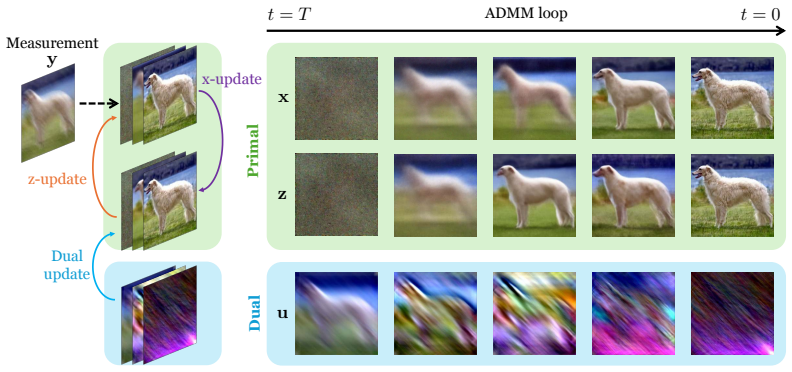
We introduce a new approach to solving MAP problems with diffusion model priors using a dual ascent optimization framework. Our framework achieves better image quality as measured by various metrics for image restoration problems, it is more robust to high levels of measurement noise, it is faster, and it estimates solutions that represent the observations more faithfully than the state of the art.
What carries the argument
Dual ascent optimization framework that incorporates diffusion model priors to solve MAP estimation in inverse problems without relying on common approximations.
If this is right
- Better image quality as measured by standard metrics on image restoration tasks.
- Greater robustness when the input measurements contain high levels of noise.
- Faster runtime than existing state-of-the-art approaches.
- Reconstructed solutions that match the given observations more closely.
Where Pith is reading between the lines
- The same dual-ascent structure might be tested with other types of generative priors besides diffusion models.
- It could be adapted to inverse problems outside imaging, such as signal recovery in physics or astronomy.
- Real-time implementations could be explored for settings where noise levels vary during acquisition.
Load-bearing premise
The dual ascent optimization framework can be combined with diffusion model priors to solve MAP problems while avoiding the inaccurate or suboptimal approximations that affect existing MAP and posterior sampling methods.
What would settle it
A head-to-head test on standard image restoration benchmarks with high added noise that shows no gains in quality metrics or data fidelity compared with current best methods would falsify the central claim.
Figures


read the original abstract
Ill-posed inverse problems are fundamental in many domains, ranging from astrophysics to medical imaging. Emerging diffusion models provide a powerful prior for solving these problems. Existing maximum-a-posteriori (MAP) or posterior sampling approaches, however, rely on different computational approximations, leading to inaccurate or suboptimal samples. To address this issue, we introduce a new approach to solving MAP problems with diffusion model priors using a dual ascent optimization framework. Our framework achieves better image quality as measured by various metrics for image restoration problems, it is more robust to high levels of measurement noise, it is faster, and it estimates solutions that represent the observations more faithfully than the state of the art.
Editorial analysis
A structured set of objections, weighed in public.
Referee Report
Summary. The paper introduces a dual ascent optimization framework for solving maximum-a-posteriori (MAP) estimation problems in ill-posed inverse problems, using diffusion models as priors. It positions this approach as avoiding the inaccurate or suboptimal approximations common in existing MAP and posterior sampling methods, and reports superior performance on image restoration tasks in terms of image quality metrics, robustness to high measurement noise, computational speed, and fidelity to observations.
Significance. If the central claim holds—that dual ascent with diffusion priors yields more accurate MAP solutions without the gradient or sampling approximations of prior work—it would offer a principled and potentially more reliable optimization route for diffusion-based inverse problems. This could improve results in domains such as medical imaging and astrophysics where faithful reconstruction under noise is critical. The absence of free parameters or ad-hoc inventions in the core framework is a positive structural feature.
major comments (2)
- [§3] §3 (Method, dual ascent formulation): The claim that the framework solves the MAP problem while sidestepping suboptimal approximations rests on convergence of dual ascent under the non-convex objective induced by the diffusion score function. Standard dual ascent provides only local convergence guarantees in non-convex settings; the manuscript does not appear to supply a global optimality proof, error bound relative to exact MAP, or analysis of inexact gradient steps/early stopping. This is load-bearing for the central claim that reported gains stem from the framework rather than implementation choices.
- [§5] §5 (Experiments): The reported improvements in metrics, noise robustness, and speed are presented without accompanying details on the number of independent runs, standard deviations, hyperparameter sensitivity (e.g., dual ascent step sizes or penalty parameters), or statistical tests against baselines. This makes it difficult to determine whether the gains are reproducible and attributable to the proposed method.
minor comments (2)
- [§2] Notation for the dual variable and the diffusion prior score should be introduced with explicit definitions in the first use to improve readability.
- [§5] Figure captions for the qualitative restoration examples should include the specific noise levels and inverse problem type (e.g., deblurring vs. inpainting) for each panel.
Simulated Author's Rebuttal
We thank the referee for their thoughtful and constructive comments, which help us clarify the theoretical foundations and strengthen the experimental validation of our dual ascent framework for diffusion-based MAP estimation. We address each major comment below.
read point-by-point responses
-
Referee: [§3] §3 (Method, dual ascent formulation): The claim that the framework solves the MAP problem while sidestepping suboptimal approximations rests on convergence of dual ascent under the non-convex objective induced by the diffusion score function. Standard dual ascent provides only local convergence guarantees in non-convex settings; the manuscript does not appear to supply a global optimality proof, error bound relative to exact MAP, or analysis of inexact gradient steps/early stopping. This is load-bearing for the central claim that reported gains stem from the framework rather than implementation choices.
Authors: We agree that dual ascent applied to the non-convex objective induced by a diffusion score function yields local rather than global convergence guarantees, and the manuscript does not provide a global optimality proof or explicit error bounds relative to the exact MAP solution. Such global results are generally intractable for this class of problems. Our central claim is instead that the dual ascent formulation directly targets the MAP objective without the specific gradient or sampling approximations employed by prior MAP and posterior sampling methods. In the revision we will expand the discussion in §3 to explicitly state the local convergence properties, reference relevant results from non-convex optimization literature, and add targeted experiments analyzing the effects of inexact gradient steps and early stopping on solution quality. revision: partial
-
Referee: [§5] §5 (Experiments): The reported improvements in metrics, noise robustness, and speed are presented without accompanying details on the number of independent runs, standard deviations, hyperparameter sensitivity (e.g., dual ascent step sizes or penalty parameters), or statistical tests against baselines. This makes it difficult to determine whether the gains are reproducible and attributable to the proposed method.
Authors: We acknowledge that the experimental section would benefit from greater statistical detail. In the revised manuscript we will report the number of independent runs performed, include standard deviations for all quantitative metrics, present sensitivity analysis with respect to key hyperparameters such as dual ascent step sizes and penalty parameters, and add statistical significance tests comparing our method against the baselines. These additions will be incorporated into §5 and the supplementary material. revision: yes
Circularity Check
No significant circularity in derivation chain
full rationale
The paper presents a dual ascent optimization framework to solve MAP estimation problems using diffusion model priors, claiming it avoids the approximations of prior MAP and sampling methods. The provided abstract and context describe the approach as combining standard dual ascent with diffusion priors without any equations or steps that reduce the central result to a fitted parameter renamed as prediction, a self-definitional loop, or a load-bearing self-citation chain. No quoted derivation shows the output being equivalent to the input by construction, and the framework builds on independent optimization techniques applied to existing diffusion models. This is the common case of a self-contained contribution.
Axiom & Free-Parameter Ledger
Lean theorems connected to this paper
-
IndisputableMonolith/Cost/FunctionalEquation.leanwashburn_uniqueness_aczel unclear?
unclearRelation between the paper passage and the cited Recognition theorem.
We introduce a new approach to solving MAP problems with diffusion model priors using a dual ascent optimization framework... z-update... x-update... dual update
-
IndisputableMonolith/Foundation/BranchSelection.leanbranch_selection unclear?
unclearRelation between the paper passage and the cited Recognition theorem.
the z-update consists in denoising x+u... replace the z-update with z ← 1/√ᾱt (xt + (1−ᾱt)sθ(xt,t))
What do these tags mean?
- matches
- The paper's claim is directly supported by a theorem in the formal canon.
- supports
- The theorem supports part of the paper's argument, but the paper may add assumptions or extra steps.
- extends
- The paper goes beyond the formal theorem; the theorem is a base layer rather than the whole result.
- uses
- The paper appears to rely on the theorem as machinery.
- contradicts
- The paper's claim conflicts with a theorem or certificate in the canon.
- unclear
- Pith found a possible connection, but the passage is too broad, indirect, or ambiguous to say the theorem truly supports the claim.
Reference graph
Works this paper leans on
-
[1]
First m87 event horizon telescope results
Kazunori Akiyama, Antxon Alberdi, Walter Alef, Keiichi Asada, Rebecca Azulay, Anne- Kathrin Baczko, David Ball, Mislav Balokovi´c, John Barrett, Dan Bintley, et al. First m87 event horizon telescope results. iv. imaging the central supermassive black hole.The Astrophysical Journal Letters, 875(1):L4, 2019
work page 2019
-
[2]
Brian DO Anderson. Reverse-time diffusion equation models.Stochastic Processes and their Applications, 12(3):313–326, 1982
work page 1982
-
[3]
Amir Beck and Marc Teboulle. Fast gradient-based algorithms for constrained total variation image denoising and deblurring problems.IEEE transactions on image processing, 18(11): 2419–2434, 2009
work page 2009
-
[4]
Stephen Boyd, Neal Parikh, Eric Chu, Borja Peleato, Jonathan Eckstein, et al. Distributed opti- mization and statistical learning via the alternating direction method of multipliers.F oundations and Trends® in Machine learning, 3(1):1–122, 2011
work page 2011
-
[5]
Stanley H Chan, Xiran Wang, and Omar A Elgendy. Plug-and-play admm for image restoration: Fixed-point convergence and applications.IEEE Transactions on Computational Imaging, 3(1): 84–98, 2016
work page 2016
-
[6]
doi:10.48550/arXiv.2108.02938 , urldate =
Jooyoung Choi, Sungwon Kim, Yonghyun Jeong, Youngjune Gwon, and Sungroh Yoon. Ilvr: Conditioning method for denoising diffusion probabilistic models.arXiv preprint arXiv:2108.02938, 2021
-
[7]
Diffusion Posterior Sampling for General Noisy Inverse Problems
Hyungjin Chung, Jeongsol Kim, Michael T Mccann, Marc L Klasky, and Jong Chul Ye. Diffu- sion posterior sampling for general noisy inverse problems.arXiv preprint arXiv:2209.14687, 2022
work page internal anchor Pith review Pith/arXiv arXiv 2022
-
[8]
Hyungjin Chung, Byeongsu Sim, Dohoon Ryu, and Jong Chul Ye. Improving diffusion models for inverse problems using manifold constraints.Advances in Neural Information Processing Systems, 35:25683–25696, 2022
work page 2022
-
[9]
A Survey on Diffusion Models for Inverse Problems
Giannis Daras, Hyungjin Chung, Chieh-Hsin Lai, Yuki Mitsufuji, Jong Chul Ye, Peyman Milanfar, Alexandros G Dimakis, and Mauricio Delbracio. A survey on diffusion models for inverse problems.arXiv preprint arXiv:2410.00083, 2024
work page internal anchor Pith review Pith/arXiv arXiv 2024
-
[10]
Jia Deng, Wei Dong, Richard Socher, Li-Jia Li, Kai Li, and Li Fei-Fei. Imagenet: A large- scale hierarchical image database. In2009 IEEE Conference on Computer Vision and Pattern Recognition, pages 248–255, 2009. doi: 10.1109/CVPR.2009.5206848
-
[11]
Diffusion models beat GANs on image synthesis
Prafulla Dhariwal and Alexander Quinn Nichol. Diffusion models beat GANs on image synthesis. In A. Beygelzimer, Y . Dauphin, P. Liang, and J. Wortman Vaughan, editors,Advances in Neural Information Processing Systems, 2021. URL https://openreview.net/forum? id=AAWuCvzaVt
work page 2021
-
[12]
Compressed sensing.IEEE Transactions on information theory, 52(4): 1289–1306, 2006
David L Donoho. Compressed sensing.IEEE Transactions on information theory, 52(4): 1289–1306, 2006
work page 2006
-
[13]
Bradley Efron. Tweedie’s formula and selection bias.Journal of the American Statistical Association, 106(496):1602–1614, 2011
work page 2011
-
[14]
Alisia Fadini, Minhuan Li, Airlie J McCoy, Thomas C Terwilliger, Randy J Read, Doeke Hekstra, and Mohammed AlQuraishi. Alphafold as a prior: Experimental structure determination conditioned on a pretrained neural network.bioRxiv, pages 2025–02, 2025
work page 2025
-
[15]
Score-based diffusion models as principled priors for inverse imaging
Berthy T Feng, Jamie Smith, Michael Rubinstein, Huiwen Chang, Katherine L Bouman, and William T Freeman. Score-based diffusion models as principled priors for inverse imaging. InProceedings of the IEEE/CVF International Conference on Computer Vision, pages 10520– 10531, 2023
work page 2023
-
[16]
Time reversal of diffusions.The Annals of Probability, pages 1188–1205, 1986
Ulrich G Haussmann and Etienne Pardoux. Time reversal of diffusions.The Annals of Probability, pages 1188–1205, 1986. 10
work page 1986
-
[17]
Denoising Diffusion Probabilistic Models
Jonathan Ho, Ajay Jain, and Pieter Abbeel. Denoising diffusion probabilistic models.arXiv preprint arxiv:2006.11239, 2020
work page internal anchor Pith review Pith/arXiv arXiv 2006
-
[18]
Ajil Jalal, Marius Arvinte, Giannis Daras, Eric Price, Alexandros G Dimakis, and Jon Tamir. Robust compressed sensing mri with deep generative priors.Advances in Neural Information Processing Systems, 34:14938–14954, 2021
work page 2021
-
[19]
A style-based generator architecture for generative adversarial networks.IEEE Trans
Tero Karras, Samuli Laine, and Timo Aila. A style-based generator architecture for generative adversarial networks.IEEE Trans. Pattern Anal. Mach. Intell., 43(12):4217–4228, December
-
[20]
doi: 10.1109/TPAMI.2020.2970919
ISSN 0162-8828. doi: 10.1109/TPAMI.2020.2970919. URL https://doi.org/10. 1109/TPAMI.2020.2970919
-
[21]
Bahjat Kawar, Gregory Vaksman, and Michael Elad. Snips: Solving noisy inverse problems stochastically.Advances in Neural Information Processing Systems, 34:21757–21769, 2021
work page 2021
-
[22]
Bahjat Kawar, Michael Elad, Stefano Ermon, and Jiaming Song. Denoising diffusion restoration models.Advances in Neural Information Processing Systems, 35:23593–23606, 2022
work page 2022
-
[23]
Chan, Sara Fridovich-Keil, Frederic Poitevin, Ellen D
Axel Levy, Eric R Chan, Sara Fridovich-Keil, Frédéric Poitevin, Ellen D Zhong, and Gordon Wetzstein. Solving inverse problems in protein space using diffusion-based priors.arXiv preprint arXiv:2406.04239, 2024
-
[24]
Xiang Li, Soo Min Kwon, Ismail R Alkhouri, Saiprasad Ravishanka, and Qing Qu. De- coupled data consistency with diffusion purification for image restoration.arXiv preprint arXiv:2403.06054, 2024
-
[25]
Swinir: Image restoration using swin transformer
Jingyun Liang, Jiezhang Cao, Guolei Sun, Kai Zhang, Luc Van Gool, and Radu Timofte. Swinir: Image restoration using swin transformer. InProceedings of the IEEE/CVF international conference on computer vision, pages 1833–1844, 2021
work page 2021
-
[26]
Sai Advaith Maddipatla, Nadav Bojan Sellam, Sanketh Vedula, Ailie Marx, and Alex Bronstein. Generative modeling of protein ensembles guided by crystallographic electron densities.arXiv preprint arXiv:2412.13223, 2024
-
[27]
Morteza Mardani, Jiaming Song, Jan Kautz, and Arash Vahdat. A variational perspective on solving inverse problems with diffusion models.arXiv preprint arXiv:2305.04391, 2023
-
[28]
Proximal algorithms.F oundations and trends® in Optimiza- tion, 1(3):127–239, 2014
Neal Parikh, Stephen Boyd, et al. Proximal algorithms.F oundations and trends® in Optimiza- tion, 1(3):127–239, 2014
work page 2014
-
[29]
Solving linear inverse problems provably via posterior sampling with latent diffusion models
Litu Rout, Negin Raoof, Giannis Daras, Constantine Caramanis, Alex Dimakis, and Sanjay Shakkottai. Solving linear inverse problems provably via posterior sampling with latent diffusion models. InThirty-seventh Conference on Neural Information Processing Systems, 2023. URL https://openreview.net/forum?id=XKBFdYwfRo
work page 2023
-
[30]
Leonid I Rudin, Stanley Osher, and Emad Fatemi. Nonlinear total variation based noise removal algorithms.Physica D: nonlinear phenomena, 60(1-4):259–268, 1992
work page 1992
-
[31]
Solving inverse problems with latent diffusion models via hard data consistency
Bowen Song, Soo Min Kwon, Zecheng Zhang, Xinyu Hu, Qing Qu, and Liyue Shen. Solving inverse problems with latent diffusion models via hard data consistency. InThe Twelfth International Conference on Learning Representations, 2024. URL https://openreview. net/forum?id=j8hdRqOUhN
work page 2024
-
[32]
Denoising Diffusion Implicit Models
Jiaming Song, Chenlin Meng, and Stefano Ermon. Denoising diffusion implicit models.arXiv preprint arXiv:2010.02502, 2020
work page internal anchor Pith review Pith/arXiv arXiv 2010
-
[33]
Pseudoinverse-guided diffusion models for inverse problems
Jiaming Song, Arash Vahdat, Morteza Mardani, and Jan Kautz. Pseudoinverse-guided diffusion models for inverse problems. InInternational Conference on Learning Representations, 2023
work page 2023
-
[34]
Score-Based Generative Modeling through Stochastic Differential Equations
Yang Song, Jascha Sohl-Dickstein, Diederik P Kingma, Abhishek Kumar, Stefano Ermon, and Ben Poole. Score-based generative modeling through stochastic differential equations.arXiv preprint arXiv:2011.13456, 2020. 11
work page internal anchor Pith review Pith/arXiv arXiv 2011
-
[35]
Yang Song, Conor Durkan, Iain Murray, and Stefano Ermon. Maximum likelihood training of score-based diffusion models.Advances in neural information processing systems, 34: 1415–1428, 2021
work page 2021
-
[36]
Yang Song, Liyue Shen, Lei Xing, and Stefano Ermon. Solving inverse problems in medical imaging with score-based generative models.arXiv preprint arXiv:2111.08005, 2021
-
[37]
Explore image deblurring via encoded blur kernel space
Phong Tran, Anh Tran, Quynh Phung, and Minh Hoai. Explore image deblurring via encoded blur kernel space. InProceedings of the IEEE Conference on Computer Vision and Pattern Recognition (CVPR), 2021
work page 2021
-
[38]
Plug-and-play priors for model based reconstruction
Singanallur V Venkatakrishnan, Charles A Bouman, and Brendt Wohlberg. Plug-and-play priors for model based reconstruction. In2013 IEEE global conference on signal and information processing, pages 945–948. IEEE, 2013
work page 2013
-
[39]
Yinhuai Wang, Jiwen Yu, and Jian Zhang. Zero-shot image restoration using denoising diffusion null-space model.arXiv preprint arXiv:2212.00490, 2022
-
[40]
Bingliang Zhang, Wenda Chu, Julius Berner, Chenlin Meng, Anima Anandkumar, and Yang Song. Improving diffusion inverse problem solving with decoupled noise annealing.arXiv preprint arXiv:2407.01521, 2024
-
[41]
Kai Zhang, Wangmeng Zuo, Yunjin Chen, Deyu Meng, and Lei Zhang. Beyond a gaussian denoiser: Residual learning of deep cnn for image denoising.IEEE transactions on image processing, 26(7):3142–3155, 2017
work page 2017
-
[42]
Richard Zhang, Phillip Isola, Alexei A. Efros, Eli Shechtman, and Oliver Wang. The unreasonable effectiveness of deep features as a perceptual metric. In2018 IEEE/CVF Conference on Computer Vision and Pattern Recognition, pages 586–595, 2018. doi: 10.1109/CVPR.2018.00068
-
[43]
Denoising diffusion models for plug-and-play image restoration
Yuanzhi Zhu, Kai Zhang, Jingyun Liang, Jiezhang Cao, Bihan Wen, Radu Timofte, and Luc Van Gool. Denoising diffusion models for plug-and-play image restoration. InProceedings of the IEEE/CVF Conference on Computer Vision and Pattern Recognition, pages 1219–1229, 2023. 12 A Technical Appendices and Supplementary Material A.1 Statistical Significance Buildin...
work page 2023
discussion (0)
Sign in with ORCID, Apple, or X to comment. Anyone can read and Pith papers without signing in.