REVIEW 3 major objections 4 minor 60 references
FastCAV: Efficient Computation of Concept Activation Vectors for Explaining Deep Neural Networks
T0 review · 3 major / 4 minor · reviewed 2026-08-07 · deepseek-v4-flash
Pith's one-line read FastCAV computes a concept activation vector as the normalized difference between the concept-activation mean and the global mean in layer space, matching SVM-based CAVs while running up to 63.6x faster.
desk verdict FastCAV is a useful empirical speedup for CAV computation, but the SVM-equivalence theory is over-claimed and the drop-in framing needs a tail-risk qualifier. read the letter →
The pith
A machine-rendered reading of the paper's core claim, the machinery that carries it, and where it could break.
The reading
What carries the argument
The load-bearing object is the normalized vector $$v^l_c \propto \frac{1}{|D_c|}\sum_{x\in D_c}\bigl(g_l(x)-\hat\mu_{D_c\cup D_r}\bigr),$$ the direction from the pooled activation mean to the concept-example mean, with the linear boundary completed by $b=-v^l_c\cdot\hat\mu_{D_c\cup D_r}$. It replaces the SVM objective with a single pass over activations. The identity that carries the argument is the reduction of Fisher discriminant analysis to this mean difference under isotropic within-class covariance, together with the known result that a linear SVM is a sparsified Fisher discriminant whose solution converges to the same vector in the $d \gg n$ regime. This chain is what turns a mean computation into a justified CAV rather than an arbitrary probe.
What would settle it
Pick a modern ViT or ConvNeXt layer and compute the eigenvalue spread (condition number) of the pooled within-class covariance for concept versus random activations, then compare FastCAV's direction with an SVM-trained CAV on the same data. If layers with large condition numbers consistently show cosine similarity far below the reported 0.8-0.9 range, or the fraction of concepts with accuracy gaps above 25 points grows well beyond the reported 2.8%, the drop-in equivalence claim is falsified.
Extended reading notes
Core claim
The central claim is that a concept activation vector can be computed as the normalized mean-difference direction, $v^l_c \propto \frac{1}{|D_c|}\sum_{x\in D_c}(g_l(x)-\hat\mu_{D_c\cup D_r})$, where $D_c$ is the concept image set, $D_r$ the random set, and $\hat\mu$ the pooled activation mean. Under equal Gaussian classes the expected direction is proportional to $\mu_c-\mu_r$; with additional isotropic within-class covariance it equals the Fisher LDA normal vector, and via the known SVM-Fisher relationship the SVM-based CAV of prior work converges to the same vector when activation dimension greatly exceeds sample count. Across ResNet50, Inception-v3, ViT-B/16, ConvNeXt-XXLarge, ViT-H/14-CLIP, EVA-G/14, EVA-02-L/14 and RegNetY, the paper reports speeds 46.4x faster on average (up to 63.6x), CAV accuracies similar to or better than SVM-CAV, higher stability under resampled random sets, and matching TCAV and ACE conclusions. The paper also states the Gaussian-isotropy assumptions are strong and likely violated in practice, and reports that in 2.8% of CAVs the accuracy difference between the two methods exceeds 25 percentage points, with SVM favored in 1% of all cases.
Load-bearing premise
The concept and random activations are Gaussian, equally mixed, and have isotropic within-class covariance, so the within-class covariance matrix is a scalar multiple of the identity and the Fisher discriminant normal vector collapses to the mean difference; the paper itself calls these assumptions strong and likely false in practice.
Editorial extensions
If this is right
- Concept-based explanations become affordable at per-layer and per-epoch granularity; the paper demonstrates this by tracking CAVs through all 90 epochs of a ResNet50 trained on ImageNet, a computation previously impractical.
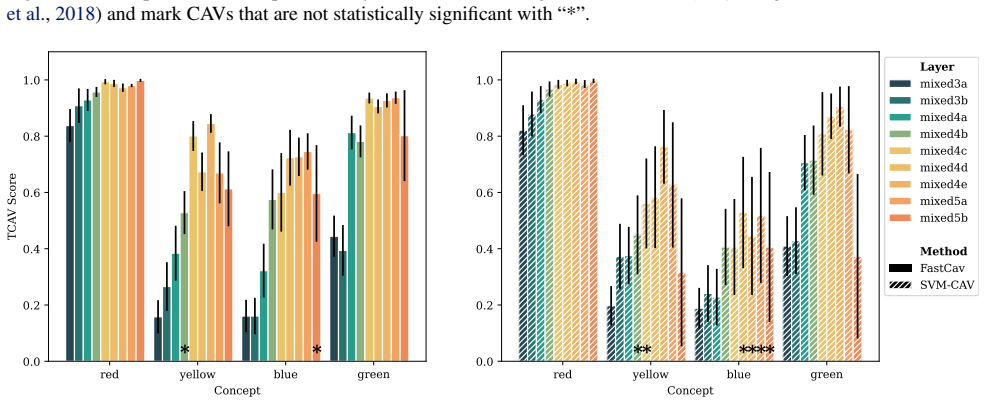
- TCAV and ACE can substitute FastCAV for their SVM component without changing pipelines: reported TCAV scores show the same qualitative conclusions, with smaller variance across resampled random sets.
- Higher intra-method robustness means fewer resampled random sets are needed to get stable TCAV significance, reducing the cost of statistical testing further.
- The theoretical equivalence establishes that in high-dimensional activation spaces, linear SVM training for CAVs is effectively solving for a mean difference, so the speedup does not come at the cost of a different semantic direction in the typical regime.
Reading between the lines
- A direct extension the paper leaves implicit: since FastCAV's only source of variation across runs is the estimated global mean, the run-to-run variance in TCAV scores is likely dominated by SVM optimizer noise; replacing the SVM with FastCAV and recomputing TCAV confidence intervals would test this directly.
- The mean-difference construction could be generalized to class-conditional concepts (replacing the global mean with a class-conditional mean) to attribute concept directions within specific classes, a variant the paper does not explore.
- The reported 2.8% of large-accuracy-divergence cases suggests a practical diagnostic: estimate the eigenvalue spread of the within-class covariance for each concept and fall back to SVM training when it is high, making FastCAV a front-end filter rather than a full replacement.
Editorial analysis
A structured set of objections, weighed in public.
Referee Report
Summary. FastCAV replaces SVM-based CAV training with a one-pass mean computation: the normalized difference between the concept activation mean and the global activation mean. The paper claims speedups of up to 63.6x (46.4x on average) with comparable CAV accuracy and similarity across eight ImageNet architectures, a medical chest X-ray task, and downstream TCAV and ACE analyses, and demonstrates the method's usefulness by tracking concept evolution during ResNet50 training. A theoretical section argues that FastCAV is equivalent to Fisher LDA under Gaussian isotropic within-class covariance and, via Shashua's support-vector sparsification result, to linear SVM when d >> n.
Significance. The empirical contribution is substantial and carefully executed: the evaluation spans eight architectures, multiple layers, repeated random sets, multiple concepts, several linear classifiers, and downstream explanation methods, with consistent results. The speed advantage of a simple mean arithmetic estimator over iterative SVM training is robust and the training-time tracking experiment is a genuine new capability. If the theoretical equivalence claim is either proven under precise conditions or honestly weakened to an approximate/empirical statement, and the drop-in claim is qualified by the acknowledged failure cases, the paper would be a useful and practical contribution to concept-based interpretability. The present version, however, overstates the theoretical support for the method.
major comments (3)
- [§3.3] The claimed exact equivalence to linear SVM is not established. Shashua (1999) equates the linear SVM solution with the Fisher discriminant computed on the support-vector set, not on the full data. Appendix A.2 (Table 3) reports support-vector fractions between 52.31% and 99.67%; whenever this fraction is below 100%, the support-vector set is selected by the margin and its within-class scatter is not the full-data scatter, so the SVM direction need not coincide with the full-data LDA direction even under isotropic Gaussian class-conditional distributions. The heuristic that "d >> n implies many support vectors" plus the empirical percentages does not bridge this gap. In addition, Eq. (6) states that the expectation of the normalized CAV is proportional to the mean difference, but expectation and normalization do not commute; this needs a concentration argument or an explicit statement that the proportionality is only approximate. Please either provide a precise theorem with conditions under which the two directions are equal (or a bound on their angle), or clearly label the equivalence as approximate and empirically motivated.
- [Appendix B.2.2] The tail behavior reported by the authors contradicts the unqualified "drop-in replacement" claim made in the abstract and conclusion. Appendix B.2.2 states that 2.8% of all computed CAVs have accuracy differences above 25 percentage points, with SVM winning in 1% of cases, and that one ViT-B/16 encoder layer shows a 40-point gap (95% vs 55%). These are precisely the cases where the isotropic Gaussian assumption fails, and Table 1 reports only averages, so it does not quantify the risk faced by a user applying FastCAV to a new concept or layer. Please add a clearly visible caveat to the abstract and conclusion, and ideally provide a practical diagnostic (e.g., checking separability or comparing against a small SVM holdout) to detect such cases.
- [§3.3, Eq. (7)] Equation (7) contains a visible typo in the definition of the within-class covariance estimator: the second sum uses (gl(x) − μ̂_r)(gl(x) − μ̂_c)⊤, where the second factor should be (gl(x) − μ̂_r)⊤. Because the equation is the basis for the LDA reduction that motivates FastCAV, this should be corrected, and the surrounding derivation should be checked for similar indexing errors.
minor comments (4)
- [Appendix A.3, Figure 10] The caption "It can be seen that our method results in similar results" is uninformative and appears to be a leftover; it should describe the runtime scaling with n and d and label the plotted curves clearly.
- [Appendix A.2, Table 3] The header "∅ Activation Dimensionality" uses the empty-set symbol where "Mean" or "Average" is intended; please use conventional notation.
- [Figures 3, 11–14] The method label "FastCav" is inconsistent with the "FastCAV" spelling used in the text; please unify the spelling across all figures and captions.
- [Appendix A.2] The support-vector percentages are reported only for pre-final layers; given the theoretical argument, reporting the per-layer spread of support-vector fractions would be informative, since the argument's validity depends on the fraction being close to 1.
Circularity Check
No circularity: FastCAV is a closed-form estimator benchmarked against an external SVM baseline; its equivalence arguments rest on external classical results, not on the paper's own output.
full rationale
FastCAV is defined directly by Eq. (3) as the normalized mean difference between concept activations and the global mean, with no parameter fitted to any target that is later called a prediction. The theoretical derivation in Section 3.3 uses standard Gaussian-mixture calculations (Eqs. 5-6) and the classical fact that under isotropic within-class covariance the Fisher LDA normal direction is proportional to the mean difference; the identification with linear SVM relies on the externally published equivalence of Shashua (1999) and on externally published support-vector proliferation results (Muthukumar et al., 2021; Hsu et al., 2021), not on results of the present paper. The empirical comparisons in Sections 4.1-4.3 benchmark FastCAV against an independently computed SVM baseline on held-out validation data (Appendix B.1), so the reported accuracy and similarity measurements are external checks rather than consequences of the method's construction. The acknowledged 2.8% large-accuracy-difference cases (Appendix B.2.2) are an empirical limitation of the stated Gaussian-isotropy assumptions, but no fitted constant is fed back into the method; this is a correctness and robustness caveat, not circularity. The only self-citation (Penzel et al., 2022) appears as a supporting aside on training dynamics in Appendix B.5 and is not load-bearing, and the typo in Eq. (7) does not make the derivation circular. Overall, the derivation chain is self-contained and the central claim is tested against an external baseline, so there is no significant circularity.
Assumptions & free parameters
assumptions (3)
- domain assumption Activations for concept and random images follow multivariate Gaussian distributions with equal mixture weights.
- ad hoc to paper Within-class covariance is isotropic, i.e., Sigma^{-1} is proportional to the identity matrix.
- domain assumption The dimensionality is much larger than the sample size, and the support vector fraction is close to 1.
Cite this review
Pith. "Pith review of FastCAV: Efficient Computation of Concept Activation Vectors for Explaining Deep Neural Networks." pith.science (2026). https://pith.science/paper/DAWM2H3H
@misc{pith2026250517883,
  author       = {Pith},
  title        = {Pith review of: FastCAV: Efficient Computation of Concept Activation Vectors for Explaining Deep Neural Networks},
  year         = {2026},
  howpublished = {\url{https://pith.science/paper/DAWM2H3H}},
  note         = {Machine review of arXiv:2505.17883}
}
read the original abstract
Concepts such as objects, patterns, and shapes are how humans understand the world. Building on this intuition, concept-based explainability methods aim to study representations learned by deep neural networks in relation to human-understandable concepts. Here, Concept Activation Vectors (CAVs) are an important tool and can identify whether a model learned a concept or not. However, the computational cost and time requirements of existing CAV computation pose a significant challenge, particularly in large-scale, high-dimensional architectures. To address this limitation, we introduce FastCAV, a novel approach that accelerates the extraction of CAVs by up to 63.6x (on average 46.4x). We provide a theoretical foundation for our approach and give concrete assumptions under which it is equivalent to established SVM-based methods. Our empirical results demonstrate that CAVs calculated with FastCAV maintain similar performance while being more efficient and stable. In downstream applications, i.e., concept-based explanation methods, we show that FastCAV can act as a replacement leading to equivalent insights. Hence, our approach enables previously infeasible investigations of deep models, which we demonstrate by tracking the evolution of concepts during model training.
Figures


Figures from the paper (17 more)




Reference graph
Works this paper leans on
-
[1]
write newline
" write newline "" before.all 'output.state := FUNCTION n.dashify 't := "" t empty not t #1 #1 substring "-" = t #1 #2 substring "--" = not "--" * t #2 global.max substring 't := t #1 #1 substring "-" = "-" * t #2 global.max substring 't := while if t #1 #1 substring * t #2 global.max substring 't := if while FUNCTION format.date year duplicate empty "emp...
-
[2]
Understanding intermediate layers using linear classifier probes
Alain, G. Understanding intermediate layers using linear classifier probes. arXiv preprint arXiv:1610.01644, 2016
arXiv 2016
-
[3]
Barsalou, L. Perceptual symbol systems. The Behavioral and brain sciences/Cambridge University Press, 1999
work page 1999
-
[4]
Network dissection: Quantifying interpretability of deep visual representations
Bau, D., Zhou, B., Khosla, A., Oliva, A., and Torralba, A. Network dissection: Quantifying interpretability of deep visual representations. In Proceedings of the IEEE conference on computer vision and pattern recognition, pp.\ 6541--6549, 2017
work page 2017
-
[5]
Understanding the role of individual units in a deep neural network
Bau, D., Zhu, J.-Y., Strobelt, H., Lapedriza, A., Zhou, B., and Torralba, A. Understanding the role of individual units in a deep neural network. Proceedings of the National Academy of Sciences, 117 0 (48): 0 30071--30078, 2020
work page 2020
-
[6]
Bishop, C. M. Pattern recognition and machine learning, volume 4. Springer, 2006
work page 2006
-
[7]
L., Anil, C., Denison, C., Askell, A., et al
Bricken, T., Templeton, A., Batson, J., Chen, B., Jermyn, A., Conerly, T., Turner, N. L., Anil, C., Denison, C., Askell, A., et al. Towards Monosemanticity: Decomposing Language Models With Dictionary Learning. Anthropic, 2023
work page 2023
-
[8]
Chang, C.-C. and Lin, C.-J. Libsvm: A library for support vector machines. ACM transactions on intelligent systems and technology (TIST), 2 0 (3): 0 1--27, 2011
work page 2011
Show all 60 references
-
[9]
Training a support vector machine in the primal
Chapelle, O. Training a support vector machine in the primal. Neural Computation, 19 0 (5): 0 1155--1178, 2007. doi:10.1162/neco.2007.19.5.1155
2007 doi
-
[10]
An image is worth 16x16 words: Transformers for image recognition at scale
Dosovitskiy, A., Beyer, L., Kolesnikov, A., Weissenborn, D., Zhai, X., Unterthiner, T., Dehghani, M., Minderer, M., Heigold, G., Gelly, S., Uszkoreit, J., and Houlsby, N. An image is worth 16x16 words: Transformers for image recognition at scale. ICLR, 2021
2021
-
[11]
Toy models of superposition
Elhage, N., Hume, T., Olsson, C., Schiefer, N., Henighan, T., Kravec, S., Hatfield-Dodds, Z., Lasenby, R., Drain, D., Chen, C., et al. Toy models of superposition. arXiv preprint arXiv:2209.10652, 2022
2022 arXiv
-
[12]
Liblinear: A library for large linear classification
Fan, R.-E., Chang, K.-W., Hsieh, C.-J., Wang, X.-R., and Lin, C.-J. Liblinear: A library for large linear classification. Journal of machine learning research, 9 0 (Aug): 0 1871--1874, 2008
2008
-
[13]
Eva: Exploring the limits of masked visual representation learning at scale
Fang, Y., Wang, W., Xie, B., Sun, Q., Wu, L., Wang, X., Huang, T., Wang, X., and Cao, Y. Eva: Exploring the limits of masked visual representation learning at scale. In Proceedings of the IEEE/CVF Conference on Computer Vision and Pattern Recognition, pp.\ 19358--19369, 2023
2023
-
[14]
Eva-02: A visual representation for neon genesis
Fang, Y., Sun, Q., Wang, X., Huang, T., Wang, X., and Cao, Y. Eva-02: A visual representation for neon genesis. Image and Vision Computing, 149: 0 105171, 2024
2024
-
[15]
Y., and Kim, B
Ghorbani, A., Wexler, J., Zou, J. Y., and Kim, B. Towards automatic concept-based explanations. In Advances in Neural Information Processing Systems, pp.\ 9273--9282, 2019
2019
-
[16]
Distilling blackbox to interpretable models for efficient transfer learning
Ghosh, S., Yu, K., and Batmanghelich, K. Distilling blackbox to interpretable models for efficient transfer learning. In International Conference on Medical Image Computing and Computer-Assisted Intervention, pp.\ 628--638. Springer, 2023
2023
-
[17]
Decoding the thought vector, 2016
Goh, G. Decoding the thought vector, 2016. URL https://gabgoh.github.io/ThoughtVectors/. Accessed: 2025-01-07
2016
-
[18]
Regression concept vectors for bidirectional explanations in histopathology
Graziani, M., Andrearczyk, V., and M \"u ller, H. Regression concept vectors for bidirectional explanations in histopathology. In Understanding and Interpreting Machine Learning in Medical Image Computing Applications: First International Workshops, MLCN 2018, DLF 2018, and iM...
2018
-
[19]
Concept distillation: leveraging human-centered explanations for model improvement
Gupta, A., Saini, S., and Narayanan, P. Concept distillation: leveraging human-centered explanations for model improvement. Advances in Neural Information Processing Systems, 36, 2024
2024
-
[20]
Deep residual learning for image recognition
He, K., Zhang, X., Ren, S., and Sun, J. Deep residual learning for image recognition. In Proceedings of the IEEE conference on computer vision and pattern recognition, pp.\ 770--778, 2016
2016
-
[21]
On the proliferation of support vectors in high dimensions
Hsu, D., Muthukumar, V., and Xu, J. On the proliferation of support vectors in high dimensions. In International Conference on Artificial Intelligence and Statistics, pp.\ 91--99. PMLR, 2021
2021
-
[22]
Huang, G., Liu, Z., Van Der Maaten, L., and Weinberger, K. Q. Densely connected convolutional networks. In Proceedings of the IEEE conference on computer vision and pattern recognition, pp.\ 4700--4708, 2017
2017
-
[23]
Lg-cav: Train any concept activation vector with language guidance
Huang, Q., Song, J., Xue, M., Zhang, H., Hu, B., Wang, H., Jiang, H., Wang, X., and Song, M. Lg-cav: Train any concept activation vector with language guidance. arXiv preprint arXiv:2410.10308, 2024
2024 arXiv
-
[24]
Timm leaderboard, 2025
HuggingFace. Timm leaderboard, 2025. URL https://huggingface.co/spaces/timm/leaderboard. Accessed: [05/01/2025]
2025
-
[25]
Chexpert: A large chest radiograph dataset with uncertainty labels and expert comparison
Irvin, J., Rajpurkar, P., Ko, M., Yu, Y., Ciurea-Ilcus, S., Chute, C., Marklund, H., Haghgoo, B., Ball, R., Shpanskaya, K., et al. Chexpert: A large chest radiograph dataset with uncertainty labels and expert comparison. In Thirty-Third AAAI Conference on Artificial Intelligence, 2019
2019
-
[26]
E., Pollard, T
Johnson, A. E., Pollard, T. J., Greenbaum, N. R., Lungren, M. P., Deng, C.-y., Peng, Y., Lu, Z., Mark, R. G., Berkowitz, S. J., and Horng, S. Mimic-cxr-jpg, a large publicly available database of labeled chest radiographs. arXiv preprint arXiv:1901.07042, 2019
1901 arXiv
-
[27]
Visualizing and understanding recurrent networks
Karpathy, A., Johnson, J., and Fei-Fei, L. Visualizing and understanding recurrent networks. arXiv preprint arXiv:1506.02078, 2015
2015 arXiv
-
[28]
Interpretability beyond feature attribution: Quantitative testing with concept activation vectors (tcav), 2018
Kim, B., Wattenberg, M., Gilmer, J., Cai, C., Wexler, J., Viegas, F., and Sayres, R. Interpretability beyond feature attribution: Quantitative testing with concept activation vectors (tcav), 2018. URL https://arxiv.org/abs/1711.11279
2018 arXiv
-
[29]
A convnet for the 2020s
Liu, Z., Mao, H., Wu, C.-Y., Feichtenhofer, C., Darrell, T., and Xie, S. A convnet for the 2020s. In Proceedings of the IEEE/CVF conference on computer vision and pattern recognition, pp.\ 11976--11986, 2022
2022
-
[30]
and Hutter, F
Loshchilov, I. and Hutter, F. Decoupled weight decay regularization. arXiv preprint arXiv:1711.05101, 2017
2017 arXiv
-
[31]
Text2concept: Concept activation vectors directly from text
Moayeri, M., Rezaei, K., Sanjabi, M., and Feizi, S. Text2concept: Concept activation vectors directly from text. In Proceedings of the IEEE/CVF Conference on Computer Vision and Pattern Recognition, pp.\ 3744--3749, 2023
2023
-
[32]
Classification vs regression in overparameterized regimes: Does the loss function matter? Journal of Machine Learning Research, 22 0 (222): 0 1--69, 2021
Muthukumar, V., Narang, A., Subramanian, V., Belkin, M., Hsu, D., and Sahai, A. Classification vs regression in overparameterized regimes: Does the loss function matter? Journal of Machine Learning Research, 22 0 (222): 0 1--69, 2021
2021
-
[33]
A., and Gal, Y
Nicolson, A., Schut, L., Noble, J. A., and Gal, Y. Explaining explainability: Understanding concept activation vectors, 2024. URL https://arxiv.org/abs/2404.03713
2024 arXiv
-
[34]
and Weng, T.-W
Oikarinen, T. and Weng, T.-W. Clip-dissect: Automatic description of neuron representations in deep vision networks. arXiv preprint arXiv:2204.10965, 2022
2022 arXiv
-
[35]
and Weng, T.-W
Oikarinen, T. and Weng, T.-W. Linear explanations for individual neurons. arXiv preprint arXiv:2405.06855, 2024
2024 arXiv
-
[36]
Feature visualization
Olah, C., Mordvintsev, A., and Schubert, L. Feature visualization. Distill, 2 0 (11): 0 e7, 2017
2017
-
[37]
Zoom in: An introduction to circuits
Olah, C., Cammarata, N., Schubert, L., Goh, G., Petrov, M., and Carter, S. Zoom in: An introduction to circuits. Distill, 5 0 (3): 0 e00024--001, 2020
2020
-
[38]
J., Wiegand, T., Samek, W., and Lapuschkin, S
Pahde, F., Dreyer, M., Weckbecker, M., Weber, L., Anders, C. J., Wiegand, T., Samek, W., and Lapuschkin, S. Navigating neural space: Revisiting concept activation vectors to overcome directional divergence. In The Thirteenth International Conference on Learning Representations, 2025
2025
-
[39]
Pytorch: An imperative style, high-performance deep learning library
Paszke, A., Gross, S., Massa, F., Lerer, A., Bradbury, J., Chanan, G., Killeen, T., Lin, Z., Gimelshein, N., Antiga, L., et al. Pytorch: An imperative style, high-performance deep learning library. Advances in neural information processing systems, 32, 2019
2019
-
[40]
Scikit-learn: Machine learning in python
Pedregosa, F., Varoquaux, G., Gramfort, A., Michel, V., Thirion, B., Grisel, O., Blondel, M., Prettenhofer, P., Weiss, R., Dubourg, V., et al. Scikit-learn: Machine learning in python. Journal of machine learning research, 12 0 (Oct): 0 2825--2830, 2011
2011
-
[41]
Investigating neural network training on a feature level using conditional independence
Penzel, N., Reimers, C., Bodesheim, P., and Denzler, J. Investigating neural network training on a feature level using conditional independence. In ECCV Workshop on Causality in Vision (ECCV-WS), pp.\ 383--399, Cham, 2022. Springer Nature Switzerland. ISBN 978-3-031-25075-0. d...
2022 doi
-
[42]
T., Wei, J., Wei, M
Pfau, J., Young, A. T., Wei, J., Wei, M. L., and Keiser, M. J. Robust semantic interpretability: Revisiting concept activation vectors. arXiv preprint arXiv:2104.02768, 2021
2021 arXiv
-
[43]
Platt, J. C. Fast training of support vector machines using sequential minimal optimization. In Advances in Kernel Methods: Support Vector Learning. The MIT Press, 12 1998. ISBN 9780262283199. doi:10.7551/mitpress/1130.003.0016. URL https://doi.org/10.7551/mitpress/1130.003.0016
1998 doi
-
[44]
W., Hallacy, C., Ramesh, A., Goh, G., Agarwal, S., Sastry, G., Askell, A., Mishkin, P., Clark, J., et al
Radford, A., Kim, J. W., Hallacy, C., Ramesh, A., Goh, G., Agarwal, S., Sastry, G., Askell, A., Mishkin, P., Clark, J., et al. Learning transferable visual models from natural language supervision. In International conference on machine learning, pp.\ 8748--8763. PMLR, 2021
2021
-
[45]
Imagenet large scale visual recognition challenge
Russakovsky, O., Deng, J., Su, H., Krause, J., Satheesh, S., Ma, S., Huang, Z., Karpathy, A., Khosla, A., Bernstein, M., et al. Imagenet large scale visual recognition challenge. International journal of computer vision, 115: 0 211--252, 2015
2015
-
[46]
Best of both worlds: local and global explanations with human-understandable concepts
Schrouff, J., Baur, S., Hou, S., Mincu, D., Loreaux, E., Blanes, R., Wexler, J., Karthikesalingam, A., and Kim, B. Best of both worlds: local and global explanations with human-understandable concepts. arXiv preprint arXiv:2106.08641, 2021
2021 arXiv
-
[47]
On the relationship between the support vector machine for classification and sparsified fisher's linear discriminant
Shashua, A. On the relationship between the support vector machine for classification and sparsified fisher's linear discriminant. Neural Processing Letters, 9 0 (2): 0 129--139, Apr 1999. ISSN 1573-773X. doi:10.1023/A:1018677409366. URL https://doi.org/10.1023/A:1018677409366
1999 doi
-
[48]
and Tishby, N
Shwartz-Ziv, R. and Tishby, N. Opening the black box of deep neural networks via information. arXiv preprint arXiv:1703.00810, 2017
2017 arXiv
-
[49]
Singh, M., Gustafson, L., Adcock, A., Reis, V. d. F., Gedik, B., Kosaraju, R. P., Mahajan, D., Girshick, R., Doll 'a r, P., and van der Maaten, L. Revisiting Weakly Supervised Pre-Training of Visual Perception Models . In CVPR, 2022
2022
-
[50]
Using causal analysis for conceptual deep learning explanation
Singla, S., Wallace, S., Triantafillou, S., and Batmanghelich, K. Using causal analysis for conceptual deep learning explanation. In Medical Image Computing and Computer Assisted Intervention--MICCAI 2021: 24th International Conference, Strasbourg, France, September 27--Octobe...
2021
-
[51]
Intriguing properties of neural networks
Szegedy, C. Intriguing properties of neural networks. arXiv preprint arXiv:1312.6199, 2013
2013 arXiv
-
[52]
Going deeper with convolutions
Szegedy, C., Liu, W., Jia, Y., Sermanet, P., Reed, S., Anguelov, D., Erhan, D., Vanhoucke, V., and Rabinovich, A. Going deeper with convolutions. In Proceedings of the IEEE conference on computer vision and pattern recognition, pp.\ 1--9, 2015
2015
-
[53]
Rethinking the inception architecture for computer vision
Szegedy, C., Vanhoucke, V., Ioffe, S., Shlens, J., and Wojna, Z. Rethinking the inception architecture for computer vision. In Proceedings of the IEEE conference on computer vision and pattern recognition, pp.\ 2818--2826, 2016
2016
-
[54]
Scaling monosemanticity: Extracting interpretable features from claude 3 sonnet
Templeton, A. Scaling monosemanticity: Extracting interpretable features from claude 3 sonnet. Anthropic, 2024
2024
-
[55]
Statistical learning theory
Vapnik, V. Statistical learning theory. John Wiley & Sons, 2: 0 831--842, 1998
1998
-
[56]
Pytorch image models
Wightman, R. Pytorch image models. https://github.com/rwightman/pytorch-image-models, 2019
2019
-
[57]
L., Gugger, S., Drame, M., Lhoest, Q., and Rush, A
Wolf, T., Debut, L., Sanh, V., Chaumond, J., Delangue, C., Moi, A., Cistac, P., Rault, T., Louf, R., Funtowicz, M., Davison, J., Shleifer, S., von Platen, P., Ma, C., Jernite, Y., Plu, J., Xu, C., Scao, T. L., Gugger, S., Drame, M., Lhoest, Q., and Rush, A. M. Huggingface's tr...
1910 arXiv
-
[58]
On completeness-aware concept-based explanations in deep neural networks
Yeh, C.-K., Kim, B., Arik, S., Li, C.-L., Pfister, T., and Ravikumar, P. On completeness-aware concept-based explanations in deep neural networks. Advances in neural information processing systems, 33: 0 20554--20565, 2020
2020
-
[59]
A., Shechtman, E., and Wang, O
Zhang, R., Isola, P., Efros, A. A., Shechtman, E., and Wang, O. The unreasonable effectiveness of deep features as a perceptual metric. In Proceedings of the IEEE conference on computer vision and pattern recognition, pp.\ 586--595, 2018
2018
-
[60]
A., and Rubinstein, B
Zhang, R., Madumal, P., Miller, T., Ehinger, K. A., and Rubinstein, B. I. Invertible concept-based explanations for cnn models with non-negative concept activation vectors. In Proceedings of the AAAI Conference on Artificial Intelligence, volume 35, pp.\ 11682--11690, 2021
2021
Reviewed August 7, 2026 · model on record in the stance chip above.
Discussion (0). Sign in to comment.