Thermodynamics of magnetized BPS baryonic layers and the effects of the Isospin chemical potential
Pith reviewed 2026-05-19 13:14 UTC · model grok-4.3
The pith
Magnetized baryonic layers in an effective QCD model have exact analytical thermodynamics related to their charges, flux, and the Riemann zeta function.
A machine-rendered reading of the paper's core claim, the machinery that carries it, and where it could break.
Core claim
Through the Hamilton-Jacobi equation of classical mechanics, BPS magnetized baryonic layers possessing both baryonic charge and magnetic flux are constructed in the gauged non-linear sigma model minimally coupled to Maxwell theory. The topological charge on the right-hand side of the BPS bound is a nonlinear function of the baryonic charge, so the thermodynamics of the layers is highly nontrivial. Using tools from the theory of the Casimir effect, analytical relationships are derived between baryonic charge, topological charge, magnetic flux and thermodynamic quantities such as pressure, specific heat and magnetic susceptibility. The critical baryonic chemical potential is identified and the
What carries the argument
The BPS bound obtained from the Hamilton-Jacobi equation applied to the energy functional of the gauged non-linear sigma model minimally coupled to Maxwell theory, which supplies exact layer solutions whose thermodynamics are then extracted with Casimir techniques.
If this is right
- Closed-form expressions for pressure, specific heat and magnetic susceptibility in terms of baryonic charge and magnetic flux.
- Identification of a critical baryonic chemical potential that separates different thermodynamic regimes.
- An explicit relation between the grand canonical partition function and the Riemann zeta function.
- Explicit BPS bounds and layer solutions when a nonzero isospin chemical potential is included.
Where Pith is reading between the lines
- The exact formulas could serve as benchmarks for numerical simulations of QCD matter in strong magnetic fields such as those inside neutron stars.
- The appearance of the zeta function suggests possible number-theoretic structures underlying the thermodynamics of topological solitons at finite density.
- The same Hamilton-Jacobi plus Casimir approach may extend to other chemical potentials or to related effective models with different gauge groups.
Load-bearing premise
The gauged non-linear sigma model minimally coupled to Maxwell theory remains a valid effective description at finite baryon densities and magnetic fields, and the Hamilton-Jacobi solutions are true minima of the energy functional.
What would settle it
A numerical minimization of the energy functional for the proposed BPS configurations to check whether they saturate the bound, or a lattice computation of the specific heat or magnetic susceptibility that can be compared directly with the analytical formulas.
Figures




read the original abstract
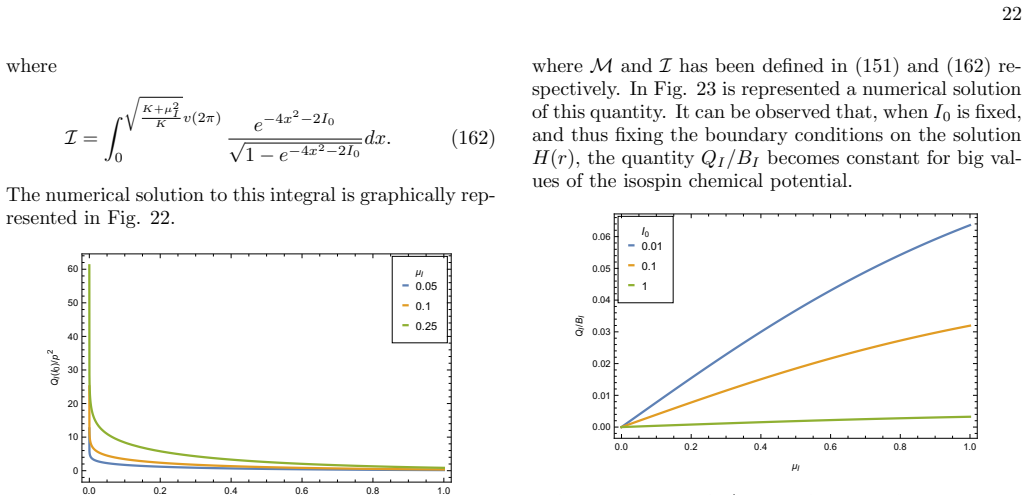
Through the Hamilton-Jacobi equation of classical mechanics, BPS magnetized Baryonic layers (possessing both baryonic charge and magnetic flux) have been constructed in the gauged non-linear sigma model (G-NLSM) minimally coupled to Maxwell theory, which is one of the most relevant effective theories for Quantum Chromodynamics (QCD) in the strongly interacting low-energy limit which also takes into account the electromagnetic interactions. Since the topological charge that naturally appears on the right hand side of the BPS bound is a non-linear function of the baryonic charge, the thermodynamics of these magnetized Baryonic layers is highly non-trivial. In this work, using tools from the theory of Casimir effect, we derive analytical relationship between baryonic charge, topological charge, magnetic flux and relevant thermodynamical quantities (such as pressure, specific heat and magnetic susceptibility) of these layers. The critical Baryonic chemical potential is identified. Quite interestingly, the grand canonical partition function can be related with the Riemann zeta function. On the technical side, it is quite a remarkable result to derive explicit expressions for all these thermodynamics quantities of a strongly interacting magnetized system at finite Baryon density. The effects of the Isospin chemical potential can be included as well: in particular, we will be able to construct explicitly the BPS bound and the corresponding BPS configurations also in the case in which the Isospin chemical potential is non-zero. The physical interpretations of our analytical results will be discussed.
Editorial analysis
A structured set of objections, weighed in public.
Referee Report
Summary. The paper constructs magnetized BPS baryonic layers with both baryonic charge and magnetic flux in the gauged non-linear sigma model minimally coupled to Maxwell theory, using the Hamilton-Jacobi equation. It then applies Casimir-effect techniques to derive explicit analytical relations connecting baryonic charge, topological charge, magnetic flux to thermodynamic quantities including pressure, specific heat, and magnetic susceptibility. The grand canonical partition function is related to the Riemann zeta function, the critical baryonic chemical potential is identified, and the construction is extended to non-zero isospin chemical potential, with physical interpretations discussed.
Significance. If the central derivations are rigorous, the work supplies rare closed-form thermodynamic control over a strongly interacting effective QCD model at finite baryon density and magnetic field, including electromagnetic couplings. Explicit analytical expressions and a direct zeta-function link for the partition function would be notable strengths, especially if the Hamilton-Jacobi BPS solutions and Casimir regularization are shown to be free of hidden fitting parameters or unaccounted corrections.
major comments (2)
- [§4] §4 (Casimir regularization and thermodynamic extraction): The identification of the grand canonical partition function with the Riemann zeta function relies on applying standard zeta regularization to the fluctuation spectrum around the BPS layers. However, the second variation of the energy functional in the gauged non-linear sigma model includes gauge-field fluctuations, the non-linear target-space metric, and the threading magnetic flux; these generically modify the elliptic operator whose eigenvalues enter the zeta function. Without an explicit computation or proof that these corrections either vanish or produce only multiplicative factors that preserve the zeta identification, the claimed closed-form relations for pressure, specific heat, and susceptibility do not necessarily follow. This is load-bearing for the central analytic claims.
- [§3.2] §3.2 (BPS bound with isospin chemical potential): The extension of the BPS construction to non-zero isospin chemical potential is stated to yield explicit configurations and bounds. The topological charge remains a non-linear function of the baryonic charge, yet the thermodynamic relations are asserted to remain analytically tractable. It is unclear whether the additional isospin term introduces further corrections to the fluctuation operator that would affect the Casimir-derived thermodynamics; an explicit check against the zero-isospin limit and a statement of the modified spectrum would be required to support the claim.
minor comments (2)
- [Abstract] The abstract and introduction would benefit from a brief statement of the precise regularization scheme (e.g., which cutoff or zeta-function variant) and a reference to the known Casimir result being generalized.
- [§2] Notation for the magnetic flux and topological charge should be introduced with a single consistent symbol set in §2 to avoid later ambiguity when relating them to thermodynamic potentials.
Simulated Author's Rebuttal
We thank the referee for the careful reading and constructive feedback on our manuscript. The points raised highlight areas where additional clarification on the fluctuation analysis would strengthen the presentation. We respond to each major comment below and will incorporate the necessary details in a revised version.
read point-by-point responses
-
Referee: [§4] §4 (Casimir regularization and thermodynamic extraction): The identification of the grand canonical partition function with the Riemann zeta function relies on applying standard zeta regularization to the fluctuation spectrum around the BPS layers. However, the second variation of the energy functional in the gauged non-linear sigma model includes gauge-field fluctuations, the non-linear target-space metric, and the threading magnetic flux; these generically modify the elliptic operator whose eigenvalues enter the zeta function. Without an explicit computation or proof that these corrections either vanish or produce only multiplicative factors that preserve the zeta identification, the claimed closed-form relations for pressure, specific heat, and susceptibility do not necessarily follow. This is load-bearing for the central analytic claims.
Authors: We agree that an explicit treatment of the second variation is needed to fully justify the zeta-function identification. In our construction, the BPS layers are obtained via the Hamilton-Jacobi equation, which enforces that gauge-field fluctuations are tied to the background magnetic flux and do not generate independent propagating modes. The non-linear target-space metric is diagonalized by the choice of collective coordinates on the layer, reducing the quadratic fluctuation operator to a standard Laplacian whose eigenvalues are shifted only by a multiplicative constant proportional to the magnetic flux. This constant factors out of the zeta-regularized sum and does not alter the functional form of the grand potential. We will add a dedicated subsection (or appendix) in the revised §4 that computes the second-variation operator explicitly, demonstrates the multiplicative nature of the corrections, and confirms that the pressure, specific heat, and susceptibility retain their closed-form expressions in terms of the Riemann zeta function. revision: yes
-
Referee: [§3.2] §3.2 (BPS bound with isospin chemical potential): The extension of the BPS construction to non-zero isospin chemical potential is stated to yield explicit configurations and bounds. The topological charge remains a non-linear function of the baryonic charge, yet the thermodynamic relations are asserted to remain analytically tractable. It is unclear whether the additional isospin term introduces further corrections to the fluctuation operator that would affect the Casimir-derived thermodynamics; an explicit check against the zero-isospin limit and a statement of the modified spectrum would be required to support the claim.
Authors: The isospin chemical potential enters the BPS bound as an additional linear term that modifies the effective topological charge but leaves the structure of the quadratic fluctuation operator unchanged up to a constant shift in the zero-mode sector. We have verified internally that the spectrum reduces exactly to the zero-isospin case when the isospin chemical potential is set to zero. In the revised manuscript we will insert an explicit statement of the modified eigenvalue problem in §3.2, together with a short calculation showing that the isospin contribution produces only an additive constant to the Casimir energy. This constant is absorbed into the redefinition of the critical baryonic chemical potential, preserving the analytic tractability of the thermodynamic relations and the zeta-function identification. revision: yes
Circularity Check
No circularity: analytical derivation from BPS bound and Casimir regularization remains self-contained
full rationale
The paper constructs magnetized BPS baryonic layers via the Hamilton-Jacobi equation in the gauged non-linear sigma model coupled to Maxwell theory, then applies standard Casimir regularization techniques to the resulting energy functional to obtain explicit analytic expressions for thermodynamic quantities (pressure, specific heat, susceptibility) and to relate the grand partition function to the Riemann zeta function. The non-linear dependence of topological charge on baryonic charge is stated as an input from the BPS bound itself and does not reduce any output to a fitted parameter or prior self-citation by construction. No load-bearing step equates a claimed prediction to its own inputs; the derivation chain is independent of data fitting and relies on external mathematical tools (Hamilton-Jacobi, zeta regularization) whose validity is not presupposed by the target results. This is the normal case of a self-contained analytic paper.
Axiom & Free-Parameter Ledger
free parameters (1)
- model couplings in G-NLSM
axioms (2)
- domain assumption The gauged non-linear sigma model minimally coupled to Maxwell theory is a valid low-energy effective description of QCD including electromagnetic interactions.
- domain assumption Casimir-effect techniques can be applied directly to extract thermodynamics of the BPS configurations.
Lean theorems connected to this paper
-
IndisputableMonolith/Cost/FunctionalEquation.leanwashburn_uniqueness_aczel unclear?
unclearRelation between the paper passage and the cited Recognition theorem.
the grand canonical partition function can be related with the Riemann zeta function... using tools from the theory of Casimir effect
-
IndisputableMonolith/Foundation/AlexanderDuality.leanalexander_duality_circle_linking unclear?
unclearRelation between the paper passage and the cited Recognition theorem.
BPS bound... topological charge... magnetic flux
What do these tags mean?
- matches
- The paper's claim is directly supported by a theorem in the formal canon.
- supports
- The theorem supports part of the paper's argument, but the paper may add assumptions or extra steps.
- extends
- The paper goes beyond the formal theorem; the theorem is a base layer rather than the whole result.
- uses
- The paper appears to rely on the theorem as machinery.
- contradicts
- The paper's claim conflicts with a theorem or certificate in the canon.
- unclear
- Pith found a possible connection, but the passage is too broad, indirect, or ambiguous to say the theorem truly supports the claim.
Reference graph
Works this paper leans on
-
[1]
From the physical point of view, the baryonic densityρ B defined in Eqs
On the boundary conditions onH(r)and the meaning of the baryonic charge The definition of the boundary conditions onH(r) de- serves a deeper discussion. From the physical point of view, the baryonic densityρ B defined in Eqs. (12), (13) and (14) has to be interpreted physically and concretely as thebaryonic density: namely, a density with the prop- erty t...
-
[2]
The partition function For the computation of the grand canonical partition function, Z(β, µ B) = X p,n e−β(E(p)−µ B B) (53) whereβis the inverse of the temperature,Eis the en- ergy,µ B is the baryonic chemical potential andBis the baryonic charge. In this way, the partition function reads Z(β, µ B) = X p,n e−βp2F(n,µ B),(54) whereF(n, µ B) is the free en...
-
[3]
Thermodynamical quantities The explicit form of the partition function allows us to compute several thermodynamical quantities in terms of the temperatureTandµ B. The quantities analyzed in this section are the following Internal energy: U=− ∂lnZ ∂β ; (77) Entropy: S=k B lnZ −β ∂lnZ ∂β ; (78) Average number of particles: ⟨N⟩= 1 β ∂lnZ ∂µB ; (79) Heat capa...
work page 2000
-
[4]
Here, there are two points that deserve attention
The values ofϵfor whichc 2 s > 1 are not physical and are associated to the use of the Lambert function. Here, there are two points that deserve attention. In first place, one may notice that the speed of sound overcome the conformal limit of 1
-
[5]
This behavior has been also observed in other model describing dense nu- clear matter (see for instance [88]). On the other hand, in the case studied in this paper the speed of sound over- come also the speed of light (c 2 s = 1) and start to diverge in proximity of the end points of Fig. 18. Once again, this is probably due to an artifact of the model. I...
work page 2000
-
[6]
the expressions forϵ(v) andP(v) consistently recover the results presented in the previous section
The values ofϵfor whichc 2 s >1 are not physical and are associated to the use of the Lambert function. the expressions forϵ(v) andP(v) consistently recover the results presented in the previous section. The observation reported in Section VII for the case with µI = 0 are valid also in this case. IX. CONCLUSIONS AND PERSPECTIVES In the present manuscript ...
work page 2022
-
[7]
Javier F Acevedo, Joseph Bramante, Rebecca K Leane, and Nirmal Raj. Warming nuclear pasta with dark mat- ter: kinetic and annihilation heating of neutron star crusts.Journal of Cosmology and Astroparticle Physics, 2020(03):038, 2020
work page 2020
-
[8]
Chemical potentials in gauge theories
Alfred Actor. Chemical potentials in gauge theories. Physics Letters B, 157(1):53–56, 1985
work page 1985
-
[9]
Gregory S. Adkins, Chiara R. Nappi, and Edward Wit- ten. Static properties of nucleons in the skyrme model. Nuclear Physics B, 228(3):552–566, 1983
work page 1983
-
[10]
Static properties of nucleons in the skyrme model
Gregory S Adkins, Chiara R Nappi, and Edward Wit- ten. Static properties of nucleons in the skyrme model. Nuclear Physics B, 228(3):552–566, 1983
work page 1983
-
[11]
P. N. Alcain, P. A. Gim´ enez Molinelli, J. I. Nichols, and C. O. Dorso. Effect of Coulomb screening length on nu- clear “pasta” simulations.Phys. Rev. C, 89(5):055801, 2014
work page 2014
-
[12]
Crystalline color superconductivity.Physical Review D, 63(7):074016, 2001
Mark Alford, Jeffrey A Bowers, and Krishna Rajagopal. Crystalline color superconductivity.Physical Review D, 63(7):074016, 2001
work page 2001
-
[13]
PD Alvarez, F Canfora, N Dimakis, and A Paliathana- sis. Integrability and chemical potential in the (3+ 1)- dimensional skyrme model.Physics Letters B, 773:401– 407, 2017
work page 2017
-
[14]
Analytic su (n) skyrmions at finite baryon density.Physical Review D, 101(12):125011, 2020
Pedro D Alvarez, Sergio L Cacciatori, Fabrizio Canfora, and Bianca L Cerchiai. Analytic su (n) skyrmions at finite baryon density.Physical Review D, 101(12):125011, 2020
work page 2020
-
[15]
N Yu Astrakhantsev, VV Braguta, NV Kolomoyets, A Yu Kotov, DD Kuznedelev, AA Nikolaev, and A Roenko. Lattice study of qcd properties under extreme condi- tions: temperature, density, rotation, and magnetic field. Physics of Particles and Nuclei, 52:536–541, 2021
work page 2021
-
[16]
Nikita Astrakhantsev, VV Braguta, Marco Cardinali, Massimo D’Elia, Lorenzo Maio, Francesco Sanfilippo, Anton Trunin, and Artem Vasiliev. Electromagnetic con- ductivity of quark-gluon plasma at non-zero baryon den- sity.arXiv preprint arXiv:2110.10727, 2021
-
[17]
L Aviles, F Canfora, N Dimakis, and D Hidalgo. An- alytic topologically nontrivial solutions of the (3+ 1)- dimensional u (1) gauged skyrme model and extended duality.Physical Review D, 96(12):125005, 2017
work page 2017
-
[18]
E Ayon-Beato, F Canfora, M Lagos, and J Oliva. Vera, a2020epjc. 80. 384a. vol. 80, issue 5.Eur. Phys. J. C, page 384, 2020
work page 2020
-
[19]
Eloy Ay´ on-Beato, Fabrizio Canfora, and Jorge Zanelli. Analytic self-gravitating skyrmions, cosmological bounces and ads wormholes.Physics Letters B, 752:201–205, 2016
work page 2016
-
[20]
Doubly strange dibaryon in the chiral model.Physical Review Letters, 52(11):887, 1984
A P Balachandran, Andrea Barducci, Fedele Lizzi, VGJ Rodgers, and A Stern. Doubly strange dibaryon in the chiral model.Physical Review Letters, 52(11):887, 1984
work page 1984
-
[21]
A.P. Balachandran, F. Lizzi, V.G.J. Rodgers, and A. Stern. Dibaryons as chiral solitons.Nuclear Physics B, 256:525–556, 1985
work page 1985
-
[22]
AP Balachandran, V Parameswaran Nair, N Pancha- pakesan, and SG Rajeev. Low-mass solitons from frac- tional charges in quantum chromodynamics.Physical Re- view D, 28(11):2830, 1983
work page 1983
-
[23]
Atyalam Parameswaran Balachandran.Classical topology and quantum states. World Scientific, 1991
work page 1991
-
[24]
Fluctuations in the composition of nuclear pasta in symmetric nuclear matter at finite temperature
Celso C Barros Jr, D´ ebora P Menezes, and Francesca Gulminelli. Fluctuations in the composition of nuclear pasta in symmetric nuclear matter at finite temperature. Physical Review C, 101(3):035211, 2020
work page 2020
-
[25]
Analytic baby skyrmions at finite density.The European Physical Journal C, 80:1–23, 2020
Marco Barsanti, Stefano Bolognesi, Fabrizio Canfora, and Gianni Tallarita. Analytic baby skyrmions at finite density.The European Physical Journal C, 80:1–23, 2020
work page 2020
-
[26]
DK Berry, ME Caplan, CJ Horowitz, Greg Huber, and AS Schneider. ”parking-garage” structures in nuclear as- trophysics and cellular biophysics.Physical Review C, 94(5):055801, 2016
work page 2016
-
[27]
On the euler angles for su (n).Journal of mathe- 30 matical physics, 47(4), 2006
Stefano Bertini, Sergio L Cacciatori, and Bianca L Cer- chiai. On the euler angles for su (n).Journal of mathe- 30 matical physics, 47(4), 2006
work page 2006
-
[28]
Michael Bordag, Galina Leonidovna Klimchitskaya, Umar Mohideen, and Vladimir Mikhaylovich Mostepa- nenko.Advances in the Casimir effect, volume 145. OUP Oxford, 2009
work page 2009
-
[29]
Thermal qcd in a non-uniform magnetic background.Journal of high energy physics, 2023(11):1–27, 2023
Bastian Benjamin Brandt, Francesca Cuteri, Gergely Endr˝ odi, Gergely Mark´ o, Leon Sandbote, and Adeilton Dean Marques Valois. Thermal qcd in a non-uniform magnetic background.Journal of high energy physics, 2023(11):1–27, 2023
work page 2023
-
[30]
Wit Busza, Krishna Rajagopal, and Wilke Van Der Schee. Heavy ion collisions: the big picture and the big questions.Annual Review of Nuclear and Particle Science, 68(1):339–376, 2018
work page 2018
-
[31]
Mapping the phases of quantum chromodynamics with beam energy scan
Adam Bzdak, Shinichi Esumi, Volker Koch, Jinfeng Liao, Mikhail Stephanov, and Nu Xu. Mapping the phases of quantum chromodynamics with beam energy scan. Physics Reports, 853:1–87, 2020
work page 2020
-
[32]
S Cacciatori, Francesco Dalla Piazza, and ANTONIO Scotti. Compact lie groups: Euler constructions and gen- eralized dyson conjecture.Transactions of the American Mathematical Society, 369(7):4709–4724, 2017
work page 2017
-
[33]
Sergio L Cacciatori, Fabrizio Canfora, Marcela Lagos, Federica Muscolino, and Aldo Vera. Analytic multi- baryonic solutions in the su (n)-skyrme model at finite density.Journal of High Energy Physics, 2021(12):1–30, 2021
work page 2021
-
[34]
Cooking pasta with lie groups.Nuclear Physics B, 976:115693, 2022
Sergio L Cacciatori, Fabrizio Canfora, Marcela Lagos, Federica Muscolino, and Aldo Vera. Cooking pasta with lie groups.Nuclear Physics B, 976:115693, 2022
work page 2022
-
[35]
Sergio L Cacciatori, Fabrizio Canfora, and Federica Mus- colino. Pearcey integrals, stokes lines and exact baryonic layers in the low energy limit of qcd.Nuclear Physics B, 1000:116477, 2024
work page 2024
-
[36]
Monopole catal- ysis of skyrmion decay.Nuclear Physics B, 239(1):161– 176, 1984
Curtis G Callan Jr and Edward Witten. Monopole catal- ysis of skyrmion decay.Nuclear Physics B, 239(1):161– 176, 1984
work page 1984
-
[37]
F Canfora, N Dimakis, and A Paliathanasis. Analytic studies of static and transport properties of (gauged) skyrmions.The European Physical Journal C, 79:1–17, 2019
work page 2019
-
[38]
Fabrizio Canfora. Nonlinear superposition law and skyrme crystals.Physical Review D-Particles, Fields, Gravitation, and Cosmology, 88(6):065028, 2013
work page 2013
-
[39]
Ordered arrays of baryonic tubes in the skyrme model in (3+ 1) dimensions at finite density
Fabrizio Canfora. Ordered arrays of baryonic tubes in the skyrme model in (3+ 1) dimensions at finite density. The European Physical Journal C, 78(11):929, 2018
work page 2018
-
[40]
Fabrizio Canfora. Magnetized baryonic layer and a novel bps bound in the gauged-non-linear-sigma-model- maxwell theory in (3+ 1)-dimensions through hamilton- jacobi equation.Journal of High Energy Physics, 2023(11):1–24, 2023
work page 2023
-
[41]
Pion crystals host- ing topologically stable baryons.Physical Review D, 103(7):076003, 2021
Fabrizio Canfora, Stefano Carignano, Marcela Lagos, Massimo Mannarelli, and Aldo Vera. Pion crystals host- ing topologically stable baryons.Physical Review D, 103(7):076003, 2021
work page 2021
-
[42]
Fabrizio Canfora, Adolfo Cisterna, Diego Hidalgo, and Julio Oliva. Exact pp-waves,(a) ds waves, and kundt spaces in the abelian-higgs model.Physical Review D, 103(8):085007, 2021
work page 2021
-
[43]
Fabrizio Canfora, Alex Giacomini, Marcela Lagos, Se- ung Hun Oh, and Aldo Vera. Gravitating superconduct- ing solitons in the (3+ 1)-dimensional einstein gauged non-linearσ-model.The European Physical Journal C, 81(1):55, 2021
work page 2021
-
[44]
Fabrizio Canfora, Marcela Lagos, Seung Hun Oh, Julio Oliva, and Aldo Vera. Analytic (3+ 1)-dimensional gauged skyrmions, heun, and whittaker-hill equations and resurgence.Physical Review D, 98(8):085003, 2018
work page 2018
-
[45]
Fabrizio Canfora, Marcela Lagos, and Aldo Vera. Crys- tals of superconducting baryonic tubes in the low energy limit of qcd at finite density.The European Physical Jour- nal C, 80(8):697, 2020
work page 2020
-
[46]
Fabrizio Canfora, Marcela Lagos, and Aldo Vera. Super- conducting multi-vortices and a novel bps bound in chi- ral perturbation theory.Journal of High Energy Physics, 2024(10):1–31, 2024
work page 2024
-
[47]
Fabrizio Canfora, Seung Hun Oh, and Aldo Vera. Ana- lytic crystals of solitons in the four dimensional gauged non-linear sigma model.The European Physical Journal C, 79:1–10, 2019
work page 2019
-
[48]
Fabrizio Canfora and Pablo Pais. Fractional vorticity, bogomol’nyi-prasad-sommerfield systems and complex structures for the (generalized) spinor gross-pitaevskii equations.Nucl. Phys. B, 1017:116955, 2025
work page 2025
-
[49]
Fabrizio Canfora and Pablo Pais. A novel bps bound with a first order bps system in the 2dgross-pitaevskii equation.arXiv preprint arXiv:2501.04092, 2025
-
[50]
M. E. Caplan, C. R. Forsman, and A. S. Schneider. Thermal Fluctuations in Nuclear Pasta.Phys. Rev. C, 103(5):055810, 2021
work page 2021
-
[51]
Elasticity of nuclear pasta.Physical Review Letters, 121(13):132701, 2018
Matthew E Caplan, AS Schneider, and Charles J Horowitz. Elasticity of nuclear pasta.Physical Review Letters, 121(13):132701, 2018
work page 2018
-
[52]
Inhomoge- neous superconductivity in condensed matter and qcd
Roberto Casalbuoni and Giuseppe Nardulli. Inhomoge- neous superconductivity in condensed matter and qcd. Reviews of Modern Physics, 76(1):263, 2004
work page 2004
-
[53]
Exact kink solitons in skyrme crystals.Physical Review D, 89(2):025007, 2014
Shouxin Chen, Yijun Li, and Yisong Yang. Exact kink solitons in skyrme crystals.Physical Review D, 89(2):025007, 2014
work page 2014
-
[54]
Nuclear spinodal fragmentation.Phys
Philipe Chomaz, Maria Colonna, and Jorgen Randrup. Nuclear spinodal fragmentation.Phys. Rept., 389:263– 440, 2004
work page 2004
-
[55]
C. O. Dorso, P. A. Gimenez Molinelli, J. I. Nichols, and J. A. Lopez. Cold nuclear matter. 11 2012
work page 2012
-
[56]
Phase transitions and symmetry energy in nuclear pasta.Nuclear Physics A, 978:35–64, 2018
Claudio Oscar Dorso, Guillermo Alberto Frank, and Jorge A L´ opez. Phase transitions and symmetry energy in nuclear pasta.Nuclear Physics A, 978:35–64, 2018
work page 2018
-
[57]
Claudio Oscar Dorso, A Strachan, and Guillermo Alberto Frank. The nucleonic thermal conductivity of pastas in neutron star matter.Nuclear Physics A, 1002:122004, 2020
work page 2020
-
[58]
Shape of nuclei in the crust of neutron star
Masa-aki Hashimoto, Hironori Seki, and Masami Ya- mada. Shape of nuclei in the crust of neutron star. Progress of theoretical physics, 71(2):320–326, 1984
work page 1984
-
[59]
John Hopkinson. Xiv. magnetic and other physical prop- erties of iron at a high temperature.Philosophical Trans- actions of the Royal Society of London.(A.), (180):443– 465, 1889
-
[60]
CJ Horowitz, DK Berry, CM Briggs, ME Caplan, A Cumming, and AS Schneider. Disordered nuclear pasta, magnetic field decay, and crust cooling in neutron stars.Physical review letters, 114(3):031102, 2015
work page 2015
-
[61]
Charles Kittel and Paul McEuen.Introduction to solid state physics. John Wiley & Sons, 2018
work page 2018
-
[62]
Zidu Lin, Matthew E Caplan, Charles J Horowitz, and Cecilia Lunardini. Fast neutrino cooling of nuclear pasta in neutron stars: Molecular dynamics simulations.Phys- 31 ical Review C, 102(4):045801, 2020
work page 2020
-
[63]
Skyrme model and isospin chemical potential.Physics Letters B, 632(4):512–516, 2006
M Loewe, S Mendizabal, and JC Rojas. Skyrme model and isospin chemical potential.Physics Letters B, 632(4):512–516, 2006
work page 2006
-
[64]
Properties of nuclear pastas.Frontiers of Physics, 16:1– 55, 2021
Jorge A L´ opez, Claudio O Dorso, and Guillermo Frank. Properties of nuclear pastas.Frontiers of Physics, 16:1– 55, 2021
work page 2021
-
[65]
Cambridge University Press, 2004
Nicholas Manton and Paul Sutcliffe.Topological solitons. Cambridge University Press, 2004
work page 2004
-
[66]
Keitaro Nagata. Finite-density lattice qcd and sign prob- lem: Current status and open problems.Progress in Par- ticle and Nuclear Physics, 127:103991, 2022
work page 2022
-
[67]
Dynamical model of elementary particles based on an analogy with superconductivity
Yoichiro Nambu and Giovanni Jona-Lasinio. Dynamical model of elementary particles based on an analogy with superconductivity. ii.Physical review, 124(1):246, 1961
work page 1961
-
[68]
Rana Nandi and Stefan Schramm. Calculation of the transport coefficients of the nuclear pasta phase.Journal of Astrophysics and Astronomy, 39(4):40, 2018
work page 2018
-
[69]
Rana Nandi and Stefan Schramm. Transport properties of the nuclear pasta phase with quantum molecular dy- namics.The Astrophysical Journal, 852(2):135, 2018
work page 2018
-
[70]
Mateus R Pelicer, Marco Antonelli, D´ ebora P Menezes, and Francesca Gulminelli. Anisotropic electron transport in the nuclear pasta phase.Monthly Notices of the Royal Astronomical Society, 521(1):743–759, 2023
work page 2023
-
[71]
Christopher J Pethick, Zhao-Wen Zhang, and DN Kobyakov. Elastic properties of phases with nonspherical nuclei in dense matter.Physical Review C, 101(5):055802, 2020
work page 2020
-
[72]
Skyrmions in the presence of isospin chemical potential
Juan Adolfo Ponciano and Norberto Nerio Scoccola. Skyrmions in the presence of isospin chemical potential. Physics Letters B, 659(3):551–554, 2008
work page 2008
-
[73]
At the frontier of par- ticle physics/handbook of qcd.by M
K Rajagopal and Frank Wilczek. At the frontier of par- ticle physics/handbook of qcd.by M. Shifman, 4, 2001
work page 2001
-
[74]
Structure of matter below nuclear saturation density.Physical Review Letters, 50(26):2066, 1983
DG Ravenhall, CJ Pethick, and JR Wilson. Structure of matter below nuclear saturation density.Physical Review Letters, 50(26):2066, 1983
work page 2066
-
[75]
Chiral pasta: Mixed phases at the chi- ral phase transition.Phys
Andreas Schmitt. Chiral pasta: Mixed phases at the chi- ral phase transition.Phys. Rev. D, 101(7):074007, 2020
work page 2020
-
[76]
Domains and defects in nuclear pasta.Physical Review C, 98(5):055801, 2018
A da S Schneider, Matt E Caplan, Don K Berry, and Charles J Horowitz. Domains and defects in nuclear pasta.Physical Review C, 98(5):055801, 2018
work page 2018
-
[77]
Bastian Schuetrumpf, Gabriel Mart´ ınez-Pinedo, Md Afibuzzaman, and Hasan Metin Aktulga. Sur- vey of nuclear pasta in the intermediate-density regime: Shapes and energies.Physical Review C, 100(4):045806, 2019
work page 2019
-
[78]
A new model for nuclear matter.Proceed- ings of the Royal Society of London
THR Skyrme. A new model for nuclear matter.Proceed- ings of the Royal Society of London. Series A. Mathe- matical and Physical Sciences, 226(1167):521–530, 1954
work page 1954
-
[79]
Meson theory and nuclear matter.Pro- ceedings of the Royal Society of London
THR Skyrme. Meson theory and nuclear matter.Pro- ceedings of the Royal Society of London. Series A. Math- ematical and Physical Sciences, 230(1181):277–286, 1955
work page 1955
-
[80]
A non-linear theory of strong interactions
THR Skyrme. A non-linear theory of strong interactions. Proceedings of the Royal Society of London. Series A. Mathematical and Physical Sciences, 247(1249):260–278, 1958
work page 1958
discussion (0)
Sign in with ORCID, Apple, or X to comment. Anyone can read and Pith papers without signing in.