REVIEW 4 major objections 5 minor 43 references
Think Twice before Adaptation: Improving Adaptability of DeepFake Detection via Online Test-Time Adaptation
T0 review · 4 major / 5 minor · reviewed 2026-08-07 · deepseek-v4-flash
Pith's one-line read T2A adapts deepfake detectors during inference by training on flipped pseudo-labels, making the model consider the opposite class, and argues this objective complements entropy minimization.
desk verdict T2A has a genuinely new combination and a broad empirical study, but the theory is invalid and the paper's own Table 4 contradicts its 'consistently enhances' claim. read the letter →
The pith
A machine-rendered reading of the paper's core claim, the machinery that carries it, and where it could break.
The reading
What carries the argument
The load-bearing object is the noise-tolerant negative loss $L_{NTNL} = \alpha L_{nn}(x,\tilde{y}) + \beta L_p(x,\tilde{y})$ built from normalized negative learning with Bernoulli-flipped pseudo-labels, plus a focal-loss reweighting that down-weights high-confidence samples. The theoretical hook is Theorem 4.1, which states that the normalized loss with a pseudo-label and the entropy $H(x)$ share local extrema, so flipping the label gives an objective whose gradient behavior opposes entropy minimization; Figure 4 in the paper plots these losses as mirror images across the probability range. The second mechanism is gradient masking: each parameter's gradient is kept only when its cosine similarity to the concatenated BatchNorm gradient vector exceeds a threshold $\psi$, with zero-padding used to align vectors of different dimensions, so that more than just BatchNorm parameters can adapt while still following a BatchNorm-referenced update direction.
What would settle it
Run the gradient-masking step on the postprocessed FF++ benchmark with the BatchNorm reference vector replaced by a fixed random vector (or a permuted version of itself) while keeping the threshold $\psi$ unchanged; if AUC does not fall back toward the no-mask level of 0.8646, the cosine-similarity alignment carries no information. A complementary check is to remove all BatchNorm layers from the detector, so no reference direction exists; if T2A still improves adaptation, the mask is not doing the work attributed to it.
Extended reading notes
Core claim
The central claim is that online test-time adaptation for deepfake detection works better when the model is trained on deliberately flipped pseudo-labels rather than trusted to its own most confident prediction. T2A generates a noisy pseudo-label $\tilde{y}$ by flipping the predicted class with probability $1-p_x$ (where $p_x$ is the model's confidence), feeds this into a normalized negative loss $L_{nn}(x,\tilde{y}) = \ell(f(x),\tilde{y}) / \sum_c \ell(f(x),c)$, combines it with a passive loss and focal weighting to focus on uncertain samples, and adds an entropy-minimization term. A theorem in the paper shows that the normalized loss with a plain pseudo-label has the same local extrema as entropy minimization, while the flipped-label version behaves oppositely, which is the formal basis for calling the two objectives complementary. Empirically, the paper reports state-of-the-art AUC among the tested TTA methods on FF++ faces corrupted by four unseen postprocessing operations, best AUC on five of six cross-dataset benchmarks, and consistent AUC gains when T2A is attached to CORE, EfficientNetB4, F3Net, and RECCE.
Load-bearing premise
The load-bearing premise is that a parameter deserves an update exactly when its gradient has cosine similarity above a threshold with the concatenated BatchNorm gradient vector, and that this similarity remains meaningful after zero-padding vectors of different dimensions; if BatchNorm gradients are the wrong reference direction, the largest reported ablation gain (AUC from 0.8646 to 0.8813) has no solid foundation.
Editorial extensions
If this is right
- A pretrained deepfake detector can be updated online from the test stream alone, with no source training data and no labels, making adaptation possible in streaming deployment settings.
- T2A is reported to improve AUC over the unadapted source model and over seven entropy-minimization-based TTA baselines on FF++ faces corrupted by four unseen postprocessing operations.
- On six cross-dataset benchmarks (CelebDF-v1/v2, DFD, FaceShifter, DFDCP, UADFV), T2A reports the best AUC among the TTA baselines on five of the six datasets.
- Bolting T2A onto CORE, EfficientNetB4, F3Net, and RECCE raises their AUC under unseen postprocessing and on several cross-dataset settings, so the method composes with existing detectors rather than replacing them.
- Because it backpropagates updates at inference time, T2A only works with end-to-end differentiable detectors, a boundary the paper states explicitly.
Reading between the lines
- Beyond the paper: because the pseudo-label flip probability is $1-p_x$, T2A is implicitly fitting a confidence-smoothed complementary target; this suggests the gain over plain entropy minimization may come partly from implicit confidence calibration, which a temperature-scaling variant could test.
- If the BatchNorm-aligned gradient mask is the operative mechanism behind the ablation jump from 0.8646 to 0.8813 AUC, then replacing the reference direction with a random or permuted vector should erase that gain, a check the paper does not run.
- The class-imbalance argument that motivates reporting AUC transfers naturally to non-face deepfake media such as manipulated audio or video streams, where fake samples also dominate; adapting T2A there would test whether the negative-learning objective generalizes beyond face forgery.
Editorial analysis
A structured set of objections, weighed in public.
Referee Report
Summary. The paper proposes T2A, an online test-time adaptation method for deepfake detectors. T2A combines entropy minimization with an uncertainty-aware negative learning objective that uses noisy pseudo-labels, a focal-loss-based uncertain sample prioritization, and a gradient masking technique that selects non-BatchNorm parameters whose gradients align with BatchNorm gradients. The authors also present a theoretical analysis intended to show that their negative learning objective is complementary to entropy minimization. The method is evaluated under two scenarios: unknown postprocessing techniques applied to FF++ test data, and a more challenging scenario with both unknown data distributions and postprocessing techniques across six deepfake datasets. Comparisons are made against TENT, MEMO, EATA, CoTTA, LAME, VIDA, and COME, as well as several deepfake detectors (CORE, EfficientNet-B4, F3Net, RECCE) with and without T2A. The paper claims state-of-the-art performance and significant enhancement of detector resilience and generalization.
Significance. If its claims were established, T2A would be practically valuable: it would allow a pretrained deepfake detector to adapt online to unknown postprocessing and distribution shift without labels or source data, and it would provide a plug-in module for existing detectors. The paper has useful strengths: it evaluates on multiple standard benchmarks, uses several postprocessing types and intensity levels, reports three metrics, includes ablations, and releases code. However, the central theoretical result in Appendix A is invalid, the gradient masking criterion in Section 4.5 is not well-defined, the hyperparameter selection protocol is underspecified for the online setting, and the paper's own Table 4 directly contradicts the stated claim of consistent significant improvement. These are load-bearing issues for the paper's main contributions rather than presentation concerns.
major comments (4)
- [Appendix A, Theorem 4.1] The proof of Theorem 4.1 is invalid. Equation (16) defines H(x) as -\hat{y}(x) log p - (-1-\hat{y}) log(1-p), which is not the entropy of the binary prediction; the coefficient on the second term has the wrong sign, and the quantity is a pseudo-label weighted cross-entropy, not the entropy used in Eq. (7). Equation (17) then defines NCE(x) = H(x) / c with c = -log p - log(1-p), and the proof asserts that c is a positive constant. This is false: p depends on x, so c is input-dependent. The identity H(x) = c * NCE(x) is therefore a tautology with an input-dependent scaling factor, and the derivative equivalence in Eqs. (19)-(30) only shows that H and H/c have common stationary points under the unjustified constancy assumption. The claimed complementarity between the proposed negative learning objective and entropy minimization is not established.
- [Section 4.5, Eq. (15)] The gradient masking procedure is not well-defined. The cosine similarity sim(u, v_i) is computed after zero-padding vectors of different dimensions, but the result depends on which vector is padded and on how the BatchNorm gradient vector u is ordered and concatenated; zero-padding does not give an invariant geometric notion of alignment. More fundamentally, the assumption that the concatenated BatchNorm gradient direction is a reliable reference for deciding which non-BatchNorm parameters to update is asserted without evidence. This matters because Table 6 attributes the largest single ablation gain to gradient masking (AUC improving from 0.8646 to 0.8813); if the similarity criterion is arbitrary or order-dependent, the main source of improvement is not grounded.
- [Implementation, Section 5.1] The hyperparameter selection for the online setting is underspecified. The Implementation section states that alpha, beta, and psi are selected by a grid-search manner, with candidate values listed in Table 5, but it does not state which validation data are used. In online TTA the target stream is the test distribution and labels are unavailable; if the grid search is performed on the same target datasets used for evaluation, the reported results are inflated and the setting is violated. This concern is amplified by Table 1, where the average AUC margin over TENT is only 0.8813 vs. 0.8808, well within the reported +/-0.01 standard deviations. Without a fixed a priori hyperparameter choice or a clearly separated validation protocol, the claimed state-of-the-art advantage is not established.
- [Section 5.2, Table 4] The claim that T2A consistently and significantly enhances deepfake detectors is contradicted by Table 4. For example, EfficientNet-B4 AUC on CelebDF-v2 decreases from 0.5489 to 0.4347, F3Net ACC on DFD decreases from 0.8547 to 0.7500, and RECCE AP on CelebDF-v1 decreases from 0.7837 to 0.7599; numerous other cells also show degradation. The text highlights selected gains (e.g., DFDCP) but does not report these substantial losses, so the general statements in the abstract and conclusion that T2A significantly enhances resilience and generalization are unsupported. At minimum, the claims must be rephrased to report the full pattern of gains and losses and to condition the conclusions on which datasets and detectors benefit.
minor comments (5)
- [Throughout] There are several typos: 'Mehtod' in the Table 2 header, 'SAppendix' in Section C.3, 'THe' at the start of Appendix D.3, and inconsistent use of the convolution symbols '⊛' and '⊗' in Lemma 3.2 and its proof.
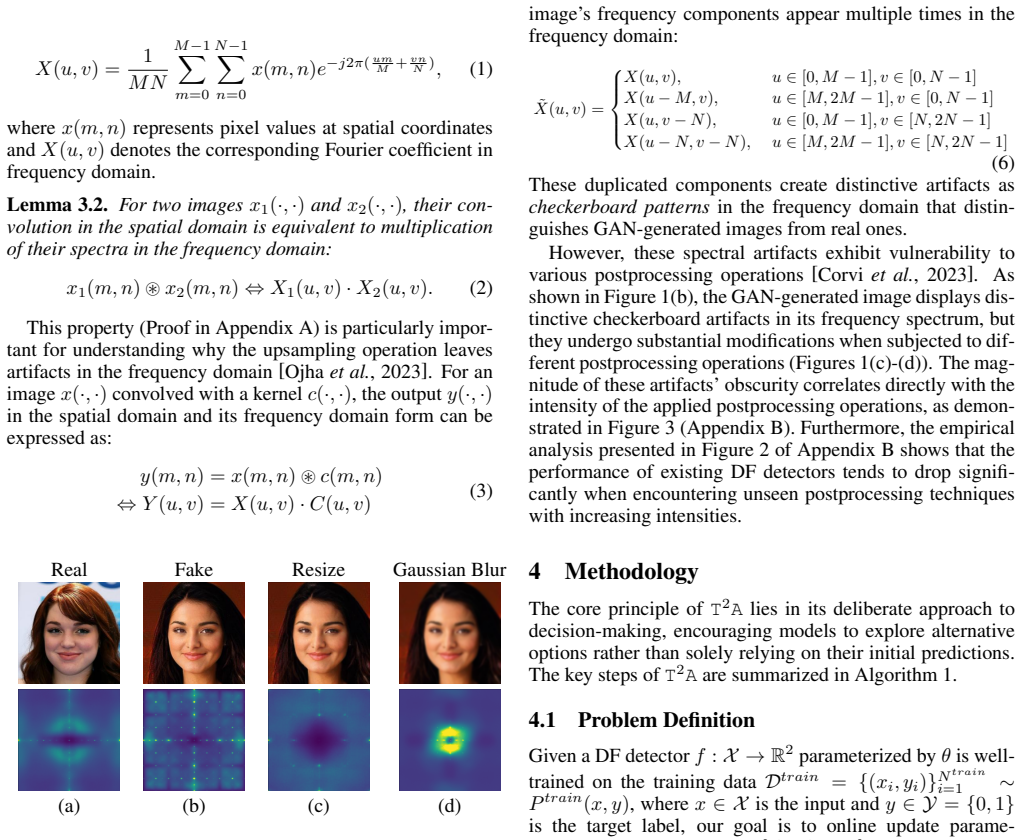
- [Eq. (6)] Equation (6) lists the duplicated spectral component as X(u-N, v-N) in the fourth case, but based on the preceding pattern the intended argument is likely X(u-M, v-N); please correct the notation.
- [Definition A.1] Definition A.1 calls the quantity in Eq. (16) entropy, but it is not the entropy of a binary prediction; it should be clearly distinguished from the entropy in Eq. (7), or the definition should be corrected.
- [Algorithm 1 and Eq. (13)] Algorithm 1 lists the hyperparameters alpha, beta, psi, and learning rate eta, but the focal-loss exponent gamma from Eq. (13) and the pseudo-label threshold tau from Eq. (8) are not listed in the algorithm definition; please include them.
- [Table 6] The check-mark rows in Table 6 are ambiguous because the row labels do not clearly indicate which loss components are active; please make the configuration of each ablation row explicit.
Circularity Check
Minor non-load-bearing circularity: Theorem 4.1 restates its own definition; the empirical SOTA claim is benchmarked against external baselines and is not forced by construction.
-
self definitional
[Section 4.3, Theorem 4.1; Appendix A (Definition A.2, Eqs. 16-18, proof of Theorem 4.1).]
"Theorem 4.1. In the binary classification with pseudo-label ˆy ∈ {0, 1}, if the normalized loss function Lnorm has the local extremum at x∗, the entropy minimization function LEM also has the local at x∗, and vice versa. ... Definition A.2. The normalized cross-entropy loss is defined as: NCE(x) = H(x)/(− log(p) − log(1 − p)). ... Let c = − log(p) − log(1 − p) ... H(x) = c ∗ NCE(x) ... ∂H(x)/∂xi = 0 ⇐⇒ ∂NCE(x)/∂xi = 0."
Definition A.2 defines the normalized pseudo-label loss NCE(x) as the pseudo-label entropy H(x) divided by c = −log p − log(1−p), and the proof immediately records H(x) = c · NCE(x). The entire argument for Theorem 4.1 is then the scaling identity ∂H/∂xi = c · ∂NCE/∂xi = 0, so the asserted equivalence of local extrema between the normalized pseudo-label loss and the entropy objective holds by construction of the definition rather than by derivation; in fact c depends on p(x), so the scaling is not even constant in x. Section 4.3 uses this identity to claim that pseudo-label normalization aligns with the EM objective and to motivate the noisy-label flip, and the claimed 'opposite' behavior of Lnn(x, ỹ) shown in Figure 4 likewise follows from the Bernoulli-flip definition (Eq. 9).
full rationale
The paper's central claim—that T2A improves deepfake-detector adaptability under unknown postprocessing and distribution shift—is empirical and is evaluated against external baselines (TENT, MEMO, EATA, CoTTA, LAME, VIDA, COME) on public benchmarks; the adaptation objective (Eqs. 7-14) is a designed loss whose components (entropy, normalized loss, passive loss, focal loss) come from external works (Kim et al. 2019; Ma et al. 2020; Ye et al. 2023; Ross and Dollár 2017), and the reported metrics are not inverted from the loss by construction. Self-citations [Nguyen-Le et al., 2024a, b] are survey references in the introduction and related work and carry no load-bearing premise; no uniqueness theorem or ansatz is imported via self-citation. The grid-search of α, β, ψ (Table 5) is underspecified and is a validity concern, but those hyperparameters do not encode the reported per-dataset metrics, so it is not a fitted-input-called-prediction reduction. The skeptic's concerns (per-dataset degradations in Table 4, small margins in Table 1, hyperparameter protocol) are correctness and over-claiming issues, not circularity, because the numbers are measured rather than derived from the method's definitions. The single definitional reduction is Theorem 4.1: the normalized pseudo-label loss is defined in Appendix A as the pseudo-label entropy scaled by a positive factor, so the asserted extremum equivalence is built into the definition; the theorem only motivates flipping to noisy pseudo-labels and does not itself produce the empirical results, making this minor (score 1) rather than load-bearing circularity.
Assumptions & free parameters
free parameters (5)
- alpha =
grid-searched over {1.0, 2.0}, final value not reported
- beta =
grid-searched over {1.0, 2.0}, final value not reported
- psi =
grid-searched over {0.01, 0.1}, final value not reported
- gamma =
2.0
- tau =
not stated (likely 0.5)
assumptions (5)
- domain assumption Softmax output probabilities are used as confidence measures for pseudo-label reliability in the Bernoulli flip (Eq. 9).
- standard math Normalized losses of the form Eq. 10 inherit noise-robustness properties from Ghosh et al. and Ma et al.
- ad hoc to paper BatchNorm gradient direction is a suitable reference for which non-BN parameters to update.
- domain assumption Zero-insertion upsampling model (Eq. 4) represents GAN upsampling artifacts.
- domain assumption Postprocessing operations and intensity levels from Hendrycks and Dietterich cover unknown postprocessing scenarios.
Cite this review
Pith. "Pith review of Think Twice before Adaptation: Improving Adaptability of DeepFake Detection via Online Test-Time Adaptation." pith.science (2026). https://pith.science/paper/G3B56L5P
@misc{pith2026250518787,
  author       = {Pith},
  title        = {Pith review of: Think Twice before Adaptation: Improving Adaptability of DeepFake Detection via Online Test-Time Adaptation},
  year         = {2026},
  howpublished = {\url{https://pith.science/paper/G3B56L5P}},
  note         = {Machine review of arXiv:2505.18787}
}
abstract
Deepfake (DF) detectors face significant challenges when deployed in real-world environments, particularly when encountering test samples deviated from training data through either postprocessing manipulations or distribution shifts. We demonstrate postprocessing techniques can completely obscure generation artifacts presented in DF samples, leading to performance degradation of DF detectors. To address these challenges, we propose Think Twice before Adaptation (\texttt{T$^2$A}), a novel online test-time adaptation method that enhances the adaptability of detectors during inference without requiring access to source training data or labels. Our key idea is to enable the model to explore alternative options through an Uncertainty-aware Negative Learning objective rather than solely relying on its initial predictions as commonly seen in entropy minimization (EM)-based approaches. We also introduce an Uncertain Sample Prioritization strategy and Gradients Masking technique to improve the adaptation by focusing on important samples and model parameters. Our theoretical analysis demonstrates that the proposed negative learning objective exhibits complementary behavior to EM, facilitating better adaptation capability. Empirically, our method achieves state-of-the-art results compared to existing test-time adaptation (TTA) approaches and significantly enhances the resilience and generalization of DF detectors during inference. Code is available \href{https://github.com/HongHanh2104/T2A-Think-Twice-Before-Adaptation}{here}.
Figures


Figures from the paper (3 more)


Reference graph
Works this paper leans on
-
[1]
Parameter-free on- line test-time adaptation
[Boudiaf et al., 2022] Malik Boudiaf, Romain Mueller, Is- mail Ben Ayed, and Luca Bertinetto. Parameter-free on- line test-time adaptation. In Proceedings of the IEEE/CVF Conference on Computer Vision and Pattern Recognition, pages 8344–8353,
work page 2022
-
[3]
Ost: Improving general- ization of deepfake detection via one-shot test-time train- ing
[Chen et al., 2022] Liang Chen, Yong Zhang, Yibing Song, Jue Wang, and Lingqiao Liu. Ost: Improving general- ization of deepfake detection via one-shot test-time train- ing. Advances in Neural Information Processing Systems, 35:24597–24610,
work page 2022
-
[4]
Xception: Deep learning with depthwise separable convolutions
[Chollet, 2017] Franc ¸ois Chollet. Xception: Deep learning with depthwise separable convolutions. In Proceedings of the IEEE conference on computer vision and pattern recognition, pages 1251–1258,
work page 2017
-
[5]
Figure 2 shows the performance degrada- tion of DF detectors under different types of postprocessing techniques across 5 intensity levels. Note that, in this exper- imental evaluation, both training and test samples are drawn from the same underlying data distribution (FaceForensics++ [Rossler et al., 2019]), and only postprocessing operations are unseen ...
work page 2019
-
[10]
Contributing data to deepfake de- tection research,
[Google, 2019] Google. Contributing data to deepfake de- tection research,
work page 2019
-
[11]
Joint physical-digital facial attack detection via simulating spoofing clues
[He et al., 2024] Xianhua He, Dashuang Liang, Song Yang, Zhanlong Hao, Hui Ma, Binjie Mao, Xi Li, Yao Wang, Pengfei Yan, and Ajian Liu. Joint physical-digital facial attack detection via simulating spoofing clues. InProceed- ings of the IEEE/CVF Conference on Computer Vision and Pattern Recognition, pages 995–1004,
work page 2024
-
[12]
Benchmarking neural network robustness to common corruptions and perturbations
[Hendrycks and Dietterich, 2019] Dan Hendrycks and Thomas Dietterich. Benchmarking neural network robustness to common corruptions and perturbations. International Conference on Learning Representations ,
work page 2019
-
[13]
Nlnl: Negative learning for noisy labels
[Kim et al., 2019] Youngdong Kim, Junho Yim, Juseung Yun, and Junmo Kim. Nlnl: Negative learning for noisy labels. In Proceedings of the IEEE/CVF international con- ference on computer vision, pages 101–110,
work page 2019
Show all 43 references
-
[14]
Joint negative and positive learning for noisy labels
[Kim et al., 2021] Youngdong Kim, Juseung Yun, Hyoun- guk Shon, and Junmo Kim. Joint negative and positive learning for noisy labels. In Proceedings of the IEEE/CVF conference on computer vision and pattern recognition , pages 9442–9451,
2021
-
[16]
In ictu oculi: Exposing ai created fake videos by detecting eye blinking
[Li et al., 2018] Yuezun Li, Ming-Ching Chang, and Siwei Lyu. In ictu oculi: Exposing ai created fake videos by detecting eye blinking. In 2018 IEEE International work- shop on information forensics and security (WIFS), pages 1–7. Ieee,
2018
-
[17]
A comprehensive survey on source- free domain adaptation
[Li et al., 2024] Jingjing Li, Zhiqi Yu, Zhekai Du, Lei Zhu, and Heng Tao Shen. A comprehensive survey on source- free domain adaptation. IEEE Transactions on Pattern Analysis and Machine Intelligence,
2024
-
[18]
A comprehensive survey on test-time adaptation under dis- tribution shifts
[Liang et al., 2024] Jian Liang, Ran He, and Tieniu Tan. A comprehensive survey on test-time adaptation under dis- tribution shifts. International Journal of Computer Vision, pages 1–34,
2024
-
[19]
Spatial-phase shallow learning: rethinking face forgery detection in frequency domain
[Liu et al., 2021] Honggu Liu, Xiaodan Li, Wenbo Zhou, Yuefeng Chen, Yuan He, Hui Xue, Weiming Zhang, and Nenghai Yu. Spatial-phase shallow learning: rethinking face forgery detection in frequency domain. In Proceed- ings of the IEEE/CVF conference on computer vision and patte...
2021
-
[20]
Cfpl-fas: Class free prompt learning for general- izable face anti-spoofing
[Liu et al., 2024] Ajian Liu, Shuai Xue, Jianwen Gan, Jun Wan, Yanyan Liang, Jiankang Deng, Sergio Escalera, and Zhen Lei. Cfpl-fas: Class free prompt learning for general- izable face anti-spoofing. In Proceedings of the IEEE/CVF Conference on Computer Vision and Pattern Reco...
2024
-
[21]
Nor- malized loss functions for deep learning with noisy labels
[Ma et al., 2020] Xingjun Ma, Hanxun Huang, Yisen Wang, Simone Romano, Sarah Erfani, and James Bailey. Nor- malized loss functions for deep learning with noisy labels. In International conference on machine learning , pages 6543–6553. PMLR,
2020
-
[22]
Passive deepfake detection across multi-modalities: A comprehensive survey
[Nguyen-Le et al., 2024b] Hong-Hanh Nguyen-Le, Van- Tuan Tran, Dinh-Thuc Nguyen, and Nhien-An Le-Khac. Passive deepfake detection across multi-modalities: A comprehensive survey. arXiv preprint arXiv:2411.17911,
-
[23]
Core: Consistent representation learning for face forgery detec- tion
[Ni et al., 2022] Yunsheng Ni, Depu Meng, Changqian Yu, Chengbin Quan, Dongchun Ren, and Youjian Zhao. Core: Consistent representation learning for face forgery detec- tion. In Proceedings of the IEEE/CVF conference on com- puter vision and pattern recognition, pages 12–21,
2022
-
[24]
Efficient test-time model adaptation without forgetting
[Niu et al., 2022] Shuaicheng Niu, Jiaxiang Wu, Yifan Zhang, Yaofo Chen, Shijian Zheng, Peilin Zhao, and Mingkui Tan. Efficient test-time model adaptation without forgetting. In International conference on machine learn- ing, pages 16888–16905. PMLR,
2022
-
[25]
Towards stable test-time adaptation in dy- namic wild world
[Niu et al., 2023] Shuaicheng Niu, Jiaxiang Wu, Yifan Zhang, Zhiquan Wen, Yaofo Chen, Peilin Zhao, and Mingkui Tan. Towards stable test-time adaptation in dy- namic wild world. The Eleventh International Conference on Learning Representations,
2023
-
[26]
Towards universal fake image detectors that gen- eralize across generative models
[Ojha et al., 2023] Utkarsh Ojha, Yuheng Li, and Yong Jae Lee. Towards universal fake image detectors that gen- eralize across generative models. In Proceedings of the IEEE/CVF Conference on Computer Vision and Pattern Recognition, pages 24480–24489,
2023
-
[27]
Dfil: Deepfake incremental learning by exploiting domain-invariant forgery clues
[Pan et al., 2023] Kun Pan, Yifang Yin, Yao Wei, Feng Lin, Zhongjie Ba, Zhenguang Liu, Zhibo Wang, Lorenzo Cav- allaro, and Kui Ren. Dfil: Deepfake incremental learning by exploiting domain-invariant forgery clues. In Proceed- ings of the 31st ACM International Conference on M...
2023
-
[28]
Thinking in frequency: Face forgery detection by mining frequency-aware clues
[Qian et al., 2020] Yuyang Qian, Guojun Yin, Lu Sheng, Zixuan Chen, and Jing Shao. Thinking in frequency: Face forgery detection by mining frequency-aware clues. In European conference on computer vision , pages 86–103. Springer,
2020
-
[29]
Focal loss for dense object detection
[Ross and Doll´ar, 2017] T-YLPG Ross and GKHP Doll ´ar. Focal loss for dense object detection. Inproceedings of the IEEE conference on computer vision and pattern recogni- tion, pages 2980–2988,
2017
-
[30]
Faceforensics++: Learning to de- tect manipulated facial images
[Rossler et al., 2019] Andreas Rossler, Davide Cozzolino, Luisa Verdoliva, Christian Riess, Justus Thies, and Matthias Nießner. Faceforensics++: Learning to de- tect manipulated facial images. In Proceedings of the IEEE/CVF international conference on computer vision , pages 1–11,
2019
-
[31]
Improving robustness against common corruptions by covariate shift adaptation
[Schneider et al., 2020] Steffen Schneider, Evgenia Rusak, Luisa Eck, Oliver Bringmann, Wieland Brendel, and Matthias Bethge. Improving robustness against common corruptions by covariate shift adaptation. Advances in neural information processing systems , 33:11539–11551,
2020
-
[32]
Detecting deepfakes with self-blended images
[Shiohara and Yamasaki, 2022] Kaede Shiohara and Toshi- hiko Yamasaki. Detecting deepfakes with self-blended images. In Proceedings of the IEEE/CVF Conference on Computer Vision and Pattern Recognition , pages 18720– 18729,
2022
-
[33]
Efficient- net: Rethinking model scaling for convolutional neural networks
[Tan and Le, 2019] Mingxing Tan and Quoc Le. Efficient- net: Rethinking model scaling for convolutional neural networks. In International conference on machine learn- ing, pages 6105–6114. PMLR,
2019
-
[34]
Tent: Fully test-time adaptation by entropy minimization
[Wang et al., 2020] Dequan Wang, Evan Shelhamer, Shaoteng Liu, Bruno Olshausen, and Trevor Darrell. Tent: Fully test-time adaptation by entropy minimization. arXiv preprint arXiv:2006.10726,
2020 arXiv
-
[35]
Continual test-time domain adaptation
[Wang et al., 2022] Qin Wang, Olga Fink, Luc Van Gool, and Dengxin Dai. Continual test-time domain adaptation. In Proceedings of the IEEE/CVF Conference on Computer Vision and Pattern Recognition, pages 7201–7211,
2022
-
[36]
Deepfakebench: A compre- hensive benchmark of deepfake detection
[Yan et al., 2023] Zhiyuan Yan, Yong Zhang, Xinhang Yuan, Siwei Lyu, and Baoyuan Wu. Deepfakebench: A compre- hensive benchmark of deepfake detection. arXiv preprint arXiv:2307.01426,
2023 arXiv
-
[37]
Transcending forgery specificity with latent space augmentation for generaliz- able deepfake detection
[Yan et al., 2024] Zhiyuan Yan, Yuhao Luo, Siwei Lyu, Qingshan Liu, and Baoyuan Wu. Transcending forgery specificity with latent space augmentation for generaliz- able deepfake detection. In Proceedings of the IEEE/CVF Conference on Computer Vision and Pattern Recognition, pag...
2024
-
[38]
Active negative loss functions for learning with noisy labels
[Ye et al., 2023] Xichen Ye, Xiaoqiang Li, Tong Liu, Yan Sun, Weiqin Tong, et al. Active negative loss functions for learning with noisy labels. Advances in Neural Infor- mation Processing Systems, 36:6917–6940,
2023
-
[39]
Memo: Test time robustness via adapta- tion and augmentation
[Zhang et al., 2022] Marvin Zhang, Sergey Levine, and Chelsea Finn. Memo: Test time robustness via adapta- tion and augmentation. Advances in neural information processing systems, 35:38629–38642,
2022
-
[40]
Come: Test-time adaption by conservatively minimizing entropy
[Zhang et al., 2024] Qingyang Zhang, Yatao Bian, Xinke Kong, Peilin Zhao, and Changqing Zhang. Come: Test-time adaption by conservatively minimizing entropy. arXiv preprint arXiv:2410.10894,
2024 arXiv
-
[41]
Asymmetric loss func- tions for learning with noisy labels
[Zhou et al., 2021] Xiong Zhou, Xianming Liu, Junjun Jiang, Xin Gao, and Xiangyang Ji. Asymmetric loss func- tions for learning with noisy labels. In International con- ference on machine learning, pages 12846–12856. PMLR,
2021
-
[128]
For color contrast operation, we modify image contrast across 5 intensity levels by manipulating pixel values around their mean while applying channel-wise enhancements
∗ i. For color contrast operation, we modify image contrast across 5 intensity levels by manipulating pixel values around their mean while applying channel-wise enhancements. In particular, for intensity i, the pixel value c will be updated as follows: c := Ec + (c − Ec)i. The...
2020
-
[2017]
Intrigu- ing properties of synthetic images: from generative adver- sarial networks to diffusion models
[Corvi et al., 2023] Riccardo Corvi, Davide Cozzolino, Gio- vanni Poggi, Koki Nagano, and Luisa Verdoliva. Intrigu- ing properties of synthetic images: from generative adver- sarial networks to diffusion models. In Proceedings of the IEEE/CVF Conference on Computer Vision and ...
2023
-
[2019]
Uni- fied physical-digital face attack detection
[Fang et al., 2024] Hao Fang, Ajian Liu, Haocheng Yuan, Junze Zheng, Dingheng Zeng, Yanhong Liu, Jiankang Deng, Sergio Escalera, Xiaoming Liu, Jun Wan, et al. Uni- fied physical-digital face attack detection. In Proceedings of the Thirty-Third International Joint Conference on...
2024
-
[2020]
Robust loss functions under label noise for deep neural networks
[Ghosh et al., 2017] Aritra Ghosh, Himanshu Kumar, and P Shanti Sastry. Robust loss functions under label noise for deep neural networks. In Proceedings of the AAAI con- ference on artificial intelligence, volume 31,
2017
-
[2021]
{SoK}: The good, the bad, and the unbalanced: Measur- ing structural limitations of deepfake media datasets
[Layton et al., 2024] Seth Layton, Tyler Tucker, Daniel Ol- szewski, Kevin Warren, Kevin Butler, and Patrick Traynor. {SoK}: The good, the bad, and the unbalanced: Measur- ing structural limitations of deepfake media datasets. In 33rd USENIX Security Symposium (USENIX Security...
2024
-
[2022]
End-to-end reconstruction-classification learning for face forgery de- tection
[Cao et al., 2022] Junyi Cao, Chao Ma, Taiping Yao, Shen Chen, Shouhong Ding, and Xiaokang Yang. End-to-end reconstruction-classification learning for face forgery de- tection. In Proceedings of the IEEE/CVF Conference on Computer Vision and Pattern Recognition , pages 4113– 4122,
2022
-
[2023]
The deepfake detec- tion challenge (dfdc) preview dataset
[Dolhansky, 2019] B Dolhansky. The deepfake detec- tion challenge (dfdc) preview dataset. arXiv preprint arXiv:1910.08854,
2019 arXiv
-
[2024]
Leveraging frequency analysis for deepfake im- age recognition
[Frank et al., 2020] Joel Frank, Thorsten Eisenhofer, Lea Sch¨onherr, Asja Fischer, Dorothea Kolossa, and Thorsten Holz. Leveraging frequency analysis for deepfake im- age recognition. In International conference on machine learning, pages 3247–3258. PMLR,
2020
Reviewed August 7, 2026 · model on record in the stance chip above.
Discussion (0). Sign in to comment.