REVIEW 3 major objections 5 minor 3 cited by
Triangle Splatting for Real-Time Radiance Field Rendering
T0 review · 3 major / 5 minor · reviewed 2026-08-07 · deepseek-v4-flash
Pith's one-line read Triangle Splatting claims that an unstructured soup of triangles, rendered through a compact normalized window function, can be optimized end-to-end and outdo Gaussian and convex primitives in visual quality, training speed, and rendering…
desk verdict Genuinely new compact triangle window function with credible LPIPS wins, but the paper's speed and training claims are contradicted by its own tables. read the letter →
The pith
A machine-rendered reading of the paper's core claim, the machinery that carries it, and where it could break.
The reading
What carries the argument
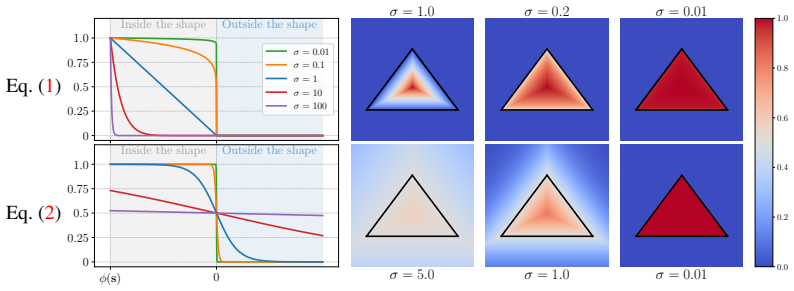
The load-bearing mechanism is the window function $I(p)=\mathrm{ReLU}(\phi(p)/\phi(s))^\sigma$, defined from the signed distance field $\phi$ of the projected triangle, the incenter $s$, and a learned smoothness $\sigma$. Unlike sigmoid-based windows used in prior convex splatting, this function is exactly 1 at the incenter, exactly 0 at the boundary and outside, so a triangle never bleeds beyond its vertices; the normalization also makes the same $\sigma$ work at every depth because uniform scaling cancels in the ratio. This window is what makes an unstructured triangle soup optimizable: compact support gives tight gradients to vertex positions, and the $\sigma$ exponent controls how solid or soft each triangle is, which in turn drives the adaptive densification that samples new triangles where coverage is sparse.
What would settle it
Measure the log-probability of a triangle configuration before and after a midpoint-subdivision or clone-with-noise step under the sampling distribution used in the densification section (built from opacity and $\sigma^{-1}$). If the ratio is not 1, or if no well-defined distribution exists, the MCMC premise fails; a simpler check is to ablate the specific split/clone moves against uniform or random densification with the same triangle budget and see whether LPIPS on Mip-NeRF360 changes materially.
Extended reading notes
Core claim
On its own terms, the paper's central claim is that a triangle soup—unstructured, disconnected triangles—can be optimized end-to-end for novel-view synthesis and outperform both volumetric (3D Gaussian Splatting and convex splatting) and planar (2D Gaussian Splatting) primitives. The key to making triangles trainable is a normalized window function $I(p)=\mathrm{ReLU}(\phi(p)/\phi(s))^\sigma$, which is 1 at the triangle's incenter, 0 at the boundary and outside, and controlled by a single smoothness parameter $\sigma$. This bounded, depth-invariant falloff lets gradients flow to vertex positions while keeping each primitive's support tightly inside its projected geometry, so the optimizer moves vertices instead of inflating soft shapes. The authors claim this yields sharper reconstructions, lower LPIPS than 2DGS, BBSplat, 3DGS, and 3DCS on Mip-NeRF360, and higher perceptual quality than Zip-NeRF on indoor scenes, with the final triangle soup renderable unmodified in mesh pipelines at over 2,400 FPS.
Load-bearing premise
The load-bearing premise is that splitting one triangle into four (or cloning and jittering it) keeps the whole triangle configuration exactly as probable as before, so densification can be described as sampling from one stable distribution; if that probability equality does not hold, the density control is a heuristic and the reported quality may rest on hand-tuned details rather than on a principled sampler.
Editorial extensions
If this is right
- If the claim holds, any radiance-field scene can be trained as a triangle soup and then rendered without conversion in off-the-shelf mesh engines, with the paper reporting 2,400+ FPS at 1280x720 on the Garden scene on an RTX 4090.
- Perceptual quality on Mip-NeRF360 indoor scenes would put a primitive-based, non-volumetric method ahead of the implicit Zip-NeRF in LPIPS, an outcome that would shift comparison standards away from PSNR.
- Because each pixel only evaluates signed distances to three edges, triangle splatting would be strictly cheaper per pixel than convex splatting's six edges, yielding the reported 4x faster inference over 3DCS.
- The depth-invariant window function removes the manual depth-scaling of smoothness that convex splatting needs, simplifying the optimizer and stabilizing coverage in sparse regions.
Reading between the lines
- I would test whether the MCMC framing is doing real work: if densification is run with the same budget but without the split-into-four/clone-and-noise moves, and the quality gap is small, then the method's gains come from the window function and loss terms, not from the sampling story.
- The bounded-support window function is a general recipe: replacing the triangle SDF with the SDF of a quad or tetrahedron should extend the same 'normalized peak, zero at boundary' scheme to other primitive families.
- The paper's own meshing section is thin, but the representation makes connected-mesh extraction more natural than Gaussian splatting because vertices are already explicit and coplanar; a direct triangulation or vertex-merge step could turn the soup into a watertight mesh.
- The consistently lower PSNR alongside better LPIPS suggests that pixel-wise metrics punish sharp solid primitives; if this holds, the field's ranking of smooth versus sharp representations may need to lean more heavily on perceptual metrics.
Editorial analysis
A structured set of objections, weighed in public.
Referee Report
Summary. The paper proposes Triangle Splatting, a differentiable renderer that optimizes an unstructured soup of 3D triangles for novel-view synthesis. Each triangle is projected to screen space and rendered with a normalized window function based on the exact signed distance field of its 2D projection; vertex positions, opacity, sharpness, and spherical-harmonic colors are optimized end-to-end. An adaptive pruning and densification routine, presented as MCMC-inspired, controls the number of triangles. Experiments on Mip-NeRF360 and Tanks and Temples report LPIPS, PSNR, SSIM, training time, rendering FPS, and memory usage, along with an annealed mesh-renderer pipeline where the authors claim over 2,400 FPS on the Garden scene. The central claim is that Triangle Splatting surpasses 3DGS, 2DGS, and 3DCS in visual fidelity, training speed, and rendering throughput.
Significance. If the empirical results hold, the method is a useful step toward optimizing triangle primitives directly for radiance-field-style rendering. The window function in Eq. (1) is compact, has a formal depth-invariance proof in Eq. (4), and the ablations in Table 3 isolate the contributions of the main loss terms. The reported LPIPS improvements over 2DGS and 3DCS, and the competitive performance on indoor Mip-NeRF360 scenes, suggest that triangle-based primitives are a viable alternative to Gaussian and convex primitives. However, the headline comparative claims are not supported by the paper's own measurements, the MCMC framing of densification is not formalized, and the high-FPS mesh pipeline is not evaluated for quality. The core primitive and window function are valuable, but the presentation overstates the results.
major comments (3)
- [Abstract; Section 1; Tables 1 and 2] The headline claim that Triangle Splatting surpasses 3DGS, 2DGS, and 3DCS in visual fidelity, training speed, and rendering throughput is contradicted by the paper's own numbers: Table 1 reports 134 FPS for 3DGS versus 97 FPS for Triangle Splatting on Mip-NeRF360, and Table 2 reports 29 minutes for 2DGS versus 39 minutes for Triangle Splatting. The Speed & Memory paragraph states that Triangle Splatting achieves "faster training and rendering," which is also inconsistent with the 29m versus 39m row. Please revise the abstract, Section 1, and the Speed & Memory discussion to state precisely which methods are improved on which axes, and add convergence curves or per-iteration metrics before claiming faster convergence.
- [Section 3.2] The MCMC-based densification is not specified. The text asserts that the transition "preserves the probability of the state" and that splitting a triangle into four is a move between equally probable samples, but it never defines the state distribution, the transition kernel, an acceptance rule, or how the probability is computed after the number of primitives changes. Since the state space changes dimension under split-by-four, the claim requires a reversible-jump or explicit hierarchical construction to be meaningful. The alternating Bernoulli sampling based on inverse sigma and opacity is not a substitute for a formal acceptance rule. Please either provide these details or present the densification as a heuristic and remove the MCMC interpretation; the current text leaves the adaptive-density mechanism, which is central to the method's coverage behavior, underspecified.
- [Section 5, Table 4; Supplementary A.5] The 2,400+ FPS result is measured with a different renderer and a different representation than the one used in the quantitative comparisons. After annealing opacity and sigma and zeroing SH in the final 5,000 iterations, the triangles are rendered by an off-the-shelf mesh renderer; no PSNR, SSIM, or LPIPS is reported for this annealed mesh output. The paper therefore does not establish that the mesh-rendered result preserves the fidelity of the trained splatting model, and the throughput claim in the abstract and Section 1 conflates two pipelines. Please report quality metrics for the annealed mesh output on the same test views, or clearly separate the two claims and avoid attributing the mesh-renderer FPS to the differentiable splatting renderer.
minor comments (5)
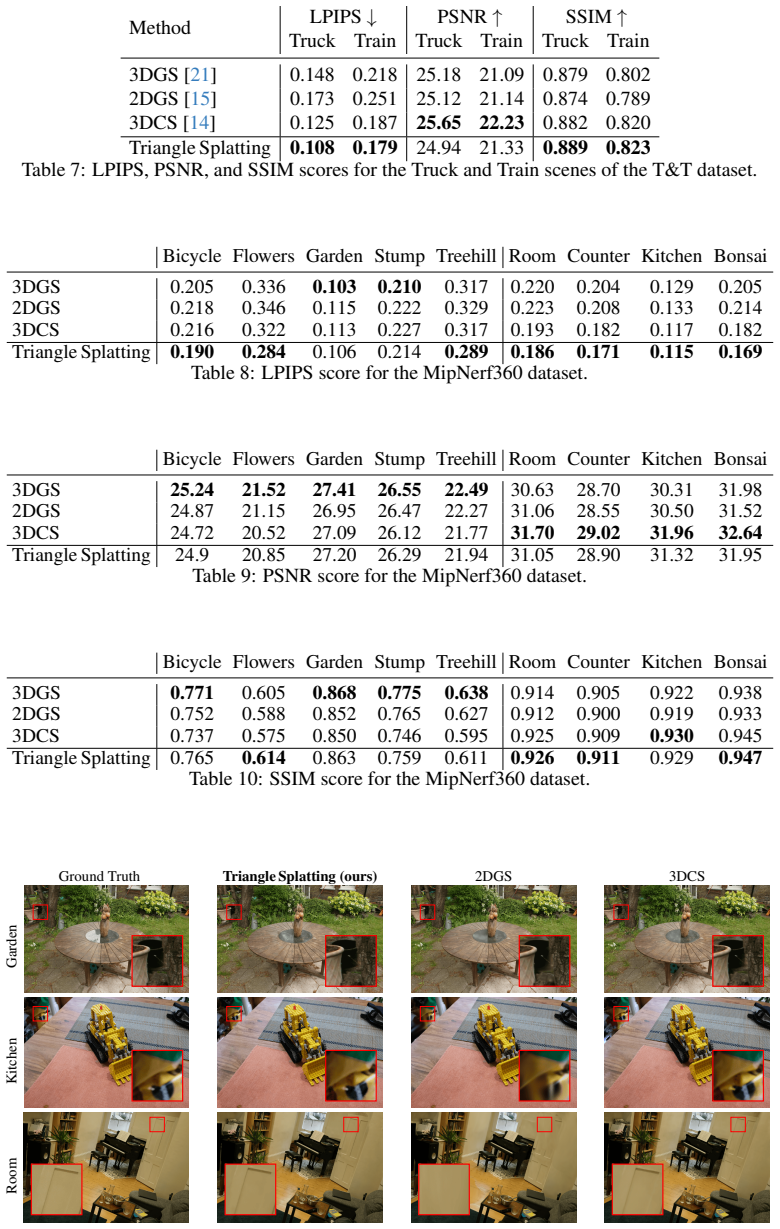
- [Table 1] The aggregated Mip-NeRF360 columns omit average PSNR and SSIM, even though per-scene values are given in Tables 9 and 10; please report the averages in the main table so that readers can compare all three standard metrics at a glance.
- [Abstract; Section 5; Supplementary A.5] The mesh-renderer FPS numbers are inconsistent: the abstract and Table 4 say "over 2,400 FPS" for Garden, while Supplementary A.5 reports 3,000 FPS; please clarify the configuration for each measurement and why they differ.
- [Section 3.1, Eq. (1)] The paper does not explain how gradients are computed through the non-smooth max in Eq. (1); since the method is described as differentiable and the window function is a core contribution, please state the subgradient or relaxed rule used in the implementation.
- [Section 4.1; Tables 8-10] No error bars or standard deviations are reported for the LPIPS, PSNR, and SSIM averages, and several differences (e.g., Triangle Splatting versus 3DCS on Mip-NeRF360 LPIPS) are small; adding variation across random seeds or multiple runs would strengthen the comparisons.
- [Section 3.1] The claim that the LogSumExp approximation means "only one of the three vertices has any influence on the final shape" is stated without supporting evidence; please provide a plot or quantitative comparison if it is used to justify the exact max choice.
Circularity Check
No significant circularity: the triangle window function is a novel definition with directly verified scaling properties, and all quality and speed claims are benchmarked against external methods.
full rationale
The paper's central contribution is a differentiable triangle-splatting renderer. The window function in Eq. (1) is introduced as a definition, not derived from the quantities it predicts; its stated properties (value 1 at the incenter, 0 at the boundary and outside) follow immediately from that definition, and the depth-scaling claim is proved in Eq. (4) from the same definition. This is a definition with a proof of a scaling property, not a prediction that reduces to a fitted parameter. The densification routine references the MCMC framework of Kheradmand et al. [22], which shares an author with the present paper, but that reference is used as an algorithmic prior for adaptive density control rather than as a proof of the paper's rendering or quality claims. The paper's comparative claims are empirical: they are supported by Tables 1-4 against external methods on Mip-NeRF360, Tanks and Temples, and DTU. Even where the paper's own tables qualify the headline (e.g., 3DGS has higher FPS than Triangle Splatting in Table 1, and the 2,400+ FPS figure comes from the annealed mesh pipeline in A.5 rather than the differentiable renderer), that is a consistency or correctness issue, not circularity. Hyperparameters are tuned empirically, but no reported quantitative result is the by-construction consequence of those choices. No equation in the paper sets a predicted output equal to a fitted input, and no load-bearing claim is justified solely by a self-citation. Therefore the appropriate finding is no significant circularity.
Assumptions & free parameters
free parameters (16)
- k (initial triangle scale) =
2.2
- initial opacity =
0.28
- initial sigma =
1.16
- densification schedule =
30% every 500 iterations, from iteration 500 to 25,000
- feature_lr =
0.0025
- opacity_lr =
0.014
- lr_convex_points_init =
0.0018 outdoor, 0.0015 indoor
- lr_sigma =
0.0008
- lambda_normals =
0.0001 outdoor, 0.00004 indoor
- lambda_opacity =
0.0055
- lambda_size =
1e-8 outdoor, 5e-8 indoor
- max_noise_factor =
1.5
- opacity_dead =
0.014
- split_size =
24.0
- importance_threshold =
0.022 outdoor, 0.0256 indoor
- tau_prune =
not specified in manuscript
assumptions (5)
- domain assumption The depth-ordered alpha composition equation from 3DGS, 2DGS, and 3DCS is a valid radiance model for triangle splats.
- domain assumption A random equilateral triangle at each SfM point, with size k times the nearest-neighbor distance, is a sufficient initialization for optimization.
- ad hoc to paper The actual max signed distance field, despite being non-smooth at triangle boundaries, provides usable gradients through the window function.
- ad hoc to paper The densification transition preserves the probability of the state, making split-by-four a valid MCMC move.
- ad hoc to paper Pruning triangles seen in fewer than two views with more than one pixel of coverage removes overfitted floaters without destroying valid geometry.
Cite this review
Pith. "Pith review of Triangle Splatting for Real-Time Radiance Field Rendering." pith.science (2026). https://pith.science/paper/OCX64SYB
@misc{pith2026250519175,
  author       = {Pith},
  title        = {Pith review of: Triangle Splatting for Real-Time Radiance Field Rendering},
  year         = {2026},
  howpublished = {\url{https://pith.science/paper/OCX64SYB}},
  note         = {Machine review of arXiv:2505.19175}
}
read the original abstract
The field of computer graphics was revolutionized by models such as Neural Radiance Fields and 3D Gaussian Splatting, displacing triangles as the dominant representation for photogrammetry. In this paper, we argue for a triangle comeback. We develop a differentiable renderer that directly optimizes triangles via end-to-end gradients. We achieve this by rendering each triangle as differentiable splats, combining the efficiency of triangles with the adaptive density of representations based on independent primitives. Compared to popular 2D and 3D Gaussian Splatting methods, our approach achieves higher visual fidelity, faster convergence, and increased rendering throughput. On the Mip-NeRF360 dataset, our method outperforms concurrent non-volumetric primitives in visual fidelity and achieves higher perceptual quality than the state-of-the-art Zip-NeRF on indoor scenes. Triangles are simple, compatible with standard graphics stacks and GPU hardware, and highly efficient: for the \textit{Garden} scene, we achieve over 2,400 FPS at 1280x720 resolution using an off-the-shelf mesh renderer. These results highlight the efficiency and effectiveness of triangle-based representations for high-quality novel view synthesis. Triangles bring us closer to mesh-based optimization by combining classical computer graphics with modern differentiable rendering frameworks. The project page is https://trianglesplatting.github.io/
Figures


Figures from the paper (10 more)




Forward citations
Cited by 3 Pith papers
-
Fourier Splatting: Generalized Fourier encoded primitives for scalable radiance fields
Planar Fourier-boundary surfels let a single radiance-field model render at continuous levels of detail by truncating coefficients, with STE gradients and HYDRA densification enabling stable training.
-
AniGS: Bridging Rendering and Diffusion Prior for 3D Scene Animation
AniGS animates a static 3D Gaussian Splatting scene by iteratively distilling video-diffusion motion into a time-conditioned deformation field while keeping static regions fixed.
-
SVR-GS: Spatially Variant Regularization for Probabilistic Masks in 3D Gaussian Splatting
SVR-GS replaces MaskGS's global mask average with a per-pixel spatial mask regularizer, cutting Gaussian counts by up to 5.63x over 3DGS with about 0.4-0.5 dB average PSNR loss.
Reference graph
Works this paper leans on
-
[1]
Barron, Ben Mildenhall, Matthew Tancik, Peter Hedman, Ricardo Martin-Brualla, and Pratul P
Jonathan T. Barron, Ben Mildenhall, Matthew Tancik, Peter Hedman, Ricardo Martin-Brualla, and Pratul P. Srinivasan. Mip-NeRF: A multiscale representation for anti-aliasing neural radiance fields. In IEEE/CVF Int. Conf. Comput. Vis. (ICCV), pages 5835–5844, Montréal, Can., Oct
-
[3]
Barron, Ben Mildenhall, Dor Verbin, Pratul P
Jonathan T. Barron, Ben Mildenhall, Dor Verbin, Pratul P. Srinivasan, and Peter Hedman. Zip-NeRF: Anti-aliased grid-based neural radiance fields. In IEEE/CVF Int. Conf. Comput. Vis. (ICCV), pages 19640–19648, Paris, Fr., Oct. 2023. Inst. Electr. Electron. Eng. (IEEE). URL https://doi.org/10.1109/ICCV51070.2023.01804. 3, 6, 7
arXiv 2023
-
[4]
Eric R. Chan, Connor Z. Lin, Matthew A. Chan, Koki Nagano, Boxiao Pan, Shalini de Mello, Orazio Gallo, Leonidas Guibas, Jonathan Tremblay, Sameh Khamis, Tero Karras, and Gordon Wetzstein. Efficient geometry-aware 3D generative adversarial networks. In IEEE/CVF Conf. Comput. Vis. Pattern Recognit. (CVPR), pages 16102–16112, New Orleans, LA, USA, Jun
-
[5]
TensoRF: Tensorial radiance fields
Anpei Chen, Zexiang Xu, Andreas Geiger, Jingyi Yu, and Hao Su. TensoRF: Tensorial radiance fields. In Eur. Conf. Comput. Vis. (ECCV), volume 13692 of Lect. Notes Comput. Sci., pages 333–350, Tel Aviv, Israël, 2022. Springer Nat. Switz. URL https://doi.org/10.1007/ 978-3-031-19824-3_20 . 3
work page 2022
-
[6]
Beyond Gaussians: Fast and high-fidelity 3D splatting with linear kernels
Haodong Chen, Runnan Chen, Qiang Qu, Zhaoqing Wang, Tongliang Liu, Xiaoming Chen, and Yuk Ying Chung. Beyond Gaussians: Fast and high-fidelity 3D splatting with linear kernels. arXiv, abs/2411.12440:1–14, 2024. URL https://doi.org/10.48550/arXiv. 2411.12440. 3
-
[8]
CvxNet: Learnable convex decomposition
Boyang Deng, Kyle Genova, Soroosh Yazdani, Sofien Bouaziz, Geoffrey Hinton, and Andrea Tagliasacchi. CvxNet: Learnable convex decomposition. In IEEE/CVF Conf. Comput. Vis. Pattern Recognit. (CVPR), pages 31–41, Seattle, WA, USA, Jun. 2020. Inst. Electr. Electron. Eng. (IEEE). URL https://doi.org/10.1109/CVPR42600.2020.00011. 2, 4
arXiv 2020
-
[9]
Learning to render novel views from wide-baseline stereo pairs
Yilun Du, Cameron Smith, Ayush Tewari, and Vincent Sitzmann. Learning to render novel views from wide-baseline stereo pairs. In IEEE/CVF Conf. Comput. Vis. Pattern Recognit. (CVPR), pages 4970–4980, Vancouver, Can., Jun. 2023. Inst. Electr. Electron. Eng. (IEEE). URL https://doi.org/10.1109/CVPR52729.2023.00481. 3
arXiv 2023
-
[11]
Markus Gross and Hanspeter Pfister. Point-Based Graphics . Morgan Kauffmann Publ. Inc., San Francisco, CA, USA, Jun. 2007. URL http://dx.doi.org/10.1016/ B978-0-12-370604-1.X5000-7 . 3 11
work page 2007
Show all 41 references
-
[14]
3D convex splatting: Radiance field rendering with 3D smooth convexes
Jan Held, Renaud Vandeghen, Abdullah Hamdi, Adrien Deliège, Anthony Cioppa, Silvio Giancola, Andrea Vedaldi, Bernard Ghanem, and Marc Van Droogenbroeck. 3D convex splatting: Radiance field rendering with 3D smooth convexes. In IEEE/CVF Conf. Comput. Vis. Pattern Recognit. (CVP...
2025
-
[15]
2D Gaussian splatting for geometrically accurate radiance fields
Binbin Huang, Zehao Yu, Anpei Chen, Andreas Geiger, and Shenghua Gao. 2D Gaussian splatting for geometrically accurate radiance fields. In ACM SIGGRAPH Conf. Pap., volume 35, pages 1–11, Denver, CO, USA, Jul. 2024. ACM. URLhttps://doi.org/10.1145/3641519. 3657428. 2, 3, 6, 7, ...
2024 doi
- [16]
-
[18]
Large scale multi-view stereopsis evaluation
Rasmus Jensen, Anders Dahl, George V ogiatzis, Engil Tola, and Henrik Aanaes. Large scale multi-view stereopsis evaluation. In IEEE Conf. Comput. Vis. Pattern Recognit. (CVPR) , pages 406–413, Columbus, OH, USA, Jun. 2014. Inst. Electr. Electron. Eng. (IEEE). URL https://doi.o...
2014 doi
-
[19]
Neural 3D mesh renderer
Hiroharu Kato, Yoshitaka Ushiku, and Tatsuya Harada. Neural 3D mesh renderer. InIEEE/CVF Conf. Comput. Vis. Pattern Recognit. (CVPR), pages 3907–3916, Salt Lake City, UT, USA, Jun
-
[20]
Poisson surface reconstruction
Michael Kazhdan, Matthew Bolitho, and Hugues Hoppe. Poisson surface reconstruction. In Symp. Geom. Process., pages 61–70, Cagliari, Italy, Jun. 2006. Eurographics Assoc. URL http://diglib.eg.org/handle/10.2312/SGP.SGP06.061-070. 2
2006 doi
-
[21]
3D Gaussian splatting for real-time radiance field rendering
Bernhard Kerbl, Georgios Kopanas, Thomas Leimkuehler, and George Drettakis. 3D Gaussian splatting for real-time radiance field rendering. ACM Trans. Graph., 42(4):1–14, Jul. 2023. URL https://doi.org/10.1145/3592433. 2, 3, 5, 6, 7, 16, 17
2023 doi
-
[22]
3D Gaussian splatting as Markov chain Monte Carlo
Shakiba Kheradmand, Daniel Rebain, Gopal Sharma, Weiwei Sun, Jeff Tseng, Hossam Isack, Abhishek Kar, Andrea Tagliasacchi, and Kwang Moo Yi. 3D Gaussian splatting as Markov chain Monte Carlo. In Adv. Neural Inf. Process. Syst. (NeurIPS), volume 37, pages 80965–80986, Vancouver,...
2024
-
[23]
Tanks and temples: bench- marking large-scale scene reconstruction
Arno Knapitsch, Jaesik Park, Qian-Yi Zhou, and Vladlen Koltun. Tanks and temples: bench- marking large-scale scene reconstruction. ACM Trans. Graph., 36(4):1–13, Jul. 2017. URL https://doi.org/10.1145/3072959.3073599. 6, 7
2017
-
[24]
Tetra-NeRF: Representing neural radiance fields using tetrahedra
Jonas Kulhanek and Torsten Sattler. Tetra-NeRF: Representing neural radiance fields using tetrahedra. In IEEE/CVF Int. Conf. Comput. Vis. (ICCV), pages 18412–18423, Paris, Fr., Oct
- [25]
-
[26]
Soft rasterizer: A differentiable renderer for image-based 3D reasoning
Shichen Liu, Weikai Chen, Tianye Li, and Hao Li. Soft rasterizer: A differentiable renderer for image-based 3D reasoning. In IEEE/CVF Int. Conf. Comput. Vis. (ICCV), pages 7707–7716, Seoul, South Korea, Oct. 2019. Inst. Electr. Electron. Eng. (IEEE). URL https://doi.org/ 10.11...
2019
-
[27]
Loper and Michael J
Matthew M. Loper and Michael J. Black. OpenDR: An approximate differentiable renderer. In Eur. Conf. Comput. Vis. (ECCV), volume 8695 of Lect. Notes Comput. Sci. , pages 154– 169, Zürich, Switzerland, 2014. Springer Int. Publ. URL https://doi.org/10.1007/ 978-3-319-10584-0_11 . 3
2014
-
[28]
Dynamic 3D Gaussians: Tracking by persistent dynamic view synthesis
Jonathon Luiten, Georgios Kopanas, Bastian Leibe, and Deva Ramanan. Dynamic 3D Gaussians: Tracking by persistent dynamic view synthesis. In Int. Conf. 3D Vis. (3DV), pages 800–809, Davos, Switzerland, Mar. 2024. Inst. Electr. Electron. Eng. (IEEE). URL https://doi.org/ 10.1109...
2024
-
[29]
Barron, and Yinda Zhang
Alexander Mai, Peter Hedman, George Kopanas, Dor Verbin, David Futschik, Qiangeng Xu, Falko Kuester, Jonathan T. Barron, and Yinda Zhang. EVER: Exact volumetric ellipsoid rendering for real-time view synthesis. arXiv, abs/2410.01804, 2024. URL https://doi. org/10.48550/arXiv.2...
-
[30]
Srinivasan, Matthew Tancik, Jonathan T
Ben Mildenhall, Pratul P. Srinivasan, Matthew Tancik, Jonathan T. Barron, Ravi Ramamoor- thi, and Ren Ng. NeRF: Representing scenes as neural radiance fields for view synthe- sis. In Eur. Conf. Comput. Vis. (ECCV), volume 12346 of Lect. Notes Comput. Sci. , pages 405–421, Virt...
2020
-
[31]
Srinivasan, Matthew Tancik, Jonathan T
Ben Mildenhall, Pratul P. Srinivasan, Matthew Tancik, Jonathan T. Barron, Ravi Ramamoorthi, and Ren Ng. NeRF. Commun. ACM, 65(1):99–106, Dec. 2021. URL https://doi.org/10. 1145/3503250. 2
2021
-
[32]
Instant neural graphics primitives with a multiresolution hash encoding
Thomas Müller, Alex Evans, Christoph Schied, and Alexander Keller. Instant neural graphics primitives with a multiresolution hash encoding. ACM Trans. Graph., 41(4):1–15, Jul. 2022. URL https://doi.org/10.1145/3528223.3530127. 2, 3, 6, 7
2022
-
[33]
StopThePop: Sorted Gaussian splatting for view-consistent real-time rendering
Lukas Radl, Michael Steiner, Mathias Parger, Alexander Weinrauch, Bernhard Kerbl, and Markus Steinberger. StopThePop: Sorted Gaussian splatting for view-consistent real-time rendering. ACM Trans. Graph., 43(4):1–17, Jul. 2024. URL https://doi.org/10.1145/ 3658187. 15
2024
-
[34]
KiloNeRF: Speeding up neural radiance fields with thousands of tiny MLPs
Christian Reiser, Songyou Peng, Yiyi Liao, and Andreas Geiger. KiloNeRF: Speeding up neural radiance fields with thousands of tiny MLPs. In IEEE/CVF Int. Conf. Comput. Vis. (ICCV), pages 14315–14325, Montréal, Can., Oct. 2021. Inst. Electr. Electron. Eng. (IEEE). URL https://d...
2021
-
[35]
MERF: Memory-efficient radiance fields for real-time view synthesis in unbounded scenes
Christian Reiser, Rick Szeliski, Dor Verbin, Pratul Srinivasan, Ben Mildenhall, Andreas Geiger, Jon Barron, and Peter Hedman. MERF: Memory-efficient radiance fields for real-time view synthesis in unbounded scenes. ACM Trans. Graph., 42(4):1–12, Jul. 2023. URL https: //doi.org...
2023 doi
-
[36]
Schonberger and Jan-Michael Frahm
Johannes L. Schonberger and Jan-Michael Frahm. Structure-from-motion revisited. In IEEE Conf. Comput. Vis. Pattern Recognit. (CVPR), pages 4104–4113, Las Vegas, NV , USA, Jun. 2016. Inst. Electr. Electron. Eng. (IEEE). URL https://doi.org/10.1109/CVPR.2016.445. 6
2016 doi
-
[37]
Direct voxel grid optimization: Super-fast convergence for radiance fields reconstruction
Cheng Sun, Min Sun, and Hwann-Tzong Chen. Direct voxel grid optimization: Super-fast convergence for radiance fields reconstruction. In IEEE/CVF Conf. Comput. Vis. Pattern Recognit. (CVPR), pages 5449–5459, New Orleans, LA, USA, Jun. 2022. Inst. Electr. Electron. Eng. (IEEE). ...
2022
-
[38]
BillBoard splatting (BBSplat): Learnable textured primitives for novel view synthesis
David Svitov, Pietro Morerio, Lourdes Agapito, and Alessio Del Bue. BillBoard splatting (BBSplat): Learnable textured primitives for novel view synthesis. arXiv, abs/2411.08508,
- [39]
-
[40]
LinPrim: Linear primitives for differentiable volumetric rendering
Nicolas von Lützow and Matthias Nießner. LinPrim: Linear primitives for differentiable volumetric rendering. arXiv, abs/2501.16312, 2025. URL https://doi.org/10.48550/ arXiv.2501.16312. 3
2025 doi
- [42]
-
[43]
HUGS: Holistic urban 3D scene understanding via Gaussian splatting
Hongyu Zhou, Jiahao Shao, Lu Xu, Dongfeng Bai, Weichao Qiu, Bingbing Liu, Yue Wang, Andreas Geiger, and Yiyi Liao. HUGS: Holistic urban 3D scene understanding via Gaussian splatting. In IEEE/CVF Conf. Comput. Vis. Pattern Recognit. (CVPR), pages 21336–21345, Seattle, WA, USA, ...
2024
-
[2018]
Inst. Electr. Electron. Eng. (IEEE). URL https://doi.org/10.1109/CVPR.2018. 00411. 2, 3
2018 doi
-
[2021]
Inst. Electr. Electron. Eng. (IEEE). URL https://doi.org/10.1109/ICCV48922. 2021.00580. 3
2021
-
[2022]
Inst. Electr. Electron. Eng. (IEEE). URL https://doi.org/10.1109/CVPR52688. 2022.01565. 3
2022
-
[2023]
Inst. Electr. Electron. Eng. (IEEE). URL https://doi.org/10.1109/ICCV51070. 2023.01692. 3 12
2023
- [2024]
Reviewed August 7, 2026 · model on record in the stance chip above.
Discussion (0). Sign in to comment.