REVIEW 4 major objections 6 minor 63 references
Effort-aware Fairness: Incorporating a Philosophy-informed, Human-centered Notion of Effort into Algorithmic Fairness Metrics
T0 review · 4 major / 6 minor · reviewed 2026-08-07 · deepseek-v4-flash
Pith's one-line read Algorithmic fairness should count the effort a person has already exerted, modeled as inertia times life-course acceleration, and a pre-registered experiment shows laypeople weigh trajectory over aggregate values.
desk verdict Trajectory perception result is solid, but the race-level inertia proxy makes the EaGF demonstration untrustworthy without a counterfactual check. read the letter →
The pith
A machine-rendered reading of the paper's core claim, the machinery that carries it, and where it could break.
The reading
What carries the argument
The load-bearing object is the Effort-as-Force score $E = m \cdot \sigma(A_{\text{avg}})$, built from two analogies: inertia $m$, drawn from race-level childhood poverty rates scaled to $[0,1]$ to represent societal holding-back beyond individual control, and acceleration $A_{\text{avg}}$, the average second-order difference of the cumulative version of the task feature (cumulative income or cumulative arrests), with the sigmoid $\sigma$ keeping effort one-signed and pooling extreme accelerations. This score is inserted into a Dwork-style Lipschitz individual-fairness constraint, $D(M\mathbf{x}_i, M\mathbf{x}_j) \le d(\mathbf{x}_i, \mathbf{x}_j)$, through a weighted distance $d$ that mixes effort difference with aggregate feature difference, and into a conditional group-fairness constraint $\hat{Y} \perp G \mid E$ computed by binning individuals by effort. The paper's empirical check that people actually judge by trajectory uses a simplified two-step evaluation of individual fairness: pairs are rated for trajectory and aggregate distance, then for overall similarity and for "fair" risk scores, with Spearman correlations, Hotelling and Steiger tests, and regressions that compare which distance drives the judgments.
What would settle it
Recompute the EaGF parity curves with a race-independent inertia proxy, such as individual-level childhood poverty or disability status, in place of race-scaled poverty rates: if the within-effort-bin parity curves and the model rankings they imply change materially or vanish, the reported audit results are artifacts of conditioning on a race-derived variable rather than evidence about effort. Separately, an experiment that matches pairs on aggregate value while varying only the steepness of the positive trajectory would test whether the continuous acceleration term, not just the sign of the trajectory, is what drives lay fairness judgments.
Extended reading notes
Core claim
The paper's central claim is that effort should enter fairness comparisons, and that effort is best modeled as force: $E = m \cdot \sigma(A_{\text{avg}})$, where $m$ is the societal "holding-back" an individual faced (operationalized by race-scaled childhood poverty rates) and $A_{\text{avg}}$ is the average acceleration of the cumulative task-relevant feature (prior arrests or income), with the sigmoid flipped for undesirable features such as arrests. On this basis the paper proposes Effort-aware Individual Fairness, requiring that pairwise output distance obey $D(M\mathbf{x}_i, M\mathbf{x}_j) \le d(\mathbf{x}_i, \mathbf{x}_j)$ with $d$ a weighted Euclidean combination of effort difference and aggregate feature difference, and Effort-aware Group Fairness, requiring $\hat{Y} \perp G \mid E$, group parity within bins of similar effort. The paper also reports a pre-registered experiment with 149 lay participants in which trajectory distance correlated significantly more strongly than aggregate distance with both overall input-space distance (CLUE $r = 0.706$ vs $0.502$; SHED $r = 0.788$ vs $0.655$) and output-space distance (CLUE $0.422$ vs $0.209$; SHED $0.499$ vs $0.251$), which it reads as validating the trajectory and acceleration component of the metric.
Load-bearing premise
The load-bearing premise is that race-level childhood poverty rates, scaled to $[0,1]$, validly measure each individual's inertia, the societal holding-back beyond their control; if that proxy does not track individual disadvantage, every effort score and both audit metrics built on it lose their justification, and since inertia varies by race, conditioning fairness on effort implicitly conditions on the protected attribute.
Editorial extensions
If this is right
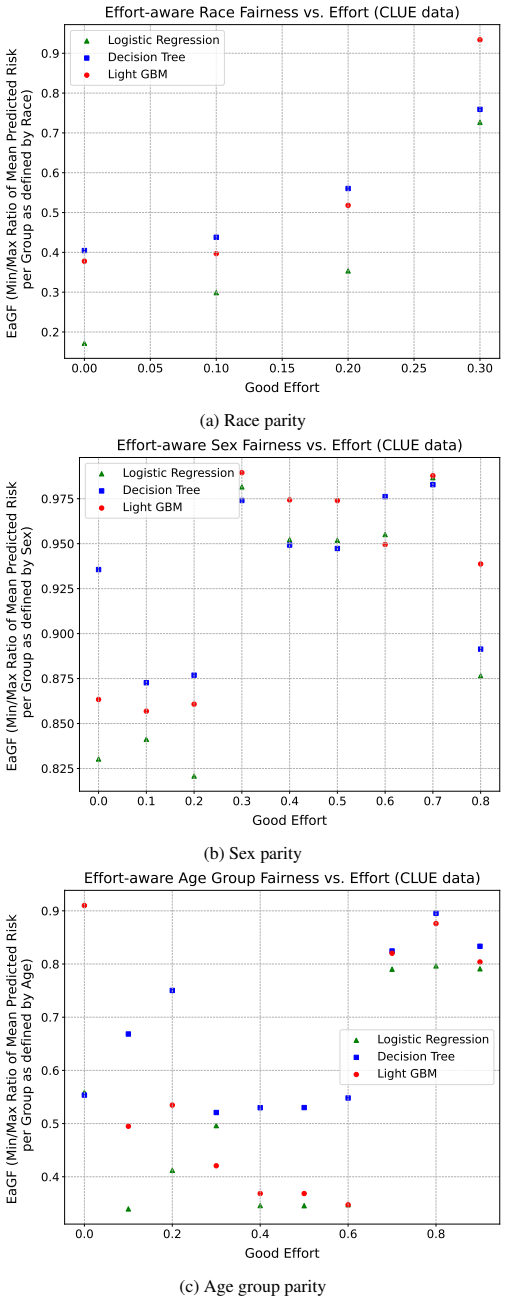
- An AI model can now be audited for effort-sensitivity: EaIF averages pairwise violations of $D(M\mathbf{x}_i, M\mathbf{x}_j) \le d(\mathbf{x}_i, \mathbf{x}_j)$, and EaGF plots within-effort-bin group parity, surfacing unfairness that overall demographic parity hides.
- The experiment implies that aggregate-only individual-fairness distances diverge from lay fairness judgment: in both the criminal-justice and personal-finance conditions, trajectory differences outweighed aggregate differences at both the similarity and risk-scoring stages.
- The metric ranks models differently from traditional fairness: on SHED, random forest leads EaIF while XGBoost wins highest-effort sex parity; on CLUE, Light GBM leads EaIF while decision tree leads traditional parity, so an effort-aware audit can change model selection.
- The EaGF definition $\hat{Y} \perp G \mid E$ embeds the philosophical claim that people who exerted similar effort deserve similar predicted outcomes regardless of demographics, making the fairness debate one about effort rather than outcome alone.
Reading between the lines
- Because $E = m \cdot \sigma(A_{\text{avg}})$ and $m$ is scaled from race-level poverty rates, conditioning fairness on effort is partly conditioning on the protected attribute: effort bins are partially separated by race, so within-bin parity could rise mechanically even if individuals of different races with identical trajectories are treated differently. The paper does not analyze this statistic
- A decisive test of the framework is to swap in individual-level inertia measures such as actual childhood poverty or disability status; if audit conclusions change materially, the race-level proxy is carrying the results, and if they do not, the proxy is a fair stand-in.
- The experiment contrasts increasing versus decreasing trajectories, but the metric rewards continuous acceleration; whether laypeople credit a steep climb more than a gradual one at equal aggregate value is an open question the current design does not resolve.
- The moderation finding, that trajectory's weight relative to aggregate was smaller in the criminal-history condition, implies the weight $\alpha$ in the EaIF distance is domain-dependent, so applying a single fixed weight across contexts needs justification.
Editorial analysis
A structured set of objections, weighed in public.
Referee Report
Summary. The paper proposes Effort-aware Fairness (EaF), a framework that incorporates a force-based notion of effort into algorithmic fairness metrics. Effort is defined as E = m · σ(A_avg), where m is an inertia term proxied by race-level childhood poverty rates and A_avg is the average acceleration of a cumulative task-relevant feature. The paper also proposes Effort-aware Individual Fairness (EaIF), which modifies the input-space distance to include effort differences, and Effort-aware Group Fairness (EaGF), which conditions group parity on similar-effort bins. The empirical contributions include a pre-registered human subjects experiment (N=149) showing that trajectory distance correlates more strongly than aggregate distance with overall input-space and output-space distances in both criminal justice (CLUE) and personal finance (SHED) contexts, and demonstration pipelines applying EaIF and EaGF to CLUE and SHED datasets with several predictive models.
Significance. If the claims hold, the paper introduces a novel and philosophically grounded way to incorporate effort into algorithmic fairness audits, with experimental evidence that laypeople prioritize trajectories over aggregate values when judging fairness. The pre-registration, the release of code and a record-linked SHED dataset, and the real-world demonstrations are notable strengths. However, the operationalization of inertia via a race-level poverty proxy is a critical weakness: because m is constant within each racial group, the effort variable implicitly encodes protected attributes, which can mechanically affect the EaGF audit results. The human experiment validates only the trajectory component, not the inertia multiplier, so the link between the human-centered claim and the complete effort metric is incomplete. A counterfactual analysis with a race-invariant inertia term is needed to establish the robustness of the audit conclusions.
major comments (4)
- [Computing Effort, Eqs. (9)–(10)] The inertia term m is assigned at the racial-group level from NCES childhood poverty rates, making m constant within each group. Consequently, E = m · σ(A_avg) is a deterministic function of both the individual's acceleration and their race's poverty rate. EaGF, defined in Eq. (3) as conditional independence of the predicted outcome G and the protected attribute given E, therefore conditions on a variable that encodes race. Within any effort bin, individuals from a group with higher m require a lower σ(A_avg) to fall in the bin than individuals from a group with lower m, so the two groups are compared at different acceleration histories. The paper calls race an 'imperfect proxy' but does not analyze this statistical consequence. A counterfactual recomputation of EaGF with m set to a constant (e.g., m=1) or to an individual-level proxy, if available, is necessary to show that the within-bin parity curves in Figures 3 and 6 are not artifacts of the group-level proxy rather than reflections of genuine effort-based disparities.
- [Human Subjects Experiment] The pre-registered experiment demonstrates that participants weigh trajectory (acceleration) more heavily than aggregate feature values in their individual fairness judgments. However, the full Effort metric E = m · σ(A_avg) includes the inertia multiplier m, which is never tested in the experiment. The paper's conclusion correctly states that the acceleration/trajectory component aligns with laypeople's perception, but the abstract and introduction imply that the entire Effort-aware formulation is human-centered. Because the inertia term is a race-level proxy for childhood poverty, the experiment provides no evidence that laypeople endorse multiplying the trajectory component by such a proxy. This gap should be explicitly acknowledged as a limitation, and ideally tested in a follow-up study that varies m independently of acceleration.
- [Computing Effort-aware Individual Fairness] The EaIF pipeline on SHED uses the regression coefficients from the SHED condition of the human study (α1 = 0.6114, α2 = 0.3182, normalized to 0.6577 and 0.3423) as the weight α in the distance function, and then applies these weights to the same SHED dataset. Because the human participants viewed SHED-based stimuli, the weights are not independent of the data used to evaluate the EaIF metric. This is not a fatal circularity, but the paper should clarify whether the weights are intended to be context-specific or generalizable, and it would strengthen the analysis to validate the findings using the CLUE condition's coefficients or a held-out sample.
- [Analysis Methods and Tables 5] The regression analyses in Table 5 treat each pairwise rating as an independent observation (900 CLUE and 888 SHED observations from 149 participants). Because each participant provided multiple ratings, the observations are non-independent, and the reported standard errors and p-values may be underestimated. To confirm that the significant differences between trajectory and aggregate effects are robust, the authors should use a mixed-effects model with participant random intercepts or cluster standard errors by participant.
minor comments (6)
- [Computing Effort] The text states that the sigmoid function 'eliminates the possibility of a negative sign.' This would be clearer if phrased as ensuring that the product m·σ(A_avg) is always positive, whereas m·A_avg could be negative when A_avg is negative.
- [Computing Effort-aware Group Fairness] Equation (14) operationalizes EaGF using a min/max ratio of mean predicted risks, which is a specific choice; the paper should note that this is one of several possible parity metrics for conditional independence in Eq. (3).
- [Appendix D] The SHED outcome is described first as 'the respondent's frequency of unpaid credit card balance' and later as 'whether a household missed a payment on a credit card balance at least once.' The conversion from the ordinal frequency variable to a binary outcome should be stated explicitly in the main text.
- [References] The reference to 'V on K¨ugelgen' contains a LaTeX spacing artifact; it should be formatted as 'von Kügelgen' or 'Von Kügelgen.'
- [Table 2] The row 'raggr,traj' (aggregate vs. trajectory correlation) is not discussed in the text; consider adding a brief interpretation or removing it to avoid confusion.
- [Figure 3 caption] The caption notes that the x-axes differ across subplots; it would be helpful to state this in the main text as well, as it affects the interpretation of the parity curves.
Circularity Check
The EaGF audit conditions on an Effort variable that embeds race-level inertia, making its parity-vs-Effort curves partly self-referential; the human-trajectory experiment itself is independent.
-
self definitional
[Section 'Computing Effort' (Eq. 9) and Section 'Computing Effort-aware Group Fairness' (Eq. 3)]
"To obtain m per race, we scale these poverty rates by the maximum rate (39%) so that m spreads across [0,1]. ... SHED: E=m·σ(A_avg) ... We formulate Effort-aware Group Fairness (EaGF) as ˆY⊥ G|E, where ˆY is a predicted outcome ... G is a protected demographic feature (e.g., race, sex, or age group ...), and E is Effort as force."
m is assigned at the race level, so E is a deterministic function of the protected attribute G and acceleration A_avg. The EaGF condition therefore conditions on a variable that already contains G: within an Effort bin, a member of a high-poverty group needs a lower sigma(A_avg) than a member of a low-poverty group to fall in the same bin. Thus the within-bin comparisons in Figure 3 do not hold acceleration histories constant; they compare different acceleration values that happen to yield the same race-scaled product. The 'Effort-aware parity' curves are artifacts of the m(G) construction rather than an independent measurement of parity conditional on equal effort, and the paper's caveat that race is an 'imperfect proxy' does not address this statistical consequence.
full rationale
The paper's central empirical claim—that laypeople weight trajectory (cumulative-view acceleration) more than aggregate feature value in individual-fairness judgments—is supported by a pre-registered human-subjects experiment with Spearman correlations, Hotelling/Steiger tests, and regression analyses. That result is not derived from the Effort formula; it is an independent behavioral test. The later EaIF demonstration reuses the SHED-condition regression coefficients (0.6114, 0.3182) as weights in the EaIF distance, but Table 1 is presented as an illustration of the metric rather than as a predictive validation of those weights, so this is a calibration choice rather than a fitted-input-called-prediction step. The EaGF demonstration, however, contains a self-definitional element: Effort in Eq. 9 is E = m·sigma(A_avg), with m assigned by race from NCES poverty rates, and EaGF is defined as Y-hat independent of G given E. Because m(G) is constant within each racial group, conditioning on E implicitly conditions on race-scaled acceleration; groups in the same Effort bin are not matched on comparable acceleration histories. The parity-versus-Effort curves in Figure 3 are therefore partly an artifact of building the protected attribute into the conditioning variable. No author self-citation chain or imported uniqueness theorem is load-bearing. Overall, the main perception result remains independent, but the EaGF audit's interpretation is partially circular.
Assumptions & free parameters
free parameters (6)
- Race-based inertia multipliers m_g =
White 0.333, Asian 0.359, Pacific Islander 0.641, American Indian 0.923, Black 1.000
- Aggregate feature sigmoid scale lambda (SHED) =
200,000 USD
- Aggregate feature sigmoid scale lambda (CLUE) =
1 arrest
- Effort weight alpha in EaIF distance =
0.5 equal baseline; 0.6577 SHED human-study; 0.6037 CLUE human-study
- EaGF Effort bin length =
0.1
- Minimum EaGF bin group size =
10 individuals
assumptions (5)
- domain assumption Newton's second law F=ma is an appropriate analogical basis for quantifying human effort.
- domain assumption Cumulative-view acceleration A_avg captures the force-based account of effort.
- domain assumption Race-level childhood poverty rates from NCES are a valid individual-level proxy for inertia or systemic disadvantage.
- domain assumption Laypeople's fairness perceptions should inform algorithmic fairness metric design.
- domain assumption The SHED 2019-2022 record-linked sample of 704 households is suitable for model audit demonstrations.
invented entities (3)
-
Force-based Effort E = m * sigma(A_avg)
-
Effort-aware Individual Fairness (EaIF) distance d(x_i,x_j)
-
Effort-aware Group Fairness (EaGF): Yhat perpendicular G | E
Cite this review
Pith. "Pith review of Effort-aware Fairness: Incorporating a Philosophy-informed, Human-centered Notion of Effort into Algorithmic Fairness Metrics." pith.science (2026). https://pith.science/paper/E2E2EBUZ
@misc{pith2026250519317,
  author       = {Pith},
  title        = {Pith review of: Effort-aware Fairness: Incorporating a Philosophy-informed, Human-centered Notion of Effort into Algorithmic Fairness Metrics},
  year         = {2026},
  howpublished = {\url{https://pith.science/paper/E2E2EBUZ}},
  note         = {Machine review of arXiv:2505.19317}
}
read the original abstract
Although popularized AI fairness metrics, e.g., demographic parity, have uncovered bias in AI-assisted decision-making outcomes, they do not consider how much effort one has spent to get to where one is today in the input feature space. However, the notion of effort is important in how Philosophy and humans understand fairness. We propose a philosophy-informed approach to conceptualize and evaluate Effort-aware Fairness (EaF), grounded in the concept of Force, which represents the temporal trajectory of predictive features coupled with inertia. Besides theoretical formulation, our empirical contributions include: (1) a pre-registered human subjects experiment, which shows that for both stages of the (individual) fairness evaluation process, people consider the temporal trajectory of a predictive feature more than its aggregate value; (2) pipelines to compute Effort-aware Individual/Group Fairness in the criminal justice and personal finance contexts. Our work may enable AI model auditors to uncover and potentially correct unfair decisions against individuals who have spent significant efforts to improve but are still stuck with systemic disadvantages outside their control.
Figures


Figures from the paper (3 more)


Reference graph
Works this paper leans on
-
[1]
, " * write output.state after.block = add.period write newline
ENTRY address archivePrefix author booktitle chapter edition editor eid eprint howpublished institution isbn journal key month note number organization pages publisher school series title type volume year label extra.label sort.label short.list INTEGERS output.state before.all mid.sentence after.sentence after.block FUNCTION init.state.consts #0 'before.a...
-
[2]
write newline
" write newline "" before.all 'output.state := FUNCTION n.dashify 't := "" t empty not t #1 #1 substring "-" = t #1 #2 substring "--" = not "--" * t #2 global.max substring 't := t #1 #1 substring "-" = "-" * t #2 global.max substring 't := while if t #1 #1 substring * t #2 global.max substring 't := if while FUNCTION word.in bbl.in capitalize " " * FUNCT...
-
[3]
A \" vodji, U.; Arai, H.; Fortineau, O.; Gambs, S.; Hara, S.; and Tapp, A. 2019. Fairwashing: the risk of rationalization. In International Conference on Machine Learning, 161--170. PMLR
work page 2019
-
[4]
A \" vodji, U.; Arai, H.; Gambs, S.; and Hara, S. 2021. Characterizing the risk of fairwashing. Advances in Neural Information Processing Systems, 34: 14822--14834
work page 2021
-
[5]
Arai, T. 1912. Mental fatigue (Unpublished doctoral dissertation). Teachers College, Columbia University, New York, NY
work page 1912
-
[6]
Awad, E.; Dsouza, S.; Bonnefon, J.-F.; Shariff, A.; and Rahwan, I. 2020. Crowdsourcing moral machines. Communications of the ACM, 63(3): 48--55
work page 2020
-
[7]
Bao, M.; Zhou, A.; Zottola, S.; Brubach, B.; Desmarais, S.; Horowitz, A.; Lum, K.; and Venkatasubramanian, S. 2021. It's COMPASlicated: The Messy Relationship between RAI Datasets and Algorithmic Fairness Benchmarks. Conference on Neural Information Processing Systems (NeurIPS)
work page 2021
-
[8]
Barocas, S.; Hardt, M.; and Narayanan, A. 2019. Fairness and Machine Learning: Limitations and Opportunities. fairmlbook.org. http://www.fairmlbook.org
work page 2019
Show all 63 references
-
[9]
P.; and Massin, O
Berm \'u dez, J. P.; and Massin, O. 2023. Efforts and their feelings. Philosophy Compass, 18(1): e12894
2023
-
[10]
Binns, R. 2020. On the apparent conflict between individual and group fairness. In Proceedings of the 2020 conference on fairness, accountability, and transparency, 514--524
2020
-
[11]
A.; Hull, P.; and Imas, A
Bohren, J. A.; Hull, P.; and Imas, A. 2022. Systemic discrimination: Theory and measurement. Technical report, National Bureau of Economic Research
2022
-
[12]
Caine, K. 2016. Local standards for sample size at CHI. In Proceedings of the 2016 CHI conference on human factors in computing systems, 981--992
2016
-
[13]
De Tracy, D. 1803. Projet d' \'e l \'e ments d'id \'e ologie \`a l'usage des \'e coles centrales de la R \'e publique fran c aise , volume 2
-
[14]
J.; Ziol-Guest, K
Duncan, G. J.; Ziol-Guest, K. M.; and Kalil, A. 2010. Early-childhood poverty and adult attainment, behavior, and health. Child development, 81(1): 306--325
2010
-
[15]
Dwork, C.; Hardt, M.; Pitassi, T.; Reingold, O.; and Zemel, R. 2012. Fairness through awareness. In Proceedings of the 3rd innovations in theoretical computer science conference, 214--226
2012
-
[16]
H.; Wright, R
Gendolla, G. H.; Wright, R. A.; and Richter, M. 2012. Effort intensity: Some insights from the cardiovascular system. The Oxford handbook of human motivation, 420--438
2012
-
[17]
Guldogan, O.; Zeng, Y.; Sohn, J.-y.; Pedarsani, R.; and Lee, K. 2023. Equal improvability: A new fairness notion considering the long-term impact
2023
-
[18]
D.; and Venkatasubramanian, S
Gupta, V.; Nokhiz, P.; Roy, C. D.; and Venkatasubramanian, S. 2019. Equalizing recourse across groups. arXiv preprint arXiv:1909.03166
2019 arXiv
-
[19]
Hardin, R.; and Cullity, G. 2003. The free rider problem
2003
-
[20]
Harrison, G.; Hanson, J.; Jacinto, C.; Ramirez, J.; and Ur, B. 2020. An empirical study on the perceived fairness of realistic, imperfect machine learning models. In Proceedings of the 2020 conference on fairness, accountability, and transparency, 392--402
2020
-
[21]
Heidari, H.; Nanda, V.; and Gummadi, K. P. 2019. On the long-term impact of algorithmic decision policies: Effort unfairness and feature segregation through social learning
2019
-
[22]
Huang, W.; Wu, Y.; Zhang, L.; and Wu, X. 2020. Fairness through equality of effort. In Companion Proceedings of the Web Conference 2020, 743--751
2020
-
[23]
IBM . 2024. AI and Decision-Making: Where Do Businesses Draw the Line?
2024
-
[24]
Ilvento, C. 2020. Metric Learning for Individual Fairness. In 1st Symposium on Foundations of Responsible Computing (FORC 2020). Schloss-Dagstuhl-Leibniz Zentrum f \"u r Informatik
2020
-
[25]
Inzlicht, M.; Shenhav, A.; and Olivola, C. Y. 2018. The effort paradox: Effort is both costly and valued. Trends in cognitive sciences, 22(4): 337--349
2018
-
[26]
A.; and Gelman, R
Jacobs Danan, J. A.; and Gelman, R. 2018. The problem with percentages. Philosophical Transactions of the Royal Society B: Biological Sciences, 373(1740): 20160519
2018
-
[27]
K.; Loewenstein, G.; and Prelec, D
John, L. K.; Loewenstein, G.; and Prelec, D. 2012. Measuring the prevalence of questionable research practices with incentives for truth telling. Psychological science, 23(5): 524--532
2012
-
[28]
W.; B \'e langer, J
Kruglanski, A. W.; B \'e langer, J. J.; Chen, X.; K \"o petz, C.; Pierro, A.; and Mannetti, L. 2012. The energetics of motivated cognition: a force-field analysis. Psychological review, 119(1): 1
2012
-
[29]
P.; and Weikum, G
Lahoti, P.; Gummadi, K. P.; and Weikum, G. 2019. Operationalizing Individual Fairness with Pairwise Fair Representations. Proceedings of the VLDB Endowment, 13(4)
2019
-
[30]
T.; Dean, S.; Rolf, E.; Simchowitz, M.; and Hardt, M
Liu, L. T.; Dean, S.; Rolf, E.; Simchowitz, M.; and Hardt, M. 2018. Delayed impact of fair machine learning. In International Conference on Machine Learning, 3150--3158. PMLR
2018
-
[31]
Liu, P.; Du, M.; and Li, T. 2021. Psychological consequences of legal responsibility misattribution associated with automated vehicles. Ethics and information technology, 23(4): 763--776
2021
-
[32]
Loeber, R.; and Snyder, H. N. 1990. Rate of offending in juvenile careers: Findings of constancy and change in lambda. Criminology, 28(1): 97--109
1990
-
[33]
Maine de Biran, P. 2002. Essai sur les fondements de la psychologie [Essay on the Foundations of Psychology]. uvres completes , 1
2002
-
[34]
Massin, O. 2017. Towards a definition of efforts. Motivation Science, 3(3): 230
2017
-
[35]
May, K.; and Hittner, J. B. 1997. Tests for comparing dependent correlations revisited: A Monte Carlo study. The Journal of Experimental Education, 65(3): 257--269
1997
-
[36]
Mayer, A.-S.; Strich, F.; and Fiedler, M. 2020. Unintended Consequences of Introducing AI Systems for Decision Making. MIS Quarterly Executive, 19(4)
2020
-
[37]
McNeill, F.; and Farrall, S. 2013. A moral in the story? Virtues, values and desistance from crime. In Values in criminology and community justice, 147--164. Policy Press
2013
-
[38]
Meng, X.-L.; Rosenthal, R.; and Rubin, D. B. 1992. Comparing correlated correlation coefficients. Psychological bulletin, 111(1): 172
1992
-
[39]
R.; Bailey, B
Miller, S. R.; Bailey, B. P.; and Kirlik, A. 2014. Exploring the utility of Bayesian truth serum for assessing design knowledge. Human--Computer Interaction, 29(5-6): 487--515
2014
-
[40]
S.; and Land, K
Nagin, D. S.; and Land, K. C. 1993. Age, criminal careers, and population heterogeneity: Specification and estimation of a nonparametric, mixed Poisson model. Criminology, 31(3): 327--362
1993
-
[41]
Ni, H.; Han, L.; Chen, T.; Sadiq, S.; and Demartini, G. 2024. Fairness without Sensitive Attributes via Knowledge Sharing. In Proceedings of the 2024 ACM Conference on Fairness, Accountability, and Transparency, 1897--1906
2024
-
[42]
Pedreshi, D.; Ruggieri, S.; and Turini, F. 2008. Discrimination-aware data mining. In Proceedings of the 14th ACM SIGKDD international conference on Knowledge discovery and data mining, 560--568
2008
-
[43]
R.; Farrington, D
Piquero, A. R.; Farrington, D. P.; and Blumstein, A. 2003. The criminal career paradigm. Crime and justice, 30: 359--506
2003
-
[44]
R.; Whitcomb, M
Porter, S. R.; Whitcomb, M. E.; and Weitzer, W. H. 2004. Multiple surveys of students and survey fatigue. New directions for institutional research, 2004(121): 63--73
2004
-
[45]
Prelec, D. 2004. A Bayesian truth serum for subjective data. science, 306(5695): 462--466
2004
-
[46]
Romano, Y.; Bates, S.; and Candes, E. 2020. Achieving equalized odds by resampling sensitive attributes. Advances in neural information processing systems, 33: 361--371
2020
-
[47]
J.; and Laub, J
Sampson, R. J.; and Laub, J. H. 2017. Life-course desisters? Trajectories of crime among delinquent boys followed to age 70. In Developmental and Life-Course Criminological Theories, 37--74. Routledge
2017
-
[48]
Sandel, M. J. 2021. How meritocracy fuels inequality—part i The Tyranny of Merit: An Overview. American Journal of Law and Equality, 1: 4--14
2021
-
[49]
Sariaslan, A.; Larsson, H.; D'Onofrio, B.; L ngstr \"o m, N.; and Lichtenstein, P. 2014. Childhood family income, adolescent violent criminality and substance misuse: quasi-experimental total population study. The British Journal of Psychiatry, 205(4): 286--290
2014
-
[50]
A.; Huang, K.; DeFilippis, E.; Radanovic, G.; Parkes, D
Saxena, N. A.; Huang, K.; DeFilippis, E.; Radanovic, G.; Parkes, D. C.; and Liu, Y. 2019. How do fairness definitions fare? Examining public attitudes towards algorithmic definitions of fairness. In Proceedings of the 2019 AAAI/ACM Conference on AI, Ethics, and Society, 99--106
2019
-
[51]
SCOTUS. 1920. FS Royster Guano Co. v. Virginia. (No. 165)
1920
-
[52]
SCOTUS. 1976. Washington v. Davis. (No. 74-1492)
1976
-
[53]
SCOTUS. 1985. Cleburne v. Cleburne Living Center, Inc. (No. 84-468)
1985
-
[54]
Steele, J. 2020. What is (perception of) effort? Objective and subjective effort during task performance. PsyArXiv
2020
-
[55]
Turnbull, S. 2002. Grounding social theory in the natural sciences. In XVth ISA World Congress of Sociology
2002
-
[56]
Ustun, B.; Spangher, A.; and Liu, Y. 2019. Actionable recourse in linear classification. In Proceedings of the conference on fairness, accountability, and transparency, 10--19
2019
-
[57]
Van Berkel, N.; Goncalves, J.; Russo, D.; Hosio, S.; and Skov, M. B. 2021. Effect of information presentation on fairness perceptions of machine learning predictors. In Proceedings of the 2021 CHI conference on Human Factors in Computing Systems, 1--13
2021
-
[58]
u gelgen, J.; Karimi, A.-H.; Bhatt, U.; Valera, I.; Weller, A.; and Sch \
Von K \"u gelgen, J.; Karimi, A.-H.; Bhatt, U.; Valera, I.; Weller, A.; and Sch \"o lkopf, B. 2022. On the fairness of causal algorithmic recourse. In Proceedings of the AAAI conference on artificial intelligence, volume 36, 9584--9594
2022
-
[59]
P.; and Weller, A
Wang, H.; Grgic-Hlaca, N.; Lahoti, P.; Gummadi, K. P.; and Weller, A. 2019. An Empirical Study on Learning Fairness Metrics for COMPAS Data with Human Supervision. Workshop on Human-Centric Machine Learning at NeurIPS 2019
2019
-
[60]
Weaver, R.; and Prelec, D. 2013. Creating truth-telling incentives with the Bayesian truth serum. Journal of Marketing Research, 50(3): 289--302
2013
-
[61]
Witkowski, J.; and Parkes, D. 2012. A robust bayesian truth serum for small populations. In Proceedings of the AAAI Conference on Artificial Intelligence, volume 26, 1492--1498
2012
-
[62]
D.; Freedman, R
Young, H. D.; Freedman, R. A.; and Ford, A. L. 2014. University physics with modern physics. Pearson New York
2014
-
[63]
Zemel, R.; Wu, Y.; Swersky, K.; Pitassi, T.; and Dwork, C. 2013. Learning fair representations. In International conference on machine learning, 325--333. PMLR
2013
Reviewed August 7, 2026 · model on record in the stance chip above.
Discussion (0). Sign in to comment.