REVIEW 4 major objections 5 minor 1 cited by
MT$^{3}$: Scaling MLLM-based Text Image Machine Translation via Multi-Task Reinforcement Learning
T0 review · 4 major / 5 minor · reviewed 2026-08-07 · deepseek-v4-flash
Pith's one-line read MT3 applies multi-task reinforcement learning to a 7B multimodal language model for end-to-end text image machine translation, reporting state-of-the-art results that beat much larger baselines and introducing a social-media benchmark.
desk verdict The in-domain SOTA for a 7B MLLM on TIMT may well survive scrutiny, but the OOD generalization claim is contradicted by the paper's own Table 2 and needs correction before the headline stands. read the letter →
The pith
A machine-rendered reading of the paper's core claim, the machinery that carries it, and where it could break.
The reading
What carries the argument
The central machinery is the MT3 generation-and-reward loop. A structured prompt requires the model to answer inside <recognize>, <think>, and <translate> tags, and a multi-mixed reward adds a format penalty to continuous OCR and translation metric scores: recognition is rewarded with BLEU, METEOR, F1, normalized edit distance, and normalized CER, while translation is rewarded with averaged BLEU, chrF++, and METEOR. GRPO computes group-relative advantages from these rewards and updates the policy. The design makes each sub-skill independently measurable, so the model receives fine-grained, non-binary feedback on all three stages rather than a single yes/no signal on the final translation.
What would settle it
Rerun the same RL recipe on several independently drawn 15K subsets of MIT-10M and have bilingual raters judge translation quality; if the reported margin over Qwen2.5-VL-72B disappears on some subsets or the metric gains do not track human preference, the central claim would be refuted.
Extended reading notes
Core claim
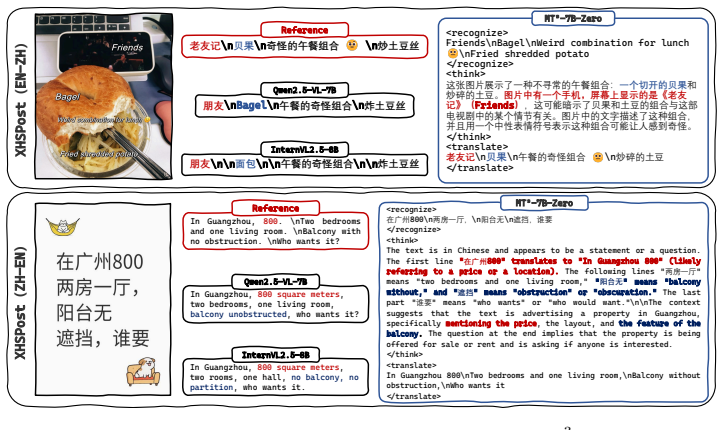
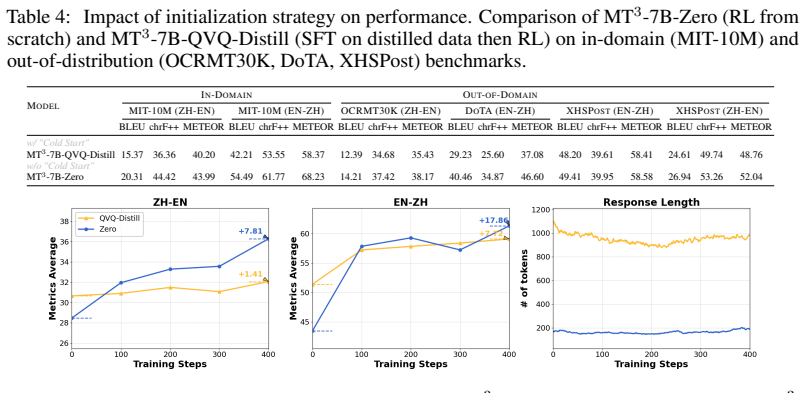
The central claim is that R1-style reinforcement learning can be adapted to TIMT when the reward is decomposed by sub-task and mixes several quality metrics. With a prompt that forces the model to emit recognized text, a reasoning step, and a translation in sequence, and a reward combining format compliance, OCR-quality scores, and the average of BLEU, chrF++, and METEOR, a 7B model trained with GRPO from the base Qwen2.5-VL checkpoint surpasses the in-domain performance of the 72B and 78B zero-shot baselines. The paper further claims that starting RL directly from the base checkpoint outperforms initializing with supervised fine-tuning on distilled demonstrations, and that the learned behavior transfers out of distribution. The introduction of XHSPost is presented as a benchmark contribution for evaluating TIMT in realistic social-media settings.
Load-bearing premise
The load-bearing premise is that the 15,000 training images selected from MIT-10M are representative of the benchmark, and that the averaged BLEU, chrF++, and METEOR reward measures a real improvement in translation quality rather than a way to game the metrics.
Editorial extensions
If this is right
- A 7B model trained this way can outperform zero-shot 72B and 78B MLLMs on in-domain TIMT, so model scale is not the only route to high-quality text-image translation.
- Reinforcement learning that explicitly rewards OCR and reasoning beats supervised fine-tuning of the same base model, including SFT with an OCR-plus-translation format.
- Zero-start RL reaches a higher final performance than supervised fine-tuning on distilled demonstrations followed by RL, and it does so with shorter, more stable outputs.
- The learned translation transfers to unseen language pairs and datasets, including social-media posts, where it generally rivals much larger baselines.
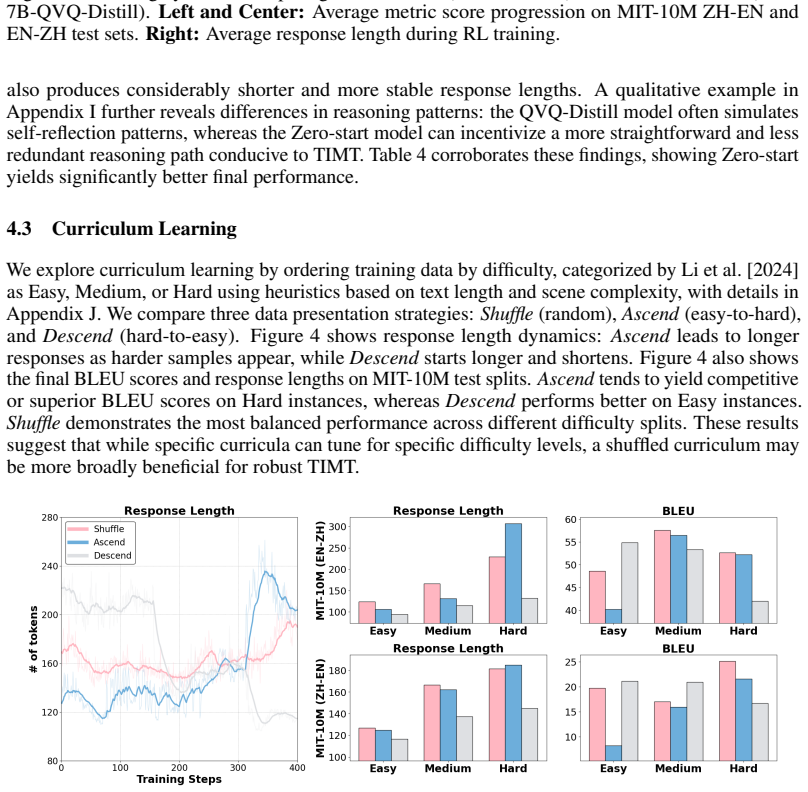
- Averaging BLEU, chrF++, and METEOR as the translation reward yields more consistent gains than optimizing any one of them alone.
Reading between the lines
- If the result holds, TIMT capability may be scalable through training recipes rather than model size, making high-quality text-image translation feasible at 7B scale for real deployments.
- The same recognize-think-translate decomposition with mixed rewards could transfer to other vision-language tasks where text in images must be grounded before answering, such as document VQA or scene-text understanding.
- A direct extension would replace the n-gram-based mixed reward with a neural or human-preference reward to test whether the reported gains reflect translation quality rather than reference overlap.
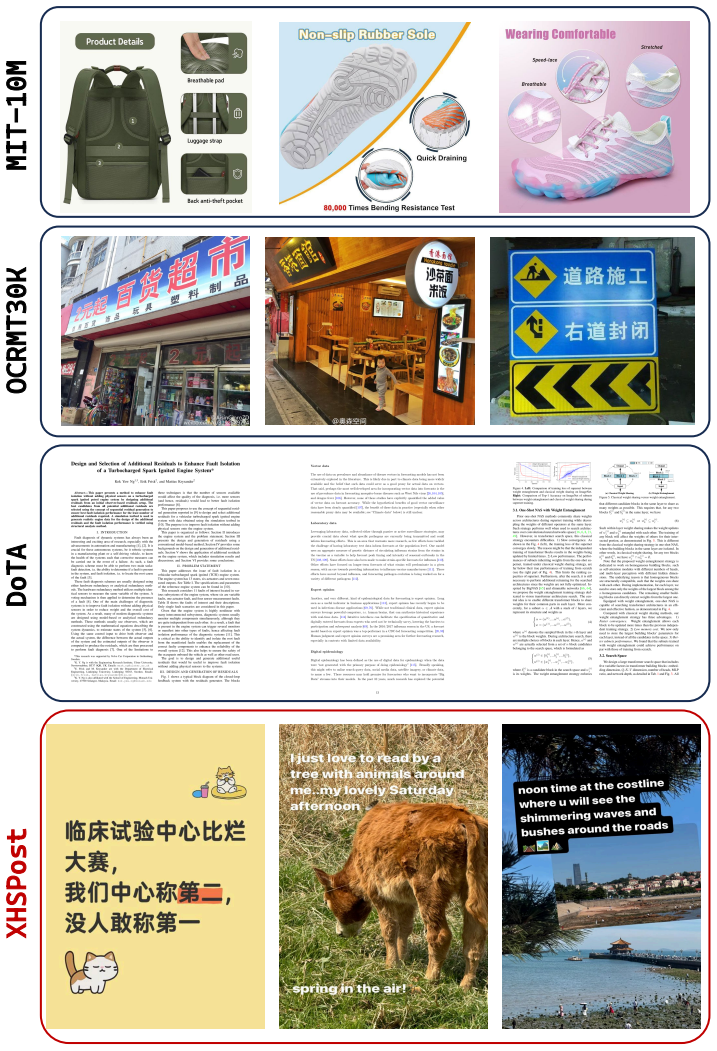
- XHSPost, as a social-media benchmark, invites future work on emoji, code-switching, memes, and informal register, which are underrepresented in existing TIMT datasets.
Editorial analysis
A structured set of objections, weighed in public.
Referee Report
Summary. The paper proposes MT3, a framework that applies multi-task reinforcement learning to a 7B multimodal large language model (Qwen2.5-VL-7B) for end-to-end text image machine translation (TIMT). The model is trained with GRPO using a structured prompt that separates recognition, reasoning, and translation, and a reward function that combines format adherence with averaged BLEU, chrF++, and METEOR scores for translation, plus a separate recognition reward. The authors report state-of-the-art in-domain results on the MIT-10M benchmark, claim strong out-of-distribution generalization to unseen language pairs and datasets, and introduce a new social media TIMT benchmark, XHSPost. The paper also provides ablations on the multi-task design, initialization strategy, curriculum learning, and reward metric selection.
Significance. If the in-domain result is robust, this paper makes a valuable empirical contribution: it shows that a 7B MLLM trained with multi-task RL can surpass much larger zero-shot MLLMs on a recent TIMT benchmark, and it provides a new benchmark plus systematic analyses of RL design choices for TIMT. The XHSPost benchmark and the detailed ablations are useful resources for the community. However, the paper's central OOD generalization claim is currently contradicted by its own Table 2, and the overlap between the training reward and the evaluation metrics, together with the unclear use of test-set curves during training, means that the headline claims need additional validation. The in-domain results appear internally consistent and may survive these fixes, but the advertised OOD performance does not.
major comments (4)
- [Section 3.5, Table 2] The OOD paragraph misreports Table 2. The claim that 'On DoTA, our model's 46.60 chrF++ was considerably higher than Qwen2.5-VL-72B's 37.65' is false: 46.60 is the METEOR score, and it is below Qwen2.5-VL-72B's 50.75; the chrF++ values are 34.87 for MT3-7B-Zero and 37.65 for Qwen2.5-VL-72B. Similarly, the sentence 'on MIT-10M (DE-FR), MT3-7B-Zero achieved 54.99 chrF++ and 53.88 METEOR' swaps the two metrics, since Table 2 lists 53.88 chrF++ and 54.99 METEOR. More broadly, Table 2 shows MT3-7B-Zero below Qwen2.5-VL-72B on OCRMT30K, DoTA, and both XHSPost directions on both reported metrics, so the abstract's assertion of 'strong generalization to out-of-distribution ... datasets' is not supported by the reported numbers. Please correct these errors and revise the OOD claim to match the table.
- [Section 3.2, Section 3.5, Figures 3/4/6] The reward and evaluation metrics overlap, and the paper does not rule out test-set-based selection. The translation reward R_task-trans is the average of BLEU, chrF++, and METEOR, and the evaluation in Tables 1 and 2 uses the same three metrics. This does not by itself invalidate the in-domain comparison, but it means the model is directly optimizing the reported evaluation measure; surface-level n-gram overlap could be rewarded independently of translation quality. I recommend adding a human evaluation or at least one metric that was not part of the reward (e.g., COMET or CometKiwi) for the main comparisons. In addition, Figures 3, 4, and 6 plot performance progression on MIT-10M test sets, and the text never states whether any checkpoint, reward-choice, or curriculum decision was made using those test curves. If test data were used for model selection, the held-out interpretation of Tables 1 and 2 is compromised. Please state the exact selection protocol and, if necessary, re-evaluate using a checkpoint chosen on a validation split.
- [Section 3.4, Table 2] The paper does not establish image-level disjointness between the 15K RL training pairs and the MIT-10M test sets, including the 'unseen language pair' test blocks. MIT-10M is a multilingual parallel corpus in which the same image can appear in multiple language-pair splits. If the same visual content occurred in the 15K training subset, then MT3's gains on EN-DE, ZH-FR, and DE-FR could reflect memorized visual or OCR context rather than transfer to genuinely unseen input. Similarly, the in-domain ZH-EN and EN-ZH results could be inflated if the training subset overlaps the standard test splits. Please report an image-level deduplication check between the training subset and all evaluation splits, and re-run the OOD evaluation on images that are provably disjoint from training.
- [Section 3.4, Table 1] The SFT baselines are described only as 'trained on the MIT-10M dataset', without specifying the number of training pairs or the exact data split. If those baselines used a much larger training sample than the 15K pairs used for RL, the claim that RL surpasses SFT is not a controlled comparison; if they used the same 15K pairs, that should be stated explicitly. Please provide the training data size, the split, and the prompt format for each SFT baseline so that the comparison is reproducible and fair.
minor comments (5)
- [Abstract / Introduction] The claim of 'approximately 15-25 points average improvement across BLEU, chrF++, METEOR' over Qwen2.5-VL-72B is not supported by Table 1: the average gains are about 7.77 points for ZH-EN and 15.14 points for EN-ZH, and the average over all six metric-direction cells is roughly 11.5 points. Please correct or clarify this statement.
- [Table 2] Several table entries are concatenated without separators (e.g., '27.2930.13', '48.8245.06'), which makes the table difficult to read. Please reformat with clear column separation.
- [Section 3.5, Table 2, Appendix E] The dataset name is spelled inconsistently: 'DoTA' in the text and Appendix E, but 'DOTA' in Table 2. Please use one spelling throughout.
- [Figure 3 and Figure 6 captions] These figures explicitly show progression on MIT-10M test sets. If these curves were generated only for post-hoc analysis and did not influence any training decision, please add a clear statement to that effect in the captions or in Section 3.4; otherwise, state which decisions, if any, were based on these curves.
- [Section 4.4, Figure 5] The correlation matrices are described as being based on 'final reward'; please clarify whether these are training rewards or test-set metric scores, since the interpretation and the implications for metric selection differ.
Circularity Check
Mixed-reward choice is validated on the same MIT-10M test sets used for the headline SOTA, making the reward-formulation analysis partially circular; the central in-domain result remains an empirical, non-forced claim.
-
fitted input called prediction
[Section 4.4, Figure 6; cf. Figure 3 caption]
"Here, we analyze using individual metrics (BLEU, chrF++, METEOR) versus our proposed Mixed Reward (average of these three) for Rtask−trans. ... These performance plots demonstrate that the Mixed Reward generally results in the most consistent and often the highest performance across all three evaluation metrics. [Figure 3 caption:] Average metric score progression on MIT-10M ZH-EN and EN-ZH test sets."
The reward formulation is selected and justified using performance-progression curves on MIT-10M, and Figure 3 confirms that these progression curves are computed on the MIT-10M test sets. The final MT3-7B-Zero model uses the Mixed Reward and is then evaluated on those same test sets with those same three metrics. Thus the reported advantage of the Mixed Reward over single-metric rewards, and the resulting SOTA numbers, are not independent predictions: the reward input was chosen by looking at the evaluation data, and the same evaluation data is then cited as evidence that the choice succeeds. This makes the reward-formulation analysis partly circular, though the final test scores are still measured rather than derived.
full rationale
The paper's central derivation is not circular: MT3-7B-Zero is trained with GRPO and a reward that averages BLEU, chrF++, and METEOR, and it is then evaluated on held-out MIT-10M test splits, OOD language pairs, and external datasets. Optimizing for the same metrics used in evaluation is a standard training/evaluation design and does not by itself make the reported improvements forced. The main circular element is in Section 4.4: the choice of the Mixed Reward versus single-metric rewards is justified by performance-progression plots on MIT-10M, and Figure 3 confirms that such progression curves are computed on the MIT-10M test sets. The final model then reports SOTA numbers on those same test sets with those same metrics, so the validation of the reward formulation is an input selected on the evaluation data rather than an independent prediction. The same test-set-selection issue may apply to the choice of the full multi-task configuration in Table 3, though the paper does not explicitly state that the final configuration was chosen from those curves. The OOD language-pair results present a leakage risk because the training pairs and the 'unseen' language-pair test images both come from MIT-10M with no stated image-disjointness check, but this is not demonstrated circularity and does not raise the score further. Self-citations to MT-R1-Zero are used to motivate the mixed-metric and implicit-reasoning rewards, but the central claims are backed by this paper's own ablations and held-out evaluations, so they are not load-bearing.
Assumptions & free parameters
free parameters (4)
- Format reward constants =
+1 correct, -3 incorrect
- Reward metric weights =
Equal weights (1/3 for BLEU, chrF++, METEOR; 1/5 for BLEU, METEOR, F1, 1-CER, 1-edit distance)
- RL training subset size =
15K pairs per direction from MIT-10M
- QVQ cold-start threshold =
top 5K samples per direction by BLEU against ground truth
assumptions (4)
- standard math GRPO optimizes the stated reward correctly
- domain assumption BLEU, chrF++, METEOR and the OCR metrics are valid proxies for TIMT quality
- ad hoc to paper Explicit recognition and reasoning stages improve end-to-end translation
- domain assumption MIT-10M test sets represent in-domain TIMT performance
Cite this review
Pith. "Pith review of MT$^{3}$: Scaling MLLM-based Text Image Machine Translation via Multi-Task Reinforcement Learning." pith.science (2026). https://pith.science/paper/BFNCSKVW
@misc{pith2026250519714,
  author       = {Pith},
  title        = {Pith review of: MT$^3$: Scaling MLLM-based Text Image Machine Translation via Multi-Task Reinforcement Learning},
  year         = {2026},
  howpublished = {\url{https://pith.science/paper/BFNCSKVW}},
  note         = {Machine review of arXiv:2505.19714}
}
abstract
Text Image Machine Translation (TIMT)-the task of translating textual content embedded in images-is critical for applications in accessibility, cross-lingual information access, and real-world document understanding. However, TIMT remains a complex challenge due to the need for accurate optical character recognition (OCR), robust visual-text reasoning, and high-quality translation, often requiring cascading multi-stage pipelines. Recent advances in large-scale Reinforcement Learning (RL) have improved reasoning in Large Language Models (LLMs) and Multimodal LLMs (MLLMs), but their application to end-to-end TIMT is still underexplored. To bridge this gap, we introduce MT$^{3}$, the first framework to apply Multi-Task RL to MLLMs for end-to-end TIMT. MT$^{3}$ adopts a multi-task optimization paradigm targeting three key sub-skills: text recognition, context-aware reasoning, and translation. It is trained using a novel multi-mixed reward mechanism that adapts rule-based RL strategies to TIMT's intricacies, offering fine-grained, non-binary feedback across tasks. Furthermore, to facilitate the evaluation of TIMT in authentic cross-cultural and real-world social media contexts, we introduced XHSPost, the first social media TIMT benchmark. Our MT$^{3}$-7B-Zero achieves state-of-the-art results on the latest in-domain MIT-10M benchmark, outperforming strong baselines such as Qwen2.5-VL-72B and InternVL2.5-78B by notable margins across multiple metrics. Additionally, the model shows strong generalization to out-of-distribution language pairs and datasets. In-depth analyses reveal how multi-task synergy, reinforcement learning initialization, curriculum design, and reward formulation contribute to advancing MLLM-driven TIMT.
Figures

Figures from the paper (5 more)



Forward citations
Cited by 1 Pith paper
-
Multi-Task GRPO: Reliable LLM Reasoning Across Tasks
MT-GRPO reweights tasks by reward and improvement and enforces those weights after zero-gradient filtering, improving worst-task accuracy by 6–28% over GRPO/DAPO baselines on 3- and 9-task setups.
Reference graph
Works this paper leans on
-
[1]
Improving end-to-end text image translation from the auxiliary text translation task
Cong Ma, Yaping Zhang, Mei Tu, Xu Han, Linghui Wu, Yang Zhao, and Yu Zhou. Improving end-to-end text image translation from the auxiliary text translation task. In 2022 26th International Conference on Pattern Recognition (ICPR), pages 1664--1670. IEEE, 2022
work page 2022
-
[2]
Exploring better text image translation with multimodal codebook
Zhibin Lan, Jiawei Yu, Xiang Li, Wen Zhang, Jian Luan, Bin Wang, Degen Huang, and Jinsong Su. Exploring better text image translation with multimodal codebook. In Proceedings of the 61st Annual Meeting of the Association for Computational Linguistics (Volume 1: Long Papers), pages 3479--3491, 2023
work page 2023
-
[3]
Document image machine translation with dynamic multi-pre-trained models assembling
Yupu Liang, Yaping Zhang, Cong Ma, Zhiyang Zhang, Yang Zhao, Lu Xiang, Chengqing Zong, and Yu Zhou. Document image machine translation with dynamic multi-pre-trained models assembling. In Proceedings of the 2024 Conference of the North American Chapter of the Association for Computational Linguistics: Human Language Technologies (Volume 1: Long Papers), p...
work page 2024
-
[4]
X-alma: Plug & play modules and adaptive rejection for quality translation at scale
Haoran Xu, Kenton Murray, Philipp Koehn, Hieu Hoang, Akiko Eriguchi, and Huda Khayrallah. X-alma: Plug & play modules and adaptive rejection for quality translation at scale. arXiv preprint arXiv:2410.03115, 2024
arXiv 2024
-
[5]
Improving llm-based machine translation with systematic self-correction
Zhaopeng Feng, Yan Zhang, Hao Li, Wenqiang Liu, Jun Lang, Yang Feng, Jian Wu, and Zuozhu Liu. Improving llm-based machine translation with systematic self-correction. arXiv preprint arXiv:2402.16379, 2024
arXiv 2024
-
[6]
Towards fully automated manga translation
Ryota Hinami, Shonosuke Ishiwatari, Kazuhiko Yasuda, and Yusuke Matsui. Towards fully automated manga translation. In Proceedings of the AAAI conference on artificial intelligence, volume 35, pages 12998--13008, 2021
work page 2021
-
[7]
Nilesh P Sable, Priya Shelke, Ninad Deogaonkar, Nachiket Joshi, Rudra Kabadi, and Tushar Joshi. Doc-handler: Document scanner, manipulator, and translator based on image and natural language processing. In 2023 International Conference on Emerging Smart Computing and Informatics (ESCI), pages 1--6. IEEE, 2023
work page 2023
-
[8]
A novel dataset and benchmark analysis on document image translation
Zhiyang Zhang, Yaping Zhang, Lu Xiang, Yang Zhao, Yu Zhou, and Chengqing Zong. A novel dataset and benchmark analysis on document image translation. In China Conference on Machine Translation, pages 103--115. Springer, 2023
work page 2023
Show all 38 references
-
[9]
Understand layout and translate text: Unified feature-conductive end-to-end document image translation
Zhiyang Zhang, Yaping Zhang, Yupu Liang, Cong Ma, Lu Xiang, Yang Zhao, Yu Zhou, and Chengqing Zong. Understand layout and translate text: Unified feature-conductive end-to-end document image translation. IEEE Transactions on Pattern Analysis and Machine Intelligence, 2025 a
2025
-
[10]
Peit: bridging the modality gap with pre-trained models for end-to-end image translation
Shaolin Zhu, Shangjie Li, Yikun Lei, and Deyi Xiong. Peit: bridging the modality gap with pre-trained models for end-to-end image translation. In Proceedings of the 61st Annual Meeting of the Association for Computational Linguistics (Volume 1: Long Papers), pages 13433--13447, 2023
2023
-
[11]
Born a babynet with hierarchical parental supervision for end-to-end text image machine translation
Cong Ma, Yaping Zhang, Zhiyang Zhang, Yupu Liang, Yang Zhao, Yu Zhou, and Chengqing Zong. Born a babynet with hierarchical parental supervision for end-to-end text image machine translation. In Proceedings of the 2024 Joint International Conference on Computational Linguistics...
2024
-
[12]
Umtit: Unifying recognition, translation, and generation for multimodal text image translation
Liqiang Niu, Fandong Meng, and Jie Zhou. Umtit: Unifying recognition, translation, and generation for multimodal text image translation. In Proceedings of the 2024 Joint International Conference on Computational Linguistics, Language Resources and Evaluation (LREC-COLING 2024)...
2024
-
[13]
Qwen2.5-vl technical report, 2025
Shuai Bai, Keqin Chen, Xuejing Liu, Jialin Wang, Wenbin Ge, Sibo Song, Kai Dang, Peng Wang, Shijie Wang, Jun Tang, Humen Zhong, Yuanzhi Zhu, Mingkun Yang, Zhaohai Li, Jianqiang Wan, Pengfei Wang, Wei Ding, Zheren Fu, Yiheng Xu, Jiabo Ye, Xi Zhang, Tianbao Xie, Zesen Cheng, Han...
2025 arXiv
-
[14]
Expanding performance boundaries of open-source multimodal models with model, data, and test-time scaling, 2025 a
Zhe Chen, Weiyun Wang, Yue Cao, Yangzhou Liu, Zhangwei Gao, Erfei Cui, Jinguo Zhu, Shenglong Ye, Hao Tian, Zhaoyang Liu, Lixin Gu, Xuehui Wang, Qingyun Li, Yimin Ren, Zixuan Chen, Jiapeng Luo, Jiahao Wang, Tan Jiang, Bo Wang, Conghui He, Botian Shi, Xingcheng Zhang, Han Lv, Yi...
2025 arXiv
-
[15]
Qvq: To see the world with wisdom, December 2024
Qwen Team. Qvq: To see the world with wisdom, December 2024. URL https://qwenlm.github.io/blog/qvq-72b-preview/
2024
-
[16]
Deepseek-r1: Incentivizing reasoning capability in llms via reinforcement learning
Daya Guo, Dejian Yang, Haowei Zhang, Junxiao Song, Ruoyu Zhang, Runxin Xu, Qihao Zhu, Shirong Ma, Peiyi Wang, Xiao Bi, et al. Deepseek-r1: Incentivizing reasoning capability in llms via reinforcement learning. arXiv preprint arXiv:2501.12948, 2025
2025 arXiv
-
[17]
Kimi k1.5: Scaling reinforcement learning with llms
Kimi Team. Kimi k1.5: Scaling reinforcement learning with llms. 2025 a
2025
-
[18]
Qwq-32b: Embracing the power of reinforcement learning, March 2025 b
Qwen Team. Qwq-32b: Embracing the power of reinforcement learning, March 2025 b . URL https://qwenlm.github.io/blog/qwq-32b/
2025
-
[19]
Vision-r1: Incentivizing reasoning capability in multimodal large language models
Wenxuan Huang, Bohan Jia, Zijie Zhai, Shaosheng Cao, Zheyu Ye, Fei Zhao, Zhe Xu, Yao Hu, and Shaohui Lin. Vision-r1: Incentivizing reasoning capability in multimodal large language models. arXiv preprint arXiv:2503.06749, 2025
2025 arXiv
-
[20]
R1-vl: Learning to reason with multimodal large language models via step-wise group relative policy optimization
Jingyi Zhang, Jiaxing Huang, Huanjin Yao, Shunyu Liu, Xikun Zhang, Shijian Lu, and Dacheng Tao. R1-vl: Learning to reason with multimodal large language models via step-wise group relative policy optimization. arXiv preprint arXiv:2503.12937, 2025 b
2025 arXiv
-
[21]
Vlm-r1: A stable and generalizable r1-style large vision-language model
Haozhan Shen, Peng Liu, Jingcheng Li, Chunxin Fang, Yibo Ma, Jiajia Liao, Qiaoli Shen, Zilun Zhang, Kangjia Zhao, Qianqian Zhang, et al. Vlm-r1: A stable and generalizable r1-style large vision-language model. arXiv preprint arXiv:2504.07615, 2025
2025 arXiv
-
[22]
Visual-rft: Visual reinforcement fine-tuning, 2025
Ziyu Liu, Zeyi Sun, Yuhang Zang, Xiaoyi Dong, Yuhang Cao, Haodong Duan, Dahua Lin, and Jiaqi Wang. Visual-rft: Visual reinforcement fine-tuning, 2025. URL https://arxiv.org/abs/2503.01785
2025 arXiv
-
[23]
Mm-eureka: Exploring the frontiers of multimodal reasoning with rule-based reinforcement learning, 2025
Fanqing Meng, Lingxiao Du, Zongkai Liu, Zhixiang Zhou, Quanfeng Lu, Daocheng Fu, Tiancheng Han, Botian Shi, Wenhai Wang, Junjun He, Kaipeng Zhang, Ping Luo, Yu Qiao, Qiaosheng Zhang, and Wenqi Shao. Mm-eureka: Exploring the frontiers of multimodal reasoning with rule-based rei...
2025 arXiv
-
[24]
R1-v: Reinforcing super generalization ability in vision-language models with less than \ 3
Liang Chen, Lei Li, Haozhe Zhao, Yifan Song, and Vinci. R1-v: Reinforcing super generalization ability in vision-language models with less than \ 3. https://github.com/Deep-Agent/R1-V, 2025 b . Accessed: 2025-02-02
2025
-
[25]
Mit-10m: A large scale parallel corpus of multilingual image translation, 2024
Bo Li, Shaolin Zhu, and Lijie Wen. Mit-10m: A large scale parallel corpus of multilingual image translation, 2024. URL https://arxiv.org/abs/2412.07147
2024 arXiv
-
[26]
Kimi Team, Angang Du, Bofei Gao, Bowei Xing, Changjiu Jiang, Cheng Chen, Cheng Li, Chenjun Xiao, Chenzhuang Du, Chonghua Liao, et al. Kimi k1. 5: Scaling reinforcement learning with llms. arXiv preprint arXiv:2501.12599, 2025
2025 arXiv
-
[27]
Deepseekmath: Pushing the limits of mathematical reasoning in open language models
Zhihong Shao, Peiyi Wang, Qihao Zhu, Runxin Xu, Junxiao Song, Xiao Bi, Haowei Zhang, Mingchuan Zhang, YK Li, Y Wu, et al. Deepseekmath: Pushing the limits of mathematical reasoning in open language models. arXiv preprint arXiv:2402.03300, 2024
2024 arXiv
-
[28]
Markus Freitag, Ricardo Rei, Nitika Mathur, Chi-kiu Lo, Craig Stewart, Eleftherios Avramidis, Tom Kocmi, George Foster, Alon Lavie, and Andr \'e F. T. Martins. Results of WMT 22 metrics shared task: Stop using BLEU -- neural metrics are better and more robust. In Philipp Koehn...
2022
-
[29]
Results of WMT 23 metrics shared task: Metrics might be guilty but references are not innocent
Markus Freitag, Nitika Mathur, Chi-kiu Lo, Eleftherios Avramidis, Ricardo Rei, Brian Thompson, Tom Kocmi, Frederic Blain, Daniel Deutsch, Craig Stewart, Chrysoula Zerva, Sheila Castilho, Alon Lavie, and George Foster. Results of WMT 23 metrics shared task: Metrics might be gui...
2023
-
[30]
Mt-r1-zero: Advancing llm-based machine translation via r1-zero-like reinforcement learning, 2025
Zhaopeng Feng, Shaosheng Cao, Jiahan Ren, Jiayuan Su, Ruizhe Chen, Yan Zhang, Zhe Xu, Yao Hu, Jian Wu, and Zuozhu Liu. Mt-r1-zero: Advancing llm-based machine translation via r1-zero-like reinforcement learning, 2025. URL https://arxiv.org/abs/2504.10160
2025 arXiv
-
[31]
Miguel Moura Ramos, Tomás Almeida, Daniel Vareta, Filipe Azevedo, Sweta Agrawal, Patrick Fernandes, and André F. T. Martins. Fine-grained reward optimization for machine translation using error severity mappings, 2025. URL https://arxiv.org/abs/2411.05986
2025
-
[32]
A call for clarity in reporting BLEU scores
Matt Post. A call for clarity in reporting BLEU scores. In Proceedings of the Third Conference on Machine Translation: Research Papers, pages 186--191, Belgium, Brussels, October 2018. Association for Computational Linguistics. URL https://www.aclweb.org/anthology/W18-6319
2018
-
[33]
chrf++: words helping character n-grams
Maja Popovi \'c . chrf++: words helping character n-grams. In Proceedings of the second conference on machine translation, pages 612--618, 2017
2017
-
[34]
Meteor: An automatic metric for mt evaluation with improved correlation with human judgments
Satanjeev Banerjee and Alon Lavie. Meteor: An automatic metric for mt evaluation with improved correlation with human judgments. In Proceedings of the acl workshop on intrinsic and extrinsic evaluation measures for machine translation and/or summarization, pages 65--72, 2005
2005
-
[35]
Ocrbench v2: An improved benchmark for evaluating large multimodal models on visual text localization and reasoning, 2024
Ling Fu, Biao Yang, Zhebin Kuang, Jiajun Song, Yuzhe Li, Linghao Zhu, Qidi Luo, Xinyu Wang, Hao Lu, Mingxin Huang, Zhang Li, Guozhi Tang, Bin Shan, Chunhui Lin, Qi Liu, Binghong Wu, Hao Feng, Hao Liu, Can Huang, Jingqun Tang, Wei Chen, Lianwen Jin, Yuliang Liu, and Xiang Bai. ...
2024 arXiv
-
[36]
Proximal policy optimization algorithms
John Schulman, Filip Wolski, Prafulla Dhariwal, Alec Radford, and Oleg Klimov. Proximal policy optimization algorithms. arXiv preprint arXiv:1707.06347, 2017
2017 arXiv
-
[37]
No language left behind: Scaling human-centered machine translation
Marta R Costa-Juss \`a , James Cross, Onur C elebi, Maha Elbayad, Kenneth Heafield, Kevin Heffernan, Elahe Kalbassi, Janice Lam, Daniel Licht, Jean Maillard, et al. No language left behind: Scaling human-centered machine translation. arXiv preprint arXiv:2207.04672, 2022
2022 arXiv
-
[38]
Deep nn for nsfw detection
Gant Laborde. Deep nn for nsfw detection. URL https://github.com/GantMan/nsfw_model
Reviewed August 7, 2026 · model on record in the stance chip above.
Discussion (0). Sign in to comment.