REVIEW 3 major objections 5 minor 2 cited by
Paths Not Taken: Understanding and Mending the Multilingual Factual Recall Pipeline
T0 review · 3 major / 5 minor · reviewed 2026-08-07 · deepseek-v4-flash
Pith's one-line read Multilingual LLMs recall facts through an English-centric internal route, then translate; two injected vectors can re-engage underused pathways and recover most of the lost accuracy.
desk verdict Worth refereeing: a useful two-stage failure taxonomy and two vector interventions for cross-lingual factual recall, but the taxonomy's load-bearing metric is permissive and needs a strict-match rerun. read the letter →
The pith
A machine-rendered reading of the paper's core claim, the machinery that carries it, and where it could break.
The reading
What carries the argument
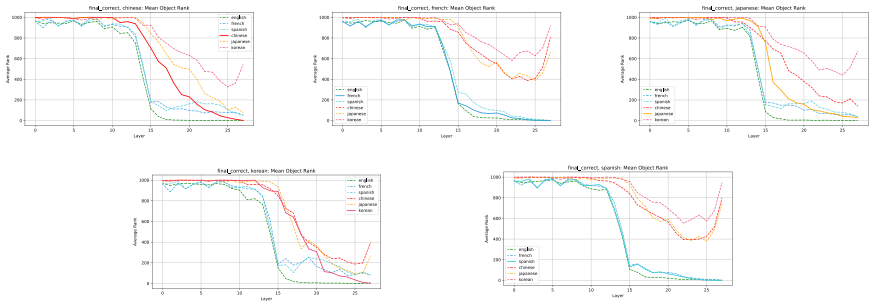
The central objects are the two injected residual-stream vectors. The translation difference vector is $\Delta^{(\ell)} = \bar{h}^{(\ell)}_T - \bar{h}^{(\ell)}_C$, the difference in mean last-token activations between explicit-translation prompts and fact-recall prompts at layer $\ell$, added at layer 21 to steer late-layer MLP activations toward the pattern the model uses when explicitly asked to translate. The recall vector is the mean hidden activation at the final token position over training instances presented with 5-shot in-context learning examples, injected at layer 3 with a scaling factor of 2, which re-engages relation propagation and answer extraction. The diagnostic that links all observations to the pipeline is the logit lens, decoding each intermediate layer's last-token representation into a vocabulary distribution; this is how 'English answer known at layer 21' and 'relation token propagated by layer 16' are measured.
What would settle it
Run the same logit-lens analysis on a multilingual model whose training distribution is not English-dominated and on a language with equal weight to English: the hypothesized pipeline predicts that the dominant pretraining language should play the role English plays here, with retrieval in that language before late-layer conversion. If the top-ranked intermediate answer stays in the input language through the middle layers for such a model, the English-centric claim falls. More concretely, one could test whether a model whose layer-21 English token rank is not predictive of final correctness, for example because the top-ranked English token is never converted, breaks the claimed 21.7%/78.3% failure split.
Extended reading notes
Core claim
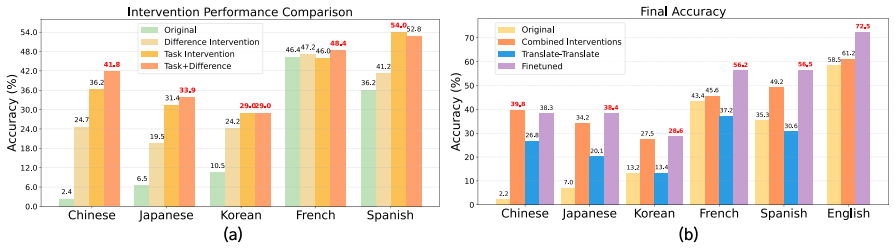
On its own terms, the paper claims to have identified the functional pipeline behind multilingual factual recall: early layers encode the subject and relation of the prompt, middle layers retrieve the answer using English-centric mechanisms (relation propagation around layer 16, answer extraction peaking at layer 21, where the English answer is top-ranked under the logit lens), and layers 21–27, especially MLP neurons, convert that English answer into the target language. The paper further claims that the two failure modes seen in incorrect multilingual predictions, 21.7% where the English answer is correct but the final answer is wrong and 78.3% where even the English answer is wrong, correspond to insufficient engagement of the translation pathway and of the English recall pathway respectively. The discovery is that both pathways already exist in the model and are under-activated under multilingual prompts; they can be re-engaged by adding (i) a translation difference vector computed as the difference in mean residual-stream activations between fact-recall and explicit-translation prompts at layer 21, and (ii) a recall vector equal to the mean activation under 5-shot in-context examples at layer 3 with scale 2. On Llama-3.2-3B across six languages and ten relations, the combined intervention lifts the lowest-performing language by up to 37.6 accuracy points and averages a gain of 19.04 points over the unmodified model.
Load-bearing premise
That decoding an internal layer's representation as if it were the model's next-token distribution faithfully reveals what the model 'knows' at that layer, and the paper itself concedes this is questionable in early layers where the recall vector is injected at layer 3.
Editorial extensions
If this is right
- The two interventions are language- and dataset-independent: the same vectors transfer across all six languages and ten relation types without retraining.
- Combined, the interventions beat the translate-recall-translate prompting baseline and approach fine-tuning performance, especially on the non-Latin scripts Chinese, Japanese, and Korean, with no training cost.
- Under the paper's mechanism, cross-lingual factual inconsistency is largely a routing failure rather than a knowledge failure, and it is recoverable through inference-time vector injection.
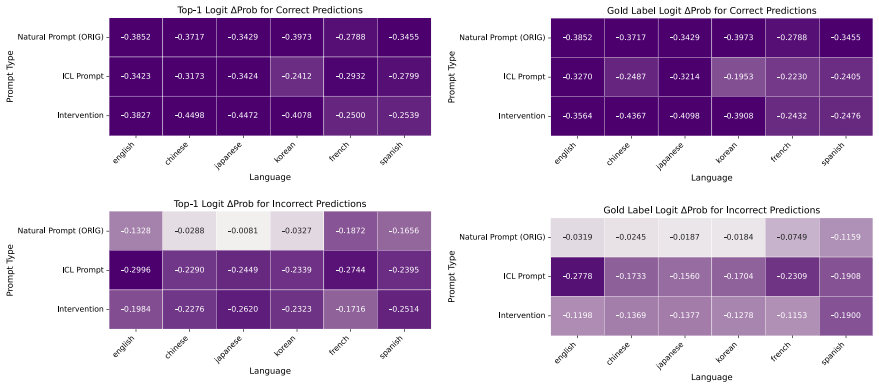
- Component-level evidence, such as reactivated English fact-recall attention heads and higher cosine similarity to explicit-translation MLP activations, supports the claim that the interventions re-engage existing underused pathways instead of introducing new behavior.
- The same mechanism is expected to extend to other languages and relations beyond the evaluated set, since the vectors are derived from a general task signal rather than from language-specific or relation-specific data.
Reading between the lines
- If the pipeline generalizes, the same recipe could be applied to other languages of a model using its dominant pretraining language as the pivot, yielding a cheap way to audit and repair per-language factual gaps without fine-tuning.
- The recall vector's effectiveness at layer 3 points to task-recognition signals being encoded very early in the network; a testable extension is to search for more targeted vectors, per relation or per script, that improve beyond the single generic vector.
- The paper's own note that full 5-shot ICL outperforms the intervention suggests a natural next step: combine explicit ICL examples with the injected vectors, or learn vector weights, to close the remaining gap with the full-ICL upper bound.
- A direct out-of-sample test of the English-centric story would apply the same pipeline diagnostics to a model pretrained predominantly on a non-English language; if the pivot language shifts accordingly, the mechanism is about dominant-pretraining-language rather than English per se.
Editorial analysis
A structured set of objections, weighed in public.
Referee Report
Summary. The paper proposes a mechanistic account of multilingual factual recall in Llama-3.2-3B. Using logit-lens decoding and activation patching, the authors argue that the model first retrieves facts in an English-centric concept space and then translates the answer into the target language in late layers. They split errors into two classes—cases where the intermediate English answer is correct but the final translation is wrong, and cases where the English answer itself is not retrieved—and introduce two averaged activation vectors (a translation difference vector and a recall vector) intended to steer the model toward better internal paths. They report that the combined interventions improve the lowest-performing language by more than 35 percentage points and outperform a translate-recall-translate prompting baseline on held-out data.
Significance. If the central pipeline claim were established, this would be a valuable synthesis: it unifies existing evidence for English-centric intermediate representations with a concrete error taxonomy and gives training-free interventions with large measured gains. The paper has clear strengths: evaluations on held-out test sets with three data splits, validation-based hyperparameter selection, component-level tests (attention knockout, activation patching, head ablations), and comparison against prompting and fine-tuning baselines. However, the empirical basis for the central claim is currently fragile because both failure-mode labels and the 'model knows the answer' inference rest on permissive logit-lens matching at a single layer, and the paper's own tables show that the relevant quantity changes sharply across adjacent layers. The intervention results may survive, but the mechanistic interpretation needs additional robustness analysis.
major comments (3)
- [Section 2 / Appendix B.1] The 'English Correct' failure bucket is defined by a permissive containment match: a predicted token is agnostic-correct if it 'appears within the correct answer string or the correct answer is contained within the predicted token.' For multi-token answers such as 'United States' or 'Indo-European', a top-1 prediction of only the first token is scored as correct, so the 21.7% translation-failure share in Figure 2 is inflated to an unknown degree. Because this bucket is the main evidence that the model 'knows' the answer in English and only fails to convert it, the authors should recompute the taxonomy under strict full-answer matching (e.g., exact match of the full answer, or greedy decoding from layer 21) and report whether the translation-failure category survives. If it shrinks, the motivation for the translation-difference-vector intervention and the English-centric pipeline claim in Sections 2-3 needs to be reconsidered.
- [Section 2 / Tables 5-12] The choice of layer 21 is load-bearing but appears unstable. Under the paper's own definition, the agnostic-correct rate is 21.1% at layer 20, 33.2% at layer 21, 36.4% at layer 22, and 51.9% at layer 26; the split between the two error classes therefore depends heavily on which layer is inspected. The manuscript does not justify why layer 21, rather than layer 22 or 26, is the privileged diagnostic point, and Section 7's caveat about logit-lens reliability is directed at early layers rather than at layer 21. The authors should either justify layer 21 with an independent probe (tuned lens, patchscopes, or causal evidence) or report the full layer sweep and show that the taxonomy and conclusions are stable.
- [Section 3.3 / Figure 3] The conversion-correctness metric is conditioned on 'identifying the correct intermediate English answer', which is exactly the permissive agnostic-correct definition questioned above. If the intervention changes which instances satisfy that condition, the reported increase from 39.56% to 67.74% can partly reflect a change in the conditioning set rather than improved translation. In addition, the neuron cosine-similarity comparison in Figure 3(a) is reported without confidence intervals or a null baseline (e.g., random directions or non-translation tasks), so the claim that recall and translation pathways are 'partially but not fully overlapping' is not yet statistically grounded. Please add error bars and a control.
minor comments (5)
- [Abstract / Section 1 / Table 16] The abstract says 'over 35 percent', Section 1 says 'up to 37.6 percentage points', and Table 16 shows a 39.4-point gain for Chinese; please reconcile these numbers and state which split and metric are used.
- [Section 3.3 / Appendix E] Section 3.3 says the translation vector is most effective at layer 21, but Appendix E states that the final grid search selects the translation vector at layer 25; please clarify the selection criterion and which configuration underlies Tables 13-16.
- [Figure 2] The caption uses 'zero-rank' where the text refers to being 'top-ranked'; please use consistent rank terminology (rank 1 or top-1) throughout.
- [Section 2 / Appendix B.1] The term 'agnostic correct' is used in Section 2 but defined only in Appendix B.1; define it in the main text, ideally with the exact matching rule, so that readers can assess the taxonomy without consulting the appendix.
- [Tables 13-16] The column 'TransAcc%' is not defined in the main text, and the 0.00 value for Chinese in Table 13 is surprising given the reported translation ability; please clarify the column definition and check whether this is an evaluation artifact.
Circularity Check
No circular derivation found; the pipeline is posed as a hypothesis and the interventions are evaluated on held-out data against external baselines.
full rationale
The paper's central claim—that multilingual factual recall proceeds through an English-centric concept space and then a translation stage—is explicitly framed as a hypothesized pipeline (§2) and is not derived from the definitions of the intervention vectors. The translation difference vector (Eq. 1) is computed as the mean activation difference between fact-recall and explicit-translation prompts on training data, then injected into held-out inputs; layer and scaling choices are selected on a validation set, and final accuracy is reported on a test set (§3.2–3.3, Appendix E). The recall vector is likewise extracted from ICL runs on training instances and evaluated on unseen examples (§4.2–4.3, Appendix F). These are standard out-of-sample evaluations, not predictions that equal their inputs by construction. The failure taxonomy in §2 uses logit-lens top-1 matching at layer 21 with a permissive substring criterion (Appendix B.1), which is a measurement-validity concern—and the paper itself flags logit-lens reliability limits in early layers (§7)—but the taxonomy categories are not defined in terms of the intervention outcomes, so no circular reduction is exhibited. Self-citations (e.g., Zhang et al. 2024; Merullo et al. 2023, 2024) appear as supporting references for known phenomena such as late-layer MLP language specificity and vector arithmetic; they are not load-bearing, and the paper's own activation patching, ablations, and baseline comparisons carry the argument. No uniqueness theorem or ansatz is imported from the authors' prior work. Overall, the central claims preserve independent empirical content; the score reflects only minor self-citation without circular import.
Assumptions & free parameters
free parameters (4)
- translation vector intervention layer =
21 (single intervention); 25 (combined grid search)
- recall vector intervention layer =
3
- recall vector scaling factor =
2
- relation token equivalence threshold =
0.8 (GPT-4o score)
assumptions (4)
- domain assumption Logit lens projections of hidden states onto token space reflect the model's actual computation path.
- domain assumption The knowledge-retrieval mechanism described for English models (relation propagation, answer extraction) operates in Llama-3.2-3B and is the mechanism multilingual prompts should engage.
- domain assumption Layer 21 top-1 decoded token being 'agnostic correct' is a valid proxy for whether the model knows the English answer.
- domain assumption Llama-3.2-3B is representative of multilingual LLMs for this pipeline.
Cite this review
Pith. "Pith review of Paths Not Taken: Understanding and Mending the Multilingual Factual Recall Pipeline." pith.science (2026). https://pith.science/paper/WYE6ESI3
@misc{pith2026250520546,
  author       = {Pith},
  title        = {Pith review of: Paths Not Taken: Understanding and Mending the Multilingual Factual Recall Pipeline},
  year         = {2026},
  howpublished = {\url{https://pith.science/paper/WYE6ESI3}},
  note         = {Machine review of arXiv:2505.20546}
}
read the original abstract
Multilingual large language models (LLMs) often exhibit factual inconsistencies across languages, with significantly better performance in factual recall tasks in English than in other languages. The causes of these failures, however, remain poorly understood. Using mechanistic analysis techniques, we uncover the underlying pipeline that LLMs employ, which involves using the English-centric factual recall mechanism to process multilingual queries and then translating English answers back into the target language. We identify two primary sources of error: insufficient engagement of the reliable English-centric mechanism for factual recall, and incorrect translation from English back into the target language for the final answer. To address these vulnerabilities, we introduce two vector interventions, both independent of languages and datasets, to redirect the model toward better internal paths for higher factual consistency. Our interventions combined increase the recall accuracy by over 35 percent for the lowest-performing language. Our findings demonstrate how mechanistic insights can be used to unlock latent multilingual capabilities in LLMs.
Figures


Figures from the paper (15 more)







Forward citations
Cited by 2 Pith papers
-
Verbalizable Representations Form a Global Workspace in Language Models
Language models represent their current reasoning in a small, readable set of verbalizable vectors (the J-space) that functions like a global workspace.
-
Rethinking Cross-lingual Gaps from a Statistical Viewpoint
Cross-lingual accuracy gaps in LLMs are dominated by higher response variance in target languages, not missing knowledge; ensembling and variance-reduction prompts shrink the gap.
Reference graph
Works this paper leans on
-
[1]
online" 'onlinestring :=
ENTRY address archivePrefix author booktitle chapter edition editor eid eprint eprinttype howpublished institution journal key month note number organization pages publisher school series title type volume year doi pubmed url lastchecked label extra.label sort.label short.list INTEGERS output.state before.all mid.sentence after.sentence after.block STRING...
-
[2]
write newline
" write newline "" before.all 'output.state := FUNCTION n.dashify 't := "" t empty not t #1 #1 substring "-" = t #1 #2 substring "--" = not "--" * t #2 global.max substring 't := t #1 #1 substring "-" = "-" * t #2 global.max substring 't := while if t #1 #1 substring * t #2 global.max substring 't := if while FUNCTION word.in bbl.in capitalize " " * FUNCT...
-
[3]
Explosion AI. 2020. https://spacy.io spacy: Industrial-strength natural language processing in python . Accessed: 2025-05-20
work page 2020
-
[4]
Andy Arditi, Oscar Obeso, Aaquib Syed, Daniel Paleka, Nina Panickssery, Wes Gurnee, and Neel Nanda. 2024. https://arxiv.org/abs/2406.11717 Refusal in language models is mediated by a single direction . Preprint, arXiv:2406.11717
arXiv 2024
-
[5]
Nora Belrose. 2023. Diff-in-means concept editing is worst-case optimal: Explaining a result by sam marks and max tegmark. https://blog.eleuther.ai/diff-in-means/. Accessed on: May 20, 2025
work page 2023
-
[6]
Nora Belrose, Zach Furman, Logan Smith, Danny Halawi, Lev McKinney, Igor Ostrovsky, Stella Biderman, and Jacob Steinhardt. 2023. Eliciting latent predictions from transformers with the tuned lens. to appear
work page 2023
-
[7]
Bilal Chughtai, Alan Cooney, and Neel Nanda. 2024. Summing up the facts: Additive mechanisms behind factual recall in llms. arXiv preprint arXiv:2402.07321
arXiv 2024
-
[8]
Alexis Conneau, Shijie Wu, Haoran Li, Luke Zettlemoyer, and Veselin Stoyanov. 2020. https://doi.org/10.18653/v1/2020.acl-main.536 Emerging cross-lingual structure in pretrained language models . In Proceedings of the 58th Annual Meeting of the Association for Computational Linguistics, pages 6022--6034, Online. Association for Computational Linguistics
Show all 49 references
-
[9]
Yue Deng, Wenxuan Zhang, Sinno Jialin Pan, and Lidong Bing. 2023. Multilingual jailbreak challenges in large language models. arXiv preprint arXiv:2310.06474
2023 arXiv
-
[10]
Cl \'e ment Dumas, Veniamin Veselovsky, Giovanni Monea, Robert West, and Chris Wendler. 2024. How do llamas process multilingual text? a latent exploration through activation patching. In ICML 2024 Workshop on Mechanistic Interpretability
2024
-
[11]
Javier Ferrando and Marta R Costa-juss \`a . 2024. On the similarity of circuits across languages: a case study on the subject-verb agreement task. arXiv preprint arXiv:2410.06496
2024 arXiv
-
[12]
Constanza Fierro, Negar Foroutan, Desmond Elliott, and Anders Søgaard. 2025. https://arxiv.org/abs/2410.14387 How do multilingual language models remember facts? Preprint, arXiv:2410.14387
2025 arXiv
-
[13]
Mor Geva, Jasmijn Bastings, Katja Filippova, and Amir Globerson. 2023. https://arxiv.org/abs/2304.14767 Dissecting recall of factual associations in auto-regressive language models . Preprint, arXiv:2304.14767
2023 arXiv
-
[14]
Asma Ghandeharioun, Avi Caciularu, Adam Pearce, Lucas Dixon, and Mor Geva. 2024. Patchscopes: A unifying framework for inspecting hidden representations of language models. arXiv preprint arXiv:2401.06102
2024 arXiv
-
[15]
Aaron Grattafiori, Abhimanyu Dubey, Abhinav Jauhri, Abhinav Pandey, Abhishek Kadian, Ahmad Al-Dahle, Aiesha Letman, Akhil Mathur, Alan Schelten, Alex Vaughan, and 1 others. 2024. The llama 3 herd of models. arXiv preprint arXiv:2407.21783
2024 arXiv
-
[16]
Wes Gurnee, Neel Nanda, Matthew Pauly, Katherine Harvey, Dmitrii Troitskii, and Dimitris Bertsimas. 2023. Finding neurons in a haystack: Case studies with sparse probing. arXiv preprint arXiv:2305.01610
2023 arXiv
-
[17]
Peter Hase, Mohit Bansal, Been Kim, and Asma Ghandeharioun. 2023. Does localization inform editing? surprising differences in causality-based localization vs. knowledge editing in language models. Advances in Neural Information Processing Systems, 36:17643--17668
2023
-
[18]
Roee Hendel, Mor Geva, and Amir Globerson. 2023. https://arxiv.org/abs/2310.15916 In-context learning creates task vectors . Preprint, arXiv:2310.15916
2023 arXiv
-
[19]
Haoyang Huang, Tianyi Tang, Dongdong Zhang, Wayne Xin Zhao, Ting Song, Yan Xia, and Furu Wei. 2023. https://arxiv.org/abs/2305.07004 Not all languages are created equal in llms: Improving multilingual capability by cross-lingual-thought prompting . Preprint, arXiv:2305.07004
2023 arXiv
-
[20]
Kenneth Li, Oam Patel, Fernanda Vi \'e gas, Hanspeter Pfister, and Martin Wattenberg. 2023. Inference-time intervention: Eliciting truthful answers from a language model. Advances in Neural Information Processing Systems, 36:41451--41530
2023
-
[21]
Weihao Liu, Ning Wu, Wenbiao Ding, Shining Liang, Ming Gong, and Dongmei Zhang. 2025. https://arxiv.org/abs/2406.14434 Selected languages are all you need for cross-lingual truthfulness transfer . Preprint, arXiv:2406.14434
2025 arXiv
-
[22]
Samuel Marks and Max Tegmark. 2024. https://arxiv.org/abs/2310.06824 The geometry of truth: Emergent linear structure in large language model representations of true/false datasets . Preprint, arXiv:2310.06824
2024 arXiv
-
[23]
Kevin Meng, David Bau, Alex Andonian, and Yonatan Belinkov. 2022. Locating and editing factual associations in gpt. Advances in neural information processing systems, 35:17359--17372
2022
-
[24]
Jack Merullo, Carsten Eickhoff, and Ellie Pavlick. 2023. Language models implement simple word2vec-style vector arithmetic. arXiv preprint arXiv:2305.16130
2023 arXiv
-
[25]
Jack Merullo, Carsten Eickhoff, and Ellie Pavlick. 2024. https://arxiv.org/abs/2310.08744 Circuit component reuse across tasks in transformer language models . Preprint, arXiv:2310.08744
2024 arXiv
-
[26]
Miller and the Princeton WordNet Group
George A. Miller and the Princeton WordNet Group. 1995. https://wordnet.princeton.edu Wordnet: A lexical database for english . Accessed: 2025-05-20
1995
-
[27]
Benjamin Muller, Yanai Elazar, Beno \^ t Sagot, and Djam \'e Seddah. 2021. https://doi.org/10.18653/v1/2021.eacl-main.189 First align, then predict: Understanding the cross-lingual ability of multilingual BERT . In Proceedings of the 16th Conference of the European Chapter of ...
2021 doi
-
[28]
Neel Nanda and Joseph Bloom. 2022. Transformerlens. https://github.com/neelnanda-io/TransformerLens. Accessed: 2025-05-19
2022
-
[29]
Nostalgebraist. 2020. https://www.lesswrong.com/posts/AcKRB8wDpdaN6v6ru/interpreting-gpt-the-logit-lens Interpreting gpt: the logit lens
2020
-
[30]
Catherine Olsson, Nelson Elhage, Neel Nanda, Nicholas Joseph, Nova DasSarma, Tom Henighan, Ben Mann, Amanda Askell, Yuntao Bai, Anna Chen, and 1 others. 2022. In-context learning and induction heads. arXiv preprint arXiv:2209.11895
2022 arXiv
-
[31]
Nina Panickssery, Nick Gabrieli, Julian Schulz, Meg Tong, Evan Hubinger, and Alexander Matt Turner. 2023. Steering llama 2 via contrastive activation addition. arXiv preprint arXiv:2312.06681
2023 arXiv
-
[32]
Jirui Qi, Raquel Fernández, and Arianna Bisazza. 2023. https://doi.org/10.18653/v1/2023.emnlp-main.658 Cross-lingual consistency of factual knowledge in multilingual language models . In Proceedings of the 2023 Conference on Empirical Methods in Natural Language Processing, pa...
2023 doi
-
[33]
Lisa Schut, Yarin Gal, and Sebastian Farquhar. 2025. Do multilingual llms think in english? arXiv preprint arXiv:2502.15603
2025 arXiv
-
[34]
Freda Shi, Mirac Suzgun, Markus Freitag, Xuezhi Wang, Suraj Srivats, Soroush Vosoughi, Hyung Won Chung, Yi Tay, Sebastian Ruder, Denny Zhou, Dipanjan Das, and Jason Wei. 2022. https://arxiv.org/abs/2210.03057 Language models are multilingual chain-of-thought reasoners . Prepri...
2022 arXiv
-
[35]
Suzanna Sia, David Mueller, and Kevin Duh. 2024. https://arxiv.org/abs/2403.04510 Where does in-context translation happen in large language models . Preprint, arXiv:2403.04510
2024 arXiv
-
[36]
Nishant Subramani, Nivedita Suresh, and Matthew E Peters. 2022. Extracting latent steering vectors from pretrained language models. arXiv preprint arXiv:2205.05124
2022 arXiv
-
[37]
Tianyi Tang, Wenyang Luo, Haoyang Huang, Dongdong Zhang, Xiaolei Wang, Xin Zhao, Furu Wei, and Ji-Rong Wen. 2024. Language-specific neurons: The key to multilingual capabilities in large language models. arXiv preprint arXiv:2402.16438
2024 arXiv
-
[38]
Curt Tigges, Oskar John Hollinsworth, Atticus Geiger, and Neel Nanda. 2023. https://arxiv.org/abs/2310.15154 Linear representations of sentiment in large language models . Preprint, arXiv:2310.15154
2023 arXiv
-
[39]
Li, Arnab Sen Sharma, Aaron Mueller, Byron C
Eric Todd, Millicent L. Li, Arnab Sen Sharma, Aaron Mueller, Byron C. Wallace, and David Bau. 2024. https://arxiv.org/abs/2310.15213 Function vectors in large language models . Preprint, arXiv:2310.15213
2024 arXiv
-
[40]
Alexander Matt Turner, Lisa Thiergart, Gavin Leech, David Udell, Juan J Vazquez, Ulisse Mini, and Monte MacDiarmid. 2023. Steering language models with activation engineering. arXiv preprint arXiv:2308.10248
2023 arXiv
-
[41]
Jesse Vig, Sebastian Gehrmann, Yonatan Belinkov, Sharon Qian, Daniel Nevo, Yaron Singer, and Stuart Shieber. 2020. https://proceedings.neurips.cc/paper_files/paper/2020/file/92650b2e92217715fe312e6fa7b90d82-Paper.pdf Investigating gender bias in language models using causal me...
2020
-
[42]
o tgen, and Hinrich Sch \
Mingyang Wang, Heike Adel, Lukas Lange, Yihong Liu, Ercong Nie, Jannik Str \"o tgen, and Hinrich Sch \"u tze. 2025. Lost in multilinguality: Dissecting cross-lingual factual inconsistency in transformer language models. arXiv preprint arXiv:2504.04264
2025 arXiv
-
[43]
Chris Wendler, Veniamin Veselovsky, Giovanni Monea, and Robert West. 2024. https://arxiv.org/abs/2402.10588 Do llamas work in english? on the latent language of multilingual transformers . Preprint, arXiv:2402.10588
2024 arXiv
-
[44]
Bryan Wilie, Samuel Cahyawijaya, Junxian He, and Pascale Fung. 2025. High-dimensional interlingual representations of large language models. arXiv preprint arXiv:2503.11280
2025 arXiv
-
[45]
Zhaofeng Wu, Xinyan Velocity Yu, Dani Yogatama, Jiasen Lu, and Yoon Kim. 2024. The semantic hub hypothesis: Language models share semantic representations across languages and modalities. arXiv preprint arXiv:2411.04986
2024 arXiv
-
[46]
Yunzhi Yao, Ningyu Zhang, Zekun Xi, Mengru Wang, Ziwen Xu, Shumin Deng, and Huajun Chen. 2024. Knowledge circuits in pretrained transformers. arXiv preprint arXiv:2405.17969
2024 arXiv
-
[47]
Zheng-Xin Yong, Cristina Menghini, and Stephen H Bach. 2023. Low-resource languages jailbreak gpt-4. arXiv preprint arXiv:2310.02446
2023 arXiv
-
[48]
Ruochen Zhang, Qinan Yu, Matianyu Zang, Carsten Eickhoff, and Ellie Pavlick. 2024. https://arxiv.org/abs/2410.09223 The same but different: Structural similarities and differences in multilingual language modeling . Preprint, arXiv:2410.09223
2024 arXiv
-
[49]
Yiran Zhao, Wenxuan Zhang, Guizhen Chen, Kenji Kawaguchi, and Lidong Bing. 2024. https://arxiv.org/abs/2402.18815 How do large language models handle multilingualism? Preprint, arXiv:2402.18815
2024 arXiv
Reviewed August 7, 2026 · model on record in the stance chip above.
Discussion (0). Sign in to comment.