REVIEW 1 major objections 3 minor 108 references
Scheduling in Queueing Systems with Uncertain and Evolving Holding Costs
T0 review · 1 major / 3 minor · reviewed 2026-08-07 · deepseek-v4-flash
Pith's one-line read This paper claims that in queues where a job's holding cost evolves along a known Markov chain and the future is unknown, an index derived from a Markovian ski-rental problem is asymptotically optimal, with regret O(√N polylog) that does…
desk verdict A nice modeling idea and a genuinely new index policy, but the main regret theorem rests on a false step in Lemma 4.10 and is unproven as written. read the letter →
The pith
A machine-rendered reading of the paper's core claim, the machinery that carries it, and where it could break.
The reading
What carries the argument
The load-bearing object is the Markovian ski-rental dynamic program. For a candidate capacity price γ (the dual variable of a fluid LP), each job's cost-to-go obeys V(γ,i) = min{γ, c(i) + V_f(γ,i)}, where serving the job now costs γ (buying equipment) and waiting costs the current state cost plus the expected future cost (renting). OaRC sets γ* to minimize µγ − λV(γ,r), then serves jobs in decreasing order of the index Index(i) = c(i) + V_f(γ*, i). The tree shape of the job-state Markov chain makes the fluid equilibrium computable by a water-filling procedure over top sets, and the new geometric tail bound (Lemma 4.9) converts high-probability negative drift into a steady-state guarantee without an almost-sure drift bound, which is the step that yields the O(√N) rather than O(N) gap.
What would settle it
Run OaRC on a small finite system whose state Markov chain is not a tree — two parent states feeding a common child, or a two-state cycle — and compare its long-run average cost against a dynamic-programming optimum; if the regret grows with the number of states or exceeds c_max · 1610 θ⁻² $L^{{1.5}}$ ln²(55NL) √N, then the tree assumption is doing the work the paper assigns to the algorithm.
Extended reading notes
Core claim
The paper's central claim is that a priority index formed by solving a per-job Markovian ski-rental problem at the optimal capacity price is asymptotically optimal in an overloaded many-server queue with uncertain, evolving holding costs. Concretely, OaRC's regret is bounded by c_max · 1610 θ⁻² $L^{{1.5}}$ ln²(55NL) √N, so the long-run average holding-cost gap to an optimal feasible algorithm vanishes after dividing by system size N, and the bound does not depend on the state-space size. The proof constructs, for any priority algorithm, a water-filling fluid equilibrium over the tree of job states; verifies via complementary slackness that OaRC's equilibrium is the fluid optimum; shows through a Lyapunov drift argument with a new geometric tail bound that the stochastic steady-state queue lengths sit within O(√N polylog) of this equilibrium; and proves that the fluid optimum lower-bounds every feasible algorithm.
Load-bearing premise
The argument rests on jobs' states evolving along a rooted tree in which every state abandons with probability at least θ > 0; if states merge or form cycles, the fluid equilibrium and the regret proof are not defined.
Editorial extensions
If this is right
- For overloaded systems where the system size N grows, the per-job average holding-cost gap to the optimal policy shrinks to zero, so OaRC is asymptotically optimal while the cµ and cµ/θ rules are not in general.
- Because the regret does not depend on the state-space size, the index remains useful when job states encode rich contextual information such as view histories, where the number of possible states is enormous.
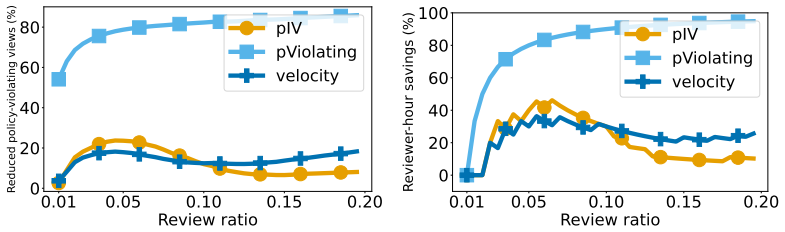
- The same index machinery yields the practical heuristic HOaRC, which approximates the future cost-to-go with a hindsight-trained regressor; in simulated content moderation it reduces policy-violating views by 2.6% to 8.5% versus deployed heuristics and saves 7.8% to 25% of reviewer hours.
- The algorithm sidesteps the hard-to-verify indexability and global-attractor conditions of restless-bandit index policies: when a served job stops incurring cost and an idle job evolves on a tree, an index policy is asymptotically optimal without those conditions.
- The alternative bound in Remark 1, O(θ^{-3.5} ln²(NL) √N), shows that even with very long cost trajectories only logarithmic dependence on the trajectory length L remains, as long as every state has a strictly positive abandonment probability.
Reading between the lines
- If the regret bound's independence from the state-space size extends beyond the tree case — which the paper does not prove — OaRC-style indices would become candidate policies for structured state spaces such as truncated view histories, where Whittle indices are typically intractable to compute.
- The Markovian ski-rental view suggests a testable design rule for content moderation: HOaRC interpolates between Velocity (cap γ = 0) and pIV (cap γ = ∞) through the single parameter γ, and the paper's calibration-error simulations indicate the choice is forgiving, so a deployment could treat γ as a searchable hyper-parameter.
- A natural extension the authors leave open is learning the state Markov chain from censored data, since jobs removed from the platform stop revealing their view trajectories; a learning-augmented version of OaRC could plausibly split its regret into the Õ(√N) term plus a term from kernel estimation error.
- The geometric tail bound separating high-probability from almost-sure drift applies to any Markov chain satisfying its three drift conditions, so it may transfer to other many-server control problems where the Lyapunov function can jump by O(N) but only jumps by O(√N) with high probability.
Editorial analysis
A structured set of objections, weighed in public.
Referee Report
Summary. The paper studies a discrete-time queueing system in which each job's holding cost is governed by a known Markov chain with a rooted-tree state space and positive abandonment probability. It proposes OaRC, an index policy built from a Markovian ski-rental dynamic program whose capacity price is taken from the dual of a fluid LP. The main result, Theorem 1, claims a regret bound of O(c_max θ^{-2} L^{1.5} log^2(55NL) sqrt(N)), giving asymptotic optimality and a bound independent of the state-space size. The proof proceeds by characterizing fluid equilibria of priority algorithms through a water-filling construction, proving OaRC's equilibrium is fluid-optimal via complementary slackness, and then bounding the stochastic gap with a Lyapunov/state-space-collapse argument using a new geometric tail bound. The paper also presents a practical heuristic, HOaRC, and evaluates it on synthetic and real content-moderation datasets.
Significance. If Theorem 1 is established, this is a substantial contribution: it provides an asymptotically optimal index policy for scheduling with uncertain and evolving holding costs, with a non-asymptotic regret bound that is independent of the number of states. The analytical architecture---fluid LP and dual, complementary slackness verification, water-filling equilibria, and a geometric tail bound for Lyapunov drift---is likely to be reusable. The paper also ships a detailed proof appendix and an extensive simulation study that includes real YouTube view-trajectory data and calibration-robustness checks. My assessment is conditional, however, because one load-bearing step in the Lyapunov argument is not established as written; see Major Comment 1.
major comments (1)
- [Appendix B.9, proof of Lemma 4.10 (Eq. (37))] The proof asserts that "By the rule of Prio(o), the R(t) available services must first serve jobs with states in Sub(T) before they are used to serve jobs in S \ Sub(T)" and concludes, in the case sum_{i in Sub(T)} R_i(t+1) < sum_{i in Sub(T)} Q_i(t+1), that sum_{i in Sub(T)} R_i(t+1) = R(t+1). This is not implied by a priority ordering, which is a global ordering of individual states, not a subtree-restricted ordering. A descendant of T can have lower priority than a state outside Sub(T). Concretely, take the tree with root r, children 2 and 4, and 2 -> 3; set lambda = 0.8, mu = 0.5, p2 = p4 = 0.45, p3 = 0.5, and costs c2 = 100, c3 = 1, c4 = 30, c_r = 1. Then gamma* = 30 and OaRC's index order is (2, 4, 1, 3). Here m = 1, T = {2}, Sub(T) = {2,3}, and state 4 is outside Sub(T) but has strictly higher priority than state 3. If Q2 < R(t+1) and Q4 > R(t+1) - Q2, the leftover service is consumed by state 4, so sum_{i in Sub(T)} R_i(t+1) = Q2 < R(t+1). Since -sum_{i in Sub(T)} R_i(t+1) >= -R(t+1), replacing the actual service allocated to Sub(T) by R(t+1) in Eq. (37) gives a lower bound on the drift, not an upper bound; the displayed inequality does not follow. This step is load-bearing: Lemma 4.10 is used to prove Lemma 4.7, which feeds Lemmas 4.12 and 4.4, and hence Theorem 1. The authors should repair this part of the drift argument, for example by augmenting the Lyapunov function to account for priority inversions involving the partially served subtree, or by proving a subtree-closure property of OaRC's priority ordering that rules out such inversions.
minor comments (3)
- [Appendix B.10 (proof of Lemma 4.7)] Several occurrences of "Phi h" in this proof should be "Phi"; as printed, the argument is harder to follow than necessary.
- [Remark 1 and Appendix B.14] The L-independent bound in Remark 1 is presented as a theorem-level claim, but Appendix B.14 is explicitly a sketch ("we outline", "changes to the proofs are..."). Because the sketch inherits the same Lemma 4.10 gap, the remark should either be fully proved or explicitly marked as a conjecture.
- [Notation: Section 2 and Table 2] The symbol R(t) is used both for the random number of available servers and for the vector of served jobs (R_i(t)); Table 2 disambiguates the vector, but the text uses R(t) in both senses, which can confuse the reader.
Circularity Check
No circularity: the OaRC regret bound follows from the fluid LP, the Bellman cost-to-go recursion, and independent drift/tail arguments; nothing is fitted to the regret target.
full rationale
The central derivation chain is self-contained. The algorithm's capacity price gamma* is obtained by minimizing the dual function D*(gamma)=mu*gamma+lambda(c_f(r)-V(gamma,r)) with V defined by the Bellman recursion (3); this depends only on the stated model primitives (N, lambda, mu, c, P) and not on any target regret value. Lemma 4.3 verifies optimality of the resulting priority ordering's fluid equilibrium against (OriginalFluid)/(SimplerFluid) via complementary slackness conditions (Lemma 4.6), which is a genuine optimality proof rather than a restatement of the index definition. Lemmas 4.4 and 4.5 compare any priority algorithm and any feasible algorithm to the same fluid LP value N*C*; this is a legitimate lower-bound benchmark, not the algorithm's own fitted output. The stochastic gap is bounded by Lemmas 4.7-4.12 using concentration, a Lyapunov drift argument, and a tail bound that refines the externally published [BGT01, theorem 1]; no 'prediction' is constructed from the data it later claims to predict. Self-citations occur mainly in related work and in the empirical HOaRC implementation (hindsight approximation [SFC+23]), and they are not load-bearing for Theorem 1. The noted Lemma 4.10 concern in the skeptic summary is a correctness objection about whether all service is spent on Sub(T), not a circularity: even if that bound failed, the derivation would be invalid rather than tautological.
Assumptions & free parameters
free parameters (2)
- gamma* in HOaRC simulations =
99th percentile of total views in training set
- XGBoost hyper-parameters for the regression M_gamma =
max depth 10, 100 estimators
assumptions (4)
- domain assumption Job-state evolution is a rooted tree Markov chain with a unique root and strictly positive minimum abandonment probability theta > 0
- domain assumption The transition kernel P and cost vector c are known to the scheduling algorithm
- domain assumption Arrival rate lambda < 1
- standard math Standard concentration inequalities and drift-method background results
Cite this review
Pith. "Pith review of Scheduling in Queueing Systems with Uncertain and Evolving Holding Costs." pith.science (2026). https://pith.science/paper/OTZXWNGM
@misc{pith2026250521331,
  author       = {Pith},
  title        = {Pith review of: Scheduling in Queueing Systems with Uncertain and Evolving Holding Costs},
  year         = {2026},
  howpublished = {\url{https://pith.science/paper/OTZXWNGM}},
  note         = {Machine review of arXiv:2505.21331}
}
abstract
In content moderation for social media platforms, the cost of delaying the review of a content is proportional to its view trajectory, which fluctuates and is apriori unknown. Motivated by such uncertain and evolving holding costs, we consider a queueing model where job states evolve based on a Markov chain with state-dependent instantaneous holding costs. We demonstrate that in the presence of such uncertain and evolving holding costs, the two canonical algorithmic principles, instantaneous-cost ($c\mu$-rule) and expected-remaining-cost ($c\mu/\theta$-rule), are suboptimal. By viewing each job as a Markovian ski-rental problem, we develop a new index-based algorithm, Opportunity-adjusted Remaining Cost (OaRC), that adjusts to the opportunity of serving jobs in the future when uncertainty partly resolves. We show that the suboptimality gap of OaRC scales as $\tilde{O}(\sqrt{N})$, where $N$ is the system size. This bound shows that OaRC achieves asymptotic optimality for overloaded systems when the system size $N$ scales to infinity. Moreover, the bound is independent of the state-space size, which is a desirable property when job states contain contextual information. We corroborate our results with an extensive simulation study based on two holding cost patterns (online ads and user-generated content) that arise in content moderation for social media platforms. Our simulations based on synthetic and real datasets demonstrate that OaRC consistently outperforms existing practice, which is based on the two canonical algorithmic principles.
Figures


Figures from the paper (4 more)


Reference graph
Works this paper leans on
-
[1]
A broader view of designing the liver allocation system
Mustafa Akan, Oguzhan Alagoz, Baris Ata, Fatih Safa Erenay, and Adnan Said. A broader view of designing the liver allocation system. Operations research , 60(4):757--770, 2012
2012
-
[2]
Whittle index approach to multiserver scheduling with impatient customers and dhr service times
Samuli Aalto. Whittle index approach to multiserver scheduling with impatient customers and dhr service times. Queueing Systems , 107(1):1--30, 2024
2024
-
[3]
Bandits for online calibration: An application to content moderation on social media platforms
Vashist Avadhanula, Omar Abdul Baki, Hamsa Bastani, Osbert Bastani, Caner Gocmen, Daniel Haimovich, Darren Hwang, Dima Karamshuk, Thomas Leeper, Jiayuan Ma, Gregory Macnamara, Jake Mullett, Christopher Palow, Sung Park, Varun S Rajagopal, Kevin Schaeffer, Parikshit Shah, Deeksha Sinha, Nicolas Stier-Moses, and Peng Xu. Bandits for online calibration: An a...
arXiv 2022
-
[4]
Lagrangian index policy for restless bandits with average reward
Konstantin Avrachenkov, Vivek S Borkar, and Pratik Shah. Lagrangian index policy for restless bandits with average reward. arXiv preprint arXiv:2412.12641 , 2024
arXiv 2024
-
[5]
Finite-time analysis of the multiarmed bandit problem
Peter Auer, Nicolo Cesa-Bianchi , and Paul Fischer. Finite-time analysis of the multiarmed bandit problem. Machine learning , 47:235--256, 2002
2002
-
[6]
Diagnostic accuracy under congestion
Saed Alizamir, Francis De V \'e ricourt, and Peng Sun. Diagnostic accuracy under congestion. Management Science , 59(1):157--171, 2013
2013
-
[7]
The c / rule for many-server queues with abandonment
Rami Atar, Chanit Giat, and Nahum Shimkin. The c / rule for many-server queues with abandonment. Operations Research , 58(5):1427--1439, 2010
2010
-
[8]
On the asymptotic optimality of the c / rule under ergodic cost
Rami Atar, Chanit Giat, and Nahum Shimkin. On the asymptotic optimality of the c / rule under ergodic cost. Queueing Systems , 67:127--144, 2011
2011
Show all 108 references
-
[9]
Budget pacing for targeted online advertisements at linkedin
Deepak Agarwal, Souvik Ghosh, Kai Wei, and Siyu You. Budget pacing for targeted online advertisements at linkedin. In Proceedings of the 20th ACM SIGKDD international conference on Knowledge discovery and data mining , pages 1613--1619, 2014
2014
-
[10]
On patient flow in hospitals: A data-based queueing-science perspective
Mor Armony, Shlomo Israelit, Avishai Mandelbaum, Yariv N Marmor, Yulia Tseytlin, and Galit B Yom-Tov. On patient flow in hospitals: A data-based queueing-science perspective. Stochastic systems , 5(1):146--194, 2015
2015
-
[11]
Scheduling of multi-class multi-server queueing systems with abandonments
Urtzi Ayesta, Peter Jacko, and Vladimir Novak. Scheduling of multi-class multi-server queueing systems with abandonments. Journal of Scheduling , 20:129--145, 2017
2017
-
[12]
Fair allocation over time, with applications to content moderation
Amine Allouah, Christian Kroer, Xuan Zhang, Vashist Avadhanula, Nona Bohanon, Anil Dania, Caner Gocmen, Sergey Pupyrev, Parikshit Shah, Nicolas Stier-Moses, et al. Fair allocation over time, with applications to content moderation. In Proceedings of the 29th ACM SIGKDD Confere...
2023
-
[13]
Conditions for indexability of restless bandits and an algorithm to compute whittle index
Nima Akbarzadeh and Aditya Mahajan. Conditions for indexability of restless bandits and an algorithm to compute whittle index. Advances in Applied Probability , 54(4):1164--1192, 2022
2022
-
[14]
Performance of multiclass markovian queueing networks via piecewise linear lyapunov functions
Dimitris Bertsimas, David Gamarnik, and John N Tsitsiklis. Performance of multiclass markovian queueing networks via piecewise linear lyapunov functions. Annals of Applied Probability , pages 1384--1428, 2001
2001
-
[15]
Concentration Inequalities: A Nonasymptotic Theory of Independence
St \'e phane Boucheron, G \'a bor Lugosi, and Pascal Massart. Concentration Inequalities: A Nonasymptotic Theory of Independence . Oxford University Press, 2013
2013
-
[16]
What makes online content viral? Journal of marketing research , 49(2):192--205, 2012
Jonah Berger and Katherine L Milkman. What makes online content viral? Journal of marketing research , 49(2):192--205, 2012
2012
-
[17]
Learning and hierarchies in service systems
Kostas Bimpikis and Mihalis G Markakis. Learning and hierarchies in service systems. Management Science , 65(3):1268--1285, 2019
2019
-
[18]
Restless bandits, linear programming relaxations, and a primal-dual index heuristic
Dimitris Bertsimas and Jos \'e Ni \ n o-Mora. Restless bandits, linear programming relaxations, and a primal-dual index heuristic. Operations Research , 48(1):80--90, 2000
2000
-
[19]
Scheduling homogeneous impatient customers
Achal Bassamboo and Ramandeep Singh Randhawa. Scheduling homogeneous impatient customers. Management Science , 62(7):2129--2147, 2016
2016
-
[20]
Optimally scheduling heterogeneous impatient customers
Achal Bassamboo, Ramandeep Randhawa, and Chenguang Wu. Optimally scheduling heterogeneous impatient customers. Manufacturing & Service Operations Management , 25(3):1066--1080, 2023
2023
-
[21]
Index policies and performance bounds for dynamic selection problems
David B Brown and James E Smith. Index policies and performance bounds for dynamic selection problems. Management Science , 66(7):3029--3050, 2020
2020
-
[22]
Can cascades be predicted? In Proceedings of the 23rd international conference on World wide web , pages 925--936, 2014
Justin Cheng, Lada Adamic, P Alex Dow, Jon Michael Kleinberg, and Jure Leskovec. Can cascades be predicted? In Proceedings of the 23rd international conference on World wide web , pages 925--936, 2014
2014
-
[23]
Xgboost: A scalable tree boosting system
Tianqi Chen and Carlos Guestrin. Xgboost: A scalable tree boosting system. In Proceedings of the 22nd acm sigkdd international conference on knowledge discovery and data mining , pages 785--794, 2016
2016
-
[24]
Augmenting our content moderation efforts through machine learning and dynamic content prioritization, 2023
Abhishek Chandak. Augmenting our content moderation efforts through machine learning and dynamic content prioritization, 2023. https://www.linkedin.com/blog/engineering/trust-and-safety/augmenting-our-content-moderation-efforts-through-machine-learni. Accessed on February 24, 2025
2023
-
[25]
Analyzing the video popularity characteristics of large-scale user generated content systems
Meeyoung Cha, Haewoon Kwak, Pablo Rodriguez, Yong-Yeol Ahn, and Sue Moon. Analyzing the video popularity characteristics of large-scale user generated content systems. IEEE/ACM Transactions on networking , 17(5):1357--1370, 2009
2009
-
[26]
Mortal multi-armed bandits
Deepayan Chakrabarti, Ravi Kumar, Filip Radlinski, and Eli Upfal. Mortal multi-armed bandits. Advances in neural information processing systems , 21, 2008
2008
-
[27]
Complex graphs and networks
Fan RK Chung and Linyuan Lu. Complex graphs and networks . Number 107. American Mathematical Soc., 2006
2006
-
[28]
An online learning approach to dynamic pricing and capacity sizing in service systems
Xinyun Chen, Yunan Liu, and Guiyu Hong. An online learning approach to dynamic pricing and capacity sizing in service systems. Operations Research , 72(6):2677--2697, 2024
2024
-
[29]
Cox and Walter L
D.R. Cox and Walter L. Smith. Queues . Methuen, 1961
1961
-
[30]
Detecting offensive language in social media to protect adolescent online safety
Ying Chen, Yilu Zhou, Sencun Zhu, and Heng Xu. Detecting offensive language in social media to protect adolescent online safety. In 2012 international conference on privacy, security, risk and trust and 2012 international confernece on social computing , pages 71--80. Ieee, 2012
2012
-
[31]
The comparison and evaluation of forecasters
Morris H DeGroot and Stephen E Fienberg. The comparison and evaluation of forecasters. Journal of the Royal Statistical Society: Series D (The Statistician) , 32(1-2):12--22, 1983
1983
-
[32]
The n-network model with upgrades
Douglas G Down and Mark E Lewis. The n-network model with upgrades. Probability in the Engineering and Informational Sciences , 24(2):171--200, 2010
2010
-
[33]
Hate speech detection with comment embeddings
Nemanja Djuric, Jing Zhou, Robin Morris, Mihajlo Grbovic, Vladan Radosavljevic, and Narayan Bhamidipati. Hate speech detection with comment embeddings. In Proceedings of the 24th international conference on world wide web , pages 29--30, 2015
2015
-
[34]
Asymptotically tight steady-state queue length bounds implied by drift conditions
Atilla Eryilmaz and Rayadurgam Srikant. Asymptotically tight steady-state queue length bounds implied by drift conditions. Queueing Systems , 72:311--359, 2012
2012
-
[35]
Stability of decentralized queueing networks beyond complete bipartite cases
Hu Fu, Qun Hu, and Jia’nan Lin. Stability of decentralized queueing networks beyond complete bipartite cases. In International Conference on Web and Internet Economics , pages 96--114. Springer, 2022
2022
-
[36]
Quantifying the cost of learning in queueing systems
Daniel Freund, Thodoris Lykouris, and Wentao Weng. Quantifying the cost of learning in queueing systems. Advances in Neural Information Processing Systems , 36:6532--6544, 2023
2023
-
[37]
Efficient decentralized multi-agent learning in asymmetric bipartite queueing systems
Daniel Freund, Thodoris Lykouris, and Wentao Weng. Efficient decentralized multi-agent learning in asymmetric bipartite queueing systems. Operations Research , 72(3):1049--1070, 2024
2024
-
[38]
Optimal routing to parallel servers with unknown utilities—multi-armed bandit with queues
Xinzhe Fu and Eytan Modiano. Optimal routing to parallel servers with unknown utilities—multi-armed bandit with queues. IEEE/ACM Transactions on Networking , 31(5):1997--2012, 2022
1997
-
[39]
Algorithmic content moderation: Technical and political challenges in the automation of platform governance
Robert Gorwa, Reuben Binns, and Christian Katzenbach. Algorithmic content moderation: Technical and political challenges in the automation of platform governance. Big Data & Society , 7(1):2053951719897945, 2020
2020
-
[40]
Linear program-based policies for restless bandits: Necessary and sufficient conditions for (exponentially fast) asymptotic optimality
Nicolas Gast, Bruno Gaujal, and Chen Yan. Linear program-based policies for restless bandits: Necessary and sufficient conditions for (exponentially fast) asymptotic optimality. Mathematics of Operations Research , 49(4):2468--2491, 2024
2024
-
[41]
Custodians of the Internet: Platforms, content moderation, and the hidden decisions that shape social media
Tarleton Gillespie. Custodians of the Internet: Platforms, content moderation, and the hidden decisions that shape social media . Yale University Press, 2018
2018
-
[42]
Walking in facebook: A case study of unbiased sampling of osns
Minas Gjoka, Maciej Kurant, Carter T Butts, and Athina Markopoulou. Walking in facebook: A case study of unbiased sampling of osns. In 2010 Proceedings IEEE Infocom , pages 1--9. Ieee, 2010
2010
-
[43]
Telephone call centers: Tutorial, review, and research prospects
Noah Gans, Ger Koole, and Avishai Mandelbaum. Telephone call centers: Tutorial, review, and research prospects. Manufacturing & Service Operations Management , 5(2):79--141, 2003
2003
-
[44]
Can q-learning be improved with advice? In Conference on Learning Theory , pages 4548--4619
Noah Golowich and Ankur Moitra. Can q-learning be improved with advice? In Conference on Learning Theory , pages 4548--4619. PMLR, 2022
2022
-
[45]
The price of anarchy of strategic queuing systems
Jason Gaitonde and \'E va Tardos. The price of anarchy of strategic queuing systems. Journal of the ACM , 70(3):1--63, 2023
2023
-
[46]
Hitting-time and occupation-time bounds implied by drift analysis with applications
Bruce Hajek. Hitting-time and occupation-time bounds implied by drift analysis with applications. Advances in Applied probability , 14(3):502--525, 1982
1982
-
[47]
Performance modeling and design of computer systems: queueing theory in action
Mor Harchol-Balter. Performance modeling and design of computer systems: queueing theory in action . Cambridge University Press, 2013
2013
-
[48]
Optimal scheduling of proactive service with customer deterioration and improvement
Yue Hu, Carri W Chan, and Jing Dong. Optimal scheduling of proactive service with customer deterioration and improvement. Management science , 68(4):2533--2578, 2022
2022
-
[49]
Preserving integrity in online social networks
Alon Halevy, Cristian Canton-Ferrer, Hao Ma, Umut Ozertem, Patrick Pantel, Marzieh Saeidi, Fabrizio Silvestri, and Ves Stoyanov. Preserving integrity in online social networks. Communications of the ACM , 65(2):92--98, 2022
2022
-
[50]
Popularity prediction for social media over arbitrary time horizons
Daniel Haimovich, Dima Karamshuk, Thomas J Leeper, Evgeniy Riabenko, and Milan Vojnovic. Popularity prediction for social media over arbitrary time horizons. Proceedings of the VLDB Endowment , 15(4):841--849, 2021
2021
-
[51]
Restless bandits with average reward: Breaking the uniform global attractor assumption
Yige Hong, Qiaomin Xie, Yudong Chen, and Weina Wang. Restless bandits with average reward: Breaking the uniform global attractor assumption. Advances in Neural Information Processing Systems , 36:12810--12844, 2023
2023
-
[52]
Achieving exponential asymptotic optimality in average-reward restless bandits without global attractor assumption
Yige Hong, Qiaomin Xie, Yudong Chen, and Weina Wang. Achieving exponential asymptotic optimality in average-reward restless bandits without global attractor assumption. arXiv preprint arXiv:2405.17882 , 2024
2024 arXiv
-
[53]
Unichain and aperiodicity are sufficient for asymptotic optimality of average-reward restless bandits
Yige Hong, Qiaomin Xie, Yudong Chen, and Weina Wang. Unichain and aperiodicity are sufficient for asymptotic optimality of average-reward restless bandits. arXiv preprint arXiv:2402.05689 , 2024
2024
-
[54]
Integrated online learning and adaptive control in queueing systems with uncertain payoffs
Wei-Kang Hsu, Jiaming Xu, Xiaojun Lin, and Mark R Bell. Integrated online learning and adaptive control in queueing systems with uncertain payoffs. Operations Research , 70(2):1166--1181, 2022
2022
-
[55]
Online learning and pricing for service systems with reusable resources
Huiwen Jia, Cong Shi, and Siqian Shen. Online learning and pricing for service systems with reusable resources. Operations Research , 72(3):1203--1241, 2024
2024
-
[56]
Watch your language: Investigating content moderation with large language models
Deepak Kumar, Yousef Anees AbuHashem, and Zakir Durumeric. Watch your language: Investigating content moderation with large language models. In Proceedings of the International AAAI Conference on Web and Social Media , volume 18, pages 865--878, 2024
2024
-
[57]
On learning the c rule in single and parallel server networks
Subhashini Krishnasamy, Ari Arapostathis, Ramesh Johari, and Sanjay Shakkottai. On learning the c rule in single and parallel server networks. In 2018 56th Annual Allerton Conference on Communication, Control, and Computing (Allerton) , pages 153--154. IEEE, 2018
2018
-
[58]
Dynamic tcp acknowledgement and other stories about e/(e-1)
Anna R Karlin, Claire Kenyon, and Dana Randall. Dynamic tcp acknowledgement and other stories about e/(e-1). In Proceedings of the thirty-third annual ACM symposium on Theory of computing , pages 502--509, 2001
2001
-
[59]
Learning unknown service rates in queues: A multiarmed bandit approach
Subhashini Krishnasamy, Rajat Sen, Ramesh Johari, and Sanjay Shakkottai. Learning unknown service rates in queues: A multiarmed bandit approach. Operations research , 69(1):315--330, 2021
2021
-
[60]
Asymptotically optimal index policies for an abandonment queue with convex holding cost
Maialen Larra \ n aga, Urtzi Ayesta, and Ina Maria Verloop. Asymptotically optimal index policies for an abandonment queue with convex holding cost. Queueing systems , 81(2):99--169, 2015
2015
-
[61]
Improving upon the generalized c-mu rule: a whittle approach
Zhouzi Li, Keerthana Gurushankar, Mor Harchol-Balter , and Alan Scheller-Wolf . Improving upon the generalized c-mu rule: a whittle approach. arXiv preprint arXiv:2504.10622 , 2025
2025 arXiv
-
[62]
Beyond black-box advice: Learning-augmented algorithms for mdps with q-value predictions
Tongxin Li, Yiheng Lin, Shaolei Ren, and Adam Wierman. Beyond black-box advice: Learning-augmented algorithms for mdps with q-value predictions. Advances in Neural Information Processing Systems , 36:45502--45515, 2023
2023
-
[63]
Design and scheduling of an ai-based queueing system
Jiung Lee, Hongseok Namkoong, and Yibo Zeng. Design and scheduling of an ai-based queueing system. arXiv preprint arXiv:2406.06855 , 2024
2024
-
[64]
Dynamic scheduling of multiclass many-server queues with abandonment: The generalized c /h rule
Zhenghua Long, Nahum Shimkin, Hailun Zhang, and Jiheng Zhang. Dynamic scheduling of multiclass many-server queues with abandonment: The generalized c /h rule. Operations Research , 68(4):1218--1230, 2020
2020
-
[65]
Learning to defer in content moderation: The human-ai interplay
Thodoris Lykouris and Wentao Weng. Learning to defer in content moderation: The human-ai interplay. arXiv preprint arXiv:2402.12237 , 2024
2024 arXiv
-
[66]
Steady-state analysis of load-balancing algorithms in the sub-halfin--whitt regime
Xin Liu and Lei Ying. Steady-state analysis of load-balancing algorithms in the sub-halfin--whitt regime. Journal of Applied Probability , 57(2):578--596, 2020
2020
-
[67]
The supermarket model with known and predicted service times
Michael Mitzenmacher and Matteo Dell'Amico. The supermarket model with known and predicted service times. IEEE Transactions on Parallel and Distributed Systems , 33(11):2740--2751, 2022
2022
-
[68]
The people behind meta's review teams, 2022
Meta. The people behind meta's review teams, 2022. https://transparency.meta.com/enforcement/detecting-violations/people-behind-our-review-teams/. Accessed on February 28, 2025
2022
-
[69]
Community standards, 2025
Meta. Community standards, 2025. https://transparency.meta.com/policies/community-standards. Accessed on March 6, 2025
2025
-
[70]
Human-level control through deep reinforcement learning
Volodymyr Mnih, Koray Kavukcuoglu, David Silver, Andrei A Rusu, Joel Veness, Marc G Bellemare, Alex Graves, Martin Riedmiller, Andreas K Fidjeland, Georg Ostrovski, et al. Human-level control through deep reinforcement learning. nature , 518(7540):529--533, 2015
2015
-
[71]
Scheduling flexible servers with convex delay costs: Heavy-traffic optimality of the generalized c -rule
Avishai Mandelbaum and Alexander L Stolyar. Scheduling flexible servers with convex delay costs: Heavy-traffic optimality of the generalized c -rule. Operations Research , 52(6):836--855, 2004
2004
-
[72]
Heavy traffic queue length behavior in a switch under the maxweight algorithm
Siva Theja Maguluri and R Srikant. Heavy traffic queue length behavior in a switch under the maxweight algorithm. Stochastic Systems , 6(1):211--250, 2016
2016
-
[73]
Stier-Moses, and Julián Mestre
Rahul Makhijani, Parikshit Shah, Vashist Avadhanula, Caner Gocmen, Nicolás E. Stier-Moses, and Julián Mestre. Quest: Queue simulation for content moderation at scale. arXiv preprint arXiv:2103.16816 , 2021
2021 arXiv
-
[74]
On the capacity of information processing systems
Laurent Massouli \'e and Kuang Xu. On the capacity of information processing systems. In Conference on Learning Theory , pages 1292--1297. PMLR, 2016
2016
-
[75]
Learning to schedule in non-stationary wireless networks with unknown statistics
Quang Minh Nguyen and Eytan Modiano. Learning to schedule in non-stationary wireless networks with unknown statistics. In Proceedings of the Twenty-fourth International Symposium on Theory, Algorithmic Foundations, and Protocol Design for Mobile Networks and Mobile Computing ,...
2023
-
[76]
Markovian restless bandits and index policies: A review
Jos \'e Ni \ n o-Mora. Markovian restless bandits and index policies: A review. Mathematics , 11(7):1639, 2023
2023
-
[77]
Max weight learning algorithms for scheduling in unknown environments
Michael J Neely, Scott T Rager, and Thomas F La Porta. Max weight learning algorithms for scheduling in unknown environments. IEEE Transactions on Automatic Control , 57(5):1179--1191, 2012
2012
-
[78]
Ties: temporal interaction embeddings for enhancing social media integrity at facebook
Nima Noorshams, Saurabh Verma, and Aude Hofleitner. Ties: temporal interaction embeddings for enhancing social media integrity at facebook. In Proceedings of the 26th ACM SIGKDD international conference on knowledge discovery & data mining , pages 3128--3135, 2020
2020
-
[79]
Scheduling , volume 29
Michael L Pinedo. Scheduling , volume 29. Springer, 2012
2012
-
[80]
Fluid limits for multiclass many-server queues with general reneging distributions and head-of-the-line scheduling
Amber L Puha and Amy R Ward. Fluid limits for multiclass many-server queues with general reneging distributions and head-of-the-line scheduling. Mathematics of Operations Research , 47(2):1192--1228, 2022
2022
-
[81]
Behind the screen
Sarah T Roberts. Behind the screen . Yale University Press, 2019
2019
-
[82]
Expecting to be hip: Hawkes intensity processes for social media popularity
Marian-Andrei Rizoiu, Lexing Xie, Scott Sanner, Manuel Cebrian, Honglin Yu, and Pascal Van Hentenryck. Expecting to be hip: Hawkes intensity processes for social media popularity. In Proceedings of the 26th international conference on world wide web , pages 735--744, 2017
2017
-
[83]
Customer acquisition via display advertising using multi-armed bandit experiments
Eric M Schwartz, Eric T Bradlow, and Peter S Fader. Customer acquisition via display advertising using multi-armed bandit experiments. Marketing Science , 36(4):500--522, 2017
2017
-
[84]
Decentralized learning in online queuing systems
Flore Sentenac, Etienne Boursier, and Vianney Perchet. Decentralized learning in online queuing systems. Advances in Neural Information Processing Systems , 34:18501--18512, 2021
2021
-
[85]
Experimental study of inequality and unpredictability in an artificial cultural market
Matthew J Salganik, Peter Sheridan Dodds, and Duncan J Watts. Experimental study of inequality and unpredictability in an artificial cultural market. science , 311(5762):854--856, 2006
2006
-
[86]
Hindsight learning for mdps with exogenous inputs
Sean R Sinclair, Felipe Vieira Frujeri, Ching-An Cheng, Luke Marshall, Hugo De Oliveira Barbalho, Jingling Li, Jennifer Neville, Ishai Menache, and Adith Swaminathan. Hindsight learning for mdps with exogenous inputs. In International Conference on Machine Learning , pages 318...
2023
-
[87]
Uniform bounds for scheduling with job size estimates
Ziv Scully, Isaac Grosof, and Michael Mitzenmacher. Uniform bounds for scheduling with job size estimates. In 13th Innovations in Theoretical Computer Science Conference (ITCS 2022) , pages 114--1. Schloss Dagstuhl--Leibniz-Zentrum f \"u r Informatik, 2022
2022
-
[88]
Adaptive matching for expert systems with uncertain task types
Virag Shah, Lennart Gulikers, Laurent Massouli \'e , and Milan Vojnovi \'c . Adaptive matching for expert systems with uncertain task types. Operations Research , 68(5):1403--1424, 2020
2020
-
[89]
Backlogged bandits: Cost-effective learning for utility maximization in queueing networks
Juaren Steiger, Bin Li, and Ning Lu. Backlogged bandits: Cost-effective learning for utility maximization in queueing networks. In IEEE INFOCOM 2024-IEEE Conference on Computer Communications , pages 381--390. IEEE, 2024
2024
-
[90]
Learning algorithms for minimizing queue length regret
Thomas Stahlbuhk, Brooke Shrader, and Eytan Modiano. Learning algorithms for minimizing queue length regret. IEEE Transactions on Information Theory , 67(3):1759--1781, 2021
2021
-
[91]
Maxweight scheduling in a generalized switch: State space collapse and workload minimization in heavy traffic
Alexander L Stolyar. Maxweight scheduling in a generalized switch: State space collapse and workload minimization in heavy traffic. The Annals of Applied Probability , 14(1):1--53, 2004
2004
-
[92]
Stability properties of constrained queueing systems and scheduling policies for maximum throughput in multihop radio networks
L Tassiulas and A Ephremides. Stability properties of constrained queueing systems and scheduling policies for maximum throughput in multihop radio networks. IEEE Transactions on Automatic Control , 37(12):1936--1948, 1992
1936
-
[93]
Community guidelines, 2025
TikTok. Community guidelines, 2025. https://www.tiktok.com/community-guidelines/en/. Accessed on March 9, 2025
2025
-
[94]
Our approach to content moderation, 2025
TikTok. Our approach to content moderation, 2025. https://www.tiktok.com/transparency/en/content-moderation/. Accessed on February 28, 2025
2025
-
[95]
Power-of-d choices load balancing in the sub-halfin whitt regime
Sushil Mahavir Varma, Francisco Castro, and Siva Theja Maguluri. Power-of-d choices load balancing in the sub-halfin whitt regime. In Proceedings of the 2023 ACM SIGMETRICS International Conference on Measurement and Modeling of Computer Systems , pages 95--96, 2023
2023
-
[96]
I.M. Verloop. Asymptotically optimal priority policies for indexable and nonindexable restless bandits. The Annals of Applied Probability , 26(4):1947--1995, 2016
1947
-
[97]
Learning payoffs while routing in skill-based queues
Sanne van Kempen, Jaron Sanders, Fiona Sloothaak, and Maarten G Wolf. Learning payoffs while routing in skill-based queues. arXiv preprint arXiv:2412.10168 , 2024
2024 arXiv
-
[98]
Dynamic scheduling with convex delay costs: The generalized c| mu rule
Jan A Van Mieghem. Dynamic scheduling with convex delay costs: The generalized c| mu rule. The Annals of Applied Probability , pages 809--833, 1995
1995
-
[99]
Restless bandits: Activity allocation in a changing world
Peter Whittle. Restless bandits: Activity allocation in a changing world. Journal of applied probability , 25(A):287--298, 1988
1988
-
[100]
On an index policy for restless bandits
Richard R Weber and Gideon Weiss. On an index policy for restless bandits. Journal of applied probability , 27(3):637--648, 1990
1990
-
[101]
Learning and information in stochastic networks and queues
Neil Walton and Kuang Xu. Learning and information in stochastic networks and queues. In Tutorials in Operations Research: Emerging Optimization Methods and Modeling Techniques with Applications , pages 161--198. INFORMS, 2021
2021
-
[102]
Optimal load balancing with locality constraints
Wentao Weng, Xingyu Zhou, and Rayadurgam Srikant. Optimal load balancing with locality constraints. Proceedings of the ACM on Measurement and Analysis of Computing Systems , 4(3):1--37, 2020
2020
-
[103]
Online learning for dynamic service mode control
Wenqian Xing, Yue Hu, Anand Kalvit, and Vahid Sarhangian. Online learning for dynamic service mode control. Available at SSRN 5123355 , 2025
2025
-
[104]
Stein's method for mean field approximations in light and heavy traffic regimes
Lei Ying. Stein's method for mean field approximations in light and heavy traffic regimes. Proceedings of the ACM on Measurement and Analysis of Computing Systems , 1(1):1--27, 2017
2017
-
[105]
Learning while scheduling in multi-server systems with unknown statistics: Maxweight with discounted ucb
Zixian Yang, R Srikant, and Lei Ying. Learning while scheduling in multi-server systems with unknown statistics: Maxweight with discounted ucb. In International Conference on Artificial Intelligence and Statistics , pages 4275--4312. PMLR, 2023
2023
-
[106]
Learning to schedule in multiclass many-server queues with abandonment
Yueyang Zhong, John R Birge, and Amy R Ward. Learning to schedule in multiclass many-server queues with abandonment. Operations Research , 2024
2024
-
[107]
Seismic: A self-exciting point process model for predicting tweet popularity
Qingyuan Zhao, Murat A Erdogdu, Hera Y He, Anand Rajaraman, and Jure Leskovec. Seismic: A self-exciting point process model for predicting tweet popularity. In Proceedings of the 21th ACM SIGKDD international conference on knowledge discovery and data mining , pages 1513--1522, 2015
2015
-
[108]
Content-driven detection of cyberbullying on the instagram social network
Haoti Zhong, Hao Li, Anna Cinzia Squicciarini, Sarah Michele Rajtmajer, Christopher Griffin, David J Miller, and Cornelia Caragea. Content-driven detection of cyberbullying on the instagram social network. In IJCAI , volume 16, pages 3952--3958, 2016
2016
Reviewed August 7, 2026 · model on record in the stance chip above.
Discussion (0). Sign in to comment.