REVIEW 3 major objections 6 minor 84 references
Structure from Collision
T0 review · 3 major / 6 minor · reviewed 2026-08-07 · deepseek-v4-flash
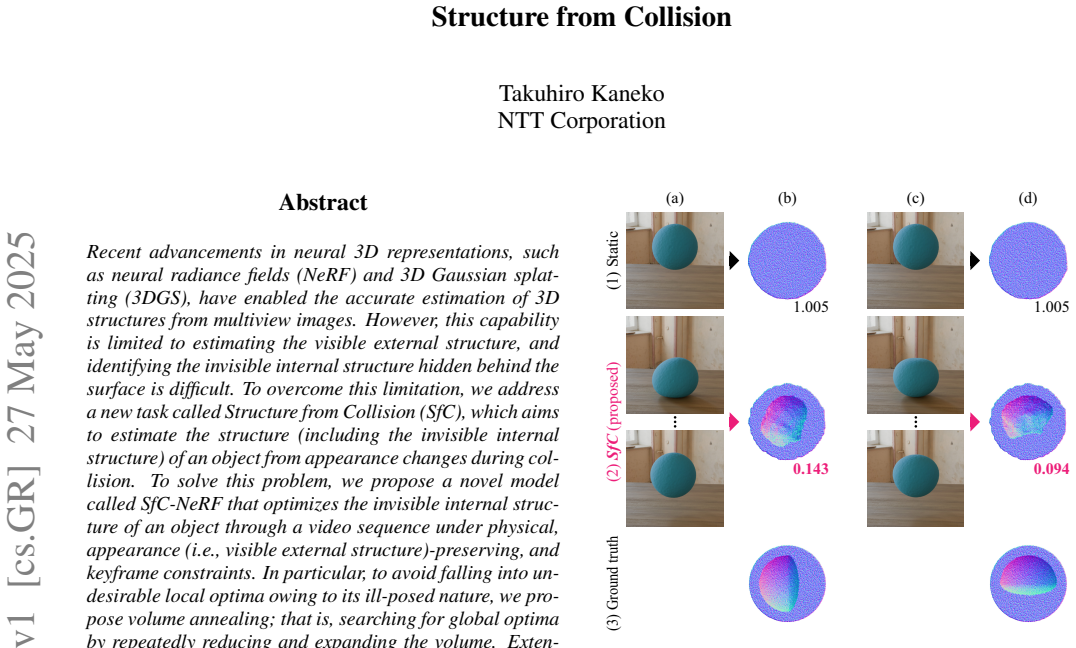
Pith's one-line read Collision video can reveal the hidden internal structure of a deforming object, and SfC-NeRF recovers it by matching a physics simulation to the observed deformation.
desk verdict A genuinely new task with a method that works in simulation; the headline numbers lean on the known-mass prior, but the core claim survives ablation. read the letter →
The pith
A machine-rendered reading of the paper's core claim, the machinery that carries it, and where it could break.
The reading
What carries the argument
The load-bearing object is the voxel-grid volume density field $\sigma^{G'}(t_0)$ of the object at the first frame, which encodes where material is and where the cavity is. SfC-NeRF optimizes this field by coupling it to a differentiable material point method: particle samples of the field are simulated through the collision, rendered back to pixels, and compared with the video. Around that core sit the appearance-preserving losses (pixel and depth differences against the first frame), the keyframe pixel loss at the frame right after impact, the mass loss $L_{\text{mass}}$ that pins total mass to the known value $\hat{m}$, and volume annealing, which periodically expands the volume during optimization to escape local minima.
What would settle it
Run SfC-NeRF on a real hollow object whose cavity is known from a CT scan, using only collision video and independently measured material properties, without providing the mass. If the recovered cavity no longer matches the scan, or if supplying an intentionally wrong mass by 30% changes the recovered cavity as sharply as the paper's density-error experiments show, then the known-mass constraint, not the video itself, is doing the decisive work.
Extended reading notes
Core claim
The central claim is that the shape and location of an invisible internal cavity can be estimated from appearance changes during collision, even when static images of the object give no clue that the cavity exists. SfC-NeRF does this by taking the voxel-based volume density field learned from the first frame and optimizing the internal part of it so that a differentiable continuum-mechanics simulation, run forward through the video, reproduces the observed deformation. Three additional constraints keep the search well-posed: appearance-preserving losses hold the outer surface to the first frame, a keyframe loss emphasizes the frame just after impact, and a known-mass loss fixes the total amount of material, turning the problem from finding any cavity into placing a cavity of the right size. Volume annealing, which repeatedly shrinks and regrows the volume, helps avoid local optima. The supporting experiments argue that the method captures the positional bias of cavities across sizes and materials and outperforms baselines that optimize particles or grids without these constraints.
Load-bearing premise
The object's total mass is known in advance and is enforced as a hard loss; if the mass or density is misestimated, the recovered cavity volume is wrong even when the video is perfectly explained.
Editorial extensions
If this is right
- If the central claim holds, collision video is a usable observation modality for internal structure, not just for surface shape.
- Optimizing the internal structure, rather than assuming the interior is filled, improves prediction of how the object will deform in future frames.
- The method works across elastic materials, fluids, plasticine, and sand, with the best results for moderately deformable objects; very stiff or very soft objects give weaker cues.
- Larger cavities are harder to recover because optimization starts from a filled volume, but volume annealing and the mass constraint reduce that gap.
- The same optimization approach could in principle be attached to other neural 3D representations, since the constraints act on the density field rather than on a specific renderer.
Reading between the lines
- If the known-mass assumption is removed, the problem becomes appreciably harder; a natural extension would be to jointly estimate mass and structure, perhaps by exploiting the material-property ambiguity the paper acknowledges.
- Because a hollow soft object and a filled stiff object can deform similarly, the method is most convincing when material properties are independently known; in real use, material identification and structure estimation would need to be solved together.
- A direct real-data test, recovering the interior of a hollow object from a collision video and comparing with a CT or X-ray scan, would be the natural next validation step beyond simulation.
Editorial analysis
A structured set of objections, weighed in public.
Referee Report
Summary. The paper introduces a new problem, Structure from Collision (SfC): given multi-view videos of an object colliding with a surface, estimate the object's 3D structure, including invisible internal cavities. The proposed model, SfC-NeRF, builds on PAC-NeRF and optimizes the initial volume-density field under physical constraints (known material properties and total mass), appearance-preserving losses, a keyframe loss, and a volume-annealing schedule. Experiments on a synthetic dataset of 115 objects across five external shapes, multiple cavity sizes/locations, and various materials report chamfer-distance improvements over a static reconstruction baseline and over ablated variants, together with a future-prediction application. The paper includes extensive appendices with per-shape results, component ablations, robustness to erroneous physical parameters, and collision-angle variations.
Significance. If the claims hold, the paper opens a useful new task and provides a systematic first solution with a thorough empirical study. It is honest about its assumptions, reports detailed ablations and per-shape numbers, and demonstrates that the full method improves over baselines even when the mass loss is removed (SfC-NeRF−mass 0.503 vs Static 0.720 in Table 1). The known-mass prior, however, is load-bearing for the headline margin, and the evaluation is entirely synthetic with the same MPM formulation used by the model, so the external validity of the central claim is not yet established. The paper's strength lies in its clearly framed problem, reproducible experimental protocol (detailed in Appendices), and the range of ablations isolating each component.
major comments (3)
- [§3.3, Eq. (7); Tables 1 and 6] The known total mass m-hat is a hard constraint via L_mass, and the paper's own ablations show that this prior is load-bearing: removing it degrades CD from 0.165 to 0.503 (Table 1), and a -30% density error degrades CD to 0.798 (Table 6). Because the appearance-preserving losses fix the external volume, the mass prior effectively pins down the total cavity volume before any video frame is used. To support the claim that the collision video itself reveals the internal structure, the paper should include a control experiment that uses the mass prior and appearance-preserving losses but no temporal frames (i.e., a 'mass-only' optimization on t0). This control would quantify how much of the reported improvement is attributable to the prior versus the dynamics, and would strengthen the interpretation of the ablation results.
- [Tables 1–4 and 16–17] All headline quantitative claims are based on averages over five external shapes without any measure of variance or statistical significance. Given the wide per-shape spread (e.g., SfC-NeRF CD 0.067 for sphere vs 0.264 for cylinder in Table 16), the robustness of the reported improvements is unclear. The paper should report error bars (e.g., standard deviation over shapes, or over multiple random seeds) and, where the sample size allows, a paired significance test between the full model and its key ablations/baselines. At minimum, the range of per-shape scores should be stated in the main text alongside the averages.
- [§4.1 and Appendix C.1] The evaluation is conducted entirely on synthetic data generated with the MLS-MPM simulator, which shares the same MPM formulation (DiffMPM) used inside SfC-NeRF. This simulator-to-simulator agreement likely overstates the method's performance, since the physical prior matches the data-generation process exactly. The paper acknowledges real-data validation as future work (Section 5 and Appendix A.4), but this remains a central limitation: the claim that appearance changes during collision carry usable information about invisible internal structure would be substantially strengthened by a cross-simulator experiment (e.g., generating data with a different MPM or FEM solver) or by any real-world test. The authors should either add such a test or explicitly discuss the extent to which the current evaluation can support the general claim.
minor comments (6)
- [§4.1] The text says 'We also examined Stacic'—this should be 'Static'.
- [Table 3] The table caption reads 'Young's moduls'—this should be 'Young's modulus'.
- [§2] The related work contains the typo 'assumeed' in 'considereded non-transparent objects but assumeed that the interior is filled'—should be 'assumed'.
- [Appendix A.1.1] The text uses 'SFC-NeRF' in several places (e.g., 'SFC-NeRF with only Lpixel0')—should be 'SfC-NeRF' for consistency.
- [§3.3, Eq. (10)] In the definition of the depth-preserving loss, the integral for Z(r, t0) is written with a time variable t in the integrand (Tr(s,t) and σ(r(s),t)) rather than t0; please clarify whether this is a typo or an intentional notation.
- [§3.3, Eq. (12)] The full objective omits the background loss L_bg, which is described in Section 4.1 as being included in the pixel-related losses; please state this explicitly in the equation or its surrounding text to avoid confusion.
Circularity Check
No significant circularity: the internal-structure estimate is optimized against video appearance under a disclosed mass prior, never against the ground-truth particles it is evaluated on; the self-cited LPO baseline is used adversarially, not as a load-bearing premise.
full rationale
The derivation chain is self-contained with respect to the claimed output. SfC-NeRF optimizes the volume-density field sigma_G'(t0) that seeds the internal particles, using video pixel losses (L_pixel, Eq. 3; L_pixelk, Eq. 11), appearance-preserving losses (L_pixel0 and L_depth0, Eqs. 9-10), and the mass loss (Eq. 7). The ground-truth particle set P-hat_P(t0) appears only in evaluation (chamfer distance), never in any training loss, so the reported CD improvement is not a fitted quantity renamed as a prediction. The mass prior m-hat is a disclosed input assumption (Section 3.1), not a parameter fitted from the video; it constrains total cavity volume once the appearance-preserving losses fix the external volume, but it cannot determine the cavity's location or shape, and the anti-chamfer results (Table 2: CD 0.281 vs. ACD 0.416) show the location signal comes from the video itself. Crucially, the mass-free ablation SfC-NeRF-minus-mass (0.503) still beats the Static baseline (0.720) in Table 1, so the central claim does not reduce to the mass input. The only self-citation of note, LPO [31], is used adversarially as a baseline whose failure is demonstrated by the paper's own experiments (LPO 0.656 vs. SfC-NeRF 0.165), not imported as a premise; no load-bearing uniqueness theorem or ansatz is smuggled via citation. The sensitivity of results to a -30% density error (CD 0.798, Table 6) is an explicitly disclosed robustness limitation (Section 5 and Appendix A.4), appropriate for correctness risk rather than circularity. No equation-level equivalence (Eq. X = Eq. Y by construction) can be exhibited anywhere in the method. The score of 2 reflects only the presence of minor, non-load-bearing self-citations, not any circular step.
Assumptions & free parameters
free parameters (8)
- lambda_mass =
1
- lambda_pres =
100
- w_depth =
0.01
- lambda_key =
10
- w_bg =
0.2
- keyframe index k =
6
- volume annealing interval =
100 iterations
- learning rate schedule parameters =
lr max 6.4, min 0.1, halve/double based on mass comparison
assumptions (7)
- domain assumption Material physical properties (Young's modulus, Poisson's ratio, density) and total mass are known exactly.
- domain assumption The differentiable MPM simulation (DiffMPM) faithfully reproduces the deformation dynamics of the object.
- domain assumption The external structure estimated from the first frame is accurate and is preserved during dynamic optimization.
- domain assumption The object deforms measurably upon collision; rigid objects provide insufficient signal.
- domain assumption Camera parameters and collision objects (e.g., ground plane) are known, and background matting is reliable.
- domain assumption The ground-truth simulator (MLS-MPM) and the differentiable simulator (DiffMPM) share the same physical model.
- standard math Volume rendering along rays (Eq. 1-2) and continuum conservation laws (Eq. 4-5) accurately model image formation and material motion.
Cite this review
Pith. "Pith review of Structure from Collision." pith.science (2026). https://pith.science/paper/GBRFKGB2
@misc{pith2026250521335,
  author       = {Pith},
  title        = {Pith review of: Structure from Collision},
  year         = {2026},
  howpublished = {\url{https://pith.science/paper/GBRFKGB2}},
  note         = {Machine review of arXiv:2505.21335}
}
read the original abstract
Recent advancements in neural 3D representations, such as neural radiance fields (NeRF) and 3D Gaussian splatting (3DGS), have enabled the accurate estimation of 3D structures from multiview images. However, this capability is limited to estimating the visible external structure, and identifying the invisible internal structure hidden behind the surface is difficult. To overcome this limitation, we address a new task called Structure from Collision (SfC), which aims to estimate the structure (including the invisible internal structure) of an object from appearance changes during collision. To solve this problem, we propose a novel model called SfC-NeRF that optimizes the invisible internal structure of an object through a video sequence under physical, appearance (i.e., visible external structure)-preserving, and keyframe constraints. In particular, to avoid falling into undesirable local optima owing to its ill-posed nature, we propose volume annealing; that is, searching for global optima by repeatedly reducing and expanding the volume. Extensive experiments on 115 objects involving diverse structures (i.e., various cavity shapes, locations, and sizes) and material properties revealed the properties of SfC and demonstrated the effectiveness of the proposed SfC-NeRF.
Figures


Figures from the paper (11 more)


Reference graph
Works this paper leans on
-
[1]
Par- ticleNeRF: A particle-based encoding for online neural radi- ance fields
Jad Abou-Chakra, Feras Dayoub, and Niko S ¨underhauf. Par- ticleNeRF: A particle-based encoding for online neural radi- ance fields. In WACV, 2024. 2, 3
2024
-
[2]
Physically embodied Gaussian splatting: Em- bedding physical priors into a visual 3D world model for robotics
Jad Abou-Chakra, Krishan Rana, Feras Dayoub, and Niko S¨underhauf. Physically embodied Gaussian splatting: Em- bedding physical priors into a visual 3D world model for robotics. In CoRL, 2024. 2, 3
2024
-
[3]
Learning neural light fields with ray-space embedding networks
Benjamin Attal, Jia-Bin Huang, Michael Zollhoefer, Jo- hannes Kopf, and Changil Kim. Learning neural light fields with ray-space embedding networks. In CVPR, 2022. 2
2022
-
[4]
Barron, Ben Mildenhall, Matthew Tancik, Pe- ter Hedman, Ricardo Martin-Brualla, and Pratul P
Jonathan T. Barron, Ben Mildenhall, Matthew Tancik, Pe- ter Hedman, Ricardo Martin-Brualla, and Pratul P. Srini- vasan. Mip-NeRF: A multiscale representation for anti- aliasing neural radiance fields. In ICCV, 2021. 2
2021
-
[5]
Barron, Ben Mildenhall, Dor Verbin, Pratul P
Jonathan T. Barron, Ben Mildenhall, Dor Verbin, Pratul P. Srinivasan, and Peter Hedman. Mip-NeRF 360: Unbounded anti-aliased neural radiance fields. In CVPR, 2022
work page 2022
-
[6]
Barron, Ben Mildenhall, Dor Verbin, Pratul P
Jonathan T. Barron, Ben Mildenhall, Dor Verbin, Pratul P. Srinivasan, and Peter Hedman. Zip-NeRF: Anti-aliased grid- based neural radiance fields. In ICCV, 2023. 2
work page 2023
-
[7]
Chan, Marco Monteiro, Petr Kellnhofer, Jiajun Wu, and Gordon Wetzstein
Eric R. Chan, Marco Monteiro, Petr Kellnhofer, Jiajun Wu, and Gordon Wetzstein. pi-GAN: Periodic implicit genera- tive adversarial networks for 3D-aware image synthesis. In CVPR, 2021. 2
work page 2021
-
[8]
Eric R. Chan, Connor Z. Lin, Matthew A. Chan, Koki Nagano, Boxiao Pan, Shalini De Mello, Orazio Gallo, Leonidas J. Guibas, Jonathan Tremblay, Sameh Khamis, Tero Karras, and Gordon Wetzstein. Efficient geometry- aware 3D generative adversarial networks. In CVPR, 2022
work page 2022
Show all 84 references
-
[9]
Chan, Koki Nagano, Matthew A
Eric R. Chan, Koki Nagano, Matthew A. Chan, Alexander W. Bergman, Jeong Joon Park, Axel Levy, Miika Aittala, Shalini De Mello, Tero Karras, and Gordon Wetzstein. Generative novel view synthesis with 3D-aware diffusion models. In ICCV, 2023. 2
2023
-
[10]
TensoRF: Tensorial radiance fields
Anpei Chen, Zexiang Xu, Andreas Geiger, Jingyi Yu, and Hao Su. TensoRF: Tensorial radiance fields. InECCV, 2022. 2
2022
-
[11]
Fan- tasia3D: Disentangling geometry and appearance for high- quality text-to-3D content creation
Rui Chen, Yongwei Chen, Ningxin Jiao, and Kui Jia. Fan- tasia3D: Disentangling geometry and appearance for high- quality text-to-3D content creation. In ICCV, 2023. 2
2023
-
[12]
HAC: Hash-grid assisted context for 3D Gaussian splatting compression
Yihang Chen, Qianyi Wu, Weiyao Lin, Mehrtash Harandi, and Jianfei Cai. HAC: Hash-grid assisted context for 3D Gaussian splatting compression. In ECCV, 2024. 2
2024
-
[13]
Physics informed neural fields for smoke reconstruction with sparse data
Mengyu Chu, Lingjie Liu, Quan Zheng, Erik Franz, Hans- Peter Seidel, Christian Theobalt, and Rhaleb Zayer. Physics informed neural fields for smoke reconstruction with sparse data. ACM Trans. Graph., 41(4), 2022. 2, 3
2022
-
[14]
GRAM: Generative radiance manifolds for 3D-aware image generation
Yu Deng, Jiaolong Yang, Jianfeng Xiang, and Xin Tong. GRAM: Generative radiance manifolds for 3D-aware image generation. In CVPR, 2022. 2
2022
-
[15]
PIE-NeRF: Physics-based inter- active elastodynamics with NeRF
Yutao Feng, Yintong Shang, Xuan Li, Tianjia Shao, Chen- fanfu Jiang, and Yin Yang. PIE-NeRF: Physics-based inter- active elastodynamics with NeRF. In CVPR, 2023. 2, 3
2023
-
[16]
Plenoxels: Radiance fields without neural networks
Sara Fridovich-Keil, Alex Yu, Matthew Tancik, Qinhong Chen, Benjamin Recht, and Angjoo Kanazawa. Plenoxels: Radiance fields without neural networks. In CVPR, 2022. 2
2022
-
[17]
Dynamic neural radiance fields for monocular 4D facial avatar reconstruction
Guy Gafni, Justus Thies, Michael Zollhofer, and Matthias Nießner. Dynamic neural radiance fields for monocular 4D facial avatar reconstruction. In CVPR, 2021. 2
2021
-
[18]
Barron, and Ben Poole
Ruiqi Gao, Aleksander Holynski, Philipp Henzler, Arthur Brussee, Ricardo Martin-Brualla, Pratul Srinivasan, Jonathan T. Barron, and Ben Poole. CAT3D: Create any- thing in 3D with multi-view diffusion models. In NeurIPS,
-
[19]
Garbin, Marek Kowalski, Matthew Johnson, Jamie Shotton, and Julien Valentin
Stephan J. Garbin, Marek Kowalski, Matthew Johnson, Jamie Shotton, and Julien Valentin. FastNeRF: High-fidelity neural rendering at 200FPS. In ICCV, 2021. 2
2021
-
[20]
StyleNeRF: A style-based 3D-aware generator for high- resolution image synthesis
Jiatao Gu, Lingjie Liu, Peng Wang, and Christian Theobalt. StyleNeRF: A style-based 3D-aware generator for high- resolution image synthesis. In ICLR, 2022. 2
2022
-
[21]
NeuroFluid: Fluid dynamics grounding with particle- driven neural radiance fields
Shanyan Guan, Huayu Deng, Yunbo Wang, and Xiaokang Yang. NeuroFluid: Fluid dynamics grounding with particle- driven neural radiance fields. In ICML, 2022. 2, 3
2022
-
[22]
Srinivasan, Ben Mildenhall, Jonathan T
Peter Hedman, Pratul P. Srinivasan, Ben Mildenhall, Jonathan T. Barron, and Paul Debevec. Baking neural ra- diance fields for real-time view synthesis. In ICCV, 2021. 2
2021
-
[23]
EfficientNeRF: Efficient neural radiance fields
Tao Hu, Shu Liu, Yilun Chen, Tiancheng Shen, and Jiaya Jia. EfficientNeRF: Efficient neural radiance fields. In CVPR,
-
[24]
Tri-MipRF: Tri-Mip represen- tation for efficient anti-aliasing neural radiance fields
Wenbo Hu, Yuling Wang, Lin Ma, Bangbang Yang, Lin Gao, Xiao Liu, and Yuewen Ma. Tri-MipRF: Tri-Mip represen- tation for efficient anti-aliasing neural radiance fields. In ICCV, 2023. 2
2023
-
[25]
A moving least squares material point method with displacement discontinu- ity and two-way rigid body coupling
Yuanming Hu, Yu Fang, Ziheng Ge, Ziyin Qu, Yixin Zhu, Andre Pradhana, and Chenfanfu Jiang. A moving least squares material point method with displacement discontinu- ity and two-way rigid body coupling. ACM Trans. Graph., 37(4), 2018. 6, 27
2018
-
[26]
Diff- Taichi: Differentiable programming for physical simulation
Yuanming Hu, Luke Anderson, Tzu-Mao Li, Qi Sun, Nathan Carr, Jonathan Ragan-Kelley, and Fr ´edo Durand. Diff- Taichi: Differentiable programming for physical simulation. In ICLR, 2020. 3, 4, 16, 27
2020
-
[27]
GaussianShader: 3D Gaussian splatting with shading functions for reflective surfaces
Yingwenqi Jiang, Jiadong Tu, Yuan Liu, Xifeng Gao, Xiaox- iao Long, Wenping Wang, and Yuexin Ma. GaussianShader: 3D Gaussian splatting with shading functions for reflective surfaces. In CVPR, 2024. 2
2024
-
[28]
VR-GS: A physical dynamics- aware interactive Gaussian splatting system in virtual reality
Ying Jiang, Chang Yu, Tianyi Xie, Xuan Li, Yutao Feng, Huamin Wang, Minchen Li, Henry Lau, Feng Gao, Yin Yang, and Chenfanfu Jiang. VR-GS: A physical dynamics- aware interactive Gaussian splatting system in virtual reality. ACM Trans. Graph., 78, 2024. 2, 3
2024
-
[29]
AR-NeRF: Unsupervised learning of depth and defocus effects from natural images with aperture rendering neural radiance fields
Takuhiro Kaneko. AR-NeRF: Unsupervised learning of depth and defocus effects from natural images with aperture rendering neural radiance fields. In CVPR, 2022. 2
2022
-
[30]
MIMO-NeRF: Fast neural rendering with multi-input multi-output neural radiance fields
Takuhiro Kaneko. MIMO-NeRF: Fast neural rendering with multi-input multi-output neural radiance fields. In ICCV,
-
[31]
Improving physics-augmented continuum neural radiance field-based geometry-agnostic system iden- tification with Lagrangian particle optimization
Takuhiro Kaneko. Improving physics-augmented continuum neural radiance field-based geometry-agnostic system iden- tification with Lagrangian particle optimization. In CVPR,
-
[32]
3D Gaussian splatting for real-time radiance field rendering
Bernhard Kerbl, Georgios Kopanas, Thomas Leimk ¨uhler, and George Drettakis. 3D Gaussian splatting for real-time radiance field rendering. ACM Trans. Graph., 42(4), 2023. 1, 2
2023
-
[33]
Kingma and Jimmy Ba
Diederik P. Kingma and Jimmy Ba. Adam: A method for stochastic optimization. In ICLR, 2015. 27
2015
-
[34]
AdaNeRF: Adaptive sampling for real-time rendering of neural radiance fields
Andreas Kurz, Thomas Neff, Zhaoyang Lv, Michael Zollh¨ofer, and Markus Steinberger. AdaNeRF: Adaptive sampling for real-time rendering of neural radiance fields. In ECCV, 2022. 2
2022
-
[35]
Compact 3D Gaussian representation for radiance field
Joo Chan Lee, Daniel Rho, Xiangyu Sun, Jong Hwan Ko, and Eunbyung Park. Compact 3D Gaussian representation for radiance field. In CVPR, 2024. 2
2024
-
[36]
PAC-NeRF: Physics augmented continuum neural ra- diance fields for geometry-agnostic system identification
Xuan Li, Yi-Ling Qiao, Peter Yichen Chen, Krishna Murthy Jatavallabhula, Ming Lin, Chenfanfu Jiang, and Chuang Gan. PAC-NeRF: Physics augmented continuum neural ra- diance fields for geometry-agnostic system identification. In ICLR, 2023. 2, 3, 6, 8, 17, 25, 27
2023
-
[37]
GeoGaussian: Geometry-aware Gaussian splatting for scene rendering
Yanyan Li, Chenyu Lyu, Yan Di, Guangyao Zhai, Gim Hee Lee, and Federico Tombari. GeoGaussian: Geometry-aware Gaussian splatting for scene rendering. In ECCV, 2024. 2
2024
-
[38]
Neural scene flow fields for space-time view synthesis of dy- namic scenes
Zhengqi Li, Simon Niklaus, Noah Snavely, and Oliver Wang. Neural scene flow fields for space-time view synthesis of dy- namic scenes. In CVPR, 2021. 2
2021
-
[39]
Analytic-Splatting: Anti-aliased 3D Gaussian splatting via analytic integration
Zhihao Liang, Qi Zhang, Wenbo Hu, Ying Feng, Lei Zhu, and Kui Jia. Analytic-Splatting: Anti-aliased 3D Gaussian splatting via analytic integration. In ECCV, 2024. 2
2024
-
[40]
Magic3D: High-resolution text-to-3D content creation
Chen-Hsuan Lin, Jun Gao, Luming Tang, Towaki Takikawa, Xiaohui Zeng, Xun Huang, Karsten Kreis, Sanja Fidler, Ming-Yu Liu, and Tsung-Yi Lin. Magic3D: High-resolution text-to-3D content creation. In CVPR, 2023. 2
2023
-
[41]
Curless, Steven M
Shanchuan Lin, Andrey Ryabtsev, Soumyadip Sengupta, Brian L. Curless, Steven M. Seitz, and Ira Kemelmacher- Shlizerman. Real-time high-resolution background matting. In CVPR, 2021. 6, 13
2021
-
[42]
Lindell, Julien N
David B. Lindell, Julien N. P. Martel, and Gordon Wetzstein. AutoInt: Automatic integration for fast neural volume ren- dering. In CVPR, 2021. 2
2021
-
[43]
MirrorGaussian: Reflecting 3D Gaussians for reconstructing mirror reflec- tions
Jiayue Liu, Xiao Tang, Freeman Cheng, Roy Yang, Zhihao Li, Jianzhuang Liu, Yi Huang, Jiaqi Lin, Shiyong Liu, Xi- aofei Wu, Songcen Xu, and Chun Yuan. MirrorGaussian: Reflecting 3D Gaussians for reconstructing mirror reflec- tions. In ECCV, 2024. 2
2024
-
[44]
Neural sparse voxel fields
Lingjie Liu, Jiatao Gu, Kyaw Zaw Lin, Tat-Seng Chua, and Christian Theobalt. Neural sparse voxel fields. In NeurIPS,
-
[45]
3D geometry-aware deformable Gaussian splatting for dynamic view synthesis
Zhicheng Lu, Xiang Guo, Le Hui, Tianrui Chen, Min Yang, Xiao Tang, Feng Zhu, and Yuchao Dai. 3D geometry-aware deformable Gaussian splatting for dynamic view synthesis. In CVPR, 2024. 2
2024
-
[46]
Dynamic 3D Gaussians: Tracking by per- sistent dynamic view synthesis
Jonathon Luiten, Georgios Kopanas, Bastian Leibe, and Deva Ramanan. Dynamic 3D Gaussians: Tracking by per- sistent dynamic view synthesis. In 3DV, 2024. 2
2024
-
[47]
Srinivasan, Matthew Tancik, Jonathan T
Ben Mildenhall, Pratul P. Srinivasan, Matthew Tancik, Jonathan T. Barron, Ravi Ramamoorthi, and Ren Ng. NeRF: Representing scenes as neural radiance fields for view syn- thesis. In ECCV, 2020. 1, 2, 3
2020
-
[48]
Srinivasan, and Jonathan T
Ben Mildenhall, Peter Hedman, Ricardo Martin-Brualla, Pratul P. Srinivasan, and Jonathan T. Barron. NeRF in the dark: High dynamic range view synthesis from noisy raw images. In CVPR, 2022. 2
2022
-
[49]
Instant neural graphics primitives with a multires- olution hash encoding
Thomas M ¨uller, Alex Evans, Christoph Schied, and Alexan- der Keller. Instant neural graphics primitives with a multires- olution hash encoding. ACM Trans. Graph., 41(4), 2022. 2
2022
-
[50]
Mueller, Chakravarty R
Thomas Neff, Pascal Stadlbauer, Mathias Parger, Andreas Kurz, Joerg H. Mueller, Chakravarty R. Alla Chaitanya, An- ton Kaplanyan, and Markus Steinberger. DONeRF: Towards real-time rendering of compact neural radiance fields using depth oracle networks. Comput. Graph. Forum, 40...
2021
-
[51]
Compressed 3D Gaussian splatting for accelerated novel view synthesis
Simon Niedermayr, Josef Stumpfegger, and R ¨udiger West- ermann. Compressed 3D Gaussian splatting for accelerated novel view synthesis. In CVPR, 2024. 2
2024
-
[52]
GIRAFFE: Rep- resenting scenes as compositional generative neural feature fields
Michael Niemeyer and Andreas Geiger. GIRAFFE: Rep- resenting scenes as compositional generative neural feature fields. In CVPR, 2021. 2
2021
-
[53]
Barron, Sofien Bouaziz, Dan B
Keunhong Park, Utkarsh Sinha, Jonathan T. Barron, Sofien Bouaziz, Dan B. Goldman, Steven M. Seitz, and Ricardo Martin-Brualla. Nerfies: Deformable neural radiance fields. In ICCV, 2021. 2
2021
-
[54]
Barron, and Ben Milden- hall
Ben Poole, Ajay Jain, Jonathan T. Barron, and Ben Milden- hall. DreamFusion: Text-to-3D using 2D diffusion. In ICLR,
-
[55]
D-NeRF: Neural radiance fields for dynamic scenes
Albert Pumarola, Enric Corona, Gerard Pons-Moll, and Francesc Moreno-Noguer. D-NeRF: Neural radiance fields for dynamic scenes. In CVPR, 2021. 2, 3
2021
-
[56]
Feature Splatting: Language-driven physics-based scene synthesis and editing
Ri-Zhao Qiu, Ge Yang, Weijia Zeng, and Xiaolong Wang. Feature Splatting: Language-driven physics-based scene synthesis and editing. In ECCV, 2024. 2, 3
2024
-
[57]
DeRF: Decom- posed radiance fields
Daniel Rebain, Wei Jiang, Soroosh Yazdani, Ke Li, Kwang Moo Yi, and Andrea Tagliasacchi. DeRF: Decom- posed radiance fields. In CVPR, 2021. 2
2021
-
[58]
KiloNeRF: Speeding up neural radiance fields with thousands of tiny MLPs
Christian Reiser, Songyou Peng, Yiyi Liao, and Andreas Geiger. KiloNeRF: Speeding up neural radiance fields with thousands of tiny MLPs. In ICCV, 2021. 2
2021
-
[59]
GRAF: Generative radiance fields for 3D-aware im- age synthesis
Katja Schwarz, Yiyi Liao, Michael Niemeyer, and Andreas Geiger. GRAF: Generative radiance fields for 3D-aware im- age synthesis. In NeurIPS, 2020. 2
2020
-
[60]
Light field networks: Neu- ral scene representations with single-evaluation rendering
Vincent Sitzmann, Semon Rezchikov, Bill Freeman, Josh Tenenbaum, and Fredo Durand. Light field networks: Neu- ral scene representations with single-evaluation rendering. In NeurIPS, 2021. 2
2021
-
[61]
EpiGRAF: Rethinking training of 3D GANs
Ivan Skorokhodov, Sergey Tulyakov, Yiqun Wang, and Peter Wonka. EpiGRAF: Rethinking training of 3D GANs. In NeurIPS, 2022. 2
2022
-
[62]
Light field neural rendering
Mohammed Suhail, Carlos Esteves, Leonid Sigal, and Ameesh Makadia. Light field neural rendering. In CVPR,
-
[63]
Direct voxel grid optimization: Super-fast convergence for radiance fields reconstruction
Cheng Sun, Min Sun, and Hwann-Tzong Chen. Direct voxel grid optimization: Super-fast convergence for radiance fields reconstruction. In CVPR, 2022. 1, 2, 3, 4, 27
2022
-
[64]
LGM: Large multi-view Gaus- sian model for high-resolution 3D content creation
Jiaxiang Tang, Zhaoxi Chen, Xiaokang Chen, Tengfei Wang, Gang Zeng, and Ziwei Liu. LGM: Large multi-view Gaus- sian model for high-resolution 3D content creation. In ECCV, 2024. 2 10
2024
-
[65]
DreamGaussian: Generative Gaussian splatting for efficient 3D content creation
Jiaxiang Tang, Jiawei Ren, Hang Zhou, Ziwei Liu, and Gang Zeng. DreamGaussian: Generative Gaussian splatting for efficient 3D content creation. In ICLR, 2024. 2
2024
-
[66]
Non- rigid neural radiance fields: Reconstruction and novel view synthesis of a dynamic scene from monocular video
Edgar Tretschk, Ayush Tewari, Vladislav Golyanik, Michael Zollh¨ofer, Christoph Lassner, and Christian Theobalt. Non- rigid neural radiance fields: Reconstruction and novel view synthesis of a dynamic scene from monocular video. In ICCV, 2021. 2
2021
-
[67]
Barron, and Pratul P
Dor Verbin, Peter Hedman, Ben Mildenhall, Todd Zickler, Jonathan T. Barron, and Pratul P. Srinivasan. Ref-NeRF: Structured view-dependent appearance for neural radiance fields. In CVPR, 2022. 2
2022
-
[68]
R2L: Distilling neural radiance field to neural light field for efficient novel view synthesis
Huan Wang, Jian Ren, Zeng Huang, Kyle Olszewski, Men- glei Chai, Yun Fu, and Sergey Tulyakov. R2L: Distilling neural radiance field to neural light field for efficient novel view synthesis. In ECCV, 2022. 2
2022
-
[69]
Bovik, Hamid R
Zhou Wang, Alan C. Bovik, Hamid R. Sheikh, and Eero P. Simoncelli. Image quality assessment: From error visibility to structural similarity. IEEE Trans. Image Process., 13(4),
-
[70]
ProlificDreamer: High-fidelity and diverse text-to-3D generation with variational score dis- tillation
Zhengyi Wang, Cheng Lu, Yikai Wang, Fan Bao, Chongxuan Li, Hang Su, and Jun Zhu. ProlificDreamer: High-fidelity and diverse text-to-3D generation with variational score dis- tillation. In NeurIPS, 2023. 2
2023
-
[71]
NeX: Real-time view synthesis with neural basis expansion
Suttisak Wizadwongsa, Pakkapon Phongthawee, Jiraphon Yenphraphai, and Supasorn Suwajanakorn. NeX: Real-time view synthesis with neural basis expansion. In CVPR, 2021. 2
2021
-
[72]
PhysGaussian: Physics- integrated 3D Gaussians for generative dynamics
Tianyi Xie, Zeshun Zong, Yuxing Qiu, Xuan Li, Yutao Feng, Yin Yang, and Chenfanfu Jiang. PhysGaussian: Physics- integrated 3D Gaussians for generative dynamics. In CVPR,
-
[73]
GIRAFFE HD: A high-resolution 3D-aware generative model
Yang Xue, Yuheng Li, Krishna Kumar Singh, and Yong Jae Lee. GIRAFFE HD: A high-resolution 3D-aware generative model. In CVPR, 2022. 2
2022
-
[74]
Multi-scale 3D Gaussian splatting for anti-aliased rendering
Zhiwen Yan, Weng Fei Low, Yu Chen, and Gim Hee Lee. Multi-scale 3D Gaussian splatting for anti-aliased rendering. In CVPR, 2024. 2
2024
-
[75]
Deformable 3D Gaussians for high-fidelity monocular dynamic scene reconstruction
Ziyi Yang, Xinyu Gao, Wen Zhou, Shaohui Jiao, Yuqing Zhang, and Xiaogang Jin. Deformable 3D Gaussians for high-fidelity monocular dynamic scene reconstruction. In CVPR, 2024. 2
2024
-
[76]
Real- time photorealistic dynamic scene representation and render- ing with 4D Gaussian splatting
Zeyu Yang, Hongye Yang, Zijie Pan, and Li Zhang. Real- time photorealistic dynamic scene representation and render- ing with 4D Gaussian splatting. In ICLR, 2024. 2
2024
-
[77]
GaussianDreamer: Fast generation from text to 3D Gaussians by bridging 2D and 3D diffusion models
Taoran Yi, Jiemin Fang, Junjie Wang, Guanjun Wu, Lingxi Xie, Xiaopeng Zhang, Wenyu Liu, Qi Tian, and Xinggang Wang. GaussianDreamer: Fast generation from text to 3D Gaussians by bridging 2D and 3D diffusion models. In CVPR, 2024. 2
2024
-
[78]
PlenOctrees for real-time rendering of neural radiance fields
Alex Yu, Ruilong Li, Matthew Tancik, Hao Li, Ren Ng, and Angjoo Kanazawa. PlenOctrees for real-time rendering of neural radiance fields. In ICCV, 2021. 2
2021
-
[79]
Mip-Splatting: Alias-free 3D Gaussian splatting
Zehao Yu, Anpei Chen, Binbin Huang, Torsten Sattler, and Andreas Geiger. Mip-Splatting: Alias-free 3D Gaussian splatting. In CVPR, 2024. 2
2024
-
[80]
NeRF++: Analyzing and improving neural radiance fields
Kai Zhang, Gernot Riegler, Noah Snavely, and Vladlen Koltun. NeRF++: Analyzing and improving neural radiance fields. arXiv preprint arXiv:2010.07492, 2020. 2
2010 arXiv
-
[81]
DreamScene360: Uncon- strained text-to-3D scene generation with panoramic Gaus- sian splatting
Shijie Zhou, Zhiwen Fan, Dejia Xu, Haoran Chang, Pradyumna Chari, Tejas Bharadwaj, Suya You, Zhangyang Wang, and Achuta Kadambi. DreamScene360: Uncon- strained text-to-3D scene generation with panoramic Gaus- sian splatting. In ECCV, 2024. 2 11 Contents
2024
-
[82]
Problem statement
Method 3 3.1. Problem statement . . . . . . . . . . . . . . 3 3.2. Preliminary: PAC-NeRF . . . . . . . . . . . 3 3.3. Proposal: SfC-NeRF . . . . . . . . . . . . . 4
-
[83]
Experimental setup
Experiments 6 4.1. Experimental setup . . . . . . . . . . . . . . 6 4.2. Experiment I: Influence of cavity size . . . . 7 4.3. Experiment II: Influence of cavity location . 7 4.4. Experiment III: Influence of material . . . . 8 4.5. Application to future prediction . . . . . . . 8
-
[84]
Droplet” setting (fluid viscosity ˆµ = 200and bulk modulus ˆκ = 105). (2) Newtonian fluid with the “Letter
Conclusion 8 A . Detailed analyses and discussions 12 A.1 . Detailed ablation studies . . . . . . . . . . . 12 A.1.1. Effect of each appearance-preserving loss . . . . . . . . . . . . . . . . . 12 A.1.2. Effect of keyframe selection . . . . . 13 A.1.3. Effect of background los...
Reviewed August 7, 2026 · model on record in the stance chip above.
Discussion (0). Sign in to comment.