REVIEW 2 major objections 6 minor 1 cited by
UI-Genie: A Self-Improving Approach for Iteratively Boosting MLLM-based Mobile GUI Agents
T0 review · 2 major / 6 minor · reviewed 2026-08-07 · deepseek-v4-flash
Pith's one-line read This paper claims that a specially trained reward model can verify individual GUI actions and whole-task outcomes without human annotation, and that three generations of agent–reward self-improvement on that signal yield state-of-the-art…
desk verdict Strong systems paper on GUI-agent self-improvement with genuine agent gains, but the reward model's verification claims are circular until independently evaluated. read the letter →
The pith
A machine-rendered reading of the paper's core claim, the machinery that carries it, and where it could break.
The reading
What carries the argument
The load-bearing object is UI-Genie-RM, a reward model built on an MLLM backbone with an image-text-interleaved context window: the task goal, the current screenshot, the five most recent screenshots, earlier actions condensed into language summaries, and the candidate action. It unifies step-level and task-level rewards by treating 'task complete' as a special terminal action, so both granularities share one next-token binary classification objective. The machinery that carries the self-improvement claim is the reward-guided beam search in a dynamic Android environment: at each step the agent proposes ten candidate actions, UI-Genie-RM scores them, the top five partial trajectories are kept, and terminal states are verified by the outcome-level judgment; successful trajectories feed the agent's training set while potential-based step labels from continuation rollouts feed the reward model's training set.
What would settle it
Take a held-out set of GUI tasks with expert human labels per action, deliberately including cases the three rules cannot catch (typing the right text into the wrong app, or clicking inside the correct bounding box but on a different element), and measure UI-Genie-RM's step-level F1 on those cases; if it is near chance while overall F1 stays high, the rule-based verification is the weak link and the claim of annotation-free accurate verification is falsified.
Extended reading notes
Core claim
The central claim is that GUI-agent training can be made fully automatic: a learned reward model can replace human annotation for judging both single actions and full task outcomes, and that same reward signal can bootstrap the agent that produces the next round of training data. UI-Genie-RM is an MLLM fine-tuned to emit a binary positive/negative token for a candidate action given the task, the current screenshot, five recent screenshots, and language summaries of older actions; because 'task completion' is represented as a terminal action, one architecture covers step-level and outcome-level rewards. The initial reward-model training data are generated without manual labels: rule-based checks (matching action type, coordinates inside the ground-truth box, semantic equivalence of typed text) label positive and negative steps, corrupted trajectories supply negative task-level examples, and hard negatives come from examples the first reward model misclassifies. In three self-improvement rounds with increasing task difficulty, the agent explores dynamic environments under reward-guided beam search, outcome verification expands the agent's training set, and potential-based step labeling expands the reward model's training set. The paper claims this loop reaches state-of-the-art performance on AndroidControl, AndroidLab, and A3, with the reward model also beating prompted proprietary and open MLLM judges in step-level and outcome-level F1.
Load-bearing premise
The whole loop leans on the initial 458k reward-training samples being labeled correctly by three rule-based checks—same action type, coordinate inside the ground-truth box, and semantically equivalent typed text—so if those rules miss a common class of wrong actions, the reward model learns the blind spot and the self-improvement loop propagates it.
Editorial extensions
If this is right
- Mobile GUI agents can keep improving without fresh human-annotated trajectories, because the released 16k synthetic trajectories and 517k reward samples demonstrate that the pipeline generates its own training signal.
- Because UI-Genie-RM can be used at inference time, best-of-N action selection raises task-level success rates, and the reported gains grow as N goes from 5 to 10.
- A single unified reward model can serve both process supervision during exploration and outcome verification at terminal states, removing the need to train separate judges for steps and tasks.
- Three self-improvement rounds lift the 7B agent on AndroidLab from about 18% to 38.7% success, indicating that iterating the same loop on harder tasks is a path to further gains.
Reading between the lines
- A testable extension: if the initial rule-based labels are blind to wrong-destination actions (e.g., typing the requested text into the wrong app), the self-improvement loop could systematically reinforce that error, since later exploration and labeling are graded by a reward model trained on those rules.
- The same agent–reward co-improvement recipe should transfer to desktop or web GUI agents, because the core mechanism—ranking candidate actions with a learned verifier and bootstrapping data from rollouts—does not depend on Android-specific interfaces.
- A direct prediction from the paper's numbers: expanding the reward dataset with more hard-task samples (10+ steps) should improve agent success on long tasks more than adding easy-task samples, since hard-task F1 is the reported weak spot.
Editorial analysis
A structured set of objections, weighed in public.
Referee Report
Summary. The paper introduces UI-Genie, an iterative self-improvement framework for mobile GUI agents. It trains a reward model, UI-Genie-RM, on synthetically labeled data constructed via rule-based verification, controlled trajectory corruption, and hard negative mining, and then uses this reward model to guide beam-search exploration in a dynamic Android environment. Successful trajectories are added to the agent training set, and potential-based labeling from the reward model refines the reward model itself across three generations. The paper reports state-of-the-art results on AndroidControl, AndroidLab, and A3, and claims that UI-Genie-RM provides accurate action- and task-level verification without manual annotation. The authors release two datasets and the framework code.
Significance. If the claims hold, this is a valuable step toward scaling GUI-agent training beyond human-annotated demonstrations. The agent-level gains are consistent across model sizes (3B, 7B, 72B) and across static, emulator, and online benchmarks, which is genuinely impressive. The open-sourced datasets and code would be useful to the community. However, the evaluation of the reward model itself is self-referential: the benchmark is built from the same rule-based protocol that generated the training data, and the reward model is also the verifier inside the self-improvement loop. This means the paper's central contribution — accurate verification without human annotation — is not yet anchored to independent ground truth.
major comments (2)
- [Sec. 4.2.2, Table 5] The benchmark used to evaluate UI-Genie-RM is constructed with the same procedures that produced its training set. Step-level negatives are 'generated by the agent model and verified through rule-based methods' — the same type-alignment, coordinate-accuracy, and semantic-consistency checks described in Sec. 3.2 — and outcome-level negatives are created via 'controlled trajectory corruption,' one of the training-data generation techniques. The F1 scores in Table 5 therefore measure how well the model reproduces the rule-based labeling distribution, not how accurately it judges GUI correctness against independent ground truth. This is load-bearing because the same RM serves as the outcome verifier in the self-improvement loop (Sec. 3.3). I recommend building a held-out evaluation set with human labels that is disjoint from the rule-based label-generation protocol.
- [Sec. 3.3] The self-improvement loop is closed in a way that can amplify systematic reward-model errors. Successful trajectories for the agent training set are selected by UI-Genie-RM itself ('we apply outcome verification using UI-Genie-RM to identify successful completions'), and the reward model's own continuation rollouts provide the step-level labels used to refine the reward model. If the RM has blind spots — for example, accepting a click inside the correct bounding box but on the wrong element, or rejecting a valid alternative action because it does not match the ground-truth action — those blind spots are inherited by both models in later generations. The gains on external benchmarks (Tables 2–4) show that the pipeline improves task success, but they do not establish that the verification signal is accurate, which is a central claim of the paper. A comparison against an independent verifier on a subsample of trajectories, or an ablation in which exploration is guided by a held-out oracle, would substantially strengthen the claim of accurate verification without manual annotation.
minor comments (6)
- [Abstract] The phrase 'eliminating the need for extensive human annotation' overstates the contribution, because the initial agent and reward model are trained on human-annotated datasets (AndroidControl, AMEX, AndroidLab). I suggest 'reducing additional human annotation' or a similar qualification.
- [Sec. 3.1] In the first paragraph, 'these methods fails to provide validation' should be 'these methods fail to provide validation.'
- [Table 2] The Claude Computer Use row shows identical values '74.3 0.0 19.4' for both Low and High settings, including a Type accuracy of 74.3 and a Grounding accuracy of 0.0. This appears to be a formatting error and should be corrected.
- [Sec. 4.2.2] The reward-model evaluation set is small (1,050 paired items, with 200 step-level positives per dataset), and the reported F1 differences are not accompanied by confidence intervals or significance tests. Please add uncertainty estimates or a statistical test.
- [Table 6] For QwenVL2.5-7B on hard tasks, adding UI-Genie-RM with N=5 lowers task-level success rate from 1.4 to 0.9. This regression is not discussed in the text and should be addressed, however minor the absolute numbers are.
- [Sec. 4.3.3, Figure 4] The y-axis label 'Reward Accuracy' is ambiguous; please specify that it is the step-level reward F1 on the paper's custom benchmark.
Circularity Check
UI-Genie-RM's verification accuracy is measured against the same rule-based protocol used to create its training labels, and the self-improvement loop uses the reward model's own outcome judgments as ground truth; external agent benchmarks are independent, but the 'accurate verification without manual annotation' claim is not independently anchored.
-
self definitional
[Sec. 3.2 'Rule-based Verification' and Sec. 4.2.2 'Reward Model Evaluation' (Table 5)]
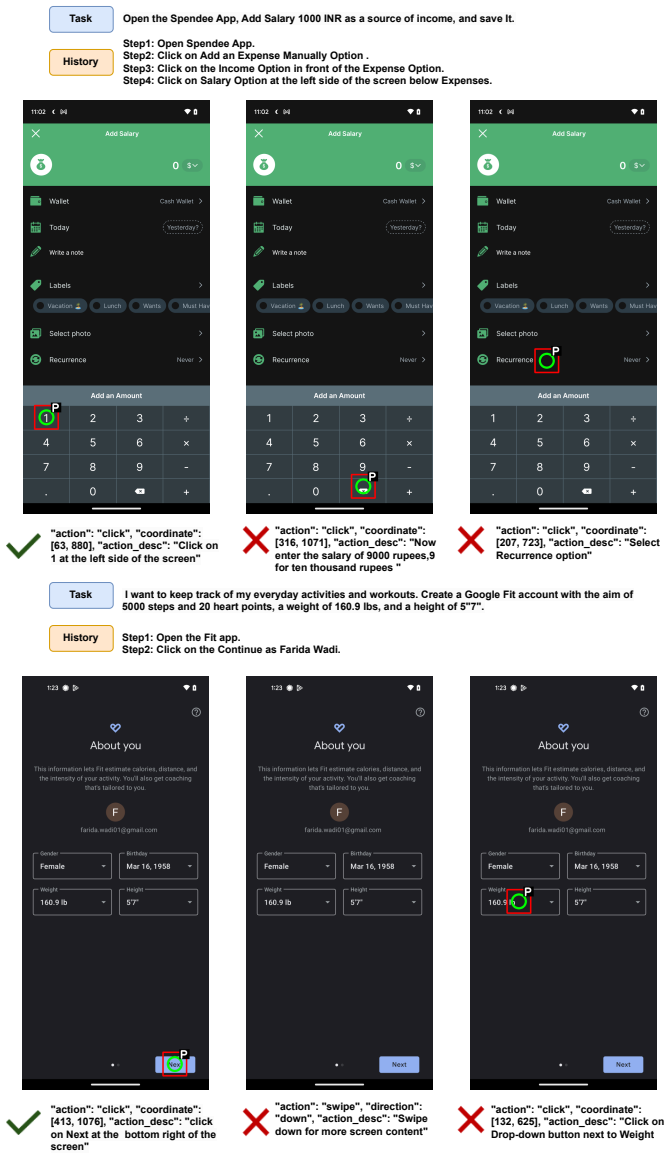
"we generate candidate actions by sampling prediction from this initial agent given the same task instructions, then validate them against ground truth actions using three criteria: (1)Type alignment—whether predicted and ground truth actions must share the same type; (2)Coordinate accuracy—for spatial operations like “click” and “long press”, predicted coordinates must fall within ground truth bounding boxes ... (3)Semantic consistency—for text-based operations like “typing”, generated content must maintain semantic equivalence with ground truth. ..."
The Table 5 benchmark for UI-Genie-RM is constructed with the same labeling operations used to create the 458k reward-training samples in Sec. 3.2: step-level negatives are 'verified through rule-based methods' (type alignment, coordinate accuracy, semantic consistency), and trajectory-level negatives come from 'controlled trajectory corruption.' The high step/outcome F1 therefore measures how faithfully UI-Genie-RM reproduces the rule-based label distribution it was trained on, not whether those rules capture genuine GUI correctness. The claim of accurate verification without manual annotation reduces to agreement with the paper's own labeling protocol.
-
other
[Sec. 3.3 'Training Data Expansion with Outcome Verification' and Sec. 4.1 'Reward Model Training']
"To expand the training set of UI-Genie-Agent, we apply outcome verification using UI-Genie-RM to identify successful completions. These successful trajectories are directly added to the agent’s training set ... To expand the training set of UI-Genie-RM, we employ a potential-based labeling approach [33] for step-level reward annotation. For successful trajectories, each constituent step is annotated as correct (label y+). For unsuccessful trajectories, we determine the viability of each intermediate step through continuation rollouts."
The 59k process-reward samples used for iterative RM refinement are labeled by the same model that is being refined: UI-Genie-RM performs the outcome verification that decides which rollouts 'successfully complete the task,' and those success judgments become the y+/y- training targets for the next RM round. No independent human, rule-based, or external check is applied to these self-generated labels, so the measured reward-model improvement across rounds can reflect self-consistency rather than increased correctness. The paper's Limitations concede that the 'reward model may occasionally generate suboptimal rewards signals,' which is exactly the unverified possibility in this loop.
full rationale
The external agent evaluations on AndroidControl, AndroidLab, and A3 are genuine benchmarks with independent task definitions, so UI-Genie's agent-level gains are not themselves circular. The circularity is concentrated in the reward-model verification claim. Section 3.2 builds the 458k RM training labels from rule-based type/coordinate/semantic checks and controlled trajectory corruption; Section 4.2.2 constructs the Table 5 'custom benchmark' with the identical protocol—rule-based verification for step negatives and controlled trajectory corruption for trajectory negatives. UI-Genie-RM's high F1 is therefore a measure of how well it reproduces its own training label distribution, not an independent demonstration that it can judge GUI correctness. The self-improvement loop amplifies this: Sec. 3.3 uses UI-Genie-RM outcome verification to select successful trajectories and to label continuation rollouts, so the 59k refinement samples are labeled by the very model being refined. Because the central 'accurate verification without manual annotation' claim is supported only by a self-consistent protocol, while the external agent benchmarks remain independent evidence of agent capability, the partial circularity score is 6.
Assumptions & free parameters
free parameters (4)
- Number of historical screenshots =
5
- Beam search width during exploration =
top-5 paths, 10 candidates per step
- Continuation rollout count for potential-based labeling =
5
- Number of self-improvement rounds =
3
assumptions (5)
- domain assumption Rule-based verification (type alignment, coordinate accuracy, semantic consistency) produces accurate ground-truth labels for action correctness.
- domain assumption The dynamic Android environment faithfully simulates real mobile GUI behavior.
- domain assumption A step that can lead to any successful continuation is a correct step (potential-based labeling).
- domain assumption UI-Genie-RM's outcome verification is sufficiently accurate to label training trajectories.
- domain assumption The evaluation benchmarks (AndroidControl, AndroidLab, A3) are valid proxies for real-world GUI agent competence.
Cite this review
Pith. "Pith review of UI-Genie: A Self-Improving Approach for Iteratively Boosting MLLM-based Mobile GUI Agents." pith.science (2026). https://pith.science/paper/FESBVAH3
@misc{pith2026250521496,
  author       = {Pith},
  title        = {Pith review of: UI-Genie: A Self-Improving Approach for Iteratively Boosting MLLM-based Mobile GUI Agents},
  year         = {2026},
  howpublished = {\url{https://pith.science/paper/FESBVAH3}},
  note         = {Machine review of arXiv:2505.21496}
}
read the original abstract
In this paper, we introduce UI-Genie, a self-improving framework addressing two key challenges in GUI agents: verification of trajectory outcome is challenging and high-quality training data are not scalable. These challenges are addressed by a reward model and a self-improving pipeline, respectively. The reward model, UI-Genie-RM, features an image-text interleaved architecture that efficiently pro- cesses historical context and unifies action-level and task-level rewards. To sup- port the training of UI-Genie-RM, we develop deliberately-designed data genera- tion strategies including rule-based verification, controlled trajectory corruption, and hard negative mining. To address the second challenge, a self-improvement pipeline progressively expands solvable complex GUI tasks by enhancing both the agent and reward models through reward-guided exploration and outcome verification in dynamic environments. For training the model, we generate UI- Genie-RM-517k and UI-Genie-Agent-16k, establishing the first reward-specific dataset for GUI agents while demonstrating high-quality synthetic trajectory gen- eration without manual annotation. Experimental results show that UI-Genie achieves state-of-the-art performance across multiple GUI agent benchmarks with three generations of data-model self-improvement. We open-source our complete framework implementation and generated datasets to facilitate further research in https://github.com/Euphoria16/UI-Genie.
Figures


Figures from the paper (11 more)




Forward citations
Cited by 1 Pith paper
-
MobiBench: Multi-Branch, Modular Benchmark for Mobile GUI Agents
MobiBench reaches near-human offline evaluation fidelity for mobile GUI agents by accepting any valid action at each step, and enables modular attribution of performance to agent components.
Reference graph
Works this paper leans on
-
[1]
Saaket Agashe, Kyle Wong, Vincent Tu, Jiachen Yang, Ang Li, and Xin Eric Wang. Agent s2: A compositional generalist-specialist framework for computer use agents.arXiv preprint arXiv:2504.00906, 2025
arXiv 2025
-
[2]
Jinze Bai, Shuai Bai, Shusheng Yang, Shijie Wang, Sinan Tan, Peng Wang, Junyang Lin, Chang Zhou, and Jingren Zhou. Qwen-vl: A frontier large vision-language model with versatile 11 abilities.ArXiv, abs/2308.12966, 2023
arXiv 2023
-
[3]
Shuai Bai, Keqin Chen, Xuejing Liu, Jialin Wang, Wenbin Ge, Sibo Song, Kai Dang, Peng Wang, Shijie Wang, Jun Tang, et al. Qwen2. 5-vl technical report.arXiv preprint arXiv:2502.13923, 2025
arXiv 2025
-
[4]
A survey of monte carlo tree search methods.IEEE Transactions on Computational Intelligence and AI in games, 4(1):1–43, 2012
Cameron B Browne, Edward Powley, Daniel Whitehouse, Simon M Lucas, Peter I Cowling, Philipp Rohlfshagen, Stephen Tavener, Diego Perez, Spyridon Samothrakis, and Simon Colton. A survey of monte carlo tree search methods.IEEE Transactions on Computational Intelligence and AI in games, 4(1):1–43, 2012
2012
-
[5]
Yuxiang Chai, Siyuan Huang, Yazhe Niu, Han Xiao, Liang Liu, Dingyu Zhang, Peng Gao, Shuai Ren, and Hongsheng Li. Amex: Android multi-annotation expo dataset for mobile gui agents.arXiv preprint arXiv:2407.17490, 2024
arXiv 2024
-
[6]
A3: Android agent arena for mobile gui agents.arXiv preprint arXiv:2501.01149, 2025
Yuxiang Chai, Hanhao Li, Jiayu Zhang, Liang Liu, Guangyi Liu, Guozhi Wang, Shuai Ren, Siyuan Huang, and Hongsheng Li. A3: Android agent arena for mobile gui agents.arXiv preprint arXiv:2501.01149, 2025
arXiv 2025
-
[7]
Alphamath almost zero: process supervision without process.arXiv preprint arXiv:2405.03553, 2024
Guoxin Chen, Minpeng Liao, Chengxi Li, and Kai Fan. Alphamath almost zero: process supervision without process.arXiv preprint arXiv:2405.03553, 2024
arXiv 2024
-
[8]
Kanzhi Cheng, Qiushi Sun, Yougang Chu, Fangzhi Xu, Yantao Li, Jianbing Zhang, and Zhiyong Wu. Seeclick: Harnessing gui grounding for advanced visual gui agents.arXiv preprint arXiv:2401.10935, 2024
arXiv 2024
Show all 45 references
-
[9]
rstar-math: Small llms can master math reasoning with self-evolved deep thinking.arXiv preprint arXiv:2501.04519, 2025
Xinyu Guan, Li Lyna Zhang, Yifei Liu, Ning Shang, Youran Sun, Yi Zhu, Fan Yang, and Mao Yang. rstar-math: Small llms can master math reasoning with self-evolved deep thinking.arXiv preprint arXiv:2501.04519, 2025
2025 arXiv
-
[10]
Deepseek-r1: Incentivizing reasoning capability in llms via reinforcement learning.arXiv preprint arXiv:2501.12948, 2025
Daya Guo, Dejian Yang, Haowei Zhang, Junxiao Song, Ruoyu Zhang, Runxin Xu, Qihao Zhu, Shirong Ma, Peiyi Wang, Xiao Bi, et al. Deepseek-r1: Incentivizing reasoning capability in llms via reinforcement learning.arXiv preprint arXiv:2501.12948, 2025
2025 arXiv
-
[11]
Cogagent: A visual language model for gui agents
Wenyi Hong, Weihan Wang, Qingsong Lv, Jiazheng Xu, Wenmeng Yu, Junhui Ji, Yan Wang, Zihan Wang, Yuxiao Dong, Ming Ding, et al. Cogagent: A visual language model for gui agents. InProceedings of the IEEE/CVF Conference on Computer Vision and Pattern Recognition, pages 14281–14290, 2024
2024
-
[12]
3d-llm: Injecting the 3d world into large language models.arXiv preprint arXiv:2307.12981, 2023
Yining Hong, Haoyu Zhen, Peihao Chen, Shuhong Zheng, Yilun Du, Zhenfang Chen, and Chuang Gan. 3d-llm: Injecting the 3d world into large language models.arXiv preprint arXiv:2307.12981, 2023
2023 arXiv
-
[13]
On the effects of data scale on computer control agents.arXiv e-prints, pages arXiv–2406, 2024
Wei Li, William Bishop, Alice Li, Chris Rawles, Folawiyo Campbell-Ajala, Divya Tyamagundlu, and Oriana Riva. On the effects of data scale on computer control agents.arXiv e-prints, pages arXiv–2406, 2024
2024
-
[14]
Let’s verify step by step
Hunter Lightman, Vineet Kosaraju, Yuri Burda, Harrison Edwards, Bowen Baker, Teddy Lee, Jan Leike, John Schulman, Ilya Sutskever, and Karl Cobbe. Let’s verify step by step. InThe Twelfth International Conference on Learning Representations, 2023
2023
-
[15]
Sphinx: The joint mixing of weights, tasks, and visual embeddings for multi-modal large language models.arXiv preprint arXiv:2311.07575, 2023
Ziyi Lin, Chris Liu, Renrui Zhang, Peng Gao, Longtian Qiu, Han Xiao, Han Qiu, Chen Lin, Wenqi Shao, Keqin Chen, et al. Sphinx: The joint mixing of weights, tasks, and visual embeddings for multi-modal large language models.arXiv preprint arXiv:2311.07575, 2023
2023 arXiv
-
[16]
Deepseek-v3 technical report.arXiv preprint arXiv:2412.19437, 2024
Aixin Liu, Bei Feng, Bing Xue, Bingxuan Wang, Bochao Wu, Chengda Lu, Chenggang Zhao, Chengqi Deng, Chenyu Zhang, Chong Ruan, et al. Deepseek-v3 technical report.arXiv preprint arXiv:2412.19437, 2024
2024 arXiv
-
[17]
Infigui-r1: Advancing multimodal gui agents from reactive actors to deliberative reasoners.arXiv preprint arXiv:2504.14239, 2025
Yuhang Liu, Pengxiang Li, Congkai Xie, Xavier Hu, Xiaotian Han, Shengyu Zhang, Hongxia Yang, and Fei Wu. Infigui-r1: Advancing multimodal gui agents from reactive actors to deliberative reasoners.arXiv preprint arXiv:2504.14239, 2025. 12
2025 arXiv
-
[18]
Ui-r1: Enhancing action prediction of gui agents by reinforcement learning
Zhengxi Lu, Yuxiang Chai, Yaxuan Guo, Xi Yin, Liang Liu, Hao Wang, Guanjing Xiong, and Hongsheng Li. Ui-r1: Enhancing action prediction of gui agents by reinforcement learning. arXiv preprint arXiv:2503.21620, 2025
2025 arXiv
-
[19]
Improve mathematical reasoning in language models by automated process supervision.arXiv preprint arXiv:2406.06592, 2024
Liangchen Luo, Yinxiao Liu, Rosanne Liu, Samrat Phatale, Meiqi Guo, Harsh Lara, Yunxuan Li, Lei Shu, Yun Zhu, Lei Meng, et al. Improve mathematical reasoning in language models by automated process supervision.arXiv preprint arXiv:2406.06592, 2024
2024 arXiv
-
[20]
Chatgpt.https://chat.openai.com, 2023
OpenAI. Chatgpt.https://chat.openai.com, 2023
2023
-
[21]
Gpt-4 technical report.ArXiv, abs/2303.08774, 2023
OpenAI. Gpt-4 technical report.ArXiv, abs/2303.08774, 2023
2023 arXiv
-
[22]
Agent q: Advanced reasoning and learning for autonomous ai agents.arXiv preprint arXiv:2408.07199, 2024
Pranav Putta, Edmund Mills, Naman Garg, Sumeet Motwani, Chelsea Finn, Divyansh Garg, and Rafael Rafailov. Agent q: Advanced reasoning and learning for autonomous ai agents.arXiv preprint arXiv:2408.07199, 2024
2024 arXiv
-
[23]
Ui-tars: Pioneering automated gui interaction with native agents.arXiv preprint arXiv:2501.12326, 2025
Yujia Qin, Yining Ye, Junjie Fang, Haoming Wang, Shihao Liang, Shizuo Tian, Junda Zhang, Jiahao Li, Yunxin Li, Shijue Huang, et al. Ui-tars: Pioneering automated gui interaction with native agents.arXiv preprint arXiv:2501.12326, 2025
2025 arXiv
-
[24]
Language models are unsupervised multitask learners.OpenAI blog, 1(8):9, 2019
Alec Radford, Jeffrey Wu, Rewon Child, David Luan, Dario Amodei, Ilya Sutskever, et al. Language models are unsupervised multitask learners.OpenAI blog, 1(8):9, 2019
2019
-
[25]
Deepseekmath: Pushing the limits of mathematical reasoning in open language models.arXiv preprint arXiv:2402.03300, 2024
Zhihong Shao, Peiyi Wang, Qihao Zhu, Runxin Xu, Junxiao Song, Xiao Bi, Haowei Zhang, Mingchuan Zhang, YK Li, Y Wu, et al. Deepseekmath: Pushing the limits of mathematical reasoning in open language models.arXiv preprint arXiv:2402.03300, 2024
2024 arXiv
-
[26]
Mas- tering the game of go with deep neural networks and tree search.nature, 529(7587):484–489, 2016
David Silver, Aja Huang, Chris J Maddison, Arthur Guez, Laurent Sifre, George Van Den Driess- che, Julian Schrittwieser, Ioannis Antonoglou, Veda Panneershelvam, Marc Lanctot, et al. Mas- tering the game of go with deep neural networks and tree search.nature, 529(7587):484–489, 2016
2016
-
[27]
Scaling llm test-time compute opti- mally can be more effective than scaling model parameters.arXiv preprint arXiv:2408.03314, 2024
Charlie Snell, Jaehoon Lee, Kelvin Xu, and Aviral Kumar. Scaling llm test-time compute opti- mally can be more effective than scaling model parameters.arXiv preprint arXiv:2408.03314, 2024
2024 arXiv
-
[28]
Os-genesis: Automating gui agent trajectory construction via reverse task synthesis.arXiv preprint arXiv:2412.19723, 2024
Qiushi Sun, Kanzhi Cheng, Zichen Ding, Chuanyang Jin, Yian Wang, Fangzhi Xu, Zhenyu Wu, Chengyou Jia, Liheng Chen, Zhoumianze Liu, et al. Os-genesis: Automating gui agent trajectory construction via reverse task synthesis.arXiv preprint arXiv:2412.19723, 2024
2024 arXiv
-
[29]
Solving math word problems with process-and outcome-based feedback.arXiv preprint arXiv:2211.14275, 2022
Jonathan Uesato, Nate Kushman, Ramana Kumar, Francis Song, Noah Siegel, Lisa Wang, Antonia Creswell, Geoffrey Irving, and Irina Higgins. Solving math word problems with process-and outcome-based feedback.arXiv preprint arXiv:2211.14275, 2022
2022 arXiv
-
[30]
Mobile-agent-v2: Mobile device operation assistant with effective navigation via multi-agent collaboration.arXiv preprint arXiv:2406.01014, 2024
Junyang Wang, Haiyang Xu, Haitao Jia, Xi Zhang, Ming Yan, Weizhou Shen, Ji Zhang, Fei Huang, and Jitao Sang. Mobile-agent-v2: Mobile device operation assistant with effective navigation via multi-agent collaboration.arXiv preprint arXiv:2406.01014, 2024
2024 arXiv
-
[31]
Mobile-agent: Autonomous multi-modal mobile device agent with visual perception
Junyang Wang, Haiyang Xu, Jiabo Ye, Ming Yan, Weizhou Shen, Ji Zhang, Fei Huang, and Jitao Sang. Mobile-agent: Autonomous multi-modal mobile device agent with visual perception. arXiv preprint arXiv:2401.16158, 2024
2024 arXiv
-
[32]
Mathcoder-VL: Bridging vision and code for enhanced multimodal mathematical reasoning
Ke Wang, Junting Pan, Linda Wei, Aojun Zhou, Weikang Shi, Zimu Lu, Han Xiao, Yunqiao Yang, Houxing Ren, Mingjie Zhan, and Hongsheng Li. Mathcoder-VL: Bridging vision and code for enhanced multimodal mathematical reasoning. InThe 63rd Annual Meeting of the Association for Compu...
2025
-
[33]
Math-shepherd: Verify and reinforce llms step-by-step without human annotations.arXiv preprint arXiv:2312.08935, 2023
Peiyi Wang, Lei Li, Zhihong Shao, RX Xu, Damai Dai, Yifei Li, Deli Chen, Yu Wu, and Zhifang Sui. Math-shepherd: Verify and reinforce llms step-by-step without human annotations.arXiv preprint arXiv:2312.08935, 2023
2023 arXiv
-
[34]
Visualprm: An effective process reward model for multimodal reasoning.arXiv preprint arXiv:2503.10291, 2025
Weiyun Wang, Zhangwei Gao, Lianjie Chen, Zhe Chen, Jinguo Zhu, Xiangyu Zhao, Yangzhou Liu, Yue Cao, Shenglong Ye, Xizhou Zhu, et al. Visualprm: An effective process reward model for multimodal reasoning.arXiv preprint arXiv:2503.10291, 2025. 13
2025 arXiv
-
[35]
Unified reward model for multimodal understanding and generation.arXiv preprint arXiv:2503.05236, 2025
Yibin Wang, Yuhang Zang, Hao Li, Cheng Jin, and Jiaqi Wang. Unified reward model for multimodal understanding and generation.arXiv preprint arXiv:2503.05236, 2025
2025 arXiv
-
[36]
Os-atlas: A foundation action model for generalist gui agents.arXiv preprint arXiv:2410.23218, 2024
Zhiyong Wu, Zhenyu Wu, Fangzhi Xu, Yian Wang, Qiushi Sun, Chengyou Jia, Kanzhi Cheng, Zichen Ding, Liheng Chen, Paul Pu Liang, et al. Os-atlas: A foundation action model for generalist gui agents.arXiv preprint arXiv:2410.23218, 2024
-
[37]
Agentrm: Enhancing agent generalization with reward modeling.arXiv preprint arXiv:2502.18407, 2025
Yu Xia, Jingru Fan, Weize Chen, Siyu Yan, Xin Cong, Zhong Zhang, Yaxi Lu, Yankai Lin, Zhiyuan Liu, and Maosong Sun. Agentrm: Enhancing agent generalization with reward modeling.arXiv preprint arXiv:2502.18407, 2025
2025 arXiv
-
[38]
Androidlab: Training and systematic benchmarking of android autonomous agents.arXiv preprint arXiv:2410.24024, 2024
Yifan Xu, Xiao Liu, Xueqiao Sun, Siyi Cheng, Hao Yu, Hanyu Lai, Shudan Zhang, Dan Zhang, Jie Tang, and Yuxiao Dong. Androidlab: Training and systematic benchmarking of android autonomous agents.arXiv preprint arXiv:2410.24024, 2024
-
[39]
Aguvis: Unified pure vision agents for autonomous gui interaction
Yiheng Xu, Zekun Wang, Junli Wang, Dunjie Lu, Tianbao Xie, Amrita Saha, Doyen Sahoo, Tao Yu, and Caiming Xiong. Aguvis: Unified pure vision agents for autonomous gui interaction. arXiv preprint arXiv:2412.04454, 2024
2024 arXiv
-
[40]
Ovm, outcome-supervised value models for planning in mathematical reasoning.arXiv preprint arXiv:2311.09724, 2023
Fei Yu, Anningzhe Gao, and Benyou Wang. Ovm, outcome-supervised value models for planning in mathematical reasoning.arXiv preprint arXiv:2311.09724, 2023
2023 arXiv
-
[41]
Free process rewards without process labels.arXiv preprint arXiv:2412.01981, 2024
Lifan Yuan, Wendi Li, Huayu Chen, Ganqu Cui, Ning Ding, Kaiyan Zhang, Bowen Zhou, Zhiyuan Liu, and Hao Peng. Free process rewards without process labels.arXiv preprint arXiv:2412.01981, 2024
2024 arXiv
-
[42]
Internlm-xcomposer2
Yuhang Zang, Xiaoyi Dong, Pan Zhang, Yuhang Cao, Ziyu Liu, Shengyuan Ding, Shenxi Wu, Yubo Ma, Haodong Duan, Wenwei Zhang, et al. Internlm-xcomposer2. 5-reward: A simple yet effective multi-modal reward model.arXiv preprint arXiv:2501.12368, 2025
2025 arXiv
-
[43]
Appagent: Multimodal agents as smartphone users
Chi Zhang, Zhao Yang, Jiaxuan Liu, Yanda Li, Yucheng Han, Xin Chen, Zebiao Huang, Bin Fu, and Gang Yu. Appagent: Multimodal agents as smartphone users. InProceedings of the 2025 CHI Conference on Human Factors in Computing Systems, pages 1–20, 2025
2025
-
[44]
Generative verifiers: Reward modeling as next-token prediction.arXiv preprint arXiv:2408.15240, 2024
Lunjun Zhang, Arian Hosseini, Hritik Bansal, Mehran Kazemi, Aviral Kumar, and Rishabh Agarwal. Generative verifiers: Reward modeling as next-token prediction.arXiv preprint arXiv:2408.15240, 2024
2024 arXiv
-
[45]
action_desc
Jinguo Zhu, Weiyun Wang, Zhe Chen, Zhaoyang Liu, Shenglong Ye, Lixin Gu, Yuchen Duan, Hao Tian, Weijie Su, Jie Shao, et al. Internvl3: Exploring advanced training and test-time recipes for open-source multimodal models.arXiv preprint arXiv:2504.10479, 2025. 14 A UI-Genie Train...
2025 arXiv
Reviewed August 7, 2026 · model on record in the stance chip above.
Discussion (0). Sign in to comment.