REVIEW 3 major objections 5 minor 118 references
Learning Compositional Behaviors from Demonstration and Language
T0 review · 3 major / 5 minor · reviewed 2026-08-07 · deepseek-v4-flash
Pith's one-line read BLADE automatically recovers structured action knowledge from language-annotated demonstrations and plans long-horizon manipulation with it.
desk verdict A genuinely useful integration of LLM-generated operators, auto-labeled predicates, and learned policies, but the automatic annotation needs an oracle check before the grounding claim is fully trusted. read the letter →
The pith
A machine-rendered reading of the paper's core claim, the machinery that carries it, and where it could break.
The reading
What carries the argument
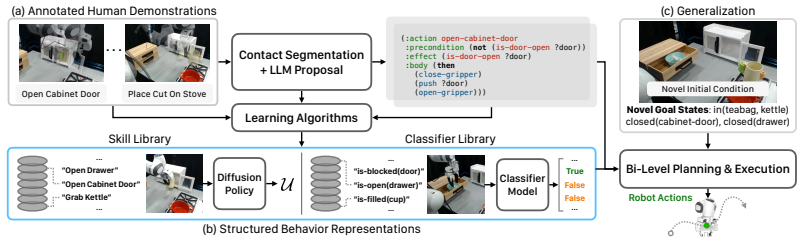
The load-bearing object is a behavior, defined as a PDDL-style tuple $\langle name, args, pre, eff, \pi \rangle$: a symbolic precondition and effect formula paired with a neural policy $\pi$. BLADE generates the symbolic part by asking a large language model to interpret language-annotated demonstrations that have been segmented into contact primitives, and uses the generated body section to re-segment noisy trajectories. The mechanism that carries the automatic-learning claim is automatic predicate annotation: unrolling the proposed behavior sequence labels many observations as positive or negative examples for each predicate, training classifiers $f_\theta(p): O \to \{T,F\}$ without human labels. At execution time, the planner operates on this grounded abstract state, and replanning after each behavior is what turns perturbations and hidden-object situations into solvable subgoals.
What would settle it
Take a trained BLADE domain and swap one effect in a single behavior description, for example make 'turn on faucet' claim is-filled(kettle) while keeping all demonstrations and training labels otherwise identical. If the resulting state classifier for is-filled still reaches high accuracy on held-out real states and plans still succeed, then the automatic recovery does not actually depend on the correctness of the LLM's proposed abstractions; if accuracy or success collapses, the paper's claims are tied to that correctness.
Extended reading notes
Core claim
BLADE's central discovery is that a small fixed vocabulary of contact primitives, namely grasp, place, move, push, move-to, open, and close, gives a large language model enough structure to propose PDDL-style behavior descriptions whose preconditions and effects are causally consistent with the demonstrations. Those descriptions are then not just plan templates but also an automatic labeling mechanism: by unrolling the behavior sequence over the recorded observations, the system marks states before an action as satisfying its preconditions and states after it as satisfying its effects, generating training labels for visual state classifiers with no human annotation. With these classifiers grounding the abstract state, a planner chains the learned behaviors, and because planning is rerun after each behavior, the loop absorbs perturbations, geometric constraints, and partial observability. The paper validates this in simulation and on a real robot, reporting that the approach completes novel compositions of behaviors at higher rates than latent-planning and LLM/VLM planning baselines.
Load-bearing premise
The load-bearing premise is that the LLM-proposed behavior descriptions are correct enough to be used as training labels, because the automatic predicate annotation converts those descriptions into ground-truth supervision for state classifiers without any independent check against real states.
Editorial extensions
If this is right
- Any language goal expressible with the learned predicates becomes reachable without retraining, by composing existing behavior policies through the planner.
- A perturbation mid-task is converted into a replanning event, so moving an object or failing an execution no longer ends the episode.
- Visibility and geometric clearance, encoded as ordinary preconditions, let the planner insert search and obstacle-removal steps before the behavior that needs them.
- The same demonstrations supply training signal for every predicate classifier through label propagation, removing the need for state labels or manually authored transition models.
- Labeling the whole observation stream, not only segment endpoints, is what the paper's ablation identifies as the source of classifier accuracy and thus of planning success.
Reading between the lines
- If predicate invention were fully automated, BLADE would no longer need its one remaining manual input, the list of predicate names; the appendix's predicate-generation experiment suggests this is close but not yet the paper's central claim.
- The same automatically generated predicate labels could be reused as in-context examples or fine-tuning data for general-purpose vision-language classifiers, a use the paper only sketches in its appendix.
- Replacing the most-likely-state planner with a belief-space or observation-based planner would be the natural upgrade for partial observability; BLADE currently gets by with optimistic visibility effects and replanning.
- Because the contact-primitive segmentation relies on gripper state thresholds, the framework would need finer contact sensing to cover caging or sustained-contact manipulations, a limitation the paper states.
Editorial analysis
A structured set of objections, weighed in public.
Referee Report
Summary. The paper introduces BLADE, a framework for long-horizon robotic manipulation that combines imitation learning with model-based planning. Given language-annotated demonstrations, BLADE segments trajectories into contact primitives, uses an LLM to propose PDDL-style behavior descriptions with preconditions and effects, and automatically generates observation-level labels to train visual predicate classifiers and diffusion-policy controllers. At test time, a symbolic planner composes these behaviors, with replanning after each execution. The authors evaluate in the CALVIN simulation benchmark on three generalization categories (abstract goals, geometric constraints, partial observability) and in two real-world tabletop domains, reporting substantial improvements over latent-planning and LLM/VLM baselines. The main claims are that BLADE recovers structured action representations automatically, without manual state labels or symbolic definitions, and that these representations support generalization to novel initial states, perturbations, and goals.
Significance. If the claims hold, BLADE would be a meaningful step toward automatic acquisition of grounded symbolic abstractions for long-horizon manipulation: it replaces manually designed predicate groundings or symbolic action definitions with LLM-generated operators combined with learned visual classifiers. The simulation results on CALVIN show clear gains over HULC, SayCan, Robot-VILA, and Text2Motion, and the ablation against Migimatsu and Bohg shows the value of the proposed label-propagation scheme over prior classifier learning. The paper also provides detailed appendices with algorithm pseudocode (Algorithms 1 and 2), full LLM prompts, and task definitions, which substantially aids reproducibility. However, as detailed below, the automatic predicate-annotation loop is not audited against ground-truth states, and the headline 'without symbolic definitions' claim is stronger than the implementation's requirement of a provided predicate list. The approach is significant if these gaps are addressed.
major comments (3)
- [Section 4.2, Algorithm 2] The supervision for every predicate classifier is generated from the LLM's own preconditions and effects, with labels assigned before and after behaviors by unrolling the symbolic operators; the same operators are then used by the planner that the classifiers feed. Section 4.1's abstract verification checks only that accumulated symbolic effects satisfy later preconditions, not that the atoms match the observed state before or after each action. If an LLM operator omits a predicate that actually changes, Algorithm 2 propagates the stale label to subsequent time steps (lines 10-24). For example, if place-in-drawer did not delete is-on(block, table), the is-on classifier would receive positive labels on images of a block inside the drawer. Because CALVIN provides simulator ground-truth states, this can be audited directly. I ask the authors to (i) evaluate the learned classifiers against ground-truth predicate values on held-out states, and (ii) report the accuracy of the LLM-proposed operators' preconditions and effects against observed state changes. Without such an audit, the F1 improvement cited in Section 5.2 and the end-to-end success rates in Table 1 are consistent with an internally self-consistent but misgrounded model, and the central claim of recovering grounded representations is not established.
- [Abstract and Section 3] The abstract claims that BLADE recovers structured representations 'without manually labeled states or symbolic definitions,' but Section 3 states that 'BLADE requires humans to additionally provide a list of predicate names in natural language,' and the main simulation and real-world results use expert-provided predicates. Appendix A.2 shows automatic predicate generation only as an additional study (28/30 predicates match), not as part of the main pipeline. Since predicate names are themselves part of the symbolic vocabulary, the headline claim overstates what the main experiments demonstrate. Please either integrate automatic predicate generation into the main evaluation or qualify the claim to 'without manually labeled states' while stating that the predicate vocabulary is provided by the user.
- [Section 5.3, Fig. 5] The real-robot evaluation reports counts out of six trials per condition with no variance, confidence intervals, or per-trial detail, and all tasks are author-designed. With n=6, the claim that BLADE 'significantly outperforms' Robot-VILA is not statistically supportable. I recommend either increasing the number of trials, reporting exact binomial confidence intervals, or softening the significance wording. This does not undermine the simulation-based evidence, but the real-world generalization claim in the abstract should be scaled to what the data can support.
minor comments (5)
- [Algorithm 2] The pseudocode uses the variable t both as the behavior index and as the time step inside GETTIMEDPREDICATES, which makes the indexing ambiguous; please clarify the notation.
- [Algorithm 1] The abstract verification threshold is not specified anywhere in the paper; please report the value used in the experiments and, if possible, a sensitivity analysis over this threshold.
- [Section 5.2, Table 2] The text reports F1 improvements of 20.7% overall, 16.3% for object states, and 38.6% for spatial relations, but Table 2 shows only planning success rates; adding a classifier-level table with per-predicate F1 would make the comparison with Migimatsu and Bohg more concrete.
- [Table 1] The column headers 'State Classifier' and 'Latent Feasibility' are not explained in the caption; please state what entries such as 'N/A', 'Short', 'Long', 'Learned', and 'GT' mean.
- [General] The paper does not state whether code or trained models will be released; please add a statement on code availability to improve reproducibility.
Circularity Check
Predicate groundings and their F1 evaluation are both derived from the same LLM-generated behavior descriptions, so the 'recovered' representation is a self-consistent bootstrap rather than an independently verified grounding.
-
self definitional
[Section 4.2 'Automatic predicate annotation' and Algorithm 2]
"before applying a behavior a at step ot, we label all predicates in prea true and predicates in effa false. When a finishes at step ot′, we label all predicates in effa. In addition, we will propagate the labels for state predicates to later time steps until they are explicitly altered by another behavior a."
The classifier supervision is generated from the LLM-proposed preconditions and effects—the very symbolic description whose grounding BLADE claims to recover. Algorithm 1's abstract verification only checks that prior operators' symbolic effects entail the next preconditions; it never checks atoms against observed state. If an effect omits a predicate that really changes (e.g., place_in_drawer omitting is-on(block, table)), Algorithm 2 propagates the stale label and the classifier learns it as ground truth. No audit against CALVIN simulator ground truth or real-world states is reported, so the 'recovered' representation is internally consistent but not independently grounded.
-
fitted input called prediction
[Section 5.2, Table 2 ablation text]
"We compare the two classifier learning algorithms, given the same LLM-generated behavior definitions, by evaluating the classifier accuracy on held-out states. BLADE shows a 20.7% improvement in F1 (16.3% improvement for classifying object states and 38.6% improvement for classifying spatial relations) compared to the baseline model."
The 'held-out states' used for this F1 comparison are labeled by the same automatic predicate annotation (Algorithm 2) that derives all labels from the LLM-generated behavior definitions. Both BLADE and the Migimatsu-and-Bohg baseline are trained and evaluated against labels produced by the same symbolic descriptions, so the reported F1 measures agreement with the LLM operator semantics, not accuracy against physical state. The evaluation target is generated by the same source whose grounding is being measured; end-to-end success in Table 1 is external but does not isolate whether the recovered predicates and operators are correct.
full rationale
The paper's main loop is: LLM proposes behavior operators; Algorithm 2 labels observations using those operators; classifiers are trained on those labels; the planner consumes the classifiers; Table 2 evaluates classifier accuracy on the same self-generated labels. This makes the claimed 'automatic recovery' of grounded state abstractions a bootstrap: the symbolic description determines the perceptual groundings that are then presented as recovered from data. The abstract verification (Algorithm 1) only checks symbolic self-consistency of operator chains, and no direct comparison to CALVIN's simulator ground-truth states is reported for operator correctness or classifier accuracy. The paper is transparent that labels come from behavior descriptions, but the F1 numbers in Table 2 are nevertheless self-referential. The Limitations section also concedes that a given set of predicate names is assumed, which tempers the abstract's 'without symbolic definitions' but is a scope caveat rather than another circular step. The mitigating factor is that end-to-end generalization success (Table 1, real-robot experiments) uses externally defined goal satisfaction functions, so the system as a whole has independent content and is not merely restating its inputs. Because the central representation-evaluation claim reduces by construction to the LLM-generated labels, a score of 6 is appropriate. There is no load-bearing self-citation or imported uniqueness theorem.
Assumptions & free parameters
free parameters (1)
- Abstract verification threshold =
not specified
assumptions (5)
- domain assumption Each behavior corresponds to a single contact primitive sequence and a single language label.
- ad hoc to paper The LLM-generated behavior descriptions (preconditions and effects) are correct for the domain.
- ad hoc to paper Predicate effects persist until explicitly altered by another behavior.
- domain assumption Contact-based temporal segmentation from gripper state correctly identifies behavior boundaries.
- domain assumption In simulation, ground-truth segmentation masks and contact states are available for training.
Cite this review
Pith. "Pith review of Learning Compositional Behaviors from Demonstration and Language." pith.science (2026). https://pith.science/paper/UQUIGJEU
@misc{pith2026250521981,
  author       = {Pith},
  title        = {Pith review of: Learning Compositional Behaviors from Demonstration and Language},
  year         = {2026},
  howpublished = {\url{https://pith.science/paper/UQUIGJEU}},
  note         = {Machine review of arXiv:2505.21981}
}
read the original abstract
We introduce Behavior from Language and Demonstration (BLADE), a framework for long-horizon robotic manipulation by integrating imitation learning and model-based planning. BLADE leverages language-annotated demonstrations, extracts abstract action knowledge from large language models (LLMs), and constructs a library of structured, high-level action representations. These representations include preconditions and effects grounded in visual perception for each high-level action, along with corresponding controllers implemented as neural network-based policies. BLADE can recover such structured representations automatically, without manually labeled states or symbolic definitions. BLADE shows significant capabilities in generalizing to novel situations, including novel initial states, external state perturbations, and novel goals. We validate the effectiveness of our approach both in simulation and on real robots with a diverse set of objects with articulated parts, partial observability, and geometric constraints.
Figures


Figures from the paper (3 more)



Reference graph
Works this paper leans on
-
[1]
C. Chi, S. Feng, Y . Du, Z. Xu, E. Cousineau, B. Burchfiel, and S. Song. Diffusion policy: Visuomotor policy learning via action diffusion. InRSS, 2023. 1, 5, 18, 19
2023
-
[2]
C. R. Garrett, T. Lozano-P ´erez, and L. P. Kaelbling. PDDLStream: Integrating Symbolic Planners and Blackbox Samplers via Optimistic Adaptive Planning. InICAPS, 2020. 1, 2
2020
-
[3]
D. Xu, A. Mandlekar, R. Mart ´ın-Mart´ın, Y . Zhu, S. Savarese, and L. Fei-Fei. Deep affordance foresight: Planning through what can be done in the future. InICRA, 2021
2021
-
[4]
H. Shi, H. Xu, Z. Huang, Y . Li, and J. Wu. RoboCraft: Learning to see, simulate, and shape elasto-plastic objects in 3d with graph networks.IJRR, 43(4):533–549, 2024. 1
2024
-
[5]
Lynch, M
C. Lynch, M. Khansari, T. Xiao, V . Kumar, J. Tompson, S. Levine, and P. Sermanet. Learning latent plans from play. InCoRL, 2020. 1
2020
-
[6]
Brohan, Y
A. Brohan, Y . Chebotar, C. Finn, K. Hausman, A. Herzog, D. Ho, J. Ibarz, A. Irpan, E. Jang, R. Julian, et al. Do as I can, not as I say: Grounding language in robotic affordances. InCoRL,
-
[7]
Srivastava, E
S. Srivastava, E. Fang, L. Riano, R. Chitnis, S. Russell, and P. Abbeel. Combined Task and Motion Planning through an Extensible Planner-Independent Interface Layer. InICRA, 2014. 2
2014
-
[8]
N. T. Dantam, Z. K. Kingston, S. Chaudhuri, and L. E. Kavraki. Incremental task and motion planning: A constraint-based approach. InRSS, 2016
2016
Show all 118 references
-
[9]
Toussaint
M. Toussaint. Logic-Geometric Programming: An optimization-based approach to combined task and motion planning. InIJCAI, 2015
2015
-
[10]
Curtis, X
A. Curtis, X. Fang, L. P. Kaelbling, T. Lozano-P´erez, and C. R. Garrett. Long-horizon manipu- lation of unknown objects via task and motion planning with estimated affordances. InICRA, 2022
2022
-
[11]
Driess, O
D. Driess, O. Oguz, J.-S. Ha, and M. Toussaint. Deep visual heuristics: Learning feasibility of mixed-integer programs for manipulation planning. InICRA, 2020
2020
-
[12]
Z. Yang, C. R. Garrett, T. Lozano-P ´erez, L. Kaelbling, and D. Fox. Sequence-based plan feasibility prediction for efficient task and motion planning. InRSS, 2023. 2
2023
-
[13]
Finn and S
C. Finn and S. Levine. Deep visual foresight for planning robot motion. InICRA, 2017. 2
2017
-
[14]
Nair and C
S. Nair and C. Finn. Hierarchical foresight: Self-supervised learning of long-horizon tasks via visual subgoal generation. InICLR, 2020
2020
-
[15]
H. Shi, H. Xu, S. Clarke, Y . Li, and J. Wu. Robocook: Long-horizon elasto-plastic object manipulation with diverse tools. InCoRL, 2023
2023
-
[16]
Simeonov, Y
A. Simeonov, Y . Du, B. Kim, F. Hogan, J. Tenenbaum, P. Agrawal, and A. Rodriguez. A long horizon planning framework for manipulating rigid pointcloud objects. InCoRL, 2021. 9
2021
-
[17]
X. Lin, C. Qi, Y . Zhang, Z. Huang, K. Fragkiadaki, Y . Li, C. Gan, and D. Held. Planning with spatial and temporal abstraction from point clouds for deformable object manipulation. In CoRL, 2022
2022
-
[18]
Y . Du, M. Yang, P. Florence, F. Xia, A. Wahid, B. Ichter, P. Sermanet, T. Yu, P. Abbeel, J. B. Tenenbaum, et al. Video language planning.arXiv:2310.10625, 2023. 2
2023 arXiv
-
[19]
J. Luo, C. Xu, X. Geng, G. Feng, K. Fang, L. Tan, S. Schaal, and S. Levine. Multi-stage cable routing through hierarchical imitation learning.IEEE Transactions on Robotics, 2024. 2
2024
-
[20]
L. X. Shi, Z. Hu, T. Z. Zhao, A. Sharma, K. Pertsch, J. Luo, S. Levine, and C. Finn. Yell at your robot: Improving on-the-fly from language corrections.arXiv:2403.12910, 2024
2024 arXiv
-
[21]
S. Pirk, K. Hausman, A. Toshev, and M. Khansari. Modeling long-horizon tasks as sequential interaction landscapes. InCoRL, 2020
2020
-
[22]
C. Wang, L. Fan, J. Sun, R. Zhang, L. Fei-Fei, D. Xu, Y . Zhu, and A. Anandkumar. Mimicplay: Long-horizon imitation learning by watching human play. InCoRL, 2023
2023
-
[23]
Lynch and P
C. Lynch and P. Sermanet. Language conditioned imitation learning over unstructured data. In RSS, 2021. 2
2021
-
[24]
O. Mees, J. Borja-Diaz, and W. Burgard. Grounding language with visual affordances over unstructured data. InICRA, 2023. 21
2023
-
[25]
Mandlekar, C
A. Mandlekar, C. Garrett, D. Xu, and D. Fox. Human-in-the-loop task and motion planning for imitation learning. InCoRL, 2023. 2
2023
-
[26]
Zhang, Y
Z. Zhang, Y . Li, O. Bastani, A. Gupta, D. Jayaraman, Y . J. Ma, and L. Weihs. Universal Visual Decomposer: Long-horizon manipulation made easy. InICRA, 2024. 2
2024
-
[27]
Y . Zhu, P. Stone, and Y . Zhu. Bottom-up skill discovery from unsegmented demonstrations for long-horizon robot manipulation.IEEE Robotics and Automation Letters, 7(2):4126–4133,
-
[28]
Y . Zhu, J. Tremblay, S. Birchfield, and Y . Zhu. Hierarchical planning for long-horizon manipu- lation with geometric and symbolic scene graphs. InICRA, 2020. 2
2020
-
[29]
Huang, S
D.-A. Huang, S. Nair, D. Xu, Y . Zhu, A. Garg, L. Fei-Fei, S. Savarese, and J. C. Niebles. Neural task graphs: Generalizing to unseen tasks from a single video demonstration. InCVPR, 2019
2019
-
[30]
Huang, D
D.-A. Huang, D. Xu, Y . Zhu, A. Garg, S. Savarese, F.-F. Li, and J. C. Niebles. Continuous relaxation of symbolic planner for one-shot imitation learning. InIROS, 2019
2019
-
[31]
Huang, N
Y . Huang, N. C. Taylor, A. Conkey, W. Liu, and T. Hermans. Latent space planning for multi-object manipulation with environment-aware relational classifiers.IEEE Transactions on Robotics, 2024. 2
2024
-
[32]
Konidaris, L
G. Konidaris, L. P. Kaelbling, and T. Lozano-Perez. From skills to symbols: Learning symbolic representations for abstract high-level planning.Journal of Artificial Intelligence Research, 61: 215–289, 2018. 2
2018
-
[33]
Silver, R
T. Silver, R. Chitnis, N. Kumar, W. McClinton, T. Lozano-P ´erez, L. Kaelbling, and J. B. Tenenbaum. Predicate invention for bilevel planning. InAAAI, 2023
2023
-
[34]
Ahmetoglu, E
A. Ahmetoglu, E. Oztop, and E. Ugur. Symbolic manipulation planning with discovered object and relational predicates.arXiv preprint arXiv:2401.01123, 2024
2024 arXiv
-
[35]
N. Shah, J. Nagpal, P. Verma, and S. Srivastava. From reals to logic and back: Inventing symbolic vocabularies, actions and models for planning from raw data.arXiv preprint arXiv:2402.11871, 2024. 10
2024
-
[36]
M. Han, Y . Zhu, S.-C. Zhu, Y . N. Wu, and Y . Zhu. Interpret: Interactive predicate learning from language feedback for generalizable task planning. InRSS, 2024. 2
2024
-
[37]
Huang, P
W. Huang, P. Abbeel, D. Pathak, and I. Mordatch. Language models as zero-shot planners: Extracting actionable knowledge for embodied agents. InICML, 2022. 2
2022
-
[38]
Silver, V
T. Silver, V . Hariprasad, R. S. Shuttleworth, N. Kumar, T. Lozano-P´erez, and L. P. Kaelbling. Pddl planning with pretrained large language models. InNeurIPS 2022 foundation models for decision making workshop, 2022. 2
2022
-
[39]
Valmeekam, M
K. Valmeekam, M. Marquez, S. Sreedharan, and S. Kambhampati. On the planning abilities of large language models-a critical investigation. InNeurIPS, 2023. 2
2023
-
[40]
Kambhampati, K
S. Kambhampati, K. Valmeekam, L. Guan, K. Stechly, M. Verma, S. Bhambri, L. Saldyt, and A. Murthy. Llms can’t plan, but can help planning in llm-modulo frameworks.arXiv:2402.01817,
-
[41]
Y . Chen, J. Arkin, Y . Zhang, N. Roy, and C. Fan. AutoTAMP: Autoregressive task and motion planning with llms as translators and checkers. InICRA, 2024. 2
2024
-
[42]
B. Liu, Y . Jiang, X. Zhang, Q. Liu, S. Zhang, J. Biswas, and P. Stone. LLM+P: Empowering large language models with optimal planning proficiency.arXiv:2304.11477, 2023
2023 arXiv
-
[43]
Y . Xie, C. Yu, T. Zhu, J. Bai, Z. Gong, and H. Soh. Translating natural language to planning goals with large-language models.arXiv:2302.05128, 2023
2023 arXiv
-
[44]
Mavrogiannis, C
A. Mavrogiannis, C. Mavrogiannis, and Y . Aloimonos. Cook2ltl: Translating cooking recipes to ltl formulae using large language models. InICRA, 2024. 2
2024
-
[45]
Silver, S
T. Silver, S. Dan, K. Srinivas, J. B. Tenenbaum, L. Kaelbling, and M. Katz. Generalized planning in PDDL domains with pretrained large language models. InAAAI, 2024. 2
2024
-
[46]
X. Zhu, Y . Chen, H. Tian, C. Tao, W. Su, C. Yang, G. Huang, B. Li, L. Lu, X. Wang, et al. Ghost in the Minecraft: Generally capable agents for open-world enviroments via large language models with text-based knowledge and memory.arXiv:2305.17144, 2023. 2
2023 arXiv
-
[47]
Nottingham, P
K. Nottingham, P. Ammanabrolu, A. Suhr, Y . Choi, H. Hajishirzi, S. Singh, and R. Fox. Do embodied agents dream of pixelated sheep: Embodied decision making using language guided world modelling. InICML, 2023. 2
2023
-
[48]
S. Hao, Y . Gu, H. Ma, J. J. Hong, Z. Wang, D. Z. Wang, and Z. Hu. Reasoning with language model is planning with world model. InEMNLP, 2023. 2
2023
-
[49]
Liang, W
J. Liang, W. Huang, F. Xia, P. Xu, K. Hausman, B. Ichter, P. Florence, and A. Zeng. Code as policies: Language model programs for embodied control. InICRA, 2023. 2
2023
-
[50]
Singh, V
I. Singh, V . Blukis, A. Mousavian, A. Goyal, D. Xu, J. Tremblay, D. Fox, J. Thomason, and A. Garg. Progprompt: Generating situated robot task plans using large language models. In ICRA, 2023. 2
2023
-
[51]
K. Lin, C. Agia, T. Migimatsu, M. Pavone, and J. Bohg. Text2motion: From natural language instructions to feasible plans.Autonomous Robots, 47(8):1345–1365, 2023. 2, 6
2023
-
[52]
Skreta, Z
M. Skreta, Z. Zhou, J. L. Yuan, K. Darvish, A. Aspuru-Guzik, and A. Garg. Replan: Robotic replanning with perception and language models.arXiv:2401.04157, 2024. 2
2024 arXiv
-
[53]
Driess, F
D. Driess, F. Xia, M. S. Sajjadi, C. Lynch, A. Chowdhery, B. Ichter, A. Wahid, J. Tompson, Q. Vuong, T. Yu, et al. Palm-e: An embodied multimodal language model.arXiv:2303.03378,
-
[54]
Z. Wu, Z. Wang, X. Xu, J. Lu, and H. Yan. Embodied task planning with large language models. arXiv:2307.01848, 2023
2023 arXiv
-
[55]
Xiang, T
J. Xiang, T. Tao, Y . Gu, T. Shu, Z. Wang, Z. Yang, and Z. Hu. Language models meet world models: Embodied experiences enhance language models. InNeurIPS, 2024. 2
2024
-
[56]
H. Wang, K. Kedia, J. Ren, R. Abdullah, A. Bhardwaj, A. Chao, K. Y . Chen, N. Chin, P. Dan, X. Fan, et al. Mosaic: A modular system for assistive and interactive cooking.arXiv preprint arXiv:2402.18796, 2024. 2
2024
-
[57]
Y . Hu, F. Lin, T. Zhang, L. Yi, and Y . Gao. Look before you leap: Unveiling the power of GPT-4v in robotic vision-language planning.arXiv:2311.17842, 2023. 2, 6
2023 arXiv
-
[58]
N. Wake, A. Kanehira, K. Sasabuchi, J. Takamatsu, and K. Ikeuchi. ChatGPT empowered long-step robot control in various environments: A case application.IEEE Access, 2023. 2
2023
-
[59]
L. Wong, J. Mao, P. Sharma, Z. S. Siegel, J. Feng, N. Korneev, J. B. Tenenbaum, and J. Andreas. Learning adaptive planning representations with natural language guidance. InICLR, 2024. 2
2024
-
[60]
L. Guan, K. Valmeekam, S. Sreedharan, and S. Kambhampati. Leveraging pre-trained large language models to construct and utilize world models for model-based task planning. In NeurIPS, 2023
2023
-
[61]
Smirnov, F
P. Smirnov, F. Joublin, A. Ceravola, and M. Gienger. Generating consistent PDDL domains with large language models.arXiv:2404.07751, 2024. 2
2024 arXiv
-
[62]
Z. Li, K. Yu, S. Cheng, and D. Xu. League++: Empowering continual robot learning through guided skill acquisition with large language models. InICLR 2024 Workshop on Large Language Model (LLM) Agents, 2024. 2
2024
-
[63]
Dalal, T
M. Dalal, T. Chiruvolu, D. Chaplot, and R. Salakhutdinov. Plan-seq-learn: Language model guided rl for solving long horizon robotics tasks. InICLR, 2024. 2
2024
-
[64]
Lifschitz
V . Lifschitz. On the semantics of STRIPS. In M. Georgeff, Lansky, and Amy, editors,Reasoning about Actions and Plans, pages 1–9. Morgan Kaufmann, San Mateo, CA, 1987. 3
1987
-
[65]
Aeronautiques, A
C. Aeronautiques, A. Howe, C. Knoblock, I. D. McDermott, A. Ram, M. Veloso, D. Weld, D. W. SRI, A. Barrett, and D. Christianson. PDDL: The Planning Domain Definition Language, 1998. 4
1998
-
[66]
Migimatsu and J
T. Migimatsu and J. Bohg. Grounding predicates through actions. InICRA, 2022. 5, 7
2022
-
[67]
J. Mao, T. Lozano-P ´erez, J. Tenenbaum, and L. Kaelbling. PDSketch: Integrated domain programming, learning, and planning. InNeurIPS, 2022. 5
2022
-
[68]
S. Liu, Z. Zeng, T. Ren, F. Li, H. Zhang, J. Yang, C. Li, J. Yang, H. Su, J. Zhu, et al. Grounding Dino: Marrying dino with grounded pre-training for open-set object detection. arXiv:2303.05499, 2023. 5, 17
2023 arXiv
-
[69]
Hoffmann and B
J. Hoffmann and B. Nebel. The FF planning system: Fast plan generation through heuristic search.JAIR, 14:253–302, 2001. 5
2001
-
[70]
M. Helmert. The fast downward planning system.JAIR, 26:191–246, 2006. 5
2006
-
[71]
O. Mees, L. Hermann, E. Rosete-Beas, and W. Burgard. Calvin: A benchmark for language- conditioned policy learning for long-horizon robot manipulation tasks.RA-L, 7:7327–7334,
-
[72]
O. Mees, L. Hermann, and W. Burgard. What matters in language conditioned robotic imitation learning over unstructured data.RA-L, 7:11205–11212, 2022. 6, 21 12
2022
-
[73]
Zhang, X
Y . Zhang, X. Huang, J. Ma, Z. Li, Z. Luo, Y . Xie, Y . Qin, T. Luo, Y . Li, S. Liu, et al. Recognize Anything: A strong image tagging model. InCVPR, 2024. 14
2024
-
[74]
Shridhar, L
M. Shridhar, L. Manuelli, and D. Fox. Perceiver-Actor: A multi-task transformer for robotic manipulation. InCoRL, 2023. 16
2023
-
[75]
T.-W. Ke, N. Gkanatsios, and K. Fragkiadaki. 3D Diffuser Actor: Policy diffusion with 3D scene representations.arXiv:2402.10885, 2024. 16
2024 arXiv
-
[76]
Zhang, Y
Z. Zhang, Y . Li, O. Bastani, A. Gupta, D. Jayaraman, Y . J. Ma, and L. Weihs. Universal Visual Decomposer: Long-horizon manipulation made easy. InICRA, 2024. 16
2024
-
[77]
W. Wan, Y . Zhu, R. Shah, and Y . Zhu. Lotus: Continual imitation learning for robot manipulation through unsupervised skill discovery. InICRA, 2024. 16
2024
-
[78]
Guo, J.-X
M.-H. Guo, J.-X. Cai, Z.-N. Liu, T.-J. Mu, R. R. Martin, and S.-M. Hu. PCT: Point cloud transformer.Computational Visual Media, 7:187–199, 2021. 17
2021
-
[79]
L. P. Kaelbling and T. Lozano-P´erez. Hierarchical task and motion planning in the now. In ICRA, 2011. 19, 20
2011
-
[80]
place the kettle on the stove
C. R. Garrett, C. Paxton, T. Lozano-P´erez, L. P. Kaelbling, and D. Fox. Online replanning in belief space for partially observable task and motion problems. InICRA, 2020. 20 13 Supplementary Material for Learning Compositional Behaviors from Demonstration and Language This su...
2020
-
[81]
Move Faucet Head 3
Place In Sink 2. Move Faucet Head 3. Turn On Faucet 4. Turn Off Faucet
-
[82]
Place Pot on Table 7
Move Faucet Away 6. Place Pot on Table 7. Move Kettle to Stove Unseen Init., Pertub., Geo. Constr. Unseen Initial Conditions Initial States Human Perturbation Perturbed States Geometric Constraints Initial States Not Seen During Training Figure A2:Training and testing states f...
-
[83]
Open Right Door 3
Unblock Doors 2. Open Right Door 3. Place Kettle On Stove 4. Open Drawer 5. Place Teabag In Kettle Unseen Initial Conditions Initial States Human Perturbation Intermediate States Geometric Constraints Initial States Partial Observability Initial States
-
[84]
place_in_slider
Unblock Doors 2. Open Right Door 3. Place Kettle On Stove 4. Open Drawer 5. Place Teabag In Kettle Not Seen During Training Figure A3:Training and testing states for the Make Tea domain. • Initial State:The kettle is placed inside the sink and the stove is blocked, creating a ...
-
[85]
place_in_slider
Parse the goal. For example "place_in_slider", the goal is to place a block into the slider
-
[86]
lift_block_table
Think about the possible effects achieved by previous tasks and the previous actions that have been performed. For "lift_block_table", a block is lifted from the table and the effect is that the block is lifted. For "lift_block_drawer", a block is lifted from the drawer and th...
-
[87]
place_in_slider
Parse the demonstrations and choose the combination of primitives for the current task. The demonstrations are noisy so that the demonstrated primitive sequences may include extra primitive actions that are not necessary for the current task at the beginning or end. The extra ...
-
[88]
place_in_slider
Think about the preconditions. Also specify the types of all relevant objects in the preconditions. 4a. In this case, previous tasks are relevant to the current task. We should think about the effects of the previous tasks. For "place_in_slider", the effects of previous tasks ...
-
[89]
place_in_slider
Think about the effects. For "place_in_slider", the effects are that the block is in the slider and the block is not lifted
-
[90]
**Additional Instructions: **
Write down the mechanism in the format of the example. **Additional Instructions: **
-
[91]
mechanism
Make sure the generated lifted description starts with <code name="mechanism"> and ends with </code>
-
[92]
You can only use the predicates listed above
Please do not invent any new predicates for the precondition and effect. You can only use the predicates listed above
-
[93]
For example, a robot arm can not go through a closed door
Consider the physical constraints of the objects. For example, a robot arm can not go through a closed door
-
[94]
primitive_sequence
For each parameter in :parameters, you should use one of the predicates for specifying the type of the object to indicate its type (e.g., is-drawer, is-block, and etc). Listing 6: Example Prompt for CALVIN–Task Input. **Current Task: ** place_in_drawer **Example Sequences: ** ...
-
[95]
lift_red_block_table
-
[96]
lift_red_block_slider
-
[97]
lift_red_block_drawer
-
[98]
lift_blue_block_table
-
[99]
lift_blue_block_slider
-
[100]
lift_blue_block_drawer
-
[101]
lift_pink_block_table
-
[102]
lift_pink_block_slider
-
[103]
lift_pink_block_drawer
-
[104]
rotate_red_block_right
-
[105]
rotate_red_block_left
-
[106]
rotate_blue_block_right
-
[107]
rotate_blue_block_left
-
[108]
rotate_pink_block_right
-
[109]
rotate_pink_block_left
-
[110]
push_red_block_right
-
[111]
push_blue_block_right
-
[112]
push_blue_block_left
-
[113]
push_pink_block_right
-
[114]
push_pink_block_left
-
[115]
Group the predicates into unary predicates that define the states of objects and binary relations that specify relations between two objects
turn_off_led Before writing the operators, define the predicates that should be used to write the preconditions and effects of the operators. Group the predicates into unary predicates that define the states of objects and binary relations that specify relations between two ob...
-
[117]
Think Step-by-Step. Goal predicate: {Based on the given task} Current symbolic state: {Based on the simulator state} Executed actions: {Based on the previously executed actions} Listing 9: Initial Prompt for Robot-VILA. You are highly skilled in robotic task planning, breaking...
-
[118]
Place the list between ‘‘‘python and ends with ‘‘‘
Make sure the generated plan is a list of actions. Place the list between ‘‘‘python and ends with ‘‘‘
-
[119]
Think Step-by-Step. 37
Reviewed August 7, 2026 · model on record in the stance chip above.
Discussion (0). Sign in to comment.