REVIEW 3 major objections 6 minor 26 references
Spin current compensation from competing magnon modes in ferrimagnets
T0 review · 3 major / 6 minor · reviewed 2026-08-07 · deepseek-v4-flash
Pith's one-line read This paper claims that in the compensated ferrimagnet GdIG, the low-temperature sign reversal of thermal spin pumping arises from a statistical cancellation between right- and left-handed magnon populations, not from a crossing of the…
desk verdict A clean qualitative story about magnon-mode cancellation in GdIG, but the quantitative TA/TB=0.3 rests on an unproven equal-weight assumption that likely shifts the result. read the letter →
The pith
A machine-rendered reading of the paper's core claim, the machinery that carries it, and where it could break.
The reading
What carries the argument
The carrying objects are the temperature-dependent eigenvalues of the linearized Landau–Lifshitz equations for the Fe and Gd sublattices, obtained from a Hamiltonian with Fe–Fe exchange constant $I$ and Fe–Gd exchange constant $\lambda$, plus the sign convention that right-handed modes enter transport with positive frequency and left-handed modes with negative frequency. The key identity is the substitution in Eq. (13), which sends the negative-frequency branch's Bose–Einstein factor $1/(e^{\beta\omega}-1)$ to $1/(e^{-\beta\omega}-1)$, making mode populations additive in $L_0$ but subtractive in $L_1$, analogous to electrons and holes. The compensation temperature is the root of the resulting frequency-weighted integral, with sublattice magnetizations fixed self-consistently by Brillouin functions. The model's analytical transparency comes from neglecting Gd–Gd exchange, anisotropy, and dipolar terms, with corrections estimated in the appendix.
What would settle it
A temperature- and field-resolved measurement of the spin Seebeck voltage of GdIG/Pt that resolves the two magnon branches would settle the claim: the paper predicts $T_A/T_B \approx 0.3$ set by the integrated Bose-population balance, so observing $T_A$ instead track the $|\omega_R| = |\omega_L|$ crossing as the field or exchange parameters are varied would falsify the statistical-cancellation interpretation.
Extended reading notes
Core claim
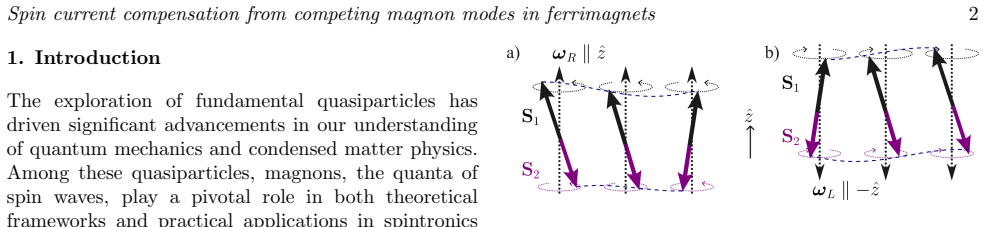
Within the paper's two-magnetic-lattice model of GdIG, the spin-wave spectrum has two branches of opposite sign: $\omega_R > 0$ for right-handed and $\omega_L < 0$ for left-handed precession, with a temperature dependence entering through the sublattice magnetizations $S_{\mathrm{Fe},z}(T)$ and $S_{\mathrm{Gd},z}(T)$. Substituting the two branches into the spin-transport integrals gives $L_0$ as the sum of both mode populations and $L_1$ as the difference of their frequency-weighted populations, since the Bose factor for negative frequencies is $1/(e^{-\beta\omega}-1)$. The paper's central numerical result is that the total $L_1$ crosses zero at $T_A/T_B = 0.3$ in the low-temperature regime, reproducing the measured compensation temperatures (72\,K and 80\,K against $T_B \simeq 250$\,\u2013\,256.5 K), while $L_0$ stays positive because the two contributions add. The author emphasizes that this cancellation is not tied to $|\omega_R| = |\omega_L|$: a spectral crossing occurs at high temperatures where spin pumping remains finite, and the low-temperature compensation occurs without any crossing.
Load-bearing premise
The argument assumes that both magnon branches pump spin through one interface channel characterized by a single spin-mixing conductance $G$, weighted only by the total spin $S_z$, so the two branches' contributions add in $L_0$ and subtract in $L_1$; if the Fe and Gd sublattices couple to the adjacent metal with different efficiencies, the cancellation point could shift or disappear.
Editorial extensions
If this is right
- For GdIG, the spin Seebeck sign-change temperature is predicted to be about 0.3 of the magnetization compensation temperature, reproducing experimental values without a full multi-sublattice model.
- Compensation of thermal spin current is a statistical effect: it requires the integrated Bose-populated contributions to cancel, not a degeneracy point in the $|\omega|$ spectrum.
- The electron–hole analogy transfers to magnons: $L_0$ counts populations of both branches, while $L_1$ counts their frequency-weighted difference, so the two coefficients can behave differently around $T_A$.
- By Onsager reciprocity, the same cancellation means a vanishing heat current driven by spin accumulation at $T_A$, extending the compensation to the spin Peltier channel.
- A spectral crossing of $|\omega_R|$ and $|\omega_L|$ is neither necessary nor sufficient for a vanishing spin current, correcting the interpretation of earlier work.
Reading between the lines
- If the minimal model is transferable, other rare-earth iron garnets with quenched orbital moment should show their own $T_A/T_B$ ratios determined by spin values and the exchange ratio $\lambda/I$; measuring a series of such garnets would map this prediction.
- The paper's assumption of one spin-mixing conductance for both sublattices could be tested by interface engineering: capping layers or surface terminations that preferentially couple Fe or Gd modes should shift or smear $T_A$ if the assumption fails.
- The electron–hole analogy suggests that spin accumulation or a magnon chemical potential could act like a gate voltage, moving $T_A$ and potentially allowing electrical control of the compensation point.
- The model's neglect of anisotropy and dipolar interactions could be probed by comparing GdIG films with different strain states: a strong strain dependence of $T_A$ would signal that the omitted terms matter.
Editorial analysis
A structured set of objections, weighed in public.
Referee Report
Summary. The manuscript proposes a minimal two-sublattice model of GdIG with Fe–Fe and Fe–Gd exchange interactions, linearizes the Landau–Lifshitz equations to obtain a temperature-dependent spin-wave spectrum, and computes the thermal spin pumping coefficients L0 and L1 by treating right- and left-handed magnons as positive- and negative-frequency branches, respectively. The central result is a compensation temperature TA below the magnetization compensation temperature TB, at which the L1 contributions of the two branches cancel, giving a sign change of the spin Seebeck signal. The paper reports TA/TB ≈ 0.3 and compares this with experiments in Refs. [25,26], and argues that a spectral crossing of |ωR| and |ωL| is neither necessary nor sufficient for compensation, in contrast to the interpretation of Ref. [10].
Significance. If the central derivation were fully established, this would be a valuable contribution: it offers an analytically transparent explanation of the low-temperature spin Seebeck sign change in GdIG and makes a falsifiable prediction for TA/TB that is not directly fitted, since λ is fixed by the experimental TB through Eq. (11). The electron/hole analogy and the distinction between spectral crossing and statistical cancellation are conceptually useful and likely to interest the spin-caloritronics community. However, the quantitative claim TA/TB = 0.3 and the comparison with experiment currently rest on an assumption about mode-independent spectral weights that is not derived; this weakens, but does not necessarily invalidate, the paper's main message.
major comments (3)
- [Section 3, Eq. (13)] The decomposition of L1 into right- and left-handed contributions with weights ±ω assumes that the two magnon branches couple to the interface with equal spectral weight. The interface spin current is generated by the total transverse spin operator S^+ = SFe^+ + SGd^+, so after Holstein–Primakoff linearization and diagonalization each eigenmode n contributes a spectral weight W_n = |√(2SFe) u_n + √(2SGd) v_n|^2, where u_n and v_n are the eigenvector components for the Fe and Gd sublattices. These weights are generally different for the two branches; for example, at k = 0 for T < TB the gapless and gapped branches have different v/u ratios. Equation (13) effectively sets W_R = W_L = |SFe_z + SGd_z|, which is not derived and is generally false. Since TA is defined as the zero of L1, the reported value TA/TB = 0.3 and the claimed agreement with Refs. [25,26] depend on this unproven equal-weight assumption. The authors should derive the mode-resolved spectral weights from the two-sublattice eigenvectors and recompute L1 and TA.
- [Section 2, Eqs. (6)–(8) and Section 3] The derivation of L0 and L1 in Eqs. (6)–(8) is performed for a single macrospin with one Holstein–Primakoff boson, and the extension to the ferrimagnet in Section 3 is made by substituting Sz = SFe_z + SGd_z and replacing the single integral by Eq. (13). This substitution is imposed rather than derived. In particular, the cancellation of spin pumping and spin backflow in Eq. (4) assumes a single interface channel and a single spin-mixing conductance G acting on the total spin, but in a two-sublattice ferrimagnet the Fe and Gd modes may couple to the Pt electrode with different efficiencies or through different channels. If the coupling is mode-dependent, the cancellation point TA would shift or could disappear. The manuscript should either justify the mode-independent coupling from a microscopic interface model or treat the mode-dependent spectral weights explicitly.
- [Section 3.2, paragraph after Eq. (22)] The numerical result TA/TB = 0.3 is stated without reporting the parameter values, integration limits, or the numerical procedure used. The text says only 'Numerical evaluation of the integrals yields TA/TB = 0.3,' but the reader cannot reproduce this central quantitative claim from the equations alone, because the spectral weights are not specified and the Bose–Einstein integrals over the two branches are not evaluated in closed form. Given that this number is the basis for the comparison with experiments, the authors should provide the full numerical details, including the values of SFe, SGd, I, λ, and the definitions of the densities of states used, or an analytic derivation of the cancellation condition.
minor comments (6)
- [Figure 3 caption] The caption states that the negative frequency ωL is 'associated with right-handed magnon branches'; based on the text, ωL is associated with left-handed magnons, so this appears to be a typographical error.
- [Equation (13) and surrounding text] The notation ∫_{-∞}^{0} ω^n DOS(ω)dω/(e^{βω}−1) is ambiguous because for negative ω the density of states should be a function of |ω|. Please define DOS(ω) for negative frequencies explicitly, for example by DOS(ω) = DOS(|ω|) for ω < 0.
- [Section 3.1, Eq. (16) and Eq. (17)] The ratios nL/nR and L1L/L1R are written with approximate prefactors, but the intermediate steps are not shown; in particular, the density-of-states prefactors for the L-branch appear to use an implied parabolic approximation around the band minimum. It would improve reproducibility to state the explicit DOS forms used in the integrals.
- [General] There are several typographical issues, including 'matriks' instead of 'matrix' in the sentence after Eq. (1) and the broken table heading 'T able 1'.
- [Section 2, Eq. (9)] The Hamiltonian in Eq. (9) omits a magnetic field and anisotropy terms, which is a deliberate simplification, but the signs of the exchange terms should be checked: with λ > 0 the Fe–Gd coupling is antiferromagnetic, which is consistent with the text, but the Hamiltonian as written has a plus sign in front of the Fe–Gd term; a brief clarification of the sign convention would help the reader.
- [Section 4, Conclusion] The conclusion repeats the claim that a spectral crossing is neither necessary nor sufficient for compensation, but it is not stated explicitly which of the two statements is the novel result of this paper; the paper should clarify what exactly is being claimed beyond Ref. [10].
Circularity Check
No material circularity; the central TA/TB prediction is an output of the model, not a re-fit.
full rationale
The central claim is the compensation ratio TA/TB=0.3, obtained by numerically integrating the mode-resolved L1 contributions. The ratio is not fitted: the exchange constant λ enters both TA and TB, and the spin-wave stiffness D cancels in the prefactors of the branch ratios, so the numerical result depends only on the spin magnitudes and the model structure. The step from the single-macrospin L1 to the two-sublattice formula in Eq. (13) is a stated modeling assumption (equal coupling of both branches to the interface), but it is not circular: the cancellation point is computed from the integrals, not inserted as an input. The two-sublattice model is attributed to the author's prior Ref. [20], but the compensation-temperature relation in Eq. (11) follows from the statistical averages in Eq. (10), and the comparison to experimental data in Refs. [25,26] is external to the calculation. A mild self-citation for the two-sublattice model is present, but it is not load-bearing in the sense of forcing the central result, so no qualifying circular step is found.
Assumptions & free parameters
free parameters (2)
- Fe-Fe exchange constant I =
not stated; enters D_YIG and T_C
- Fe-Gd exchange constant λ =
λ ≈ 0.1 I, with T_B ≈ 0.5 T_C
assumptions (6)
- standard math Holstein-Primakoff transformation and linear spin-wave expansion justify replacing spin operators with bosons a, a†.
- domain assumption Landau-Lifshitz equations of motion (12) describe the coupled dynamics of Fe and Gd spins.
- domain assumption Magnons are in internal thermal equilibrium and obey Bose-Einstein statistics at temperature T.
- domain assumption The interface spin current is described by spin-mixing conductance G with the total spin Sz, and both magnon modes couple to the metal with the same G.
- domain assumption Sublattice magnetizations follow the Brillouin-function mean-field equations in Eq. (10).
- ad hoc to paper The two-sublattice reduction neglecting Gd-Gd exchange, anisotropy, dipolar fields, and orbital effects is sufficient for spin transport.
Cite this review
Pith. "Pith review of Spin current compensation from competing magnon modes in ferrimagnets." pith.science (2026). https://pith.science/paper/B5JGXLEE
@misc{pith2026250522315,
  author       = {Pith},
  title        = {Pith review of: Spin current compensation from competing magnon modes in ferrimagnets},
  year         = {2026},
  howpublished = {\url{https://pith.science/paper/B5JGXLEE}},
  note         = {Machine review of arXiv:2505.22315}
}
read the original abstract
We investigate thermal spin pumping in gadolinium iron garnet (GdIG), focusing on the mode-resolved dynamics of antiferromagnetic magnons and their impact on spin and heat transport. Antiferromagnets support both right-handed and left-handed magnon modes, which we treat as positive and negative frequency branches, analogous to electrons and holes in semiconductors. Using a two-sublattice model with a minimal exchange interaction scheme, we derive the temperature-dependent spin-wave spectrum and evaluate the associated thermal spin pumping coefficients. Our analysis reveals that the competition between left- and right-handed modes gives rise to a compensation temperature, where the net thermally generated spin current vanishes. Importantly, we show that this compensation point does not necessarily coincide with the crossing of magnon dispersion branches. While previous research considers a detailed microscopic model including all magnetic sublattices and exchange couplings, our approach demonstrates that key features of mode-resolved spin transport can be captured by a simplified and analytically transparent model. These findings advance the understanding of spin-caloritronic phenomena in ferrimagnets and offer new perspectives for the design of chiral magnon-based spintronic devices.
Figures


Figures from the paper (2 more)


Reference graph
Works this paper leans on
-
[18]
K. Shen. Temperature-switched anomaly in the spin seebeck effect in gd 3fe5o12. Phys. Rev. B, 99:024417, Jan 2019
work page 2019
-
[10]
Y. Li, D. Zheng, B. Fang, C. Liu, C. Zhang, A. Chen, Y. Ma, K. Shen, H. Liu, A. Manchon, and X. Zhang. Unconventional spin pumping and magnetic damping in an insulating compensated ferrimagnet. Advanced Materials, 34(24), May 2022
work page 2022
-
[1]
R. Lebrun, A. Ross, O. Gomonay, V. Baltz, U. Ebels, A.- L. Barra, A. Qaiumzadeh, A. Brataas, J. Sinova, and M. Kl¨ aui. Long-distance spin-transport across the morin phase transition up to room temperature in ultra-low damping single crystals of the antiferromagnet α-fe2o3. Nature Communications, 11(1), December 2020
work page 2020
-
[2]
L. J. Cornelissen, J. Liu, R. A. Duine, J. Ben Youssef, and B. J. van Wees. Long-distance transport of magnon spin information in a magnetic insulator at room temperature. Nature Physics, 11(12):1022–1026, September 2015
work page 2015
-
[3]
A. El Kanj, O. Gomonay, I. Boventer, P. Bortolotti, V. Cros, A. Anane, and R. Lebrun. Antiferromagnetic magnon spintronic based on nonreciprocal and nondegen- erated ultra-fast spin-waves in the canted antiferromag- net α-Fe2O3. Science Advances, 9(32), August 2023
work page 2023
-
[4]
S. A. Siddiqui, D. Hong, J. E. Pearson, and A. Hoffmann. Antiferromagnetic oxide thin films for spintronic appli- cations. Coatings, 11(7):786, June 2021
work page 2021
-
[5]
S. Shrestha, M. Souri, C. J. Dietl, E. M. P¨ arschke, M. Krautloher, Gabriel A. Calderon O., M. Minola, X. Shi, A. V. Boris, J. Hwang, G. Khaliullin, G. Cao, B. Keimer, J.-W. Kim, J. Kim, and A. Seo. Tunable magnons of an antiferromagnetic mott insulator via interfacial metal-insulator transitions. Nature Communications, 16(1), April 2025
work page 2025
-
[6]
J. Barker and G. E. W. Bauer. Thermal spin dynamics of yttrium iron garnet. Phys. Rev. Lett., 117:217201, Nov 2016
work page 2016
Show all 26 references
-
[7]
Huang, L
C. Huang, L. Luo, M. Mootz, J. Shang, P. Man, L. Su, I. E. Perakis, Y. X. Yao, A. Wu, and J. Wang. Extreme terahertz magnon multiplication induced by resonant magnetic pulse pairs. Nature Communications, 15(1), April 2024
2024
-
[8]
Zhang, F
Z. Zhang, F. Sekiguchi, T. Moriyama, S. C. Furuya, M. Sato, T. Satoh, Y. Mukai, K. Tanaka, T. Yamamoto, H. Kageyama, Y. Kanemitsu, and H. Hirori. Generation of third-harmonic spin oscillation from strong spin precession induced by terahertz magnetic near fields. Nature Communi...
2023
-
[9]
Cheng, S
R. Cheng, S. Okamoto, and D. Xiao. Spin nernst effect of magnons in collinear antiferromagnets. Phys. Rev. Lett., 117:217202, Nov 2016
2016
-
[11]
A. B. Cahaya, O. A. Tretiakov, and Gerrit E. W. Bauer. Spin seebeck power generators. Applied Physics Letters, 104(4):042402, January 2014
2014
-
[12]
J. Xiao, G. E. W. Bauer, K. Uchida, E. Saitoh, and S. Maekawa. Theory of magnon-driven spin seebeck effect. Phys. Rev. B, 81:214418, Jun 2010
2010
-
[13]
Jiao and G
H. Jiao and G. E. W. Bauer. Spin backflow and ac voltage generation by spin pumping and the inverse spin hall effect. Phys. Rev. Lett., 110:217602, May 2013
2013
-
[14]
G. P. Rodrigue, H. Meyer, and R. V. Jones. Resonance measurements in magnetic garnets. Journal of Applied Physics, 31(5):S376–S382, May 1960
1960
-
[15]
Kikkawa, K
T. Kikkawa, K. Uchida, S. Daimon, Z. Qiu, Y. Shiomi, and E. Saitoh. Critical suppression of spin seebeck effect by magnetic fields. Phys. Rev. B, 92:064413, Aug 2015
2015
-
[16]
N´ eel, R
L. N´ eel, R. Pauthenet, and B. Dreyfus. Chapter vii the rare earth garnets. volume 4 of Progress in Low Temperature Physics, pages 344–383. Elsevier, 1964
1964
-
[17]
Wang, L.-S
L.-W. Wang, L.-S. Xie, P.-X. Xu, and K. Xia. First- principles study of magnon-phonon interactions in gadolinium iron garnet. Phys. Rev. B, 101:165137, Apr 2020
2020
-
[19]
J. Kondo. Anomalous hall effect and magnetoresistance of ferromagnetic metals. Progress of Theoretical Physics, 27(4):772–792, 04 1962
1962
-
[20]
A. B. Cahaya. Enhancement of thermal spin pumping by orbital angular momentum of rare earth iron garnet. Journal of Magnetism and Magnetic Materials, 553:169248, July 2022
2022
-
[21]
A. B. Cahaya, A. Azhar, D. Djuhana, and M. A. Majidi. Effect of interfacial spin mixing conductance on gyromagnetic ratio of gd substituted y3fe5o12. Physics Letters A, 437:128085, June 2022
2022
-
[22]
M. Tinkham. Low-lying spectrum of rare-earth iron garnets. Phys. Rev., 124:311–320, Oct 1961
1961
-
[23]
Geller, H
S. Geller, H. J. Williams, and R. C. Sherwood. Magnetic and crystallographic study of neodymium-substituted yttrium and gadolinium iron garnets. Phys. Rev. , 123:1692–1699, Sep 1961
1961
-
[24]
M. A. Gilleo. Chapter 1 Ferromagnetic insulators: Garnets, page 1–53. Elsevier, 1980
1980
-
[25]
Cramer, E.-J
J. Cramer, E.-J. Guo, S. Gepr¨ ags, A. Kehlberger, Y. P. Ivanov, K. Ganzhorn, F. Della Coletta, M. Althammer, H. Huebl, R. Gross, J. Kosel, M. Kl¨ aui, and S. T. B. Goennenwein. Magnon mode selective spin transport in compensated ferrimagnets. Nano Letters, 17(6):3334–3340, May 2017
2017
-
[26]
Gepr¨ ags, A
S. Gepr¨ ags, A. Kehlberger, F. Della Coletta, Z. Qiu, Spin current compensation from competing magnon modes in ferrimagnets 9 E.-J. Guo, T. Schulz, C. Mix, S. Meyer, A. Kamra, M. Althammer, H. Huebl, G. Jakob, Y. Ohnuma, H. Adachi, J. Barker, S. Maekawa, G. E. W. Bauer, E. Sa...
2016
Reviewed August 7, 2026 · model on record in the stance chip above.
Discussion (0). Sign in to comment.