REVIEW 1 major objections 4 minor 5 cited by
Renormalizing the Quark-Meson-Diquark Model
T0 review · 1 major / 4 minor · reviewed 2026-08-07 · deepseek-v4-flash
Pith's one-line read The paper shows that a properly renormalized quark-meson-diquark model obeys the BCS relation $T_c=(e^\gamma/\pi)\Delta_{\mathrm{gap}}(T=0)$ at high density, while the cutoff-regularized mean field does not.
desk verdict Solid effective-model paper with a real but addressable gap: the missing dominated-convergence proof for finite quark masses in Sec. V E. read the letter →
The pith
A machine-rendered reading of the paper's core claim, the machinery that carries it, and where it could break.
The reading
What carries the argument
The load-bearing object is the mean-field thermodynamic potential $\Omega(\sigma,\Delta;T,\mu)$ built from a tree-level bosonic potential, a quartic diquark sector, the diquark kinetic term $-4Z_\Delta\mu^2\Delta^2$, and a one-loop quark contribution. At fixed cutoff the quark loop has a logarithmic medium divergence proportional to $\mu^2\Delta^2\ln\Lambda$; the renormalized model absorbs it, together with mass and quartic divergences, into scale-dependent bare couplings and the running diquark wave-function renormalization $Z_\Delta(\Lambda)$. The RG-consistent schemes instead keep a fixed microscopic action and construct modified UV initial conditions by integrating the mean-field flow upward in vacuum; the minimal and vacuum-matching schemes reproduce the same $Z_\Delta$ running, while the $\sigma$-delta scheme adds an extra field-dependent $\mu^2$ counterterm. The diagnostic that separates them is the BCS ratio $T_c/\Delta_{\mathrm{gap}}(T=0)$, which the authors compute analytically in the chiral limit $\sigma=0$ and verify numerically away from it.
What would settle it
Solve the $\sigma$-delta scheme's zero-temperature gap equation at very large chemical potential with the paper's parameter set ($\Lambda'=600$ MeV, $Z_\Delta=0$, $g_\Delta=4.5$) and independently determine $T_c$ on the 2SC boundary: if $\lim_{\mu\to\infty} T_c/\Delta_{\mathrm{gap}}$ approaches $e^\gamma/\pi\simeq0.567$ rather than about 0.260, the paper's claim that this scheme violates the BCS relation is falsified. A second test would add meson and diquark fluctuations and check whether the BCS ratio survives; if it does, the attribution of the result to the mean-field truncation would be wrong.
Extended reading notes
Core claim
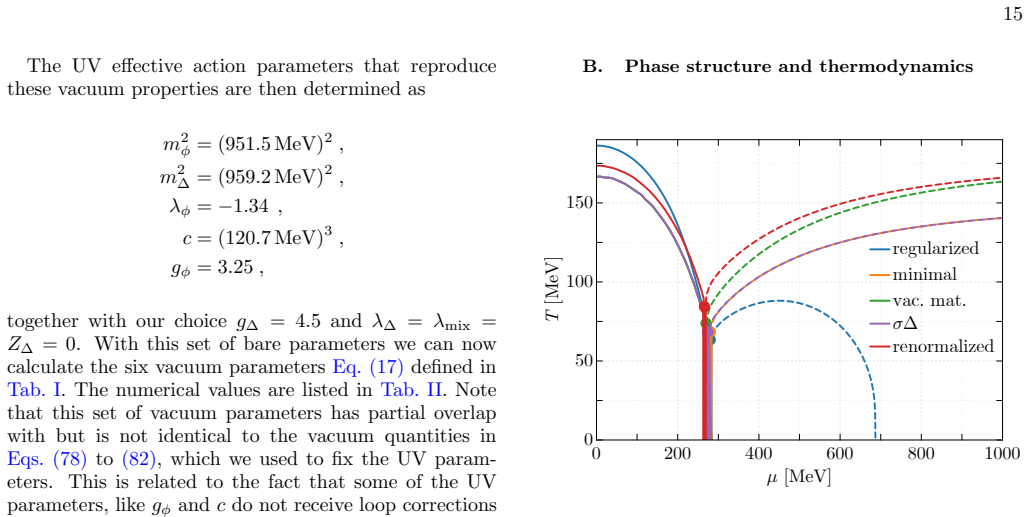
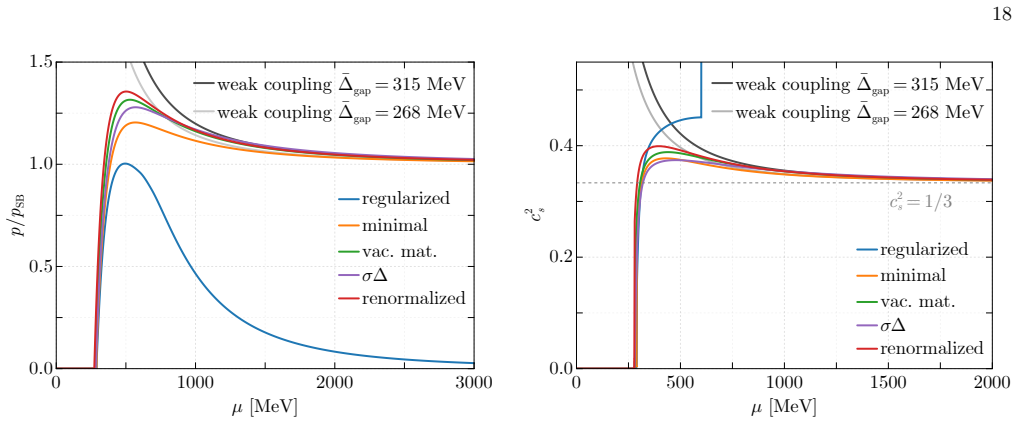
With a common vacuum fit, the renormalized QMD model and the RGC vacuum-matching scheme agree almost completely: both recover the Stefan-Boltzmann limit, both give an asymptotic diquark gap of 315.2 MeV, and both satisfy $T_c = (e^\gamma/\pi)\Delta_{\mathrm{gap}}(T=0)$ in the limit $\mu\to\infty$. The RGC minimal scheme also reproduces the BCS relation but with a different asymptotic gap, 267.8 MeV, because its vacuum value of the diquark wave-function renormalization differs. The $\sigma$-delta scheme, which subtracts a field-dependent medium counterterm, has a much larger asymptotic gap of 584.2 MeV and its $T_c/\Delta_{\mathrm{gap}}$ ratio tends to about 0.260, not 0.567. The cutoff-regularized mean field shows no BCS scaling at all: its curve bends back on itself and the 2SC phase eventually disappears, with unphysical thermodynamics at large $\mu$. The authors use the BCS ratio only as a diagnostic, not as a fundamental benchmark for color superconductivity, but the pattern singles out the diquark wave-function renormalization as the place where the medium divergence must be absorbed.
Load-bearing premise
Everything rests on the mean-field approximation, in which the meson and diquark fields are frozen to homogeneous expectation values and all bosonic fluctuations are neglected; if those fluctuations are included, new operators are generated and the BCS diagnostics could change.
Editorial extensions
If this is right
- A scheme-independent statement now exists: once vacuum parameters match, the renormalized and vacuum-matching QMD descriptions of the 2SC phase agree, so the vacuum-matching prescription can stand in for full renormalization in models where that is not available.
- The BCS ratio becomes a cheap analytic test of whether medium divergences were subtracted in the right place; the minimal and vacuum-matching schemes pass it, and the sigma-delta scheme fails.
- Cutoff-regularized mean-field equations of state are unreliable for dense-matter applications, because they predict a linear pressure, a missing Stefan-Boltzmann limit, and a divergent speed of sound at high chemical potential.
- At asymptotically high $\mu$ the QMD diquark gap saturates to a constant, in contrast to the growing gap expected in QCD, so the model needs additional physics before it can describe the very high-density regime.
- The same entropy analysis at $\mu=0$ and $\mu=450$ MeV confirms that both the renormalized and the RG-consistent schemes approach the Stefan-Boltzmann entropy, while the regularized mean field falls short.
Reading between the lines
- If the BCS relation is taken as a scheme-quality criterion, the natural rule is that an RG-consistent subtraction should be expressible as a pure renormalization of $Z_\Delta$; counterterms with extra field dependence will generically distort the gap-temperature relation at high density.
- The same diagnostic could be applied to three-flavor color-flavor-locked pairing, where field-dependent subtractions may also change the melting pattern of the condensates, an extension the paper lists as outlook.
- Beyond mean field, meson and diquark fluctuations generate additional operators in the effective potential, so the scheme separation found here may shift; an FRG calculation including bosonic fluctuations would show whether the minimal and vacuum-matching schemes keep the BCS ratio.
- Since the asymptotic gap in the renormalized model depends only on the vacuum quark mass and the infrared diquark coupling, lattice or continuum QCD input for the diquark wave-function renormalization would turn the model into a parameter-free prediction for dense-matter thermodynamics.
Editorial analysis
A structured set of objections, weighed in public.
Referee Report
Summary. The paper studies the two-flavor Quark-Meson-Diquark (QMD) model in mean-field approximation, comparing a fully renormalized formulation with three RG-consistent schemes (minimal, vacuum matching, and sigma-delta). All schemes are matched to a common set of vacuum parameters. The central results are analytic derivations for the zero-temperature diquark gap, the critical temperature, and the pressure, leading to the claim that the renormalized model and the minimal and vacuum-matching RG schemes satisfy the BCS relation Tc = (e^gamma/pi) Delta(T=0) in the high-density limit, whereas the sigma-delta scheme violates it. Numerical solutions of the full gap equations with physical quark masses support these findings, and both renormalization and RG consistency remove the cutoff artifacts present in the regularized cutoff calculation.
Significance. If the claims hold, the paper provides a valuable controlled comparison of renormalization strategies in a renormalizable effective model, with the BCS relation used as a sharp diagnostic and the Stefan-Boltzmann limit as a thermodynamic consistency check. The analytic results (Sec. V and Apps. C, D) are detailed and internally consistent; the recovery of the BCS ratio is not assumed but emerges from the gap equations. The authors are careful to acknowledge the mean-field truncation and the diagnostic nature of the BCS relation. The main weakness is the omitted dominated-convergence proof for extending the analytical BCS claim from the chiral limit to finite quark masses, which is central to the unqualified statement of the result.
major comments (1)
- [Sec. V E] The paper asserts that a dominated-convergence argument justifies interchanging the mu -> infinity limit with the momentum integrals in the coupled gap equations (24a)-(24b) for finite quark masses (c != 0), and that sigma -> 0 and Delta -> Delta_asymp constitute the simultaneous solution. The argument is not presented ('Given the technical nature of this analysis, we refrain from presenting the detailed calculations here'). This is load-bearing because the analytical BCS result Eq. (75) and the asymptotic gap Eq. (62) are derived for sigma = 0, while the abstract, Sec. VII, and the numerical comparisons in Figs. 3 and 6 present the BCS relation for the physical model with explicit chiral symmetry breaking. The numerics at mu = 1000 MeV and mu = 4 GeV are supportive but do not prove the limit. Please supply the proof in an appendix or explicitly restrict the rigorous claim to the chiral limit; the current wording overstates the domain of validity.
minor comments (4)
- [App. D] In the vacuum-matching subsection, 'asymptomatic diquark gap' should be 'asymptotic diquark gap'.
- [Sec. VI C] The numerical results at mu = 1000 MeV are quoted as T_c(min) = 140.5 MeV and T_c(vm) = T_c(ren) = 166.0 MeV, but the corresponding values from the analytic formulas (e.g., Eq. (73)) are not shown, so the reader cannot assess the convergence rate; a small table listing T_c and Delta_gap at selected mu values would help.
- [Sec. III B] The renormalized potential U_ren in Eq. (22) is expressed in terms of vacuum parameters, but the dependence on the pion mass enters through the combination of c and f_tilde_pi; this is not immediately obvious and could be spelled out.
- [Sec. V D] The branch of the Lambert W function is discussed in App. C, but it would be useful to state in the main text that both branches are considered and the physical one is selected.
Circularity Check
No circularity in the BCS derivation; self-citations and vacuum matching are non-load-bearing.
full rationale
Walking the derivation chain, the BCS relation is not an input. In Sec. V D the authors solve the renormalized model's gap equations at T=0 (Eq. 59) and at Tc (Eq. 70), subtract them (Eq. 71), solve for Tc via a Lambert-W expression (Eqs. 72-73), and take mu -> infinity; Eq. (62) for the asymptotic gap is independently obtained from the pole of mu^2(Delta). The ratio e^gamma/pi then follows algebraically from W(x) ~ x at small argument, so the high-density BCS result is a derived identity, not a fitted one. The Stefan-Boltzmann pressure (Eq. 57) and speed of sound (Eq. 68) likewise emerge from the same gap solution and contain no BCS input. Parameters are fixed to vacuum observables (Sec. VI A); none of g_Delta, Z_Delta, Ztilde_Delta, or the vacuum masses are tuned to the asymptotic gap or Tc, so the high-density outputs are genuine predictions. Self-citations: Ref. [18] (two present authors) supplies the nomenclature and minimal/sigma-Delta subtraction schemes, but these are redefined in Eqs. (44)-(45), and the paper's BCS/SB results are derived rather than imported; the sigma-Delta scheme's failure is a finding against one of the cited scheme variants, not an endorsement. The RG-consistency concept is cited to independent Ref. [10]. No circular reduction is exhibited: Eq. (66) equating the vacuum-matching and renormalized asymptotic gaps follows from the deliberate matching of Ztilde_Delta (Eq. 49), but this is an explicit construction, not a hidden fit to the gap. The omitted dominated-convergence proof in Sec. V E is a rigor gap for finite quark masses, not a circularity. Overall score 2 reflects the presence of non-load-bearing self-citation; the central claims are self-contained.
Assumptions & free parameters
free parameters (4)
- g_delta (diquark Yukawa coupling) =
4.5
- Lambda' (initial UV scale in RGC schemes) =
600 MeV
- m_Delta (vacuum diquark mass) =
600 MeV
- Z_Delta,bare (UV diquark wave function renormalization) =
0
assumptions (5)
- domain assumption Mean-field approximation: bosonic fluctuations are neglected and fields are homogeneous.
- domain assumption Sharp three-momentum regulator in the FRG flow.
- domain assumption The UV effective potential is truncated to quartic order in sigma and Delta.
- standard math Dominated convergence theorem allows interchange of limit and integral in the gap equations away from the chiral limit.
- standard math Lambert W function branch selection and infinite product identities.
Cite this review
Pith. "Pith review of Renormalizing the Quark-Meson-Diquark Model." pith.science (2026). https://pith.science/paper/SQHR5DVI
@misc{pith2026250522542,
  author       = {Pith},
  title        = {Pith review of: Renormalizing the Quark-Meson-Diquark Model},
  year         = {2026},
  howpublished = {\url{https://pith.science/paper/SQHR5DVI}},
  note         = {Machine review of arXiv:2505.22542}
}
read the original abstract
We present a comprehensive study of the two-flavor Quark--Meson--Diquark (QMD) model by comparing a renormalization approach with a renormalization-group (RG) consistent mean-field formulation based on the functional renormalization group (FRG). The renormalized QMD model allows analytical investigations of key quantities such as the zero-temperature diquark gap and the critical temperature for color superconductivity, ultimately reproducing the exact BCS relation in the high-density limit. We carry out the same analysis for different schemes of RG-consistent QMD models. We show that the RG-consistent approach yields a phase diagram and thermodynamic properties qualitatively similar to those of the renormalized model, provided both are embedded within a unified scheme that ensures consistent vacuum properties. In particular, both treatments recover the Stefan--Boltzmann limit at high densities. On the other hand, whether the BCS relation for the critical temperature is satisfied depends on the details of the RG-consistent setup. Our results highlight the relevance of renormalization and RG-consistent methods for accurately capturing the thermodynamics of QMD and related effective models with diquark degrees of freedom.
Figures


Figures from the paper (3 more)


Forward citations
Cited by 5 Pith papers
-
Neutrino absorption in two-flavor color-superconducting quark matter
In 2SC quark matter, neutrino absorption is dominated by strange-quark capture at low temperature, and a degenerate neutrino gas at electron lepton fraction 0.1 has a mean free path of meters or less.
-
Speed of sound peak in two-color dense QCD: confronting effective models with lattice data
A medium-separated NJL model reproduces the lattice-observed peak in the speed of sound for two-color dense QCD, where conventional cutoff regularization fails.
-
Comparison of chiral limit studies in curvature mass versus on-shell renormalized quark-meson model using ChPT
Using ChPT scaling of f_pi, f_K, and M_eta^2, the QMVT model yields much smaller first-order regions in the Columbia plot than the on-shell renormalized RQM model, and moderately smaller than the FRG study.
-
Renormalization of the three-flavor quark-meson diquark model
The authors extend the quark-meson diquark model to three flavors, renormalize its thermodynamic potential in the CFL phase, and show the speed of sound approaches the conformal limit from above.
-
Comparative analysis of critical regions: The renormalized quark-meson model under Polyakov loop, quark back-reaction, and vector interaction effects
On-shell renormalized quark-meson models give broad, roughly symmetric critical regions around the CEP; the Logarithmic Polyakov loop compresses their temperature width, while the PolyLog-glue back-reaction restores s...
Reference graph
Works this paper leans on
-
[11]
Buballa, NJL model analysis of dense quark matter, Phys
M. Buballa, NJL model analysis of dense quark matter, Phys. Rept. 407, 205 (2005), arXiv:hep-ph/0402234
arXiv 2005
-
[1]
chiral condensate (pion decay constant) ˜fπ = 92.4 MeV , (78)
-
[2]
pion mass m2 π = 2 (∂σ2 Ω)|vac = (137 MeV)2 , (79)
-
[3]
sigma mass ˜m2 σ = (560 MeV)2 , (80)
-
[4]
quark mass mq,vac = gϕ ˜fπ = 300 MeV , (81)
-
[5]
(82) The choice of the mesonic properties follows Ref
diquark mass ˜m2 ∆ = (600 MeV)2 . (82) The choice of the mesonic properties follows Ref. [60], while for the diquark mass we just made the reasonable assumption that it is twice the quark mass. This value is also consistent with Refs. [57–59]. 6 This choice is particularly convenient for the RGC schemes, as it renders the UV initial conditions µ-independe...
2000
-
[6]
+ m2 ϕ,k0 , (B4) λϕ,k = − 3g4 ϕ π2 ln k k0 + λϕ,k0 , (B5) m2 ∆,k = g2 ∆ π2 (k2 − k0
-
[7]
(B9) Here, k0 represents an arbitrary reference scale
+ m2 ∆,k0 , (B6) λ∆,k = − g4 ∆ 2π2 ln k k0 + λ∆,k0 , (B7) λmix,k = − 2g2 ∆g2 ϕ π2 ln k k0 + λmix,k0 , (B8) Z∆,k = − g2 ∆ 2π2 ln k k0 + Z∆,k0 . (B9) Here, k0 represents an arbitrary reference scale. Notably, if we choose k = Λ, the RG scale dependence of the couplings exactly matches the Λ-dependence of the renormalized model couplings, as given in Eqs. (1...
Show all 85 references
-
[8]
Aarts et al
G. Aarts et al. , Phase Transitions in Particle Physics: Results and Perspectives from Lattice Quantum Chromo- Dynamics, Prog. Part. Nucl. Phys. 133, 104070 (2023), arXiv:2301.04382 [hep-lat]
2023 arXiv
-
[9]
C. S. Fischer, QCD at finite temperature and chemical potential from Dyson–Schwinger equations, Prog. Part. Nucl. Phys. 105, 1 (2019), arXiv:1810.12938 [hep-ph]. 29
2019 arXiv
-
[10]
Fu, QCD at finite temperature and density within the fRG approach: an overview, Commun
W.-j. Fu, QCD at finite temperature and density within the fRG approach: an overview, Commun. Theor. Phys. 74, 097304 (2022), arXiv:2205.00468 [hep-ph]
2022 arXiv
-
[12]
Schaefer and J
B.-J. Schaefer and J. Wambach, The Phase diagram of the quark meson model, Nucl. Phys. A 757, 479 (2005), arXiv:nucl-th/0403039
2005 arXiv
-
[13]
Fukushima and T
K. Fukushima and T. Hatsuda, The phase diagram of dense qcd, Rep. Prog. Phys. 74, 014001 (2011)
2011
-
[14]
M. G. Alford, A. Schmitt, K. Rajagopal, and T. Sch¨ afer, Color superconductivity in dense quark matter, Rev. Mod. Phys. 80, 1455 (2008), arXiv:0709.4635 [hep-ph]
2008 arXiv
-
[15]
Berges and K
J. Berges and K. Rajagopal, Color superconductivity and chiral symmetry restoration at nonzero baryon den- sity and temperature, Nucl. Phys. B 538, 215 (1999), arXiv:hep-ph/9804233
1999 arXiv
-
[16]
T. M. Schwarz, S. P. Klevansky, and G. Papp, The Phase diagram and bulk thermodynamical quantities in the NJL model at finite temperature and density, Phys. Rev. C 60, 055205 (1999), arXiv:nucl-th/9903048
1999 arXiv
-
[17]
Braun, M
J. Braun, M. Leonhardt, and J. M. Pawlowski, Renormal- ization group consistency and low-energy effective theo- ries, SciPost Phys. 6, 056 (2019), arXiv:1806.04432 [hep- ph]
2019 arXiv
-
[18]
J. O. Andersen and M. P. Nødtvedt, Color supercon- ductivity and speed of sound in the two-flavor quark- meson diquark model, Phys. Rev. D 111, 034031 (2025), arXiv:2408.12361 [hep-ph]
2025 arXiv
-
[19]
J. O. Andersen and M. P. Nødtvedt, Pion condensa- tion versus 2SC, speed of sound, and charge neutral- ity effects in the quark-meson diquark model, (2025), arXiv:2502.10229 [hep-ph]
2025 arXiv
-
[20]
J. B. Kogut, M. A. Stephanov, and D. Toublan, On two color qcd with baryon chemical potential, Phys. Lett. B 464, 183 (1999), arXiv:hep-ph/9906346
1999 arXiv
-
[21]
J. O. Andersen and T. Brauner, Phase diagram of two- color quark matter at nonzero baryon and isospin density, Phys. Rev. D 81, 096004 (2010), arXiv:1001.5168 [hep- ph]
2010 arXiv
-
[22]
Strodthoff, B.-J
N. Strodthoff, B.-J. Schaefer, and L. von Smekal, Quark- meson-diquark model for two-color QCD, Phys. Rev. D 85, 074007 (2012), arXiv:1112.5401 [hep-ph]
2012 arXiv
-
[23]
R. L. S. Farias, G. Dallabona, G. Krein, and O. A. Bat- tistel, Cutoff-independent regularization of four-fermion interactions for color superconductivity, Phys. Rev. C73, 018201 (2006), arXiv:hep-ph/0510145
2006 arXiv
-
[24]
Skokov, B
V. Skokov, B. Friman, E. Nakano, K. Redlich, and B. J. Schaefer, Vacuum fluctuations and the thermodynam- ics of chiral models, Phys. Rev. D 82, 034029 (2010), arXiv:1005.3166 [hep-ph]
2010 arXiv
-
[25]
Gholami, M
H. Gholami, M. Hofmann, and M. Buballa, Renormalization-group consistent treatment of color superconductivity in the NJL model, Phys. Rev. D 111, 014006 (2025), arXiv:2408.06704 [hep-ph]
2025 arXiv
-
[26]
Wetterich, Exact evolution equation for the effective potential, Phys
C. Wetterich, Exact evolution equation for the effective potential, Phys. Lett. B301, 90 (1993), arXiv:1710.05815 [hep-th]
1993 arXiv
-
[27]
T. K. Herbst, M. Mitter, J. M. Pawlowski, B.-J. Schae- fer, and R. Stiele, Thermodynamics of QCD at vanishing density, Phys. Lett. B 731, 248 (2014), arXiv:1308.3621 [hep-ph]
2014 arXiv
-
[28]
K. Iida, T. Matsuura, M. Tachibana, and T. Hat- suda, Melting pattern of diquark condensates in quark matter, Physical Review Letters 93, 10.1103/phys- revlett.93.132001 (2004)
2004 doi
-
[29]
Rehberg, S
P. Rehberg, S. P. Klevansky, and J. H¨ ufner, Hadroniza- tion in the SU(3) Nambu-Jona-Lasinio model, Phys. Rev. C 53, 410 (1996), arXiv:hep-ph/9506436
1996 arXiv
-
[30]
D. T. Son, Superconductivity by long range color mag- netic interaction in high density quark matter, Phys. Rev. D 59, 094019 (1999), arXiv:hep-ph/9812287
1999 arXiv
-
[31]
Sch¨ afer and F
T. Sch¨ afer and F. Wilczek, Superconductivity from per- turbative one gluon exchange in high density quark matter, Phys. Rev. D 60, 114033 (1999), arXiv:hep- ph/9906512
1999
-
[32]
Nickel, R
D. Nickel, R. Alkofer, and J. Wambach, On the unlock- ing of color and flavor in color-superconducting quark matter, Phys. Rev. D 74, 114015 (2006), arXiv:hep- ph/0609198
2006
-
[33]
Nickel, J
D. Nickel, J. Wambach, and R. Alkofer, Color- superconductivity in the strong-coupling regime of Lan- dau gauge QCD, Phys. Rev. D 73, 114028 (2006), arXiv:hep-ph/0603163
2006 arXiv
-
[34]
Nickel, R
D. Nickel, R. Alkofer, and J. Wambach, Neutrality of the color-flavor-locked phase in a Dyson-Schwinger approach, Phys. Rev. D 77, 114010 (2008), arXiv:0802.3187 [hep- ph]
2008 arXiv
-
[35]
Marhauser, D
F. Marhauser, D. Nickel, M. Buballa, and J. Wambach, Color-spin locking in a selfconsistent Dyson-Schwinger approach, Phys. Rev. D 75, 054022 (2007), arXiv:hep- ph/0612027
2007
-
[36]
M¨ uller, M
D. M¨ uller, M. Buballa, and J. Wambach, Dyson- Schwinger approach to color superconductivity at finite temperature and density, Eur. Phys. J. A 49, 96 (2013), arXiv:1303.2693 [hep-ph]
2013 arXiv
-
[37]
M¨ uller, M
D. M¨ uller, M. Buballa, and J. Wambach, Dyson- Schwinger Approach to Color-Superconductivity: Ef- fects of Selfconsistent Gluon Dressing, (2016), arXiv:1603.02865 [hep-ph]
2016 arXiv
-
[38]
N. Khan, J. M. Pawlowski, F. Rennecke, and M. M. Scherer, The Phase Diagram of QC2D from Functional Methods, (2015), arXiv:1512.03673 [hep-ph]
2015 arXiv
-
[39]
Braun and B
J. Braun and B. Schallmo, From quarks and gluons to color superconductivity at supranuclear densities, Phys. Rev. D 105, 036003 (2022), arXiv:2106.04198 [hep-ph]
2022 arXiv
-
[40]
Cruz Rojas, T
J. Cruz Rojas, T. Demircik, C. Ecker, and M. J¨ arvinen, Towards holographic color superconductivity in QCD, (2025), arXiv:2505.06338 [hep-th]
2025 arXiv
-
[41]
B. B. Brandt, V. Chelnokov, G. Endr˝ odi, G. Marko, D. Scheid, and L. von Smekal, Renormalization group invariant mean-field model for QCD at finite isospin den- sity, (2025), arXiv:2502.04025 [hep-ph]
2025 arXiv
-
[42]
Carignano, M
S. Carignano, M. Buballa, and B.-J. Schaefer, Inho- mogeneous phases in the quark-meson model with vac- uum fluctuations, Phys. Rev. D 90, 014033 (2014), arXiv:1404.0057 [hep-ph]
2014 arXiv
-
[43]
Carignano, M
S. Carignano, M. Buballa, and W. Elkamhawy, Consis- tent parameter fixing in the quark-meson model with vacuum fluctuations, Phys. Rev. D94, 034023 (2016), arXiv:1606.08859 [hep-ph]
2016 arXiv
-
[44]
J. M. Pawlowski, M. M. Scherer, R. Schmidt, and S. J. Wetzel, Physics and the choice of regulators in func- tional renormalisation group flows, Annals Phys. 384, 165 (2017), arXiv:1512.03598 [hep-th]
2017 arXiv
-
[45]
Bailin and A
D. Bailin and A. Love, Superfluidity and Superconduc- tivity in Relativistic Fermion Systems, Phys. Rept. 107, 325 (1984). 30
1984
-
[46]
J. A. Bowers and K. Rajagopal, The Crystallography of color superconductivity, Phys. Rev. D 66, 065002 (2002), arXiv:hep-ph/0204079
2002 arXiv
-
[47]
D. K. Hong, An Effective field theory of QCD at high density, Phys. Lett. B 473, 118 (2000), arXiv:hep- ph/9812510
2000
-
[48]
Rajagopal and F
K. Rajagopal and F. Wilczek, The Condensed matter physics of QCD, in At the frontier of particle physics. Handbook of QCD. Vol. 1-3 , edited by M. Shifman and B. Ioffe (2000) pp. 2061–2151, arXiv:hep-ph/0011333
2000 arXiv
-
[49]
Huang and I
M. Huang and I. A. Shovkovy, Screening masses in neu- tral two-flavor color superconductor, Phys. Rev. D 70, 094030 (2004), arXiv:hep-ph/0408268
2004 arXiv
-
[50]
R. D. Pisarski and D. H. Rischke, Color superconductiv- ity in weak coupling, Phys. Rev. D 61, 074017 (2000), arXiv:nucl-th/9910056
2000 arXiv
-
[51]
Braun, T
J. Braun, T. D¨ ornfeld, B. Schallmo, and S. T¨ opfel, Renor- malization group studies of dense relativistic systems, Phys. Rev. D 104, 096002 (2021), arXiv:2008.05978 [hep- ph]
2021 arXiv
-
[52]
Braun and B
J. Braun and B. Schallmo, Zero-temperature thermo- dynamics of dense asymmetric strong-interaction mat- ter, Phys. Rev. D 106, 076010 (2022), arXiv:2204.00358 [nucl-th]
2022 arXiv
-
[53]
J. Deng, A. Schmitt, and Q. Wang, Relativistic BCS- BEC crossover in a boson-fermion model, Phys. Rev. D 76, 034013 (2007), arXiv:nucl-th/0611097
2007 arXiv
-
[54]
I. A. Shovkovy and P. J. Ellis, Thermal conductivity of dense quark matter and cooling of stars, Phys. Rev. C 66, 015802 (2002), arXiv:hep-ph/0204132
2002 arXiv
-
[55]
Rajagopal and F
K. Rajagopal and F. Wilczek, Enforced electrical neu- trality of the color flavor locked phase, Phys. Rev. Lett. 86, 3492 (2001), arXiv:hep-ph/0012039
2001 arXiv
-
[56]
Fukushima and S
K. Fukushima and S. Minato, Speed of sound and trace anomaly in a unified treatment of the two-color diquark superfluid, the pion-condensed high-isospin matter, and the 2SC quark matter, Phys. Rev. D 111, 094006 (2025), arXiv:2411.03781 [hep-ph]
2025 arXiv
-
[57]
B. A. Freedman and L. D. McLerran, Fermions and Gauge Vector Mesons at Finite Temperature and Den- sity. 3. The Ground State Energy of a Relativistic Quark Gas, Phys. Rev. D 16, 1169 (1977)
1977
-
[58]
Kurkela, P
A. Kurkela, P. Romatschke, and A. Vuorinen, Cold Quark Matter, Phys. Rev. D 81, 105021 (2010), arXiv:0912.1856 [hep-ph]
2010 arXiv
-
[59]
Kurkela and A
A. Kurkela and A. Vuorinen, Cool quark matter, Phys. Rev. Lett. 117, 042501 (2016), arXiv:1603.00750 [hep- ph]
2016 arXiv
-
[60]
Gorda, A
T. Gorda, A. Kurkela, P. Romatschke, S. S¨ appi, and A. Vuorinen, Next-to-Next-to-Next-to-Leading Order Pressure of Cold Quark Matter: Leading Logarithm, Phys. Rev. Lett. 121, 202701 (2018), arXiv:1807.04120 [hep-ph]
2018 arXiv
-
[61]
Fujimoto and K
Y. Fujimoto and K. Fukushima, Equation of state of cold and dense QCD matter in resummed perturbation the- ory, Phys. Rev. D 105, 014025 (2022), arXiv:2011.10891 [hep-ph]
2022 arXiv
-
[62]
Geißel, T
A. Geißel, T. Gorda, and J. Braun, Pressure and speed of sound in two-flavor color-superconducting quark mat- ter at next-to-leading order, Phys. Rev. D 110, 014034 (2024), arXiv:2403.18010 [hep-ph]
2024 arXiv
-
[63]
Geißel, T
A. Geißel, T. Gorda, and J. Braun, Color superconduc- tivity under neutron-star conditions at next-to-leading order, (2025), arXiv:2504.03834 [hep-ph]
2025
-
[64]
M. Hess, F. Karsch, E. Laermann, and I. Wetzorke, Di- quark masses from lattice QCD, Phys. Rev. D58, 111502 (1998), arXiv:hep-lat/9804023
1998 arXiv
-
[65]
Oettel, R
M. Oettel, R. Alkofer, and L. von Smekal, Nucleon prop- erties in the covariant quark diquark model, Eur. Phys. J. A 8, 553 (2000), arXiv:nucl-th/0006082
2000 arXiv
-
[66]
Maris, Effective masses of diquarks, Few Body Syst
P. Maris, Effective masses of diquarks, Few Body Syst. 32, 41 (2002), arXiv:nucl-th/0204020
2002 arXiv
-
[67]
K. Otto, M. Oertel, and B.-J. Schaefer, Hybrid and quark star matter based on a nonperturbative equation of state, Phys. Rev. D 101, 103021 (2020), arXiv:1910.11929 [hep- ph]
2020 arXiv
-
[68]
Leonhardt, M
M. Leonhardt, M. Pospiech, B. Schallmo, J. Braun, C. Drischler, K. Hebeler, and A. Schwenk, Symmetric nuclear matter from the strong interaction, Phys. Rev. Lett. 125, 142502 (2020), arXiv:1907.05814 [nucl-th]
2020 arXiv
-
[69]
Gholami, I
H. Gholami, I. A. Rather, M. Hofmann, M. Buballa, and J. Schaffner-Bielich, Astrophysical constraints on color- superconducting phases in compact stars within the RG- consistent NJL model, Phys. Rev. D 111, 103034 (2025), arXiv:2411.04064 [hep-ph]
2025 arXiv
-
[70]
A. E. B. Pasqualotto, R. L. S. Farias, W. R. Tavares, S. S. Avancini, and G. Krein, Causality violation and the speed of sound of hot and dense quark matter in the Nambu–Jona-Lasinio model, Phys. Rev. D 107, 096017 (2023), arXiv:2301.10721 [hep-ph]
2023 arXiv
-
[71]
G. Baym, T. Hatsuda, T. Kojo, P. D. Powell, Y. Song, and T. Takatsuka, From hadrons to quarks in neutron stars: a review, Rept. Prog. Phys. 81, 056902 (2018), arXiv:1707.04966 [astro-ph.HE]
2018 arXiv
-
[72]
Bonanno and A
L. Bonanno and A. Sedrakian, Composition and sta- bility of hybrid stars with hyperons and quark color- superconductivity, Astron. Astrophys. 539, A16 (2012), arXiv:1108.0559 [astro-ph.SR]
2012 arXiv
-
[73]
Kl¨ ahn, R
T. Kl¨ ahn, R. Lastowiecki, and D. B. Blaschke, Implica- tions of the measurement of pulsars with two solar masses for quark matter in compact stars and heavy-ion colli- sions: A Nambu–Jona-Lasinio model case study, Phys. Rev. D 88, 085001 (2013), arXiv:1307.6996 [nucl-th]
2013 arXiv
-
[74]
K. Otto, M. Oertel, and B.-J. Schaefer, Nonperturbative quark matter equations of state with vector interactions, Eur. Phys. J. ST 229, 3629 (2020), arXiv:2007.07394 [hep-ph]
2020 arXiv
-
[75]
Buballa, L
M. Buballa, L. Kurth, M. Wagner, and M. Winstel, Regulator dependence of inhomogeneous phases in the (2+1)-dimensional Gross-Neveu model, Phys. Rev. D 103, 034503 (2021), arXiv:2012.09588 [hep-lat]
2021 arXiv
-
[76]
Pannullo, M
L. Pannullo, M. Wagner, and M. Winstel, Inhomo- geneous phases in the 3+1-dimensional Nambu-Jona- Lasinio model and their dependence on the regu- larization scheme, PoS LA TTICE2022, 156 (2023), arXiv:2212.05783 [hep-lat]
2023 arXiv
-
[77]
Pannullo, M
L. Pannullo, M. Wagner, and M. Winstel, Regulariza- tion effects in the Nambu–Jona-Lasinio model: Strong scheme dependence of inhomogeneous phases and per- sistence of the moat regime, Phys. Rev. D 110, 076006 (2024), arXiv:2406.11312 [hep-ph]
2024 arXiv
-
[78]
R. M. Corless, G. H. Gonnet, D. E. G. Hare, D. J. Jeffrey, and D. E. Knuth, On the Lambert W function, Advances in Computational Mathematics 5, 329 (1996)
1996
-
[79]
NIST Digital Library of Mathematical Functions, Lambert W -function (2024), release 1.2.3, accessed 22 May 2025. 31
2024
-
[80]
V. K. Dixit and C. Rackauckas, Optimization.jl: A uni- fied optimization package (2023)
2023
-
[81]
S. G. Johnson, The NLopt nonlinear-optimization pack- age, https://github.com/stevengj/nlopt (2007)
2007
-
[82]
J. A. Nelder and R. Mead, A simplex method for function minimization, The Computer Journal 7, 308 (1965)
1965
-
[83]
Revels, M
J. Revels, M. Lubin, and T. Papamarkou, Forward-mode automatic differentiation in Julia, arXiv:1607.07892 [cs.MS] (2016)
2016 arXiv
-
[84]
Gholami, On the Calculation of Pressure Deriva- tives in Mean-Field Thermal Field Theories, (2025), arXiv:2501.05192 [hep-ph]
H. Gholami, On the Calculation of Pressure Deriva- tives in Mean-Field Thermal Field Theories, (2025), arXiv:2501.05192 [hep-ph]
2025 arXiv
-
[85]
Danisch and J
S. Danisch and J. Krumbiegel, Makie.jl: Flexible high- performance data visualization for Julia, Journal of Open Source Software 6, 3349 (2021)
2021
Reviewed August 7, 2026 · model on record in the stance chip above.
Discussion (0). Sign in to comment.