REVIEW 5 major objections 4 minor 59 references
RICO: Improving Accuracy and Completeness in Image Recaptioning via Visual Reconstruction
T0 review · 5 major / 4 minor · reviewed 2026-08-07 · deepseek-v4-flash
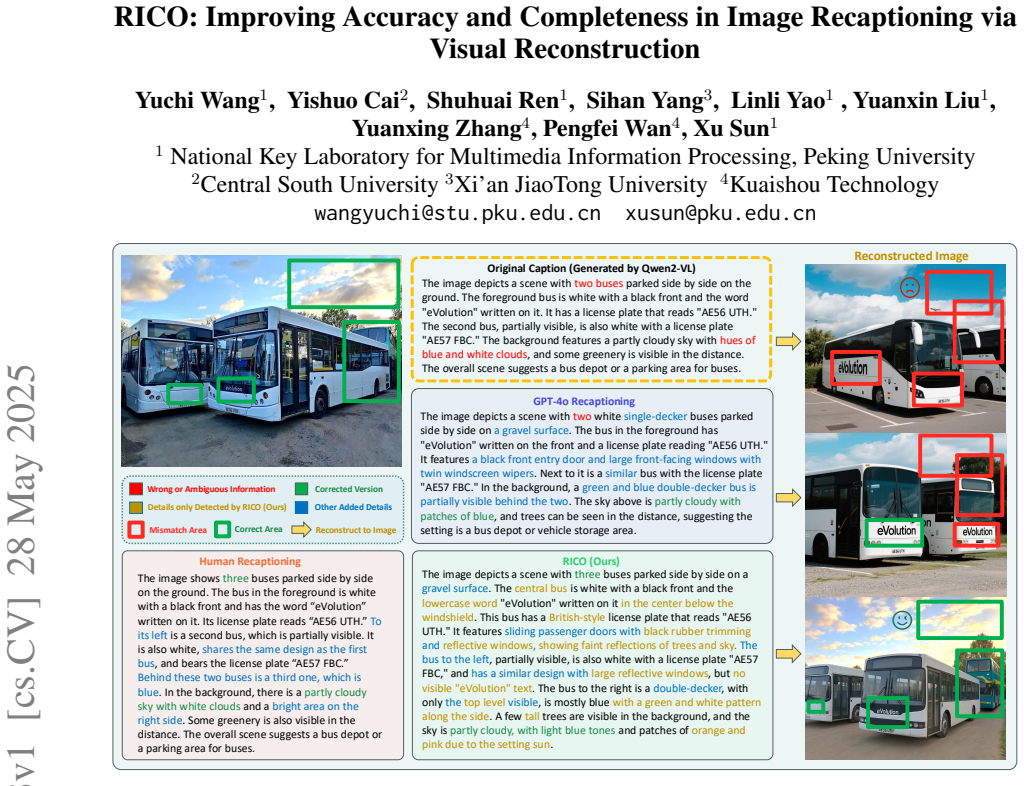
Pith's one-line read RICO claims that recaptioning improves when each candidate caption is reconstructed into an image and the visible discrepancies between original and reconstruction drive the rewrite.
desk verdict Reconstruction-based caption revision is a genuine new mechanism, but the paper never isolates reconstruction from its own detailed prompt, so the central claim needs one more control before it lands. read the letter →
The pith
A machine-rendered reading of the paper's core claim, the machinery that carries it, and where it could break.
The reading
What carries the argument
The load-bearing mechanism is the reconstruction–refinement loop, formalized as $v_i = T(c_{i-1})$ and $c_i = R(v_i, v_0, c_{i-1})$, where $T$ is the FLUX.1-dev text-to-image model and $R$ is GPT-4o prompted to contrast the original image with the reconstructed one. Reconstruction is what moves the comparison into a single modality: instead of asking whether text matches an image, the reviser looks at two images and names what differs. The prompt's eight focus aspects and its requirement to emit an analysis before the revised caption are what turn those named differences into concrete corrections and additions. For RICO-Flash, the mechanism is preference distillation: the ordered pair of initial and final captions from the loop becomes a DPO training signal that teaches one model to reproduce the effect of the loop in a single forward pass.
What would settle it
Take a probe set where the reconstruction model is known to fail on one attribute class, such as object count or small in-image text, and run RICO; if captions still gain accuracy on that class, the gains are not coming from the visual-discrepancy loop, while if they do not improve, the stated dependence on reconstruction power is confirmed.
Extended reading notes
Core claim
The central claim is that semantic alignment between image and caption should be bidirectional: the caption is faithful only if an image reconstructed from it agrees with the original. RICO operationalizes that test by alternating a text-to-image model, FLUX.1-dev, with an MLLM reviser, GPT-4o, applying $c_i = R(T(c_{i-1}), v_0, c_{i-1})$ for two steps. The reviser is prompted to attend to eight aspects—visual details, composition and layout, human attributes, perspective and style, text in the image, image quality, world knowledge, and color aesthetics—and to output an analysis before the revised caption. On the benchmarks used, the loop moves Qwen2-VL captions from 42.0 to 59.0 CapsBench accuracy and from 32.4 to 59.5 relative-position accuracy, while Amber's Cover minus CHAIR composite improves, indicating reduced hallucination. The paper further claims that a distilled single-pass model, RICO-Flash, trained with DPO on the loop's initial-to-final caption preferences, approaches the iterative version's performance without per-image reconstruction, and that a text-to-image model fine-tuned on RICO-refined captions outperforms one trained on the initial captions.
Load-bearing premise
The whole pipeline depends on the text-to-image model being strong enough to render fine-grained attributes and spatial relations from the caption; the paper says this in its limitations section, and if the reconstruction drops those details, the reviser sees no discrepancy and the completeness gains vanish.
Editorial extensions
If this is right
- Recaptioning pipelines built on an MLLM can expect double-digit gains on fine-grained accuracy metrics simply by adding the reconstruction–refinement loop, with diminishing returns after two iterations.
- Captions refined by the loop are better supervision for text-to-image training, since a FLUX model fine-tuned on RICO-refined captions beat one trained on initial captions on DPG-Bench and VQAScore.
- The preference pairs produced by the loop are sufficient supervision for a distilled one-pass captioner, so the iterative cost does not have to be paid at inference time.
- The method is model-agnostic on the captioning side: it improved initial captions from seven different captioning models and across several prompting schemes in the paper's experiments.
Reading between the lines
- If the paper's stated assumption is right, the loop's ceiling is set by the reconstruction model, not the reviser; swapping FLUX.1-dev for a stronger text-to-image generator should produce larger gains than swapping GPT-4o for another reviser, a claim the paper does not test.
- The same discrepancy loop could be applied to other image-to-text products, such as structured scene-graph extraction or accessibility alt-text, where fine-grained omissions are costly; nothing in the mechanism restricts it to full-sentence captions.
- A testable extension would measure whether details added by the reviser are ever true of neither image: if the reviser over-trusts its own analysis, precision of added tokens against the scene graph would decline even as coverage rises.
Editorial analysis
A structured set of objections, weighed in public.
Referee Report
Summary. The paper presents RICO, a recaptioning framework that iteratively reconstructs a candidate caption with FLUX.1-dev and then asks GPT-4o to revise the caption by comparing the original image with the reconstructed image. After N=2 iterations, the authors report substantial gains on CapsBench, CompreCap, Amber, and CAPTURE relative to several initial captioning models and to existing recaptioning baselines. To reduce inference cost, RICO-Flash fine-tunes Qwen2-VL with DPO using the initial and final RICO captions as a preference pair. The paper also reports that a FLUX model fine-tuned on RICO-refined captions achieves higher DPG-Bench and VQAScore scores than one trained on the original captions.
Significance. If the reconstruction signal is genuinely the cause of the measured gains, RICO is a useful and well-motivated contribution to image recaptioning, with a clear mechanism and a practical distilled variant. The evaluation is broad, covering multiple initial MLLMs, multiple prompts, several benchmarks, and a downstream text-to-image generation task, and the code is released. However, the paper does not yet demonstrate that visual reconstruction itself, rather than the detailed refinement prompt, drives the improvements, and the evaluative overlap between the GPT-4o reviser and the CapsBench judge weakens the reliability of the reported effect sizes. These issues are addressable with additional experiments.
major comments (5)
- [§3.3, Table 2, Table 6, Table 12] The central claim is that the reconstructed image provides an error signal beyond the original image and caption, but no experiment isolates this signal. Table 6 ablates the aspect guidance ('wo/ tips') and the analysis output ('wo/ output analy.') while always providing both images; Table 2 compares RICO Edit against a GPT-4o baseline that receives only the short instruction in Table 7, not the full Table 12 prompt with eight focus aspects and forced CoT. Please add a control that runs GPT-4o with the complete RICO prompt but without the reconstructed image (original image plus caption only), at both N=1 and N=2, and also a GPT-4o Edit variant using the full prompt. If these controls match RICO's numbers, the reconstruction mechanism is not the active ingredient.
- [§3.3, §B.2, Table 1, Table 3] CapsBench is judged by GPT-4o (2024-08-06), the same model family used as the RICO reviser, so the measured gains may partly reflect the captions conforming to the reviser's preferences rather than improved accuracy or completeness. Please re-score a subset with an independent judge (e.g., Gemini 1.5 Pro or Qwen2-VL) and report per-item agreement with GPT-4o. In addition, all tables report only point estimates; please provide confidence intervals or significance tests, especially for small differences such as CompreCap Rel. 2.82 versus 2.84 in Table 1.
- [§3.4, §4.2] The RICO-Flash preference pairs are (initial Qwen2-VL caption, final RICO caption), where the final caption is produced by GPT-4o under the detailed RICO prompt. Without the no-reconstruction control in the first major comment, RICO-Flash may simply be a DPO distillation of GPT-4o's captioning behavior rather than evidence for the reconstruction loop. Please compare RICO-Flash against a model trained with DPO on preference pairs generated by GPT-4o using the full RICO prompt but no reconstructed image.
- [Table 2] The claim that RICO improves fine-grained spatial information is not consistently supported by this table: RICO Edit raises Shape from 20.41 to 49.51 but lowers Rel.Pos. from 39.45 to 34.04, below both the original caption (39.45) and GPT-4o Edit (44.04). Please address this drop explicitly and provide the same breakdown on the full CapsBench set, since the central claim includes completeness of spatial relations.
- [§E] The paper acknowledges that the pipeline assumes the text-to-image model is powerful enough to render fine-grained details, but it does not test this assumption. Please add a sensitivity analysis, for example by using a weaker reconstruction model or by measuring how often FLUX fails to reproduce attributes and relations that are annotated in the benchmark; otherwise it is unclear whether the completeness gains would survive with a different reconstruction model.
minor comments (4)
- [Appendix D] The DPO loss is written as -E log( pi_theta(y+)^beta / (pi_theta(y+)^beta + pi_theta(y-)^beta) ), which omits the reference policy and the sigmoid and is inconsistent with the formula in Section 3.4; please correct or remove this simplified derivation.
- [§4.2, §B.3] The comparison with human annotators uses 100 images and two annotators; please report inter-annotator agreement and note that this is a small sample when claiming that RICO surpasses humans.
- [Abstract, §1, Table 5] The statement of 'over 10 points' improvement on CapsBench is not true for all initial models in Table 5 (e.g., GPT-4o +8.1, Gemini 1.5 Pro +8.0); please qualify the claim to the models where it holds.
- [Figure 4, Table 1] The iteration-curve analysis and all headline tables would benefit from error bars or variance reporting; this is related to the statistical point in the second major comment.
Circularity Check
No significant circularity: RICO's improvement is an empirical pipeline result evaluated on fixed external benchmarks, and the noted GPT-4o reviser/judge overlap is an evaluator confound rather than a definitional reduction.
full rationale
The paper's derivation chain is empirical rather than analytic: the central claim is that iterating a text-to-image reconstruction step (FLUX.1-dev) and a GPT-4o-based reviser improves caption accuracy and completeness, as measured on CapsBench, CompreCap, Amber, and CAPTURE. Nothing in the method defines the evaluation score in terms of the pipeline's own outputs or fitted parameters. The benchmark labels and scene graphs are externally fixed, and the revised captions are generated without access to those labels, so the reported gains are not constructed to equal an input. RICO-Flash is a DPO distillation of RICO outputs and is then evaluated on the same benchmarks; this is a standard distillation-fidelity check, not a circular derivation, because the preference pairs come from RICO's iterative outputs and the evaluation benchmarks are independent of that training signal. The two most serious validity concerns—the absence of an ablation that removes only the reconstructed image while holding the full Table 12 prompt fixed, and the use of GPT-4o as both reviser (§3.3) and CapsBench judge (§B.2)—are experimental confounds that could exaggerate the mechanism's contribution, but they do not reduce the result to its inputs by construction: there is no fitted parameter, self-citation chain, or definitional identity between the reconstruction step and the evaluation metric. The Limitations section explicitly flags the FLUX fidelity assumption, which is an external precondition of the method rather than a circular step. No load-bearing self-citations or imported uniqueness claims are present. Score 0.
Assumptions & free parameters
free parameters (3)
- Refinement iterations N =
N=2
- DPO preference scaling beta =
0.1
- DPO learning rate =
1.0e-5
assumptions (4)
- domain assumption The text-to-image model (FLUX.1-dev) can faithfully reconstruct enough fine-grained details from a caption for discrepancies to be informative.
- domain assumption GPT-4o can reliably identify discrepancies between original and reconstructed images and convert them into correct caption revisions.
- domain assumption The final refined caption is consistently better than the initial caption, justifying the DPO preference pairs.
- domain assumption CapsBench, CompreCap, and Amber measure what the paper claims they measure.
Cite this review
Pith. "Pith review of RICO: Improving Accuracy and Completeness in Image Recaptioning via Visual Reconstruction." pith.science (2026). https://pith.science/paper/7NGKZ2GT
@misc{pith2026250522613,
  author       = {Pith},
  title        = {Pith review of: RICO: Improving Accuracy and Completeness in Image Recaptioning via Visual Reconstruction},
  year         = {2026},
  howpublished = {\url{https://pith.science/paper/7NGKZ2GT}},
  note         = {Machine review of arXiv:2505.22613}
}
read the original abstract
Image recaptioning is widely used to generate training datasets with enhanced quality for various multimodal tasks. Existing recaptioning methods typically rely on powerful multimodal large language models (MLLMs) to enhance textual descriptions, but often suffer from inaccuracies due to hallucinations and incompleteness caused by missing fine-grained details. To address these limitations, we propose RICO, a novel framework that refines captions through visual reconstruction. Specifically, we leverage a text-to-image model to reconstruct a caption into a reference image, and prompt an MLLM to identify discrepancies between the original and reconstructed images to refine the caption. This process is performed iteratively, further progressively promoting the generation of more faithful and comprehensive descriptions. To mitigate the additional computational cost induced by the iterative process, we introduce RICO-Flash, which learns to generate captions like RICO using DPO. Extensive experiments demonstrate that our approach significantly improves caption accuracy and completeness, outperforms most baselines by approximately 10% on both CapsBench and CompreCap. Code released at https://github.com/wangyuchi369/RICO.
Figures


Figures from the paper (3 more)


Reference graph
Works this paper leans on
-
[1]
Jean-Baptiste Alayrac, Jeff Donahue, Pauline Luc, Antoine Miech, Iain Barr, Yana Hasson, Karel Lenc, Arthur Mensch, Katie Millican, Malcolm Reynolds, Roman Ring, Eliza Rutherford, Serkan Cabi, Tengda Han, Zhitao Gong, Sina Samangooei, Marianne Monteiro, Jacob Menick, Sebastian Borgeaud, and 8 others. 2022. https://arxiv.org/abs/2204.14198 Flamingo: a visu...
arXiv 2022
-
[2]
Peter Anderson, Basura Fernando, Mark Johnson, and Stephen Gould. 2016. https://arxiv.org/abs/1607.08822 Spice: Semantic propositional image caption evaluation . Preprint, arXiv:1607.08822
arXiv 2016
-
[3]
Jinze Bai, Shuai Bai, Yunfei Chu, Zeyu Cui, Kai Dang, Xiaodong Deng, Yang Fan, Wenbin Ge, Yu Han, Fei Huang, Binyuan Hui, Luo Ji, Mei Li, Junyang Lin, Runji Lin, Dayiheng Liu, Gao Liu, Chengqiang Lu, Keming Lu, and 29 others. 2023 a . https://arxiv.org/abs/2309.16609 Qwen technical report . Preprint, arXiv:2309.16609
arXiv 2023
-
[4]
Jinze Bai, Shuai Bai, Shusheng Yang, Shijie Wang, Sinan Tan, Peng Wang, Junyang Lin, Chang Zhou, and Jingren Zhou. 2023 b . https://arxiv.org/abs/2308.12966 Qwen-vl: A versatile vision-language model for understanding, localization, text reading, and beyond . Preprint, arXiv:2308.12966
arXiv 2023
-
[5]
Zechen Bai, Pichao Wang, Tianjun Xiao, Tong He, Zongbo Han, Zheng Zhang, and Mike Zheng Shou. 2025. https://arxiv.org/abs/2404.18930 Hallucination of multimodal large language models: A survey . Preprint, arXiv:2404.18930
arXiv 2025
-
[6]
James Betker, Gabriel Goh, Li Jing, Tim Brooks, Jianfeng Wang, Linjie Li, Long Ouyang, Juntang Zhuang, Joyce Lee, Yufei Guo, Wesam Manassra, Prafulla Dhariwal, Casey Chu, Yunxin Jiao, and Aditya Ramesh. 2023. https://cdn.openai.com/papers/dall-e-3.pdf Improving image generation with better captions
work page 2023
-
[7]
Lin Chen, Jinsong Li, Xiaoyi Dong, Pan Zhang, Conghui He, Jiaqi Wang, Feng Zhao, and Dahua Lin. 2023. https://arxiv.org/abs/2311.12793 Sharegpt4v: Improving large multi-modal models with better captions . Preprint, arXiv:2311.12793
arXiv 2023
-
[8]
Gonzalez, Ion Stoica, and Eric P
Wei-Lin Chiang, Zhuohan Li, Zi Lin, Ying Sheng, Zhanghao Wu, Hao Zhang, Lianmin Zheng, Siyuan Zhuang, Yonghao Zhuang, Joseph E. Gonzalez, Ion Stoica, and Eric P. Xing. 2023. https://lmsys.org/blog/2023-03-30-vicuna/ Vicuna: An open-source chatbot impressing gpt-4 with 90\
2023
Show all 59 references
-
[9]
DeepSeek-AI, Daya Guo, Dejian Yang, Haowei Zhang, Junxiao Song, Ruoyu Zhang, Runxin Xu, Qihao Zhu, Shirong Ma, Peiyi Wang, Xiao Bi, Xiaokang Zhang, Xingkai Yu, Yu Wu, Z. F. Wu, Zhibin Gou, Zhihong Shao, Zhuoshu Li, Ziyi Gao, and 181 others. 2025. https://arxiv.org/abs/2501.129...
2025 arXiv
-
[10]
Hongyuan Dong, Jiawen Li, Bohong Wu, Jiacong Wang, Yuan Zhang, and Haoyuan Guo. 2024 a . https://arxiv.org/abs/2405.19092 Benchmarking and improving detail image caption . Preprint, arXiv:2405.19092
2024 arXiv
-
[11]
Qingxiu Dong, Lei Li, Damai Dai, Ce Zheng, Jingyuan Ma, Rui Li, Heming Xia, Jingjing Xu, Zhiyong Wu, Tianyu Liu, Baobao Chang, Xu Sun, Lei Li, and Zhifang Sui. 2024 b . https://arxiv.org/abs/2301.00234 A survey on in-context learning . Preprint, arXiv:2301.00234
2024 arXiv
-
[12]
Lijie Fan, Dilip Krishnan, Phillip Isola, Dina Katabi, and Yonglong Tian. 2023. https://arxiv.org/abs/2305.20088 Improving clip training with language rewrites . Preprint, arXiv:2305.20088
2023 arXiv
-
[13]
Taraneh Ghandi, Hamidreza Pourreza, and Hamidreza Mahyar. 2023. https://doi.org/10.1145/3617592 Deep learning approaches on image captioning: A review . ACM Computing Surveys, 56(3):1–39
2023 doi
-
[14]
Dhruba Ghosh, Hanna Hajishirzi, and Ludwig Schmidt. 2023. https://arxiv.org/abs/2310.11513 Geneval: An object-focused framework for evaluating text-to-image alignment . Preprint, arXiv:2310.11513
2023 arXiv
-
[15]
Jack Hessel, Ari Holtzman, Maxwell Forbes, Ronan Le Bras, and Yejin Choi. 2022. https://arxiv.org/abs/2104.08718 Clipscore: A reference-free evaluation metric for image captioning . Preprint, arXiv:2104.08718
2022 arXiv
-
[16]
Wenyi Hong, Weihan Wang, Ming Ding, Wenmeng Yu, Qingsong Lv, Yan Wang, Yean Cheng, Shiyu Huang, Junhui Ji, Zhao Xue, Lei Zhao, Zhuoyi Yang, Xiaotao Gu, Xiaohan Zhang, Guanyu Feng, Da Yin, Zihan Wang, Ji Qi, Xixuan Song, and 6 others. 2024. https://arxiv.org/abs/2408.16500 Cogv...
2024 arXiv
-
[17]
Hu, Yelong Shen, Phillip Wallis, Zeyuan Allen-Zhu, Yuanzhi Li, Shean Wang, Lu Wang, and Weizhu Chen
Edward J. Hu, Yelong Shen, Phillip Wallis, Zeyuan Allen-Zhu, Yuanzhi Li, Shean Wang, Lu Wang, and Weizhu Chen. 2021. https://arxiv.org/abs/2106.09685 Lora: Low-rank adaptation of large language models . Preprint, arXiv:2106.09685
2021 arXiv
-
[18]
Xiwei Hu, Rui Wang, Yixiao Fang, Bin Fu, Pei Cheng, and Gang Yu. 2024. https://arxiv.org/abs/2403.05135 Ella: Equip diffusion models with llm for enhanced semantic alignment . Preprint, arXiv:2403.05135
2024 arXiv
-
[19]
Kaiyi Huang, Chengqi Duan, Kaiyue Sun, Enze Xie, Zhenguo Li, and Xihui Liu. 2025. https://arxiv.org/abs/2307.06350 T2i-compbench++: An enhanced and comprehensive benchmark for compositional text-to-image generation . Preprint, arXiv:2307.06350
2025 arXiv
-
[20]
Imagen-Team-Google, :, Jason Baldridge, Jakob Bauer, Mukul Bhutani, Nicole Brichtova, Andrew Bunner, Lluis Castrejon, Kelvin Chan, Yichang Chen, Sander Dieleman, Yuqing Du, Zach Eaton-Rosen, Hongliang Fei, Nando de Freitas, Yilin Gao, Evgeny Gladchenko, Sergio Gómez Colmenarej...
2024
-
[21]
Black Forest Labs. 2024. Flux. https://github.com/black-forest-labs/flux
2024
-
[22]
Zhengfeng Lai, Haotian Zhang, Bowen Zhang, Wentao Wu, Haoping Bai, Aleksei Timofeev, Xianzhi Du, Zhe Gan, Jiulong Shan, Chen-Nee Chuah, Yinfei Yang, and Meng Cao. 2024. https://arxiv.org/abs/2310.07699 Veclip: Improving clip training via visual-enriched captions . Preprint, ar...
2024 arXiv
-
[23]
Junnan Li, Dongxu Li, Silvio Savarese, and Steven Hoi. 2023 a . https://arxiv.org/abs/2301.12597 Blip-2: Bootstrapping language-image pre-training with frozen image encoders and large language models . Preprint, arXiv:2301.12597
2023 arXiv
-
[24]
Junnan Li, Dongxu Li, Caiming Xiong, and Steven Hoi. 2022. https://arxiv.org/abs/2201.12086 Blip: Bootstrapping language-image pre-training for unified vision-language understanding and generation . Preprint, arXiv:2201.12086
2022 arXiv
-
[25]
Zhuang Li, Yuyang Chai, Terry Yue Zhuo, Lizhen Qu, Gholamreza Haffari, Fei Li, Donghong Ji, and Quan Hung Tran. 2023 b . https://arxiv.org/abs/2305.17497 Factual: A benchmark for faithful and consistent textual scene graph parsing . Preprint, arXiv:2305.17497
2023 arXiv
-
[26]
Chin-Yew Lin. 2004. https://aclanthology.org/W04-1013/ ROUGE : A package for automatic evaluation of summaries . In Text Summarization Branches Out, pages 74--81, Barcelona, Spain. Association for Computational Linguistics
2004
-
[27]
Zhiqiu Lin, Deepak Pathak, Baiqi Li, Jiayao Li, Xide Xia, Graham Neubig, Pengchuan Zhang, and Deva Ramanan. 2024. https://arxiv.org/abs/2404.01291 Evaluating text-to-visual generation with image-to-text generation . Preprint, arXiv:2404.01291
2024 arXiv
-
[28]
Bingchen Liu, Ehsan Akhgari, Alexander Visheratin, Aleks Kamko, Linmiao Xu, Shivam Shrirao, Chase Lambert, Joao Souza, Suhail Doshi, and Daiqing Li. 2024 a . https://arxiv.org/abs/2409.10695 Playground v3: Improving text-to-image alignment with deep-fusion large language model...
2024 arXiv
-
[29]
Haotian Liu, Chunyuan Li, Yuheng Li, and Yong Jae Lee. 2024 b . https://arxiv.org/abs/2310.03744 Improved baselines with visual instruction tuning . Preprint, arXiv:2310.03744
2024 arXiv
-
[30]
Haotian Liu, Chunyuan Li, Qingyang Wu, and Yong Jae Lee. 2023. https://arxiv.org/abs/2304.08485 Visual instruction tuning . Preprint, arXiv:2304.08485
2023 arXiv
-
[31]
Ilya Loshchilov and Frank Hutter. 2019. https://arxiv.org/abs/1711.05101 Decoupled weight decay regularization . Preprint, arXiv:1711.05101
2019 arXiv
-
[32]
Fan Lu, Wei Wu, Kecheng Zheng, Shuailei Ma, Biao Gong, Jiawei Liu, Wei Zhai, Yang Cao, Yujun Shen, and Zheng-Jun Zha. 2025. https://arxiv.org/abs/2412.08614 Benchmarking large vision-language models via directed scene graph for comprehensive image captioning . Preprint, arXiv:...
2025 arXiv
-
[33]
OpenAI, :, Aaron Hurst, Adam Lerer, Adam P. Goucher, Adam Perelman, Aditya Ramesh, Aidan Clark, AJ Ostrow, Akila Welihinda, Alan Hayes, Alec Radford, Aleksander Mądry, Alex Baker-Whitcomb, Alex Beutel, Alex Borzunov, Alex Carney, Alex Chow, Alex Kirillov, and 401 others. 2024....
2024 arXiv
-
[34]
OpenAI. 2023. https://cdn.openai.com/papers/GPTV_System_Card.pdf Gpt-4v(ision) system card
2023
-
[35]
Long Ouyang, Jeff Wu, Xu Jiang, Diogo Almeida, Carroll L. Wainwright, Pamela Mishkin, Chong Zhang, Sandhini Agarwal, Katarina Slama, Alex Ray, John Schulman, Jacob Hilton, Fraser Kelton, Luke Miller, Maddie Simens, Amanda Askell, Peter Welinder, Paul Christiano, Jan Leike, and...
2022 arXiv
-
[36]
Kishore Papineni, Salim Roukos, Todd Ward, and Wei-Jing Zhu. 2002. https://doi.org/10.3115/1073083.1073135 B leu: a method for automatic evaluation of machine translation . In Proceedings of the 40th Annual Meeting of the Association for Computational Linguistics, pages 311--3...
2002
-
[37]
Ruotian Peng, Haiying He, Yake Wei, Yandong Wen, and Di Hu. 2025. https://arxiv.org/abs/2504.06666 Patch matters: Training-free fine-grained image caption enhancement via local perception . Preprint, arXiv:2504.06666
2025 arXiv
-
[38]
Rafael Rafailov, Archit Sharma, Eric Mitchell, Christopher D Manning, Stefano Ermon, and Chelsea Finn. 2024. Direct preference optimization: Your language model is secretly a reward model. Advances in Neural Information Processing Systems, 36
2024
-
[39]
Colin Raffel, Noam Shazeer, Adam Roberts, Katherine Lee, Sharan Narang, Michael Matena, Yanqi Zhou, Wei Li, and Peter J. Liu. 2023. https://arxiv.org/abs/1910.10683 Exploring the limits of transfer learning with a unified text-to-text transformer . Preprint, arXiv:1910.10683
2023 arXiv
-
[40]
Shuhuai Ren, Linli Yao, Shicheng Li, Xu Sun, and Lu Hou. 2024. https://arxiv.org/abs/2312.02051 Timechat: A time-sensitive multimodal large language model for long video understanding . Preprint, arXiv:2312.02051
2024 arXiv
-
[41]
Yanpeng Sun, Jing Hao, Ke Zhu, Jiang-Jiang Liu, Yuxiang Zhao, Xiaofan Li, Gang Zhang, Zechao Li, and Jingdong Wang. 2025. https://arxiv.org/abs/2412.14233 Descriptive caption enhancement with visual specialists for multimodal perception . Preprint, arXiv:2412.14233
2025
-
[42]
Gemini Team, Rohan Anil, Sebastian Borgeaud, Jean-Baptiste Alayrac, Jiahui Yu, Radu Soricut, Johan Schalkwyk, Andrew M. Dai, Anja Hauth, Katie Millican, David Silver, Melvin Johnson, Ioannis Antonoglou, Julian Schrittwieser, Amelia Glaese, Jilin Chen, Emily Pitler, Timothy Lil...
2024 arXiv
-
[43]
Gemini Team, Petko Georgiev, Ving Ian Lei, Ryan Burnell, Libin Bai, Anmol Gulati, Garrett Tanzer, Damien Vincent, Zhufeng Pan, Shibo Wang, Soroosh Mariooryad, Yifan Ding, Xinyang Geng, Fred Alcober, Roy Frostig, Mark Omernick, Lexi Walker, Cosmin Paduraru, Christina Sorokin, a...
2024 arXiv
-
[44]
Hugo Touvron, Thibaut Lavril, Gautier Izacard, Xavier Martinet, Marie-Anne Lachaux, Timothée Lacroix, Baptiste Rozière, Naman Goyal, Eric Hambro, Faisal Azhar, Aurelien Rodriguez, Armand Joulin, Edouard Grave, and Guillaume Lample. 2023. https://arxiv.org/abs/2302.13971 Llama:...
2023 arXiv
-
[45]
Lawrence Zitnick, and Devi Parikh
Ramakrishna Vedantam, C. Lawrence Zitnick, and Devi Parikh. 2015. https://arxiv.org/abs/1411.5726 Cider: Consensus-based image description evaluation . Preprint, arXiv:1411.5726
2015 arXiv
-
[46]
Junyang Wang, Yuhang Wang, Guohai Xu, Jing Zhang, Yukai Gu, Haitao Jia, Jiaqi Wang, Haiyang Xu, Ming Yan, Ji Zhang, and Jitao Sang. 2024 a . https://arxiv.org/abs/2311.07397 Amber: An llm-free multi-dimensional benchmark for mllms hallucination evaluation . Preprint, arXiv:2311.07397
2024 arXiv
-
[47]
Peng Wang, Shuai Bai, Sinan Tan, Shijie Wang, Zhihao Fan, Jinze Bai, Keqin Chen, Xuejing Liu, Jialin Wang, Wenbin Ge, Yang Fan, Kai Dang, Mengfei Du, Xuancheng Ren, Rui Men, Dayiheng Liu, Chang Zhou, Jingren Zhou, and Junyang Lin. 2024 b . https://arxiv.org/abs/2409.12191 Qwen...
2024 arXiv
-
[48]
Weihan Wang, Qingsong Lv, Wenmeng Yu, Wenyi Hong, Ji Qi, Yan Wang, Junhui Ji, Zhuoyi Yang, Lei Zhao, Xixuan Song, Jiazheng Xu, Bin Xu, Juanzi Li, Yuxiao Dong, Ming Ding, and Jie Tang. 2024 c . https://arxiv.org/abs/2311.03079 Cogvlm: Visual expert for pretrained language model...
2024 arXiv
-
[49]
Yuchi Wang, Shuhuai Ren, Rundong Gao, Linli Yao, Qingyan Guo, Kaikai An, Jianhong Bai, and Xu Sun. 2024 d . https://arxiv.org/abs/2404.10763 Ladic: Are diffusion models really inferior to autoregressive counterparts for image-to-text generation? Preprint, arXiv:2404.10763
2024 arXiv
-
[50]
Jason Wei, Xuezhi Wang, Dale Schuurmans, Maarten Bosma, Brian Ichter, Fei Xia, Ed Chi, Quoc Le, and Denny Zhou. 2023. https://arxiv.org/abs/2201.11903 Chain-of-thought prompting elicits reasoning in large language models . Preprint, arXiv:2201.11903
2023 arXiv
-
[51]
Hu Xu, Po-Yao Huang, Xiaoqing Ellen Tan, Ching-Feng Yeh, Jacob Kahn, Christine Jou, Gargi Ghosh, Omer Levy, Luke Zettlemoyer, Wen tau Yih, Shang-Wen Li, Saining Xie, and Christoph Feichtenhofer. 2024. https://arxiv.org/abs/2410.17251 Altogether: Image captioning via re-alignin...
2024 arXiv
-
[52]
Le Xue, Manli Shu, Anas Awadalla, Jun Wang, An Yan, Senthil Purushwalkam, Honglu Zhou, Viraj Prabhu, Yutong Dai, Michael S Ryoo, Shrikant Kendre, Jieyu Zhang, Can Qin, Shu Zhang, Chia-Chih Chen, Ning Yu, Juntao Tan, Tulika Manoj Awalgaonkar, Shelby Heinecke, and 8 others. 2024...
2024
-
[53]
Linli Yao, Weijing Chen, and Qin Jin. 2023. https://arxiv.org/abs/2211.09371 Capenrich: Enriching caption semantics for web images via cross-modal pre-trained knowledge . Preprint, arXiv:2211.09371
2023 arXiv
-
[54]
Qinghao Ye, Xianhan Zeng, Fu Li, Chunyuan Li, and Haoqi Fan. 2025. https://arxiv.org/abs/2503.07906 Painting with words: Elevating detailed image captioning with benchmark and alignment learning . Preprint, arXiv:2503.07906
2025 arXiv
-
[55]
Qiying Yu, Quan Sun, Xiaosong Zhang, Yufeng Cui, Fan Zhang, Yue Cao, Xinlong Wang, and Jingjing Liu. 2024. https://arxiv.org/abs/2310.20550 Capsfusion: Rethinking image-text data at scale . Preprint, arXiv:2310.20550
2024 arXiv
-
[56]
Yaowei Zheng, Richong Zhang, Junhao Zhang, Yanhan Ye, Zheyan Luo, Zhangchi Feng, and Yongqiang Ma. 2024. http://arxiv.org/abs/2403.13372 Llamafactory: Unified efficient fine-tuning of 100+ language models . In Proceedings of the 62nd Annual Meeting of the Association for Compu...
2024 arXiv
-
[57]
Deyao Zhu, Jun Chen, Xiaoqian Shen, Xiang Li, and Mohamed Elhoseiny. 2023. https://arxiv.org/abs/2304.10592 Minigpt-4: Enhancing vision-language understanding with advanced large language models . Preprint, arXiv:2304.10592
2023 arXiv
-
[58]
online" 'onlinestring :=
ENTRY address archivePrefix author booktitle chapter edition editor eid eprint eprinttype howpublished institution journal key month note number organization pages publisher school series title type volume year doi pubmed url lastchecked label extra.label sort.label short.list...
-
[59]
write newline
" write newline "" before.all 'output.state := FUNCTION n.dashify 't := "" t empty not t #1 #1 substring "-" = t #1 #2 substring "--" = not "--" * t #2 global.max substring 't := t #1 #1 substring "-" = "-" * t #2 global.max substring 't := while if t #1 #1 substring * t #2 gl...
Reviewed August 7, 2026 · model on record in the stance chip above.
Discussion (0). Sign in to comment.