REVIEW 3 major objections 6 minor 74 references
IMTS is Worth Time $\times$ Channel Patches: Visual Masked Autoencoders for Irregular Multivariate Time Series Prediction
T0 review · 3 major / 6 minor · reviewed 2026-08-07 · deepseek-v4-flash
Pith's one-line read VIMTS claims that a visual masked autoencoder, fed with time-channel patches and cross-channel compensation, beats specialized irregular-time-series models on four benchmarks and matches the strongest baseline using 20-50% of the training…
desk verdict Solid engineering and an honest ablation suite, but the few-shot claim is overstated on MIMIC by the paper's own numbers. read the letter →
The pith
A machine-rendered reading of the paper's core claim, the machinery that carries it, and where it could break.
The reading
What carries the argument
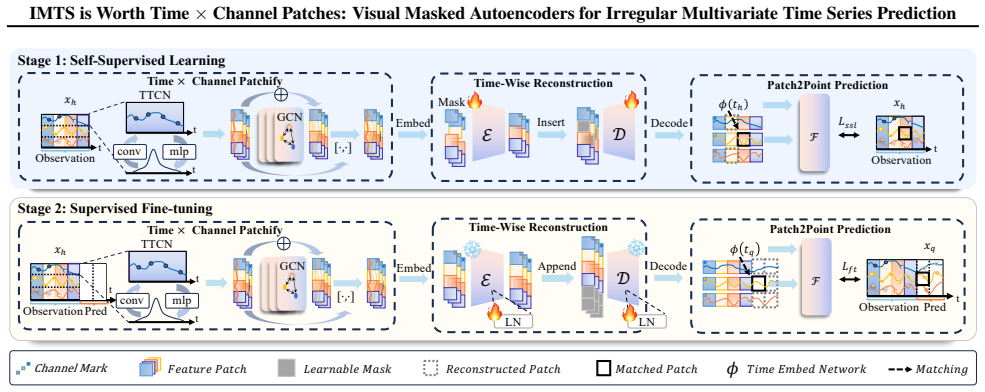
Time × channel patchification: the irregular samples of each channel are grouped into equal-width time intervals, and each interval is compressed by a Transformable Time-aware Convolutional Network (TTCN) into a fixed-size feature patch, with a missingness mask and channel embedding appended. The patches are then complemented by a Graph Convolutional Network (GCN) that builds a learned, section-specific directed graph among channels, so a sparse or empty patch inherits information from correlated channels. The visual MAE encoder-decoder reconstructs masked or future patches along each channel, using sinusoidal temporal-period positional embeddings to fit patches into the pretrained positional understanding. Finally, a coarse-to-fine Patch2Point predictor queries a reconstructed patch with the target timestamp embedding and produces point-level predictions through a small MLP.
What would settle it
Take a held-out irregular multivariate dataset not used in the paper, train VIMTS from random initialization and from ImageNet initialization on the same small data budget, and compare. If the ImageNet-initialized version does not clearly beat the random-initialized version at 20% data, the transfer claim is falsified. A complementary check: on a dataset where channels are nearly independent, the GCN compensation should stop helping; if it still helps, the mechanism is doing something other than cross-channel imputation.
Extended reading notes
Core claim
On its own terms, the paper's central discovery is that irregular multivariate time series can be treated as an image-like grid whose two axes are time and channel, and that a visual MAE pretrained on natural images can then be adapted to forecast them. The adaptation consists of three moves: time-aligned patches extracted with a time-aware convolutional network; explicit cross-channel compensation by a lightweight GCN so that missing values in one channel borrow information from related channels; and a two-stage training schedule in which self-supervised mask reconstruction adapts the image-trained MAE to sparse multi-channel series before supervised fine-tuning for forecasting. The reported result is that VIMTS achieves the lowest MSE and MAE on PhysioNet, Human Activity, USHCN and MIMIC, and that at 20% or 50% of the training data it matches t-PatchGNN trained on complete data while exceeding all other baselines.
Load-bearing premise
The result rests on the premise that weights pretrained to reconstruct natural images transfer to sparse, irregular multi-channel sensor streams after self-supervised adaptation; if that transfer is weak on datasets outside the four tested, the few-shot advantage and the image-pretrained framing lose their support.
Editorial extensions
If this is right
- Visual masks can be adapted to sparse multi-channel signals: an architecture designed for image reconstruction is sufficient to model temporal dependencies in irregular multivariate series without specialized continuous-time machinery.
- Training data requirements drop: at 20-50% of the training data, the reported accuracy matches the strongest prior baseline at full data, so data-scarce deployment is the intended use case.
- Cross-channel compensation is load-bearing: removing the GCN raises error sharply, most visibly on the 96-channel MIMIC dataset, so imputation at the representation level, not raw-value imputation, drives the gains.
- Pretraining and self-supervised adaptation are complementary: ablations show each contributes, and fine-tuning only normalization layers preserves most of the benefit while keeping the pretrained sparse-data ability.
- If the claim holds, image-pretrained MAEs become a practical starting point for forecasting in clinical, biomechanical and climate settings where recordings are irregular and missingness is high.
Reading between the lines
- A testable extension of the paper's logic is that the ImageNet-pretrained initialization could be replaced by any large pretrained encoder with a token-level masking objective; the few-shot advantage should survive as long as the pretrained attention and normalization structure transfers.
- The fixed-patch and fixed-channel limitation the paper acknowledges suggests the next bottleneck is not the MAE but the patchizer: a dynamic patchization that adapts interval width to local sampling density would be needed for true zero-shot irregular-series forecasting.
- One consequence the authors leave implicit is that the same time-channel patchification may benefit other sparse multi-channel prediction tasks, such as imputation or anomaly detection, by reusing the stage-one self-supervised model without fine-tuning.
- The paper reports that the leading baseline's published MIMIC numbers came from a preprocessing pipeline it could not reproduce; after correcting the pipeline, the comparison still favors VIMTS, and a re-implementation on the corrected data remains the cleanest external check of that result.
Editorial analysis
A structured set of objections, weighed in public.
Referee Report
Summary. The manuscript proposes VIMTS, an architecture that adapts a visual masked autoencoder (MAE) to irregular multivariate time series (IMTS) forecasting. It patches the time series into equal-interval time by channel blocks, compensates missing information via graph convolutional cross-channel interactions, and uses a pre-trained visual MAE to reconstruct and forecast patch-level representations, followed by a coarse-to-fine Patch2Point predictor. The model is trained in two stages: self-supervised masked patch reconstruction adapted to IMTS, then supervised fine-tuning. The authors report state-of-the-art MSE/MAE on PhysioNet, Human Activity, USHCN, and MIMIC, and claim that with only 20-50% of training data VIMTS matches the full-data performance of the best baseline, t-PatchGNN.
Significance. If the empirical claims hold, VIMTS is a useful adaptation of vision foundation models to irregular multivariate time series, and the paper's strengths include experiments on four public datasets, five-seed mean±std reporting, extensive ablations, and sensitivity analyses. The framework is original in combining time by channel patchification, GCN-based cross-channel compensation, and two-stage MAE-based training, and the authors provide code. However, the headline few-shot claim is contradicted by the paper's own numbers on MIMIC, and the provenance of the MIMIC baseline is not fully transparent; these issues must be fixed before the claimed generalization can be accepted.
major comments (3)
- [Sec. 3.2, Table 5] The headline few-shot claim is contradicted by the paper's own MIMIC numbers. The text in Sec. 3.2 says that with 20% or 50% of training data VIMTS 'matches the performance of t-PatchGNN with complete data.' Table 5 reports, for MIMIC at 20% data, VIMTS MSE 1.47±0.01 and MAE 6.71±0.06, while Table 1 reports t-PatchGNN at 100% data with MSE 1.36±0.02 and MAE 6.56±0.11; at 50% data VIMTS MSE is 1.41±0.01, still above 1.36. These differences are several times the reported standard deviations. The unscoped claim therefore fails on one of the four datasets and should be replaced by dataset-specific statements or by the more accurate 'competitive' wording used in Appendix B.1.
- [Appendix B.1 vs. Table 1 footnote] The provenance of the MIMIC baseline is inconsistent. Table 1 marks t-PatchGNN with an asterisk defined as 'reproduced following the original paper,' but Appendix B.1 states that the authors could not reproduce t-PatchGNN on MIMIC and instead re-evaluated it with 'corrected preprocessing.' Since the full-data t-PatchGNN values used as the few-shot reference (MSE 1.36, MAE 6.56) are exactly the re-derived numbers, the main comparison on MIMIC rests on a non-standard baseline. Please report both the original and corrected numbers, mark them separately, and clarify why the corrected preprocessing is the appropriate protocol.
- [Sec. 3.1 baselines and Appendix B] The comparison against most baselines is not performed under a common protocol. Appendix B states that values marked with † are quoted from Zhang et al. (2024a), and the table does not distinguish quoted from reproduced entries; no paired significance tests are reported. This is load-bearing for the 'consistently outperforms' claim because some margins are very small (Human Activity MSE 2.65±0.01 vs 2.66±0.03 for t-PatchGNN; MIMIC MSE 1.36±0.02 vs 1.36±0.02). Please re-run the closest baselines under the same seeds, data splits, and evaluation code, or clearly separate quoted from reproduced results and add statistical tests.
minor comments (6)
- [Eq. (3)] The definition L_p = l_p - r_p + 1 appears to have the indices reversed and should be r_p - l_p + 1; also, f_n_d is described as an L_p by D_in matrix while the softmax expression produces an L_p-vector, so the filter shape and the inner product in Eq. (4) should be clarified.
- [Eq. (28)] The self-supervised loss sums over all history query timestamps H_n, but only masked patches have reconstructions from Eq. (25); please state explicitly that the sum is restricted to timestamps whose patch index is in M, or otherwise define reconstructions for unmasked patches.
- [Table 4] The three rows marked '✓ ✓', '✓', and blank do not identify which training stage uses Patch2Point; add column headings for SSL and fine-tuning.
- [Sec. 3.2] The statement 'VIMTS consistently outperforms other methods, including t-PatchGNN' is too strong given Table 1 shows a tie with t-PatchGNN on MIMIC MSE (1.36±0.02 vs 1.36±0.02); use 'matches or outperforms' and give dataset-specific details.
- [Table 1 / Sec. 3.1] The baseline name is written as both t-PatchGNN and T-PATCHGNN; please use a single convention.
- [Fig. 2] Consider adding error bars to the bars in Fig. 2, since the paper reports mean±std in tables and the few-shot comparisons are close.
Circularity Check
No circularity found: VIMTS's forecasting results are produced by a trained network and evaluated on external public benchmarks, with no fitted input renamed as a prediction and no load-bearing self-citation.
full rationale
The paper's central claim is empirical: VIMTS forecasts IMTS and is evaluated on PhysioNet, Human Activity, USHCN, and MIMIC using held-out test splits with MSE and MAE. The method uses a visual MAE backbone pre-trained on ImageNet, which is an independent external anchor, and the two-stage training (self-supervised reconstruction on historical patches, then supervised fine-tuning on future queries) is a standard training scheme rather than a derivation that reduces to its inputs. The self-supervised loss in Eq. (28) and the fine-tuning loss in Eq. (29) are both prediction losses, but they operate on different data roles (reconstructing observed historical values in masked patches versus forecasting future values), and the reported numbers are on test data not used for training. There are no fitted parameters that are subsequently renamed as predictions; hyperparameters are tuned on validation splits and reported with standard deviations over seeds. The paper contains no load-bearing self-citation: the cited prior work (e.g., t-PatchGNN, VisionTS, MAE) is by other authors, and the ImageNet pretraining is an external, independently verifiable resource. The appendix note that t-PatchGNN's MIMIC results were re-evaluated with 'corrected preprocessing' is a reproducibility and comparability concern, not a circularity, because the baseline's numbers are not defined in terms of VIMTS's outputs. Similarly, the discrepancy between the few-shot claim and the MIMIC numbers in Table 5 is a factual/correctness risk, not a circular step. No equation in the paper defines a predicted quantity in terms of the quantity it is supposed to predict, and no claimed 'prediction' is equivalent by construction to an input or fitted parameter. Therefore the appropriate circularity score is 0.
Assumptions & free parameters
free parameters (6)
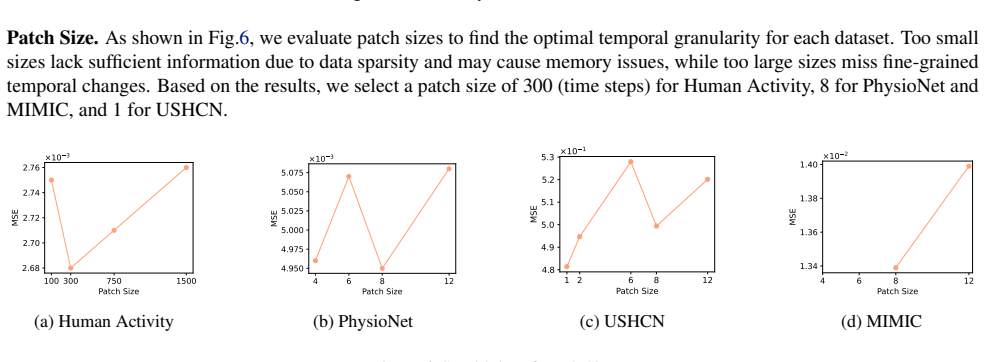
- Patch size s =
300 (Human Activity), 8 (PhysioNet/MIMIC), 1 (USHCN)
- SSL mask ratio r =
0.7 (Human Activity), 0.6 (PhysioNet), 0.4 (USHCN/MIMIC)
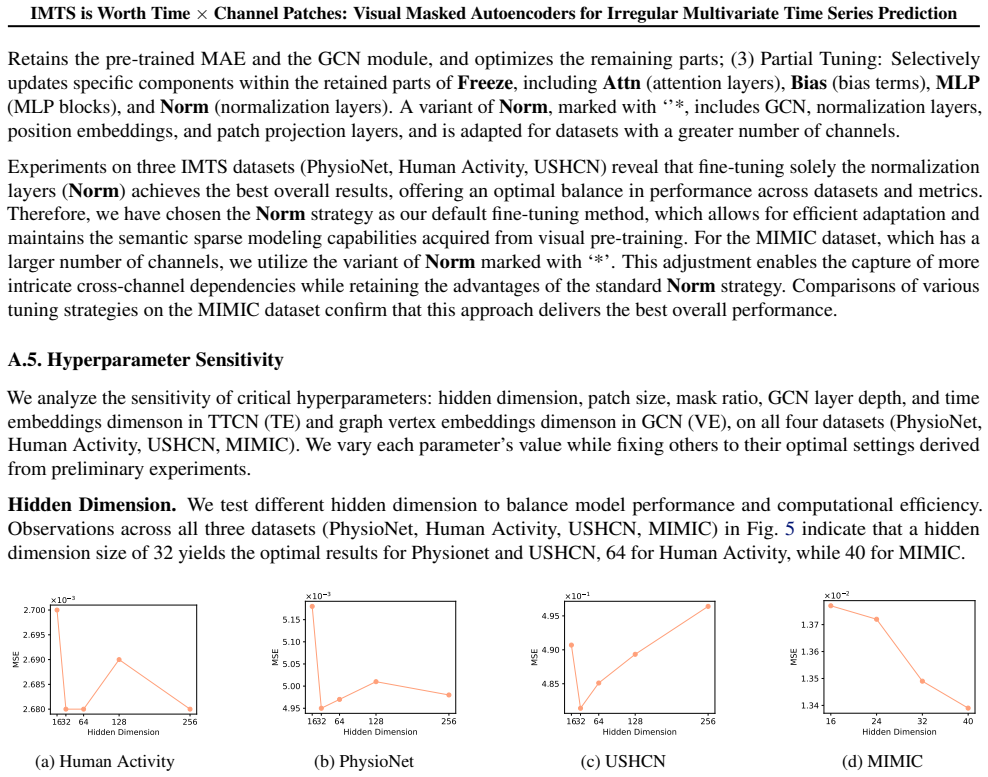
- Hidden dimension =
32 (PhysioNet/USHCN), 40 (MIMIC), 64 (Human Activity)
- GCN layer count M =
2 (Human Activity), 3 (PhysioNet/USHCN/MIMIC)
- Time embedding (TE) and graph vertex embedding (VE) dimensions =
5 (Human Activity/PhysioNet), 10 (USHCN), 40 (MIMIC)
- Fine-tuning strategy =
Norm (freeze all but normalization layers); Norm+GCN for MIMIC
assumptions (4)
- domain assumption Visual MAE pretrained on ImageNet RGB images transfers to IMTS forecasting.
- domain assumption IMTS can be segmented into globally aligned equal-length time patches starting from a common t1.
- domain assumption Cross-channel missingness can be compensated by a per-patch learned directed graph (GCN).
- domain assumption Self-supervised mask reconstruction on the same data improves downstream forecasting.
Cite this review
Pith. "Pith review of IMTS is Worth Time $\times$ Channel Patches: Visual Masked Autoencoders for Irregular Multivariate Time Series Prediction." pith.science (2026). https://pith.science/paper/Y3XO4MBS
@misc{pith2026250522815,
  author       = {Pith},
  title        = {Pith review of: IMTS is Worth Time $\times$ Channel Patches: Visual Masked Autoencoders for Irregular Multivariate Time Series Prediction},
  year         = {2026},
  howpublished = {\url{https://pith.science/paper/Y3XO4MBS}},
  note         = {Machine review of arXiv:2505.22815}
}
read the original abstract
Irregular Multivariate Time Series (IMTS) forecasting is challenging due to the unaligned nature of multi-channel signals and the prevalence of extensive missing data. Existing methods struggle to capture reliable temporal patterns from such data due to significant missing values. While pre-trained foundation models show potential for addressing these challenges, they are typically designed for Regularly Sampled Time Series (RTS). Motivated by the visual Mask AutoEncoder's (MAE) powerful capability for modeling sparse multi-channel information and its success in RTS forecasting, we propose VIMTS, a framework adapting Visual MAE for IMTS forecasting. To mitigate the effect of missing values, VIMTS first processes IMTS along the timeline into feature patches at equal intervals. These patches are then complemented using learned cross-channel dependencies. Then it leverages visual MAE's capability in handling sparse multichannel data for patch reconstruction, followed by a coarse-to-fine technique to generate precise predictions from focused contexts. In addition, we integrate self-supervised learning for improved IMTS modeling by adapting the visual MAE to IMTS data. Extensive experiments demonstrate VIMTS's superior performance and few-shot capability, advancing the application of visual foundation models in more general time series tasks. Our code is available at https://github.com/WHU-HZY/VIMTS.
Figures


Figures from the paper (6 more)



Reference graph
Works this paper leans on
-
[1]
write newline
" write newline "" before.all 'output.state := FUNCTION n.dashify 't := "" t empty not t #1 #1 substring "-" = t #1 #2 substring "--" = not "--" * t #2 global.max substring 't := t #1 #1 substring "-" = "-" * t #2 global.max substring 't := while if t #1 #1 substring * t #2 global.max substring 't := if while FUNCTION format.date year duplicate empty "emp...
-
[2]
Altman, N. S. An introduction to kernel and nearest-neighbor nonparametric regression. The American Statistician, 1992
work page 1992
-
[3]
Author, N. N. Suppressed for anonymity, 2021
work page 2021
- [4]
-
[5]
S., Januschowski, T., and G \"u nnemann, S
Bilo s , M., Sommer, J., Rangapuram, S. S., Januschowski, T., and G \"u nnemann, S. Neural flows: Efficient alternative to neural odes. NeurIPS, 2021
work page 2021
-
[6]
A., Adeli, E., Altman, R., Arora, S., von Arx, S., Bernstein, M
Bommasani, R., Hudson, D. A., Adeli, E., Altman, R., Arora, S., von Arx, S., Bernstein, M. S., Bohg, J., Bosselut, A., Brunskill, E., Brynjolfsson, E., Buch, S., Card, D., Castellon, R., Chatterji, N., Chen, A., Creel, K., Davis, J. Q., Demszky, D., Donahue, C., Doumbouya, M., and et. al. On the opportunities and risks of foundation models. arXiv, 2022
work page 2022
-
[7]
D., Dhariwal, P., Neelakantan, A., Shyam, P., Sastry, G., Askell, A., et al
Brown, T., Mann, B., Ryder, N., Subbiah, M., Kaplan, J. D., Dhariwal, P., Neelakantan, A., Shyam, P., Sastry, G., Askell, A., et al. Language models are few-shot learners. NeurIPS, 2020
2020
-
[8]
Spectral temporal graph neural network for multivariate time-series forecasting
Cao, D., Wang, Y., Duan, J., Zhang, C., Zhu, X., Huang, C., Tong, Y., Xu, B., Bai, J., Tong, J., et al. Spectral temporal graph neural network for multivariate time-series forecasting. NeurIPS, 2020
work page 2020
Show all 74 references
-
[9]
and Draxler, R
Chai, T. and Draxler, R. R. Root mean square error (rmse) or mean absolute error (mae)?--arguments against avoiding rmse in the literature. Geoscientific model development, 2014
2014
-
[10]
Recurrent neural networks for multivariate time series with missing values
Che, Z., Purushotham, S., Cho, K., Sontag, D., and Liu, Y. Recurrent neural networks for multivariate time series with missing values. Scientific Reports, 2018
2018
-
[11]
J., Sun, J., and Liu, C
Chen, M., Shen, L., Li, Z., Wang, X. J., Sun, J., and Liu, C. Visionts: Visual masked autoencoders are free-lunch zero-shot time series forecasters. In ICML, 2025
2025
-
[12]
Chen, R. T. Q., Rubanova, Y., Bettencourt, J., and Duvenaud, D. K. Neural ordinary differential equations. In NeurIPS, 2018
2018
-
[13]
A decoder-only foundation model for time-series forecasting
Das, A., Kong, W., Sen, R., and Zhou, Y. A decoder-only foundation model for time-series forecasting. arXiv, 2024
2024
-
[14]
and Ghosh, S
Das, M. and Ghosh, S. K. sembnet: a semantic bayesian network for multivariate prediction of meteorological time series data. PRL, 2017
2017
-
[15]
Gru-ode-bayes: Continuous modeling of sporadically-observed time series
De Brouwer, E., Simm, J., Arany, A., and Moreau, Y. Gru-ode-bayes: Continuous modeling of sporadically-observed time series. NeurIPS, 2019
2019
-
[16]
Imagenet: A large-scale hierarchical image database
Deng, J., Dong, W., Socher, R., Li, L.-J., Li, K., and Fei-Fei, L. Imagenet: A large-scale hierarchical image database. In CVPR, 2009
2009
-
[17]
O., Hart, P
Duda, R. O., Hart, P. E., and Stork, D. G. Pattern Classification. 2000
2000
-
[18]
L., and R \"a tsch, G
Esteban, C., Hyland, S. L., and R \"a tsch, G. Real-valued (medical) time series generation with recurrent conditional gans. arXiv, 2017
2017
-
[19]
Missing value imputation for multi-view urban statistical data via spatial correlation learning
Gong, Y., Li, Z., Zhang, J., Liu, W., Yin, Y., and Zheng, Y. Missing value imputation for multi-view urban statistical data via spatial correlation learning. TKDE, 2021
2021
-
[20]
Generative adversarial networks
Goodfellow, I., Pouget-Abadie, J., Mirza, M., Xu, B., Warde-Farley, D., Ozair, S., Courville, A., and Bengio, Y. Generative adversarial networks. Communications of the ACM, 2020
2020
-
[21]
Moment: A family of open time-series foundation models
Goswami, M., Szafer, K., Choudhry, A., Cai, Y., Li, S., and Dubrawski, A. Moment: A family of open time-series foundation models. In ICML, 2024
2024
-
[22]
Improving artificial neural networks’ performance in seasonal time series forecasting
Hamza c ebi, C. Improving artificial neural networks’ performance in seasonal time series forecasting. Information Sciences, 2008
2008
-
[23]
Masked autoencoders are scalable vision learners
He, K., Chen, X., Xie, S., Li, Y., Doll \'a r, P., and Girshick, R. Masked autoencoders are scalable vision learners. In CVPR, 2022
2022
-
[24]
Neural jump ordinary differential equations: Consistent continuous-time prediction and filtering
Herrera, C., Krach, F., and Teichmann, J. Neural jump ordinary differential equations: Consistent continuous-time prediction and filtering. arXiv, 2021
2021
-
[25]
Denoising diffusion probabilistic models
Ho, J., Jain, A., and Abbeel, P. Denoising diffusion probabilistic models. NeurIPS, 2020
2020
-
[26]
Set functions for time series
Horn, M., Moor, M., Bock, C., Rieck, B., and Borgwardt, K. Set functions for time series. In ICML, 2020
2020
-
[27]
Crossgnn: Confronting noisy multivariate time series via cross interaction refinement
Huang, Q., Shen, L., Zhang, R., Ding, S., Wang, B., Zhou, Z., and Wang, Y. Crossgnn: Confronting noisy multivariate time series via cross interaction refinement. NeurIPS, 2023
2023
-
[28]
Y., Shi, X., Chen, P.-Y., Liang, Y., Li, Y.-F., Pan, S., and Wen, Q
Jin, M., Wang, S., Ma, L., Chu, Z., Zhang, J. Y., Shi, X., Chen, P.-Y., Liang, Y., Li, Y.-F., Pan, S., and Wen, Q. Time-llm: Time series forecasting by reprogramming large language models. arXiv, 2024
2024
-
[29]
E., Pollard, T
Johnson, A. E., Pollard, T. J., Shen, L., Lehman, L.-w. H., Feng, M., Ghassemi, M., Moody, B., Szolovits, P., Anthony Celi, L., and Mark, R. G. Mimic-iii, a freely accessible critical care database. Scientific Data, 2016
2016
-
[30]
Representation learning for wearable-based applications in the case of missing data
Jungo, J., Xiang, Y., Gashi, S., and Holz, C. Representation learning for wearable-based applications in the case of missing data. arXiv, 2024
2024
-
[31]
Kearns, M. J. Computational Complexity of Machine Learning. PhD thesis, Department of Computer Science, Harvard University, 1989
1989
-
[32]
Neural controlled differential equations for irregular time series
Kidger, P., Morrill, J., Foster, J., and Lyons, T. Neural controlled differential equations for irregular time series. In NuerIPS, 2020
2020
-
[33]
Kingma, D. P. Auto-encoding variational bayes. arXiv, 2013
2013
-
[34]
Kipf, T. N. and Welling, M. Semi-supervised classification with graph convolutional networks. arXiv, 2016
2016
-
[35]
Crafting papers on machine learning
Langley, P. Crafting papers on machine learning. In ICML, 2000
2000
-
[36]
Time series as images: Vision transformer for irregularly sampled time series
Li, Z., Li, S., and Yan, X. Time series as images: Vision transformer for irregularly sampled time series. In NeurIPS, 2023
2023
-
[37]
Foundation models for time series analysis: A tutorial and survey
Liang, Y., Wen, H., Nie, Y., Jiang, Y., Jin, M., Song, D., Pan, S., and Wen, Q. Foundation models for time series analysis: A tutorial and survey. In ACM SIGKDD, 2024
2024
-
[38]
and Zohren, S
Lim, B. and Zohren, S. Time-series forecasting with deep learning: a survey. Philos T R Soc A, 2021
2021
-
[39]
C., Kale, D., and Wetzel, R
Lipton, Z. C., Kale, D., and Wetzel, R. Directly modeling missing data in sequences with rnns: Improved classification of clinical time series. In MLHC, 2016
2016
-
[40]
M., Kale, D
Marlin, B. M., Kale, D. C., Khemani, R. G., and Wetzel, R. C. Unsupervised pattern discovery in electronic health care data using probabilistic clustering models. In ACM SIGHIT, 2012
2012
-
[41]
Long-term daily climate records from stations across the contiguous united states, 2015
Menne, M., Williams Jr, C., Vose, R., and Files, D. Long-term daily climate records from stations across the contiguous united states, 2015
2015
-
[42]
S., Carbonell, J
Michalski, R. S., Carbonell, J. G., and Mitchell, T. M. (eds.). Machine Learning: An Artificial Intelligence Approach, Vol. I. 1983
1983
-
[43]
Mitchell, T. M. The need for biases in learning generalizations. Technical report, Computer Science Department, Rutgers University, 1980
1980
-
[44]
Phased LSTM : Accelerating Recurrent Network Training for Long or Event -based Sequences
Neil, D., Pfeiffer, M., and Liu, S.-C. Phased LSTM : Accelerating Recurrent Network Training for Long or Event -based Sequences . In NeurIPS, 2016
2016
-
[45]
and Rosenbloom, P
Newell, A. and Rosenbloom, P. S. Mechanisms of skill acquisition and the law of practice. In Cognitive Skills and Their Acquisition. 1981
1981
-
[46]
H., Sinthong, P., and Kalagnanam, J
Nie, Y., Nguyen, N. H., Sinthong, P., and Kalagnanam, J. A time series is worth 64 words: Long-term forecasting with transformers. arXiv, 2022
2022
-
[47]
W., Hallacy, C., Ramesh, A., Goh, G., Agarwal, S., Sastry, G., Askell, A., Mishkin, P., Clark, J., et al
Radford, A., Kim, J. W., Hallacy, C., Ramesh, A., Goh, G., Agarwal, S., Sastry, G., Askell, A., Mishkin, P., Clark, J., et al. Learning transferable visual models from natural language supervision. In ICML, 2021
2021
-
[48]
T., and Duvenaud, D
Rubanova, Y., Chen, R. T., and Duvenaud, D. K. Latent ordinary differential equations for irregularly-sampled time series. NeurIPS, 2019
2019
-
[49]
Samuel, A. L. Some studies in machine learning using the game of checkers. IBM J RES DEV, 1959
1959
-
[50]
Modeling irregular time series with continuous recurrent units
Schirmer, M., Eltayeb, M., Lessmann, S., and Rudolph, M. Modeling irregular time series with continuous recurrent units. In ICML, 2022
2022
-
[51]
Shukla, S. N. and Marlin, B. Multi-time attention networks for irregularly sampled time series. In ICLR, 2021 a
2021
-
[52]
Shukla, S. N. and Marlin, B. M. A survey on principles, models and methods for learning from irregularly sampled time series. arXiv, 2021 b
2021
-
[53]
J., Celi, L
Silva, I., Moody, G., Scott, D. J., Celi, L. A., and Mark, R. G. Predicting in-hospital mortality of icu patients: The physionet/computing in cardiology challenge 2012. In 2012 Computing in Cardiology, 2012
2012
-
[54]
A., Gupta, V., Althoff, T., and Hartvigsen, T
Tan, M., Merrill, M. A., Gupta, V., Althoff, T., and Hartvigsen, T. Are language models actually useful for time series forecasting? In NeurIPS, 2024
2024
-
[55]
and Groothuis-Oudshoorn, K
Van Buuren, S. and Groothuis-Oudshoorn, K. mice: Multivariate imputation by chained equations in r. Journal of Statistical Software, 2011
2011
-
[56]
Attention is all you need
Vaswani, A. Attention is all you need. NeurIPS, 2017
2017
-
[57]
Deep learning for multivariate time series imputation: A survey
Wang, J., Du, W., Cao, W., Zhang, K., Wang, W., Liang, Y., and Wen, Q. Deep learning for multivariate time series imputation: A survey. arXiv, 2024
2024
-
[58]
B., Wong, K
Weerakody, P. B., Wong, K. W., Wang, G., and Ela, W. A review of irregular time series data handling with gated recurrent neural networks. Neurocomputing, 2021
2021
-
[59]
Etsformer: Exponential smoothing transformers for time-series forecasting
Woo, G., Liu, C., Sahoo, D., Kumar, A., and Hoi, S. Etsformer: Exponential smoothing transformers for time-series forecasting. arXiv, 2022
2022
-
[60]
Unified training of universal time series forecasting transformers
Woo, G., Liu, C., Kumar, A., Xiong, C., Savarese, S., and Sahoo, D. Unified training of universal time series forecasting transformers. arXiv, 2024
2024
-
[61]
Timesnet: Temporal 2d-variation modeling for general time series analysis
Wu, H., Hu, T., Liu, Y., Zhou, H., Wang, J., and Long, M. Timesnet: Temporal 2d-variation modeling for general time series analysis. arXiv, 2022
2022
-
[62]
Graph wavenet for deep spatial-temporal graph modeling
Wu, Z., Pan, S., Long, G., Jiang, J., and Zhang, C. Graph wavenet for deep spatial-temporal graph modeling. arXiv, 2019
2019
-
[63]
Connecting the dots: Multivariate time series forecasting with graph neural networks
Wu, Z., Pan, S., Long, G., Jiang, J., Chang, X., and Zhang, C. Connecting the dots: Multivariate time series forecasting with graph neural networks. In ACM SIGKDD, 2020
2020
-
[64]
Vitime: A visual intelligence-based foundation model for time series forecasting
Yang, L., Wang, Y., Fan, X., Cohen, I., Chen, J., Zhao, Y., and Zhang, Z. Vitime: A visual intelligence-based foundation model for time series forecasting. arXiv, 2024
2024
-
[65]
Fouriergnn: Rethinking multivariate time series forecasting from a pure graph perspective
Yi, K., Zhang, Q., Fan, W., He, H., Hu, L., Wang, P., An, N., Cao, L., and Niu, Z. Fouriergnn: Rethinking multivariate time series forecasting from a pure graph perspective. NeurIPS, 2024
2024
-
[66]
R., and van der Schaar, M
Yoon, J., Zame, W. R., and van der Schaar, M. Estimating missing data in temporal data streams using multi-directional recurrent neural networks. IEEE Transactions on Biomedical Engineering, 2018
2018
-
[67]
Are transformers effective for time series forecasting? In AAAI, 2023
Zeng, A., Chen, M., Zhang, L., and Xu, Q. Are transformers effective for time series forecasting? In AAAI, 2023
2023
-
[68]
Warpformer: A multi-scale modeling approach for irregular clinical time series
Zhang, J., Zheng, S., Cao, W., Bian, J., and Li, J. Warpformer: A multi-scale modeling approach for irregular clinical time series. In ACM SIGKDD, 2023
2023
-
[69]
Irregular multivariate time series forecasting: A transformable patching graph neural networks approach
Zhang, W., Yin, C., Liu, H., Zhou, X., and Xiong, H. Irregular multivariate time series forecasting: A transformable patching graph neural networks approach. In ICML, 2024 a
2024
-
[70]
Irregular traffic time series forecasting based on asynchronous spatio-temporal graph convolutional networks
Zhang, W., Zhang, L., Han, J., Liu, H., Fu, Y., Zhou, J., Mei, Y., and Xiong, H. Irregular traffic time series forecasting based on asynchronous spatio-temporal graph convolutional networks. In ACM SIGKDD, 2024 b
2024
-
[71]
Graph-guided network for irregularly sampled multivariate time series
Zhang, X., Zeman, M., Tsiligkaridis, T., and Zitnik, M. Graph-guided network for irregularly sampled multivariate time series. arXiv, 2022
2022
-
[72]
and Yan, J
Zhang, Y. and Yan, J. Crossformer: Transformer utilizing cross-dimension dependency for multivariate time series forecasting. In ICLR, 2023
2023
-
[73]
X., Zhou, K., Li, J., Tang, T., Wang, X., Hou, Y., Min, Y., Zhang, B., Zhang, J., Dong, Z., Du, Y., and et
Zhao, W. X., Zhou, K., Li, J., Tang, T., Wang, X., Hou, Y., Min, Y., Zhang, B., Zhang, J., Dong, Z., Du, Y., and et. al. A survey of large language models. arXiv, 2024
2024
-
[74]
One fits all: Power general time series analysis by pretrained lm
Zhou, T., Niu, P., wang, x., Sun, L., and Jin, R. One fits all: Power general time series analysis by pretrained lm. In NeurIPS, 2023
2023
Reviewed August 7, 2026 · model on record in the stance chip above.
Discussion (0). Sign in to comment.