REVIEW 3 major objections 5 minor 1 cited by
Dynamic Estimation Loss Control in Variational Quantum Sensing via Online Conformal Inference
T0 review · 3 major / 5 minor · reviewed 2026-08-07 · deepseek-v4-flash
Pith's one-line read Variational quantum sensors can provably keep long-term estimation loss at a user-set level by coupling the sensing loop with online conformal inference.
desk verdict A genuinely new application of online conformal inference to variational quantum sensing, with the central guarantee imported correctly from [25]; the per-step feedback assumption narrows the sensing scope, but the paper deserves a serious referee. read the letter →
The pith
A machine-rendered reading of the paper's core claim, the machinery that carries it, and where it could break.
The reading
What carries the argument
The central object is the online conformal risk-control rule for the threshold: $\lambda_{t+1} = \lambda_t + \eta_t (L(x_t,\hat{X}_t) - \alpha)$. It is the mechanism that converts past errors into future set sizes: when the current loss exceeds the target $\alpha$ the threshold rises, making the set more inclusive, and when loss is below $\alpha$ it falls, tightening the set. The argument rests on the score function $C(s_t,x) = -\log p_w(x|s_t)$, learned by a sequential neural estimator, and on a smooth sigmoid surrogate $G_{\theta,w,t}$ that replaces set cardinality so that the probe parameters $\theta$ and estimator weights $w$ can be updated by online gradient descent.
What would settle it
Run the scheme on a sensing task in which the ground-truth parameter is withheld after a short training phase, with drift between the training distribution and the test sequence, and record the time-averaged loss; if the empirical loss exceeds $\alpha$, the feedback and transferability premise fails and the guarantee does not apply in deployment.
Extended reading notes
Core claim
The paper establishes that online conformal prediction, a classical tool for risk control in sequential prediction, transfers to variational quantum sensing. At each time step the sensor produces a set $\hat{X}_t = \{x: C(s_t,x) \le \lambda_t\}$ using a learned score $C(s_t,x) = -\log p_w(x|s_t)$, then updates the threshold by $\lambda_{t+1} = \lambda_t + \eta_t (L(x_t,\hat{X}_t) - \alpha)$. Because the loss is bounded and monotone in the set, this online update yields $\bar{L}(T) \le \alpha + \frac{L_{\max} + \max_{1\le t\le T} \eta_t}{T} \|\Delta_{1:T}\|$, so long-term loss converges to $\alpha$ at rate $1/T$. The same feedback is used to update the probe parameters $\theta$ and estimator weights $w$ by online gradient descent on a smooth surrogate of the set cardinality, which keeps the sets informative while maintaining coverage.
Load-bearing premise
The load-bearing premise is that the true parameter $x_t$ is known to the estimator after every round, through human labels, a local measuring device, or a training phase; in actual sensing the parameter is unknown, so this feedback must come from somewhere and the method's transfer to that setting is assumed rather than demonstrated.
Editorial extensions
If this is right
- Long-term estimation loss can be controlled to any user-set $\alpha$ without distributional assumptions on the parameter sequence.
- The same update loop works for any bounded, monotone loss, including minimum-distance loss $\min_{\hat{x}\in\hat{X}}\|x-\hat{x}\|_p$, not only coverage loss.
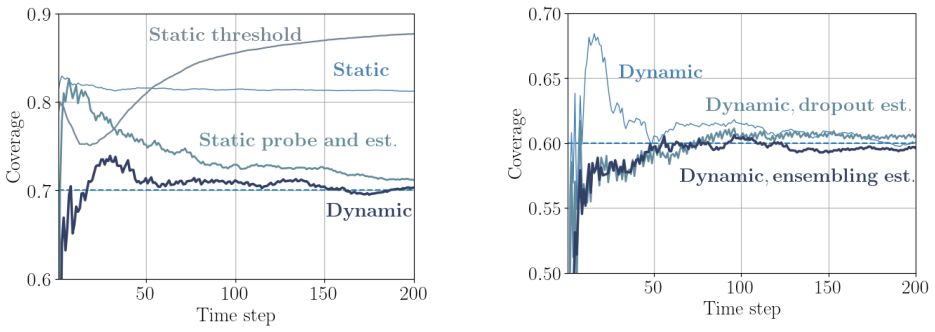
- Dynamic updates of the probe and the estimator tighten the estimation sets at fixed coverage, giving more informative estimates than static or threshold-only strategies.
- The guarantee holds over indefinitely long runs, so the method is suited to continuous monitoring tasks such as magnetometry inside a control loop.
- Experiments indicate the coverage target is met even under quantum noise and drift, provided feedback of the true parameter is available.
Reading between the lines
- Editorial: the guarantee is proven for the online update loop, but its deployment value depends on transferability from a training phase with known parameters to real sensing without oracle feedback; that transfer is untested and is the link most worth probing experimentally.
- Editorial: if feedback is delayed or noisy, the threshold update would see a corrupted loss; one could test whether a modified update with bounded feedback error still keeps long-term loss near $\alpha$.
- Editorial: extending the method to continuous parameters with a volume-based loss could make it relevant beyond discretized magnetometry, at the cost of a different set-size surrogate.
Editorial analysis
A structured set of objections, weighed in public.
Referee Report
Summary. The paper proposes an online conformal inference framework for variational quantum sensing (VQS) that adaptively updates the prediction threshold λ_t and the probe/estimator parameters θ,w to control the long-term average estimation loss. The central theoretical result, Proposition 1, is an application of existing online conformal prediction (Conformal PID) and bounds the time-averaged loss by α + O(1/T). The method is demonstrated on a simulated quantum magnetometry task with a 4-qubit equivariant ansatz and an LSTM-based estimator, showing that the target coverage levels (1−α) are achieved and that dynamic updates of the probe and estimator yield smaller estimation sets than static baselines.
Significance. If the feedback assumption is satisfied, the paper offers a principled way to bring distribution-free, long-term risk guarantees to variational quantum sensing, an area where such guarantees have been lacking. The authors correctly attribute the core guarantee to prior conformal prediction work, specifically [25], and provide code for the experiments. The paper is also honest in acknowledging the need for a training phase with known parameters and the assumption of transferability. The main weakness is that the guarantee and the threshold update require oracle access to the true parameter at each time step, which is unavailable in the standard sensing deployment scenario; this currently limits the practical scope of the contribution.
major comments (3)
- [§2.2, §3.2, Proposition 1 (Eq. 10 and Eq. 16)] The online threshold update in Eq. (10), λ_{t+1} = λ_t + η_t(L(x_t, X̂_t) − α), and the guarantee in Eq. (16) both require the true parameter x_t at every time step to compute the loss L(x_t, X̂_t). In an actual sensing task, x_t is unknown by definition. The paper's only bridge is the claim in Section 1.3 that a training phase with known parameters can be used, 'assuming transferability,' but no transfer argument or experiment is provided. The Section 4 simulations feed x_t to the controller throughout, so they validate the feedback-aided loop rather than unknown-parameter deployment. This is a load-bearing scope gap: the advertised guarantee 'for any sequence of target parameters' holds only under oracle feedback. The authors should either reframe the deployment scenario (e.g., control-loop or periodic recalibration with known ground truth, as mentioned in Section 1.3) or supply a transfer experiment showing that thresholds and variational parameters calibrated on known x_t maintain coverage when x_t is withheld.
- [§4.3 and §4.4] The 'Static' baseline fixes the threshold λ by choosing it uniformly in the interval [0,2], which is arbitrary and likely not representative of a reasonable fixed-threshold competitor. A static threshold tuned on a calibration set or by grid search would be a more meaningful benchmark. Additionally, all results are averaged over five independent trials, but no error bars, standard deviations, or per-trial values are reported. Without these, the reader cannot assess whether the observed coverage differences and set-size reductions are statistically significant. Please report trial-level variation, for example with shaded regions or confidence intervals, and describe the random seed or initialization procedure.
- [Abstract and §1.2] The abstract states that the approach 'produces sequential estimation sets with a guaranteed long-term risk level,' but the phrase 'deterministic error bars' in the abstract is misleading. The guarantee in Proposition 1 is only on the time-averaged loss (long-run coverage), not on per-step coverage or interval length. The authors should revise the wording to clearly distinguish long-term average risk control from per-step error bars.
minor comments (5)
- [§5] There is a typo in the conclusions: 'quarantee' should be 'guarantee.'
- [Fig. 2 caption] The caption says 'as a function of the time step st' but should read 'time step t.'
- [Fig. 3 caption] The caption refers to 'number of epochs' while the text and other figures refer to 'time steps'; please make the terminology consistent.
- [References, [30]] The code link is given as a bare GitHub username; please provide a specific repository URL or commit identifier so that the exact code version is accessible.
- [§3.3, Eq. (12)] The surrogate in Eq. (12) uses σ(−(C(s_t,x)−λ_t)/τ), but the sigmoid is defined in Eq. (13); please verify the sign convention is consistent with the intended approximation of the indicator {x : C(s_t,x) ≤ λ_t}.
Circularity Check
No circularity found: the central long-term risk bound is imported from an external conformal-PID theorem and is not derived from quantities fitted in this paper.
full rationale
The paper's central guarantee, Proposition 1 with Eq. (16), is attributed to Angelopoulos, Candes, and Tibshirani [25], an external source with no author overlap with the present paper. The threshold update (10) is a direct instantiation of that external online conformal control rule, and the bound uses only the boundedness and monotonicity assumptions on the loss, not the particular learned score (9) or the probe/estimator updates (14)-(15). No fitted parameter is relabeled as a prediction: the target level alpha is user-defined, and the learned LSTM affects set size rather than the risk guarantee. The requirement of feedback about the true parameter x_t, used in (10), (14), and (15), is explicitly disclosed in Section 2.2 and Section 1.3, including the stated training-phase and transferability caveat, so it is a scope limitation rather than a circular derivation. The self-citations in the paper (e.g., refs. [16], [20], [21], [29], [36]) appear as related-work mentions or as sources for standard smooth-surrogate and Bayesian-uncertainty techniques, and none carries the conformal risk-control argument. The experiments validate the feedback-aided calibration loop and do not claim unsupervised deployment beyond the disclosed assumption. The derivation is therefore self-contained relative to its stated assumptions.
Assumptions & free parameters
free parameters (3)
- Threshold learning rate sequence eta_t =
Not reported
- Surrogate temperature tau =
0.5
- Gradient learning rates eta and mu =
eta = 0.001, mu not reported
assumptions (5)
- domain assumption The true parameter x_t is revealed after each time step.
- domain assumption The loss is bounded above and monotone decreasing in the set size.
- standard math The online conformal risk-control theorem of Angelopoulos et al. [25] is valid.
- standard math The sigmoid surrogate (12) approximates the set cardinality as tau tends to zero.
- domain assumption The learned model p_w(x|s_t) provides a useful score for the parameter x.
Cite this review
Pith. "Pith review of Dynamic Estimation Loss Control in Variational Quantum Sensing via Online Conformal Inference." pith.science (2026). https://pith.science/paper/MWWP3Q3O
@misc{pith2026250523389,
  author       = {Pith},
  title        = {Pith review of: Dynamic Estimation Loss Control in Variational Quantum Sensing via Online Conformal Inference},
  year         = {2026},
  howpublished = {\url{https://pith.science/paper/MWWP3Q3O}},
  note         = {Machine review of arXiv:2505.23389}
}
read the original abstract
Quantum sensing exploits non-classical effects to overcome limitations of classical sensors, with applications ranging from gravitational-wave detection to nanoscale imaging. However, practical quantum sensors built on noisy intermediate-scale quantum (NISQ) devices face significant noise and sampling constraints, and current variational quantum sensing (VQS) methods lack rigorous performance guarantees. This paper proposes an online control framework for VQS that dynamically updates the variational parameters while providing deterministic error bars on the estimates. By leveraging online conformal inference techniques, the approach produces sequential estimation sets with a guaranteed long-term risk level. Experiments on a quantum magnetometry task confirm that the proposed dynamic VQS approach maintains the required reliability over time, while still yielding precise estimates. The results demonstrate the practical benefits of combining variational quantum algorithms with online conformal inference to achieve reliable quantum sensing on NISQ devices.
Figures


Figures from the paper (1 more)

Forward citations
Cited by 1 Pith paper
-
Adaptive Bayesian Single-Shot Quantum Sensing
An adaptive Bayesian variational quantum sensing protocol selects probe and measurement settings by maximizing active information gain, demonstrated on a simulated sawtooth phase-tracking task.
Reference graph
Works this paper leans on
-
[25]
Conformal pid control for time se- riesprediction,
A. Angelopoulos, E. Candes, and R. J. Tib- shirani, “Conformal pid control for time se- riesprediction,”Advances in neural informa- tion processing systems, vol. 36, 2024
work page 2024
-
[1]
Quantum sensing,
C. L. Degen, F. Reinhard, and P. Cappel- laro, “Quantum sensing,”Reviews of modern physics, vol. 89, no. 3, p. 035002, 2017
2017
-
[2]
Exposing gravitational waves be- low the quantum sensing limit,
H. Yu, D. Martynov, R. X. Adhikari, and Y. Chen, “Exposing gravitational waves be- low the quantum sensing limit,”Physical Re- view D, vol. 106, no. 6, p. 063017, 2022
2022
-
[3]
Quan- tum measurement theory in gravitational- wave detectors,
S. L. Danilishin and F. Y. Khalili, “Quan- tum measurement theory in gravitational- wave detectors,”Living Reviews in Relativ- ity, vol. 15, pp. 1–147, 2012
work page 2012
-
[4]
I. Schwartz, J. Rosskopf, S. Schmitt, B. Tratzmiller, Q. Chen, L. P. McGuinness, F. Jelezko, and M. B. Plenio, “Blueprint for nanoscale nmr,”Scientific reports, vol. 9, no. 1, p. 6938, 2019
work page 2019
-
[5]
Roadmap on nanoscale magnetic res- onance imaging,
R. Budakian, A. Finkler, A. Eichler, M. Pog- gio, C. L. Degen, S. Tabatabaei, I. Lee, P. C. Hammel, S. P. Eugene, T. H. Taminiau et al., “Roadmap on nanoscale magnetic res- onance imaging,”Nanotechnology, vol. 35, no. 41, p. 412001, 2024
work page 2024
-
[6]
M. Schuld and F. Petruccione,Machine learning with quantum computers. Springer, 2021
work page 2021
-
[7]
An introduction to quantum machinelearningforengineers,
O. Simeone, “An introduction to quantum machinelearningforengineers,”Foundations and Trends®in Signal Processing, 2022
work page 2022
Show all 36 references
-
[8]
A variational toolbox for quantum multi- parameter estimation,
J. J. Meyer, J. Borregaard, and J. Eisert, “A variational toolbox for quantum multi- parameter estimation,”npj Quantum Infor- mation, vol. 7, no. 1, p. 89, 2021
2021
-
[9]
End-to-end variational quan- tum sensing,
B. MacLellan, P. Roztocki, S. Czischek, and R. G. Melko, “End-to-end variational quan- tum sensing,”npj Quantum Information, vol. 10, no. 1, p. 118, 2024
2024
-
[10]
A ma- chine learning approach to bayesian param- eter estimation,
S. Nolan, A. Smerzi, and L. Pezzè, “A ma- chine learning approach to bayesian param- eter estimation,”npj Quantum Information, vol. 7, no. 1, p. 169, 2021
2021
-
[11]
Parameter es- timation in quantum sensing based on deep reinforcement learning,
T. Xiao, J. Fan, and G. Zeng, “Parameter es- timation in quantum sensing based on deep reinforcement learning,”npj Quantum Infor- mation, vol. 8, no. 1, p. 2, 2022
2022
-
[12]
Adaptiveconformal inference under distribution shift,
I.GibbsandE.Candes, “Adaptiveconformal inference under distribution shift,”Advances in Neural Information Processing Systems, vol. 34, pp. 1660–1672, 2021
2021
-
[13]
Achieving risk control in online learning settings,
S. Feldman, L. Ringel, S. Bates, and Y. Romano, “Achieving risk control in online learning settings,”arXiv preprint arXiv:2205.09095, 2022
2022 arXiv
-
[14]
Online conformal prediction with decaying step sizes,
A. N. Angelopoulos, R. F. Barber, and S. Bates, “Online conformal prediction with decaying step sizes,”arXiv preprint arXiv:2402.01139, 2024
2024 arXiv
-
[15]
Improved online conformal pre- diction via strongly adaptive online learn- ing,
A. Bhatnagar, H. Wang, C. Xiong, and Y. Bai, “Improved online conformal pre- diction via strongly adaptive online learn- ing,” inInternational Conference on Ma- chine Learning. PMLR, 2023, pp. 2337– 2363
2023
-
[16]
Localized adaptive risk control,
M. Zecchin and O. Simeone, “Localized adaptive risk control,” inThe Thirty-eighth Annual Conference on Neural Information Processing Systems
-
[17]
Adaptive conformal prediction for motion planning among dynamic agents,
A. Dixit, L. Lindemann, S. X. Wei, M. Cleaveland, G. J. Pappas, and J. W. Burdick, “Adaptive conformal prediction for motion planning among dynamic agents,” in Learning for Dynamics and Control Confer- ence. PMLR, 2023, pp. 300–314
2023
-
[18]
Calibra- tion improves bayesian optimization,
S. Deshpande and V. Kuleshov, “Calibra- tion improves bayesian optimization,”arXiv preprint arXiv:2112.04620, 2021. 8
2021 arXiv
-
[19]
Attentive neural processes,
H. Kim, A. Mnih, J. Schwarz, M. Garnelo, A. Eslami, D. Rosenbaum, O. Vinyals, and Y. W. Teh, “Attentive neural processes,” arXiv preprint arXiv:1901.05761, 2019
1901 arXiv
-
[20]
Bayesian optimization with formal safety guarantees via online conformal prediction,
Y. Zhang, S. Park, and O. Simeone, “Bayesian optimization with formal safety guarantees via online conformal prediction,” IEEE Journal of Selected Topics in Signal Processing, 2024
2024
-
[21]
Con- formal calibration: Ensuring the reliability of black-box ai in wireless systems,
O. Simeone, S. Park, and M. Zecchin, “Con- formal calibration: Ensuring the reliability of black-box ai in wireless systems,”arXiv preprint arXiv:2504.09310, 2025
2025 arXiv
-
[22]
On nmr spin imag- ing by magnetic field modulation,
L. Feiner and P. Locher, “On nmr spin imag- ing by magnetic field modulation,”Applied physics, vol. 22, pp. 257–271, 1980
1980
-
[23]
Smooth optimal quantum control for robust solid-state spin magnetometry,
T. Nöbauer, A. Angerer, B. Bartels, M. Trupke, S. Rotter, J. Schmiedmayer, F. Mintert, and J. Majer, “Smooth optimal quantum control for robust solid-state spin magnetometry,”Physical review letters, vol. 115, no. 19, p. 190801, 2015
2015
-
[24]
High dynamic-range and portable magnetometer using ensemble nitrogen-vacancy centers in diamond,
H. Kumar, S. Dasika, M. Mangat, S. Tal- lur, and K. Saha, “High dynamic-range and portable magnetometer using ensemble nitrogen-vacancy centers in diamond,”Re- view of Scientific Instruments, vol. 95, no. 7, 2024
2024
-
[26]
Theoretical foundations of confor- mal prediction,
A. N. Angelopoulos, R. F. Barber, and S. Bates, “Theoretical foundations of confor- mal prediction,” 2025. [Online]. Available: https://arxiv.org/abs/2411.11824
2025 arXiv
-
[27]
Transformers can do bayesian inference,
S. Müller, N. Hollmann, S. P. Arango, J. Grabocka, and F. Hutter, “Transformers can do bayesian inference,”arXiv preprint arXiv:2112.10510, 2021
2021 arXiv
-
[28]
Learning optimal conformal classifiers,
D. Stutz, A. T. Cemgil, A. Doucetet al., “Learning optimal conformal classifiers,” arXiv preprint arXiv:2110.09192, 2021
2021 arXiv
-
[29]
Few-shot calibration of set predictors via meta-learned cross-validation-based con- formal prediction,
S. Park, K. M. Cohen, and O. Sime- one, “Few-shot calibration of set predictors via meta-learned cross-validation-based con- formal prediction,”IEEE Transactions on Pattern Analysis and Machine Intelligence, vol. 46, no. 1, pp. 280–291, 2023
2023
-
[30]
Github repository,
“Github repository,” https://github.com/ikoloska
-
[31]
Composite-pulse magnetometry with a solid-state quantum sensor,
C. D. Aiello, M. Hirose, and P. Cappel- laro, “Composite-pulse magnetometry with a solid-state quantum sensor,”Nature com- munications, vol. 4, no. 1, p. 1419, 2013
2013
-
[32]
Distributed quantum fiber mag- netometry,
S. Maayani, C. Foy, D. Englund, and Y. Fink, “Distributed quantum fiber mag- netometry,”Laser & Photonics Reviews, vol. 13, no. 7, p. 1900075, 2019
2019
-
[33]
Theoretical guarantees for permutation-equivariant quantum neural networks,
L. Schatzki, M. Larocca, F. Sauvage, and M. Cerezo, “Theoretical guarantees for permutation-equivariant quantum neural networks,”arXiv preprint arXiv:2210.09974, 2022
2022 arXiv
-
[34]
Bayesian inference with anchored ensembles of neural networks, and applica- tion to exploration in reinforcement learn- ing,
T. Pearce, N. Anastassacos, M. Zaki, and A. Neely, “Bayesian inference with anchored ensembles of neural networks, and applica- tion to exploration in reinforcement learn- ing,”arXiv preprint arXiv:1805.11324, 2018
2018 arXiv
-
[35]
Dropout as a bayesian approximation: Representing model uncertainty in deep learning,
Y. Gal and Z. Ghahramani, “Dropout as a bayesian approximation: Representing model uncertainty in deep learning,” inin- ternational conference on machine learning. PMLR, 2016, pp. 1050–1059
2016
-
[36]
Generalization and informa- tiveness of conformal prediction,
M. Zecchin, S. Park, O. Simeone, and F. Hellström, “Generalization and informa- tiveness of conformal prediction,” in2024 IEEE International Symposium on Informa- tion Theory (ISIT). IEEE, 2024, pp. 244– 249. 9
2024
Reviewed August 7, 2026 · model on record in the stance chip above.
Discussion (0). Sign in to comment.