REVIEW 3 major objections 6 minor 35 references
Spin-current correlations in photoionization of chiral molecules
T0 review · 3 major / 6 minor · reviewed 2026-08-07 · deepseek-v4-flash
Pith's one-line read For randomly oriented chiral molecules ionized by isotropic light, resolving the photoelectron spin turns a symmetric arrangement into a directional current locked to the spin axis, with opposite sign for the opposite enantiomer.
desk verdict A genuinely new symmetry-based prediction for spin-locked currents in chiral photoionization, with a fixable but real inconsistency in the printed definitions that needs to be resolved before publication. read the letter →
The pith
A machine-rendered reading of the paper's core claim, the machinery that carries it, and where it could break.
The reading
What carries the argument
The load-bearing object is the momentum-resolved Bloch pseudovector $\mathbf{S}_{\mathbf{k}} = \mathrm{Tr}(\tilde{\rho}\,\boldsymbol{\sigma})$, a spin-orientation vector for the degenerate two-level system formed by the spin-up and spin-down continuum states of the photoelectron; its entries are built from the spin-resolved photoionization dipoles $\mathbf{D}_{\mathbf{k},\mu} = \langle\Psi^-_{\mathbf{k},\mu}|\mathbf{d}|\psi_0\rangle$ through the reduced density matrix $\tilde{\rho}_{\mu\nu} = \mathbf{D}^*_{\mathbf{k},\mu}\cdot\mathbf{D}_{\mathbf{k},\nu}$ after orientation averaging. The flux of this vector through the energy shell — the sphere of fixed photoelectron momentum $|\mathbf{k}|$ — is the pseudoscalar that sets the isotropic spin-conditioned current. The companion object is the spin-resolved propensity field $\mathbf{B}_{\mathbf{k}} = i\,\mathbf{D}^*_{\mathbf{k},\mu}\times\mathbf{D}_{\mathbf{k},\nu}$, whose spin trace gives the standard photoelectron circular dichroism and whose spin torque $\boldsymbol{\tau}_{\mathbf{k}} = \mathrm{Tr}(\boldsymbol{\sigma}\times\mathbf{B}_{\mathbf{k}})$ produces the triple-locked vortex current. The measurement step that converts these objects into a current is the spin projection operator $\hat{P}_{\hat{s}} = (I + \hat{s}\cdot\boldsymbol{\sigma})/2$ inserted into the photoelectron yield, and the orientation averages are evaluated with a set of rotational-averaging identities that reduce every conditioned measurement to a flux of one of these vectors.
What would settle it
Ionize a randomly oriented gas of one enantiomer with unpolarized light whose propagation and polarization directions are fully averaged, collect electrons in all directions, and postselect on a fixed spin axis: Eq. (8) predicts a net current collinear with that axis, and the same measurement on the opposite enantiomer must give an oppositely directed current along the same axis. A null result, or a current that fails to flip sign with handedness, refutes the central claim. A second check: in a molecule with negligible spin-orbit coupling the predicted currents are zero, so a clearly nonzero spin-conditioned current there would indicate that a different mechanism is at work.
Extended reading notes
Core claim
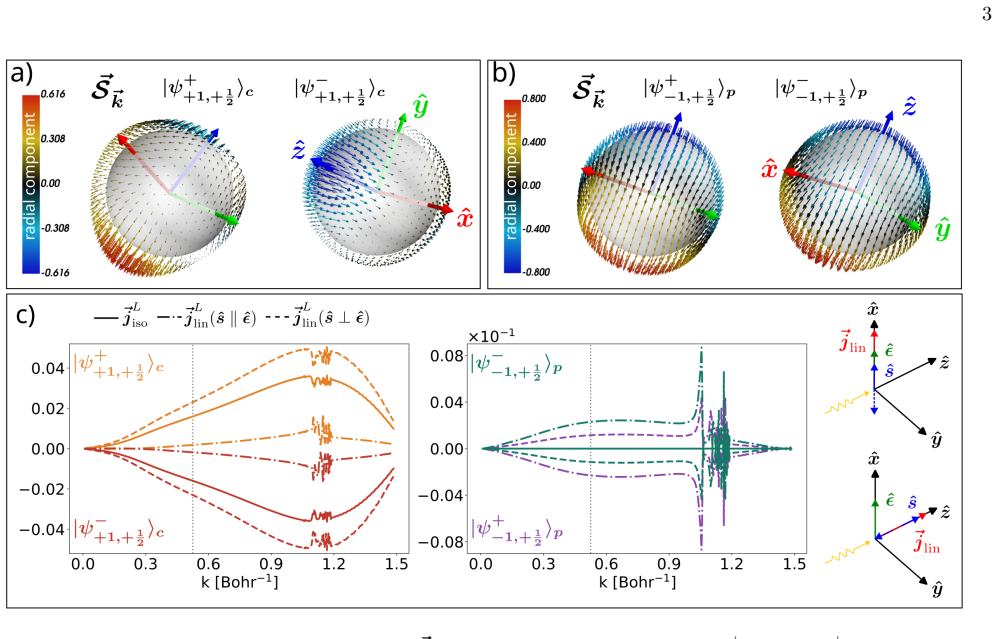
The paper's central claim is that spin-conditioned measurements are the origin of chiral spin filtering, and that in one-photon ionization the entire effect is carried by two molecular-frame geometric objects built from the spin-resolved transition dipoles $\mathbf{D}_{\mathbf{k},\mu}$. For isotropic illumination of an isotropic ensemble, the spin-conditioned photoelectron current is $$\mathbf{j}^L_{\mathrm{iso}} = \frac{1}{3S_0}\,\frac{1}{k}\int d\mathbf{\Theta}^M_{\mathbf{k}}\cdot \mathbf{S}^M_{\mathbf{k}}\,\hat{s}^L,$$ collinear with the spin-detection axis $\hat{s}^L$, with $S_0$ the total ionization yield and $\mathbf{S}_{\mathbf{k}} = \mathrm{Tr}(\tilde{\rho}\,\boldsymbol{\sigma})$ a Bloch pseudovector built from the reduced density matrix $\tilde{\rho}_{\mu\nu} = \mathbf{D}^*_{\mathbf{k},\mu}\cdot\mathbf{D}_{\mathbf{k},\nu}$. The current is therefore the flux of this momentum-resolved Bloch pseudovector through the energy shell; it is time-even, vanishes if the measurement is not conditioned on spin, and changes sign with the enantiomer. Under circularly polarized light a second object, the spin-resolved propensity field $\mathbf{B}_{\mathbf{k}} = i\,\mathbf{D}^*_{\mathbf{k},\mu}\times\mathbf{D}_{\mathbf{k},\nu}$, generates the familiar photoelectron circular dichroism current plus a transversal vortex current proportional to the flux of a spin-torque vector $\boldsymbol{\tau}_{\mathbf{k}} = \mathrm{Tr}(\boldsymbol{\sigma}\times\mathbf{B}_{\mathbf{k}})$, a triple correlation of photoelectron momentum, spin, and photon spin. In the synthetic chiral argon states used for quantification, the isotropic spin-locked current reaches a few percent of the total signal.
Load-bearing premise
The entire effect hinges on the ionization amplitudes for spin-up and spin-down electrons being different, which requires spin-orbit coupling or some other spin-dependent interaction in the initial or continuum states of the molecule; the paper assumes this spin dependence without quantifying how strong it must be.
Editorial extensions
If this is right
- A fully isotropic photoionization experiment — no molecular alignment, no defined polarization, no magnetic field — becomes enantio-sensitive as soon as the photoelectron spin is resolved; the current direction labels both the spin axis and the molecular handedness.
- The measured current directly reads out a molecular property: the flux of the momentum-resolved Bloch pseudovector through the energy shell, which can be computed from spin-resolved transition dipoles and compared across molecules.
- With circularly polarized light and spin detection perpendicular to the photon spin, three mutually orthogonal currents separate cleanly: the spin-locked radial current, the spin-averaged photoelectron circular dichroism background, and the transversal vortex current.
- The two molecular pseudovectors behind these currents supply the dynamical content that earlier kinematic descriptions of spin polarization in molecular photoionization left implicit, unifying them in one geometric picture.
- In the synthetic chiral argon model, the isotropic spin-locked current reaches a few percent of the total photoionization signal, showing the effect is not negligibly small in a concrete electronic structure.
Reading between the lines
- Extending the logic beyond the paper, spin-filtering in chiral transport devices could be re-expressed as the flux of a momentum-space spin texture through the relevant energy surface, a translation that would connect these photoionization results to condensed-matter CISS measurements.
- The collinear locking also suggests a device consequence the authors do not draw: in a chiral medium, spin-resolving the detector is the only symmetry-breaking step needed to convert an otherwise isotropic illumination into a directional charge current.
- A natural testable extension is the multiphoton regime: measuring the spin-conditioned current versus laser intensity would show at which order the one-photon flux structure breaks down, since the Bloch-vector construction is defined for one-photon electric-dipole amplitudes.
Editorial analysis
A structured set of objections, weighed in public.
Referee Report
Summary. The manuscript considers one-photon photoionization of randomly oriented chiral molecules with spin-resolved detection. It claims that the photoelectron current conditioned on a spin-detection axis is collinear with that axis even under isotropic illumination, with magnitude proportional to the flux of a momentum-resolved Bloch pseudovector through the energy shell (Eq. (8)), and opposite for opposite enantiomers (Eq. (11)). It then generalizes the treatment to linearly and circularly polarized light, identifying a time-even Bloch-vector term, the standard PECD term, and a time-odd spin-torque term, and states consistency with Ritchie's and Cherepkov's earlier expressions. The results are illustrated on a synthetic chiral argon model built from 4p and 4d orbitals.
Significance. If Eq. (8) is correct, the paper establishes a qualitatively new enantio-sensitive observable that requires no external directional bias: a spin-conditioned current from an isotropic ensemble under isotropic illumination. This gives a concrete operational meaning to CISS as a conditioned measurement and offers a clear experimental target. The analytic formulas are transparent, the numerical estimates (up to about 3% of the total signal for one synthetic chiral state) suggest feasibility, and the explicit reduction to the known PECD expression in Eq. (19) is a valuable cross-check. At the same time, the central derivation as printed is internally inconsistent in a way that must be repaired, and the role of spin-orbit coupling is not quantified, so the central claim is not yet established in the submitted form.
major comments (3)
- [Eq. (5) and Eq. (6)] The definition of W^L in Eq. (5) already contains an orientation average over dρ, so W^L is independent of the molecular orientation ρ. Substituting Eq. (5) into the numerator of Eq. (6) gives ∫dρ W^L k^L = W^L ∫dρ k^L, and ∫dρ R_ρ k^M = 0, so the isotropic current vanishes identically, contradicting Eq. (8). The derivation in Eqs. (A8)-(A12) obtains a nonzero result only because it silently uses a W without this inner orientation integral; only then does the 1/(3S0) prefactor follow. This is likely a typographical error rather than a fatal flaw, but as submitted the central equation is not derivable from the printed definitions. Please remove the inner ∫dρ from Eq. (5) and from Eq. (A1b), or explain why a double orientation average is intended.
- [Eq. (8) vs. Eq. (A12a)] The prefactor in Eq. (8) contains (1/k)∫d⃗Θ^M_k·S^M_k, while the Appendix result Eq. (A12a) is (1/(3S0))∫dΘ^M_k (S^M_k·k^M) with no 1/k. Since d⃗Θ^M_k is described after Eq. (8) as dΘ^M_k k^M k^2, the two expressions differ by a factor of the momentum magnitude k unless k^M in the Appendix is a unit vector. Please reconcile the notation and specify whether k^M denotes the unit vector or the momentum vector with magnitude k.
- [Synthetic model and Eq. (3)] The predicted current is nonzero only if the spin-resolved transition dipoles D_{k,+1/2} and D_{k,-1/2} differ, which requires spin-orbit coupling in the initial or continuum molecular states. The manuscript does not state the spin-orbit coupling strength used in the synthetic argon model described by Eqs. (1)-(2), nor does it discuss the regime of negligible spin-orbit coupling, in which all predicted currents vanish. A quantitative estimate, or a numerical control calculation with the spin-orbit coupling set to zero, would clarify the practical conditions under which Eq. (8) applies.
minor comments (6)
- [Eq. (19)-(20)] The quantity N in Eqs. (19) and (20) is never defined; presumably N = S0 from Eq. (9), but this should be stated explicitly.
- [Eq. (8), following text] The sentence defining d⃗Θ^M_k is garbled by missing superscripts; please typeset it unambiguously, for example by specifying that d⃗Θ^M_k = dΘ^M_k k_unit^M k^2.
- [Eq. (13b)] The operator Re[...] is applied to a vector expression; please indicate that it is taken componentwise.
- [Eqs. (17)-(20)] The claimed correspondence with Cherepkov's coefficients B1, B2, C, and D is only asserted in words; a short mapping table would help the reader verify the statement.
- [Fig. 2] The caption of Fig. 2(a,b) refers to the states |ψ±_{1,1/2}>_c and |ψ±_{-1,1/2}>, while the text for Fig. 2(c) refers to |ψ±_{-1,1/2}>_c and |ψ±_{1,1/2}>_p; please harmonize the state labels.
- [References] Reference [34] is listed as "In prepration"; please correct the spelling and update the status if available.
Circularity Check
No significant circularity: Eq. (8) is a derived consequence of spin-resolved transition dipoles, benchmarked externally against Ritchie and Cherepkov.
full rationale
The headline result, Eq. (8), is derived in Appendix A by explicit rotational averaging of the spin-resolved photoionization rate using the identities (A2)-(A4) from Andrews and Thirunamachandran. The spin-resolved transition dipoles D_{k,mu} are the input; the current is computed from them, and S0 is a normalization factor (total yield). No parameter is fitted to the target spin-conditioned current. The paper explicitly benchmarks Eq. (19) against Ritchie's PECD expression and Eq. (20) against Cherepkov's coefficient C, which are external results. The main self-citation, Ref. [1], supplies the geometric formalism and the synthetic chiral argon model, but the relevant objects S_k and B_k are defined in this paper (Eqs. (10) and (18)), and the rotational averaging is carried out self-consistently in the appendix. Thus the central claim does not reduce to the cited prior work. The printed Eq. (5) contains an apparent extra integral over d(rho) that, if read literally, would make W independent of the molecular orientation and would make the isotropic current vanish; however, this is an internal typographical inconsistency (the appendix uses W as orientation-dependent), not a circular reduction of the conclusion to the premises. Overall circularity score is 1, reflecting only a minor, non-load-bearing self-citation.
Assumptions & free parameters
free parameters (1)
- p-d mixing amplitude 1/√2 in synthetic chiral states =
1/√2
assumptions (6)
- standard math First-order time-dependent perturbation theory with electric dipole interaction is valid for one-photon ionization.
- standard math Random orientation averaging of molecule-frame vectors follows the isotropic tensor identities (A2)-(A4).
- domain assumption The photoelectron spin is a good quantum number and can be projected along an arbitrary lab axis s with P_s = (I + s·σ)/2.
- domain assumption Spin-orbit coupling in the initial and continuum molecular states makes the spin-resolved transition dipoles D_{k,μ} differ for μ = ±1/2.
- domain assumption The ensemble is isotropic and randomly oriented, and the light field is either isotropic, linearly, or circularly polarized with no other bias.
- ad hoc to paper The synthetic chiral argon states constructed from 4p and 4d orbitals (Eqs. (1)-(2)) represent a chiral molecule whose electron correlations stabilize the handedness.
invented entities (3)
-
Momentum-resolved Bloch pseudovector S_k
-
Spin-resolved propensity field B_k
-
Spin torque vector τ_k
Cite this review
Pith. "Pith review of Spin-current correlations in photoionization of chiral molecules." pith.science (2026). https://pith.science/paper/7VNL7CXK
@misc{pith2026250523460,
  author       = {Pith},
  title        = {Pith review of: Spin-current correlations in photoionization of chiral molecules},
  year         = {2026},
  howpublished = {\url{https://pith.science/paper/7VNL7CXK}},
  note         = {Machine review of arXiv:2505.23460}
}
read the original abstract
Chirality-induced spin selectivity (CISS) refers to phenomena where molecular chirality governs spin polarization. While symmetry simply requires chiral molecules to support spin-vector correlations, we show that CISS is fundamentally a conditioned measurement of these correlations. We illustrate this principle for spin-resolved one-photon ionization of a randomly oriented ensemble of chiral molecules. We introduce and quantify the phenomenon of enantio-sensitive locking of the photoelectron current to its spin, thereby providing a complete description of spin-conditioned photoelectron currents in one-photon ionization.
Figures


Figures from the paper (1 more)

Reference graph
Works this paper leans on
- [1]
-
[2]
K. Ray, S. Ananthavel, D. Waldeck, and R. Naaman, Asymmetric scattering of polarized electrons by orga- nized organic films of chiral molecules, Science283, 814 (1999)
1999
- [3]
-
[4]
B. G¨ ohler, V. Hamelbeck, T. Z. Markus, M. Ket- tner, G. F. Hanne, Z. Vager, R. Naaman, and H. Zacharias, Spin selectivity in electron trans- mission through self-assembled monolayers of double-stranded dna, Science331, 894 (2011), https://www.science.org/doi/pdf/10.1126/science.1199339
-
[5]
D.-Y. Zhang, Y. Sang, T. K. Das, Z. Guan, N. Zhong, C.- G. Duan, W. Wang, J. Fransson, R. Naaman, and H.-B. Yang, Highly conductive topologically chiral molecular knots as efficient spin filters, Journal of the American Chemical Society145, 26791 (2023), pMID: 37972388, https://doi.org/10.1021/jacs.3c08966
-
[6]
A. F. Ordonez and O. Smirnova, Propensity rules in pho- toelectron circular dichroism in chiral molecules. i. chiral hydrogen, Physical Review A99, 043416 (2019)
work page 2019
- [7]
-
[8]
B. Ritchie, Theory of the angular distribution of pho- 9 toelectrons ejected from optically active molecules and molecular negative ions, Physical Review A13, 1411 (1976)
work page 1976
Show all 35 references
-
[9]
Powis, Photoelectron circular dichroism of the ran- domly oriented chiral molecules glyceraldehyde and lactic acid, The Journal of Chemical Physics112, 301 (2000)
I. Powis, Photoelectron circular dichroism of the ran- domly oriented chiral molecules glyceraldehyde and lactic acid, The Journal of Chemical Physics112, 301 (2000)
2000
-
[10]
B¨ owering, T
N. B¨ owering, T. Lischke, B. Schmidtke, N. M¨ uller, T. Khalil, and U. Heinzmann, Asymmetry in photoelec- tron emission from chiral molecules induced by circularly polarized light, Physical review letters86, 1187 (2001)
2001
-
[11]
Nahon, G
L. Nahon, G. A. Garcia, C. J. Harding, E. Mikajlo, and I. Powis, Determination of chiral asymmetries in the va- lence photoionization of camphor enantiomers by photo- electron imaging using tunable circularly polarized light, The Journal of chemical physics125(2006)
2006
-
[13]
Samson and W
J. Samson and W. Stolte, Precision measurements of the total photoionization cross-sections of He, Ne, Ar, Kr, and Xe, Journal of Electron Spectroscopy and Related Phenomena123, 265 (2002)
2002
-
[14]
Carlstr¨ om, R
S. Carlstr¨ om, R. Tahouri, A. Papoulia, J. M. Dahlstr¨ om, M. Y. Ivanov, O. Smirnova, and S. Patchkovskii, Spin-Polarized Photoelectrons in the Vicinity of Spec- tral Features, arXiv:2306.15665 [physics.atom-ph] (2024), manuscript submitted for review
2024 arXiv
-
[15]
Cherepkov, Spin polarisation of photoelectrons ejected from unpolarised atoms, Journal of Physics B: Atomic and Molecular Physics12, 1279 (1979)
N. Cherepkov, Spin polarisation of photoelectrons ejected from unpolarised atoms, Journal of Physics B: Atomic and Molecular Physics12, 1279 (1979)
1979
-
[16]
Cherepkov, Theory of spin polarisation phenomena in molecular photoionisation processes, Journal of Physics B: Atomic and Molecular Physics14, 2165 (1981)
N. Cherepkov, Theory of spin polarisation phenomena in molecular photoionisation processes, Journal of Physics B: Atomic and Molecular Physics14, 2165 (1981)
1981
-
[17]
Cherepkov, Manifestations of the optical activity of molecules in the dipole photoeffect, Journal of Physics B: Atomic and Molecular Physics16, 1543 (1983)
N. Cherepkov, Manifestations of the optical activity of molecules in the dipole photoeffect, Journal of Physics B: Atomic and Molecular Physics16, 1543 (1983)
1983
-
[18]
G. A. Garcia, L. Nahon, M. Lebech, J.-C. Houver, D. Dowek, and I. Powis, Circular dichroism in the pho- toelectron angular distribution from randomly oriented enantiomers of camphor, The Journal of chemical physics 119, 8781 (2003)
2003
-
[19]
Turchini, N
S. Turchini, N. Zema, G. Contini, G. Alberti, M. Ala- gia, S. Stranges, G. Fronzoni, M. Stener, P. Decleva, and T. Prosperi, Circular dichroism in photoelectron spec- troscopy of free chiral molecules: Experiment and theory on methyl-oxirane, Physical Review A—Atomic, Molec- u...
2004
-
[20]
Hergenhahn, E
U. Hergenhahn, E. E. Rennie, O. Kugeler, S. Marburger, T. Lischke, I. Powis, and G. Garcia, Photoelectron cir- cular dichroism in core level ionization of randomly ori- ented pure enantiomers of the chiral molecule camphor, The Journal of chemical physics120, 4553 (2004)
2004
-
[21]
G. A. Garcia, L. Nahon, C. J. Harding, and I. Powis, Chiral signatures in angle-resolved valence photoelec- tron spectroscopy of pure glycidol enantiomers, Physical Chemistry Chemical Physics10, 1628 (2008)
2008
-
[22]
M. H. Janssen and I. Powis, Detecting chirality in molecules by imaging photoelectron circular dichroism, Physical Chemistry Chemical Physics16, 856 (2014)
2014
-
[23]
Nahon, G
L. Nahon, G. A. Garcia, and I. Powis, Valence shell one- photon photoelectron circular dichroism in chiral sys- tems, Journal of Electron Spectroscopy and Related Phe- nomena204, 322 (2015)
2015
-
[24]
Sparling and D
C. Sparling and D. Townsend, Two decades of imag- ing photoelectron circular dichroism: from first princi- ples to future perspectives, Physical Chemistry Chemical Physics (2025)
2025
-
[25]
Cherepkov, Circular dichroism of molecules in the con- tinuous absorption region, Chemical Physics Letters87, 344 (1982)
N. Cherepkov, Circular dichroism of molecules in the con- tinuous absorption region, Chemical Physics Letters87, 344 (1982)
1982
-
[26]
Powis, Photoelectron spectroscopy and circular dichro- ism in chiral biomolecules: L-alanine, The Journal of Physical Chemistry A104, 878 (2000)
I. Powis, Photoelectron spectroscopy and circular dichro- ism in chiral biomolecules: L-alanine, The Journal of Physical Chemistry A104, 878 (2000)
2000
-
[27]
Stener, G
M. Stener, G. Fronzoni, D. D. Tommaso, and P. De- cleva, Density functional study on the circular dichroism of photoelectron angular distribution from chiral deriva- tives of oxirane, The Journal of chemical physics120, 3284 (2004)
2004
-
[28]
A. N. Artemyev, A. D. M¨ uller, D. Hochstuhl, and P. V. Demekhin, Photoelectron circular dichroism in the mul- tiphoton ionization by short laser pulses. i. propagation of single-active-electron wave packets in chiral pseudo- potentials, The Journal of chemical physics142(2015)
2015
-
[29]
A. F. Ordonez and O. Smirnova, Generalized perspective on chiral measurements without magnetic interactions, Physical Review A98, 063428 (2018)
2018
-
[30]
A. F. Ordonez, D. Ayuso, P. Decleva, and O. Smirnova, Geometric magnetism and anomalous enantio-sensitive observables in photoionization of chiral molecules, Com- munications Physics6, 257 (2023)
2023
-
[31]
P. V. Demekhin, A. N. Artemyev, A. Kastner, and T. Baumert, Photoelectron circular dichroism with two overlapping laser pulses of carrier frequenciesωand 2ω linearly polarized in two mutually orthogonal directions, Phys. Rev. Lett.121, 253201 (2018)
2018
-
[32]
Rozen, A
S. Rozen, A. Comby, E. Bloch, S. Beauvarlet, D. Descamps, B. Fabre, S. Petit, V. Blanchet, B. Pons, N. Dudovich, and Y. Mairesse, Controlling subcycle op- tical chirality in the photoionization of chiral molecules, Phys. Rev. X9, 031004 (2019)
2019
-
[33]
A. F. Ordonez and O. Smirnova, Disentangling enan- tiosensitivity from dichroism using bichromatic fields, Physical Chemistry Chemical Physics24, 7264 (2022)
2022
-
[34]
P. C. M. Flores, S. Carlstr¨ om, S. Patchkovskii, A. F. Or- donez, and O. Smirnova, Geometric magnetism links chi- rality and spin in photoionization by circularly polarized fields, In prepration (2024)
2024
-
[35]
D. L. Andrews and T. Thirunamachandran, On three- dimensional rotational averages, The Journal of Chemical Physics67, 5026 (1977)
1977
-
[36]
Brink and G
D. Brink and G. Sactchler, Angular momentum, claren (1968)
1968
Reviewed August 7, 2026 · model on record in the stance chip above.
Discussion (0). Sign in to comment.