REVIEW 4 major objections 4 minor 1 cited by
Information Structure in Mappings: An Approach to Learning, Representation, and Generalisation
T0 review · 4 major / 4 minor · reviewed 2026-08-07 · deepseek-v4-flash
Pith's one-line read This thesis establishes that the way a neural network maps inputs to vector representations can be quantified by three information-theoretic structures—regularity, variation, and disentanglement—and that this 'information structure'…
desk verdict A genuinely useful entropy estimator with an unproven invariance property; the two-phase training story is solid, but the cross-scale headline needs a dimension-sweep before I'd trust it. read the letter →
The pith
A machine-rendered reading of the paper's core claim, the machinery that carries it, and where it could break.
The reading
What carries the argument
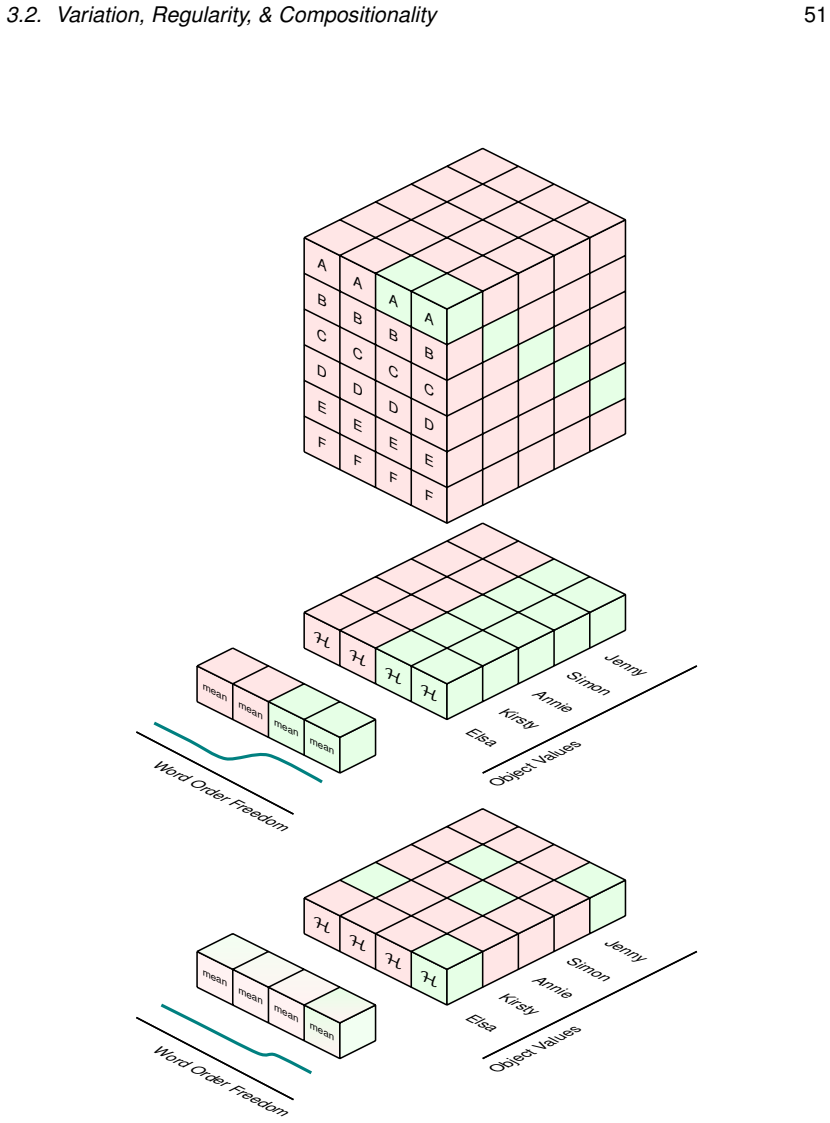
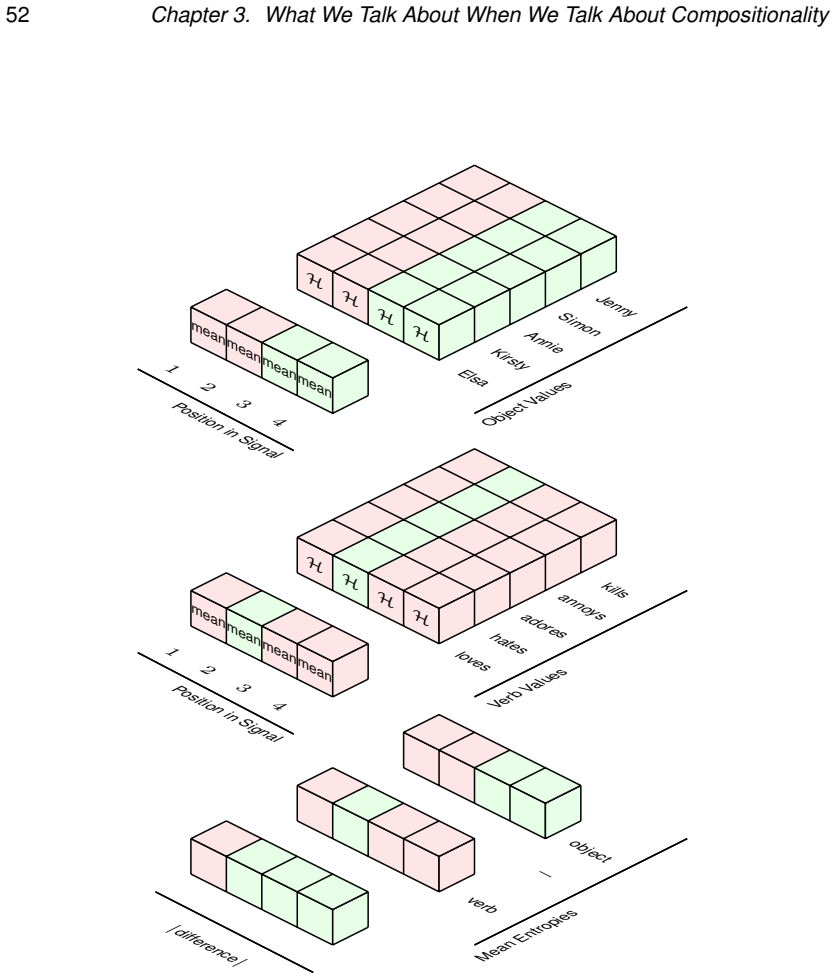
The load-bearing object is the mapping f: X -> Y from input labels (tokens, bigrams, parts of speech) to vector representations, analysed through three primitive structures: one-to-one regularity (measured by mutual information), one-to-many variation (conditional entropy), and many-to-one disentanglement (Jensen-Shannon divergence). To make these measurable in continuous high-dimensional space, the paper introduces soft entropy: representations are L2-normalised onto the unit sphere, compared by cosine similarity against uniformly sampled anchor points, and passed through a softmax to form a categorical distribution whose entropy and derived quantities are computed exactly. This estimator is differentiable, parallelisable, and cheap enough to run throughout training, which is what lets the same analysis scale from a 1-million-parameter model to a 12-billion-parameter LLM. The earlier dimension-wise binning version of the estimator is what supports the single-task transformer experiments; soft entropy extends it to large models.
What would settle it
Run the soft-entropy estimator on synthetic point clouds whose true entropy is known—for example, uniform points on the unit sphere versus tightly clustered Gaussians—while sweeping the number of anchor points and the softmax temperature; if the estimated entropy changes substantially with these hyperparameters on data whose true entropy is fixed, the measure is an artifact and the training-phase and generalisation claims built on it do not follow.
Extended reading notes
Core claim
The central discovery is that the representational spaces of trained neural networks carry a measurable 'information structure' that mirrors the structure of natural language: mappings are neither perfectly regular nor randomly variable, but combine systematic one-to-one alignment with context-dependent variation and controlled ambiguity. Quantifying these properties with entropy-based measures reveals two distinct phases of training. In the first, the model rapidly aligns representations with token and part-of-speech information and disentangles them; in the second, much longer phase, representations compress and become more contextualised, with bigram-level regularity and disentanglement rising while token-level regularity falls. This second phase is where out-of-distribution generalisation emerges, and across runs of the same model, better generalisation is predicted by higher bigram disentanglement (r = 0.65, p = 0.04) and higher bigram regularity (r = 0.61, p = 0.06). The same trajectory is found in large language models up to 12 billion parameters, where representation structure at the end of pre-training correlates with downstream GLUE performance.
Load-bearing premise
The whole argument depends on the assumption that the soft-entropy estimator's categorical distribution over anchor points faithfully represents the information content of the continuous representation space, rather than being an artifact of its own settings such as the number of anchors, the softmax scale, or the model's dimensionality.
Editorial extensions
If this is right
- If correct, transformer training can be described as a two-phase process: fast lexical alignment and disentanglement, followed by a slow compression and contextualisation phase in which out-of-distribution generalisation emerges.
- Representation structure at the end of pre-training predicts downstream performance after fine-tuning, so information-structure measures could be used to select checkpoints or architectures without running expensive downstream evaluations.
- Larger models are less regular at the token level but more regular with respect to context (bigrams and trigrams); this contextual regularity, not raw capacity, is what tracks generalisation.
- Capacity constraints regularise emergent languages: smaller agents in communication games develop more regular mappings, consistent with cognitive accounts of language regularisation.
- Meta-learning objectives that optimise update steps for similar examples can bias representational structure toward better out-of-distribution generalisation, showing that information structure is not fixed by architecture alone.
Reading between the lines
- The estimator's differentiability suggests a direct extension the thesis does not pursue: using soft entropy as a training objective or regularizer to steer models toward desirable information structures.
- The two-phase trajectory found here may be the same phenomenon as 'grokking' in smaller models, with the slow second phase being where robust generalisation appears; the thesis does not make this identification explicitly.
- The framework's reliance on token and bigram labels implies a testable extension to non-linguistic inputs, such as vision or speech, where the analogue of context would need to be defined independently of words.
- If the information-structure account is general, one would expect the same end-of-training bigram-style contextual regularity to predict generalisation in multimodal and continual-learning settings, which the thesis leaves untested.
Editorial analysis
A structured set of objections, weighed in public.
Referee Report
Summary. The thesis develops a framework for quantifying 'information structure' in mappings between input spaces and neural representations, using information-theoretic measures of regularity (mutual information), variation (conditional entropy), disentanglement (Jensen-Shannon divergence), and compression (normalised entropy). It applies this framework to emergent communication models, sequence-to-sequence transformers, and large language models up to 12B parameters, claiming two distinct phases of training, systematic effects of model capacity on representational structure, and correlations between structure and generalisation. To scale the analysis to LLMs it introduces 'soft entropy' (Eq. 5.7), an anchor-based estimator of entropy over continuous representation spaces. The manuscript is a PhD thesis drawing on several prior papers by the author and collaborators, with code made available.
Significance. If the proposed measures are faithful and comparable across model sizes, the framework would provide a useful, efficient, and non-parametric complement to probing and behavioural interpretability. The thesis asks an important question --- whether representational structures analogous to those of natural language emerge in neural networks and predict generalisation --- and it makes a credible effort to answer it with first-principles information-theoretic definitions. Credit is due for releasing code, for validating soft entropy against existing estimators, and for explicitly discussing limitations of dimension-wise discretisation. However, the central cross-scale claims depend on the soft entropy estimator being invariant, or at least stable, with respect to hidden dimensionality and anchor count; that invariance is not established, and the current evidence is insufficient to rule out geometric artifacts.
major comments (4)
- [§5.4.1, Eq. (5.7)] The soft entropy estimator has no demonstrated invariance or stability with respect to hidden dimensionality d and anchor count n. For two independent random unit vectors in d dimensions the dot product has variance proportional to 1/d, so as d grows all logits concentrate near zero, the softmax approaches a uniform distribution over anchors, and soft entropy approaches log n. Section 5.6.3 compares models that differ in hidden width (14M to 12B parameters), so the reported scale-conditions-structure relationships may be partly a geometric artifact of dimensionality rather than of representational content. Appendix B.1 benchmarks heads, mean, and scale, but not d or n. The manuscript needs either a consistency theorem, or explicit experiments varying n and d (including matching widths across model sizes or normalising for dimensionality) to show that the quantities compared across models are measuring the same thing.
- [§4.2.1, Eq. (4.1)] The dimension-wise discretisation used in Chapter 4 depends on the number of bins N, a free hyperparameter, and no sensitivity analysis is reported. The chapter acknowledges that dimension-wise binning limits tracking of cross-dimensional dependencies, but the bin count itself is load-bearing because all Chapter 4 conclusions about training phases, capacity effects, and generalisation correlations are computed through this estimator. Without evidence that the reported trajectories and correlations are robust to N (and to sample size, despite the Miller-Madow correction), the results cannot be distinguished from artifacts of the binning choice.
- [§4.3.1.2] The headline correlations between bigram disentanglement/regularity and out-of-distribution generalisation are based on 10 runs with no confidence intervals, and Section 4.3 states that only the label sets with the 'clearest effect on model performance' are reported. This is a post hoc selection, and with four measures, three label levels, and two datasets, the uncorrected p-values (r = 0.65, p = 0.04; r = 0.61, p = 0.06) are weak evidence for the specific claim that bigram-level structure predicts generalisation. The authors should report all comparisons, provide bootstrap or otherwise constructed confidence intervals, and either correct for multiple comparisons or pre-specify the primary analysis.
- [§5.3, Eq. (5.6)] Equation (5.6) appears inconsistent with its prose description. The text says residual information is what remains after subtracting the highest regularity from the entropy of the space, but the equation writes residual(Y,set) = regularity(Y,smallest set)/H(Y), which is the explained proportion, not the residual. If residual information is used in any quantitative claim or figure, this sign error would invert the reported quantity. Please correct the equation or clarify what is actually computed.
minor comments (4)
- [Abstract] The abstract contains the duplicated phrase 'large large-scale neural networks'; this should be corrected.
- [§5.4.1] The description of anchor sampling says points are 'uniformly sampled from the surface of the unit sphere' by normalising standard normal draws, which is correct for the surface measure, but the later phrase 'drawing n samples from a standard normal and taking their euclidean norm' is ambiguous about normalisation; consider rewording to avoid implying the norm itself is the sampled quantity.
- [§4.3] Table 4.1 reports summary statistics with 95% CIs for the measures, but the generalisation correlations in Section 4.3.1.2 are reported without any measure of uncertainty; adding the same confidence-interval convention there would help readers calibrate the strength of the claim.
- [§5.6.4] The claim that representation structure at the end of pre-training predicts GLUE performance after fine-tuning would be stronger if the number of GLUE tasks and the selection of which structures are reported were stated in the main text, since Appendix B.2 shows per-task correlations that may vary widely.
Circularity Check
No significant circularity found; the thesis's empirical correlations are external to its information-theoretic definitions, and self-citations are transparent rather than load-bearing.
full rationale
The thesis builds its measures from standard information-theoretic quantities defined in Chapter 2 (entropy, conditional entropy, mutual information, Jensen-Shannon divergence) and applies them to vector spaces via explicit estimators in Chapters 4-5. The key empirical claims—e.g., that runs with higher bigram disentanglement generalise better (r=0.65, p=0.04) and higher bigram regularity correlates with generalisation (r=0.61, p=0.06)—are correlations against held-out accuracy, an external performance measure not constructed from the information measures. Similarly, the Chapter 5 claim that representation structure at the end of pre-training predicts GLUE performance after fine-tuning is a predictive correlation against an independent benchmark. The soft entropy estimator (Eq. 5.7) is a proposed estimation procedure, not a derived theorem; the absence of a formal invariance proof for hidden dimensionality or anchor count is a correctness/validity concern, not circularity, because the reported quantities are defined as soft entropy and are benchmarked against existing estimators in Section 5.5. The reliance on the author's own prior papers (Conklin & Smith 2022, 2024) is transparent, and the framework is restated within this thesis rather than being justified solely by self-citation. No step reduces, by the paper's own equations or by a self-citation chain, to its own inputs.
Assumptions & free parameters
free parameters (4)
- number of bins N in dimension-wise discretisation =
unspecified in visible text
- soft entropy anchor count n =
unspecified in visible excerpt
- soft entropy scale or temperature =
benchmarked in Appendix B.1
- number of heads for multi-head soft entropy =
benchmarked in Appendix B.1
assumptions (4)
- domain assumption Shannon entropy, conditional entropy, mutual information, and Jensen-Shannon divergence are valid quantifications of regularity, variation, and disentanglement in mappings.
- domain assumption In a reconstruction game, successful out-of-distribution generalization implies compositional structure.
- domain assumption Discretising or softmaxing representation space yields a distribution whose entropy reflects information content of the space.
- domain assumption Token, bigram, and trigram labels are sufficient to characterize the information structure relevant to generalization.
Cite this review
Pith. "Pith review of Information Structure in Mappings: An Approach to Learning, Representation, and Generalisation." pith.science (2026). https://pith.science/paper/6YKTSE4M
@misc{pith2026250523960,
  author       = {Pith},
  title        = {Pith review of: Information Structure in Mappings: An Approach to Learning, Representation, and Generalisation},
  year         = {2026},
  howpublished = {\url{https://pith.science/paper/6YKTSE4M}},
  note         = {Machine review of arXiv:2505.23960}
}
read the original abstract
Despite the remarkable success of large large-scale neural networks, we still lack unified notation for thinking about and describing their representational spaces. We lack methods to reliably describe how their representations are structured, how that structure emerges over training, and what kinds of structures are desirable. This thesis introduces quantitative methods for identifying systematic structure in a mapping between spaces, and leverages them to understand how deep-learning models learn to represent information, what representational structures drive generalisation, and how design decisions condition the structures that emerge. To do this I identify structural primitives present in a mapping, along with information theoretic quantifications of each. These allow us to analyse learning, structure, and generalisation across multi-agent reinforcement learning models, sequence-to-sequence models trained on a single task, and Large Language Models. I also introduce a novel, performant, approach to estimating the entropy of vector space, that allows this analysis to be applied to models ranging in size from 1 million to 12 billion parameters. The experiments here work to shed light on how large-scale distributed models of cognition learn, while allowing us to draw parallels between those systems and their human analogs. They show how the structures of language and the constraints that give rise to them in many ways parallel the kinds of structures that drive performance of contemporary neural networks.
Figures


Figures from the paper (30 more)




Forward citations
Cited by 1 Pith paper
-
Meaning-infused grammar: Gradient Acceptability Shapes the Geometric Representations of Constructions in LLMs
In Pythia language models, the geometric distance between Double Object and Prepositional Object representations grows with human-rated preference strength, evidence for graded construction representations.
Reference graph
Works this paper leans on
-
[10]
Retrieved May 25, 2020, from http://arxiv.org/abs/1703.03400 Fodor, J. A. (1975). The language of thought. 152 BIBLIOGRAPHY Fodor, J. A., & Pylyshyn, Z. W. (1988). Connectionism and cognitive architecture: A critical analysis.Cognition, 28(1-2), 3–71. https://doi.org/10.1016/0010- 0277(88)90031-5 Frankle, J., & Carbin, M. (2018). The lottery ticket hypoth...
arXiv 1975
-
[821]
https://doi.org/10.1037/a0015097 Hudson Kam, C. L., & Newport, E. L. (2005). Regularizing Unpredictable Vari- ation: The Roles of Adult and Child Learners in Language Formation and Change.Language Learning and Development, 1(2), 151–195. https: //doi.org/10.1080/15475441.2005.9684215 Hupkes, D., Dankers, V., Mul, M., & Bruni, E. (2019). The compositional-...
arXiv 2005
-
[926]
https://doi.org/10.1613/jair.1.11196 Hurford, J. R. (2003). Why synonymy is rare: Fitness is in the speaker.European conference on artificial life, 442–451. Jaynes, E. T. (1957). Information theory and statistical mechanics.Physical Review, 106, 620–630. https://api.semanticscholar.org/CorpusID:17870175 Jia, R., & Liang, P. (2016). Data recombination for ...
arXiv 2003
-
[1964]
https://doi.org/10.3389/fpsyg.2015.01964 Dagaev, N., Roads, B. D., Luo, X., Barry, D. N., Patil, K. R., & Love, B. C. (2021). A Too-Good-to-be-True Prior to Reduce Shortcut Reliance [arXiv: 2102.06406]. arXiv:2102.06406 [cs]. Retrieved September 23, 2021, from http://arxiv.org/abs/2102.06406 Dale, R., & Lupyan, G. (2012). UNDERSTANDING THE ORIGINS OF MOR-...
arXiv 2021
Reviewed August 7, 2026 · model on record in the stance chip above.
Discussion (0). Sign in to comment.