REVIEW 3 major objections 6 minor 36 references
Large Language Models for Controllable Multi-property Multi-objective Molecule Optimization
T0 review · 3 major / 6 minor · reviewed 2026-08-07 · deepseek-v4-flash
Pith's one-line read Instruction-tuned LLMs learn to improve some drug properties without wrecking others.
desk verdict A genuinely useful controllable-optimization dataset, but the OOD split is internally contradicted and undermines the 0-shot transfer claim. read the letter →
The pith
A machine-rendered reading of the paper's core claim, the machinery that carries it, and where it could break.
The reading
What carries the argument
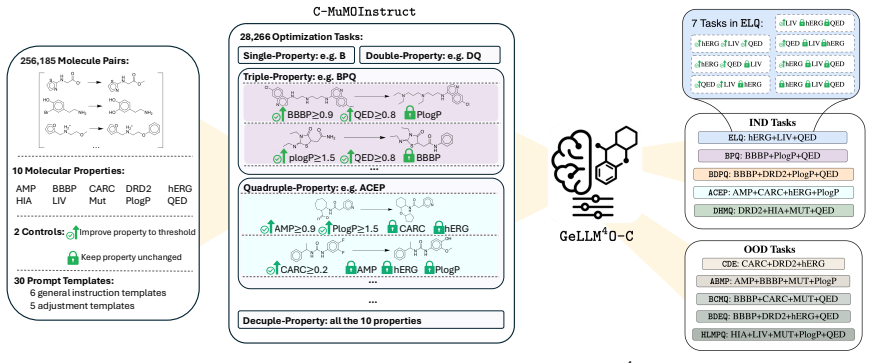
The load-bearing object is the C-MuMO task itself, defined by partitioning properties into a sub-optimal set $P_i$ to improve by at least $\Delta_p$ and a near-optimal set $P_s$ to keep within $\Delta_p$, with thresholds $\Theta_p$ marking pharmaceutically relevant levels. C-MuMOInstruct instantiates this as 256,185 molecule pairs filtered from an existing similarity-constrained pair set, while an enumeration algorithm generates tasks for every subset of the 10 properties and 30 instruction templates express the same objectives with varied phrasing. A held-out instruction and held-out property combinations are used to test transfer. The models are trained with LoRA on Mistral-7B and Llama3.1-8B to map a natural-language prompt plus source SMILES to an edited SMILES.
What would settle it
Search the released training tasks for any molecule pair or prompt whose property combination matches CDE, ABMP, BCMQ, BDEQ, or HLMPQ; if even one such pair is present, retrain the generalist on the filtered data and check whether the out-of-distribution advantage survives. As a second check, train a generalist on only single- and double-property combinations: strong performance on the five novel combinations would suggest genuine composition of property knowledge, while a collapse would suggest memorization of larger combinations.
Extended reading notes
Core claim
The central claim is that instruction tuning on carefully constrained molecule pairs teaches LLMs a controllable optimization policy: the model learns to associate small structural edits with directional changes in specified properties, so that a sub-optimal property can be pushed past its threshold without moving near-optimal properties outside their stability bounds. The paper demonstrates this with GeLLM4O-C-P(10), a generalist tuned on all property combinations up to 10 properties, which outperforms the best baseline by 37% average success rate and 102% relative improvement on in-distribution tasks, and by 35% success rate and 76% relative improvement on out-of-distribution tasks, with up to 126% higher success rates on individual tasks. The 0-shot transfer to unseen combinations, such as CDE (CARC, DRD2, hERG) and HLMPQ (HIA, LIV, MUT, PlogP, QED), is presented as evidence that the model composes knowledge about individual properties rather than memorizing task-specific pairs.
Load-bearing premise
The paper's 0-shot generalization claim rests on the assumption that the five 'out-of-distribution' property combinations never appear in the training data; because the task generator enumerates every property subset and the paper does not document an exclusion filter, a single leaked pair would undercut the transfer result.
Editorial extensions
If this is right
- If generalist GeLLM4O-C-P(10) performs as reported, a single instruction-tuned LLM can handle diverse optimization tasks without task-specific retraining or handcrafted rewards.
- Property-specific thresholds let a user specify both which properties to improve and how far, which is the regime pharmaceutical lead optimization actually operates in.
- Generalist models outperform specialists on four of five in-distribution combinations and suffer less from held-out instruction rephrasing, indicating that multi-task tuning transfers across related objectives.
- On out-of-distribution tasks the best generalist improves average success rate by about 35% over the strongest baseline, implying the learned strategies are not limited to memorized pair patterns.
Reading between the lines
- My inference: the same pair-based instruction-tuning recipe should extend to other molecular properties beyond these ten, as long as reliable predictors and pair data filtered by the same improvement and stability constraints are available.
- My inference: a natural next test is iterative optimization, because the current model performs one-step edits; whether repeated single-step calls can climb to thresholds without drifting is an open empirical question.
- My inference: because all property scores come from computational predictors rather than wet-lab assays, the practical value of the optimized molecules will only be settled by experimental validation.
- My inference: if the apparent 0-shot transfer is real composition of single-property knowledge, out-of-distribution performance should scale with the number of properties covered during training; that scaling curve would be a direct test.
Editorial analysis
A structured set of objections, weighed in public.
Referee Report
Summary. The paper introduces C-MuMOInstruct, an instruction-tuning dataset for controllable multi-property molecule optimization, where each task specifies which properties to improve up to a threshold and which to maintain. The authors instruction-tune Mistral-7B and Llama-3.1-8B (with LoRA) to produce GeLLM4O-C models in both specialist (per property combination) and generalist (up to N properties) variants. They evaluate on five in-distribution (IND) and five out-of-distribution (OOD) property combinations, reporting large gains in success rate (SR) over general-purpose LLMs and chemistry LLM baselines, as well as 0-shot generalization to unseen instructions. The manuscript includes detailed descriptions of dataset construction, quality control, prompts, and evaluation metrics, and the code/data are publicly released.
Significance. If the results are valid, C-MuMOInstruct is a valuable resource for controllable multi-objective molecule optimization, and the instruction-tuning approach demonstrates a practical path toward generalist molecular optimization LLMs. The paper ships the dataset, code, and model configurations, which supports reproducibility. The reported IND results are detailed and consistent across multiple tasks and backbones. However, the central claim of 0-shot generalization to novel property combinations is compromised by an apparent contamination of the OOD split, and the evaluation protocol gives different sampling budgets to different baseline families. These issues must be resolved before the main conclusions can be accepted.
major comments (3)
- [Section 2.6 vs. Algorithm A1 (Appendix B.1), Table 2, Section 5.1, Appendix D.1] The claim that CDE, ABMP, BCMQ, BDEQ, and HLMPQ are out-of-distribution tasks is internally contradicted by the dataset construction and model training description. Algorithm A1 enumerates all property subsets C ⊆ P with no documented filter excluding these five combinations. Table 2 reports nonzero #Pairs/#Mols for these combinations under a caption that explicitly states these are training counts (e.g., CDE 516 pairs, ABMP 1,500, HLMPQ 1,800). Section 5.1 states that GeLLM4O-C-P(10) is trained on all possible property combinations involving up to 10 properties, and Appendix D.1 reports training on up to 28K tasks and 1M pairs, which is consistent with a dataset that includes the OOD combinations. If any of these combinations appeared in the P(10) training data, the results in Table 4 are in-distribution performance, not 0-shot generalization to novel combinations. Please either provide the exact exclusion filter and the resulting training task counts, or reclassify these tasks as IND and revise the associated claims (abstract, Sections 5.2, 6).
- [Section 4.2 and Appendix D.2] The success rate (SR) metric defines a test case as successful if at least one of the 20 candidate molecules satisfies all objectives. GeLLM4O-C and open-weights baselines (Mistral, Llama, LlaSMol) generate 20 candidates via beam search, while closed-weights API models (Claude-3.5, GPT-4o) generate only one candidate per input because beam search is not available. This sampling asymmetry gives multi-candidate models an inherent advantage in SR, and the reported gains (e.g., "up to 126% higher SR" in the abstract) are not directly comparable across all baseline families. The paper should either generate 20 samples for API models via temperature sampling, or report an additional metric that controls for the number of candidates (e.g., per-candidate success rate or success rate at k=1) for all models.
- [Appendix B.1 vs. Section 2.3 and Table 1] The dataset construction description is inconsistent regarding the number of source molecule pairs. Section 2.3 says task-specific pairs are selected from the 256K molecule pairs in Chen et al. (2021), but Appendix B.1 states that Algorithm A1 is run on a random sample of 100K molecule pairs from the same source. Table 1 reports that C-MuMOInstruct contains 256,185 pairs, which is impossible if only 100K source pairs were considered. Please clarify whether the full 256K or the 100K sample was used, and reconcile the reported dataset size. This is essential for reproducing the dataset and for assessing its scale.
minor comments (6)
- [Section 2.2 and Table 2] The property abbreviation for drug-induced liver injury is given as LIV in Section 2.2 and Table 2, but Appendix C uses DILI; please use one consistent abbreviation throughout.
- [Section 2.3 and Table 2] Table 2 reports Θp values such as 0.8, 0.4, and 1.5, which appear to be rounded numbers, while Section 2.3 says thresholds are set to the 60th percentile of training molecules. Please clarify whether these are exact empirical percentiles or rounded approximations, and specify which values are used in the task construction algorithm.
- [Section 5.1] The sentence "The generalist variant, GeLLM4O-C-P(N), – trained only on tasks involving BBBP, DRD2, PlogP and QED" is inaccurate: GeLLM4O-C-P(N) with N=4 is trained on all property combinations up to 4 properties, not only the BDPQ quartet. Please correct this description.
- [Appendix B.1, Algorithm A1] The line "Set dir[p] <- (change[p]>0) if higher p is desirable, else negative" is ambiguous; it should be rewritten to specify the direction condition clearly (e.g., whether change[p] is positive for desirable direction and negative otherwise).
- [Section 2.5 and Appendix C] The paper claims 30 distinctly phrased instructions per task, but with 6 general instruction templates and 5 adjustment templates, a task with k sub-optimal properties yields 6×5^k possible prompt combinations. Please clarify what counts as a distinct instruction and how the 30 number is derived.
- [Abstract and Section 2.4] There are minor typos: "GeLLMO-C" in the abstract URL should be "GeLLM4O-C", and "Lipsinki's rule" in Section 2.4 should be "Lipinski's rule".
Circularity Check
OOD '0-shot' results are in-distribution by construction: the five OOD combinations have training pairs and P(10) is trained on all property combinations.
-
self definitional
[Section 2.6 (OOD definition); Table 2 (caption and OOD rows); Section 5.1 (P(10) training)]
"OOD tasks involve novel multi-property combinations ... that are not used during training (i.e., unseen C-MuMO tasks). ... GeLLM4O-C-P(10) – trained on all possible property combinations involving up to 10 properties – ... Table 2 caption: "#Pairs" and "#Mols", denote the number of molecule pairs and unique molecules in training, respectively. OOD rows: CDE 516 pairs, ABMP 1,500, BCMQ 1,398, BDEQ 603, HLMPQ 1,800."
By Section 2.6, an OOD combination is defined as one not used during training. However, Table 2 reports non-zero training-pair counts for every OOD combination, and Section 5.1 says GeLLM4O-C-P(10), the model evaluated on OOD tasks in Table 4, is trained on all possible property combinations involving up to 10 properties. CDE, ABMP, BCMQ, BDEQ, and HLMPQ are all such combinations, and Algorithm A1 enumerates every property subset with no OOD-exclusion filter. Therefore the Table 4 '0-shot' OOD numbers are in-distribution performance by construction: the held-out status that defines the prediction is contradicted by the paper's own training data, so the generalization claim reduces to the training distribution rather than a prediction of unseen tasks.
full rationale
This paper is an empirical benchmark rather than a formal derivation, and most of its comparisons (IND tasks, unseen-instruction evaluation, baseline comparisons) are self-contained measurements with no circular reduction. The load-bearing exception is the OOD split: Section 2.6 defines OOD tasks as 'not used during training,' but Table 2 gives training pair counts for all five OOD rows and Section 5.1 states that GeLLM4O-C-P(10) is trained on all possible property combinations with up to 10 properties, which necessarily includes those OOD combinations. If these statements are accurate, the Table 4 results are in-distribution by construction, and the '0-shot generalization to novel property combinations' claim is a renamed re-evaluation of training data. This is a definitional circularity in the paper's own reporting rather than an external benchmark issue. The reuse of the authors' prior MuMOInstruct pipeline is not circular by itself, and the specialist/IND results retain independent content, so the score is 6 rather than higher.
Assumptions & free parameters
free parameters (2)
- Property thresholds Theta_p =
60th percentile of training molecules per property (e.g., BBBP 0.8, QED 0.9)
- Improvement/stability margins Delta_p =
Table 2: 0.1 for most properties, 0.2 for CARC/hERG, 1.0 for PlogP
assumptions (4)
- domain assumption ADMET-AI and the DRD2/PlogP implementations provide sufficiently accurate property scores for training and evaluation.
- ad hoc to paper The 60th-percentile thresholds represent pharmaceutically relevant levels.
- domain assumption Tanimoto similarity > 0.6 from the Chen et al. pair set is a sufficient structural-similarity constraint for lead optimization.
- ad hoc to paper The five OOD property combinations were excluded from all training splits.
Cite this review
Pith. "Pith review of Large Language Models for Controllable Multi-property Multi-objective Molecule Optimization." pith.science (2026). https://pith.science/paper/7EKHYL4F
@misc{pith2026250523987,
  author       = {Pith},
  title        = {Pith review of: Large Language Models for Controllable Multi-property Multi-objective Molecule Optimization},
  year         = {2026},
  howpublished = {\url{https://pith.science/paper/7EKHYL4F}},
  note         = {Machine review of arXiv:2505.23987}
}
read the original abstract
In real-world drug design, molecule optimization requires selectively improving multiple molecular properties up to pharmaceutically relevant levels, while maintaining others that already meet such criteria. However, existing computational approaches and instruction-tuned LLMs fail to capture such nuanced property-specific objectives, limiting their practical applicability. To address this, we introduce C-MuMOInstruct, the first instruction-tuning dataset focused on multi-property optimization with explicit, property-specific objectives. Leveraging C-MuMOInstruct, we develop GeLLMO-Cs, a series of instruction-tuned LLMs that can perform targeted property-specific optimization. Our experiments across 5 in-distribution and 5 out-of-distribution tasks show that GeLLMO-Cs consistently outperform strong baselines, achieving up to 126% higher success rate. Notably, GeLLMO-Cs exhibit impressive 0-shot generalization to novel optimization tasks and unseen instructions. This offers a step toward a foundational LLM to support realistic, diverse optimizations with property-specific objectives. C-MuMOInstruct and code are accessible through https://github.com/ninglab/GeLLMO-C.
Figures
Reference graph
Works this paper leans on
-
[1]
1.Advanced Drug Delivery Reviews, 46(1–3):3–26
the article was originally published in advanced drug delivery reviews 23 (1997) 3–25. 1.Advanced Drug Delivery Reviews, 46(1–3):3–26. Shengchao Liu, Jiongxiao Wang, Yijin Yang, Cheng- peng Wang, Ling Liu, Hongyu Guo, and Chaowei Xiao. 2024. Conversational drug editing using re- trieval and domain feedback. InThe Twelfth Interna- tional Conference on Lear...
arXiv 1997
-
[2]
Minimize structural changes and try to maintain the core scaffold
“Adjust the molecular structure to ensure that each specified property reaches the corre- sponding threshold listed in <THRESHOLD> </THRESHOLD>. Minimize structural changes and try to maintain the core scaffold. Return the resulting molecule using <SMILES> </S- MILES> tags."
-
[3]
Preserve the core scaffold and make as few structural changes as possi- ble
“Alter the molecule to satisfy the pro- vided property thresholds in <THRESHOLD> </THRESHOLD>. Preserve the core scaffold and make as few structural changes as possi- ble. Output the SMILES of the new molecule, enclosed in <SMILES> </SMILES>."
-
[4]
Maintain as much of the original struc- ture as possible
“Update the given molecule so that the specified properties fall within acceptable ranges defined by the values in <THRESHOLD> </THRESH- OLD>. Maintain as much of the original struc- ture as possible. Output only the modified molecule enclosed in <SMILES> </SMILES> tags."
-
[5]
Try to retain the core scaffold
“Edit the molecular structure so that all required properties match or exceed the threshold values defined in <THRESHOLD> </THRESHOLD>. Try to retain the core scaffold. Output only the SMILES representation of the optimized molecule enclosed in <SMILES> </SMILES>."
-
[6]
Avoid excessive modifica- tions and preserve the core scaffold
“Modify the molecule to bring its properties to at least the levels defined in <THRESHOLD> </THRESHOLD>. Avoid excessive modifica- tions and preserve the core scaffold. Output only the resulting molecule’s SMILES wrapped in <SMILES> </SMILES>." In the 2nd part of the prompt template, multiple properties to be adjusted are described via the task- specific ...
-
[7]
Developing chemdfm as a large language foun- dation model for chemistry.Cell Reports Physical Science, 6(4):102523. 12 A Related Work Computational approaches have primarily fo- cused on single- or double-property optimization tasks (You et al., 2018; Blaschke et al., 2020; Xie et al., 2021; Bung et al., 2022; Sun et al., 2022). Graph-based methods such a...
work page 2025
-
[8]
to compute all other properties. These tools rank among the top-performing predictors in the Therapeutics Data Commons (TDC) benchmark (Catacutan et al., 2024), and have been extensively validated and adopted in recent studies (Wei et al., 2024; Thomas et al., 2024; Wahnou et al., 2024; Dey et al., 2025; Averly et al., 2025). They provide a reliable, comp...
work page 2024
Show all 36 references
-
[9]
Keep structural changes as minimal as possible
“Your task is to modify the given molecule to ad- just specific molecular properties so that the re- sulting molecule satisfies the given target thresh- olds. Keep structural changes as minimal as possible. Your response should only contain a valid SMILES representation of the...
-
[10]
QED", “drug-likeness quantified by QED score
QED: “QED", “drug-likeness quantified by QED score" D Details on Experimental Setup D.1GeLLM 4O-Cs We develop specialist and generalist GeLLM4O-Cs by instruction-tuning general-purpose LLMs on C-MuMOInstruct using specific and multiple prop- erty combinations, respectively. Th...
2023
-
[15]
change property to be direction <THRESH- OLD> value </THRESHOLD>
"change property to be direction <THRESH- OLD> value </THRESHOLD>",
-
[16]
change the value of property to be direction <THRESHOLD> value </THRESHOLD>
"change the value of property to be direction <THRESHOLD> value </THRESHOLD>",
-
[17]
change property aiming for direction <THRESHOLD> value </THRESHOLD>
"change property aiming for direction <THRESHOLD> value </THRESHOLD>",
-
[18]
change property so it is direction <THRESH- OLD> value </THRESHOLD>
"change property so it is direction <THRESH- OLD> value </THRESHOLD>",
-
[19]
change property with a goal of direction <THRESHOLD> value </THRESHOLD>
"change property with a goal of direction <THRESHOLD> value </THRESHOLD>" Thus, 6 diverse general instruction templates and 5 diverse adjustment templates together lead to 30 different templates for instruction tuning. Property Names:We used the following names for each proper...
-
[20]
membrane permeability
AMP: “membrane permeability", “Parallel Arti- ficial Membrane Permeability (PAMPA)"
-
[21]
BBB permeability
BBBP: “BBB permeability", “Blood-brain bar- rier permeability (BBBP)"
-
[22]
carcinogenicity
CARC: “carcinogenicity", “potential to disrupt cellular metabolic processes"
-
[23]
DRD2 inhibition
DRD2: “DRD2 inhibition", “inhibition proba- bility of Dopamine receptor D2"’
-
[24]
hERG": “hERG inhibition
"hERG": “hERG inhibition", "potential to block hERG channel", 16 [ INST ] { general instruction } %%% Input : < SMILES > { source - smiles } </ SMILES > %%% Adjust : { adjust_i } { property_i } , ... , { adjust_k } { property_k } [/ INST ] %%% Response : { target - smiles } Fi...
-
[25]
Intestinal adsorption
HIA: “Intestinal adsorption", “human intestinal adsorption ability"
-
[26]
DILI": "liver injury risk
"DILI": "liver injury risk", "potential to cause liver disease",
-
[27]
Mutagenicity
MUT: “Mutagenicity", “probability to induce genetic alterations (mutagenicity)"
-
[28]
Penalized octanol-water partition coeffi- cient (penalized logP)
PlogP: “Penalized octanol-water partition coeffi- cient (penalized logP)", “Penalized logP which is logP penalized by synthetic accessibility score and number of large rings"
-
[30]
When multiple candidates are op- timized, the molecule exhibiting the highest cu- mulative improvement is selected for evaluation
Success Rate (SR): SR denotes the proportion of test cases where at least one of the 20 gen- erated candidate molecules satisfies all speci- fied property objectives – i.e., improving all sub-optimal properties while preserving all near- optimal ones. When multiple candidates ...
-
[31]
High Valensures the model’s ability to gener- ate syntactically correct and chemically valid structures
Validity (Val):Validity refers to the percent- age of test instances for which at least one of the generated molecules is chemically valid, determined via successful parsing by RDKit. High Valensures the model’s ability to gener- ate syntactically correct and chemically valid ...
-
[32]
Higher Sim indicates better preservation of the similarity constraint – a key requirement in lead optimization, where maintaining the core molec- ular scaffold is essential
Similarity ( Sim): Sim measures the average Tanimoto similarity between optimized and in- put molecules based on binary Morgan finger- prints (with radius of 2 and dimension of 2048). Higher Sim indicates better preservation of the similarity constraint – a key requirement in ...
-
[33]
This indicates the model’s abil- ity to generate novel and previously unseen drug candidates, crucial for exploration in drug dis- covery pipelines
Novelty (Nov):Novelty quantifies the fraction of optimized molecules that are not present in the training set. This indicates the model’s abil- ity to generate novel and previously unseen drug candidates, crucial for exploration in drug dis- covery pipelines
-
[34]
Lower scores indicate simpler, more synthesizable molecules
Synthetic Accessibility Score (SAS): SAS eval- uates how easy a molecule is to synthesize, with scores ranging from 1 (easily synthesizable) to 10 (difficult to synthesize) (Ertl and Schuffen- hauer, 2009a). Lower scores indicate simpler, more synthesizable molecules. 18
-
[35]
This metric reflects the magnitude of property-level improvements achieved by the model
Relative Improvement (RI): RI is computed as the average relative gain in each sub-optimal property compared to the input molecule. This metric reflects the magnitude of property-level improvements achieved by the model. Formally, for a task improving Pi properties, RI is com-...
-
[36]
Average Property Score ( APS): APS is com- puted as the average property score for each molecular property across all successfully opti- mized molecules. Higher or lower APS, depend- ing on the desired direction for each property, indicates that the model consistently generate...
1995
-
[2006]
herg potassium channels and cardiac arrhyth- mia.Nature, 440(7083):463–469. P. Seeman, T. Lee, M. Chau-Wong, and K. Wong. 1976. Antipsychotic drug doses and neuroleptic/dopamine receptors.Nature, 261(5562):717–719. Philip Seeman. 2001. Antipsychotic drugs, dopamine receptors, ...
1976
-
[2020]
Navneet Bung, Sowmya Ramaswamy Krishnan, and Arijit Roy
Reinvent 2.0: an ai tool for de novo drug de- sign.Journal of chemical information and modeling, 60(12):5918–5922. Navneet Bung, Sowmya Ramaswamy Krishnan, and Arijit Roy. 2022. An in silico explainable multi- parameter optimization approach for de novo drug design against pro...
2022
-
[2023]
Hicham Wahnou, Fouzia Hmimid, Ahmed Errami, Imane Nait Irahal, Youness Limami, and Mounia Oudghiri
Llama 2: Open foundation and fine-tuned chat models. Hicham Wahnou, Fouzia Hmimid, Ahmed Errami, Imane Nait Irahal, Youness Limami, and Mounia Oudghiri. 2024. Integrating admet, enrichment anal- ysis, and molecular docking approach to elucidate the mechanism of artemisia herba...
2024 arXiv
-
[2024]
A survey on evaluation of large language mod- els. 15(3). Ziqi Chen, Martin Renqiang Min, Srinivasan Parthasarathy, and Xia Ning. 2021. A deep gen- erative model for molecule optimization via one fragment modification.Nature machine intelligence, 3(12):1040–1049. Vishal Dey, X...
2021 arXiv
-
[2025]
Mistral AI
Rdkit: Open-source cheminformatics. Mistral AI. 2023. Mistral 7b.arXiv preprint. Jaqueline S. Angelo, Isabella A. Guedes, Helio J. C. Barbosa, and Laurent E. Dardenne. 2023. Multi-and many-objective optimization: present and future in de novo drug design.Frontiers in Chemistry...
2023
Reviewed August 7, 2026 · model on record in the stance chip above.
Discussion (0). Sign in to comment.