REVIEW 4 major objections 5 minor 45 references
First principles computations of the Stark shift of a defect-bound exciton: the case of the T center in silicon
T0 review · 4 major / 5 minor · reviewed 2026-08-07 · deepseek-v4-flash
Pith's one-line read First-principles calculations predict a small, anisotropic linear Stark shift for the T center's zero-phonon line, with a dipole moment change of $-0.79$ D along X and near zero along Y.
desk verdict Read this for the binding-energy convergence study, not for the Y-component Stark shift. read the letter →
The pith
A machine-rendered reading of the paper's core claim, the machinery that carries it, and where it could break.
The reading
What carries the argument
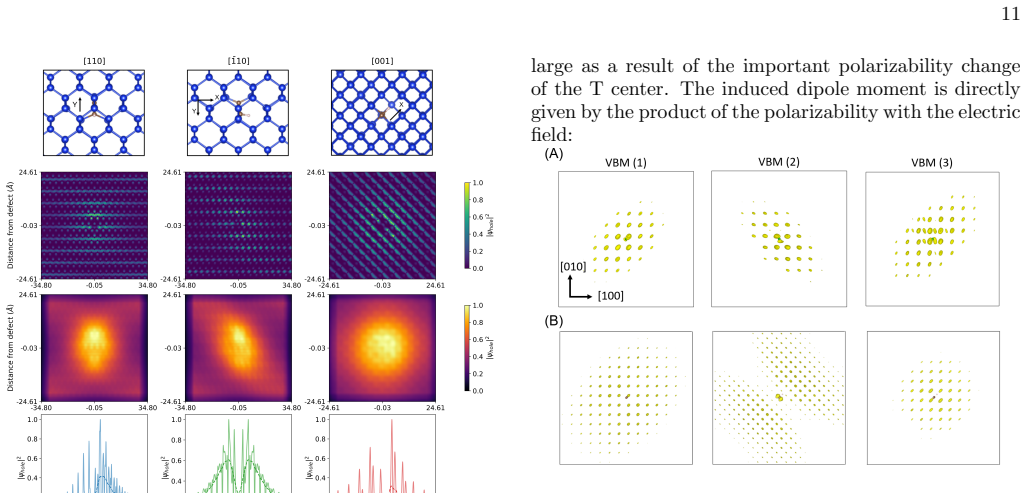
The central object is the defect-bound exciton of the T center, treated in a supercell with the excited state constrained by $\Delta$-SCF occupation of the $a''$ level. The argument is carried by two tools: supercell-size convergence of the exciton binding energy via Kohn-Sham eigenvalues, with a correction that replaces the PBE exchange slope by the HSE exchange slope, and calculation of the dipole moment change via the modern theory of polarization, a formalism that obtains dipole moments from bulk polarization rather than from a slab with vacuum. The load-bearing decomposition is band-by-band: the total $\Delta\mu$ is split into a hole contribution and an $a''$-level contribution, and the small net value is shown to be a cancellation of two large numbers. The paper also extracts the exciton Bohr radius from convoluted charge-density envelopes, giving an elongated wavefunction with a longest decay length of about 35 Å and a corresponding large polarizability change.
What would settle it
Measure the Stark shift of one isolated T center, or a dilute ensemble with controlled impurity density, at low electric field: if the Y-axis dipole change remains near +1.5 D instead of the predicted near-zero value, the claim that ensemble values are inflated by local impurity fields is falsified.
Extended reading notes
Core claim
The central claim is that the T center's zero-phonon line has a modest, anisotropic linear Stark shift, with $\Delta\mu_X = -0.79$ D and $\Delta\mu_Y \approx +0.09$ D, computed from first principles using the modern theory of polarization applied to defect supercells. The excited state is a defect-bound exciton: a delocalized hole bound to a negatively charged T center, analogous to a group-III acceptor. The paper shows that this delocalization demands supercells far larger than the standard 512-atom cell; only for cells above about 1000 atoms does a linear convergence trend emerge, giving an extrapolated exciton binding energy of $25.59 \pm 0.69$ meV, in line with the measured 22 to 35 meV range. A band-by-band decomposition reveals that the small total dipole change is the near-cancellation of large hole contributions ($-2.03$ D and $-3.47$ D) and large $a''$-state contributions ($+1.12$ D and $+3.50$ D). The paper attributes the disagreement with ensemble Stark measurements, which give $\Delta\mu_Y \approx +1.49$ D, to local field effects from charged impurities, and notes the T center's large polarizability makes it unusually susceptible to such effects.
Load-bearing premise
The final dipole result assumes that PBE and HSE give essentially the same dipole-moment change for the T center's extended bound exciton, since the reported values come from PBE while HSE could not be converged for the large supercells that contain the full wavefunction.
Editorial extensions
If this is right
- A uniform electric field detunes the T center's zero-phonon line only weakly, particularly along the Y axis, so uniform-field spectral diffusion should be small.
- Ensemble Stark measurements may not reflect the intrinsic T center response: local fields from charged impurities can induce dipoles on the order of 1 D at impurity concentrations around $10^{16}$ cm$^{-3}$, comparable to the calculated intrinsic dipole change.
- The extrapolated binding energy of about 25.6 meV implies a critical field for exciton dissociation near 70 kV/cm, well above the fields used in recent experiments.
Reading between the lines
- Beyond the paper: the same supercell-convergence and polarization approach should apply to other bound-exciton defects, such as the G center or shallow acceptors in silicon, where slab-based field calculations are unreliable because the exciton is delocalized.
- Beyond the paper: a single-T-center Stark measurement is the cleanest test; an isolated emitter showing Y-axis response near +1.5 D would cast doubt on the local-field explanation, while near-zero response would confirm it.
- Beyond the paper: because the net dipole is an accidental cancellation of large hole and $a''$-state contributions, modest perturbations such as strain or nearby charges could change the Stark coefficient by a large relative amount even though the absolute shift stays small.
- Beyond the paper: the finding that a 512-atom cell gives a binding energy about three times too large suggests that previous defect calculations on delocalized excitons may need re-examination with the same convergence protocol.
Editorial analysis
A structured set of objections, weighed in public.
Referee Report
Summary. This paper reports first-principles calculations of the zero-phonon-line (ZPL) Stark shift of the T center in silicon, treating the excited state as a defect-bound exciton. Using supercell-size convergence studies with PBE and HSE functionals on cells up to 5834 atoms, the authors extract an exciton binding energy of 25.59 ± 0.69 meV after applying the Swift et al. slope-correction scheme, in agreement with the experimental range of 22.5–35 meV. The dipole moment change between the ground and excited states is computed with the modern theory of polarization, yielding Δµ_X = -0.79 D and Δµ_Y = +0.09 D (the abstract states 0.03 D), which the authors describe as a modest and anisotropic linear Stark response. A band-by-band decomposition shows that the small Y component arises from the near-cancellation of a +3.50 D contribution from the occupied a″ state and a -3.47 D contribution from the delocalized valence-band hole. The discrepancy with the ensemble Stark measurement of Clear et al. (Δµ_Y = +1.49 D) is attributed to local field effects from charged impurities, supported by an order-of-magnitude estimate of impurity-induced dipoles, and the computed exciton polarizability change (0.0127 Hz·m²/V²) is offered as evidence of environmental sensitivity.
Significance. The binding-energy part of this paper is a significant and carefully executed contribution: the supercell convergence is documented, confidence intervals are quoted, the PBE/HSE slope-correction method is explained in the supplementary material, and the corrected value of 25.59 meV sits within the experimental range. The application of the modern theory of polarization to a delocalized bound exciton, including the band-by-band decomposition that isolates the hole and a″ contributions, goes beyond the authors' earlier NV-center work and provides a methodological template for other shallow and bound-exciton defects. The predicted weak X-component response and the large polarizability volume are falsifiable statements that single-defect Stark experiments could test. The central caveat is the quantitative security of Δµ_Y: the paper's own supplementary material concedes that the PBE and HSE dipole results cannot currently be reconciled, and the (unconverged) HSE data actually point toward a larger Y-component that would bring theory closer to the ensemble experiment.
major comments (4)
- [§II B, Fig. 3, §II C, S2, S3] The central claim of a small, anisotropic Stark response rests on Δµ_Y = +0.09 D (abstract: 0.03 D), yet this value is the near-cancellation of two roughly 3.5 D contributions (hole -3.47 D and a″ +3.50 D along Y, §II C). At the few-percent level of accuracy typical of DFT dipole errors, either term could shift the remainder by approximately 0.2 D and change its sign, and no uncertainty is quoted for Δµ_Y. The paper's own HSE data are in direct tension with the PBE result: S2 reports Δµ_Y,HSE = 2.09 D when all cells are included and 0.89 D when the two smallest cells are excluded, and states that it is 'difficult to obtain a definite value', while S3 concedes that 'it is difficult to conciliate the PBE and HSE dipole moment changes'. Because the comparison with experiment and the local-field interpretation in §II D treat Δµ_Y ≈ 0 as the signature of a field-insensitive defect, this is a load-bearing uncertainty; the revision should either provide a converged large-cell HSE value for Δµ_Y or report a quantified uncertainty spanning the HSE range and correspondingly temper the conclusions.
- [§II B, §IV, S3] The assumption that PBE and HSE give comparable dipole moment changes for the T center is argued by analogy to a compact defect (the NV center: Δµ_PBE = 2.68 D vs Δµ_HSE = 2.23 D) and to molecular benchmarks (Refs. 30 and 31), but none of these benchmarks involves a charge distribution as delocalized as the approximately 35 Å bound-exciton hole. The same functional difference changes the exciton binding energy of the T center by nearly a factor of two (PBE 14.62 meV vs HSE 28.51 meV, §II A), demonstrating that PBE and HSE are not interchangeable for this state. Since the authors note in S2 that larger supercells would be required to obtain a converged HSE dipole moment, the equivalence of PBE and HSE for this specific system remains an unverified inference rather than a demonstrated fact, and the published Δµ values (especially Δµ_Y) should be reported with an uncertainty that reflects this.
- [§II B, Fig. 3] The dipole convergence analysis does not meet the reporting standard set by the binding-energy analysis in the same paper. The binding-energy fits quote 95% confidence intervals throughout (§II A), whereas Δµ_X = -0.79 D and Δµ_Y = +0.09 D are reported without any uncertainty. In addition, smaller supercells are excluded from the dipole fit 'due to the large deviations with respect to the calculated slopes', but no quantitative criterion for the cutoff is given, and the number of retained points, the fit residuals, and the sensitivity of the extrapolated intercept to the cutoff are not reported. Since the extrapolated intercepts are the published results, the fit should be documented with the same rigor as the binding-energy extrapolation, including the excluded data points in the figure.
- [Abstract; §II B; Table I; Conclusion] The value of Δµ_Y is quoted inconsistently across the manuscript: the abstract and the decomposition analysis in §II C state 0.03 D, whereas §II B, Table I, and the conclusion report 0.09 D. This is a headline quantity that readers will propagate from the abstract, and the discrepancy must be resolved so that a single value is used throughout.
minor comments (5)
- [Abstract; §II C] The abstract's Δµ_Y = 0.03 D coincides with the scheme-1 decomposition value in §II C rather than with the converged supercell result of 0.09 D reported in §II B; the abstract appears to conflate the decomposition with the final converged value.
- [§II D] The critical-field estimate uses a Bohr radius of 35.64 Å while §II B reports 34.99 Å from the largest supercell; the origin of this difference should be stated.
- [§II B] The notation 'N at >1000' for the cell-size threshold is unclear; 'N at' should be defined as the number of atoms and the threshold stated precisely.
- [S6, Table III] The impurity-induced dipole estimate in S6 uses α = 0.123 Hz·m²/V², which is the experimental polarizability change from Ref. [13] and an order of magnitude larger than the computed Δα = 0.0127 Hz·m²/V² of §II B. Using the experimental value is reasonable if the estimate is meant to describe the experimental environment, but the text should state this explicitly, because with the computed polarizability the induced dipole at the quoted concentrations would be roughly ten times smaller.
- [Throughout] There are several typos and inconsistent notations: 'estimate the extend' (§II B), 'the larger the fields applied' (§II D), 'a a density functional theory' (§IV), '22.5eV to 32meV' (§II A), inconsistent spellings of Heyd-Scuseria-Ernzerhof ('Ernzherhof', 'Erzherhof'), and the Table III units 'Hz.m/V' should be Hz·m²/V².
Circularity Check
No circularity: Stark coefficients and binding energy are supercell-extrapolated DFT values, not fits to experiment; the self-citation to the authors' NV-center work is a transferable benchmark, not an input encoding the T-center result.
full rationale
The central results (ΔμX=-0.79D, ΔμY=+0.09D, Eb=25.59 meV) are obtained from DFT supercell calculations with explicit extrapolation to infinite cell size; they are not tuned to the experimental Stark coefficients, and in fact the Y component disagrees with the measured 1.49D. The binding energy follows the independent Swift et al. eigenvalue-based approach and its PBE-slope-corrected variant, neither of which encodes the experimental 22-35 meV target. The only noticeable self-citations (Alaerts et al. [16]) provide (i) a VASP implementation procedure for excited-state Berry-phase dipoles and (ii) an NV-center PBE/HSE comparison used as evidence that dipole changes are functional-insensitive; the latter is supported also by independent molecular benchmarks (Refs. 30, 31) and by the paper's own statement that the PBE-HSE discrepancy decreases with cell size. The supplementary material flags the HSE Y-component non-convergence explicitly ('difficult to obtain a definite value') and does not conceal the tension, so the PBE/HSE transferability assumption is an acknowledged accuracy limitation rather than a definitional input. No equation in the paper reduces to the fitted or experimental values by construction; the abstract's 0.03D versus Sec. II B's 0.09D is an internal inconsistency, not circularity.
Assumptions & free parameters
free parameters (7)
- PBE binding energy extrapolation intercept =
14.62 ± 1.37 meV
- HSE binding energy extrapolation intercept =
28.51 ± 5.53 meV
- Corrected binding energy E_b,corr =
25.59 ± 0.69 meV
- PBE dipole moment change Δµ_X =
-0.79 D
- PBE dipole moment change Δµ_Y =
+0.09 D
- Exciton Bohr radii =
34.99 Å, 23.83 Å, 21.77 Å
- Polarizability change Δα =
0.0127 Hz m²/V²
assumptions (6)
- domain assumption PBE and HSE dipole moment changes converge to the same value at large supercell size
- domain assumption KS eigenvalue difference with VBM alignment gives the exciton binding energy (Eq. 1)
- domain assumption Modern theory of polarization gives the physical ground-to-excited-state dipole difference
- domain assumption DFT functionals (PBE/HSE) describe the T center excited state sufficiently
- domain assumption Polarizability change equals 4πε0 times the exciton volume
- domain assumption Local field from charged impurities explains the experimental Y discrepancy
Cite this review
Pith. "Pith review of First principles computations of the Stark shift of a defect-bound exciton: the case of the T center in silicon." pith.science (2026). https://pith.science/paper/ESPVIRTV
@misc{pith2026250524747,
  author       = {Pith},
  title        = {Pith review of: First principles computations of the Stark shift of a defect-bound exciton: the case of the T center in silicon},
  year         = {2026},
  howpublished = {\url{https://pith.science/paper/ESPVIRTV}},
  note         = {Machine review of arXiv:2505.24747}
}
abstract
The T center in silicon has recently drawn a lot of attention for its potential in quantum information science. The sensitivity of the zero-phonon line (ZPL) to electrical field was recently investigated by a combination of different experimental methods but there is still no first principles study on the Stark shift of the T center. Dealing with the defect-bound exciton nature of the excited state is particularly challenging using density functional theory because of the large spatial delocalization associated with the wavefunction. Here, we tackle this issue by performing a convergence study over the supercell size. We obtain an exciton binding energy of 28.5meV, in good agreement with experimental results. We then calculate the Stark shift through the dipole moment change of the ZPL transition of the T center using the modern theory of polarization formalism and find a modest linear coefficient of $\Delta \mu$=0.79D along X and $\Delta \mu$=0.03D along Y. We discuss our results in light of the recent experimental measurements of the Stark shift. Our analysis suggests that bound-exciton defects could be particularly sensitive to local field effect as a result of their large spatial extent.
Figures


Figures from the paper (5 more)



Reference graph
Works this paper leans on
-
[1]
crystallographic direction, which is almost perfectly commensurate with the defect Y axis. We note that this is in contrast with group III acceptors such as boron, for which the valence bands stay degenerate (excluding the effect of spin-orbit coupling) and the resulting exciton wavefunction is quasi-spherical [20] (see Supplementary Material). In this ca...
- [2]
-
[3]
Hensen, H
B. Hensen, H. Bernien, A. E. Dr´ eau, A. Reiserer, N. Kalb, M. S. Blok, J. Ruitenberg, R. F. Vermeulen, R. N. Schouten, C. Abell´ an,et al., Loophole-free bell inequality violation using electron spins separated by 1.3 kilometres, Nature526, 682 (2015)
2015
- [4]
-
[5]
X. Yan, S. Gitt, B. Lin, D. Witt, M. Abdolahi, A. Afifi, A. Azem, A. Darcie, J. Wu, K. Awan,et al., Silicon pho- tonic quantum computing with spin qubits, APL Pho- tonics6(2021)
work page 2021
-
[6]
A. M. Day, M. Sutula, J. R. Dietz, A. Raun, D. D. Sukachev, M. K. Bhaskar, and E. L. Hu, Electrical ma- nipulation of telecom color centers in silicon, Nature Communications15, 4722 (2024)
work page 2024
-
[7]
A. DeAbreu, C. Bowness, A. Alizadeh, C. Chartrand, N. Brunelle, E. MacQuarrie, N. Lee-Hone, M. Ruether, M. Kazemi, A. Kurkjian,et al., Waveguide-integrated silicon t centres, Optics Express31, 15045 (2023)
work page 2023
-
[8]
Electrically-triggered spin-photon devices in silicon
M. Dobinson, C. Bowness, S. A. Meynell, C. Chartrand, E. Hoffmann, M. Gascoine, I. MacGilp, F. Afzal, C. Dan- gel, N. Jahed,et al., Electrically-triggered spin-photon devices in silicon, arXiv preprint arXiv:2501.10597 (2025)
work page Pith review arXiv 2025
Show all 45 references
-
[9]
A. M. Day, C. Zhang, C. Jin, H. Song, M. Sutula, A. Sipahigil, M. K. Bhaskar, and E. L. Hu, Prob- ing negative differential resistance in silicon with a pin diode-integrated t center ensemble, arXiv preprint arXiv:2501.11888 (2025)
2025
-
[10]
D. B. Higginbottom, A. T. Kurkjian, C. Chartrand, M. Kazemi, N. A. Brunelle, E. R. MacQuarrie, J. R. Klein, N. R. Lee-Hone, J. Stacho, M. Ruether,et al., Optical observation of single spins in silicon, Nature607, 266 (2022)
2022
-
[11]
Bergeron, C
L. Bergeron, C. Chartrand, A. Kurkjian, K. Morse, H. Riemann, N. Abrosimov, P. Becker, H.-J. Pohl, M. Thewalt, and S. Simmons, Silicon-integrated telecom- munications photon-spin interface, PRX Quantum1, 020301 (2020)
2020
-
[12]
Wolfowicz, F
G. Wolfowicz, F. J. Heremans, C. P. Anderson, S. Kanai, H. Seo, ´A. Gali, G. Galli, and D. D. Awschalom, Quan- tum guidelines for solid-state spin defects, Nature Re- views Materials6, 906 (2021)
2021
-
[13]
The dipole moments are given in D and the polarizability in Hz.m 2/V2 C
-0.71 1.49 0.123 0.106 This work -0.79 0.09 0.0127 TABLE I: Comparison between experimental and theoretical dipole moment and polarizability changes of the ZPL transition [13]. The dipole moments are given in D and the polarizability in Hz.m 2/V2 C. Effect of the delocalized h...
-
[14]
Dhaliah, Y
D. Dhaliah, Y. Xiong, A. Sipahigil, S. M. Griffin, and G. Hautier, First-principles study of the t center in sili- con, Physical Review Materials6, L053201 (2022)
2022
-
[15]
Clear, S
C. Clear, S. Hosseini, A. AlizadehKhaledi, N. Brunelle, A. Woolverton, J. Kanaganayagam, M. Kazemi, C. Char- trand, M. Keshavarz, Y. Xiong,et al., Optical-transition parameters of the silicon t center, Physical Review Ap- plied22, 064014 (2024)
2024
-
[16]
Udvarhelyi, R
P. Udvarhelyi, R. Nagy, F. Kaiser, S.-Y. Lee, J. Wrachtrup, and ´A. Gali, Spectrally stable defect qubits with no inversion symmetry for robust spin-to-photon in- terface, Physical Review Applied11, 044022 (2019)
2019
-
[17]
G. I. L´ opez-Morales, J. M. Zajac, J. Flick, C. A. Meriles, and C. E. Dreyer, Quantum embedding study of strain- and electric-field-induced stark effects on the nv- center in diamond, Physical Review B110, 245127 (2024)
2024
-
[18]
Alaerts, Y
L. Alaerts, Y. Xiong, S. Griffin, and G. Hautier, First- principles study of the stark shift effect on the zero- phonon line of the nv center in diamond, Physical Review Materials8, 106201 (2024)
2024
-
[19]
Irion, N
E. Irion, N. Burger, K. Thonke, and R. Sauer, The de- fect luminescence spectrum at 0.9351 ev in carbon-doped heat-treated or irradiated silicon, Journal of Physics C: Solid State Physics18, 5069 (1985)
1985
-
[20]
Safonov, E
A. Safonov, E. Lightowlers, G. Davies, P. Leary, R. Jones, and S. ¨Oberg, Interstitial-carbon hydrogen interaction in silicon, Physical review letters77, 4812 (1996)
1996
-
[21]
Pajot,Optical Absorption of Impurities and Defects in Semiconducting Crystals: Hydrogen-like Centres, Vol
B. Pajot,Optical Absorption of Impurities and Defects in Semiconducting Crystals: Hydrogen-like Centres, Vol. 158 (Springer Science & Business Media, 2010)
2010
-
[22]
Wang, Density functional calculations of shallow acceptor levels in si, Journal of Applied Physics105 (2009)
L.-W. Wang, Density functional calculations of shallow acceptor levels in si, Journal of Applied Physics105 (2009)
2009
-
[23]
Zhang, A
G. Zhang, A. Canning, N. Grønbech-Jensen, S. Derenzo, and L.-W. Wang, Shallow impurity level calculations in semiconductors using ab initio methods, Physical review letters110, 166404 (2013)
2013
-
[24]
M. W. Swift, H. Peelaers, S. Mu, J. J. Morton, and C. G. Van de Walle, First-principles calculations of hyperfine interaction, binding energy, and quadrupole coupling for shallow donors in silicon, npj Computational Materials 6, 181 (2020)
2020
-
[25]
J. P. Perdew, K. Burke, and M. Ernzerhof, Generalized gradient approximation made simple, Physical review let- ters77, 3865 (1996)
1996
-
[26]
J. Heyd, G. E. Scuseria, and M. Ernzerhof, Hybrid func- tionals based on a screened coulomb potential, The Jour- nal of chemical physics118, 8207 (2003)
2003
-
[27]
K. R. Bryenton, A. A. Adeleke, S. G. Dale, and E. R. Johnson, Delocalization error: The greatest outstanding challenge in density-functional theory, Wiley Interdisci- plinary Reviews: Computational Molecular Science13, e1631 (2023)
2023
-
[28]
J. R. Maze, ´A. Gali, E. Togan, Y. Chu, A. Trifonov, E. Kaxiras, and M. D. Lukin, Properties of nitrogen- vacancy centers in diamond: the group theoretic ap- proach, New Journal of Physics13, 025025 (2011)
2011
-
[29]
M. E. Bathen, L. Vines, and J. Coutinho, First-principles calculations of stark shifts of electronic transitions for de- fects in semiconductors: the si vacancy in 4h-sic, Journal of Physics: Condensed Matter33, 075502 (2020)
2020
-
[30]
N. A. Spaldin, A beginner’s guide to the modern theory of polarization, Journal of Solid State Chemistry195, 2 (2012)
2012
-
[31]
Zhang, J
Y. Zhang, J. Sun, J. P. Perdew, and X. Wu, Comparative first-principles studies of prototypical ferroelectric mate- rials by lda, gga, and scan meta-gga, Physical Review B 96, 035143 (2017)
2017
-
[32]
A. L. Hickey and C. N. Rowley, Benchmarking quantum chemical methods for the calculation of molecular dipole moments and polarizabilities, The Journal of Physical Chemistry A118, 3678 (2014)
2014
-
[33]
Hait and M
D. Hait and M. Head-Gordon, How accurate is density functional theory at predicting dipole moments? an as- sessment using a new database of 200 benchmark values, Journal of chemical theory and computation14, 1969 (2018)
2018
-
[34]
Smith, A
J. Smith, A. Budi, M. Per, N. Vogt, D. Drumm, L. Hol- lenberg, J. Cole, and S. Russo, Ab initio calculation of energy levels for phosphorus donors in silicon, Scientific reports7, 6010 (2017)
2017
-
[35]
Tamarat, T
P. Tamarat, T. Gaebel, J. Rabeau, M. Khan, A. Green- tree, H. Wilson, L. Hollenberg, S. Prawer, P. Hemmer, F. Jelezko, and J. Wrachtrup, Stark shift control of sin- gle optical centers in diamond, Physical review letters97, 083002 (2006)
2006
-
[36]
Ghosez, X
P. Ghosez, X. Gonze, P. Lambin, and J.-P. Michenaud, Born effective charges of barium titanate: Band-by- band decomposition and sensitivity to structural fea- tures, Physical Review B51, 6765 (1995)
1995
-
[37]
G. Smit, S. Rogge, J. Caro, and T. Klapwijk, Stark effect in shallow impurities in si, Physical Review B—Condensed Matter and Materials Physics70, 035206 8 (2004)
2004
-
[38]
K¨ opf and K
A. K¨ opf and K. Lassmann, Linear stark and nonlinear zeeman coupling to the ground state of effective mass ac- ceptors in silicon, Physical review letters69, 1580 (1992)
1992
-
[39]
Calvet, R
L. Calvet, R. Wheeler, and M. Reed, Observation of the linear stark effect in a single acceptor in si, Physical re- view letters98, 096805 (2007)
2007
-
[40]
Guichar, C
G. Guichar, C. Sebenne, F. Proix, and M. Balkanski, First-order stark effect in phosphorus-doped silicon from photoconductivity on impurity levels, Physical Review B 5, 422 (1972)
1972
-
[41]
Kohn and L
W. Kohn and L. J. Sham, Self-consistent equations in- cluding exchange and correlation effects, Physical review 140, A1133 (1965)
1965
-
[42]
Kresse and J
G. Kresse and J. Furthm¨ uller, Efficient iterative schemes for ab initio total-energy calculations using a plane-wave basis set, Physical review B54, 11169 (1996)
1996
-
[43]
Kresse and D
G. Kresse and D. Joubert, From ultrasoft pseudopoten- tials to the projector augmented-wave method, Physical review b59, 1758 (1999)
1999
-
[44]
P. E. Bl¨ ochl, Projector augmented-wave method, Physi- cal review B50, 17953 (1994)
1994
-
[45]
S. P. Ong, W. D. Richards, A. Jain, G. Hautier, M. Kocher, S. Cholia, D. Gunter, V. L. Chevrier, K. A. Persson, and G. Ceder, Python materials genomics (py- matgen): A robust, open-source python library for mate- rials analysis, Computational Materials Science68, 314 (2013). S...
2013
Reviewed August 7, 2026 · model on record in the stance chip above.
Discussion (0). Continue with ORCID to comment.