Shill Bidding Prevention in Decentralized Auctions Using Smart Contracts
Pith reviewed 2026-05-19 12:22 UTC · model grok-4.3
The pith
A smart contract system uses a Bid Shill Score to apply dynamic penalties that deter shill bidding in decentralized auctions.
A machine-rendered reading of the paper's core claim, the machinery that carries it, and where it could break.
Core claim
The authors propose a conceptual framework that applies dynamic, behavior-based penalties to deter auction fraud using blockchain smart contracts. Unlike traditional post-auction detection methods, this approach prevents manipulation in real-time by introducing an economic disincentive system where penalty severity scales with suspicious bidding patterns. The framework employs the proposed Bid Shill Score (BSS) to evaluate nine distinct bidding behaviors, dynamically adjusting the penalty fees to make fraudulent activity financially unaffordable while providing fair competition. The system is implemented within a decentralized English auction on the Ethereum blockchain, and simulations show
What carries the argument
The Bid Shill Score (BSS), which evaluates nine bidding behaviors to dynamically scale penalty fees inside the smart contract.
Load-bearing premise
The nine bidding behaviors can be reliably detected and scored in real time by the smart contract without producing high false-positive rates that would unfairly penalize legitimate bidders.
What would settle it
A simulation or deployment in which shill bidders still achieve positive net profit or honest bidders receive frequent penalties would show the mechanism fails to work as intended.
Figures



read the original abstract
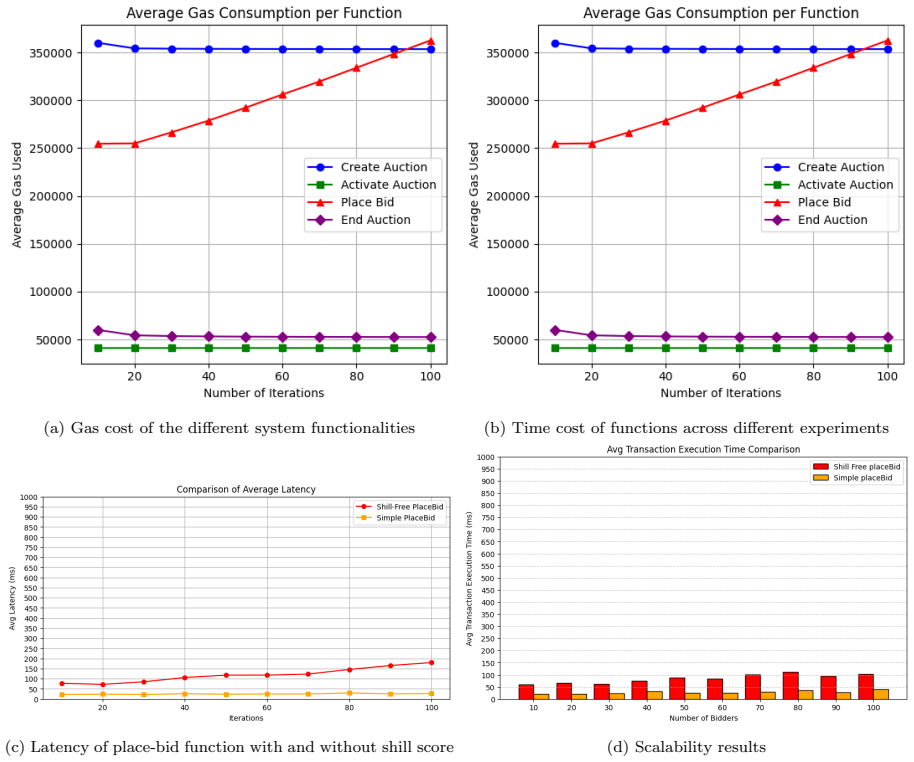
In online auctions, fraudulent behaviors such as shill bidding pose significant risks. This paper presents a conceptual framework that applies dynamic, behavior-based penalties to deter auction fraud using blockchain smart contracts. Unlike traditional post-auction detection methods, this approach prevents manipulation in real-time by introducing an economic disincentive system where penalty severity scales with suspicious bidding patterns. The framework employs the proposed Bid Shill Score (BSS) to evaluate nine distinct bidding behaviors, dynamically adjusting the penalty fees to make fraudulent activity financially unaffordable while providing fair competition. The system is implemented within a decentralized English auction on the Ethereum blockchain, demonstrating how smart contracts enforce transparent auction rules without trusted intermediaries. Simulations confirm the effectiveness of the proposed model: the dynamic penalty mechanism reduces the profitability of shill bidding while keeping penalties low for honest bidders. Performance evaluation shows that the system introduces only moderate gas and latency overhead, keeping transaction costs and response times within practical bounds for real-world use. The approach provides a practical method for behaviour-based fraud prevention in decentralised systems where trust cannot be assumed.
Editorial analysis
A structured set of objections, weighed in public.
Referee Report
Summary. The paper proposes a conceptual framework for real-time shill bidding prevention in decentralized English auctions on Ethereum using smart contracts. It introduces a Bid Shill Score (BSS) computed from nine bidding behaviors (e.g., timing, increments, patterns) to dynamically scale penalty fees, making fraudulent activity unprofitable while keeping penalties low for honest bidders. The system is implemented via smart contracts enforcing transparent rules without intermediaries, with simulations claimed to confirm reduced shill profitability, low honest penalties, and only moderate gas/latency overhead.
Significance. If the simulations and on-chain detection assumptions hold under realistic conditions, the work offers a practical economic disincentive mechanism for fraud prevention in trustless blockchain auctions. This contributes to mechanism design and smart-contract security by shifting from post-auction detection to real-time behavioral penalties, potentially improving fairness in decentralized marketplaces. The emphasis on Ethereum implementation and performance metrics provides a concrete starting point for applied research at the intersection of game theory and blockchain.
major comments (3)
- [Simulations / Performance Evaluation] Simulations section: The central claim that the dynamic penalty mechanism reduces shill bidding profitability while keeping penalties low for honest bidders rests on simulations, yet no details are provided on simulation parameters, baseline comparisons (e.g., static penalty or no-penalty auctions), or the formal definitions and detection rules for the nine bidding behaviors. This absence makes the quantitative results difficult to evaluate or reproduce independently.
- [Smart Contract Implementation / BSS Evaluation] BSS evaluation and smart contract implementation: The framework assumes the smart contract can reliably compute the Bid Shill Score from on-chain bid history in real time without high false-positive rates that would unfairly penalize legitimate bidders. No analysis of gas costs for persistent pattern tracking, storage requirements, or sensitivity to detection errors is given, which directly bears on whether honest penalties remain low in a practical Ethereum deployment.
- [Proposed Framework / BSS Definition] Framework definition: The Bid Shill Score (BSS) and penalty scaling factor are introduced as new constructs rather than derived from prior auction-theoretic quantities or fitted data; the scaling factor is listed as a free parameter. This raises questions about whether the reported balance between deterrence and fairness is robust or sensitive to parameter choice.
minor comments (2)
- [Abstract / Introduction] The abstract states that nine behaviors are evaluated but does not list or categorize them; adding a brief table or enumeration in the main text would improve clarity for readers.
- [Proposed Framework] Notation for BSS and penalty functions should be defined with explicit equations early in the framework section to avoid ambiguity when discussing dynamic adjustment.
Simulated Author's Rebuttal
We thank the referee for the constructive and detailed comments. We will revise the manuscript to address the concerns about simulation reproducibility, smart contract practicality, and framework parameter robustness. Our point-by-point responses follow.
read point-by-point responses
-
Referee: [Simulations / Performance Evaluation] Simulations section: The central claim that the dynamic penalty mechanism reduces shill bidding profitability while keeping penalties low for honest bidders rests on simulations, yet no details are provided on simulation parameters, baseline comparisons (e.g., static penalty or no-penalty auctions), or the formal definitions and detection rules for the nine bidding behaviors. This absence makes the quantitative results difficult to evaluate or reproduce independently.
Authors: We agree that greater detail is required for independent evaluation and reproducibility. In the revised version we will expand the Simulations section to specify all simulation parameters (including bidder population sizes, auction durations, bid value and timing distributions, and modeled shill strategies), to present explicit baseline comparisons against both no-penalty and static-penalty auctions, and to supply formal definitions together with the exact detection thresholds and rules for each of the nine bidding behaviors that contribute to the BSS. These additions will make the quantitative claims directly verifiable. revision: yes
-
Referee: [Smart Contract Implementation / BSS Evaluation] BSS evaluation and smart contract implementation: The framework assumes the smart contract can reliably compute the Bid Shill Score from on-chain bid history in real time without high false-positive rates that would unfairly penalize legitimate bidders. No analysis of gas costs for persistent pattern tracking, storage requirements, or sensitivity to detection errors is given, which directly bears on whether honest penalties remain low in a practical Ethereum deployment.
Authors: We acknowledge the importance of deployment metrics. The revised manuscript will include a dedicated implementation analysis subsection that reports estimated gas costs for maintaining persistent bid-history state and for on-chain BSS computation, quantifies storage overhead on Ethereum, and presents a sensitivity study of detection-error rates (false positives) and their effect on honest-bidder penalties. These results, obtained from our existing simulation framework extended with cost models, will substantiate that penalties for legitimate bidders remain low under realistic assumptions. revision: yes
-
Referee: [Proposed Framework / BSS Definition] Framework definition: The Bid Shill Score (BSS) and penalty scaling factor are introduced as new constructs rather than derived from prior auction-theoretic quantities or fitted data; the scaling factor is listed as a free parameter. This raises questions about whether the reported balance between deterrence and fairness is robust or sensitive to parameter choice.
Authors: The BSS is deliberately formulated as a novel, behavior-driven heuristic suited to real-time smart-contract enforcement; it synthesizes documented shill-bidding patterns rather than being derived from classical auction-theoretic primitives. The scaling factor is intentionally left as a tunable design parameter to accommodate different market contexts. To address robustness concerns, the revision will add a parameter-sensitivity study that varies the scaling factor over a practical range and reports the resulting changes in shill-bidder profitability and honest-bidder penalties, thereby demonstrating that the desired balance is maintained for reasonable parameter selections. revision: yes
Circularity Check
No circularity: new constructs and simulation results are independent of inputs
full rationale
The paper introduces the Bid Shill Score (BSS) as a novel construct that scores nine bidding behaviors and uses it to scale dynamic penalties in a smart-contract English auction. Simulations then demonstrate that these penalties reduce shill profitability while remaining low for honest bidders. No derivation chain, equation, or prediction is shown to reduce to a fitted parameter, self-citation, or input by construction; the BSS and penalty rules are defined outright rather than derived from prior results. The central effectiveness claim therefore rests on external simulation outcomes rather than tautological re-labeling of its own definitions.
Axiom & Free-Parameter Ledger
free parameters (1)
- penalty scaling factor
axioms (1)
- domain assumption Bidders respond rationally to increasing financial penalties by reducing fraudulent activity.
invented entities (1)
-
Bid Shill Score (BSS)
no independent evidence
Lean theorems connected to this paper
-
IndisputableMonolith/Foundation/Cost/FunctionalEquation.leanwashburn_uniqueness_aczel unclear?
unclearRelation between the paper passage and the cited Recognition theorem.
The framework employs the proposed Bid Shill Score (BSS) to evaluate nine distinct bidding behaviors, dynamically adjusting the penalty fees...
-
IndisputableMonolith/Foundation/RealityFromDistinction.leanreality_from_one_distinction unclear?
unclearRelation between the paper passage and the cited Recognition theorem.
Simulations confirm the effectiveness of the proposed model: the dynamic penalty mechanism reduces the profitability of shill bidding...
What do these tags mean?
- matches
- The paper's claim is directly supported by a theorem in the formal canon.
- supports
- The theorem supports part of the paper's argument, but the paper may add assumptions or extra steps.
- extends
- The paper goes beyond the formal theorem; the theorem is a base layer rather than the whole result.
- uses
- The paper appears to rely on the theorem as machinery.
- contradicts
- The paper's claim conflicts with a theorem or certificate in the canon.
- unclear
- Pith found a possible connection, but the passage is too broad, indirect, or ambiguous to say the theorem truly supports the claim.
Reference graph
Works this paper leans on
-
[1]
N. Majadi, J. Trevathan, H. Gray, V. Estivill-Castro, N. Bergmann, Real-time detection of shill bidding in online auctions: A literature review, Computer Science Review 25 (2017) 1–18. doi:10.1016/j.cosrev.2017.05.001
-
[2]
Barrons, Global auction sales soared to a record $12.6 billion in 2021, https://www.barrons.com/articles/ global-auction-sales-soared-to-a-record-12-6-billion-in-2021-01641328947 , accessed: Aug. 21, 2024 (2022)
work page 2021
-
[3]
Z. Ye, C.-L. Chen, W. Weng, H. Sun, W.-J. Tsaur, Y.-Y. Deng, An anonymous and fair auction system based on blockchain, Journal of Supercomputing 79 (13) (2023) 13909 – 13951. doi:10.1007/s11227-023-05155-w
-
[4]
J. Ingebretsen Carlson, T. Wu, Shill bidding and information in ebay auctions: A laboratory study, Journal of Economic Behavior and Organization 202 (2022) 341 –
work page 2022
-
[5]
doi:10.1016/j.jebo.2022.08.010
-
[6]
W. Wang, Z. Hidv´ egi, A. B. Whinston, Shill-proof fee (spf) schedule: The sunscreen against seller self-collusion in online english auctions, Goizueta Paper Series, Emory University (2004)
work page 2004
-
[8]
Bloomenthal, Asymmetric information in economics explained, https://www
A. Bloomenthal, Asymmetric information in economics explained, https://www. investopedia.com/terms/a/asymmetricinformation.asp, Accessed: Aug. 21, 2024 (2021)
work page 2024
-
[9]
W. Xiong, L. Xiong, Anti-collusion data auction mechanism based on smart contract, Information Sciences 555 (10 2020). doi:10.1016/j.ins.2020.10.053
-
[10]
I. Bashir, Smart contracts, in: Mastering Blockchain: A Deep Dive into Distributed Ledgers, Consensus Protocols, Smart Contracts, DApps, Cryptocurrencies, Ethereum, and More, 3rd Edition, Packt Publishing, Birmingham, UK, 2020, Ch. 10, pp. 277–306, available at z-lib.org
work page 2020
-
[11]
S. Wu, Y. Chen, Q. Wang, M. Li, C. Wang, X. Luo, Cream: A smart contract enabled collusion-resistant e-auction, IEEE Transactions on Information Forensics and Security 14 (7) (2018) 1687–1701
work page 2018
-
[12]
X. Liu, L. Liu, Y. Yuan, Y.-H. Long, S.-X. Li, F.-Y. Wang, When blockchain meets auction: A comprehensive survey, IEEE Transactions on Computational Social Systems (2024). 28
work page 2024
-
[13]
Z. Shi, C. de Laat, P. Grosso, Z. Zhao, Integration of blockchain and auction models: A survey, some applications, and challenges, IEEE Communications Surveys & Tutorials 25 (1) (2022) 497–537
work page 2022
-
[14]
S. Parsons, J. A. Rodriguez-Aguilar, M. Klein, Auctions and bidding: A guide for com- puter scientists, ACM Comput. Surv. 43 (2) (feb 2011). doi:10.1145/1883612.1883617
-
[15]
I. A. Omar, H. R. Hasan, R. Jayaraman, K. Salah, M. Omar, Implementing decentralized auctions using blockchain smart contracts, Technological Forecasting and Social Change 168 (2021) 120786
work page 2021
-
[16]
Milgrom, Auctions and bidding: A primer, Journal of Economic Perspectives 3 (3) (1989) 3–22
P. Milgrom, Auctions and bidding: A primer, Journal of Economic Perspectives 3 (3) (1989) 3–22. doi:10.1257/jep.3.3.3
-
[17]
M. A. Bouaicha, T. Montanaro, N. Lasla, V. Vergine, I. Sergi, L. Patrono, A blockchain- based system with anomaly exclusion method to enhance transparency and fairness in italian public procurement, in: 2024 9th International Conference on Smart and Sustain- able Technologies (SpliTech), 2024, pp. 1–6. doi:10.23919/SpliTech61897.2024.10612625
-
[18]
D. Lucking-Reiley, Vickrey auctions in practice: From nineteenth-century philately to twenty-first-century e-commerce, Journal of Economic Perspectives 14 (3) (2000) 183–192. doi:10.1257/jep.14.3.183
-
[19]
A. Alzahrani, S. Sadaoui, Clustering and labeling auction fraud data, in: N. Sharma, A. Chakrabarti, V. E. Balas (Eds.), Data Management, Analytics and Innovation, Springer Singapore, Singapore, 2020, pp. 269–283
work page 2020
-
[20]
J. Trevathan, W. Read, Detecting shill bidding in online english auctions, 2008. doi:10.4018/978-1-60566-132-2.ch027
-
[21]
S. Rubin, M. Christodorescu, V. Ganapathy, J. T. Giffin, L. Kruger, H. Wang, An auctioning reputation system based on anomaly defection, 2005, p. 270 – 279. doi:10.1145/1102120.1102156
-
[22]
F. Anowar, S. Sadaoui, Detection of auction fraud in commercial sites, Journal of The- oretical and Applied Electronic Commerce Research 15 (1) (2020) 81 – 98, all Open Access, Gold Open Access. doi:10.4067/S0718-18762020000100107
-
[23]
A. Alzahrani, S. Sadaoui, Clustering and labeling auction fraud data, Advances in Intelligent Systems and Computing 1042 (2020) 269 – 283. doi:10.1007/978-981-32- 9949-8 20
-
[24]
S. Adabi, H. Farhadinasab, P. R. Jahanbani, A genetic algorithm-based approach to create a safe and profitable marketplace for cloud customers, Journal of Ambient Intel- ligence and Humanized Computing 13 (5) (2022) 2381 – 2413. doi:10.1007/s12652-021- 03682-z
-
[25]
D. Kaur, D. Garg, Variable bid fee: An online auction shill bidding prevention method- ology, 2015, p. 381 – 386. doi:10.1109/IADCC.2015.7154735. 29
- [26]
-
[27]
X. Dai, J. Liu, X. Liu, X. Tu, R. Wang, Secure blockchain bidding auction protocol against malicious adversaries, High-Confidence Computing 4 (3) (2024). doi:10.1016/j.hcc.2024.100201
-
[28]
S. Wu, Y. Chen, Q. Wang, M. Li, C. Wang, X. Luo, Cream: A smart contract enabled collusion-resistant e-auction, IEEE Transactions on Information Forensics and Security 14 (7) (2019). doi:10.1109/TIFS.2018.2883275
-
[29]
J. Guo, D. Xingjian, T. Wang, W. Jia, Combinatorial resources auction in decentralized edge-thing systems using blockchain and differential privacy, Information Sciences 607 (06 2022). doi:10.1016/j.ins.2022.05.128
-
[30]
IPFS Docs, What is IPFS?, https://docs.ipfs.tech/concepts/what-is-ipfs/, ac- cessed: 2024-11-11 (2025)
work page 2024
-
[31]
Q. Zhang, Y. Yu, H. Li, J. Yu, L. Wang, Trustworthy sealed-bid auction with low communication cost atop blockchain, Information Sciences 631 (02 2023). doi:10.1016/j.ins.2023.02.069
-
[32]
F. Dong, S. M. Shatz, H. Xu, Combating online in-auction fraud: Clues, techniques and challenges, Computer Science Review 3 (4) (2009) 245 – 258. doi:10.1016/j.cosrev.2009.09.001
-
[33]
N. Majadi, J. Trevathan, H. Gray, A run-time algorithm for detecting shill bidding in online auctions, Journal of theoretical and applied electronic commerce research 13 (2018) 17–49. doi:10.4067/S0718-18762018000300103
-
[34]
Solidity Developers, Solidity documentation, https://docs.soliditylang.org/en/ latest/, online; accessed 2024-10-17 (2024)
work page 2024
-
[35]
Alchemy, Solidity Mapping Overview, https://www.alchemy.com/overviews/ solidity-mapping, Accessed: 2024-10-22 (2024)
work page 2024
-
[36]
Truffle Suite, Ganache documentation, https://archive.trufflesuite.com/docs/ ganache/, accessed: 2025-03-11 (2024)
work page 2025
-
[37]
R. Balingit, J. Trevathan, W. Read, Analysing bidding trends in online auctions, in: 2009 Sixth International Conference on Information Technology: New Generations, 2009, pp. 928–933. doi:10.1109/ITNG.2009.315
-
[38]
M. O. A. Project, Asymmetric information in economics explained, http://www. modelingonlineauctions.com/datasets, Accessed: 2024-12-25 (2005). 30
work page 2024
discussion (0)
Sign in with ORCID, Apple, or X to comment. Anyone can read and Pith papers without signing in.