REVIEW 2 major objections 7 minor 51 references
Action Dependency Graphs for Globally Optimal Coordinated Reinforcement Learning
T0 review · 2 major / 7 minor · reviewed 2026-08-07 · deepseek-v4-flash
Pith's one-line read In cooperative multi-agent reinforcement learning, a sparse action dependency graph derived from the coordination graph can turn locally optimal policies into globally optimal ones.
desk verdict A clean and genuinely new sufficient condition for sparse action-dependent policies to be globally optimal, but the empirical sections overstate what the theorem can certify. read the letter →
The pith
A machine-rendered reading of the paper's core claim, the machinery that carries it, and where it could break.
The reading
What carries the argument
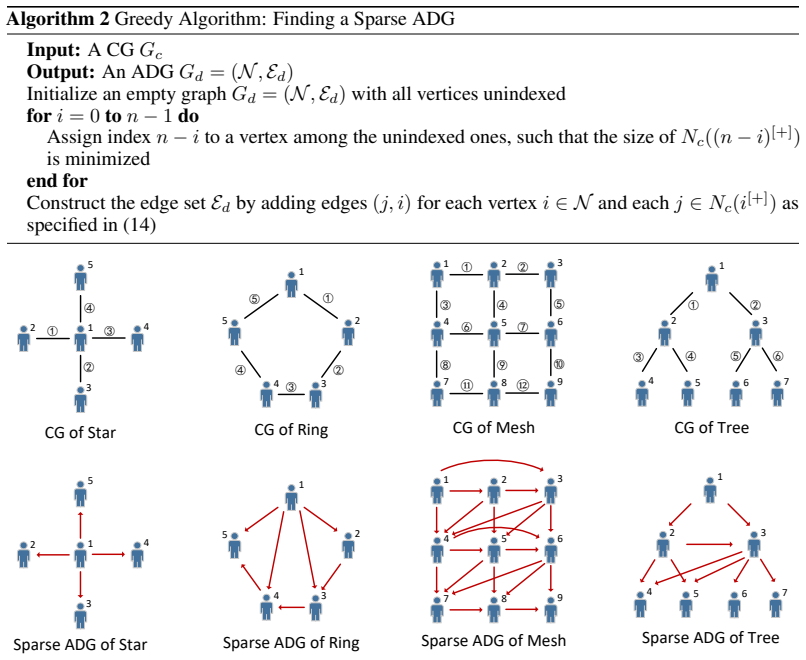
The central objects are the coordination graph (an undirected graph whose edges carry pairwise terms in a decomposition of the state-action value function) and the action dependency graph (a directed acyclic graph whose edges say which earlier agents' actions each agent's policy may condition on). The mechanism is the suffix-neighborhood identity $N_d(i) = N_c(i[+])$: agent $i$ must depend on exactly the agents outside the suffix $i[+]$ that are neighbors (in the coordination graph) of some agent in $i[+]$. Under this identity, Lemmas B.1--B.4 split $Q$ into a term that depends on the suffix actions plus a term that depends only on earlier actions, so a greedy backward induction over agents is equivalent to maximizing jointly over all actions. Algorithm 1 is the tabular action-dependent multi-agent policy iteration that realizes this induction; Algorithm 2 greedily chooses the agent ordering to keep the resulting ADG sparse.
What would settle it
Exhaustively search all small finite Markov games with a fixed sparse coordination graph, small action sets, and an ADG satisfying $N_d(i) = N_c(i[+])$: if any $G_d$-locally optimal deterministic policy has value below $V^*$, the theorem is false; a brute-force enumeration over deterministic policies and exact value iteration settles it.
Extended reading notes
Core claim
On its own terms, the paper proves Theorem 4.3: let $G_d$ be an action dependency graph for a policy $\pi$, let $G_c$ be a coordination graph for the state-action value $Q^\pi$, and suppose $N_d(i) = N_c(i[+])$ for all agents $i$, where $i[+] = \{i, i+1, \ldots, n\}$ is the suffix of the topological ordering. Then any $G_d$-locally optimal policy is globally optimal, so $V^\pi = V^*$. The proof works by induction from the last agent: under the condition, the value function splits so that each agent's local maximization step can be chained into a maximization over the whole suffix, turning a sequence of coordinated best responses into a global argmax. The same structural condition makes the proposed action-dependent multi-agent policy iteration converge in finite terms to a globally optimal policy, and the paper demonstrates empirically that sparse ADGs integrated into common policy-based and value-based deep MARL algorithms match or exceed fully dense ADGs on coordination polymatrix games, adaptive traffic signal control, and StarCraft II.
Load-bearing premise
The proof requires the state-action value function to decompose exactly as a sum of pairwise terms over the coordination graph for the policies involved (or at least for the converged policy); in the deep learning experiments this decomposition is approximate or hand-constructed, so the global-optimality guarantee is not strictly inherited.
Editorial extensions
If this is right
- For any finite Markov game whose value function decomposes exactly over a coordination graph, a sparse ADG constructed from condition (14) gives the same global-optimality guarantee as a fully dense auto-regressive graph, with fewer dependencies and lower per-step cost.
- The result subsumes existing special cases: when both graphs are empty, any Nash equilibrium is globally optimal (the VDN-style case), and when the CG is complete, the fully dense ADG recovers the known auto-regressive optimality result.
- Algorithm 1 converges in finitely many policy iterations to a globally optimal policy, providing a tabular baseline that is provably optimal rather than merely Nash.
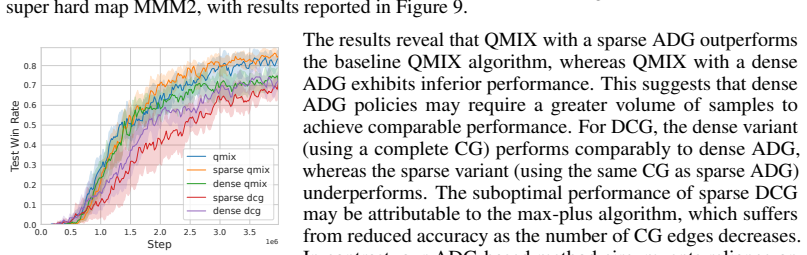
- The ADG construction can be layered onto policy-based and value-based deep MARL algorithms, where sparse ADGs empirically match dense ADGs on the tested benchmarks and avoid the max-plus inference step used by coordination-graph value methods.
Reading between the lines
- Because the sharpest sparse ADG depends on the agent ordering, the sparsity problem is effectively an elimination-order problem: the analogy to variable elimination suggests that finding the optimally sparse ADG for a given CG is computationally hard in general, so greedy index heuristics are the practical answer.
- A testable extension is to learn the coordination graph along with the ADG from data: if the learned graph is used, condition (14) becomes approximate, and the empirical question is how much the global-optimality guarantee degrades as the learned CG departs from the true decomposition.
- The same suffix-condition idea may carry over to hypergraph coordination structures, where local value terms involve more than two agents; the paper's proof structure suggests a generalized condition on hyperedge neighborhoods, though the paper does not establish this.
- In continuous-action settings, Algorithm 1's sequential argmax would become sequential gradient ascent, and the theorem would need a convexity or unimodality assumption; one could test whether the ADG ordering still improves coordination relative to independent policies.
Editorial analysis
A structured set of objections, weighed in public.
Referee Report
Summary. This paper proposes action dependency graphs (ADGs), directed acyclic graphs that specify which agents condition on the actions of others, and studies when such action-dependent policies can achieve global optimality in cooperative MARL. The main theoretical result (Theorem 4.3) states that if the state-action value function Q^π decomposes exactly over a coordination graph Gc (Eq. 6), and the policy's ADG satisfies Nd(i) = Nc(i[+]) for every agent i, then any Gd-locally optimal policy is globally optimal. The paper also contributes a tabular action-dependent multi-agent policy iteration algorithm (Algorithm 1) with a convergence proof (Theorem 5.2), a greedy construction of sparse ADGs (Algorithm 2), and an integration of the ADG idea into MAPPO and QMIX, with experiments on coordination polymatrix games, adaptive traffic signal control, and StarCraft II.
Significance. The theoretical contribution is a clean, machine-checkable-looking proof that sparse action dependency structures, derived from a coordination graph, can certify global optimality of locally optimal policies. This generalizes earlier dense auto-regressive policy results and connects action-dependent policies to variable-elimination-style structures. The tabular algorithm's convergence proof is a valid extension of policy iteration. However, the practical scope is narrow: the exact decomposition of Q^π over the CG is a strong premise that is not verified in the deep RL experiments, so the empirical results should be viewed as heuristic rather than as instances of the theoretical guarantee. If the authors address this gap, the theoretical part is a solid contribution.
major comments (2)
- [Sections 7.2-7.3, Theorem 4.3] The global optimality guarantee in Theorem 4.3 is conditional on the exact coordinate-graph decomposition of Q^π stated in Eq. (6). In the ATSC and SMAC experiments, the CG is constructed from adjacency (Tables 16-17) or is artificial (Tables 18-19), and the trained QMIX/MAPPO value functions are not constrained to decompose as a sum of pairwise edge functions. The paper provides no verification that the learned Q^π satisfies Eq. (6) for the converged policy. Consequently, Theorem 4.3 does not apply to these experiments, and the empirical results cannot be cited as evidence for the global-optimality claim. Please either add a quantitative check of the decomposition residual, or explicitly state that the deep RL results are heuristic extensions and adjust the abstract and conclusion accordingly.
- [Proposition D.1, Remark 5.3, and Section 8] The class of Markov games for which an exact CG exists is very restrictive: Proposition D.1 requires both the reward and the transition model to decompose additively over the same edge set, with P(s'|s,a)=Σ_{(i,j)∈Ec} P_ij(s'|s,a_i,a_j). This is not the usual approximation notion of a coordination graph, and the paper gives no natural multi-step examples outside one-step polymatrix games. The conclusion's statement that 'the empirical results affirm the robustness and applicability of our approach in more general scenarios' overstates what the theory supports. A discussion of how far the exact condition is from the experimental setting, and whether an approximate-decomposition error bound exists, is needed to prevent readers from attributing to the theorem what is actually a heuristic.
minor comments (7)
- [Definition 4.1, Eq. (13)] The left-hand side E_{π_{-Nd(i)}}[Q^π(s,a)] is written without indicating that the actions of agents in Nd(i) are fixed; the notation should explicitly be E_{π_{-Nd(i)}}[Q^π(s, a_{Nd(i)}, a_{-Nd(i)})] to be unambiguous.
- [Appendix B, proof of Lemma B.4] In Eq. (29) the term Q2(s, a'_{Nd(i)}, a_{i-\Nd(i)}) is written with three argument groups, whereas Q2 is defined in Eq. (26) as depending on a_{i-}; this is likely a typo for Q2(s, a'_{i-}).
- [Section 7, Figures 5, 7, and 9] The empirical curves show only mean values over ten seeds, with no error bars, confidence regions, or statistical significance tests; claims such as 'faster convergence' would be better supported by reporting variance or a bootstrap interval.
- [Section 5, Algorithm 1 and Theorem 5.2] The convergence proof uses Assumption 5.1 (singleton argmax), but the algorithm description mentions a practical tie-breaking relaxation only in a paragraph. It would be helpful to restate the algorithm with the explicit relaxation included and to clarify whether the finite-time optimality proof carries over under that tie-breaking rule.
- [Section 4.3, Algorithm 2] The greedy criterion 'assign index n-i to a vertex minimizing the size of Nc((n-i)[+])' is stated without intuition or a small worked example; adding a sentence explaining that this reduces the maximum in-degree of the resulting ADG would improve readability.
- [Introduction, Section 1] The claim that prior studies [4,6,9] 'focus exclusively on fully dense ADGs' is accurate for those references but might be misread as ignoring [7], which studies general Bayesian-network policies; the related-work section does acknowledge [7], so a small rephrasing of the contribution statement could avoid this ambiguity.
- [Throughout, technical notation] There are several instances where π_{(k+1)[+]} appears in the proof of Theorem 4.3 where π_{k+} (or π_{(k+1)[+]}) is intended; the notation is confusing, and a consistent use of the appendix's i+ and i[+] conventions would help.
Circularity Check
No significant circularity: the global-optimality theorem is derived from explicit decomposition and local-optimality assumptions, not from fitted parameters or self-citations.
full rationale
The paper's central result (Theorem 4.3) is a conditional theorem: if a policy is Gd-locally optimal (Definition 4.1) and Gc is a coordination graph of Qπ (Eq. 6), then the graph condition Nd(i)=Nc(i[+]) implies Vπ=V*. The proof in Appendix B supplies lemmas B.1-B.4 and an induction that derives the Bellman-optimal fixed point from these assumptions; the conclusion is not assumed in the definition of Gd-local optimality, which is a strictly weaker local best-response criterion (Remark 4.2). The CG-decomposition premise is stated as an assumption, with Proposition D.1 giving sufficient conditions under which it holds exactly; this is a hypothesis of the theorem, not a fitted input renamed as a prediction. Algorithm 1's convergence proof (Theorem C.1) shows the limit is Gd-locally optimal and then applies Theorem 4.3, again a proof step rather than a circular invocation. The sparse ADG (Algorithm 2) is constructed from the CG purely by graph minimization; no parameter is fit to the observed returns and then reported as a prediction. Self-citations (e.g., Ref. [5]) appear only in motivational context about Nash equilibria and are not load-bearing for the proof. The deep-RL experiments do assume or approximate a CG without verifying exact Qπ decomposition, which is an external-validity/correctness caveat, not circularity.
Assumptions & free parameters
assumptions (4)
- domain assumption The state-action value function Qπ admits a coordination graph decomposition (Eq. 6) for all policies π or at least for the converged policy.
- standard math The agent indices follow a topological order of the ADG (j < i for all j in Nd(i)).
- ad hoc to paper Assumption 5.1: the greedy argmax in Algorithm 1 is a singleton for all iterations and agents.
- standard math The Markov game is finite with discount factor gamma in [0,1), and the Bellman optimality operator has a unique fixed point.
invented entities (1)
-
Action Dependency Graph (ADG)
independent evidence
Cite this review
Pith. "Pith review of Action Dependency Graphs for Globally Optimal Coordinated Reinforcement Learning." pith.science (2026). https://pith.science/paper/NIFYGARO
@misc{pith2026250600797,
  author       = {Pith},
  title        = {Pith review of: Action Dependency Graphs for Globally Optimal Coordinated Reinforcement Learning},
  year         = {2026},
  howpublished = {\url{https://pith.science/paper/NIFYGARO}},
  note         = {Machine review of arXiv:2506.00797}
}
read the original abstract
Action-dependent individual policies, which incorporate both environmental states and the actions of other agents in decision-making, have emerged as a promising paradigm for achieving global optimality in multi-agent reinforcement learning (MARL). However, the existing literature often adopts auto-regressive action-dependent policies, where each agent's policy depends on the actions of all preceding agents. This formulation incurs substantial computational complexity as the number of agents increases, thereby limiting scalability. In this work, we consider a more generalized class of action-dependent policies, which do not necessarily follow the auto-regressive form. We propose to use the `action dependency graph (ADG)' to model the inter-agent action dependencies. Within the context of MARL problems structured by coordination graphs, we prove that an action-dependent policy with a sparse ADG can achieve global optimality, provided the ADG satisfies specific conditions specified by the coordination graph. Building on this theoretical foundation, we develop a tabular policy iteration algorithm with guaranteed global optimality. Furthermore, we integrate our framework into several SOTA algorithms and conduct experiments in complex environments. The empirical results affirm the robustness and applicability of our approach in more general scenarios, underscoring its potential for broader MARL challenges.
Figures


Figures from the paper (7 more)


Reference graph
Works this paper leans on
-
[1]
Multi-agent reinforcement learning: A selective overview of theories and algorithms
Kaiqing Zhang, Zhuoran Yang, and Tamer Ba¸ sar. Multi-agent reinforcement learning: A selective overview of theories and algorithms. Handbook of Reinforcement Learning and Control, pages 321–384, 2021. 9
work page 2021
-
[2]
A review of cooperative multi-agent deep reinforce- ment learning
Afshin Oroojlooy and Davood Hajinezhad. A review of cooperative multi-agent deep reinforce- ment learning. Applied Intelligence, 53(11):13677–13722, 2023
2023
-
[3]
Revisiting some common practices in cooperative multi-agent reinforcement learning
Wei Fu, Chao Yu, Zelai Xu, Jiaqi Yang, and Yi Wu. Revisiting some common practices in cooperative multi-agent reinforcement learning. In International Conference on Machine Learning, pages 6863–6877. PMLR, 2022
work page 2022
-
[4]
Towards global optimality in cooperative marl with sequential transformation
Jianing Ye, Chenghao Li, Jianhao Wang, Qianchuan Zhao, and Chongjie Zhang. Towards global optimality in cooperative marl with sequential transformation. 2022
work page 2022
-
[5]
Gangshan Jing, He Bai, Jemin George, Aranya Chakrabortty, and Piyush K. Sharma. Dis- tributed multiagent reinforcement learning based on graph-induced local value functions. IEEE Transactions on Automatic Control, 69(10):6636–6651, 2024
work page 2024
-
[6]
Multiagent reinforcement learning: Rollout and policy iteration
Dimitri Bertsekas. Multiagent reinforcement learning: Rollout and policy iteration. IEEE/CAA Journal of Automatica Sinica, 8(2):249–272, 2021
work page 2021
-
[7]
Dingyang Chen and Qi Zhang. Context-aware bayesian network actor-critic methods for cooperative multi-agent reinforcement learning. In International Conference on Machine Learning, pages 5327–5350. PMLR, 2023
work page 2023
-
[8]
Coordinated reinforcement learning
Carlos Guestrin, Michail G Lagoudakis, and Ronald Parr. Coordinated reinforcement learning. In Proceedings of the 19th International Conference on Machine Learning , pages 227–234, 2002
work page 2002
Show all 51 references
-
[9]
More centralized training, still decentralized execution: Multi-agent conditional policy factorization
Jiangxing Wang, Deheng Ye, and Zongqing Lu. More centralized training, still decentralized execution: Multi-agent conditional policy factorization. arXiv preprint arXiv:2209.12681, 2022
2022 arXiv
-
[10]
Multi-agent reinforcement learning: Independent vs
Ming Tan. Multi-agent reinforcement learning: Independent vs. cooperative agents. In Proceed- ings of the 10th International Conference on Machine Learning, pages 330–337, 1993
1993
-
[11]
Value- decomposition networks for cooperative multi-agent learning based on team reward
Peter Sunehag, Guy Lever, Audrunas Gruslys, Wojciech Marian Czarnecki, Vinicius Zambaldi, Max Jaderberg, Marc Lanctot, Nicolas Sonnerat, Joel Z Leibo, Karl Tuyls, et al. Value- decomposition networks for cooperative multi-agent learning based on team reward. In Pro- ceedings o...
2018
-
[12]
Qmix: Monotonic value function factorisation for deep multi-agent reinforcement learning
Tabish Rashid, Mikayel Samvelyan, Christian Schroeder, Gregory Farquhar, Jakob Foerster, and Shimon Whiteson. Qmix: Monotonic value function factorisation for deep multi-agent reinforcement learning. In International Conference on Machine Learning, pages 4295–4304. PMLR, 2018
2018
-
[13]
Qtran: Learning to factorize with transformation for cooperative multi-agent reinforcement learning
Kyunghwan Son, Daewoo Kim, Wan Ju Kang, David Earl Hostallero, and Yung Yi. Qtran: Learning to factorize with transformation for cooperative multi-agent reinforcement learning. In International Conference on Machine Learning, pages 5887–5896. PMLR, 2019
2019
-
[14]
Multi-agent actor-critic for mixed cooperative-competitive environments
Ryan Lowe, Yi I Wu, Aviv Tamar, Jean Harb, OpenAI Pieter Abbeel, and Igor Mordatch. Multi-agent actor-critic for mixed cooperative-competitive environments. Advances in Neural Information Processing Systems, 30, 2017
2017
-
[15]
Counterfactual multi-agent policy gradients
Jakob Foerster, Gregory Farquhar, Triantafyllos Afouras, Nantas Nardelli, and Shimon Whiteson. Counterfactual multi-agent policy gradients. InProceedings of the AAAI Conference on Artificial Intelligence, volume 32, 2018
2018
-
[16]
Actor-attention-critic for multi-agent reinforcement learning
Shariq Iqbal and Fei Sha. Actor-attention-critic for multi-agent reinforcement learning. In International Conference on Machine Learning, pages 2961–2970. PMLR, 2019
2019
-
[17]
The surprising effectiveness of ppo in cooperative multi-agent games
Chao Yu, Akash Velu, Eugene Vinitsky, Jiaxuan Gao, Yu Wang, Alexandre Bayen, and Yi Wu. The surprising effectiveness of ppo in cooperative multi-agent games. Advances in Neural Information Processing Systems, 35:24611–24624, 2022
2022
-
[18]
Deep coordination graphs
Wendelin Böhmer, Vitaly Kurin, and Shimon Whiteson. Deep coordination graphs. In Interna- tional Conference on Machine Learning, pages 980–991. PMLR, 2020. 10
2020
-
[19]
Deep implicit coordination graphs for multi-agent reinforcement learning
Sheng Li, Jayesh K Gupta, Peter Morales, Ross Allen, and Mykel J Kochenderfer. Deep implicit coordination graphs for multi-agent reinforcement learning. In Proceedings of the 20th International Conference on Autonomous Agents and MultiAgent Systems, pages 764–772, 2021
2021
-
[20]
Context-aware sparse deep coordination graphs
Tonghan Wang, Liang Zeng, Weijun Dong, Qianlan Yang, Yang Yu, and Chongjie Zhang. Context-aware sparse deep coordination graphs. In International Conference on Learning Representations, 2022
2022
-
[21]
Analysing factoriza- tions of action-value networks for cooperative multi-agent reinforcement learning
Jacopo Castellini, Frans A Oliehoek, Rahul Savani, and Shimon Whiteson. Analysing factoriza- tions of action-value networks for cooperative multi-agent reinforcement learning. Autonomous Agents and Multi-Agent Systems, 35(2):25, 2021
2021
-
[22]
Biasing coevolutionary search for optimal multiagent behaviors
Liviu Panait, Sean Luke, and R Paul Wiegand. Biasing coevolutionary search for optimal multiagent behaviors. IEEE Transactions on Evolutionary Computation, 10(6):629–645, 2006
2006
-
[23]
Bounded approximate decentralised coordination via the max-sum algorithm
Alex Rogers, Alessandro Farinelli, Ruben Stranders, and Nicholas R Jennings. Bounded approximate decentralised coordination via the max-sum algorithm. Artificial Intelligence, 175 (2):730–759, 2011
2011
-
[24]
Nonserial dynamic programming
Umberto Bertele and Francesco Brioschi. Nonserial dynamic programming. Academic Press, Inc., 1972
1972
-
[25]
Gcs: Graph-based coordination strategy for multi-agent rein- forcement learning
Jingqing Ruan, Yali Du, Xuantang Xiong, Dengpeng Xing, Xiyun Li, Linghui Meng, Haifeng Zhang, Jun Wang, and Bo Xu. Gcs: Graph-based coordination strategy for multi-agent rein- forcement learning. In Proceedings of the 21st International Conference on Autonomous Agents and Mult...
2022
-
[26]
Ace: Cooperative multi-agent q-learning with bidirectional action-dependency
Chuming Li, Jie Liu, Yinmin Zhang, Yuhong Wei, Yazhe Niu, Yaodong Yang, Yu Liu, and Wanli Ouyang. Ace: Cooperative multi-agent q-learning with bidirectional action-dependency. In Proceedings of the AAAI Conference on Artificial Intelligence, volume 37, pages 8536–8544, 2023
2023
-
[27]
Backpropagation through agents
Zhiyuan Li, Wenshuai Zhao, Lijun Wu, and Joni Pajarinen. Backpropagation through agents. In Proceedings of the AAAI Conference on Artificial Intelligence, pages 13718–13726, 2024
2024
-
[28]
Group-aware coordination graph for multi-agent reinforce- ment learning
Wei Duan, Jie Lu, and Junyu Xuan. Group-aware coordination graph for multi-agent reinforce- ment learning. In Proceedings of the Thirty-Third International Joint Conference on Artificial Intelligence, pages 3926–3934, 2024
2024
-
[29]
Is centralized training with decentralized execution framework centralized enough for marl? arXiv preprint arXiv:2305.17352, 2023
Yihe Zhou, Shunyu Liu, Yunpeng Qing, Kaixuan Chen, Tongya Zheng, Yanhao Huang, Jie Song, and Mingli Song. Is centralized training with decentralized execution framework centralized enough for marl? arXiv preprint arXiv:2305.17352, 2023
2023 arXiv
-
[30]
Multi-agent reinforcement learning is a sequence modeling problem
Muning Wen, Jakub Kuba, Runji Lin, Weinan Zhang, Ying Wen, Jun Wang, and Yaodong Yang. Multi-agent reinforcement learning is a sequence modeling problem. Advances in Neural Information Processing Systems, 35:16509–16521, 2022
2022
-
[31]
Coordinated multi-agent reinforcement learning in net- worked distributed POMDPs
Chongjie Zhang and Victor Lesser. Coordinated multi-agent reinforcement learning in net- worked distributed POMDPs. In Proceedings of the AAAI Conference on Artificial Intelligence, volume 25, pages 764–770, 2011
2011
-
[32]
Learning to coordinate with coordination graphs in repeated single-stage multi-agent decision problems
Eugenio Bargiacchi, Timothy Verstraeten, Diederik Roijers, Ann Nowé, and Hado Hasselt. Learning to coordinate with coordination graphs in repeated single-stage multi-agent decision problems. In International Conference on Machine Learning, pages 482–490. PMLR, 2018
2018
-
[33]
Coordinated reinforcement learning for optimizing mobile networks
Maxime Bouton, Hasan Farooq, Julien Forgeat, Shruti Bothe, Meral Shirazipour, and Per Karlsson. Coordinated reinforcement learning for optimizing mobile networks. arXiv preprint arXiv:2109.15175, 2021
2021 arXiv
-
[34]
Understanding value decomposition algo- rithms in deep cooperative multi-agent reinforcement learning.arXiv preprint arXiv:2202.04868, 2022
Zehao Dou, Jakub Grudzien Kuba, and Yaodong Yang. Understanding value decomposition algo- rithms in deep cooperative multi-agent reinforcement learning.arXiv preprint arXiv:2202.04868, 2022. 11
2022 arXiv
-
[35]
On the global convergence rates of decentralized softmax gradient play in markov potential games
Runyu Zhang, Jincheng Mei, Bo Dai, Dale Schuurmans, and Na Li. On the global convergence rates of decentralized softmax gradient play in markov potential games. Advances in Neural Information Processing Systems, 35:1923–1935, 2022
1923
-
[36]
Trust region policy optimisation in multi-agent reinforcement learning
JG Kuba, R Chen, M Wen, Y Wen, F Sun, J Wang, and Y Yang. Trust region policy optimisation in multi-agent reinforcement learning. InInternational Conference on Learning Representations, page 1046, 2022
2022
-
[37]
On minmax theorems for multiplayer games
Yang Cai and Constantinos Daskalakis. On minmax theorems for multiplayer games. In Proceedings of the 20nd Annual ACM-SIAM Symposium on Discrete Algorithms, pages 217–
-
[38]
Team theory and person-by-person optimization with binary decisions
Dario Bauso and Raffaele Pesenti. Team theory and person-by-person optimization with binary decisions. SIAM Journal on Control and Optimization, 50(5):3011–3028, 2012
2012
-
[39]
Collaborative multiagent reinforcement learning by payoff propagation
Jelle R Kok and Nikos Vlassis. Collaborative multiagent reinforcement learning by payoff propagation. Journal of Machine Learning Research, 7, 2006
2006
-
[40]
Reinforcement learning: An introduction
Richard S Sutton. Reinforcement learning: An introduction. A Bradford Book, 2018
2018
-
[41]
Microscopic traffic simulation using sumo
Pablo Alvarez Lopez, Michael Behrisch, Laura Bieker-Walz, Jakob Erdmann, Yun-Pang Flöt- teröd, Robert Hilbrich, Leonhard Lücken, Johannes Rummel, Peter Wagner, and Evamarie Wießner. Microscopic traffic simulation using sumo. InThe 21st IEEE International Conference on Intellig...
2018
-
[42]
Lucas N. Alegre. SUMO-RL. https://github.com/LucasAlegre/sumo-rl, 2019
2019
-
[43]
Mikayel Samvelyan, Tabish Rashid, Christian Schroeder de Witt, Gregory Farquhar, Nantas Nardelli, Tim G. J. Rudner, Chia-Man Hung, Philiph H. S. Torr, Jakob Foerster, and Shimon Whiteson. The StarCraft Multi-Agent Challenge. CoRR, abs/1902.04043, 2019
1902 arXiv
-
[44]
Soft actor-critic: Off- policy maximum entropy deep reinforcement learning with a stochastic actor
Tuomas Haarnoja, Aurick Zhou, Pieter Abbeel, and Sergey Levine. Soft actor-critic: Off- policy maximum entropy deep reinforcement learning with a stochastic actor. In International Conference on Machine Learning, pages 1861–1870. PMLR, 2018
2018
-
[45]
Multi-agent reinforcement learning for networked system control
Tianshu Chu, Sandeep Chinchali, and Sachin Katti. Multi-agent reinforcement learning for networked system control. arXiv preprint arXiv:2004.01339, 2020
2004 arXiv
-
[46]
Proximal policy optimization algorithms
John Schulman, Filip Wolski, Prafulla Dhariwal, Alec Radford, and Oleg Klimov. Proximal policy optimization algorithms. arXiv preprint arXiv:1707.06347, 2017
2017 arXiv
-
[47]
Abstract dynamic programming
Dimitri Bertsekas. Abstract dynamic programming. Athena Scientific, 2022
2022
-
[48]
Dynamical model of traffic congestion and numerical simulation
Masako Bando, Katsuya Hasebe, Akihiro Nakayama, Akihiro Shibata, and Yuki Sugiyama. Dynamical model of traffic congestion and numerical simulation. Physical Review E, 51(2): 1035, 1995
1995
-
[49]
High- dimensional continuous control using generalized advantage estimation
John Schulman, Philipp Moritz, Sergey Levine, Michael Jordan, and Pieter Abbeel. High- dimensional continuous control using generalized advantage estimation. arXiv preprint arXiv:1506.02438, 2015
2015 arXiv
-
[50]
Heterogeneous-agent mirror learning: A continuum of solutions to cooperative marl
Jakub Grudzien Kuba, Xidong Feng, Shiyao Ding, Hao Dong, Jun Wang, and Yaodong Yang. Heterogeneous-agent mirror learning: A continuum of solutions to cooperative marl. arXiv preprint arXiv:2208.01682, 2022
2022 arXiv
-
[51]
Albrecht
Georgios Papoudakis, Filippos Christianos, Lukas Schäfer, and Stefano V . Albrecht. Benchmark- ing multi-agent deep reinforcement learning algorithms in cooperative tasks. In Proceedings of the Neural Information Processing Systems Track on Datasets and Benchmarks (NeurIPS), 2...
2021
Reviewed August 7, 2026 · model on record in the stance chip above.
Discussion (0). Sign in to comment.