REVIEW 3 major objections 5 minor 37 references
Controlled Spherulitic Crystal Growth from Salt Mixtures: A Universal Mechanism for Complex Crystal Self-Assembly
T0 review · 3 major / 5 minor · reviewed 2026-08-07 · deepseek-v4-flash
Pith's one-line read Adding divalent metal sulfates to an evaporating sodium sulfate solution makes sodium sulfate grow as spherulites through a two-step, diffusion-limited nucleation at about 111 Pa·s.
desk verdict Genuinely new observation of Na2SO4 spherulites in divalent sulfate mixtures, but the paper's own growth-slope data contradict its headline 111 Pa·s viscosity mechanism by orders of magnitude. read the letter →
The pith
A machine-rendered reading of the paper's core claim, the machinery that carries it, and where it could break.
The reading
What carries the argument
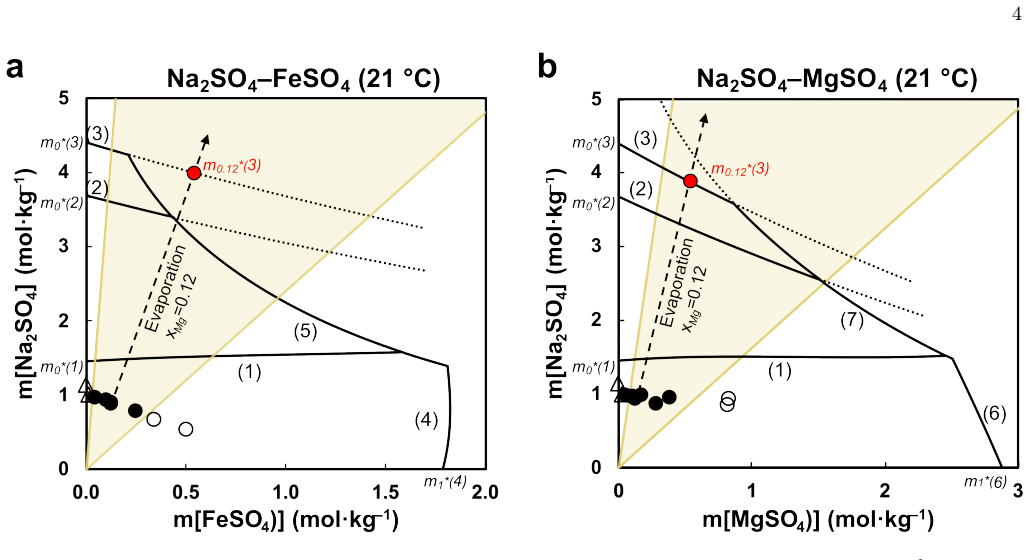
The mechanism runs on two coupled elements. The first is the viscosity–supersaturation relation of the mixed salt solution: rheometry gives $\eta = 4\times 10^{-5} \exp(10.6\,\beta_{\mathrm{Mg}})$ with $R^2=0.88$, so that as water evaporates the solution becomes exponentially more viscous, reaching about 111 Pa·s at the measured onset supersaturation $\beta_{\mathrm{Mg}}=1.4$. Through the diffusion–viscosity relation $D \sim 1/\eta$, this viscosity surge throttles ionic diffusion and makes growth diffusion-limited, with the observed $L \approx \Delta\sqrt{t}$. The second element is the two-step nucleation pathway: before spherulites appear, the solution produces micrometer-sized droplet-like clusters near the contact line; these clusters then crystallize into phase III nanocrystals whose slight orientational mismatches branch into the spherulitic form. The supersaturation values used to anchor the picture come from ternary solubility phase diagrams computed with a molality-based ion-interaction thermodynamic model.
What would settle it
Directly measure the viscosity of the x_Mg = 0.12 mixed solution at the supersaturation where spherulites first nucleate (around 1.4), and independently measure the sulfate diffusivity in that solution; if the viscosity is not close to 111 Pa·s or the spherulite radius does not follow the square root of time, the diffusion-limited viscosity mechanism is not supported.
Extended reading notes
Core claim
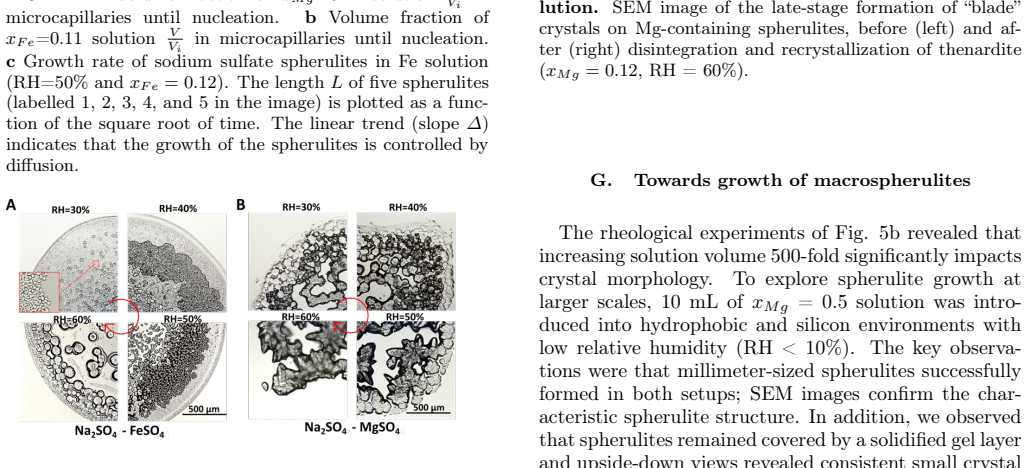
The central discovery is that sodium sulfate, which normally crystallizes as faceted polyhedra, can be driven to grow as spherulites of metastable phase III by the presence of divalent ions in an evaporating mixed-salt solution. At molar fractions $0.03 < x_{\mathrm{Fe}} < 0.29$ or $0.04 < x_{\mathrm{Mg}} < 0.38$, the solution crosses the phase III solubility limit at high supersaturation, and precipitation proceeds through micrometer-scale precursor clusters—a two-step, nonclassical nucleation—rather than directly through classical nucleation. The growth is then diffusion-limited: the spherulite radius follows $L \approx \Delta\sqrt{t}$ with $\Delta$ between 3.9 and 9.6, and the viscosity of the solution at onset is inferred to be about 111 Pa·s, consistent with a gel-like medium. The spherulites are metastable; under slow evaporation they can sprout bladed crystals that later recrystallize into thenardite, the stable phase V. The paper presents this as a universal mechanism, supported by the same spherulitic growth with Fe, Mg, Cu, and Zn sulfates, and by the absence of spherulites when only monovalent sulfates are mixed.
Load-bearing premise
The central quantitative claim rests on extending a viscosity curve from measurements that stop well before crystals appear, plus a unit-prefactor assumption in the diffusion-to-viscosity conversion; if the viscosity trend changes beyond the measured range, the 111 Pa·s value and the diffusion-limited mechanism are not established.
Editorial extensions
If this is right
- Sodium sulfate spherulites form in a predictable compositional window: $0.03 < x_{\mathrm{Fe}} < 0.29$ for iron sulfate and $0.04 < x_{\mathrm{Mg}} < 0.38$ for magnesium sulfate, outside of which the solution makes faceted crystals or a gel-like amorphous state.
- Final morphology can be tuned by evaporation rate: fast evaporation gives many small, smooth spherulites, while slow evaporation gives larger, rougher spherulites that can sprout bladed crystals and later recrystallize into thenardite.
- Divalent ion identity is not the key variable: magnesium, iron, copper, and zinc sulfates all produce sodium sulfate spherulites, whereas mixing two monovalent sulfate salts does not, so divalence itself is the trigger.
- The growth law $L \approx \Delta\sqrt{t}$ places sodium sulfate spherulites in the diffusion-limited class, and the inferred local viscosity varies by a factor of roughly 12 to 70 across an evaporating droplet.
- The recipe scales from 1 µL droplets to 10 mL bulk solutions, producing millimeter-sized spherulites under low humidity, so the controlled growth is not limited to microdroplets.
Reading between the lines
- A testable extension is to apply the same viscosity-based recipe to non-sulfate salts: any monovalent salt whose concentrated solution is made very viscous by a divalent additive should show diffusion-limited branching growth, so the design rule may transfer to carbonates, nitrates, or pharmaceuticals.
- The unidentified vibrational-spectroscopy phase of the blade-like crystals offers a concrete follow-up: if it is a new metastable sodium sulfate hydrate or a double salt, mapping its structure would complete the phase-III-to-thenardite transformation path and could explain similar blades on natural gypsum spherulites.
- The paper's diffusion-to-viscosity inference assumes a prefactor of unity; a direct measurement of sulfate diffusivity in the concentrated mixed solution would test that assumption and, if the prefactor differs, would revise the inferred 111 Pa·s onset viscosity without necessarily changing the square-root growth law.
Editorial analysis
A structured set of objections, weighed in public.
Referee Report
Summary. The manuscript reports that the addition of divalent metal sulfates (Mg2+, Fe2+, Cu2+, Zn2+) to evaporating Na2SO4 solutions induces spherulitic growth of sodium sulfate in the metastable phase III, and it maps the composition ranges where spherulites form in ternary Na2SO4-MSO4-H2O systems. The authors measure the supersaturation at the onset of spherulite nucleation (β_Mg = 1.4 ± 0.3, β_Fe > 3.3), observe diffusion-limited growth (L ∝ √t), and use rheometry to extrapolate a bulk viscosity of about 111 Pa·s at the onset. They propose that divalent ions drive a two-step nucleation process in a highly viscous solution, resulting in diffusion-limited growth and a universal mechanism for spherulite formation. The paper also documents the influence of evaporation rate on the subsequent morphological evolution of the spherulites toward more stable phases.
Significance. The core experimental observation is valuable and appears well documented: spherulitic Na2SO4 (phase III) grows reliably from mixed sulfate solutions containing divalent ions, with Raman-confirmed phase identity and reproducible morphology maps across several cations. The quantification of supersaturation at onset and the growth kinetics is a step beyond prior qualitative reports. If the mechanistic interpretation were quantitatively consistent, the paper would offer a practical route to controlled crystal morphologies. However, the central quantitative support for the proposed high-viscosity, diffusion-limited mechanism is weakened by a large internal inconsistency between the viscosity inferred from the growth-slope data and that extrapolated from the rheology experiments; this needs to be reconciled before the mechanism can be considered established.
major comments (3)
- [Growth mechanism driven by viscosity changes (Fig. 5)] The two viscosity estimates presented in this section are mutually inconsistent. The growth-slope data in Fig. 5a yield D = Δ² = 15.2–92.2 µm²/s, which with Eq. (3) and D_i = 1.07×10⁻⁹ m²/s gives η/η_i ≈ 12–70, i.e., η ≈ 12–70 mPa·s. The rheology fit in Fig. 5b, extrapolated to the onset supersaturation β = 1.4, gives η ≈ 111 Pa·s = 1.11×10⁵ mPa·s. The two estimates differ by three to four orders of magnitude at the same nominal supersaturation. If the solution at the growing interface had the extrapolated viscosity, the expected growth slope would be Δ ≈ 0.1 µm/s^1/2, not the measured Δ = 3.9–9.6 µm/s^1/2. The paper uses the 111 Pa·s value as the basis for the diffusion-limited mechanism while also using the growth-derived 12–70 mPa·s to support the same mechanism, without addressing the discrepancy. This must be resolved: either the relevant viscosity for growth is not the bulk viscosity (for example because of local concentration depletion near the growing crystal), or the exponential extrapolation is invalid; the manuscript does not currently provide a consistent picture.
- [Growth mechanism driven by viscosity changes (Eq. 3 and text)] The identification of the growth-slope Δ with √D is not justified. For diffusion-limited growth, the radius typically advances as R = λ√(Dt), where λ is a dimensionless prefactor that depends on the supersaturation, the geometry, and the boundary conditions; in general λ is not equal to 1. Setting Δ = √D implicitly assumes λ = 1. The inferred D, and hence the inferred viscosity via Eq. (3), changes by a factor λ². While λ is often order one for simple growth geometries, the manuscript provides no derivation or citation for the relation used. Although λ cannot by itself explain the orders-of-magnitude discrepancy between the growth-derived and rheology-derived viscosities, the unsupported identification leaves the growth-based viscosity estimate without a firm foundation.
- [Growth mechanism driven by viscosity changes (Fig. 5b)] The viscosity fit η = 4×10⁻⁵ exp(10.6β) is based on data only up to β = 0.73, and the extrapolation to β = 1.4 involves a factor of about 10³ in viscosity. Exponential fits of this type are typically not robust over such large extrapolations, and the exponent 10.6 carries no reported uncertainty; R² = 0.88 indicates a moderate fit. The paper should either directly measure viscosity closer to β = 1.4 (for example using a composition that remains fluid at that concentration) or provide a quantitative uncertainty bound on the extrapolated value. Without this, the statement that the viscosity 'reaches approximately 111 Pa·s' at the onset of spherulite precipitation is not supported to the precision implied.
minor comments (5)
- [Results and Discussion] The text states that spherulites form for 0.04 < x_Mg < 0.38, but the caption of Fig. 4 gives 0.07 < x_Mg < 0.38; the correct range should be stated consistently in the text, figure, and conclusion.
- [Growth mechanism driven by viscosity changes] The units in Eq. (3) are inconsistent as written: D_i is given in m²/s while Δ and D are expressed in µm²/s. The paper should state that D_i = 1.07×10⁻⁹ m²/s = 1070 µm²/s explicitly to avoid a factor of 10⁶ confusion in the viscosity ratio.
- [Abstract and Conclusion] The abstract and conclusion repeat the 'approximately 111 Pa·s' value without noting that it is an extrapolated value based on a fit to data up to β = 0.73; this qualifier should accompany every occurrence of the number.
- [Title and Abstract] The word 'universal' in the title and abstract is stronger than the evidence presented: the experiments cover four divalent cations (Mg, Fe, Cu, Zn) in sulfate mixtures, which I understand as a general family of systems, not necessarily universal across all salt mixtures. A more modest phrasing such as 'general' or 'common' would be more defensible.
- [Materials and Methods (Viscosity measurements)] The viscosity was measured at a single shear rate of 900 s⁻¹. Since the solutions are described as approaching a gel-like state, it would be helpful to report a shear-rate sweep at the highest concentrations to exclude shear-thinning effects, which could affect the extrapolation.
Circularity Check
One minor self-referential viscosity estimate from growth slopes; the central experimental claims rest on independent measurements.
-
self definitional
[Results and Discussion, 'Growth mechanism driven by viscosity changes', Fig. 5a and Eq. (3)]
"The slope ∆ of the spherulite growth measurements in Fig. 5a, corresponds to √D (in µm/s1/2), from which we infer that 15.2µm2/s ≤ D ≤ 92.2 µm2/s. By the following relation, the solvent viscosity is estimated: η/ηi = Di/D = kT/(6πηiR) 1/D ... A 12-fold viscosity increase is estimated in the bulk region (spherulite 5), and a 70-fold viscosity increase near the droplet edge (spherulite 1)."
The growth slope Δ is taken from the same L = Δ√t fit that is used to conclude diffusion-limited growth. Defining D = Δ² and then applying Stokes–Einstein (Eq. 3) turns the 'viscosity increase' into η/ηi = Di/Δ², which is a rearrangement of the slope itself rather than an independent measurement. The inset's claimed linear relationship between increased viscosity and inverse diffusivity is therefore an identity by construction. Using this growth-derived viscosity gradient to argue that 'viscosity variations and viscosity gradients drive morphological transitions' is self-referential, because the viscosity gradient is derived from the same growth-rate gradient it is invoked to explain.
full rationale
The paper's central experimental quantities are independently measured: the onset supersaturation (β_Mg = 1.4 ± 0.3, β_Fe > 3.3) comes from microcapillary volume-loss experiments combined with a Pitzer-based solubility model; the spherulite composition comes from Raman microspectroscopy; and the viscosity trend is measured by rheometry up to β = 0.73. None of these are defined in terms of the spherulitic-growth outcome, so there is no fundamental circularity in the main derivation chain. The one self-referential element is the growth-slope-based viscosity estimate in Fig. 5a/Eq. (3), where the inferred viscosity increase is just a rescaling of the observed slope under the diffusion-limited assumption. That estimate is not used as the primary support for the 111 Pa·s claim, but it is presented as independent confirmation of viscosity gradients, which is partly circular. The 111 Pa·s value itself is an extrapolation of an exponential fit well beyond the measured range (β ≤ 0.73 to β = 1.4) and is inconsistent with the growth-derived estimate (roughly 12–70 times water, i.e. tens of mPa·s, versus 111 Pa·s); this is a correctness and robustness concern rather than a circularity, because the extrapolation is not equivalent to its inputs by construction. The two-step nucleation interpretation is supported by direct observation of pre-nucleation clusters and by external literature, not solely by self-citation. Overall, the central experimental findings stand on their own, with only a minor self-referential step in the viscosity-gradient argument.
Assumptions & free parameters
free parameters (3)
- Viscosity exponential fit prefactor and exponent =
4e-5 Pa·s and 10.6 (R^2 = 0.88)
- Pitzer ternary interaction parameter psi_Na,Fe,SO4 =
0.00234
- Phase III solubility reference m*_S =
4.6 mol/kg at x = 0.12 from model
assumptions (4)
- domain assumption The Pitzer ion-interaction model accurately predicts solubilities, water activities, and densities in the ternary Na2SO4-FeSO4-H2O and Na2SO4-MgSO4-H2O systems at 21°C.
- domain assumption The Stokes-Einstein relation D ~ 1/eta holds for sulfate ion diffusion in the concentrated, partially gelled solution, so D measured from spherulite growth can be converted to solvent viscosity.
- domain assumption Spherulite growth L = delta sqrt(t) implies diffusion-limited growth with D = delta^2, i.e., the prefactor linking the parabolic rate constant to the diffusion coefficient is 1.
- domain assumption The supersaturation measured in microcapillaries (0.5 x 0.5 mm^2) represents the onset conditions in the evaporating droplets on glass slides.
Cite this review
Pith. "Pith review of Controlled Spherulitic Crystal Growth from Salt Mixtures: A Universal Mechanism for Complex Crystal Self-Assembly." pith.science (2026). https://pith.science/paper/Z5HBSMEX
@misc{pith2026250601163,
  author       = {Pith},
  title        = {Pith review of: Controlled Spherulitic Crystal Growth from Salt Mixtures: A Universal Mechanism for Complex Crystal Self-Assembly},
  year         = {2026},
  howpublished = {\url{https://pith.science/paper/Z5HBSMEX}},
  note         = {Machine review of arXiv:2506.01163}
}
abstract
Spherulites are complex polycrystalline structures that form through the self-assembly of small aggregated nanocrystals starting from a central point and growing radially outward. Despite their wide prevalence and relevance to fields ranging from geology to medicine, the dynamics of spherulitic crystallization and the conditions required for such growth remain ill-understood. Here, we report on the conditions to induce controlled spherulitic growth of sodium sulfate from evaporating aqueous solutions of sulfate salt mixtures at room temperature. We reveal that introducing divalent metal ions in the solution cause spherulitic growth of sodium sulfate. For the first time, we quantify the supersaturation at the onset of spherulitic growth from salt mixtures and determine the growth kinetics. Our results show that the nonclassical nucleation process induces the growth of sodium sulfate spherulites at high supersaturation in highly viscous solutions. The latter reaches approximately 111 Pa$\cdot$s, triggered by the divalent ions, at the onset of spherulite precipitation leading to a diffusion limited growth. We also show that spherulites, which are metastable structures formed under out-of-equilibrium conditions, can evolve into other shapes when supersaturation decreases as growth continues at different evaporation rates. These findings shed light on the conditions under which spherulites form and offer practical strategies for tuning their morphology.
Figures


Figures from the paper (10 more)



Reference graph
Works this paper leans on
-
[1]
J. M. García-Ruiz, E. Nakouzi, E. Kotopoulou, L. Tam- borrino, and O. Steinbock, Biomimetic mineral self- organization from silica-rich spring waters, Science ad- vances3, e1602285 (2017)
work page 2017
-
[2]
L. Gránásy, T. Pusztai, G. Tegze, J. A. Warren, and J. F. Douglas, Growth and form of spherulites, Physical Review E72, 011605 (2005)
work page 2005
-
[3]
A. G. Shtukenberg, Y. O. Punin, E. Gunn, and B. Kahr, Spherulites, Chemical reviews112, 1805 (2012)
work page 2012
-
[4]
C. Breitkreuz, J. Götze, and A. Weißmantel, Mineralog- ical and geochemical investigation of megaspherulites from argentina, germany, and the usa, Bulletin of Vol- canology 83, 1 (2021)
work page 2021
- [5]
-
[6]
U. Al-Atar, A. A. Bokov, D. Marshall, J. M. Teichman, B. D. Gates, Z.-G. Ye, and N. R. Branda, Mechanism of calcium oxalate monohydrate kidney stones formation: layered spherulitic growth, Chemistry of Materials22, 1318 (2010)
work page 2010
-
[7]
M. R. Krebs, C. E. MacPhee, A. F. Miller, I. E. Dun- lop, C. M. Dobson, and A. M. Donald, The formation of spherulites by amyloid fibrils of bovine insulin, Pro- ceedingsoftheNationalAcademyofSciences 101,14420 (2004)
work page 2004
-
[8]
S. Wu, J. I. Blake, L. Guo, and W. Zhou, Naturally oc- curring and biomimetic synthesized calcite spherulites, Crystal Growth & Design20, 3537 (2020)
work page 2020
Show all 37 references
-
[9]
Sun and W
W. Sun and W. Zhou, Growth mechanism and mi- crostructures of Cu2O/pvp spherulites, RSC advances 12, 20022 (2022)
2022
-
[10]
Beck and J.-P
R. Beck and J.-P. Andreassen, Spherulitic Growth of Calcium Carbonate, Crystal Growth & Design10, 2934 (2010)
2010
-
[11]
Y.-W. Wang, H. K. Christenson, and F. C. Meldrum, Confinement leads to control over calcium sulfate poly- morph, Advanced Functional Materials23, 5615 (2013)
2013
-
[12]
Wijnhorst, M
R. Wijnhorst, M. Demmenie, E. Jambon-Puillet,et al., Softness of hydrated salt crystals under deliquescence, Nature Communications14, 1090 (2023)
2023
-
[13]
Steiger and S
M. Steiger and S. Asmussen, Crystallization of sodium sulfate phases in porous materials: The phase diagram Na2SO4–H2O and the generation of stress, Geochimica et Cosmochimica Acta72, 4291 (2008)
2008
-
[14]
C. T. van Campenhout, R. L. D. Castell, T. Heeremans, S. Woutersen, D. Bonn, and N. Shahidzadeh, Water- rich amorphous state from drying mixed-metal sulfate solutions (2025), arXiv:2505.14334 [cond-mat.soft]
2025 arXiv
-
[15]
Steiger, J
M. Steiger, J. Kiekbusch, and A. Nicolai, An improved model incorporating pitzer’s equations for calculation of thermodynamic properties of pore solutions imple- mented into an efficient program code, Construction and Building Materials22, 1841 (2008)
2008
-
[16]
Lindström, T
N. Lindström, T. Talreja, K. Linnow, A. Stahlbuhk, and M. Steiger, Crystallization behavior of Na2SO4–MgSO4 salt mixtures in sandstone and comparison to single salt behavior, Applied geochemistry69, 50 (2016)
2016
-
[17]
K. S. Pitzer, Ion interaction approach: theory and data correlation, in Activity coefficients in electrolyte solu- tions (CRC Press, 2018) pp. 75–153
2018
-
[18]
Sunagawa,Crystals: growth, morphology, & perfection (Cambridge University Press, 2007)
I. Sunagawa,Crystals: growth, morphology, & perfection (Cambridge University Press, 2007)
2007
-
[19]
Shahidzadeh, M
N. Shahidzadeh, M. F. Schut, J. Desarnaud, M. Prat, and D. Bonn, Salt stains from evaporating droplets, Sci- entific reports5, 10335 (2015)
2015
-
[20]
D. L. Parkhurst and C. A. J. Appelo, Phreeqc (version
-
[21]
phreeqc.dat
– a computer program for speciation, batch-reaction, one-dimensional transport, and inverse geochemical cal- culations (2013), the diffusion coefficients are taken from the thermodynamic database “phreeqc.dat”
2013
-
[22]
Magill, Review spherulites: A personal perspective, Journal of materials science36, 3143 (2001)
J. Magill, Review spherulites: A personal perspective, Journal of materials science36, 3143 (2001)
2001
-
[23]
Bonn and N
D. Bonn and N. Shahidzadeh, Multistep crystallization processes: How not to make perfect single crystals, Pro- ceedingsoftheNationalAcademyofSciences 113,13551 (2016)
2016
-
[24]
K. K. Sand, J. D. Rodriguez-Blanco, E. Makovicky, L. G. Benning, and S. L. S. Stipp, Crystallization of CaCO 3 in Water–Alcohol Mixtures: Spherulitic Growth, Polymorph Stabilization, and Morphology Change, Crystal Growth & Design12, 842 (2012)
2012
-
[25]
Vallina, J
B. Vallina, J. Diego Rodriguez-Blanco, A. P. Brown, J. A. Blanco, and L. G. Benning, The role of amorphous precursors in the crystallization of La and Nd carbon- ates, Nanoscale7, 12166 (2015)
2015
-
[26]
A. P. Freitas, R. K. Ramamoorthy, M. Durelle, E. Lar- quet, I. Maurin, F. Testard, C. Chevallard, T. Gacoin, and D. Carriere, Crystallization within intermediate amorphous phases determines the polycrystallinity of nanoparticles from coprecipitation, Nano Letters22, 29 (2021)
2021
-
[27]
Ryschenkow and G
G. Ryschenkow and G. Faivre, Bulk crystallization of liquid selenium primary nucleation, growth kinetics and modes of crystallization, Journal of crystal growth87, 221 (1988)
1988
-
[28]
Bisault, G
J. Bisault, G. Ryschenkow, and G. Faivre, Spherulitic branching in the crystallization of liquid selenium, Jour- nal of crystal growth110, 889 (1991)
1991
-
[29]
Steiger, K
M. Steiger, K. Linnow, D. Ehrhardt, and M. Ro- hde, Decomposition reactions of magnesium sulfate hy- 11 drates and phase equilibria in the MgSO 4–H2O and Na+–Mg2+–Cl−–SO4 2−–H2O systems with implications for mars, Geochimica et Cosmochimica Acta75, 3600 (2011)
2011
-
[30]
Kobylin, H
P. Kobylin, H. Sippola, and P. Taskinen, Thermody- namic modelling of aqueous fe (ii) sulfate solutions, Cal- phad 35, 499 (2011)
2011
-
[31]
Talreja-Muthreja and M
T. Talreja-Muthreja and M. Steiger, Thermodynamics of (NH4)2SO4 (aq) and solubilities of (NH4) 2MII (SO4) 2·6H4O (M= Mg, Fe, Zn, Cu) tutton salts with impli- cations to thermochemical storage, Journal of Solution Chemistry , 1 (2025)
2025
-
[32]
Desarnaud, H
J. Desarnaud, H. Derluyn, J. Carmeliet, D. Bonn, and N. Shahidzadeh, Metastability limit for the nucleation of nacl crystals in confinement, The journal of physical chemistry letters5, 890 (2014)
2014
-
[33]
Desarnaud, H
J. Desarnaud, H. Derluyn, J. Carmeliet, D. Bonn, and N. Shahidzadeh, Hopper growth of salt crystals, The journal of physical chemistry letters9, 2961 (2018)
2018
-
[34]
Y. Shen, K. Linnow, and M. Steiger, Crystallization be- havior and damage potential of Na2SO4–NaCl mixtures in porous building materials, Crystal Growth & Design 20, 5974 (2020)
2020
-
[35]
Linnow and M
K. Linnow and M. Steiger, Modeling the properties of pore solutions in porous building materials, Simulation of Time Dependent Degradation of Porous Materials , 167 (2009)
2009
-
[36]
Tang and H
I. Tang and H. Munkelwitz, Water activities, densities, and refractive indices of aqueous sulfates and sodium nitrate droplets of atmospheric importance, Journal of Geophysical Research: Atmospheres99, 18801 (1994)
1994
-
[37]
Königsberger, L.-C
E. Königsberger, L.-C. Königsberger, I. Szilágyi, and P.M.May,Measurementandpredictionofphysicochem- ical properties of liquors relevant to the sulfate process for titania production. 1. densities in the TiOSO 4 + FeSO4 + H2SO4 + H2O system, Journal of Chemical & Engineering D...
2009
Reviewed August 7, 2026 · model on record in the stance chip above.
Discussion (0). Sign in to comment.