REVIEW 5 major objections 5 minor 30 references
Bridging Quantum and Classical Computing in Drug Design: Architecture Principles for Improved Molecule Generation
T0 review · 5 major / 5 minor · reviewed 2026-08-07 · deepseek-v4-flash
Pith's one-line read Multi-objective Bayesian optimization finds that a hybrid quantum-classical GAN with three to four layered shallow quantum circuits generates drug-like molecules at more than twice the score of prior baselines.
desk verdict Useful optimization workflow and a concrete BO-QGAN configuration, but the quantum-attribution claim lacks a classical-only control and the headline gains are inflated by best-of-100 selection. read the letter →
The pith
A machine-rendered reading of the paper's core claim, the machinery that carries it, and where it could break.
The reading
What carries the argument
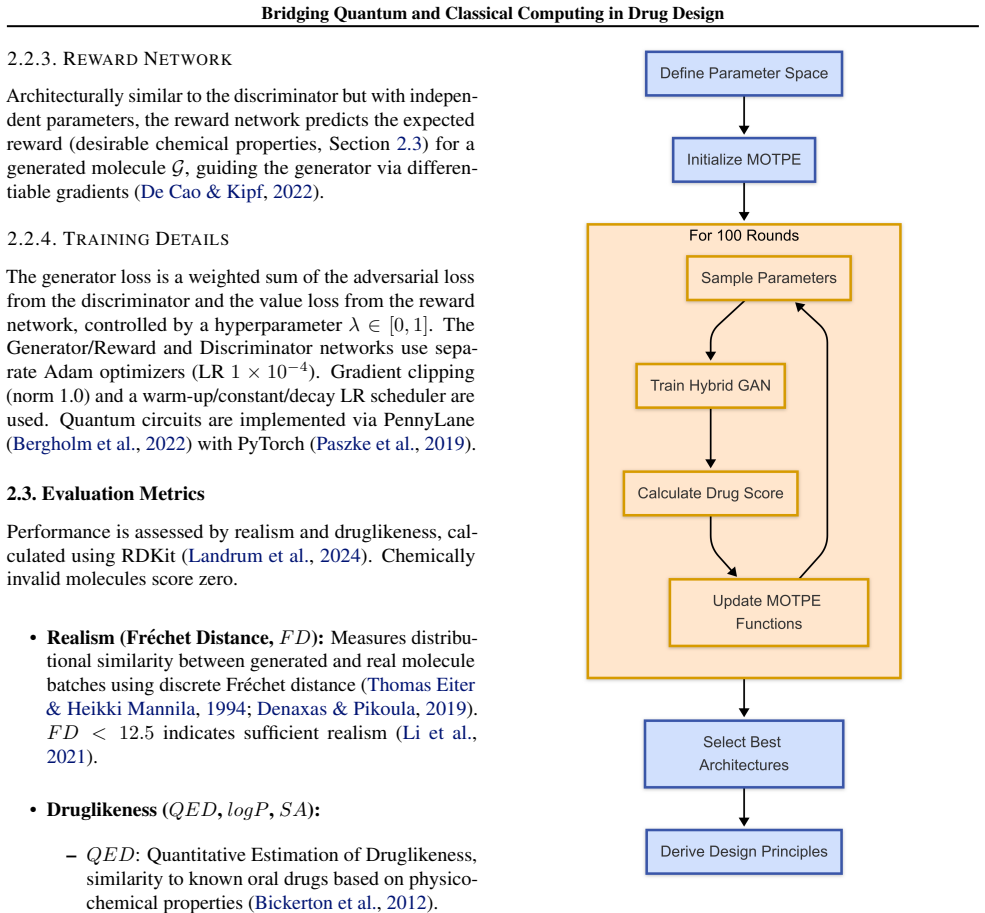
The central machinery is the quantum-classical bridge inside the GAN generator: a parameterized quantum circuit (angle-encoded inputs, single-qubit RY rotations with CNOT entangling layers in a ring) whose Pauli-Z measurements are fed into a fully connected classical decoder, with the whole generator trained by the GAN loss plus a reward network. On top of that sits Multi-Objective Tree-structured Parzen Estimator (MOTPE) Bayesian optimization, which explores the width and depth of both the quantum and classical pieces by sampling architectures, training each, and evaluating the Drug Candidate Score. The bridge is what the paper optimizes, and the MOTPE search is what turns the space of possible bridges into a small set of design principles.
What would settle it
Train a classical-only GAN with the exact classical component of BO-QGAN (two hidden layers of 227 neurons, identical loss, optimizer, and scheduler) on the same QM9 data, evaluate over 30 runs of 1000 molecules, and compare the mean DCS to 1.190; a statistically indistinguishable result would falsify the claim that the quantum architecture is responsible for the improvement.
Extended reading notes
Core claim
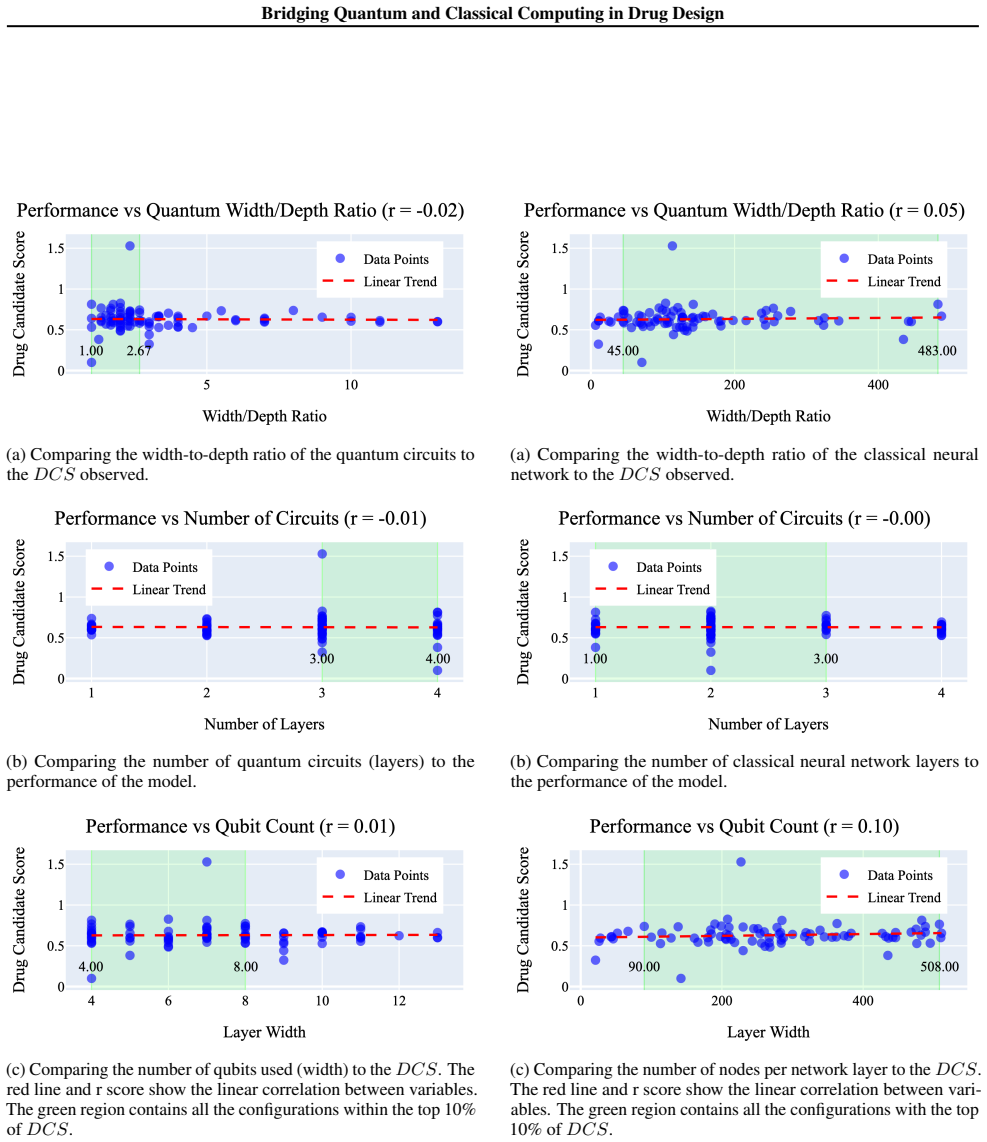
Under an identical evaluation protocol with 30 independent runs, the Bayesian-optimized hybrid model BO-QGAN achieves a mean Drug Candidate Score of 1.190 ± 0.132, compared to 0.524 ± 0.083 for the recreated QGAN-HG MR and 0.539 ± 0.068 for the recreated MolGAN, with statistically significant differences (p < 0.001) and large effect sizes. The architecture that produced this result uses 7 qubits per circuit, 3 circuit layers, and a classical stack of 2 hidden layers with 227 neurons each, totaling 158,252 parameters—158,231 classical and 21 quantum—versus MolGAN's 400,203 parameters. Across the 100-trial optimization, models with 3–4 quantum layers and 4–8 qubits clustered at the top of the Drug Candidate Score distribution, indicating that shallow, sequentially layered quantum circuits outperform wider or deeper alternatives, while classical performance flattened beyond about 90 neurons per layer. A transfer test on a 127-qubit physical processor, using a high-validity configuration, produced molecules with comparable property metrics to the simulator, suggesting the principles may transport to real NISQ hardware.
Load-bearing premise
The paper never tests a purely classical generator with the same two-layer, 227-neuron network and the same training procedure, so if that classical-only model reaches the same Drug Candidate Score, the quantum circuits are not what delivers the claimed gain.
Editorial extensions
If this is right
- If the findings hold, hybrid GANs for molecule generation can be made both more accurate and dramatically cheaper, lowering the barrier to using NISQ hardware in drug discovery pipelines.
- The principle of layering shallow circuits rather than increasing qubit count becomes a quantitative starting point for designing the quantum part of other hybrid generative models.
- Classical capacity can be chosen modestly (roughly 90+ neurons per layer) without sacrificing the quantum benefits, simplifying the engineering of the classical side.
- The finding that optimal quantum and classical dimensions are relatively independent (correlation r = -0.20) suggests designers can tune each side separately.
- Applying the same optimization methodology to larger datasets and more advanced generators (for example, diffusion models) is a logical next step for testing generalizability.
Reading between the lines
- The reported gains are only benchmarked against MolGAN and QGAN-HG; a direct ablation with the same classical network but no quantum circuit is missing, and this comparison is the test that would determine whether the quantum component is load-bearing.
- The real-hardware validation used a high-validity configuration rather than BO-QGAN itself and only 10 molecules, so it does not yet confirm that the DCS improvement survives hardware noise; the paper's claim about transfer rests on that preliminary sample.
- The weak correlation between the quantum-to-classical parameter ratio and DCS suggests the performance difference may come less from a specific balance than from overall capacity and training, consistent with the tiny quantum parameter count.
- If the shallow-circuit principle generalizes, one would predict that on larger, more diverse molecule datasets the optimal quantum width stays small (4–8 qubits) while the number of layers grows, a testable extension.
Editorial analysis
A structured set of objections, weighed in public.
Referee Report
Summary. The paper proposes BO-QGAN, a hybrid quantum-classical GAN for small-molecule generation, and uses multi-objective Bayesian optimization (MOTPE) to search over quantum width/depth and classical width/depth. The optimized model reports a Drug Candidate Score (DCS) of 1.190, about 2.27x higher than a reimplemented QGAN-HG and 2.21x higher than a reimplemented MolGAN, with 158,252 total parameters versus MolGAN's 400,203. The authors also derive architecture guidelines favoring 3-4 sequentially layered shallow (4-8 qubit) circuits and a classical capacity threshold near 90 neurons per layer, and present a small (n=10) validation on IBM's Sherbrooke QPU using a high-validity configuration rather than BO-QGAN itself.
Significance. If the central attribution holds, this would be one of the first empirically grounded architecture guidelines for hybrid quantum-classical generative models in drug design, with a concrete performance metric (DCS) and a parameter-efficiency claim. The paper's strengths include the use of standard statistical tests (t-tests, Cohen's d), a clear description of the MOTPE search space, code/data availability, and an explicit limitations section covering simulation noise, dataset scope, and metric choice. However, the significance depends on whether the quantum component is actually load-bearing: the quantum circuits contain only 21 of the 158,252 trainable parameters, and no control with the identical classical component and training protocol is provided. The paper also compares a best-of-100 optimized architecture against single default baselines, which may inflate the apparent gains.
major comments (5)
- [Section 3.2, Table 1] The central claim that the quantum-classical bridge drives the 2.27x/2.21x DCS improvement is not supported by a matched classical-only control. BO-QGAN uses a 2x227-neuron classical network with approximately 158,231 trainable classical parameters and only 21 quantum parameters, and Section 3.2 compares only against MolGAN and QGAN-HG reimplementations. A classical generator with the same 2x227 architecture, the same input encoding (replacing the quantum circuit with a fixed random or learned classical embedding of the same dimensionality), and the same training protocol could plausibly match or exceed the reported DCS. This control must be run before attributing the gain to the quantum architecture; the Limitations in Section 4.3 do not mention this missing ablation.
- [Section 2.6, Section 3.2] The evaluation compares the best architecture selected from 100 MOTPE trials against unoptimized baseline models. Under reasonable trial-to-trial noise, the maximum DCS among 100 random or optimized configurations can be systematically higher than the mean of a single baseline configuration, so the reported 2.27x/2.21x fold improvements may largely reflect selection bias rather than a genuine architecture advantage. The paper should either report the full distribution of DCS across all 100 trials, include baselines in the same MOTPE pipeline with an equivalent number of trials, or apply a multiple-comparisons correction (e.g., compare the best hybrid trial against the best baseline trial).
- [Table 1] The recreated baseline numbers deviate substantially from the originally reported values: MolGAN DCS is 0.54 in the recreation versus 0.27 reported, and QGAN-HG MR is 0.52 versus 0.27. Since Section 3.2 explicitly claims improvements over 'prior quantum-hybrid benchmarks' using these recreated values, the discrepancy should be explained. Possible causes include different evaluation protocols, dataset splits, or normalization choices; without reconciliation, the comparison between BO-QGAN and prior work is difficult to interpret.
- [Section 3.4, Section 4.2] The design principles favoring 3-4 shallow (4-8 qubit) circuits are extracted post hoc from the same 100 MOTPE trials that produced BO-QGAN, using the green 'top 10%' regions in Figure 4. This is a descriptive correlation within the training set of architectures, not an out-of-sample validation. To make the guideline load-bearing, the authors should test whether architectures with 3-4 shallow circuits outperform architectures with fewer or wider circuits when other factors (classical capacity, training budget) are held fixed, e.g., by a small ablation study or a held-out set of MOTPE trials.
- [Section 3.8, Table 3] The real-hardware validation uses a model configuration selected for high chemical validity, not the BO-QGAN architecture whose DCS is the main result, and the sample size is n=10 per backend. The paper appropriately acknowledges this in the text, but the conclusion in Section 3.8 that the 'architectural principles derived from simulation may translate reasonably well to physical quantum hardware' is not supported by this experiment, because the tested configuration is different from BO-QGAN and the confidence intervals are not reported. This point is less load-bearing for the main DCS claim, but it should be softened or reframed as a feasibility demonstration only.
minor comments (5)
- [Section 2.3, Eq. (1)] The DCS formula is written as DCS = 10 x QED x logP x SA, but the normalization that maps each individual metric to [0,1] is not defined. Please specify the reference distributions and whether the normalization is applied to each molecule before averaging or to the batch means, since this affects the comparability of DCS values across studies.
- [Abstract and Section 4.2] The phrase 'first empirically-grounded architectural guidelines' should be tempered, given that the guidelines are derived from a single dataset (QM9), a single GAN framework (MolGAN), and the post hoc analysis described in the fourth major comment.
- [Figures 4 and 5] The green 'top 10%' regions should be defined precisely (e.g., top 10% of DCS among how many trials, and whether ties are included). With only 100 trials, the correlations shown with red lines may be driven by a few outliers; reporting Pearson r with confidence intervals or nonparametric alternatives would be helpful.
- [Section 3.7, Figure 7] The claim that training time is 'primarily driven by quantum circuit width' is inferred from the search results, but Figure 7 plots only DCS versus total training time. A plot of training time versus the number of qubits, or a regression that separates width and depth, would make this claim more direct.
- [Section 5] The GitHub link should be verified to include the exact random seeds, the baseline reimplementation scripts, and the evaluation code for the DCS metric, so that the reported fold-improvements can be independently reproduced.
Circularity Check
No circularity found: the DCS gains are measured against external baseline reimplementations, and the architectural guidelines are post hoc summaries of the optimization trials rather than predictions that reduce to their own inputs.
full rationale
No load-bearing step in the paper reduces to its own input by construction. The central quantitative claim is a benchmark comparison: BO-QGAN achieves mean DCS 1.190 ± 0.132 versus recreated MolGAN 0.539 ± 0.068 and QGAN-HG MR 0.524 ± 0.083 under identical protocols (Section 3.2, Table 1); the 2.27x and 2.21x ratios are arithmetic consequences of these measured means, not fitted parameters renamed as predictions. The 'design principles' in Sections 3.4 and 4.2 are descriptive summaries of the 100 MOTPE trials that produced BO-QGAN; they are not validated out-of-sample predictions, so their evidentiary weakness is a generalization or overfitting concern, not circularity. The absence of a classical-only matched ablation weakens the causal attribution of gains to the quantum bridge, but a missing control is an experimental-design limitation, not a definitional equivalence. There are no self-citations carrying load-bearing weight, no imported uniqueness theorems, and no ansatz smuggled in via citation. The real-hardware validation is explicitly preliminary with n = 10 and is not used as the basis of the headline claim. Accordingly, the paper's derivation chain is self-contained with respect to circularity, and the score is 0.
Assumptions & free parameters
free parameters (6)
- Quantum width (number of qubits) =
7 (best)
- Quantum depth (number of circuit layers) =
3 (best)
- Classical width (neurons per layer) =
227 (best)
- Classical depth (number of layers) =
2 (best)
- DCS scaling factor =
10
- Early stopping thresholds (FD<12.5, 250 epoch patience) =
12.5; 250
assumptions (5)
- domain assumption QM9 graph representation (up to 9 heavy atoms, explicit H, bond types) captures the molecular features relevant for druglikeness scoring.
- domain assumption DCS = 10 x QED x logP x SA is a valid composite objective for drug candidate quality.
- domain assumption A noiseless simulated quantum backend is a faithful proxy for NISQ hardware for the main optimization.
- domain assumption The re-implemented MolGAN and QGAN-HG models faithfully reproduce the original methods.
- domain assumption Early stopping on validation DCS (after reaching FD<12.5) yields a fair performance estimate for each trial.
Cite this review
Pith. "Pith review of Bridging Quantum and Classical Computing in Drug Design: Architecture Principles for Improved Molecule Generation." pith.science (2026). https://pith.science/paper/DWAAL2CV
@misc{pith2026250601177,
  author       = {Pith},
  title        = {Pith review of: Bridging Quantum and Classical Computing in Drug Design: Architecture Principles for Improved Molecule Generation},
  year         = {2026},
  howpublished = {\url{https://pith.science/paper/DWAAL2CV}},
  note         = {Machine review of arXiv:2506.01177}
}
read the original abstract
Hybrid quantum-classical machine learning offers a path to leverage noisy intermediate-scale quantum (NISQ) devices for drug discovery, but optimal model architectures remain unclear. We systematically optimize the quantum-classical bridge architecture of generative adversarial networks (GANs) for molecule discovery using multi-objective Bayesian optimization. Our optimized model (BO-QGAN) significantly improves performance, achieving a 2.27-fold higher Drug Candidate Score (DCS) than prior quantum-hybrid benchmarks and 2.21-fold higher than the classical baseline, while reducing parameter count by more than 60%. Key findings favor layering multiple (3-4) shallow (4-8 qubit) quantum circuits sequentially, while classical architecture shows less sensitivity above a minimum capacity. This work provides the first empirically-grounded architectural guidelines for hybrid models, enabling more effective integration of current quantum computers into pharmaceutical research pipelines.
Figures


Figures from the paper (3 more)


Reference graph
Works this paper leans on
-
[1]
write newline
" write newline "" before.all 'output.state := FUNCTION n.dashify 't := "" t empty not t #1 #1 substring "-" = t #1 #2 substring "--" = not "--" * t #2 global.max substring 't := t #1 #1 substring "-" = "-" * t #2 global.max substring 't := while if t #1 #1 substring * t #2 global.max substring 't := if while FUNCTION format.date year duplicate empty "emp...
-
[2]
Optuna: A Next -generation Hyperparameter Optimization Framework , July 2019
Akiba, T., Sano, S., Yanase, T., Ohta, T., and Koyama, M. Optuna: A Next -generation Hyperparameter Optimization Framework , July 2019. URL http://arxiv.org/abs/1907.10902. Issue: arXiv:1907.10902 arXiv:1907.10902 [cs]
arXiv 2019
-
[3]
Hybrid Quantum Cycle Generative Adversarial Network for Small Molecule Generation
Anoshin, M., Sagingalieva, A., Mansell, C., Zhiganov, D., Shete, V., Pflitsch, M., and Melnikov, A. Hybrid Quantum Cycle Generative Adversarial Network for Small Molecule Generation . IEEE Transactions on Quantum Engineering, 5: 0 1--14, 2024. ISSN 2689-1808. doi:10.1109/TQE.2024.3414264. URL https://ieeexplore.ieee.org/document/10556803/?arnumber=1055680...
arXiv 2024
-
[4]
Bassani, D. and Moro, S. Past, Present , and Future Perspectives on Computer - Aided Drug Design Methodologies . Molecules, 28 0 (9): 0 3906, May 2023. doi:10.3390/molecules28093906. URL https://pmc.ncbi.nlm.nih.gov/articles/PMC10180087/. Number: 9
-
[5]
Parameterized quantum circuits as machine learning models
Benedetti, M., Lloyd, E., Sack, S., and Fiorentini, M. Parameterized quantum circuits as machine learning models. Quantum Science and Technology, 4 0 (4): 0 043001, November 2019. ISSN 2058-9565. doi:10.1088/2058-9565/ab4eb5. URL https://iopscience.iop.org/article/10.1088/2058-9565/ab4eb5. Number: 4
-
[6]
PennyLane : Automatic differentiation of hybrid quantum-classical computations, July 2022
Bergholm, V., Izaac, J., Schuld, M., Gogolin, C., and Ahmed, S. PennyLane : Automatic differentiation of hybrid quantum-classical computations, July 2022. URL http://arxiv.org/abs/1811.04968. Issue: arXiv:1811.04968 arXiv:1811.04968 [quant-ph]
arXiv 2022
-
[7]
Bickerton, G. R., Paolini, G. V., Besnard, J., Muresan, S., and Hopkins, A. L. Quantifying the chemical beauty of drugs. Nature Chemistry, 4 0 (2): 0 90--98, February 2012. ISSN 1755-4349. doi:10.1038/nchem.1243. URL https://www.nature.com/articles/nchem.1243. Number: 2 Publisher: Nature Publishing Group
-
[8]
Cao, Y., Romero, J., Olson, J. P., Degroote, M., Johnson, P. D., Kieferová, M., Kivlichan, I. D., Menke, T., Peropadre, B., Sawaya, N. P. D., Sim, S., Veis, L., and Aspuru-Guzik, A. Quantum Chemistry in the Age of Quantum Computing . Chemical Reviews, 119 0 (19): 0 10856--10915, October 2019. ISSN 0009-2665. doi:10.1021/acs.chemrev.8b00803. URL https://do...
Show all 30 references
-
[9]
Combarro, E. F. and González-Castillo, S. A Practical Guide to Quantum Machine Learning and Quantum Optimization : Hands -on Approach to Modern Quantum Algorithms . Packt Publishing Limited, Birmingham, 2023. ISBN 978-1-80461-383-2
2023
-
[10]
and Kipf, T
De Cao, N. and Kipf, T. MolGAN : An implicit generative model for small molecular graphs, September 2022. URL http://arxiv.org/abs/1805.11973. Issue: arXiv:1805.11973 arXiv:1805.11973 [cs, stat]
2022 arXiv
-
[11]
and Pikoula, M
Denaxas, S. and Pikoula, M. spiros/discrete\_frechet: meerkat stable release, August 2019. URL https://zenodo.org/records/3366385
2019
-
[12]
and Schuffenhauer, A
Ertl, P. and Schuffenhauer, A. Estimation of synthetic accessibility score of drug-like molecules based on molecular complexity and fragment contributions. Journal of Cheminformatics, 1 0 (1): 0 8, June 2009. ISSN 1758-2946. doi:10.1186/1758-2946-1-8. URL https://doi.org/10.11...
2009 doi
-
[13]
Feynman, R. P. Simulating physics with computers. International Journal of Theoretical Physics, 21 0 (6): 0 467--488, June 1982. ISSN 1572-9575. doi:10.1007/BF02650179. URL https://doi.org/10.1007/BF02650179. Number: 6
1982 doi
-
[14]
Ghazi Vakili, M., Gorgulla, C., Snider, J., Nigam, A., Bezrukov, D., Varoli, D., Aliper, A., Polykovsky, D., Padmanabha Das, K. M., Cox III, H., Lyakisheva, A., Hosseini Mansob, A., Yao, Z., Bitar, L., Tahoulas, D., Čerina, D., Radchenko, E., Ding, X., Liu, J., Meng, F., Ren, ...
2025 doi
-
[15]
Principles of early drug discovery
Hughes, J., Rees, S., Kalindjian, S., and Philpott, K. Principles of early drug discovery. British Journal of Pharmacology, 162 0 (6): 0 1239--1249, 2011. ISSN 1476-5381. doi:10.1111/j.1476-5381.2010.01127.x. URL https://onlinelibrary.wiley.com/doi/abs/10.1111/j.1476-5381.2010...
2011
-
[16]
and Ganguly, S
Jain, P. and Ganguly, S. Hybrid Quantum Generative Adversarial Networks for Molecular Simulation and Drug Discovery , December 2022. URL http://arxiv.org/abs/2212.07826. Issue: arXiv:2212.07826 arXiv:2212.07826 [quant-ph, q-bio]
2022
-
[17]
Exploring the Advantages of Quantum Generative Adversarial Networks in Generative Chemistry
Kao, P.-Y., Yang, Y.-C., Chiang, W.-Y., Hsiao, J.-Y., Cao, Y., Aliper, A., Ren, F., Aspuru-Guzik, A., Zhavoronkov, A., Hsieh, M.-H., and Lin, Y.-C. Exploring the Advantages of Quantum Generative Adversarial Networks in Generative Chemistry . Journal of Chemical Information and...
2023 doi
-
[18]
M., Franklin, M., Oler, E., Wilson, A., Pon, A., Cox, J., Chin, N
Knox, C., Wilson, M., Klinger, C. M., Franklin, M., Oler, E., Wilson, A., Pon, A., Cox, J., Chin, N. E. L., Strawbridge, S. A., Garcia-Patino, M., Kruger, R., Sivakumaran, A., Sanford, S., Doshi, R., Khetarpal, N., Fatokun, O., Doucet, D., Zubkowski, A., Rayat, D. Y., Jackson,...
2024
-
[19]
F., Probst, D., Ujihara, K., Walker, R., Pahl, A., godin, g., tadhurst-cdd , Lehtivarjo, J., Bérenger, F., and Bisson, J
Landrum, G., Tosco, P., Kelley, B., Rodriguez, R., Cosgrove, D., Vianello, R., sriniker , gedeck , Jones, G., NadineSchneider , Kawashima, E., Nealschneider, D., Dalke, A., Swain, M., Cole, B., Turk, S., Savelev, A., Vaucher, A., Wójcikowski, M., Take, I., Scalfani, V. F., Pro...
2024
-
[20]
O., and Ghosh, S
Li, J., Topaloglu, R. O., and Ghosh, S. Quantum Generative Models for Small Molecule Drug Discovery . IEEE Transactions on Quantum Engineering, 2: 0 1--8, 2021. ISSN 2689-1808. doi:10.1109/TQE.2021.3104804. URL https://ieeexplore.ieee.org/document/9520764/
2021
-
[21]
A., Lombardo, F., Dominy, B
Lipinski, C. A., Lombardo, F., Dominy, B. W., and Feeney, P. J. Experimental and computational approaches to estimate solubility and permeability in drug discovery and development settings1. Advanced Drug Delivery Reviews, 46 0 (1): 0 3--26, March 2001. ISSN 0169-409X. doi:10....
2001 doi
-
[22]
C., and Yuan, X
McArdle, S., Endo, S., Aspuru-Guzik, A., Benjamin, S. C., and Yuan, X. Quantum computational chemistry. Reviews of Modern Physics, 92 0 (1): 0 015003, March 2020. doi:10.1103/RevModPhys.92.015003. URL https://link.aps.org/doi/10.1103/RevModPhys.92.015003. Number: 1 Publisher: ...
2020 doi
-
[23]
R., Boixo, S., Smelyanskiy, V
McClean, J. R., Boixo, S., Smelyanskiy, V. N., Babbush, R., and Neven, H. Barren plateaus in quantum neural network training landscapes. Nature Communications, 9 0 (1): 0 4812, November 2018. ISSN 2041-1723. doi:10.1038/s41467-018-07090-4. URL https://www.nature.com/articles/s...
2018 doi
-
[24]
Multiobjective tree-structured parzen estimator for computationally expensive optimization problems
Ozaki, Y., Tanigaki, Y., Watanabe, S., and Onishi, M. Multiobjective tree-structured parzen estimator for computationally expensive optimization problems. In Proceedings of the 2020 Genetic and Evolutionary Computation Conference , pp.\ 533--541, Cancún Mexico, June 2020. ACM....
2020
-
[25]
PyTorch : An Imperative Style , High - Performance Deep Learning Library
Paszke, A., Gross, S., Massa, F., Lerer, A., Bradbury, J., Chanan, G., Killeen, T., Lin, Z., Gimelshein, N., Antiga, L., Desmaison, A., Kopf, A., Yang, E., DeVito, Z., Raison, M., Tejani, A., Chilamkurthy, S., Steiner, B., Fang, L., Bai, J., and Chintala, S. PyTorch : An Imper...
2019
-
[26]
Quantum Computing in the NISQ era and beyond
Preskill, J. Quantum Computing in the NISQ era and beyond. Quantum, 2: 0 79, August 2018. doi:10.22331/q-2018-08-06-79. URL https://quantum-journal.org/papers/q-2018-08-06-79/. Publisher: Verein zur Förderung des Open Access Publizierens in den Quantenwissenschaften
2018 doi
-
[27]
O., Rupp, M., and von Lilienfeld, O
Ramakrishnan, R., Dral, P. O., Rupp, M., and von Lilienfeld, O. A. Quantum chemistry structures and properties of 134 kilo molecules. Scientific Data, 1 0 (1): 0 140022, August 2014. ISSN 2052-4463. doi:10.1038/sdata.2014.22. URL https://www.nature.com/articles/sdata201422. Nu...
2014 doi
-
[28]
Singh, N., Vayer, P., Tanwar, S., Poyet, J.-L., Tsaioun, K., and Villoutreix, B. O. Drug discovery and development: introduction to the general public and patient groups. Frontiers in Drug Discovery, 3: 0 1201419, May 2023. ISSN 2674-0338. doi:10.3389/fddsv.2023.1201419. URL h...
2023
-
[29]
Computing discrete Fréchet distance
Thomas Eiter and Heikki Mannila . Computing discrete Fréchet distance. 1994
1994
-
[30]
Wildman, S. A. and Crippen, G. M. Prediction of Physicochemical Parameters by Atomic Contributions . Journal of Chemical Information and Computer Sciences, 39 0 (5): 0 868--873, September 1999. ISSN 0095-2338. doi:10.1021/ci990307l. URL https://doi.org/10.1021/ci990307l. Numbe...
1999 doi
Reviewed August 7, 2026 · model on record in the stance chip above.
Discussion (0). Sign in to comment.