REVIEW 4 major objections 6 minor 3 cited by
G4Seg: Generation for Inexact Segmentation Refinement with Diffusion Models
T0 review · 4 major / 6 minor · reviewed 2026-08-07 · deepseek-v4-flash
Pith's one-line read Inject a coarse mask into Stable Diffusion, regenerate the image, and use the pixel mismatch to refine the mask.
desk verdict A plausible training-free segmentation refinement heuristic whose theoretical story outstrips its evidence; worth refereeing, but the generation-discrepancy mechanism is never actually measured. read the letter →
The pith
A machine-rendered reading of the paper's core claim, the machinery that carries it, and where it could break.
The reading
What carries the argument
The load-bearing mechanism is the mask-conditioned generation discrepancy plus a semantic correspondence update. Explicit Mask Injection (EMI) rewrites the cross-attention and self-attention maps in Stable Diffusion so that foreground pixels attend only to the class token (Eqs. 3-5), biasing the regenerated image according to the coarse mask. Semantic Correspondence Alignment (SCA) then searches, for each pixel of the regenerated image, the pixel in the original image with the smallest CLIP cosine distance (Eq. 8), and updates the foreground probability by the linear mixing $S^*[j] = \beta S[j] + (1-\beta) S[\delta_j]$ (Eq. 9). The paper also introduces a confidence-filtering step that restricts the update to the most uncertain pixels. This machinery carries the claim by turning the abstract "more accurate mask yields a closer generation" intuition into a concrete per-pixel probability update.
What would settle it
Measure the semantic correctness of the correspondence: on a labeled dataset such as PASCAL VOC12, compute the fraction of nearest-neighbor matches (Eq. 8) whose two pixels have the same ground-truth class. If this fraction is not substantially higher than the baseline class prior, or if replacing the matched neighbor with a random pixel yields the same mIoU gain, then the refinement is not driven by semantic correspondence.
Extended reading notes
Core claim
The central claim is that the gap between an original image and the image generated under a mask condition is a usable training signal for segmentation refinement. The paper formalizes this by a Bayesian argument: maximizing the posterior $p(S|x)$ reduces, under a uniform mask prior, to maximizing $p(x|S)$, and if $p(x|S)$ is assumed to decrease with a Hausdorff-style distance between $x$ and the mask-conditioned reconstruction $\tilde{x}(S)$, then refining $S$ is equivalent to minimizing that distance. The paper realizes this minimization as a two-step semantic correspondence alignment: for each pixel in the regenerated image, find the nearest neighbor in the original image using CLIP cosine similarity, then update the foreground probability at that pixel as a linear mix of the old probability and the neighbor's probability. The result is a training-free, plug-and-play refinement that the paper reports to lift several TSSS and WSSS baselines by 0.4 to 2.8 mIoU points.
Load-bearing premise
The method assumes that for every pixel in the regenerated image, the most similar pixel in the original image under CLIP cosine similarity belongs to the same semantic category, so copying the coarse mask's probability from that neighbor corrects rather than corrupts the mask.
Editorial extensions
If this is right
- Any existing coarse-mask baseline, whether training-based or training-free, can be wrapped by G4Seg without retraining, and the paper reports gains across TSSS, WSSS, fully supervised, and cross-domain settings.
- The method's best improvements concentrate on masks with initial IoU between 40 and 80, suggesting a natural use as a second-stage refiner after a decent first-stage segmenter.
- Because the update is sample-wise and per-class, it can refine masks for any class name expressible as a text prompt, which is what makes the open-vocabulary gain possible.
- Replacing the attention-based mask injection with a stronger conditioning module such as ControlNet improves the gains further (72.0 to 74.1 on VOC with CLIP-ES), implying the refinement quality is bounded by the mask-conditioning fidelity of the generator.
Reading between the lines
- A testable extension the paper does not run: measuring the semantic accuracy of the CLIP nearest-neighbor match itself, e.g., the fraction of matched pairs whose ground-truth labels agree; if that fraction is low, the update would propagate the coarse mask's mistakes.
- The method's reliance on single-step denoising at a fixed timestep suggests that per-image timestep selection, chosen by reconstruction fidelity, could widen the operating range beyond the reported t=400.
- Because the correspondence is built with CLIP features, the refinement inherits CLIP's biases; switching the feature extractor to a dense self-supervised vision transformer feature is a natural experiment the paper does not conduct.
- The authors' own stratification shows the gain nearly vanishes for very poor initial masks, which places an implicit floor on the method: it corrects, but does not rescue, a failed first-stage segmenter.
Editorial analysis
A structured set of objections, weighed in public.
Referee Report
Summary. The paper introduces G4Seg, a training-free refinement method for coarse segmentation masks. It injects the coarse mask into the self- and cross-attention of Stable Diffusion, performs a one-step denoising to obtain a mask-conditioned reconstruction, and then updates each pixel's foreground probability by mixing it with the probability of the nearest-neighbor pixel in the original image under CLIP cosine similarity (Eqs. 3-9). The authors report consistent but small mIoU improvements on text-supervised semantic segmentation (Table I), weakly supervised semantic segmentation (Table II), and fully supervised or cross-domain settings (Tables V, VI, XI), and they provide a theoretical justification in Sec. VII based on Bayes' rule and the Hausdorff distance.
Significance. The appeal of the work is the possibility of using a frozen text-to-image diffusion model as a plug-in refiner without additional training. Strengths include the simplicity of the method, its inference-only nature, the breadth of evaluated settings and baselines, and the inclusion of ablation studies on timestep, mask injection, and mask quality. The reported gains are, however, small (mostly 0.4-1.2 mIoU) and are not accompanied by statistical significance tests. More importantly, the claimed generative-discrepancy mechanism is not directly validated: the relationship between mask accuracy and generation distance is never measured, and the formal derivation in Sec. VII contains unjustified steps. If the mechanism were confirmed, the work would be a useful practical contribution, but in its current form the central theoretical claim is not supported.
major comments (4)
- [Sec. VII, Eqs. (6)-(13)] The Bayes reduction max_S p(S|x) = max_S p(x|S) assumes that p(S) is constant, which is not justified; for a fixed image, plausible masks are not uniformly distributed. More critically, the step from max_S p(x|S) to min_S d(x, \tilde{x}(S)) rests on the unmeasured assumption that a more accurate mask yields a reconstruction closer to x. This monotonicity is load-bearing: if it fails, Eqs. (8)-(9) are an unsupported heuristic. I recommend directly measuring d(x, \tilde{x}(S)) versus mask IoU (e.g., by corrupting ground-truth masks to controlled IoU levels) and reporting the correlation, and also reporting the generation distance for the actual coarse masks before and after refinement.
- [Sec. VII, Eqs. (14)-(17)] The passage from the Hausdorff distance to the implemented update is not mathematically valid. Eq. (16) replaces the supremum in Eq. (14) by a summation with the sentence 'consider an equivalent formation substituting superb with summation,' which is false: the supremum cannot be replaced by a sum without changing the optimization. Furthermore, Eq. (17) differentiates D(x[\delta_j], \tilde{x}(S)[j]) with respect to S[j] while treating \delta_j and \tilde{x} as fixed, although \delta_j is defined by the argmin in Eq. (8) and \tilde{x} depends on S. The metric D is never defined in Eq. (7)/(17), and in Eq. (8) D is called cosine similarity, so the text does not establish a connection between the gradient update and the actual linear mixing in Eq. (9). The authors acknowledge Eq. (7) is intractable; the paper should therefore present Eqs. (8)-(9) explicitly as a heuristic approximation, not as a consequence of the derivation.
- [Sec. II-C2, Eqs. (8)-(9)] The method assumes that for every pixel in the generated image, the nearest neighbor in the original image under CLIP cosine similarity is semantically corresponding, so that copying S[\delta_j] into S*[j] is a valid correction. This assumption is never measured. Incorrect matches would propagate the coarse mask's existing errors instead of correcting them. Please add a quantitative evaluation of matching accuracy, for example by comparing matched pairs against ground-truth labels or an oracle correspondence, and analyze failure cases.
- [Tables I, II, V, VI, VII and Sec. XII] The reported gains are small (0.4 to 2.8 mIoU) and no error bars or significance tests are provided; many improvements are within typical run-to-run variability. The sensitivity analysis in Table VII is also not monotone: gains are +0.2 for IoU 0-40, +1.9 for 40-80, and +1.1 for 80-100, and Sec. XII states that attention-based mask injection 'does not perform well' for poor masks. This is consistent with the concern that the method borrows strength from an already reasonable mask rather than from the generation-discrepancy mechanism. Please report variance over multiple runs or paired tests, and clarify whether the ControlNet numbers in Tables VII and VIII are part of the training-free claim.
minor comments (6)
- [Sec. I] The GPT analogy ('generate responses closer to the alternative answers') is not formalized; please either remove it or back it with a concrete reference.
- [Sec. II-C2, Eq. (7)] The sentence 'The detailed deduction can be found in Supplementary' is not supported because no supplementary derivation is included in the manuscript; please include the derivation or delete the sentence.
- [Sec. VII] Typos and malformed notation: 'substituting superb with summation' should read 'substituting the supremum with a summation'; 'our institution' should be 'our intuition'; 'basic stone' should be 'basis'; the arrow 'reduce - - - →' is malformed.
- [Table III and Sec. VI] The abbreviation 'EMI' is not defined at first use, and the confidence filtering (CF) ranges are not explained in the main text; please define them and report the injection weight alpha and the CF threshold values used.
- [Table VII] The sample counts and percentages do not add up to the VOC validation size: 56 + 679 + 237 = 972, not 1449, and 3.4% of 1449 is approximately 49, not 56; please reconcile the denominator or explain the filtering.
- [Sec. XIII] The ControlNet-based experiments use a model fine-tuned on annotated masks, so they are not training-free; please state this explicitly in the main claims and distinguish these exploratory results from the core method.
Circularity Check
No significant circularity found: G4Seg's refinement is a training-free post-process evaluated on external benchmarks, and the disputed Bayes-to-Hausdorff step is an explicit empirical assumption, not a circular reduction.
full rationale
The claimed derivation chain (Eq. 6 to Eq. 12, then Eqs. 13, 17, and 9) does not reduce any predicted quantity to a fitted input by construction. Eq. 6 relies on a uniform prior over masks and the explicit assumption that a more accurate mask gives higher p(x|S); this assumption is asserted and never directly measured, but an untested premise is an empirical-support gap, not circularity. Eq. 9 is a convex combination of the input coarse mask values, so the refined mask is a function of the input mask; however, this is normal refinement design, and the output is not statistically forced by a parameter fitted to the target quantity. The final update copies probabilities from corresponding pixels rather than from the generated image, which weakens the 'generation discrepancy' narrative but does not make the derivation equivalent to its input. Self-citations appear in related work and in the generic correspondence-learning sentence in Section IX, but none is load-bearing for the method's machinery, and no uniqueness theorem or ansatz is imported from the authors' prior work. Section XII admits the attention-based mask injection is the bottleneck for poor masks, and Section VII refers to a supplementary deduction not included; these are missing-support issues, not circular reductions. The method is benchmarked against external baselines (SCLIP, DiffSegmenter, CLIP-ES, etc.), and the reported gains are direct mIoU differences rather than restatements of a fitted quantity.
Assumptions & free parameters
free parameters (5)
- alpha (attention injection weight) =
not reported (stated to follow DenseDiffusion)
- beta (mixing coefficient) =
0.8 for TSSS, 0.9 for WSSS
- timestep ts =
400
- CF (confidence filtering) range =
[0.2,0.6] or [0.1,0.7]
- gamma (step size) =
implicit (1-beta)
assumptions (5)
- ad hoc to paper The pretrained Stable Diffusion model's mask-conditioned generation quality reflects mask accuracy: a more accurate mask yields a smaller discrepancy between generated and original image.
- ad hoc to paper p(x|S) ∝ exp(-d(x, x_tilde(S))^2)
- domain assumption Bayes' rule with a uniform prior over masks: p(S) is constant for a given image.
- ad hoc to paper The sup in the Hausdorff distance can be replaced by a summation without changing the optimization.
- domain assumption CLIP image features provide a reliable semantic correspondence between original and generated pixels.
Cite this review
Pith. "Pith review of G4Seg: Generation for Inexact Segmentation Refinement with Diffusion Models." pith.science (2026). https://pith.science/paper/NJ4QFPUF
@misc{pith2026250601539,
  author       = {Pith},
  title        = {Pith review of: G4Seg: Generation for Inexact Segmentation Refinement with Diffusion Models},
  year         = {2026},
  howpublished = {\url{https://pith.science/paper/NJ4QFPUF}},
  note         = {Machine review of arXiv:2506.01539}
}
read the original abstract
This paper considers the problem of utilizing a large-scale text-to-image diffusion model to tackle the challenging Inexact Segmentation (IS) task. Unlike traditional approaches that rely heavily on discriminative-model-based paradigms or dense visual representations derived from internal attention mechanisms, our method focuses on the intrinsic generative priors in Stable Diffusion~(SD). Specifically, we exploit the pattern discrepancies between original images and mask-conditional generated images to facilitate a coarse-to-fine segmentation refinement by establishing a semantic correspondence alignment and updating the foreground probability. Comprehensive quantitative and qualitative experiments validate the effectiveness and superiority of our plug-and-play design, underscoring the potential of leveraging generation discrepancies to model dense representations and encouraging further exploration of generative approaches for solving discriminative tasks.
Figures


Figures from the paper (9 more)




Forward citations
Cited by 3 Pith papers
-
Decouple before Align: Visual Disentanglement Enhances Prompt Tuning
Decoupling images into foreground and background before aligning them with text improves CLIP prompt tuning on few-shot and generalization benchmarks.
-
ConText: Driving In-context Learning for Text Removal and Segmentation
ConText is the first visual in-context learning model for text removal and segmentation, chaining the two tasks and using self-prompting to reach new state-of-the-art scores.
-
MoMa: Modulating Mamba for Adapting Image Foundation Models to Video Recognition
MoMa adapts frozen CLIP to video by injecting Mamba-computed scale and bias into each layer, improving accuracy and efficiency on multiple action recognition benchmarks.
Reference graph
Works this paper leans on
-
[1]
High-resolution image synthesis with latent diffusion models,
Robin Rombach, Andreas Blattmann, et al., “High-resolution image synthesis with latent diffusion models,” inProceedings of the IEEE/CVF Conference on Computer Vision and Pattern Recognition, 2022, pp. 10684–10695
work page 2022
-
[2]
Long-tailed diffu- sion models with oriented calibration,
Tianjiao Zhang, Huangjie Zheng, Jiangchao Yao, Xiangfeng Wang, Mingyuan Zhou, Ya Zhang, and Yanfeng Wang, “Long-tailed diffu- sion models with oriented calibration,” inThe Twelfth International Conference on Learning Representations, 2024
work page 2024
-
[3]
Sora as an agi world model? a complete survey on text-to-video generation,
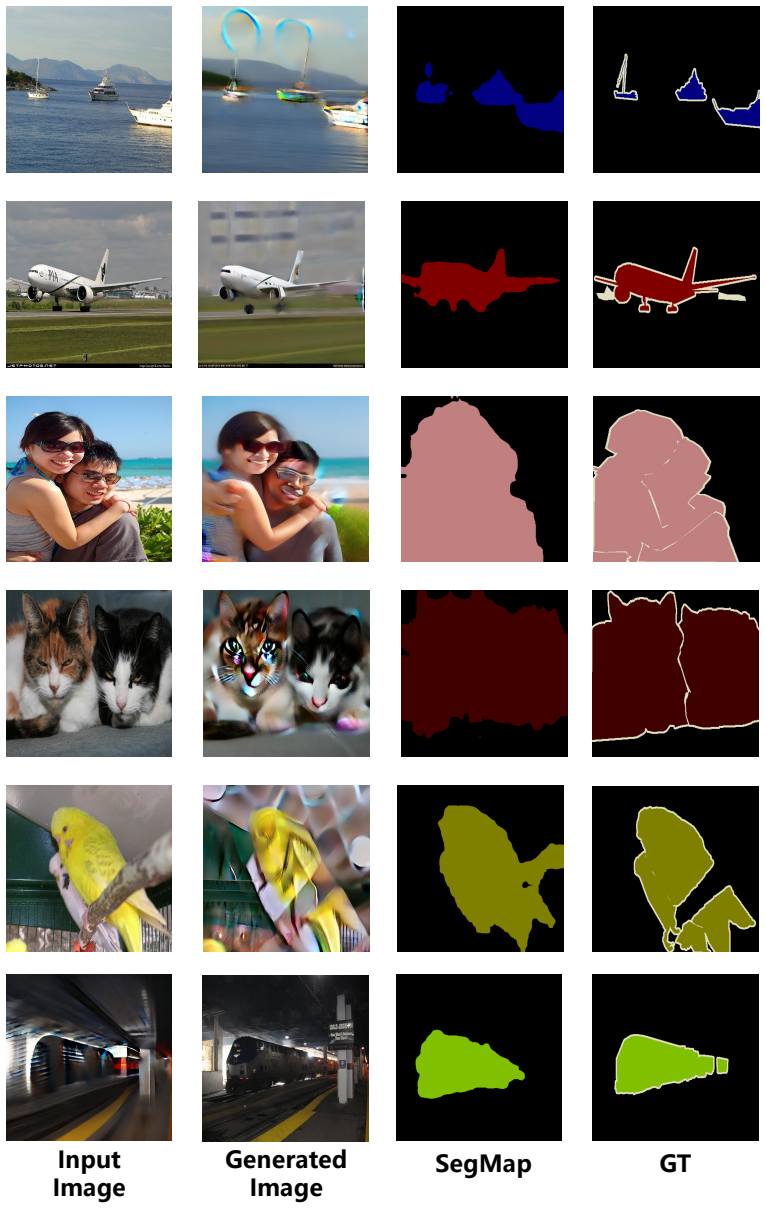
Joseph Cho, Fachrina Dewi Puspitasari, et al., “Sora as an agi world model? a complete survey on text-to-video generation,”arXiv preprint arXiv:2403.05131, 2024. Input Image Generated Image SegMap GT Fig. 10. Qualitative results on PASCAL VOC12. Image GroupViT G4Seg GT Fig. 11. Qualitative results on COCO Object. Image GroupViT G4Seg GT Fig. 12. Qualitati...
arXiv 2024
-
[4]
Diffusionseg: Adapting diffusion towards unsupervised object discovery,
Chaofan Ma, Yuhuan Yang, Chen Ju, Fei Zhang, Jinxiang Liu, Yu Wang, Ya Zhang, and Yanfeng Wang, “Diffusionseg: Adapting diffusion towards unsupervised object discovery,”arXiv preprint arXiv:2303.09813, 2023
arXiv 2023
-
[5]
Image segmentation in foundation model era: A survey,
Tianfei Zhou, Wang Xia, Fei Zhang, Boyu Chang, Wenguan Wang, Ye Yuan, Ender Konukoglu, and Daniel Cremers, “Image segmentation in foundation model era: A survey,”arXiv preprint arXiv:2408.12957, 2024
arXiv 2024
-
[6]
Alexander Kirillov, Eric Mintun, et al., “Segment anything,”arXiv preprint arXiv:2304.02643, 2023
arXiv 2023
-
[7]
Attrseg: open-vocabulary semantic segmentation via attribute decomposition-aggregation,
Chaofan Ma, Yang Yuhuan, Chen Ju, Fei Zhang, Ya Zhang, and Yanfeng Wang, “Attrseg: open-vocabulary semantic segmentation via attribute decomposition-aggregation,”Advances in neural information processing systems, vol. 36, pp. 10258–10270, 2023
work page 2023
-
[8]
Multi-modal prototypes for open-world semantic segmentation,
Yuhuan Yang, Chaofan Ma, Chen Ju, Fei Zhang, Jiangchao Yao, Ya Zhang, and Yanfeng Wang, “Multi-modal prototypes for open-world semantic segmentation,”International Journal of Computer Vision, vol. 132, no. 12, pp. 6004–6020, 2024
work page 2024
Show all 60 references
-
[9]
Uncovering prototypical knowledge for weakly open-vocabulary semantic segmentation,
Fei Zhang, Tianfei Zhou, et al., “Uncovering prototypical knowledge for weakly open-vocabulary semantic segmentation,”Advances in Neural Information Processing Systems, vol. 36, 2023
2023
-
[10]
Probabilistic conformal distillation for enhancing missing modality robustness,
Mengxi Chen, Fei Zhang, Zihua Zhao, Jiangchao Yao, Ya Zhang, and Yanfeng Wang, “Probabilistic conformal distillation for enhancing missing modality robustness,”Advances in Neural Information Processing Systems, vol. 37, pp. 36218–36242, 2024
2024
-
[11]
Learning pixel-level semantic affinity with image-level supervision for weakly supervised semantic segmentation,
Jiwoon Ahn and Suha Kwak, “Learning pixel-level semantic affinity with image-level supervision for weakly supervised semantic segmentation,” inProceedings of the IEEE Conference on Computer Vision and Pattern Recognition, 2018, pp. 4981–4990
2018
-
[12]
Com- plementary patch for weakly supervised semantic segmentation,
Fei Zhang, Chaochen Gu, Chenyue Zhang, and Yuchao Dai, “Com- plementary patch for weakly supervised semantic segmentation,” in Proceedings of the IEEE/CVF international conference on computer vision, 2021, pp. 7242–7251
2021
-
[13]
Exploiting class activation value for partial-label learning,
Fei Zhang, Lei Feng, Bo Han, Tongliang Liu, Gang Niu, Tao Qin, and Masashi Sugiyama, “Exploiting class activation value for partial-label learning,” inInternational Conference on Learning Representations (ICLR), 2022
2022
-
[14]
Exploit cam by itself: Complementary learning system for weakly supervised semantic segmentation,
Jiren Mai, Fei Zhang, Junjie Ye, Marcus Kalander, Xian Zhang, WanKou Yang, Tongliang Liu, and Bo Han, “Exploit cam by itself: Complementary learning system for weakly supervised semantic segmentation,”arXiv preprint arXiv:2303.02449, 2023
2023 arXiv
-
[15]
Monte carlo linear clustering with single-point supervision is enough for infrared small target detection,
Boyang Li, Yingqian Wang, Longguang Wang, Fei Zhang, Ting Liu, Zaiping Lin, Wei An, and Yulan Guo, “Monte carlo linear clustering with single-point supervision is enough for infrared small target detection,” inProceedings of the IEEE/CVF International Conference on Computer Vi...
2023
-
[16]
Ddaug: Differentiable data augmentation for weakly supervised semantic segmentation,
Boyang Li, Fei Zhang, Longguang Wang, Yingqian Wang, Ting Liu, Zaiping Lin, Wei An, and Yulan Guo, “Ddaug: Differentiable data augmentation for weakly supervised semantic segmentation,”IEEE Transactions on Multimedia, vol. 26, pp. 4764–4775, 2023
2023
-
[17]
Audio-visual segmentation via unlabeled frame exploitation,
Jinxiang Liu, Yikun Liu, Fei Zhang, Chen Ju, Ya Zhang, and Yanfeng Wang, “Audio-visual segmentation via unlabeled frame exploitation,” inProceedings of the IEEE/CVF Conference on Computer Vision and Pattern Recognition, 2024, pp. 26328–26339
2024
-
[18]
Exploiting counter- examples for active learning with partial labels,
Fei Zhang, Yunjie Ye, Lei Feng, Zhongwen Rao, Jieming Zhu, Marcus Kalander, Chen Gong, Jianye Hao, and Bo Han, “Exploiting counter- examples for active learning with partial labels,”Machine Learning, vol. 113, no. 6, pp. 3849–3868, 2024
2024
-
[19]
Diffusion model is secretly a training-free open vocabulary semantic segmenter,
Jinglong Wang, Xiawei Li, et al., “Diffusion model is secretly a training-free open vocabulary semantic segmenter,”arXiv preprint arXiv:2309.02773, 2023
2023 arXiv
-
[20]
Open-vocabulary panoptic segmentation with text-to-image diffusion models,
Jiarui Xu, Sifei Liu, et al., “Open-vocabulary panoptic segmentation with text-to-image diffusion models,” inProceedings of the IEEE/CVF Conference on Computer Vision and Pattern Recognition, 2023, pp. 2955–2966
2023
-
[21]
Your diffusion model is secretly a zero-shot classifier,
Alexander C. Li, Mihir Prabhudesai, et al., “Your diffusion model is secretly a zero-shot classifier,” inProceedings of the IEEE/CVF International Conference on Computer Vision (ICCV), October 2023, pp. 2206–2217
2023
-
[22]
Clip is also an efficient segmenter: A text-driven approach for weakly supervised semantic segmentation,
Yuqi Lin, Minghao Chen, et al., “Clip is also an efficient segmenter: A text-driven approach for weakly supervised semantic segmentation,” inProceedings of the IEEE/CVF Conference on Computer Vision and Pattern Recognition, 2023, pp. 15305–15314
2023
-
[23]
Null-text inversion for editing real images using guided diffusion models,
Ron Mokady, Amir Hertz, et al., “Null-text inversion for editing real images using guided diffusion models,” inProceedings of the IEEE/CVF Conference on Computer Vision and Pattern Recognition, 2023, pp. 6038–6047
2023
-
[24]
Dense text-to-image generation with attention modulation,
Yunji Kim, Jiyoung Lee, Jin-Hwa Kim, Jung-Woo Ha, and Jun-Yan Zhu, “Dense text-to-image generation with attention modulation,” in Proceedings of the IEEE/CVF International Conference on Computer Vision, 2023, pp. 7701–7711
2023
-
[25]
Comparing images using the hausdorff distance,
Daniel P Huttenlocher, Gregory A. Klanderman, et al., “Comparing images using the hausdorff distance,”IEEE Transactions on Pattern Analysis and Machine Intelligence, vol. 15, no. 9, pp. 850–863, 1993
1993
-
[26]
The pascal visual object classes challenge: A retrospective,
Mark Everingham, SM Ali Eslami, Luc Van Gool, Christopher KI Williams, John Winn, and Andrew Zisserman, “The pascal visual object classes challenge: A retrospective,”International Journal of Computer Vision, vol. 111, pp. 98–136, 2015
2015
-
[27]
The role of context for object detection and semantic segmentation in the wild,
Roozbeh Mottaghi, Xianjie Chen, et al., “The role of context for object detection and semantic segmentation in the wild,” inProceedings of the IEEE Conference on Computer Vision and Pattern Recognition, 2014, pp. 891–898
2014
-
[28]
Microsoft coco: Common objects in context,
Tsung-Yi Lin, Michael Maire, Serge Belongie, James Hays, Pietro Perona, Deva Ramanan, Piotr Doll ´ar, and C Lawrence Zitnick, “Microsoft coco: Common objects in context,” inComputer Vision–ECCV 2014: 13th European Conference, Zurich, Switzerland, September 6-12, 2014, Proceedi...
2014
-
[29]
Open-world semantic segmentation via contrasting and clustering vision-language embedding,
Quande Liu, Youpeng Wen, Jianhua Han, Chunjing Xu, Hang Xu, and Xiaodan Liang, “Open-world semantic segmentation via contrasting and clustering vision-language embedding,” inComputer Vision–ECCV 2022: 17th European Conference, Tel Aviv, Israel, October 23–27, 2022, Proceedings...
2022
-
[30]
Learning to generate text-grounded mask for open-world semantic segmentation from only image-text pairs,
Junbum Cha, Jonghwan Mun, and Byungseok Roh, “Learning to generate text-grounded mask for open-world semantic segmentation from only image-text pairs,”arXiv preprint arXiv:2212.00785, 2022
2022 arXiv
-
[31]
Groupvit: Semantic segmentation emerges from text supervision,
Jiarui Xu, Shalini De Mello, et al., “Groupvit: Semantic segmentation emerges from text supervision,” inProceedings of the IEEE/CVF Conference on Computer Vision and Pattern Recognition, 2022, pp. 18134–18144
2022
-
[32]
Viewco: Discovering text-supervised segmentation masks via multi-view semantic consistency,
Pengzhen Ren, Changlin Li, et al., “Viewco: Discovering text-supervised segmentation masks via multi-view semantic consistency,”arXiv preprint arXiv:2302.10307, 2023
2023 arXiv
-
[33]
Segclip: Patch aggregation with learnable centers for open-vocabulary semantic segmentation,
Huaishao Luo, Junwei Bao, Youzheng Wu, Xiaodong He, and Tianrui Li, “Segclip: Patch aggregation with learnable centers for open-vocabulary semantic segmentation,”arXiv preprint arXiv:2211.14813, 2022
2022 arXiv
-
[34]
Learning open-vocabulary semantic segmentation models from natural language supervision,
Jilan Xu, Junlin Hou, et al., “Learning open-vocabulary semantic segmentation models from natural language supervision,”arXiv preprint arXiv:2301.09121, 2023
2023 arXiv
-
[35]
Extract free dense labels from clip,
Chong Zhou, Chen Change Loy, and Bo Dai, “Extract free dense labels from clip,” inEuropean Conference on Computer Vision. Springer, 2022, pp. 696–712
2022
-
[36]
Sclip: Rethinking self-attention for dense vision-language inference,
Feng Wang, Jieru Mei, et al., “Sclip: Rethinking self-attention for dense vision-language inference,”arXiv preprint arXiv:2312.01597, 2023
2023 arXiv
-
[37]
Weaktr: Exploring plain vision transformer for weakly-supervised semantic segmentation,
Lianghui Zhu, Yingyue Li, et al., “Weaktr: Exploring plain vision transformer for weakly-supervised semantic segmentation,”arXiv preprint arXiv:2304.01184, 2023
2023
-
[38]
Weakly supervised learn- ing of instance segmentation with inter-pixel relations,
Jiwoon Ahn, Sunghyun Cho, and Suha Kwak, “Weakly supervised learn- ing of instance segmentation with inter-pixel relations,” inProceedings of the IEEE/CVF conference on computer vision and pattern recognition, 2019, pp. 2209–2218
2019
-
[39]
Self-supervised equivariant attention mechanism for weakly supervised semantic segmentation,
Yude Wang, Jie Zhang, Meina Kan, Shiguang Shan, and Xilin Chen, “Self-supervised equivariant attention mechanism for weakly supervised semantic segmentation,” inProceedings of the IEEE/CVF conference on computer vision and pattern recognition, 2020, pp. 12275–12284
2020
-
[40]
Multi-class token transformer for weakly supervised semantic segmentation,
Lian Xu, Wanli Ouyang, Mohammed Bennamoun, Farid Boussaid, and Dan Xu, “Multi-class token transformer for weakly supervised semantic segmentation,” inProceedings of the IEEE/CVF Conference on Computer Vision and Pattern Recognition, 2022, pp. 4310–4319
2022
-
[41]
Max pooling with vision transformers reconciles class and shape in weakly supervised semantic segmentation,
Simone Rossetti, Damiano Zappia, Marta Sanzari, Marco Schaerf, and Fiora Pirri, “Max pooling with vision transformers reconciles class and shape in weakly supervised semantic segmentation,” inEuropean Conference on Computer Vision. Springer, 2022, pp. 446–463
2022
-
[42]
Token contrast for weakly-supervised semantic segmentation,
Lixiang Ru, Heliang Zheng, Yibing Zhan, and Bo Du, “Token contrast for weakly-supervised semantic segmentation,” inProceedings of the IEEE/CVF Conference on Computer Vision and Pattern Recognition, 2023, pp. 3093–3102
2023
-
[43]
Deeplab: Semantic image segmentation with deep convolutional nets, atrous convolution, and fully connected crfs,
Liang-Chieh Chen, George Papandreou, Iasonas Kokkinos, Kevin Murphy, and Alan L Yuille, “Deeplab: Semantic image segmentation with deep convolutional nets, atrous convolution, and fully connected crfs,”IEEE Transactions on Pattern Analysis and Machine Intelligence, vol. 40, no...
2017
-
[44]
Laion-5b: An open large-scale dataset for training next generation image-text models,
Christoph Schuhmann, Romain Beaumont, Richard Vencu, Cade Gordon, Ross Wightman, Mehdi Cherti, Theo Coombes, Aarush Katta, Clayton Mullis, Mitchell Wortsman, et al., “Laion-5b: An open large-scale dataset for training next generation image-text models,”Advances in Neural Infor...
2022
-
[45]
Slice segmentation propagator: Propagating the single slice annotation to 3d volume,
Tianjiao Zhang, Yanfeng Wang, Weidi Xie, and Ya Zhang, “Slice segmentation propagator: Propagating the single slice annotation to 3d volume,”Biomedical Signal Processing and Control, vol. 107, pp. 107874, 2025
2025
-
[46]
Tracking the rareness of diseases: Improving long-tail medical detection with a calibrated diffusion model,
Tianjiao Zhang, Chaofan Ma, and Yanfeng Wang, “Tracking the rareness of diseases: Improving long-tail medical detection with a calibrated diffusion model,”Electronics, vol. 13, no. 23, pp. 4693, 2024
2024
-
[47]
Open-vocabulary attention maps with token optimization for semantic segmentation in diffusion models,
Pablo Marcos-Manch ´on, Roberto Alcover-Couso, Juan C SanMiguel, and Jose M Mart ´ınez, “Open-vocabulary attention maps with token optimization for semantic segmentation in diffusion models,” in Proceedings of the IEEE/CVF Conference on Computer Vision and Pattern Recognition,...
2024
-
[48]
Zero-shot semantic segmentation with decoupled one-pass network,
Cong Han, Yujie Zhong, Dengjie Li, Kai Han, and Lin Ma, “Zero-shot semantic segmentation with decoupled one-pass network,” inProceedings of the IEEE/CVF International Conference on Computer Vision (ICCV), 2023
2023
-
[49]
Segformer: Simple and efficient design for semantic segmentation with transformers,
Enze Xie, Wenhai Wang, Zhiding Yu, Anima Anandkumar, Jose M Alvarez, and Ping Luo, “Segformer: Simple and efficient design for semantic segmentation with transformers,”Advances in neural information processing systems, vol. 34, pp. 12077–12090, 2021
2021
-
[50]
Masked-attention mask transformer for universal image segmentation,
Bowen Cheng, Ishan Misra, Alexander G Schwing, Alexander Kirillov, and Rohit Girdhar, “Masked-attention mask transformer for universal image segmentation,” inProceedings of the IEEE/CVF conference on computer vision and pattern recognition, 2022, pp. 1290–1299
2022
-
[51]
Disentangle then parse: Night-time semantic segmentation with illumination disentanglement,
Zhixiang Wei, Lin Chen, Tao Tu, Pengyang Ling, Huaian Chen, and Yi Jin, “Disentangle then parse: Night-time semantic segmentation with illumination disentanglement,” inProceedings of the IEEE/CVF International Conference on Computer Vision, 2023, pp. 21593–21603
2023
-
[52]
Night-time scene parsing with a large real dataset,
Xin Tan, Ke Xu, Ying Cao, Yiheng Zhang, Lizhuang Ma, and Rynson WH Lau, “Night-time scene parsing with a large real dataset,”IEEE Transactions on Image Processing, vol. 30, pp. 9085–9098, 2021
2021
-
[53]
Adding conditional control to text-to-image diffusion models,
Zhang Lvmin, Rao Anyi, and Agrawala Maneesh, “Adding conditional control to text-to-image diffusion models,” 2023
2023
-
[54]
Cas- cadepsp: Toward class-agnostic and very high-resolution segmentation via global and local refinement,
Ho Kei Cheng, Jihoon Chung, Yu-Wing Tai, and Chi-Keung Tang, “Cas- cadepsp: Toward class-agnostic and very high-resolution segmentation via global and local refinement,” inProceedings of the IEEE/CVF conference on computer vision and pattern recognition, 2020, pp. 8890–8899
2020
-
[55]
Seg controlnet,
Zhang Lvmin, Rao Anyi, and Agrawala Maneesh, “Seg controlnet,”
-
[56]
Unleashing text-to-image diffusion models for visual perception,
Wenliang Zhao, Yongming Rao, Zuyan Liu, Benlin Liu, Jie Zhou, and Jiwen Lu, “Unleashing text-to-image diffusion models for visual perception,” inProceedings of the IEEE/CVF International Conference on Computer Vision, 2023, pp. 5729–5739
2023
-
[57]
Diffusion models for zero-shot open-vocabulary segmentation,
Laurynas Karazija, Iro Laina, Andrea Vedaldi, and Christian Rupprecht, “Diffusion models for zero-shot open-vocabulary segmentation,”arXiv preprint arXiv:2306.09316, 2023
2023 arXiv
-
[58]
Training-free open-vocabulary segmentation with offline diffusion-augmented prototype generation,
Luca Barsellotti, Roberto Amoroso, Marcella Cornia, Lorenzo Baraldi, and Rita Cucchiara, “Training-free open-vocabulary segmentation with offline diffusion-augmented prototype generation,” inProceedings of the IEEE/CVF Conference on Computer Vision and Pattern Recognition, 202...
2024
-
[59]
Emerging properties in self- supervised vision transformers,
Mathilde Caron, Hugo Touvron, Ishan Misra, Herv ´e J´egou, Julien Mairal, Piotr Bojanowski, and Armand Joulin, “Emerging properties in self- supervised vision transformers,” inProceedings of the IEEE/CVF international conference on computer vision, 2021, pp. 9650–9660
2021
-
[60]
Dataset diffusion: Diffusion-based synthetic data generation for pixel-level semantic segmentation,
Quang Nguyen, Truong Vu, Anh Tran, and Khoi Nguyen, “Dataset diffusion: Diffusion-based synthetic data generation for pixel-level semantic segmentation,”Advances in Neural Information Processing Systems, vol. 36, 2024
2024
Reviewed August 7, 2026 · model on record in the stance chip above.
Discussion (0). Sign in to comment.