REVIEW 3 major objections 7 minor 1 cited by
WoMAP: World Models For Embodied Open-Vocabulary Object Localization
T0 review · 3 major / 7 minor · reviewed 2026-08-07 · deepseek-v4-flash
Pith's one-line read WoMAP claims that a robot can learn open-vocabulary object search from Gaussian-Splat-rendered scenes alone, grounding VLM action proposals in a latent world model, with more than 9x and 2x higher success over VLM and diffusion-policy…
desk verdict WoMAP is a clever recipe for demonstration-free active localization, but its headline success rates are inflated by a success metric that mirrors the training reward; the underlying idea deserves peer review. read the letter →
The pith
A machine-rendered reading of the paper's core claim, the machinery that carries it, and where it could break.
The reading
What carries the argument
The central object is the latent world model: a frozen DINOv2 observation encoder $z_t = h_\theta(o_t)$, a ViT dynamics predictor $q_\psi(z_{t+1} \mid z_t, a_t)$ trained by recurrent KL supervision without teacher forcing, and a language-conditioned reward predictor $v_\phi(r_t \mid z_t, e_g)$ trained by binary cross-entropy against detector-derived rewards. Its load-bearing role is to act as a differentiable simulator at inference time: given a VLM's coarse proposal, WoMAP rolls out candidate actions through $q_\psi$, scores them with $v_\phi$, and refines them by gradient ascent on predicted reward plus a trajectory-smoothness term, executing the best sequence.
What would settle it
A concrete check: run WoMAP in scenes where target-object confidence is measured from many viewing angles at matched distances, and compare success judged by detector threshold with success judged by human-annotated visibility, e.g., whether a person can identify the target in the final camera view. If the two diverge—for instance, if detector confidence is inflated by side views or specular reflections so that WoMAP "succeeds" without the object being recognizable—the detector-reward premise fails. A quantitative version: recalibrate detector confidences (temperature scaling) and test whether the reported margin over baselines collapses.
Extended reading notes
Core claim
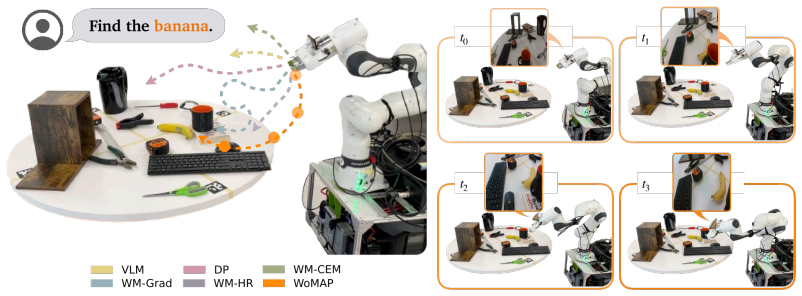
WoMAP claims that open-vocabulary active object localization can be decomposed into three parts that each remove a traditional bottleneck: (i) a Gaussian Splatting real-to-sim-to-real pipeline converts a few one-minute real-world videos into thousands of labeled training views, with object positions extracted automatically from semantic Gaussian Splat fields; (ii) a reconstruction-free latent world model—a frozen DINOv2 encoder, a ViT dynamics predictor, and a language-conditioned reward predictor—learns environment dynamics and dense rewards by distilling detector confidence scaled by bounding-box size, avoiding image-reconstruction losses; and (iii) inference-time planning uses the world model to refine and select among coarse VLM action proposals, maximizing predicted reward with a smoothness penalty. On 150 tasks per environment in PyBullet and Gaussian Splat scenes, and on hardware with a TidyBot, the method reports success rates more than 9x and 2x those of VLM and diffusion-policy baselines, and sim-to-real success that matches or exceeds simulation in two of three real scenes.
Load-bearing premise
The load-bearing premise is that GroundingDINO's confidence, scaled by bounding-box size, faithfully measures how well the target object has been localized—it serves simultaneously as the training reward and as the success criterion—so if that confidence is miscalibrated or can be inflated by particular viewing angles, the reported success rates could reflect optimizing a proxy rather than genuinely finding objects (a limitation the paper itself flags in Section 6).
Editorial extensions
If this is right
- If the central claim holds, open-vocabulary search policies no longer need expert demonstrations or online interaction: a few short videos per scene, rendered through Gaussian Splats, suffice for training, which lowers the cost of deploying search in new homes or warehouses.
- VLM commonsense proposals become executable: WoMAP turns vague suggestions like "look behind the bowl" into optimized 6-DoF camera motions, directly addressing the physically ungrounded failure mode of VLM planners.
- Reconstruction-free reward distillation is a viable substitute for image-reconstruction loss in world models, implying that the instability and data-hunger of reconstruction-based training can be avoided on at least this task class.
- The reported data efficiency (competitive performance from roughly 200 training trajectories) suggests the recipe scales to settings where collecting large demonstration datasets is impractical.
Reading between the lines
- The recipe is detector-agnostic in principle: swapping GroundingDINO for any open-set detector with better calibration or different invariances should directly shift WoMAP's ceiling, since detector confidence is both the training reward and the success metric—a testable prediction the paper does not make.
- A ceiling implied by the design: WoMAP cannot reliably find objects its detector cannot verify, so in settings where the target is semantically ambiguous or the detector is weak, gains over baselines should shrink; combining detectors or learned calibration could extend the regime the paper reports.
- The VLM-propose, world-model-optimize pattern is a general grounding strategy beyond localization—any high-level planner whose outputs are spatially vague (instruction following, embodied question answering, mobile manipulation) could plug into the same latent-scoring loop.
- Because success thresholds are chosen per object from its best view, the absolute success numbers carry a calibration dependence; a fair cross-paper comparison would need a shared, calibration-robust metric.
Editorial analysis
A structured set of objections, weighed in public.
Referee Report
Summary. WoMAP is a training-and-planning recipe for open-vocabulary active object localization that avoids expert demonstrations. The authors reconstruct real scenes as Gaussian Splats, render offline datasets of (observation, reward, pose) tuples, label each frame with GroundingDINO confidence scaled by bounding-box proportion, and distill these scores into a latent world model consisting of a frozen DINOv2 encoder, a ViT dynamics predictor, and a language-conditioned reward predictor, deliberately avoiding image-reconstruction losses. At inference, GPT-4o proposes coarse action primitives which the world model refines and scores under MPC with a smoothness penalty. Experiments in four PyBullet and three Gaussian-Splat scenes and on a TidyBot report more than 9x and 2x higher success rates than a VLM planner and a multi-task diffusion policy, respectively, with ablations on data scale, encoder choices, reconstruction losses, and semantic generalization.
Significance. WoMAP's methodological core, a GS-rendered offline data pipeline feeding a reconstruction-free latent world model, is a clean alternative to imitation learning and warrants attention; the ablations distinguishing GS data from raw video frames (Table 3), frozen-vs-finetuned encoders and reconstruction losses (Figures 12-14), and training-trajectory scaling (Figure 20) are concrete strengths. The paper also reports hyperparameters, the full VLM prompt, per-environment object lists, and complete per-condition numbers (Table 7), which makes the main claims falsifiable and largely reproducible without code release. The TidyBot sim-to-real row is a positive, clearly falsifiable result if the metric-anchoring concern below is addressed. Because the abstract's 9x/2x margins are computed from a success criterion that is the same detector confidence signal used as the training reward, the significance of the headline numbers currently depends on an unverified assumption about detector calibration.
major comments (3)
- [Sections 3.3.2 / B.3.2] The reward used to train the world model (Section 3.3.2: GroundingDINO confidence scaled by bounding-box size) and the success criterion used in every reported result (Section B.3.2: thresholds on the same confidence and bounding-box proportion, with per-object thresholds chosen from the best view) are the same scalar signal. Since WoMAP's planner optimizes predicted reward trained on exactly this signal, the reported margins (up to 9x/2x in the abstract; derived from Table 7) are not anchored to an external notion of localization success: if GroundingDINO confidence can be inflated by particular viewpoints, lighting, or distractor similarity, WoMAP's advantage could reflect proxy optimization rather than genuinely better localizations. Section 6 acknowledges that detector confidence can be uncalibrated, but no calibration analysis or independent success measure is provided. Please add at least one independent evaluation: in PyBullet and GS scenes object poses are known (via the semantic field, Section 3.2), so compute success from the target's projected pixel area and occlusion in the final view; in the real experiments, annotate a subset of final views by humans or by a second, differently trained open-vocabulary detector.
- [Appendix B.3.2] The sentence 'we choose object-specific scaling parameters from the best view' requires precise specification: it is not stated whether the thresholds were selected on the evaluation data, how many views were used, or how the threshold relates to the best view's confidence and box proportion, and it is not stated whether the same thresholds were applied to all planners. If a threshold is set near the best achievable detector response for each object, the metric implicitly rewards reaching the highest-confidence viewpoints, which is exactly the behavior WoMAP's reward is trained to produce; this would bias the comparison even under a well-calibrated detector. State the threshold selection procedure clearly (pre-registered thresholds, chosen on a held-out set, applied identically to all methods) and report sensitivity of the results to threshold choice.
- [Section 4.3 / Table 7] Headline margins of 9x and 2x are computed from point estimates with no measure of uncertainty. Table 7 reports 50 trials per condition, but no standard errors, confidence intervals, or significance tests are given, and the 9x figure is dominated by conditions in which the VLM baseline is at or near 0.00 success (e.g., PB-Kitchen-Medium/Hard, GS-Random-Hard). Report binomial confidence intervals (or standard errors over the randomized scene and initial-state draws) and, where the task draws are shared, paired comparisons against the strongest baseline per condition; this is necessary for a 'rigorous ... demonstration' as claimed in the abstract.
minor comments (7)
- [Appendix B.1.1] There is a duplicate article in 'is a a core challenge' in the second paragraph.
- [Figure 9 caption] The caption uses 'cosine distance' while Section 4.5 and Appendix B.4.3 use 'cosine similarity'; these are different quantities (a distance would imply a negative correlation with performance), so align the terminology.
- [Table 4] The smoothness weight gamma in Eq. (2) is not listed among the hyperparameters; report its value and ideally its sensitivity.
- [Section 3.4 / Figure 15] The number of VLM proposals k appears as the placeholder '{self.k}' in the prompt of Figure 15 and is described as three in Sections 1 and 3.4; state k explicitly in the experimental setup and clarify whether the VLM's confidence scores are used by WoMAP when selecting among proposals.
- [Sections 3.1 / 3.3.2] The problem formulation in Section 3.1 defines the reward R as a generic [0,1] visibility score, while the concrete definition (detector confidence times bounding-box proportion) appears only in Section 3.3.2; move the formal definition to the problem statement.
- [Appendix B.3.2] The efficiency metric uses an 'estimate of d*' (optimal distance to the object); specify how d* is estimated in each environment and whether it is computed from ground-truth object poses, since the efficiency comparisons across methods depend on it.
- [Sections 3.2 / 3.3.1] Section 3.2 states that training data consist of randomly paired observation-pose samples and that the world model 'does not require sequentially-ordered data', while Section 3.3.1 says the dynamics predictor is supervised recurrently over sequences of H observation-action pairs; clarify how the recurrent multi-step supervision is constructed from the sampled pairs, as this affects reproducibility.
Circularity Check
The reported success metric is a thresholded version of the same GroundingDINO confidence and bounding-box signal used as the training reward, so the headline 9x/2x margins are partly a self-consistency check rather than an independent measure of localization quality.
-
self definitional
[Section 3.3.2 (Reward Distillation), Section 3.4 (Eq. 2), Appendix B.3.2 (Choice of Metrics)]
""WoMAP computes a per-frame reward for each object in the observation using the detection confidence provided by a pretrained object detector, e.g., GroundingDINO [26], scaled by the associated detection bounding-box size" (Sec. 3.3.2). "[O]ur success score is defined to be 1 if both (i) the detection confidence labeled by GroundingDINO is above a certain threshold, and (ii) the labeled bounding box proportion is above a certain threshold" (App. B.3.2)."
The reward r_gt used to train the rewards predictor v_phi is the GroundingDINO confidence scaled by bounding-box size (Sec. 3.3.2). Planning (Eq. 2, Sec. 3.4) explicitly maximizes v_phi's expected output, which estimates that same scalar. The success metric in App. B.3.2 thresholds exactly the same GroundingDINO confidence and bounding-box proportion. Thus 'success' is defined as achieving the quantity WoMAP was trained to maximize, so the reported success rates are partly a self-consistency check. The per-object thresholds chosen from the best view fit the metric to the detector's own confidence distribution. The VLM and DP baselines do not optimize this detector-confidence objective, giving WoMAP an inherent advantage in the 9x/2x comparison.
full rationale
The core learning pipeline (Gaussian-Splat data generation, latent dynamics, reward distillation, VLM-proposal optimization) is not itself circular: the world model must genuinely predict latent transitions and rewards in novel scenes, and sim-to-real transfer is demonstrated on hardware. However, the paper's central empirical claim is its success-rate comparison, and that comparison is defined in terms of the same GroundingDINO confidence and bounding-box signal that constitutes the training reward. This makes the headline result partially circular: WoMAP is explicitly optimizing the scalar used to judge success, whereas VLM and DP baselines are not, so part of the 9x/2x margin reflects alignment of the metric with WoMAP's objective rather than independent localization quality. The paper's own Section 6 limitation about uncalibrated detector confidence strengthens this concern, but it is framed only as a data-corruption issue and never as a threat to the evaluation metric. No external benchmark or human-annotated success measure anchors the reported rates. The self-citations to prior Gaussian-Splat semantics work (SIREN, Fast-Splat) are not load-bearing for the main claim, so they do not add circularity. Overall: partial circularity in the evaluation, not in the derivation of the planner itself; score 6.
Assumptions & free parameters
free parameters (3)
- Per-object success thresholds (GroundingDINO confidence and bounding-box proportion) =
Not reported; set from each object's best view
- Reward scaling and MPC hyperparameters (planning horizon T, smoothness weight gamma) =
T=4; gamma not specified in main text
- Data augmentation perturbation magnitudes for trajectory generation =
Not reported
assumptions (4)
- domain assumption GroundingDINO confidence scaled by bounding-box size is a sufficient reward and success signal for object localization.
- domain assumption Gaussian Splatting renders from one-minute videos provide photorealistic training views that transfer to the real world.
- domain assumption Frozen DINOv2 patch embeddings form a latent space in which transition dynamics and rewards are predictable by the learned network.
- domain assumption A Gaussian transition model with only the last latent state suffices for multi-step planning.
Cite this review
Pith. "Pith review of WoMAP: World Models For Embodied Open-Vocabulary Object Localization." pith.science (2026). https://pith.science/paper/NCLZQBTR
@misc{pith2026250601600,
  author       = {Pith},
  title        = {Pith review of: WoMAP: World Models For Embodied Open-Vocabulary Object Localization},
  year         = {2026},
  howpublished = {\url{https://pith.science/paper/NCLZQBTR}},
  note         = {Machine review of arXiv:2506.01600}
}
read the original abstract
Language-instructed active object localization is a critical challenge for robots, requiring efficient exploration of partially observable environments. However, state-of-the-art approaches either struggle to generalize beyond demonstration datasets (e.g., imitation learning methods) or fail to generate physically grounded actions (e.g., VLMs). To address these limitations, we introduce WoMAP (World Models for Active Perception): a recipe for training open-vocabulary object localization policies that: (i) uses a Gaussian Splatting-based real-to-sim-to-real pipeline for scalable data generation without the need for expert demonstrations, (ii) distills dense rewards signals from open-vocabulary object detectors, and (iii) leverages a latent world model for dynamics and rewards prediction to ground high-level action proposals at inference time. Rigorous simulation and hardware experiments demonstrate WoMAP's superior performance in a broad range of zero-shot object localization tasks, with more than 9x and 2x higher success rates compared to VLM and diffusion policy baselines, respectively. Further, we show that WoMAP achieves strong generalization and sim-to-real transfer on a TidyBot.
Figures


Figures from the paper (18 more)



Forward citations
Cited by 1 Pith paper
-
From World Models to World Action Models: A Concise Tutorial for Robotics
World models are action-conditioned predictors of task-relevant futures; world action models couple those futures to robot actions via four paradigms: imagine-then-execute, feature-conditioned, joint, and auxiliary pr...
Reference graph
Works this paper leans on
-
[1]
J. J. Gibson.The Ecological Approach to Visual Perception. Houghton Mifflin, Boston, 1979
work page 1979
-
[2]
R. Bajcsy. Active perception.Proceedings of the IEEE, 76(8):966–1005, 1988. doi:10.1109/5. 5968
doi:10.1109/5 1988
- [3]
-
[4]
D. S. Chaplot, D. P. Gandhi, A. Gupta, and R. R. Salakhutdinov. Object goal navigation using goal-oriented semantic exploration.Advances in Neural Information Processing Systems, 33: 4247–4258, 2020
work page 2020
-
[5]
C. Wen, Y . Huang, H. Huang, Y . Huang, S. Yuan, Y . Hao, H. Lin, Y .-S. Liu, and Y . Fang. Zero- shot object navigation with vision-language models reasoning. InInternational Conference on Pattern Recognition, pages 389–404. Springer, 2025
work page 2025
-
[6]
A. Z. Ren, J. Clark, A. Dixit, M. Itkina, A. Majumdar, and D. Sadigh. Explore until confident: Efficient exploration for embodied question answering.arXiv preprint arXiv:2403.15941, 2024
arXiv 2024
-
[7]
R. Ramrakhya, D. Batra, E. Wijmans, and A. Das. Pirlnav: Pretraining with imitation and rl finetuning for objectnav. InProceedings of the IEEE/CVF Conference on Computer Vision and Pattern Recognition, pages 17896–17906, 2023
work page 2023
-
[8]
N. Yokoyama, R. Ramrakhya, A. Das, D. Batra, and S. Ha. Hm3d-ovon: A dataset and benchmark for open-vocabulary object goal navigation. In2024 IEEE/RSJ International Conference on Intelligent Robots and Systems (IROS), pages 5543–5550. IEEE, 2024
work page 2024
Show all 48 references
-
[9]
J. Ye, D. Batra, A. Das, and E. Wijmans. Auxiliary tasks and exploration enable objectgoal navigation. InProceedings of the IEEE/CVF international conference on computer vision, pages 16117–16126, 2021
2021
-
[10]
L. Fan, M. Liang, Y . Li, G. Hua, and Y . Wu. Evidential active recognition: Intelligent and prudent open-world embodied perception, 2023. URLhttps://arxiv.org/abs/2311.13793
2023 arXiv
-
[11]
S. K. Ramakrishnan, D. Jayaraman, and K. Grauman. Emergence of exploratory look- around behaviors through active observation completion.Science Robotics, 4(30), May 2019. ISSN 2470-9476. doi:10.1126/scirobotics.aaw6326. URL http://dx.doi.org/10.1126/ scirobotics.aaw6326
2019 doi
- [12]
-
[13]
Kerbl, G
B. Kerbl, G. Kopanas, T. Leimk ¨uhler, and G. Drettakis. 3d gaussian splatting for real-time radiance field rendering.ACM Trans. Graph., 42(4):139–1, 2023
2023
-
[14]
G. Zhou, H. Pan, Y . LeCun, and L. Pinto. Dino-wm: World models on pre-trained visual features enable zero-shot planning.arXiv preprint arXiv:2411.04983, 2024. 10
2024 arXiv
-
[15]
Ramrakhya, E
R. Ramrakhya, E. Undersander, D. Batra, and A. Das. Habitat-web: Learning embodied object-search strategies from human demonstrations at scale. InProceedings of the IEEE/CVF conference on computer vision and pattern recognition, pages 5173–5183, 2022
2022
-
[16]
Gervet, S
T. Gervet, S. Chintala, D. Batra, J. Malik, and D. S. Chaplot. Navigating to objects in the real world.Science Robotics, 8(79):eadf6991, 2023
2023
-
[17]
K. Zhou, K. Zheng, C. Pryor, Y . Shen, H. Jin, L. Getoor, and X. E. Wang. Esc: Exploration with soft commonsense constraints for zero-shot object navigation. InInternational Conference on Machine Learning, pages 42829–42842. PMLR, 2023
2023
-
[18]
Jiang, B
H. Jiang, B. Huang, R. Wu, Z. Li, S. Garg, H. Nayyeri, S. Wang, and Y . Li. Roboexp: Action- conditioned scene graph via interactive exploration for robotic manipulation.arXiv preprint arXiv:2402.15487, 2024
2024 arXiv
-
[19]
Mendonca, S
R. Mendonca, S. Bahl, and D. Pathak. Alan: Autonomously exploring robotic agents in the real world. In2023 IEEE International Conference on Robotics and Automation (ICRA), pages 3044–3050. IEEE, 2023
2023
-
[20]
P. Wu, A. Escontrela, D. Hafner, P. Abbeel, and K. Goldberg. Daydreamer: World models for physical robot learning. InConference on robot learning, pages 2226–2240. PMLR, 2023
2023
-
[21]
Nakamura, L
K. Nakamura, L. Peters, and A. Bajcsy. Generalizing safety beyond collision-avoidance via latent-space reachability analysis.arXiv preprint arXiv:2502.00935, 2025
2025
-
[22]
A. Bar, G. Zhou, D. Tran, T. Darrell, and Y . LeCun. Navigation world models.arXiv preprint arXiv:2412.03572, 2024
2024 arXiv
-
[23]
Hansen, H
N. Hansen, H. Su, and X. Wang. Td-mpc2: Scalable, robust world models for continuous control.arXiv preprint arXiv:2310.16828, 2023
2023 arXiv
-
[24]
H. Qi, H. Yin, Y . Du, and H. Yang. Strengthening generative robot policies through predictive world modeling.arXiv preprint arXiv:2502.00622, 2025
2025
-
[25]
Shorinwa, J
O. Shorinwa, J. Sun, M. Schwager, and A. Majumdar. Siren: Semantic, initialization-free registration of multi-robot gaussian splatting maps.arXiv preprint arXiv:2502.06519, 2025
2025 arXiv
-
[26]
S. Liu, Z. Zeng, T. Ren, F. Li, H. Zhang, J. Yang, Q. Jiang, C. Li, J. Yang, H. Su, et al. Grounding dino: Marrying dino with grounded pre-training for open-set object detection. InEuropean Conference on Computer Vision, pages 38–55. Springer, 2024
2024
-
[27]
Radford, J
A. Radford, J. W. Kim, C. Hallacy, A. Ramesh, G. Goh, S. Agarwal, G. Sastry, A. Askell, P. Mishkin, J. Clark, et al. Learning transferable visual models from natural language supervision. InInternational conference on machine learning, pages 8748–8763. PmLR, 2021
2021
-
[28]
Hafner, T
D. Hafner, T. Lillicrap, J. Ba, and M. Norouzi. Dream to control: Learning behaviors by latent imagination.arXiv preprint arXiv:1912.01603, 2019
1912 arXiv
-
[29]
Oquab, T
M. Oquab, T. Darcet, T. Moutakanni, H. V o, M. Szafraniec, V . Khalidov, P. Fernandez, D. Haziza, F. Massa, A. El-Nouby, et al. Dinov2: Learning robust visual features without supervision. arXiv preprint arXiv:2304.07193, 2023
2023 arXiv
-
[30]
Dosovitskiy, L
A. Dosovitskiy, L. Beyer, A. Kolesnikov, D. Weissenborn, X. Zhai, T. Unterthiner, M. Dehghani, M. Minderer, G. Heigold, S. Gelly, et al. An image is worth 16x16 words: Transformers for image recognition at scale.arXiv preprint arXiv:2010.11929, 2020
2010 arXiv
-
[31]
Hansen, X
N. Hansen, X. Wang, and H. Su. Temporal difference learning for model predictive control. arXiv preprint arXiv:2203.04955, 2022. 11
2022 arXiv
-
[32]
Burchi and R
M. Burchi and R. Timofte. Mudreamer: Learning predictive world models without reconstruc- tion.arXiv preprint arXiv:2405.15083, 2024
2024 arXiv
-
[33]
J. Wei, X. Wang, D. Schuurmans, M. Bosma, F. Xia, E. Chi, Q. V . Le, D. Zhou, et al. Chain-of- thought prompting elicits reasoning in large language models.Advances in neural information processing systems, 35:24824–24837, 2022
2022
-
[34]
J. Wu, W. Chong, R. Holmberg, A. Prasad, Y . Gao, O. Khatib, S. Song, S. Rusinkiewicz, and J. Bohg. Tidybot++: An open-source holonomic mobile manipulator for robot learning.arXiv preprint arXiv:2412.10447, 2024
2024 arXiv
-
[35]
Coumans and Y
E. Coumans and Y . Bai. Pybullet, a Python module for physics simulation for games, robotics and machine learning.http://pybullet.org, 2016–2022
2016
-
[36]
Hurst, A
A. Hurst, A. Lerer, A. P. Goucher, A. Perelman, A. Ramesh, A. Clark, A. Ostrow, A. Welihinda, A. Hayes, A. Radford, et al. Gpt-4o system card.arXiv preprint arXiv:2410.21276, 2024
2024 arXiv
-
[37]
Goetting, H
D. Goetting, H. G. Singh, and A. Loquercio. End-to-end navigation with vision language models: Transforming spatial reasoning into question-answering.arXiv preprint arXiv:2411.05755, 2024
2024 arXiv
-
[38]
Anderson, A
P. Anderson, A. Chang, D. S. Chaplot, A. Dosovitskiy, S. Gupta, V . Koltun, J. Kosecka, J. Malik, R. Mottaghi, M. Savva, et al. On evaluation of embodied navigation agents.arXiv preprint arXiv:1807.06757, 2018
2018 arXiv
-
[39]
Shorinwa, J
O. Shorinwa, J. Tucker, A. Smith, A. Swann, T. Chen, R. Firoozi, M. Kennedy III, and M. Schwager. Splat-mover: Multi-stage, open-vocabulary robotic manipulation via editable gaussian splatting.arXiv preprint arXiv:2405.04378, 2024
2024 arXiv
-
[40]
M. N. Qureshi, S. Garg, F. Yandun, D. Held, G. Kantor, and A. Silwal. Splatsim: Zero- shot sim2real transfer of rgb manipulation policies using gaussian splatting.arXiv preprint arXiv:2409.10161, 2024
2024 arXiv
-
[41]
S. Zhou, H. Chang, S. Jiang, Z. Fan, Z. Zhu, D. Xu, P. Chari, S. You, Z. Wang, and A. Kadambi. Feature 3dgs: Supercharging 3d gaussian splatting to enable distilled feature fields. InPro- ceedings of the IEEE/CVF Conference on Computer Vision and Pattern Recognition, pages 216...
2024
-
[42]
Shorinwa, J
O. Shorinwa, J. Sun, and M. Schwager. Fast-splat: Fast, ambiguity-free semantics transfer in gaussian splatting.arXiv preprint arXiv:2411.13753, 2024
2024 arXiv
-
[43]
Tancik, E
M. Tancik, E. Weber, E. Ng, R. Li, B. Yi, T. Wang, A. Kristoffersen, J. Austin, K. Salahi, A. Ahuja, et al. Nerfstudio: A modular framework for neural radiance field development. In ACM SIGGRAPH 2023 conference proceedings, pages 1–12, 2023
2023
-
[44]
S. M. LaValle and J. J. Kuffner. Rapidly-exploring random trees: Progress and prospects: Steven m. lavalle, iowa state university, a james j. kuffner, jr., university of tokyo, tokyo, japan. Algorithmic and computational robotics, pages 303–307, 2001
2001
-
[45]
D. Shah, M. Equi, B. Osinski, F. Xia, B. Ichter, and S. Levine. Navigation with large language models: Semantic guesswork as a heuristic for planning, 2023. URL https://arxiv.org/ abs/2310.10103
2023 arXiv
-
[46]
Sridhar, D
A. Sridhar, D. Shah, C. Glossop, and S. Levine. Nomad: Goal masked diffusion policies for navigation and exploration. In2024 IEEE International Conference on Robotics and Automation (ICRA), pages 63–70. IEEE, 2024
2024
-
[47]
R. J. Williams and D. Zipser. A learning algorithm for continually running fully recurrent neural networks.Neural computation, 1(2):270–280, 1989. 12
1989
-
[48]
descriptions
N. Reimers and I. Gurevych. Sentence-bert: Sentence embeddings using siamese bert-networks. InProceedings of the 2019 Conference on Empirical Methods in Natural Language Processing. Association for Computational Linguistics, 11 2019. URL https://arxiv.org/abs/1908. 10084. 13 A...
2019
Reviewed August 7, 2026 · model on record in the stance chip above.
Discussion (0). Sign in to comment.