REVIEW 5 major objections 4 minor 49 references
A Concurrent Multiscale Framework Coupling Direct Simulation Monte Carlo and Molecular Dynamics
T0 review · 5 major / 4 minor · reviewed 2026-08-07 · deepseek-v4-flash
Pith's one-line read A cell-based coupling of DSMC and molecular dynamics, built on lifting and restricting operators, replaces simplified gas-surface models with atomistic detail and cuts the mean surface-temperature error in a hypersonic test case from 730%…
desk verdict Genuinely useful coupling machinery with an under-validated, likely mis-implemented temporal bridge; deserves review but not acceptance without fixing Eq. 19. read the letter →
The pith
A machine-rendered reading of the paper's core claim, the machinery that carries it, and where it could break.
The reading
What carries the argument
The load-bearing machinery is the pair of lifting and restricting operators that bridge DSMC and MD. On lifting, the DSMC cell's aspect ratio and number density fix the MD box, and each DSMC particle is replaced by a circular patch of atoms on a close-packed lattice whose radius comes from the asymptotic lattice-point count $N(r)\approx 2\pi r^2/(\sqrt{3}a^2)$; choosing the lattice spacing equal to the interatomic potential cut-off keeps the configuration near an energy minimum. On restricting, the MD atoms are sorted by a nearest-neighbor criterion and grouped exactly $f_{MD}^{num}$ at a time, with position and velocity averaged into one DSMC particle, which cancels the extra information the lattice introduced. The temporal bridge uses a thermostatted bulk layer and a Stefan-Boltzmann radiative-loss term applied over the DSMC timestep of $10^{-5}$ s while the MD run lasts only 50,000 steps of $10^{-15}$ s. This pair of operators carries the argument because it is what lets a coarse stochastic method and a fine deterministic method exchange conserved quantities without a fixed coupling zone.
What would settle it
Run the same hypersonic wire case with the MD instance stopped after 20,000, 50,000, and 100,000 timesteps, and check whether the temperature returned to DSMC changes; if the coupled mean surface temperature moves by much more than the claimed 4.4% error across these durations, the steady-state bridging assumption is not converged. A second check is to turn off the analytical radiative-loss thermostat in the bulk wire layer: if the predicted surface temperature then departs from the experimental mean by far more than 4.4%, the accuracy gain is carried mainly by the temporal-balancing formula rather than by the atomistic gas-surface collision description.
Extended reading notes
Core claim
On its own terms, the paper's discovery is that a concurrent DSMC-MD coupling can be made general by deciding per DSMC cell whether to run an MD instance, rather than fixing an overlap buffer or a database of precomputed MD results. The lifting operator rescales a DSMC cell to an MD box of the same number density, decomposes each simulated DSMC particle into a cluster of MD atoms arranged on a hexagonal close-packed lattice, and assigns velocities from the DSMC phase space. The restricting operator sorts the MD atoms by nearest neighbor, regroups exactly the same number of atoms per DSMC particle, and returns a center-of-mass position and average velocity to DSMC. Applied to the hypersonic thermocouple example, this replaces the DSMC surface temperature model and reduces the mean surface-temperature error from 730% to 4.4%, while the steady cooling rate matches experiment within 8.2%. The paper also reports that the method fails to reproduce the transient initial heating and the late sharp cool-off in the experiment, attributing those to unsteady inflow effects not included in the simulation.
Load-bearing premise
The long-time accuracy depends on the assumption that a few tens of picoseconds of MD, run to a quasi-steady state with an analytical radiative-cooling thermostat, represent what the gas-surface interaction would do over the full $10^{-5}$ s DSMC timestep.
Editorial extensions
If this is right
- Selecting MD cells on a per-cell basis removes the need to know in advance where atomistic detail is required.
- DSMC surface treatment can be upgraded from accommodation-coefficient models to deterministic atomistic collisions, improving mean surface temperature prediction from a 730% error to a 4.4% error in the hypersonic example.
- The steady-state cooling rate of the wire is reproduced within 8.2% of experiment, giving confidence in heat-transfer predictions for steady hypersonic flows.
- The same coupling is claimed to apply to evaporation and condensation, gas-surface chemistry validation, foreign-particle impacts, fusion-relevant rarefied plasmas, and micro- and nanofluidic surface phenomena.
- Because the restricting operator returns a single center-of-mass particle, the DSMC particle count and mass are conserved exactly across coupling steps.
Reading between the lines
- A direct extension would be to run the MD instances only occasionally and use them to refresh gas-surface accommodation coefficients in DSMC, turning the concurrent scheme into a self-refreshing database.
- The reported miss of the initial transient suggests the method, as presented, is best trusted for quasi-steady surface response; a testable next step is whether time-varying inlet pressure reproduces the initial heating.
- Because the lifting operator seeds atoms on a lattice whose spacing equals the potential cut-off, the results may be sensitive to the chosen interatomic potential; a sensitivity study across cut-off radii would clarify how much of the accuracy gain is method versus potential.
- The cell-based decision rule could be driven by a local criterion such as the Knudsen number or a non-equilibrium measure, making the framework adaptive rather than dependent on a user-chosen cell list.
Editorial analysis
A structured set of objections, weighed in public.
Referee Report
Summary. The manuscript presents a concurrent, cell-based coupling of Direct Simulation Monte Carlo (DSMC) and molecular dynamics (MD). DSMC is the macroscopic driver; selected DSMC cells are replaced, during a DSMC step, by MD simulations. The lifting operator maps cell geometry, particle positions, velocities, and f_num to an MD domain, while the restricting operator groups MD atoms into DSMC particles and returns averaged positions and velocities. The method is implemented in SPARTA and LAMMPS. The authors verify mass and temperature behavior on a small atomic-oxygen system and then apply the method to a Mach 5.84 hypersonic flow over a thermocouple wire, comparing DSMC-MD, standard DSMC, and experiment. They report a mean surface temperature of 500.2 K for DSMC-MD versus 523.2 K experimental (4.4% error), versus 4342.7 K for standard DSMC (730% error). They conclude that the framework improves accuracy by orders of magnitude and discuss limitations.
Significance. Cell-based concurrent DSMC-MD coupling is a useful idea that generalizes existing buffer-zone and indirect coupling approaches. The lifting and restricting operators are clearly described, the implementation in open-source codes is a strength, and the hypersonic example demonstrates the potential for replacing phenomenological gas-surface models with atomistic detail. If the temporal-bridging and baseline-comparison issues are resolved, the method could become a valuable tool. However, the accuracy gain as reported is not yet convincing: the radiative loss in the MD domain uses the same model it claims to replace, the DSMC baseline appears improperly resolved, and the verification tests are too weak to establish operator correctness.
major comments (5)
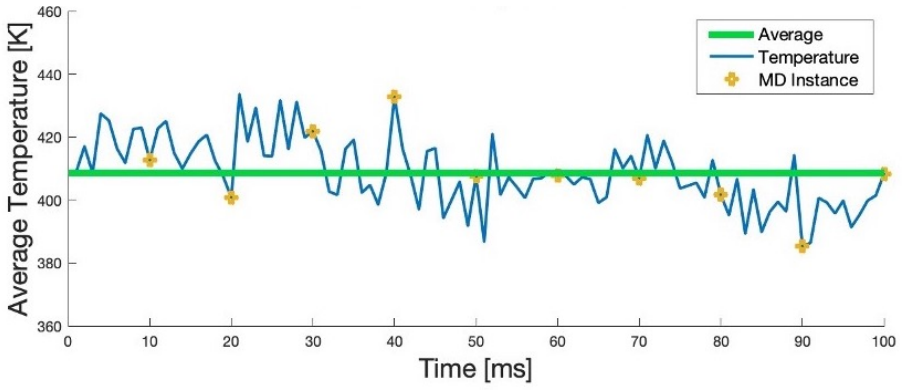
- [Sec. 5.1, Eqs. (16)-(19)] The temporal bridging is internally inconsistent and unvalidated. The text states that Delta-t in Eq. (19) is the DSMC timestep (10^-5 s) and then says that at the beginning of each MD time step the wire atoms are initialized to T_target = T_surf - Delta-t*sigma*epsilon*T^4/(rho*c*d). If the decrement intended for the full DSMC step is applied at each of the 50,000 MD steps (1 fs each), the cumulative radiative cooling exceeds the physical value by roughly a factor of 50,000; if it is applied only once per coupling call, the sentence is wrong. No sensitivity study is provided for rho, c, d, epsilon, the thermostat relaxation time, or the averaging window, and no evidence is given that a 50 ps MD run reaches the same steady state as the DSMC cell would over 10^-5 s. The 4.4% mean agreement in Fig. 12 is therefore not yet a validated accuracy claim for the lifting and restricting operators; it is at least partly determined by this imposed energy balance.
- [Sec. 5.1, simulation set-up] The DSMC timestep is inconsistent with the stated cell-transit condition. With V=1001.14 m/s and Delta-t=10^-5 s, a particle travels about 10.0 mm per timestep, which is roughly 17 cell lengths given Delta-x=0.6 mm. This directly contradicts the statement that Delta-t is chosen so that particles do not traverse an entire cell within one timestep. The baseline DSMC run is therefore not a properly resolved DSMC simulation, and the reported 730% error in Sec. 5.2 is not a meaningful benchmark for the accuracy gain. A corrected comparison with a DSMC timestep satisfying the CFL condition is needed before the improvement can be attributed to the coupling method.
- [Sec. 5.1, Eqs. (14) and (19)] The radiative cooling term in the MD domain uses the same Stefan-Boltzmann gray-body law and the same emissivity (derived from Eq. (15)) as the DSMC surface model that the coupling is intended to replace. The close agreement between the DSMC-MD mean temperature (500.2 K) and experiment (523.2 K) does not, by itself, validate the MD description; it shows that an analytic radiation law with the same parameters is being enforced in the MD energy balance. The claim in Sec. 5.2 that the MD domain bypasses the inaccurate surface temperature model is therefore overstated: the accommodation and collision dynamics are indeed atomistic, but the radiative cooling is not independent.
- [Sec. 4.1-4.2] The verification of the operators is too weak to support the claim that mass and temperature are correctly transferred. In Sec. 4.1, mass conservation is checked only by observing that the average particle count per cell remains near 15; however, the restricting operator groups exactly f_MD_num atoms into one DSMC particle, so mass conservation is enforced by construction and the test cannot detect errors in the lifting/restricting operators. In Sec. 4.2, the temperature check compares the measured standard deviation to the theoretical value from Eq. (13), but this does not verify that velocity distributions, energy, or higher moments are preserved. The statement in Sec. 4.1 that these results 'firmly prove a conservation of mass' is not supported by the presented evidence.
- [Sec. 3.1, text after Eq. (12)] The assertion that setting the hcp lattice spacing a equal to the interatomic cutoff distance r_c 'ensures an energy minimum' is not generally valid for a Lennard-Jones or embedded-atom potential. For a truncated potential, the energy at r_c is not necessarily a minimum, and for a smooth cutoff the force may not vanish there. The lattice spacing is a free parameter that affects the initial configuration energy and hence the MD dynamics; an energy minimization or a direct check of the initial configuration energy should be provided.
minor comments (4)
- [Sec. 4.1-4.2] The text is inconsistent about the coupling frequency: Sec. 4.1 says three randomly selected cells are fully coupled at every DSMC timestep, whereas Sec. 4.2 says 'the simulations with a coupling of DSMC-MD for every cell every 10 timesteps.' Please clarify which protocol corresponds to Figures 6-8.
- [Sec. 6, Conclusion] The claim of an improvement of 'three order of magnitudes' is not supported by the reported numbers: 730% versus 4.4% is a factor of about 166, not 1000. Please correct the wording.
- [Sec. 5.1, Eq. (19)] The area-to-volume ratio used in the radiative loss formula is given as 1/d, which is not the correct geometric factor for a cylindrical wire; for a cylinder of radius r, A/V would be 2/r (or a related expression depending on how the simulated thickness is defined). This affects the magnitude of the radiative decrement and should be stated explicitly.
- [Sec. 5.1, thermostat reference] The Nose-Hoover thermostat is cited to Shinoda et al. (2004); the original references are Nosé (1984) and Hoover (1985), which should be cited instead.
Circularity Check
Mass-conservation verification is by construction and the MD radiative-cooling term reuses the DSMC surface model, but the central lifting/restricting operators and MD heating dynamics carry independent content.
-
self definitional
[Section 3.2 (restricting operator) and Section 4.1 (Conservation of Mass)]
""To maintain the same mass of one DSMC particle, the same number of MD atoms is grouped to form a DSMC particle as those initially created during the lifting step." ... "These results firmly prove a conservation of mass of the cell-based coupling approach.""
Mass conservation is baked into the definition of the restricting operator: each DSMC particle is decomposed into exactly f_MD_num atoms on lifting and re-formed from exactly f_MD_num atoms on restriction. The total number of DSMC particles, and hence the total mass, is therefore conserved by construction. The 100 ms numerical test cannot fail this invariant except through an implementation bug; presenting it as a verification that 'proves' mass conservation is a self-definitional check, not an independent test of the coupling physics.
-
fitted input called prediction
[Section 5.1, Equations (14)-(19) and the paragraph beginning 'The balance between atom-surface interactions...']
""The balance between atom-surface interactions and radiation heat loss is designed to emulate the DSMC surface model closely to enable a direct comparison." ... "Rewriting the Stefan-Boltzmann law (Eq. 14) ... ΔT= Δt σϵT^4/(ρcd).""
The MD 'prediction' of the thermocouple surface temperature uses the same Stefan-Boltzmann gray-body law (Eq. 14) and the same emissivity (from Eq. 15, calibrated to the experimental wire conductivity) as the DSMC surface temperature model that the framework is claimed to bypass. The radiative-cooling side of the MD energy balance is therefore an input borrowed from the baseline model rather than an atomistic prediction. The reported 4.4% mean-temperature agreement is hence not fully independent of the DSMC model being compared against, because one side of the energy balance is shared by construction. The MD-computed heating is independent, so this is a partial reduction, not a complete equivalence.
full rationale
The paper's central claim—a cell-based concurrent DSMC-MD coupling with novel lifting and restricting operators—is not circular. The operators are defined through explicit geometric and statistical mappings (Eqs. 3-12), and the temperature verification in Sec. 4.2 is an independent statistical check against the analytic finite-size fluctuation formula (Eq. 13). The framework is implemented in external open-source codes (SPARTA and LAMMPS) and compared with experimental data [41], so no load-bearing self-citation chain is present; co-author citations such as [24] and [38] are peripheral. Two partial circularities are identified but neither collapses the central claim. First, the mass-conservation 'verification' is tautological, since the restricting operator is defined to regroup exactly f_MD_num atoms per DSMC particle, making mass conservation an identity of the algorithm rather than a demonstrated conservation law. Second, the hypersonic demonstration's radiative-loss term is the same Stefan-Boltzmann law with the same emissivity used by the DSMC surface model it replaces, so part of the predicted surface temperature is an input to the MD simulation; the MD atomistic heating term, however, is independent and provides genuine content. The temporal-bridging choice described around Eq. 19—applying the DSMC-scale radiative decrement in the MD run—is a validation and correctness risk rather than a circularity, as it concerns whether the bridging assumption is physically consistent. Overall, the core coupling derivation is self-contained, and the circular steps affect only a supporting verification and the independence of the accuracy comparison, giving a score of 3.
Assumptions & free parameters
free parameters (6)
- f_num_MD =
Not reported; examples use 15 and 19
- z_MD =
Not reported
- lattice_spacing_a =
Set equal to cutoff distance r_c
- equilibration_time =
10^4 timesteps for thermostat, 50,000 timesteps for coupled run
- balanced_layer_thickness =
At least 10 atoms
- emissivity_prefactor =
1e-4
assumptions (6)
- standard math SPARTA and LAMMPS correctly implement DSMC and MD dynamics.
- domain assumption Interatomic potentials (Lennard-Jones for air, EAM for nickel, Lorentz-Berthelot mixing) accurately model the physical interactions.
- domain assumption Conserving number density between DSMC and MD domains is sufficient to maintain physical consistency.
- ad hoc to paper A hexagonal close-packed lattice with spacing equal to the cutoff distance is an energy-minimizing and physically valid initialization.
- ad hoc to paper A short MD run reaching steady state can represent flow conditions over a much longer DSMC timestep.
- ad hoc to paper The Stefan-Boltzmann based radiative loss term applied each MD step emulates the wire's radiative cooling.
Cite this review
Pith. "Pith review of A Concurrent Multiscale Framework Coupling Direct Simulation Monte Carlo and Molecular Dynamics." pith.science (2026). https://pith.science/paper/QS4UBGZS
@misc{pith2026250601924,
  author       = {Pith},
  title        = {Pith review of: A Concurrent Multiscale Framework Coupling Direct Simulation Monte Carlo and Molecular Dynamics},
  year         = {2026},
  howpublished = {\url{https://pith.science/paper/QS4UBGZS}},
  note         = {Machine review of arXiv:2506.01924}
}
read the original abstract
We present a new method to couple the Direct Simulation Monte Carlo (DSMC) algorithm with molecular dynamics (MD). The coupling approach generalizes prior coupling methods using a cell-based decision. The approach is supported by a lifting and restricting operator, which translate length and time scales between DSMC and MD. We verify the framework on basic conservation laws, and demonstrate its usability on a hypersonic flow example. Its accuracy gain is discussed in light of conventional DSMC simulations. Advantages and limitations are discussed, and additional use cases are highlighted.
Figures


Figures from the paper (10 more)




Reference graph
Works this paper leans on
-
[1]
R. Votta,Hypersonic high altitude aerothermodynamics of a space re-entry vehicle, Aerospace Science and Technology, 2013
work page 2013
- [2]
-
[3]
S. Rauf, K. Bera, J. Kenney, P. Kothnur,Modeling of plasma processing reactors: review and perspective, Journal of Micro/Nanopatterning, Materials and Metrology 22, 2023
work page 2023
-
[4]
Y. Kawagoe,A study on pressure-driven gas transport in porous media: from nanoscale to microscale, Microfluidics and Nanofluidics, 2016
work page 2016
-
[5]
M. Gallis & J. Harvey,Modelling of chemical reactions in hypersonic rarefied flow with the direct simulation Monte Carlo method, Journal of Fluid Mechanics, 1996
work page 1996
-
[6]
H.J. Lee,Fundamentals of Theoretical Plasma Physics: Mathematical Description of Plasma Waves, World Scientific Publishing Company, 2019
work page 2019
-
[7]
Sone,Molecular Gas Dynamics, Springer, 2007
Y. Sone,Molecular Gas Dynamics, Springer, 2007
work page 2007
-
[8]
Sone,Kinetic Theory and Fluid Dynamics, Springer, 2002
Y. Sone,Kinetic Theory and Fluid Dynamics, Springer, 2002
work page 2002
Show all 49 references
-
[9]
Bird,Molecular Gas Dynamics and the Direct Simulation of Gas Flows
G.A. Bird,Molecular Gas Dynamics and the Direct Simulation of Gas Flows. New York, NY, USA: Oxford Science Publications, 1994
1994
-
[10]
Kardar,Statistical Physics of Particles, Cambridge University Press, 2007
M. Kardar,Statistical Physics of Particles, Cambridge University Press, 2007
2007
-
[11]
Mott-Smith,The Solution of the Boltzmann Equation for a Shock Wave, Physical Review, 1951
H. Mott-Smith,The Solution of the Boltzmann Equation for a Shock Wave, Physical Review, 1951
1951
-
[12]
Chapman, T
S. Chapman, T. Cowling,The Mathematical Theory of Non-Uniform Gases, Cambridge University Press, 1990
1990
-
[13]
S. J. Plimpton, S. G. Moore, A. Borner, A. K. Stagg, T. P. Koehler, J. R. Torczynski, M. A. Gallis,Direct Simulation Monte Carlo on petaflop supercomputers and beyond, Physics of Fluids, 31, 2019
2019
-
[14]
Koura & H
K. Koura & H. MatsumotoVariable soft sphere molecular model for air species, Phys. Fluids 4, (1992)
1992
-
[15]
M. A. Gallis, T. P. Koehler, J. R. Torczynski, and S. J. Plimpton,Direct simulation Monte Carlo investigation of the Richtmyer-Meshkov instability, Physics of Fluids 27, 2015
2015
-
[16]
M. A. Gallis, T. P. Koehler, J. R. Torczynski, and S. J. Plimpton,Direct simulation Monte Carlo investigation of the Rayleigh-Taylor instability, Physical Review Fluids 1, 2016. 27
2016
-
[17]
M. A. Gallis, T. P. Koehler, J. R. Torczynski, S. J. Plimpton, and G. Papadakis, Molecular-level simulations of turbulence and its decay, Physical Review Letters 118, 2017
2017
-
[18]
M. A. Gallis, T. P. Koehler, J. R. Torczynski, S. J. Plimpton, and G. Papadakis,Gas- kinetic simulation of sustained turbulence in minimal Couette flow, Physical Review Fluids 3, 2018
2018
-
[19]
Garcia,Nonequilibrium fluctuations studied by rarefied-gas simulation, Physical Re- view A 34, 1986
A. Garcia,Nonequilibrium fluctuations studied by rarefied-gas simulation, Physical Re- view A 34, 1986
1986
-
[20]
Maxwell, J.C.Illustrations of the dynamical theory of gases. Part I. On the motions and collisions of perfectly elastic spheres, The London, Edinburgh, and Dublin Philosophical Magazine and Journal of Science, 19, 1860
-
[21]
and Lampis, M.,Kinetic Models for Gas-Surface Interaction, Transport Theory and Statistical Physics 1, 1971
Cercignani, C. and Lampis, M.,Kinetic Models for Gas-Surface Interaction, Transport Theory and Statistical Physics 1, 1971
1971
-
[22]
Padilla, I
J. Padilla, I. Boyd,Assessment of Gas-Surface Interaction Models in DSMC Analysis of Rarefied Hypersonic Flow, 39th AIAA Thermophysics Conference, 2007
2007
-
[23]
Zhou,Hydrodynamic Instabilities and Turbulence: Rayleigh- Taylor, Richtmyer- Meshkov, and Kelvin-Helmholtz Mixing, Cambridge University Press, 2024
Y. Zhou,Hydrodynamic Instabilities and Turbulence: Rayleigh- Taylor, Richtmyer- Meshkov, and Kelvin-Helmholtz Mixing, Cambridge University Press, 2024
2024
-
[24]
D. M. Sterbentz, C. F. Jekel, D. A. White, S. Aubry, H. E. Lorenzana, J. L. Belof, Design optimization for Richtmyer-Meshkov instability suppression at shock-compressed material interfaces, Physics of Fluids 34 (8), 2022
2022
-
[25]
Thompson, L
A. Thompson, L. Swiller, C. Trott, S. Foiles, G. Tucker,Spectral neighbor analysis method for automated generation of quantum-accurate interatomic potentials, Journal of Computational Physics, 2015
2015
-
[26]
P. Sun, J. Ding, S. Huang, X. Luo, W. Cheng,Microscopic Richtmyer-Meshkov insta- bility under strong shock, Physics of Fluids 32, 2020
2020
-
[27]
Zhakhovskii, S
V. Zhakhovskii, S. Zybin, S. Abarzhi, K. Nishihara,Atomistic Dynamics of the Richtmyer-Meshkov Instability in Cylindrical and Planar Geometries, Proceedings of the Conference of the American Physical Society Topical Group on Shock Compression of Condensed Matter, 2005
2005
-
[28]
Longshaw, R
S. Longshaw, R. Pillai, L. Gibelli, D. Emerson, D. Lockerby,Coupling Molecular Dy- namics and Direct Simulation Monte Carlo using a general and high-performance code coupling library, Computers and Fluids, 2020
2020
-
[29]
K. Gu, C. Watkins, J. Koplik,Atomistic hybrid DSMC/NEMD method for nonequilib- rium multiscale simulations, Journal of Computational Physics, 2010. 28
2010
-
[30]
Nedea, A
S. Nedea, A. Frijns, A. Van Steenhoven, A. Markvoort, P. Hilbers,Hybrid method coupling molecular dynamics and monte carlo simulations to study the properties of gases in microchannels and nanochannels, Physical Review E - Statistical, Nonlinear, and Soft Matter Physics, 72, 2005
2005
-
[31]
Watvisave, B
D. Watvisave, B. Puranik, U. Bhandarkar,A hydrid MD-DSMC coupling method to investigate flow characteristics of micro-devices, Journal of Computational Physics, 2015
2015
-
[32]
Yamanishi, Y
N. Yamanishi, Y. Matsumoto, K. Shobatake,Multistage gas-surface interaction model for the direct simulation Monte Carlo method, Physics of Fluids, 11, 1999
1999
-
[33]
Liang, W
T. Liang, W. Ye,An Efficient Hydrid DSMC/MD Algorithm for Accurate Modeling of Micro Gas Flows, Communications of Computational Physics, 15, 2014
2014
-
[34]
Zeifman, B
M. Zeifman, B. Garrison, L. Zhigilei,Direct Simulation Monte Carlo Calculation: Strategies for Using Complex Initial Conditions, MRS Online Proceedings Library 731, 2002
2002
-
[35]
Weinan, B
E. Weinan, B. Engquist, X. Li, W. Ren, E. Vanden-Eijnden.Heterogeneous multiscale methods: a review, Communications in computational physics, Vol. 2 No. 3, 2007
2007
-
[36]
C. Gear, J. Hyman, G. Kevrekidid, I. Kevrekidis, O. Runborg, C. Theodoropoulos. Equation-free, coarse-grained multiscale computation: Enabling microscopic simulators to perform system-level analysis, Comm. Math. Sci., Vol. 1 No. 4, 2003
2003
-
[37]
P. Lax, R. Phillips,The asymptotic distribution of lattice points in euclidean and non- euclidean spaces, Journal of Functional Analysis 46, 1982
1982
-
[38]
Beazley, P
D. Beazley, P. Lomdahl, N. Grønbech-Jensen, P. Tamayo,A high performance com- munications and memory cashing scheme for molecular dynamics on the CM-5, The 8th International Parallel Processing Symposium, Cancún, Mexico, IEEE Computer Society Press, p.800, 1994
1994
-
[39]
Thompson, H
A. Thompson, H. Aktulga, R. Berger, D. Bolintineanu, W. Brown, P. Crozier, P. in ’t Veld, A. Kohlmeyer, S. Moore, T. Nguyen, R. Shan, M. Stevens, J. Tranchida, C. Trott, S. J. Plimpton,LAMMPS - a flexible simulation tool for particle-based materials modeling at the atomic, mes...
2022
-
[40]
Hadjiconstantinou, A
N. Hadjiconstantinou, A. Garica, M. Bazant, G. He,Statistical error in particle simu- lations of hydrodynamic phenomena, Journal of Computational Physics, 2003
2003
-
[41]
Widodo, D
A. Widodo, D. Buttsworth,Stagnation temperature in a cold hypersonic flow produced by a light free piston compression facility, Experiments in Fluids 54, 2013. 29
2013
-
[42]
Buttsworth,Ludwieg Tunnel Facility with Free Piston Compression Heating for Su- personic and Hypersonic Testing, Proceedings of the 9th Australian Space Science Con- ference, 2010
D. Buttsworth,Ludwieg Tunnel Facility with Free Piston Compression Heating for Su- personic and Hypersonic Testing, Proceedings of the 9th Australian Space Science Con- ference, 2010
2010
-
[43]
C. Shu, X. Mao, Y. Chew,Particle number per cell and scaling factor effect on accuracy of DSMC simulation of micro flows, International Journal of Numerical Methods for Heat & Fluid Flow, Vol. 15 No. 8, 2005
2005
-
[44]
Atallah,A relationship between emissivity and thermal conductivity of metals, British Journal of Applied Physics 17, 1966
S. Atallah,A relationship between emissivity and thermal conductivity of metals, British Journal of Applied Physics 17, 1966
1966
-
[45]
Stoller, A
R. Stoller, A. Tamm, L. Béland, G. Samolyuk, G. Stocks, A. Caro, L. Slipchenko, Y. Osetsky, A. Aabloo, M. Klintenberg, Y. Wang,Impact of Short-Range Forces on Defect Production from High-Energy Collisions, Journal of Chemical Theory and Computation 12, 2016
2016
-
[46]
R. Chen, W. Yuen,Short-Time Oxidation Behavior of Low-Carbon, Low-Silicon Steel in Air at 850–1180°C: II. Linear to Parabolic Transition Determined Using Existing Gas-Phase Transport and Solid-Phase Diffusion Theories, Oxidation of Metals 73, 2010
2010
-
[47]
Lorentz,Ueber die Anwendung des Satzes vom Virial in der kinetischen Theorie der Gase, Annalen der Physik 248, 1881
H. Lorentz,Ueber die Anwendung des Satzes vom Virial in der kinetischen Theorie der Gase, Annalen der Physik 248, 1881
-
[48]
Berthelot,Sur le mélange des gaz, Comptes rendus hebdomadaires des séances de l’Académie des Sciences 126, 1898
D. Berthelot,Sur le mélange des gaz, Comptes rendus hebdomadaires des séances de l’Académie des Sciences 126, 1898
-
[49]
Shinoda, Wataru and Shiga, Motoyuki and Mikami, Masuhiro,Rapid estimation of elastic constants by molecular dynamics simulation under constant stress, Phys. Rev. B, Vol. 69 No. 13, 2004. 30
2004
Reviewed August 7, 2026 · model on record in the stance chip above.
Discussion (0). Sign in to comment.