REVIEW 3 major objections 4 minor 78 references
The End Of Universal Lifelong Identifiers: Identity Systems For The AI Era
T0 review · 3 major / 4 minor · reviewed 2026-08-07 · deepseek-v4-flash
Pith's one-line read The paper argues that Universal Lifelong Identifiers like SSN and Aadhaar are structurally unsafe in the AI era, and that a Merkle-commitment plus zero-knowledge framework can replace them without disrupting existing workflows.
desk verdict Valuable AI-era threat model, but the verification circuit is replayable and the drop-in replacement claim is not supported. read the letter →
The pith
A machine-rendered reading of the paper's core claim, the machinery that carries it, and where it could break.
The reading
What carries the argument
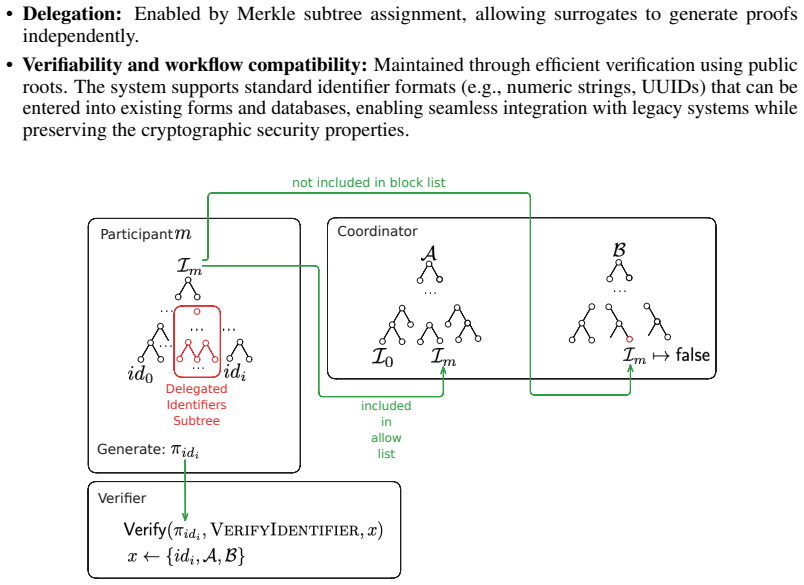
The load-bearing mechanism is the zero-knowledge circuit VERIFYIDENTIFIER (Algorithm 1) paired with two public Merkle roots maintained by a coordinator: an allow root $A$ over valid identity commitments and a block root $B$, implemented as a sparse Merkle tree, over revoked commitments. The prover knows a witness containing an identifier $id$, a hidden commitment $I$, and inclusion and non-inclusion proofs, and demonstrates that $id$ is a leaf of some commitment $I$, that $I$ is in $A$, and that $I$ is not in $B$, without revealing $I$. This single circuit carries the argument: it lets identifiers be random, per-context strings that still look like ordinary alphanumeric IDs for forms, while the legitimacy check is cryptographic and unlinkable.
What would settle it
Run Algorithm 1 in the paper's own terms: take any identifier id that is a leaf of any valid, non-revoked identity commitment I, construct the witness without any authenticator or secret, and submit the resulting proof to a verifier with the current allow and block roots. If the verifier accepts, which the circuit's constraints permit, then possession of a single transcript is sufficient to impersonate the owner. Alternatively, capture one valid proof from a real interaction and replay it unchanged in a second interaction with the same roots; acceptance would confirm the missing holder binding.
Extended reading notes
Core claim
On the paper's own terms, the central claim is that ULI failure is not an engineering bug but an architectural one: persistent cross-domain reuse makes any single leaked number a permanent join key, and commoditized AI tools have removed the practical barriers that once protected those numbers. Against this threat, the paper proposes changing the identifier itself rather than cleaning data or editing models after the fact. Each person holds a private portfolio of identifiers, commits to the portfolio with a Merkle root, registers only that root with a coordinator, and for each workflow presents one identifier plus a zero-knowledge proof that it belongs to a valid, unrevoked commitment. The proof hides which commitment, so no two services can tell they are dealing with the same person, while verifiers can still check legitimacy offline against public allow and block roots. The claimed result is comprehensive privacy, including forward, per-relying-party, and per-interaction unlinkability, with auditable delegation and minimal disruption to existing identifier workflows.
Load-bearing premise
The whole design rests on the assumption that a zero-knowledge proof of identifier legitimacy is enough to identify the person presenting it; the circuit as written proves only that the identifier belongs to some valid, unrevoked commitment, with no secret known only to the owner bound into the proof.
Editorial extensions
If this is right
- A breach of one service's database would leak identifiers that are useless for linking that individual's records at any other service, because the same person presents different identifiers elsewhere.
- Institutions could adopt the system without redesigning forms, databases, or document workflows: the presented identifier remains an ordinary alphanumeric string, and verification happens via a proof against public roots.
- Regulators and auditors retain a real function: public allow and block roots make authorization and revocation auditable without revealing who used which identifier.
- Delegation (power of attorney, caregivers) can be implemented by handing over Merkle subtrees, so the delegate proves legitimacy without learning the principal's other identifiers.
- Migration can begin incrementally by deriving the new per-context identifiers deterministically from existing ULIs, allowing a gradual transition rather than a single cutover.
Reading between the lines
- [Inference] As written, the proof circuit does not bind the proof to a secret held by the presenter, so a captured proof transcript could be replayed by someone who is not the identifier's owner; the optional authenticator binding would need to be inside the circuit for the system to work as a secure drop-in replacement.
- [Inference] Because deterministic derivation from an existing ULI is proposed as a migration seed, any future leak of that seed would re-link the entire portfolio; a safer migration would require the old ULI to be retired and destroyed rather than retained as a backup.
- [Inference] The same architecture could plausibly extend to machine identities and IoT devices, where persistent device identifiers are routinely exposed in network metadata, but the coordinator and allow-list model would need to handle highly ephemeral and frequently compromised devices.
- [Inference] The threat model implies that even a fully deployed system cannot satisfy regulators who require proof of identity at the exact instant of a transaction unless the verifier can somehow bind the proof to the physical presenter, a gap the paper leaves open.
Editorial analysis
A structured set of objections, weighed in public.
Referee Report
Summary. The paper argues that Universal Lifelong Identifiers (ULIs) such as SSNs and Aadhaar are fundamentally incompatible with AI-era privacy and must be phased out in favor of unlinkable, cryptographically scoped identifiers. It presents a threat model centered on AI-driven extraction, memorization, and linkage; defines eight desired properties for identity systems; and sketches a framework in which users self-generate portfolios of identifiers committed in a Merkle tree, a coordinator maintains public allow/block roots, and zero-knowledge proofs demonstrate that a presented identifier belongs to a valid, non-revoked commitment. The paper claims this framework satisfies all eight properties while retaining workflow compatibility, and concludes that comprehensive privacy is achievable without sacrificing functionality.
Significance. The motivating analysis is valuable: the threat model is current and well-referenced, and the use of standard primitives (Merkle trees, sparse Merkle trees, zk-SNARKs) makes the architectural direction plausible. The paper is honestly framed as a conceptual/position contribution and includes a limitations section that acknowledges engineering and deployment challenges. However, the central claim is not supported as written: the verification circuit does not bind a proof to the presenter, so captured transcripts are replayable, and the property list in Section 6.5 is asserted without formal definitions or security arguments. The framework may be a useful starting point, but the conclusions currently overstate what has been demonstrated.
major comments (3)
- [6.4 (Algorithm 1)] The VERIFYIDENTIFIER circuit does not bind the proof to the presenter. The witness contains only id, the identity commitment I, and Merkle proofs; the public inputs are id, A, and B. There is no secret key, challenge nonce, or verifier identity in the circuit, and Section 6.4 explicitly excludes identity bindings and interaction-specific gadgets. Consequently, anyone who captures a transcript (id, π) can replay it to a new verifier and be accepted as the holder of a legitimate identifier. This breaks the authentication function that ULIs serve and undermines the drop-in replacement claim. The optional authenticator binding I' ← CHF(I ∥ authenticator) in Section 6.2 is not incorporated, so the current construction is a bearer-token system rather than an identity system. The circuit must include a presenter-binding mechanism (e.g., a proof of knowledge of a secret associated with the commitment, or a signature over a verifier-supplied challenge), and the claims in Sections 6.5 and 10 must be revised accordingly.
- [6.5] The assertion that the proposed system satisfies the eight properties of Section 4 is not supported by any formal definitions, security games, or proofs. Terms such as 'forward unlinkability,' 'per-relying-party unlinkability,' and 'relying party anonymity' are not defined with respect to an adversary model, so the claims are not falsifiable. At minimum, the paper should provide precise informal definitions of the adversarial capabilities and the unlinkability/anonymity notions, and argue why the construction meets them. As written, the property list in Section 6.5 is a design target, not a verified result.
- [8 and 10] Section 8 lists 'protocol formalization' as a limitation and future work, yet Section 10 concludes that 'we have shown that comprehensive privacy is achievable without sacrificing functionality through a cryptographic architecture.' This is an unsupported leap: if the protocol is not fully specified, the conclusion should be hedged to state that the framework suggests a path toward such a system, not that it has been demonstrated.
minor comments (4)
- [5.1 and 6.2] The term 'identity commitment' is used for a Merkle root of a set of identifiers, but the paper never states what binding or hiding properties are expected of this commitment. Clarify the commitment's formal properties and whether it is intended to be hiding against coordinators and verifiers.
- [6.2] The sentence 'Identifiers may also encode commitments to attributes for selective disclosure' is undeveloped. It is unclear how attribute commitments would be embedded in identifiers and how they would interact with the VERIFYIDENTIFIER circuit.
- [Algorithm 1] The presentation of Algorithm 1 lists id as both a witness and a public input. In a zk-SNARK, id is a public input and should not be part of the witness; the text should be adjusted to avoid confusion.
- [Figure 1] Figure 1 is referenced in Section 6.5 but is not described in the text. Add a sentence explaining what the figure shows and how the three components relate to the verification flow.
Circularity Check
No significant circularity; the framework is a conceptual construction whose unproven security claims are correctness concerns, not circular reasoning.
full rationale
The paper is a position paper that defines a threat model, derives eight desired properties for identifiers, and sketches a cryptographic framework built from standard primitives (Merkle trees, sparse Merkle trees, zk-SNARKs). The central claim—that the framework satisfies the properties and offers comprehensive privacy—is an assertion about a proposed design, not a derivation that reduces to its own inputs. There are no fitted parameters, no empirical predictions, and no normalization choices. The properties are motivated by the threat model and prior literature, not by the framework's outputs, so they are not self-definitional. The paper does not rely on citations to the author's own prior work; references are to established cryptographic and legal scholarship, so there is no self-citation load-bearing chain. The framework is honestly scoped: Section 5 states it is 'not intended as an exhaustive protocol specification, but rather as a demonstration of plausibility,' and Section 8 lists 'protocol formalization' as future work. The most serious weakness—Algorithm 1's VERIFYIDENTIFIER lacks holder binding, making non-interactive transcripts replayable—is a soundness/security gap in an incomplete protocol, not a circularity. The 'properties satisfied' statements in Section 6.5 are unproven claims about a sketch, but they are not derived from the properties themselves. No step in the paper equates a prediction to a fit, renames a known result while presenting it as new, or imports a uniqueness theorem from the authors' own prior work. Therefore the circularity score is 0.
Assumptions & free parameters
assumptions (4)
- standard math Collision resistance and preimage resistance of the cryptographic hash function, plus soundness and zero-knowledge of the zk-SNARK.
- domain assumption A trusted coordinator maintains allow and block roots, never learns underlying identifiers, and cannot link usage to individuals.
- domain assumption Participants can securely generate, store, and present private identifier portfolios and zero-knowledge witnesses on capable devices.
- domain assumption Existing institutional workflows can accept alphanumeric identifiers plus offline zero-knowledge verification.
invented entities (3)
-
Identity commitment (Merkle root of a participant's private identifier portfolio)
-
Coordinator-maintained allow and block roots
-
Private identifier portfolio
Cite this review
Pith. "Pith review of The End Of Universal Lifelong Identifiers: Identity Systems For The AI Era." pith.science (2026). https://pith.science/paper/OSN2PRV7
@misc{pith2026250602027,
  author       = {Pith},
  title        = {Pith review of: The End Of Universal Lifelong Identifiers: Identity Systems For The AI Era},
  year         = {2026},
  howpublished = {\url{https://pith.science/paper/OSN2PRV7}},
  note         = {Machine review of arXiv:2506.02027}
}
read the original abstract
Many identity systems assign a single, static identifier to an individual for life, reused across domains like healthcare, finance, and education. These Universal Lifelong Identifiers (ULIs) underpin critical workflows but now pose systemic privacy risks. We take the position that ULIs are fundamentally incompatible with the AI era and must be phased out. We articulate a threat model grounded in modern AI capabilities and show that traditional safeguards such as redaction, consent, and access controls are no longer sufficient. We define core properties for identity systems in the AI era and present a cryptographic framework that satisfies them while retaining compatibility with existing identifier workflows. Our design preserves institutional workflows, supports essential functions such as auditability and delegation, and offers a practical migration path beyond ULIs.
Figures
Reference graph
Works this paper leans on
-
[1]
Internet organised crime threat assessment (iocta), 2020. URL https://www.europol. europa.eu. Accessed: 2025-05-21
work page 2020
-
[2]
Mohammad Abomhara and Geir M. Koien. Cyber security and the internet of things: Vulnerabilities, threats, intruders and attacks.Journal of Big Data, 2015. URL https: //journalofbigdata.springeropen.com/articles/10.1186/s40537-016-0059-y
-
[3]
Pii masker: Transformer-based entity masking library
HydroX AI. Pii masker: Transformer-based entity masking library. https://github.com/ HydroXai/pii-masker, 2024. Accessed: 2025-05-21. 9
work page 2024
-
[4]
The path to self-sovereign identity, 2016
Christopher Allen. The path to self-sovereign identity, 2016. URL http://www. lifewithalacrity.com/2016/04/the-path-to-self-soverereign-identity. html. Blog post
work page 2016
-
[5]
Irma: practical, decentralized and privacy-friendly identity management using smartphones
Gergely Alpár, Fabian Van Den Broek, Brinda Hampiholi, Bart Jacobs, Wouter Lueks, and Sietse Ringers. Irma: practical, decentralized and privacy-friendly identity management using smartphones. In10th Workshop on Hot Topics in Privacy Enhancing Technologies (HotPETs 2017), pages 1–2, 2017
work page 2017
-
[6]
Andreas M. Antonopoulos et al. Bip-0032: Hierarchical deterministic wallets. https:// github.com/bitcoin/bips/blob/master/bip-0032.mediawiki, 2012
work page 2012
-
[7]
The mighty torr: A benchmark for table reasoning and robustness, 2025
Shir Ashury-Tahan, Yifan Mai, Rajmohan C, Ariel Gera, Yotam Perlitz, Asaf Yehudai, Elron Bandel, Leshem Choshen, Eyal Shnarch, Percy Liang, and Michal Shmueli-Scheuer. The mighty torr: A benchmark for table reasoning and robustness, 2025. URL https://arxiv. org/abs/2502.19412
arXiv 2025
-
[8]
Domain-specific pseudony- mous signatures for the german identity card
Jens Bender, Özgür Dagdelen, Marc Fischlin, and Dennis Kügler. Domain-specific pseudony- mous signatures for the german identity card. In Dieter Gollmann and Felix C. Freiling, editors, Information Security, pages 104–119, Berlin, Heidelberg, 2012. Springer Berlin Heidelberg. ISBN 978-3-642-33383-5
work page 2012
Show all 78 references
-
[9]
An efficient system for non-transferable anonymous credentials with optional anonymity revocation
Jan Camenisch and Anna Lysyanskaya. An efficient system for non-transferable anonymous credentials with optional anonymity revocation. In Birgit Pfitzmann, editor,Advances in Cryptology — EUROCRYPT 2001, volume 2045 ofLecture Notes in Computer Science, pages 93–118. Springer, ...
2001 doi
-
[10]
The secret sharer: Evaluating and testing unintended memorization in neural networks
Nicholas Carlini, Chang Liu, Úlfar Erlingsson, Jernej Kos, and Dawn Song. The secret sharer: Evaluating and testing unintended memorization in neural networks. In28th USENIX security symposium (USENIX security 19), pages 267–284, 2019
2019
-
[11]
Extracting training data from large language models
Nicholas Carlini, Florian Tramèr, Eric Wallace, Matthew Jagielski, Ariel Herbert-V oss, Kather- ine Lee, Adam Roberts, Tom Brown, Dawn Song, Úlfar Erlingsson, Alina Oprea, and Colin Raffel. Extracting training data from large language models. In30th USENIX Security Sym- posium...
2021
-
[12]
The signal private group system and anony- mous credentials supporting efficient verifiable encryption
Melissa Chase, Trevor Perrin, and Greg Zaverucha. The signal private group system and anony- mous credentials supporting efficient verifiable encryption. InProceedings of the 2020 ACM SIGSAC Conference on Computer and Communications Security, CCS ’20, page 1445–1459, New York,...
2020
-
[13]
What is the purpose of having a social security number (ssn)?,
James Chen. What is the purpose of having a social security number (ssn)?,
-
[14]
Yale University Press, 2012
Julie E Cohen.Configuring the networked self: Law, code, and the play of everyday practice. Yale University Press, 2012
2012
-
[15]
See 6 charts that show the astonishing rise of artificial intelligence.TIME, Jul
Ken Dilanian. See 6 charts that show the astonishing rise of artificial intelligence.TIME, Jul
-
[16]
How unique is your web browser? InProceedings of the 10th International Conference on Privacy Enhancing Technologies, PETS’10, page 1–18, Berlin, Heidelberg, 2010
Peter Eckersley. How unique is your web browser? InProceedings of the 10th International Conference on Privacy Enhancing Technologies, PETS’10, page 1–18, Berlin, Heidelberg, 2010. Springer-Verlag. ISBN 3642145264
2010
-
[17]
Accessed: 2025-05-12
URL https://time.com/6300942/ai-progress-charts/ . Accessed: 2025-05-12
2025
-
[18]
Succinct non-interactive zero knowledge for a von neumann architecture
Rosario Gennaro, Craig Gentry, Bryan Parno, and Mariana Raykova. Succinct non-interactive zero knowledge for a von neumann architecture. InCRYPTO, 2013
2013
-
[19]
Ai risks: Optical character recogni- tion
European Data Protection Board. Ai risks: Optical character recogni- tion. https://www.edpb.europa.eu/system/files/2024-06/ai-risks_ d2optical-character-recognition_edpb-spe-programme_en_2.pdf , June 2024. Accessed: 2025-04-22
2024
-
[20]
The knowledge complexity of interactive proof systems
Shafi Goldwasser, Silvio Micali, and Charles Rackoff. The knowledge complexity of interactive proof systems. InSTOC, 1985
1985
-
[21]
Lecture notes on cryptography, 2008
Shafi Goldwasser and Mihir Bellare. Lecture notes on cryptography, 2008. Available at https://cseweb.ucsd.edu/~mihir/papers/gb.html. 10
2008
-
[22]
On the size of pairing-based non-interactive arguments
Jens Groth. On the size of pairing-based non-interactive arguments. InEUROCRYPT, 2016
2016
-
[23]
Employers and the social insurance number (sin), 2023
Government of Canada. Employers and the social insurance number (sin), 2023. URL https://www.canada.ca/en/employment-social-development/programs/ei/ ei-list/ei-employers-sin.html. Accessed April 30, 2025
2023
-
[24]
Privacy-enhancing identity management
Marit Hansen, Stefan Schwartz, and Alissa Cooper. Privacy-enhancing identity management. Information Security Technical Report, 13(4):181–186, 2008
2008
-
[25]
Evaluating the usability of privacy choice mechanisms
Hana Habib and Lorrie Faith Cranor. Evaluating the usability of privacy choice mechanisms. InEighteenth Symposium on Usable Privacy and Security (SOUPS 2022), pages 273–289, Boston, MA, August 2022. USENIX Association. ISBN 978-1-939133-30-4. URL https: //www.usenix.org/confer...
2022
-
[26]
Preventing generation of verbatim memorization in language models gives a false sense of privacy
Daphne Ippolito, Florian Tramer, Milad Nasr, Chiyuan Zhang, Matthew Jagielski, Katherine Lee, Christopher Choquette Choo, and Nicholas Carlini. Preventing generation of verbatim memorization in language models gives a false sense of privacy. In C. Maria Keet, Hung-Yi Lee, and ...
2023 doi
-
[27]
Personal data breaches, 2023
Information Commissioner’s Office (ICO). Personal data breaches, 2023. URL https: //ico.org.uk/for-organisations/report-a-breach/personal-data-breach/ personal-data-breaches-a-guide/
2023
-
[28]
Unique health identifiers for universal health coverage.Bulletin of the World Health Organization, 97(10):674–680, 2019
Juhwan Kim, Jong-Koo Lee, and Hyun-Sun Kim. Unique health identifiers for universal health coverage.Bulletin of the World Health Organization, 97(10):674–680, 2019. doi: 10.2471/BLT.18.226514
2019 doi
-
[29]
A systematic analysis of the capital one data breach: Critical lessons learned.ACM Trans
Shaharyar Khan, Ilya Kabanov, Yunke Hua, and Stuart Madnick. A systematic analysis of the capital one data breach: Critical lessons learned.ACM Trans. Priv. Secur., 26(1), November
-
[30]
HMAC-based Extract-and-Expand Key Derivation Function (HKDF)
Hugo Krawczyk and Pasi Eronen. HMAC-based Extract-and-Expand Key Derivation Function (HKDF). RFC 5869, May 2010. URLhttps://www.rfc-editor.org/info/rfc5869
2010
-
[31]
Revocation transparency
Ben Laurie and Emilia Kasper. Revocation transparency. https://www.links.org/files/ RevocationTransparency.pdf, 2012. Accessed: 2025-05-14
2012
-
[32]
Propile: probing privacy leakage in large language models
Siwon Kim, Sangdoo Yun, Hwaran Lee, Martin Gubri, Sungroh Yoon, and Seong Joon Oh. Propile: probing privacy leakage in large language models. InProceedings of the 37th Interna- tional Conference on Neural Information Processing Systems, NIPS ’23, Red Hook, NY , USA,
-
[33]
Curran Associates Inc
-
[34]
VHELM: A holistic evaluation of vision language models
Tony Lee, Haoqin Tu, Chi Heem Wong, Wenhao Zheng, Yiyang Zhou, Yifan Mai, Jos- selin Somerville Roberts, Michihiro Yasunaga, Huaxiu Yao, Cihang Xie, and Percy Liang. VHELM: A holistic evaluation of vision language models. InThe Thirty-eight Conference on Neural Information Pro...
2024
-
[35]
Trocr: transformer-based optical character recognition with pre- trained models
Minghao Li, Tengchao Lv, Jingye Chen, Lei Cui, Yijuan Lu, Dinei Florencio, Cha Zhang, Zhoujun Li, and Furu Wei. Trocr: transformer-based optical character recognition with pre- trained models. InProceedings of the Thirty-Seventh AAAI Conference on Artificial Intelligence and T...
2023
-
[36]
A universally unique identifier (uuid) urn namespace.https://datatracker.ietf.org/doc/html/rfc4122, 2005
Paul Leach, Michael Mealling, and Rich Salz. A universally unique identifier (uuid) urn namespace.https://datatracker.ietf.org/doc/html/rfc4122, 2005. RFC 4122
2005
-
[37]
scrubadub: Automatically clean personally identifiable information (pii) from dirty dirty text.https://github.com/LeapBeyond/scrubadub, 2018
Sam Lee. scrubadub: Automatically clean personally identifiable information (pii) from dirty dirty text.https://github.com/LeapBeyond/scrubadub, 2018. Version 2.0+
2018
-
[38]
Assessing poor adoption of the eid in germany
Philipp Liesbrock and Eriks Sneiders. Assessing poor adoption of the eid in germany. In Alvaro Rocha, Hojjat Adeli, Gintautas Dzemyda, Fernando Moreira, and Valentina Colla, editors,Information Systems and Technologies, pages 292–301, Cham, 2024. Springer Nature Switzerland. I...
2024
-
[39]
eidas implementation challenges: The case of estonia and the netherlands
Silvia Lips, Nitesh Bharosa, and Dirk Draheim. eidas implementation challenges: The case of estonia and the netherlands. In Andrei Chugunov, Igor Khodachek, Yuri Misnikov, and Dmitrii Trutnev, editors,Electronic Governance and Open Society: Challenges in Eurasia, pages 75–89, ...
2020
-
[40]
Htr-vt: Handwritten text recognition with vision transformer.Pattern Recognition, 158:110967, 2025
Yuting Li, Dexiong Chen, Tinglong Tang, and Xi Shen. Htr-vt: Handwritten text recognition with vision transformer.Pattern Recognition, 158:110967, 2025. ISSN 0031-3203. doi: https://doi.org/10.1016/j.patcog.2024.110967. URL https://www.sciencedirect.com/ science/article/pii/S0...
2025
-
[41]
Percy Liang, Rishi Bommasani, Tony Lee, Dimitris Tsipras, Dilara Soylu, Michihiro Yasunaga, Yian Zhang, Deepak Narayanan, Yuhuai Wu, Ananya Kumar, Benjamin Newman, Binhang Yuan, Bobby Yan, Ce Zhang, Christian Alexander Cosgrove, Christopher D Manning, Christopher Re, Diana Aco...
2023
-
[42]
Mass editing memory in a transformer.The Eleventh International Conference on Learning Represen- tations (ICLR), 2023
Kevin Meng, Arnab Sen Sharma, Alex Andonian, Yonatan Belinkov, and David Bau. Mass editing memory in a transformer.The Eleventh International Conference on Learning Represen- tations (ICLR), 2023
2023
-
[43]
Protocols for public key cryptosystems
Ralph C Merkle. Protocols for public key cryptosystems. InIEEE Symposium on Security and Privacy, pages 122–134, 1980
1980
-
[44]
Analyzing Leakage of Personally Identifiable Information in Language Models
Nils Lukas, Ahmed Salem, Robert Sim, Shruti Tople, Lukas Wutschitz, and Santiago Zanella- Beguelin. Analyzing Leakage of Personally Identifiable Information in Language Models . In2023 IEEE Symposium on Security and Privacy (SP), pages 346–363, Los Alamitos, CA, USA, May 2023....
2023
-
[45]
Locating and editing factual associations in gpt
Kevin Meng, David Bau, Alex Andonian, and Yonatan Belinkov. Locating and editing factual associations in gpt. InProceedings of the 36th International Conference on Neural Information Processing Systems, NIPS ’22, Red Hook, NY , USA, 2022. Curran Associates Inc. ISBN 9781713871088
2022
-
[46]
Stanford University Press, 2009
Helen Nissenbaum.Privacy in context: Technology, policy, and the integrity of social life. Stanford University Press, 2009
2009
-
[47]
Nemo curator: Pii identification and removal
NVIDIA. Nemo curator: Pii identification and removal. https:// docs.nvidia.com/nemo-framework/user-guide/latest/datacuration/ personalidentifiableinformationidentificationandremoval.html, 2024. Ac- cessed: 2025-05-21
2024
-
[48]
Robust de-anonymization of large sparse datasets
Arvind Narayanan and Vitaly Shmatikov. Robust de-anonymization of large sparse datasets. In2008 IEEE Symposium on Security and Privacy (sp 2008), pages 111–125, 2008. doi: 10.1109/SP.2008.33
2008 doi
-
[49]
Cookieless monster: Exploring the ecosystem of web-based device fingerprinting
Nick Nikiforakis, Alexandros Kapravelos, Wouter Joosen, Christopher Kruegel, Frank Piessens, and Giovanni Vigna. Cookieless monster: Exploring the ecosystem of web-based device fingerprinting. In2013 IEEE Symposium on Security and Privacy, pages 541–555, 2013. doi: 10.1109/SP.2013.43
2013 doi
-
[50]
Training language models to follow instructions with human feedback.Advances in neural information processing systems, 35:27730–27744, 2022
Long Ouyang, Jeffrey Wu, Xu Jiang, Diogo Almeida, Carroll Wainwright, Pamela Mishkin, Chong Zhang, Sandhini Agarwal, Katarina Slama, Alex Ray, et al. Training language models to follow instructions with human feedback.Advances in neural information processing systems, 35:27730...
2022
-
[51]
Choquette-Choo, Zhengming Zhang, Yaoqing Yang, and Prateek Mittal
Ashwinee Panda, Christopher A. Choquette-Choo, Zhengming Zhang, Yaoqing Yang, and Prateek Mittal. Teach LLMs to phish: Stealing private information from language models. InThe Twelfth International Conference on Learning Representations, 2024. URL https: //openreview.net/forum...
2024
-
[52]
Virtual id (vid)
Unique Identification Authority of India. Virtual id (vid). https://uidai.gov.in/ my-aadhaar/about-your-aadhaar/virtual-id.html, 2023. Accessed: 2025-05-02
2023
-
[53]
Broken promises of privacy: Responding to the surprising failure of anonymization
Paul Ohm. Broken promises of privacy: Responding to the surprising failure of anonymization. UCLA L. Rev., 57:1701, 2010. 12
2010
-
[54]
Learn to unlearn: Insights into machine unlearning.Computer, 57(3):79–90, 2024
Youyang Qu, Xin Yuan, Ming Ding, Wei Ni, Thierry Rakotoarivelo, and David Smith. Learn to unlearn: Insights into machine unlearning.Computer, 57(3):79–90, 2024. doi: 10.1109/MC. 2023.3333319
2024
-
[55]
50 ways to leak your data: An exploration of apps’ circumvention of the android permissions system
Joel Reardon, Álvaro Feal, Primal Wijesekera, Amit Elazari Bar On, Narseo Vallina-Rodriguez, and Serge Egelman. 50 ways to leak your data: An exploration of apps’ circumvention of the android permissions system. In28th USENIX Security Symposium (USENIX Security 19), pages 603–...
2019
-
[56]
U-prove cryptographic specification v1.1
Christian Paquin and Greg Zaverucha. U-prove cryptographic specification v1.1. InMicrosoft Corporation, 2011
2011
-
[57]
The story of the social security number.Social Security Bulletin, 69(2): 55–64, 2009
Carolyn Puckett. The story of the social security number.Social Security Bulletin, 69(2): 55–64, 2009. URL https://www.ssa.gov/policy/docs/ssb/v69n2/v69n2p55.html. Accessed: 2025-04-21
2009
-
[58]
Identifying and mitigating privacy risks stemming from language models: A survey.ArXiv, abs/2310.01424,
Victoria Smith, Ali Shahin Shamsabadi, Carolyn Ashurst, and Adrian Weller. Identifying and mitigating privacy risks stemming from language models: A survey.ArXiv, abs/2310.01424,
-
[59]
Daniel J. Solove. A taxonomy of privacy.University of Pennsylvania Law Review, 154(3): 477–560, 2006
2006
-
[60]
University of North Carolina Press, 1995
Priscilla M Regan.Legislating privacy: Technology, social values, and public policy. University of North Carolina Press, 1995
1995
-
[61]
Estimating the success of re-identifications in incomplete datasets using generative models.Nature Communications, 10, 07 2019
Luc Rocher, Julien Hendrickx, and Yves-Alexandre Montjoye. Estimating the success of re-identifications in incomplete datasets using generative models.Nature Communications, 10, 07 2019. doi: 10.1038/s41467-019-10933-3
2019 doi
-
[62]
Chatgpt answer goes wrong, gives away journalist’s number to join signal, 2023
LiveMint Staff. Chatgpt answer goes wrong, gives away journalist’s number to join signal, 2023. URL https://www.livemint.com/news/ chatgpt-answer-goes-wrong-gives-away-journalist-s-number-to-join-signal-11676625029542. html. Accessed: 2025-05-02
2023
-
[63]
URLhttps://api.semanticscholar.org/CorpusID:263608702
-
[64]
About aadhaar, 2024
Unique Identification Authority of India. About aadhaar, 2024. URL https://uidai.gov. in/en/?option=com_content&view=article&id=14. Accessed: 2025-04-21
2024
-
[65]
Srinivasan, Q
S. Srinivasan, Q. Pitcher, and J.S. Goldberg.Data Breach at Equifax. Main Case. Harvard Business School, 2019. URLhttps://books.google.com/books?id=LmVCzgEACAAJ
2019
-
[66]
Beyond memorization: Violating privacy via inference with large language models
Robin Staab, Mark Vero, Mislav Balunovi ´c, and Martin Vechev. Beyond memorization: Violating privacy via inference with large language models. InThe Twelfth International Conference on Learning Representations, 2024
2024
-
[67]
Department of Justice
U.S. Department of Justice. Overview of the privacy act of 1974, 2020. URL https://www.justice.gov/opcl/overview-privacy-act-1974-2020-edition/ disclosures-third-parties. 13
1974
-
[68]
Simple demographics often identify people uniquely.Health (San Francisco), 671:1–34, 2000
Latanya Sweeney. Simple demographics often identify people uniquely.Health (San Francisco), 671:1–34, 2000
2000
-
[69]
The right to privacy.Harvard Law Review, 4(5): 193–220, 1890
Samuel D Warren and Louis D Brandeis. The right to privacy.Harvard Law Review, 4(5): 193–220, 1890
-
[70]
Social security numbers: Federal and state laws restrict use of ssns, yet gaps remain
United States Government Accountability Office. Social security numbers: Federal and state laws restrict use of ssns, yet gaps remain. Technical Report GAO-05-1016T, U.S. Government Accountability Office, 2005. URL https://www.gao.gov/products/gao-05-1016t . Tes- timony Before...
2005
-
[71]
Congress
U.S. Congress. Health insurance portability and accountability act of 1996. https://www. govinfo.gov/app/details/PLAW-104publ191, 1996. Public Law 104–191
1996
-
[72]
Quantifying and analyzing entity-level memorization in large language models
Zhenhong Zhou, Jiuyang Xiang, Chaomeng Chen, and Sen Su. Quantifying and analyzing entity-level memorization in large language models. InProceedings of the Thirty-Eighth AAAI Conference on Artificial Intelligence and Thirty-Sixth Conference on Innovative Applications of Artifi...
2024 doi
-
[73]
Department of the Treasury, Office of Foreign Assets Control
U.S. Department of the Treasury, Office of Foreign Assets Control. A framework for ofac compli- ance commitments, 2019. URL https://ofac.treasury.gov/media/16331/download? inline. Accessed: 2025-05-17
2019
-
[75]
Heng Xu, Tianqing Zhu, Lefeng Zhang, Wanlei Zhou, and Philip S. Yu. Machine unlearning: A survey.ACM Comput. Surv., 56(1), August 2023. ISSN 0360-0300. doi: 10.1145/3603620. URLhttps://doi.org/10.1145/3603620
2023 doi
-
[76]
Privacy-preserving instructions for aligning large language models
Da Yu, Peter Kairouz, Sewoong Oh, and Zheng Xu. Privacy-preserving instructions for aligning large language models. InProceedings of the 41st International Conference on Machine Learning, ICML’24. JMLR.org, 2024
2024
-
[78]
Examining the adoption and abandonment of security, privacy, and identity theft protection practices
Yixin Zou, Kevin Roundy, Acar Tamersoy, Saurabh Shintre, Johann Roturier, and Flo- rian Schaub. Examining the adoption and abandonment of security, privacy, and identity theft protection practices. InProceedings of the 2020 CHI Conference on Human Fac- tors in Computing System...
2020
- [2022]
-
[2023]
Accessed: 2025-04-22
URL https://www.investopedia.com/articles/personal-finance/050615/ purpose-having-social-security-number.asp. Accessed: 2025-04-22
2025
Reviewed August 7, 2026 · model on record in the stance chip above.
Discussion (0). Sign in to comment.