REVIEW 3 major objections 5 minor 151 references
Euclidean-Monte-Carlo-informed ground-state preparation for quantum simulation of scalar field theory
T0 review · 3 major / 5 minor · reviewed 2026-08-07 · deepseek-v4-flash
Pith's one-line read Classical Monte-Carlo data alone can determine a polynomial-size quantum circuit that prepares the phi-4 ground state.
desk verdict The pipeline is real and the circuit translation is strong, but the multimode claim of closeness to the ground state is only supported by energy and targeted moments, not by any overlap estimate. read the letter →
The pith
A machine-rendered reading of the paper's core claim, the machinery that carries it, and where it could break.
The reading
What carries the argument
The load-bearing object is the $(R,Q)$ ansatz of the stellar hierarchy: a tensor product of identical single-mode squeezing operators acting on a sparse, symmetric polynomial core state of bounded rank $R$ and span $Q$. Its usefulness is that the core has support on only $N|c_{R,Q}|$ Fock states, so all required expectation values are classically computable in time independent of system size, while the state still carries enough non-Gaussian structure to bend moment ratios away from Gaussian values. The companion mechanism is the moment-optimization loss function, which adds squared fractional deviations of selected PIMC-sourced ground-state moments to the energy; the weights $w_{\hat O}$ interpolate between a pure energy-minimized state and a state tuned to reproduce chosen correlations.
What would settle it
Compute, for $N=10$ or smaller at couplings $(m^2,\lambda)=(0.6,1.5)$ through $(0.1,0.25)$, a high-precision numerical ground state and evaluate the fidelity $|\langle\Omega|\psi\rangle_{R,Q}|^2$ for both the energy-optimized and moment-optimized parameters. If the moment-optimized fidelity is substantially worse than the fidelity implied by the energy discrepancy, or if adding target moments moves the state away from the exact ground state while improving moment matching, then the central assumption fails.
Extended reading notes
Core claim
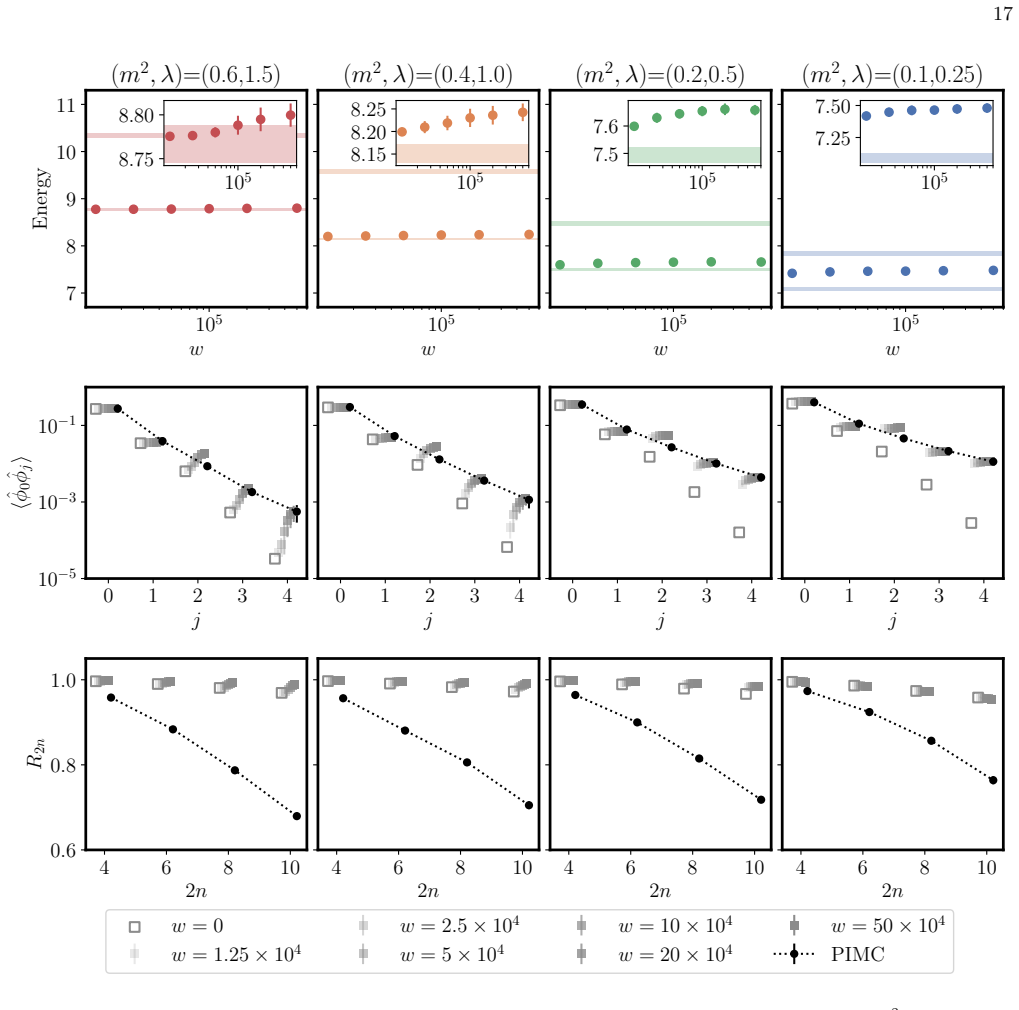
The central discovery is a workflow that turns Euclidean correlation data into a fixed, classically known quantum circuit. The paper proposes the $(R,Q)$ ansatz, $|\psi\rangle_{R,Q}=\left[\otimes_{j=0}^{N-1}\hat S_j(r)\right] C_{R,Q}(\hat a^\dagger)|0\rangle$, where $\hat S_j(r)$ is a single-mode squeezer and $C_{R,Q}$ is a polynomial of creation operators whose terms are symmetric under parity, time reversal, lattice translation, and lattice inversion, with rank $R$ (total boson number) and span $Q$ (support within neighboring sites). Because the core state has only $N|c_{R,Q}|$ nonzero Fock components, expectation values of local and two-point operators can be evaluated classically in $O(|c_{R,Q}|^2Q^2)$ time independent of $N$. The paper's moment-optimization procedure minimizes the energy plus a weighted sum of squared deviations of selected moments from their Euclidean path-integral Monte-Carlo values; it demonstrates that for a $(2,2)$ ansatz this can pull the local moment ratios $R_{2n}=\langle\hat\phi^{2n}\rangle/\left[(2n-1)!!\langle\hat\phi^2\rangle^n\right]$ toward the non-Gaussian Monte-Carlo values and, in a separate optimization, improve $\langle\hat\phi_0\hat\phi_4\rangle$, at an energy cost that is small compared with the spectral gap for most tested couplings. The same structure is then translated to a qubit circuit: the core state is prepared by a sparse state-preparation algorithm using $O(N^2R|c_{R,Q}|)$ CNOT gates, and the squeezing operators are Trotterized on a truncated Fock space with cutoffs chosen to meet a target fidelity.
Load-bearing premise
The argument rests on the assumption that the $(R,Q)$ ansatz, identical single-mode squeezers applied to a local core of rank $R$ and span $Q$, is flexible enough at the tested couplings that matching the energy and a few Monte-Carlo moments forces the state close to the true ground state; multimode fidelity is not reported to verify this.
Editorial extensions
If this is right
- For the tested couplings, a classical side computation can produce a complete quantum circuit for the $\phi^4$ ground state that requires no variational feedback from quantum hardware.
- Moment optimization selects among low-energy ansatz states: it can improve non-Gaussian moment ratios or non-local correlations that energy minimization alone leaves wrong, at energy penalties below the spectral gap except near the continuum limit.
- The efficiency statements carry over to any theory whose ground state is well approximated by an $(R,Q)$-type core: the circuit depth is polynomial in $N$, $R$, $Q$, and the boson cutoff $\Lambda$, with classical precomputation cost $O(N^3 R |c_{R,Q}|^2 \log(N|c_{R,Q}|))$.
- Since the PIMC moments carry statistical errors and the pipeline propagates them to optimized parameters, the output is naturally an ensemble of circuits; repeated runs on quantum hardware can turn this into an uncertainty on simulated real-time quantities.
Reading between the lines
- One implication the authors do not develop is that the method gives a concrete way to resolve cases where many candidate states have nearly the same energy: PIMC moments pick the one whose correlation structure matches the true state, suggesting the loss function could be tuned to whatever observable a later dynamics simulation needs.
- A direct stress test would compute the actual multimode fidelity against a high-precision numerical ground state at small $N$; the paper only verifies energy and moments, so this would reveal whether moment-matching is sufficient to guarantee closeness in state space.
- Near the continuum limit the correlation length diverges, so $R$ and $Q$ likely have to grow with $N$; then the classical cost and circuit depth cease to be independent of system size, and the pipeline would need either a better ansatz or quantum-assisted moment evaluation to remain efficient.
Editorial analysis
A structured set of objections, weighed in public.
Referee Report
Summary. The manuscript develops and tests a classical pipeline for preparing approximate ground states of (1+1)-dimensional lattice phi^4 theory on a quantum simulator. The three elements are: (i) a finite-stellar-rank bosonic ansatz, specialized to a tensor product of single-mode squeezers applied to a rank-R, span-Q polynomial core state; (ii) a moment-optimization loss that augments energy minimization with penalties for deviations from PIMC-computed ground-state moments; and (iii) a translation of the optimized ansatz into qubit circuits using sparse state preparation for the core and truncated, Trotterized squeezing operators for the Gaussian part. The paper validates the ansatz in (0+1)D with explicit fidelities and energy discrepancies, presents multimode N=10 results for energies, two-point functions, local moments, and moment ratios, and provides resource estimates with error bounds for the circuit implementation.
Significance. If the central claim is established, the paper offers a valuable and timely contribution: a classical route from Euclidean Monte-Carlo data to a fixed, polynomial-size quantum circuit for a non-trivial interacting field-theory ground state, without a quantum feedback loop. The single-mode calculations are clean and the fidelity/energy tables provide genuine support for the ansatz in that sector. The circuit-translation section is also a strength: it gives concrete gate counts, truncation bounds, and Trotter-error bounds, and it is honest about the looseness of those bounds. The main weakness is that the multimode evidence does not certify that the optimized states are close to the true ground state: no fidelity, no delta-E, and no overlap with an independent ground-state calculation is reported for N=10. Energy proximity is shown in the paper itself to be insufficient to distinguish very different ansatz states, so the central claim remains contingent on additional evidence.
major comments (3)
- [Sec. IV B, Eq. (3), Figs. 7-14] The central claim that the pipeline prepares states close to the (1+1)D ground state is not supported by the multimode numerical evidence. The only quantitative closeness metric reported for the multimode case is the Hamiltonian expectation value (Fig. 7); no fidelity, no delta-E, and no overlap with an independently obtained ground state is reported. Equation (3) provides a lower bound F >= 1 - delta-E, but delta-E is never evaluated for N=10, even though the PIMC data include an excited-state band (top panels of Fig. 7) from which the gap and hence delta-E could be estimated. Since Fig. 7 shows that the GEP and the (R,Q) ansatze attain comparable energies while differing substantially in two-point functions and moment ratios, energy proximity is demonstrably insufficient to certify closeness; Appendix A makes the same point analytically. I request either direct fidelities against an exact or exact-diagonalization ground state in the truncated Fock space for N=10, or at minimum a table of delta-E for the (R,Q) ansatze at the four couplings, with the PIMC gap used as the denominator.
- [Sec. IV A, Eqs. (25)-(28), Fig. 7] The restricted (R,Q) ansatz has a structural limitation that interacts with the closeness claim: with passive rotations dropped and span truncation Q, all cross-mode correlations must be carried by the rank-R, span-Q core, and <phi_0 phi_j> is identically zero for j > 2Q (stated in the text following Fig. 7). At the tested couplings, PIMC sees small but nonzero <phi_0 phi_5> (Figs. 20-23), which the (R,Q) ansatz cannot represent at Q=2. This does not invalidate the variational method, but it means that matching energy and the low-j two-point functions does not constrain the unconstrained tail of the correlation function. Without additional information such as fidelity, delta-E, or an un-targeted observable sensitive to the tail, the ansatz could match the plotted moments yet remain far from the true ground state. Please quantify the contribution of the j>2Q tail, or otherwise bound the neglected correlations, in assessing the multimode results.
- [Sec. IV B, Eq. (4), Figs. 9-12] The moment-optimization demonstrations are fits rather than independent tests: the loss function in Eq. (4) directly penalizes discrepancies in the target moments, so the monotone decrease in the target-moment discrepancy in Figs. 9 and 12 is guaranteed by construction and cannot be read as evidence that PIMC moments are predictive or that the ansatz is closer to the true ground state. The meaningful validation would be improvement in non-target moments or in quantities absent from the loss, or a demonstrated relation between moment matching and fidelity. As presented, the paper's stronger claims rest on the energy and qualitative correlation plots, which brings the assessment back to Major Comment 1. I recommend that the authors state this distinction explicitly and use a non-target observable such as a connected four-point function or the tail two-point function as a validation metric.
minor comments (5)
- [Abstract and Sec. VI] The sentence 'The resulting states yield comparable ground-state energy estimates but exhibit distinct correlations and local non-Gaussianity' is vague; it should specify distinct from which reference states and for which couplings this statement holds.
- [Sec. V A, Eq. (42)] There is a typo in 'we we have assumed' near Eq. (42); please correct.
- [Sec. V C, Eq. (53) and Table II] The resource estimates in Table II are derived from deliberately loose analytical bounds, as the authors note; it would be helpful to state explicitly that the reported Lambda and K are upper-resource estimates rather than the minimal resources found numerically.
- [Fig. 7] The log-scale insets for the two-point functions make it difficult to see that some ansatz values are exactly zero; use a marker or annotation to indicate the zero values rather than points that appear to be missing from the plot.
- [Appendix B, Eq. (B7)] The virial theorem estimate for <pi^2> relies on the specific form of the potential; please state the assumptions explicitly so that the PIMC energy estimate is fully reproducible.
Circularity Check
No circularity found: PIMC moments are explicit external inputs; target-moment reductions are the optimization objective, not hidden predictions.
full rationale
The paper's derivation chain is a variational construction rather than a prediction from first principles, and its load-bearing claims do not reduce to their inputs by definition. PIMC ground-state moments enter the loss function in Eq. (4) as external inputs; minimizing that loss by construction reduces the squared deviations of the target moments, so the monotone decreases in Figs. 9 and 12 are properties of the optimization objective, not independent predictions. The paper presents them as optimization outcomes and does not use them to validate the method. The central claims that do carry weight—comparable ground-state energy, distinct correlation and non-Gaussianity structure for a fixed ansatz, and polynomial circuit cost—rest on independent inputs: energy minimization is performed directly against the Hamiltonian, the GEP comparison provides an external baseline, and the circuit translation uses standard sparse-state-preparation and Trotter-error techniques. Self-citations (e.g., Refs. [74, 75, 91, 118]) appear as reviews or as a squeezing-implementation gadget and are not used to forbid alternatives or to justify the ansatz itself. The stellar-hierarchy ansatz is attributed to external references [93, 94], not to the authors' prior work. The paper also explicitly acknowledges the multimode evidentiary limitation in Sec. II: 'we will compute both energy discrepancy and fidelity for the single-mode, i.e., the (0+1)D case, but restrict the analysis to just energy discrepancy for the multimode.' That is a stated expressiveness and verification caveat, not a circular step. No equation is equivalent to its own input by construction beyond the explicit definition of the moment-optimization loss function in Eq. (4).
Assumptions & free parameters
free parameters (5)
- Moment-optimization weights w =
12.5, 25, 50, 100, 200, 400 for moment-ratio optimization; 1.25e4 to 5e5 for two-point optimization
- Ansatz variational parameters (r, A, B0, B1, B2, C coefficients) =
Optimized per (m^2, lambda), e.g., r values in Fig. 8 and Table II
- Target moment set T =
T = {phi^6_j, phi^8_j, phi^10_j} or T = {phi_0 phi_4}
- Ansatz ranks R and spans Q =
(2,1), (2,2), (4,1), (4,2)
- PIMC temporal parameters T and theta =
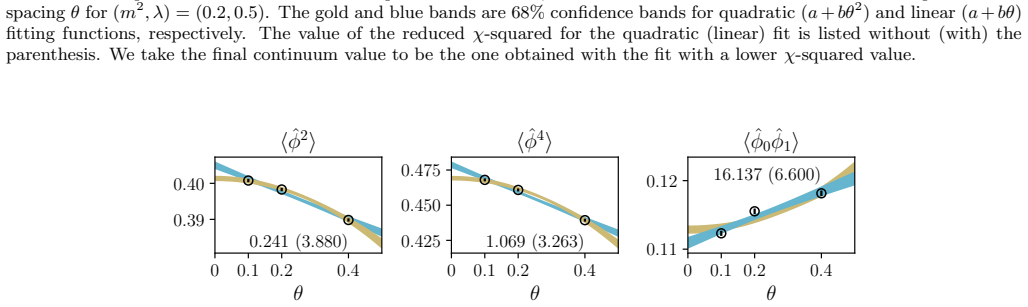
T = 10, theta in {0.4, 0.2, 0.1}
assumptions (6)
- domain assumption The ground state is non-degenerate with a non-zero spectral gap, so Eq. (3) gives a fidelity lower bound from energy discrepancy.
- domain assumption The ground state of the phi^4 Hamiltonian has infinite stellar rank, so finite-rank ansatzes can only approximate it.
- domain assumption PIMC-computed Euclidean correlation functions are faithful proxies for ground-state expectation values of the Minkowski lattice Hamiltonian after T to infinity and theta to 0 extrapolations.
- ad hoc to paper The Q-truncated core polynomial can capture the relevant non-local correlations for N = 10 at the tested couplings.
- standard math The sparse state preparation algorithm of Ref. [110] correctly prepares the core state with the quoted gate counts.
- domain assumption The truncation and Trotter error bounds in Appendix E are valid and sufficiently tight to choose Lambda and K.
Cite this review
Pith. "Pith review of Euclidean-Monte-Carlo-informed ground-state preparation for quantum simulation of scalar field theory." pith.science (2026). https://pith.science/paper/VJ7WTGKK
@misc{pith2026250602313,
  author       = {Pith},
  title        = {Pith review of: Euclidean-Monte-Carlo-informed ground-state preparation for quantum simulation of scalar field theory},
  year         = {2026},
  howpublished = {\url{https://pith.science/paper/VJ7WTGKK}},
  note         = {Machine review of arXiv:2506.02313}
}
read the original abstract
Quantum simulators offer great potential for investigating dynamical properties of quantum field theories. However, preparing accurate non-trivial initial states for these simulations is challenging. Classical Euclidean-time Monte-Carlo methods provide a wealth of information about states of interest to quantum simulations. Thus, it is desirable to facilitate state preparation on quantum simulators using this information. To this end, we present a fully classical pipeline for generating efficient quantum circuits for preparing the ground state of an interacting scalar field theory in 1+1 dimensions. The first element of this pipeline is a variational ansatz family based on the stellar hierarchy for bosonic quantum systems. The second element of this pipeline is the classical moment-optimization procedure that augments the standard variational energy minimization by penalizing deviations in selected sets of ground-state correlation functions (i.e., moments). The values of ground-state moments are sourced from classical Euclidean methods. The resulting states yield comparable ground-state energy estimates but exhibit distinct correlations and local non-Gaussianity. The third element of this pipeline is translating the moment-optimized ansatz into an efficient quantum circuit with an asymptotic cost that is polynomial in system size. This work opens the way to systematically applying classically obtained knowledge of states to prepare accurate initial states in quantum field theories of interest in nature.
Figures


Figures from the paper (28 more)






Reference graph
Works this paper leans on
-
[1]
Initialization: Initialize T = S = [0000, 0101, 0110, 1011, 1100, 1101], dif qubits = [], dif vals = []
-
[2]
, n} and look for the first qubit b such that the sizes of the sets T0 := {x ∈ T |x[b] = 0 } and T1 := {x ∈ T |x[b] = 1 } are as unequal as possible (with neither set being empty)
The first WHILE loop: Scan over all qubits b ∈ {1, . . . , n} and look for the first qubit b such that the sizes of the sets T0 := {x ∈ T |x[b] = 0 } and T1 := {x ∈ T |x[b] = 1 } are as unequal as possible (with neither set being empty). This turns out to be b = 1; in this case, T0 = [0000, 1011] and T1 = [0101, 0110, 1100, 1101], i.e., |T0| = 2 and |T1| ...
-
[3]
Also remove the last value of dif vals
Preparation for the second WHILE loop: Remove the last value appended to dif qubits, i.e., b = 0; store it as dif = 0. Also remove the last value of dif vals. Finally, store the single element of T as x1. This leaves x1 = 1011, dif = 0, dif qubits = [1], dif vals = [0]. Now, define a new set T ′ which consists of all those strings x ∈ S which take values ...
-
[4]
Since |T ′| is already 1, the loop does not run in this case
The second WHILE loop: The second WHILE loop runs in exactly the same way as the first WHILE loop, except that the initial conditions now involve the set T ′, and the updated values of dif qubits and dif vals defined above. Since |T ′| is already 1, the loop does not run in this case
-
[5]
Thus, the relevant variable values at this stage are x1 = 1011, x2 = 0000, dif = 0, dif qubits = [1], dif vals = [0]
Preparation for circuit building: Assign the single element in T ′ to the variable x2. Thus, the relevant variable values at this stage are x1 = 1011, x2 = 0000, dif = 0, dif qubits = [1], dif vals = [0]. To summarize, the above steps identify two stringsx1 and x2 which take equal values on the qubits indif qubits, and no other strings in S take the same ...
-
[6]
(a) If x1[dif ] ̸= 1, add a NOT gate to the line dif
Circuit building: Initialize ˆU = ˆ1. (a) If x1[dif ] ̸= 1, add a NOT gate to the line dif . In this case, x1[dif ] is already 1. ˆU = dif → 0 1 2 3 (D1) (b) For all qubits b other than the dif qubit, if x1[b] ̸= x2[b], apply a CNOT gate on qubit b controlled on dif . ˆU = dif → 0 1 2 3 (D2) x1[dif ] = 1 and x2[dif ] = 0 by design. Thus, the application o...
-
[7]
∞X n2=0 ⟨n2| ˆS(r) − ˆSΛ(r)|n1⟩ 2 #1/2 ≤ argmaxn1≤R
T runcation error The goal is to compare the action of the full squeezing operator, ˆS(r), and the approximate squeezing operator, ˆSΛ(r) on the single- and multi-mode core states. The single-mode rank- R core state is given by |C⟩R = ¯P ncn |n⟩. Here, the sum ¯P is restricted to a sum of R 2 + 1 terms, such that |C⟩ is a symmetric rank- R core state as d...
-
[8]
T rotter error While we presented a state-dependent, i.e., ( R, Q)-dependent, bound for the truncation error, it is common and often more straightforward to establish a state-independent bound for the Trotter error. Thus, we will bound, |ψΛ⟩R − |ψΛ,K⟩R ≤ ˆSΛ,K(r) − ˆSΛ(r) , (E23) where ˆA denotes the spectral norm of the operator which is induced by the i...
Show all 151 references
-
[9]
(E33) Since the core state, as well as the squeezing operator(s), are characterized by real coefficients, the overlap ⟨ψ|ψΛ,K⟩ is real
Combined errors The distance between the true state |ψ⟩R,Q and the state obtained by the application of the truncated, Trotterized squeezing operator(s) satisfies |ψ⟩R,Q − |ψΛ,K⟩R,Q 2 = 2 1 − Re(R,Q⟨ψ|ψΛ,K⟩R,Q) ≤ ϵ(N ) 2 . (E33) Since the core state, as well as the squeezing o...
-
[10]
(52) can be explicitly expressed as ˆsq,Λ m = ˆsq,Λ,+ m + ˆsq,Λ,− m , (F1) 44 where ˆsq,Λ,+ m := i 2 ⌊ Λ−2−m 4 ⌋X n=0 ℓ4n+m |qΛ(4n + m + 2)⟩ ⟨4n + m| , sq,Λ,− m := sq,Λ,+ m †
Implementation of the squeezing operator using a singular-value decomposition Each operator ˆsq,Λ m with m ∈ {0, · · ·, 3} in Eq. (52) can be explicitly expressed as ˆsq,Λ m = ˆsq,Λ,+ m + ˆsq,Λ,− m , (F1) 44 where ˆsq,Λ,+ m := i 2 ⌊ Λ−2−m 4 ⌋X n=0 ℓ4n+m |qΛ(4n + m + 2)⟩ ⟨4n + ...
-
[11]
squeezing Hamiltonian
Implementation of the squeezing operator using a hybrid analog-digital simulator Recall that according to Eq. (45) of the main text, the single-mode squeezing operator in the unary map can be expressed as: ˆSu,Λ(r) = e r 2 PΛ−2 n=0 √ (n+1)(n+2)|uΛ(n+2)⟩⟨uΛ(n)|−|uΛ(n)⟩⟨uΛ(n+2)|...
-
[12]
Single-mode Gaussian operations : These include the squeezing ˆS(ξ) = e 1 2 [ξ(ˆa†)2−ξ∗ˆa2] and displacement ˆD(α) = eαˆa†−α∗ˆa operators with ξ, α∈ C
-
[13]
Multimode Gaussian operations : These include passive rotations R(Φ) = ei PN −1 j,j′ =0 ˆa† j Φj,j′ ˆaj′
-
[14]
Among the above Gaussian operations, single-mode displacements and passive rotations are often easier to perform than single-mode squeezing
Single-boson additions ˆa† j. Among the above Gaussian operations, single-mode displacements and passive rotations are often easier to perform than single-mode squeezing. For example, in a photonic device, the latter is limited to smaller squeezing-parameter magnitudes |ξ| = r...
-
[15]
K. G. Wilson, Confinement of quarks, Physical review D 10, 2445 (1974)
1974
-
[16]
Creutz, L
M. Creutz, L. Jacobs, and C. Rebbi, Monte Carlo computations in lattice gauge theories, Physics Reports 95, 201 (1983)
1983
-
[17]
Montvay and G
I. Montvay and G. M¨ unster,Quantum fields on a lattice (Cambridge University Press, 1994)
1994
-
[18]
H. J. Rothe, Lattice gauge theories: an introduction (World Scientific Publishing Company, 2012)
2012
-
[19]
Gattringer and C
C. Gattringer and C. Lang, Quantum chromodynamics on the lattice: an introductory presentation , Vol. 788 (Springer Science & Business Media, 2009)
2009
-
[20]
Y. Aoki, T. Blum, S. Collins, L. Del Debbio, M. Della Morte, P. Dimopoulos, X. Feng, M. Golterman, S. Gottlieb, R. Gupta, et al. , Flag review 2024, arXiv preprint arXiv:2411.04268 (2024)
2024 arXiv
-
[21]
Collaboration, A
U. Collaboration, A. Bazavov, F. Karsch, S. Mukherjee, and P. Petreczky, Hot-dense lattice QCD, The European Physical Journal A 55, 1 (2019)
2019
-
[22]
Davoudi, E
Z. Davoudi, E. T. Neil, C. W. Bauer, T. Bhattacharya, T. Blum, P. Boyle, R. C. Brower, S. Catterall, N. H. Christ, V. Cirigliano, et al., Report of the snowmass 2021 topical group on lattice gauge theory, arXiv preprint arXiv:2209.10758 (2022)
2022 arXiv
-
[23]
A. S. Kronfeld, T. Bhattacharya, T. Blum, N. H. Christ, C. DeTar, W. Detmold, R. Edwards, A. Hasenfratz, H.-W. Lin, S. Mukherjee, et al. , Lattice QCD and particle physics, arXiv preprint arXiv:2207.07641 (2022)
2022 arXiv
-
[24]
L¨ uscher, Two-particle states on a torus and their relation to the scattering matrix, Nuclear Physics B354, 531 (1991)
M. L¨ uscher, Two-particle states on a torus and their relation to the scattering matrix, Nuclear Physics B354, 531 (1991)
1991
-
[25]
Lellouch and M
L. Lellouch and M. L¨ uscher, Weak transition matrix elements from finite-volume correlation functions, Communications in Mathematical Physics 219, 31 (2001). 49
2001
-
[26]
R. A. Briceno, Z. Davoudi, and T. C. Luu, Nuclear reactions from lattice QCD, Journal of Physics G: Nuclear and Particle Physics 42, 023101 (2015)
2015
-
[27]
R. A. Briceno, J. J. Dudek, and R. D. Young, Scattering processes and resonances from lattice QCD, Reviews of Modern Physics 90, 025001 (2018)
2018
-
[28]
M. T. Hansen and S. R. Sharpe, Lattice QCD and three-particle decays of resonances, Annual Review of Nuclear and Particle Science 69, 65 (2019)
2019
-
[29]
Davoudi, W
Z. Davoudi, W. Detmold, P. Shanahan, K. Orginos, A. Parreno, M. J. Savage, and M. L. Wagman, Nuclear matrix elements from lattice QCD for electroweak and beyond-Standard-Model processes, Physics Reports 900, 1 (2021)
2021
-
[30]
Gattringer and K
C. Gattringer and K. Langfeld, Approaches to the sign problem in lattice field theory, International Journal of Modern Physics A 31, 1643007 (2016)
2016
-
[31]
Cohen, E
G. Cohen, E. Gull, D. R. Reichman, and A. J. Millis, Taming the dynamical sign problem in real-time evolution of quantum many-body problems, Physical review letters 115, 266802 (2015)
2015
-
[32]
Troyer and U.-J
M. Troyer and U.-J. Wiese, Computational complexity and fundamental limitations to fermionic quantum monte carlo simulations, Physical review letters 94, 170201 (2005)
2005
-
[33]
V. Goy, V. Bornyakov, D. Boyda, A. Molochkov, A. Nakamura, A. Nikolaev, and V. Zakharov, Sign problem in finite density lattice QCD, Progress of Theoretical and Experimental Physics 2017, 031D01 (2017)
2017
-
[34]
Nagata, Finite-density lattice QCD and sign problem: Current status and open problems, Progress in Particle and Nuclear Physics 127, 103991 (2022)
K. Nagata, Finite-density lattice QCD and sign problem: Current status and open problems, Progress in Particle and Nuclear Physics 127, 103991 (2022)
2022
-
[35]
N. Klco, A. Roggero, and M. J. Savage, Standard Model physics and the digital quantum revolution: thoughts about the interface, Reports on Progress in Physics 85, 064301 (2022)
2022
-
[36]
C. W. Bauer, Z. Davoudi, N. Klco, and M. J. Savage, Quantum simulation of fundamental particles and forces, Nature Reviews Physics , 1 (2023)
2023
-
[37]
C. W. Bauer, Z. Davoudi, A. B. Balantekin, T. Bhattacharya, M. Carena, W. A. de Jong, P. Draper, A. El-Khadra, N. Gemelke, M. Hanada, et al. , Quantum simulation for high-energy physics, PRX Quantum 4, 027001 (2023)
2023
-
[38]
Di Meglio, K
A. Di Meglio, K. Jansen, I. Tavernelli, C. Alexandrou, S. Arunachalam, C. W. Bauer, K. Borras, S. Carrazza, A. Crippa, V. Croft, et al. , Quantum computing for high-energy physics: State of the art and challenges, PRX Quantum 5, 037001 (2024)
2024
-
[39]
D. Beck, J. Carlson, Z. Davoudi, J. Formaggio, S. Quaglioni, M. Savage, J. Barata, T. Bhattacharya, M. Bishof, I. Cloet, et al. , Quantum information science and technology for nuclear physics. input into us long-range planning, 2023, arXiv preprint arXiv:2303.00113 (2023)
2023 arXiv
-
[40]
Byrnes and Y
T. Byrnes and Y. Yamamoto, Simulating lattice gauge theories on a quantum computer, Physical Review A 73, 022328 (2006)
2006
-
[41]
A. F. Shaw, P. Lougovski, J. R. Stryker, and N. Wiebe, Quantum algorithms for simulating the lattice schwinger model, Quantum 4, 306 (2020)
2020
-
[42]
Ciavarella, N
A. Ciavarella, N. Klco, and M. J. Savage, Trailhead for quantum simulation of su(3) yang-mills lattice gauge theory in the local multiplet basis, Physical Review D 103, 094501 (2021)
2021
-
[43]
Kan and Y
A. Kan and Y. Nam, Lattice quantum chromodynamics and electrodynamics on a universal quantum computer, arXiv preprint arXiv:2107.12769 (2021)
2021 arXiv
-
[44]
H. Lamm, S. Lawrence, Y. Yamauchi, N. Collaboration, et al., General methods for digital quantum simulation of gauge theories, Physical Review D 100, 034518 (2019)
2019
-
[45]
J. F. Haase, L. Dellantonio, A. Celi, D. Paulson, A. Kan, K. Jansen, and C. A. Muschik, A resource efficient approach for quantum and classical simulations of gauge theories in particle physics, Quantum 5, 393 (2021)
2021
-
[46]
Davoudi, A
Z. Davoudi, A. F. Shaw, and J. R. Stryker, General quantum algorithms for hamiltonian simulation with applications to a non-abelian lattice gauge theory, arXiv preprint arXiv:2212.14030 (2022)
2022 arXiv
-
[47]
E. M. Murairi, M. J. Cervia, H. Kumar, P. F. Bedaque, and A. Alexandru, How many quantum gates do gauge theories require?, Physical Review D 106, 094504 (2022)
2022
-
[48]
M. L. Rhodes, M. Kreshchuk, and S. Pathak, Exponential improvements in the simulation of lattice gauge theories using near-optimal techniques, PRX Quantum 5, 040347 (2024)
2024
-
[49]
Lamm, Y.-Y
H. Lamm, Y.-Y. Li, J. Shu, Y.-L. Wang, and B. Xu, Block encodings of discrete subgroups on a quantum computer, Physical Review D 110, 054505 (2024)
2024
-
[50]
Balaji, C
P. Balaji, C. Conefrey-Shinozaki, P. Draper, J. K. Elhaderi, D. Gupta, L. Hidalgo, A. Lytle, and E. Rinaldi, Quantum circuits for su(3) lattice gauge theory, arXiv preprint arXiv:2503.08866 (2025)
2025 arXiv
-
[51]
S. P. Jordan, K. S. Lee, and J. Preskill, Quantum computation of scattering in scalar quantum field theories, arXiv preprint arXiv:1112.4833 (2011)
2011 arXiv
-
[52]
S. P. Jordan, K. S. Lee, and J. Preskill, Quantum algorithms for quantum field theories, Science 336, 1130 (2012)
2012
-
[53]
S. P. Jordan, H. Krovi, K. S. Lee, and J. Preskill, Bqp-completeness of scattering in scalar quantum field theory, Quantum 2, 44 (2018)
2018
-
[54]
A. D. Bookatz, Qma-complete problems, arXiv preprint arXiv:1212.6312 (2012)
2012 arXiv
-
[55]
Kempe, A
J. Kempe, A. Kitaev, and O. Regev, The complexity of the local hamiltonian problem, Siam journal on computing 35, 1070 (2006)
2006
-
[56]
A. Y. Kitaev, A. Shen, and M. N. Vyalyi, Classical and quantum computation , 47 (American Mathematical Soc., 2002)
2002
-
[57]
Marshall, R
K. Marshall, R. Pooser, G. Siopsis, and C. Weedbrook, Quantum simulation of quantum field theory using continuous variables, Physical Review A 92, 063825 (2015)
2015
-
[58]
Bagherimehrab, Y
M. Bagherimehrab, Y. R. Sanders, D. W. Berry, G. K. Brennen, and B. C. Sanders, Nearly optimal quantum algorithm 50 for generating the ground state of a free quantum field theory, PRX Quantum 3, 020364 (2022)
2022
-
[59]
Klco and M
N. Klco and M. J. Savage, Minimally entangled state preparation of localized wave functions on quantum computers, Physical Review A 102, 012612 (2020)
2020
-
[60]
Klco and M
N. Klco and M. J. Savage, Systematically localizable operators for quantum simulations of quantum field theories, Physical Review A 102, 012619 (2020)
2020
-
[61]
Klco and M
N. Klco and M. J. Savage, Fixed-point quantum circuits for quantum field theories, Physical Review A 102, 052422 (2020)
2020
-
[62]
Kitaev and W
A. Kitaev and W. A. Webb, Wavefunction preparation and resampling using a quantum computer, arXiv preprint arXiv:0801.0342 (2008)
2008 arXiv
-
[63]
Nishi, T
H. Nishi, T. Kosugi, and Y.-i. Matsushita, Implementation of quantum imaginary-time evolution method on nisq devices by introducing nonlocal approximation, npj Quantum Information 7, 85 (2021)
2021
-
[64]
Y. Ge, J. Tura, and J. I. Cirac, Faster ground state preparation and high-precision ground energy estimation with fewer qubits, Journal of Mathematical Physics 60 (2019)
2019
-
[65]
Y. Dong, L. Lin, and Y. Tong, Ground-state preparation and energy estimation on early fault-tolerant quantum computers via quantum eigenvalue transformation of unitary matrices, PRX Quantum 3, 040305 (2022)
2022
-
[66]
Lin and Y
L. Lin and Y. Tong, Near-optimal ground state preparation, Quantum 4, 372 (2020)
2020
-
[67]
K. Choi, D. Lee, J. Bonitati, Z. Qian, and J. Watkins, Rodeo algorithm for quantum computing, Physical Review Letters 127, 040505 (2021)
2021
-
[68]
T. D. Cohen and H. Oh, Efficient vacuum-state preparation for quantum simulation of strongly interacting local quantum field theories, Physical Review A 109, L020402 (2024)
2024
-
[69]
Luis, Quantum-state preparation and control via the zeno effect, Physical Review A 63, 052112 (2001)
A. Luis, Quantum-state preparation and control via the zeno effect, Physical Review A 63, 052112 (2001)
2001
-
[70]
Y. Zhan, Z. Ding, J. Huhn, J. Gray, J. Preskill, G. K. Chan, and L. Lin, Rapid quantum ground state preparation via dissipative dynamics, arXiv preprint arXiv:2503.15827 (2025)
2025
-
[71]
Ding, C.-F
Z. Ding, C.-F. Chen, and L. Lin, Single-ancilla ground state preparation via lindbladians, Physical Review Research 6, 033147 (2024)
2024
-
[72]
Feniou, O
C. Feniou, O. Adjoua, B. Claudon, J. Zylberman, E. Giner, and J.-P. Piquemal, Sparse quantum state preparation for strongly correlated systems, The Journal of Physical Chemistry Letters 15, 3197 (2024)
2024
-
[73]
Tilly, H
J. Tilly, H. Chen, S. Cao, D. Picozzi, K. Setia, Y. Li, E. Grant, L. Wossnig, I. Rungger, G. H. Booth,et al., The variational quantum eigensolver: a review of methods and best practices, Physics Reports 986, 1 (2022)
2022
-
[74]
H. R. Grimsley, S. E. Economou, E. Barnes, and N. J. Mayhall, An adaptive variational algorithm for exact molecular simulations on a quantum computer, Nature communications 10, 3007 (2019)
2019
-
[75]
Arute, K
Google AI Quantum and Collaborators, F. Arute, K. Arya, R. Babbush, D. Bacon, J. C. Bardin, R. Barends, S. Boixo, M. Broughton, B. B. Buckley, et al. , Hartree-Fock on a superconducting qubit quantum computer, Science 369, 1084 (2020)
2020
-
[76]
Romero, R
J. Romero, R. Babbush, J. R. McClean, C. Hempel, P. J. Love, and A. Aspuru-Guzik, Strategies for quantum computing molecular energies using the unitary coupled cluster ansatz, Quantum Science and Technology 4, 014008 (2018)
2018
-
[77]
Anand, P
A. Anand, P. Schleich, S. Alperin-Lea, P. W. Jensen, S. Sim, M. D ´ ıaz-Tinoco, J. S. Kottmann, M. Degroote, A. F. Izmaylov, and A. Aspuru-Guzik, A quantum computing view on unitary coupled cluster theory, Chemical Society Reviews 51, 1659 (2022)
2022
-
[78]
Romero, J
A. Romero, J. Engel, H. L. Tang, and S. E. Economou, Solving nuclear structure problems with the adaptive variational quantum algorithm, Physical Review C 105, 064317 (2022)
2022
-
[79]
E. F. Dumitrescu, A. J. McCaskey, G. Hagen, G. R. Jansen, T. D. Morris, T. Papenbrock, R. C. Pooser, D. J. Dean, and P. Lougovski, Cloud quantum computing of an atomic nucleus, Physical review letters 120, 210501 (2018)
2018
-
[80]
O. Kiss, M. Grossi, P. Lougovski, F. Sanchez, S. Vallecorsa, and T. Papenbrock, Quantum computing of the 6Li nucleus via ordered unitary coupled clusters, Physical Review C 106, 034325 (2022)
2022
-
[81]
Rethinasamy, E
S. Rethinasamy, E. Guo, A. Wei, M. M. Wilde, and K. D. Launey, Neutron-nucleus dynamics simulations for quantum computers, arXiv preprint arXiv:2402.14680 (2024)
2024
-
[82]
N. Klco, E. F. Dumitrescu, A. J. McCaskey, T. D. Morris, R. C. Pooser, M. Sanz, E. Solano, P. Lougovski, and M. J. Savage, Quantum-classical computation of schwinger model dynamics using quantum computers, Physical Review A 98, 032331 (2018)
2018
-
[83]
Y. Y. Atas, J. Zhang, R. Lewis, A. Jahanpour, J. F. Haase, and C. A. Muschik, SU(2) hadrons on a quantum computer via a variational approach, Nature communications 12, 6499 (2021)
2021
-
[84]
R. C. Farrell, M. Illa, A. N. Ciavarella, and M. J. Savage, Scalable circuits for preparing ground states on digital quantum computers: The schwinger model vacuum on 100 qubits, PRX Quantum 5, 020315 (2024)
2024
-
[85]
Crippa, K
A. Crippa, K. Jansen, and E. Rinaldi, Analysis of the confinement string in (2+1)-dimensional quantum electrodynamics with a trapped-ion quantum computer, arXiv preprint arXiv:2411.05628 (2024)
2024 arXiv
-
[86]
Fromm, O
M. Fromm, O. Philipsen, M. Spannowsky, and C. Winterowd, Simulating Z2 lattice gauge theory with the variational quantum thermalizer, EPJ Quantum Technology 11, 1 (2024)
2024
-
[87]
R. C. Farrell, M. Illa, A. N. Ciavarella, and M. J. Savage, Quantum simulations of hadron dynamics in the schwinger model using 112 qubits, Physical Review D 109, 114510 (2024)
2024
-
[88]
Davoudi, C.-C
Z. Davoudi, C.-C. Hsieh, and S. V. Kadam, Scattering wave packets of hadrons in gauge theories: Preparation on a quantum computer, arXiv preprint arXiv:2402.00840 (2024)
2024 arXiv
-
[89]
Davoudi, C.-C
Z. Davoudi, C.-C. Hsieh, and S. V. Kadam, Quantum computation of hadron scattering in a lattice gauge theory, arXiv preprint arXiv:2505.20408 (2025). 51
2025 arXiv
-
[90]
A. T. Than, Y. Y. Atas, A. Chakraborty, J. Zhang, M. T. Diaz, K. Wen, X. Liu, R. Lewis, A. M. Green, C. A. Muschik, et al. , The phase diagram of quantum chromodynamics in one dimension on a quantum computer, arXiv preprint arXiv:2501.00579 (2024)
2024
-
[91]
X.-D. Xie, X. Guo, H. Xing, Z.-Y. Xue, D.-B. Zhang, S.-L. Zhu, and Q. Collaboration), Variational thermal quantum simulation of the lattice schwinger model, Physical Review D 106, 054509 (2022)
2022
-
[92]
Larocca, S
M. Larocca, S. Thanasilp, S. Wang, K. Sharma, J. Biamonte, P. J. Coles, L. Cincio, J. R. McClean, Z. Holmes, and M. Cerezo, A review of barren plateaus in variational quantum computing, arXiv preprint arXiv:2405.00781 (2024)
2024 arXiv
-
[93]
Cerezo, A
M. Cerezo, A. Arrasmith, R. Babbush, S. C. Benjamin, S. Endo, K. Fujii, J. R. McClean, K. Mitarai, X. Yuan, L. Cincio, et al. , Variational quantum algorithms, Nature Reviews Physics 3, 625 (2021)
2021
-
[94]
E. R. Anschuetz and B. T. Kiani, Beyond barren plateaus: Quantum variational algorithms are swamped with traps. 2022, arXiv preprint arXiv:2205.05786 (2022)
2022 arXiv
-
[95]
Klco and M
N. Klco and M. J. Savage, Digitization of scalar fields for quantum computing, Physical Review A 99, 052335 (2019)
2019
-
[96]
J. Liu, Z. Li, H. Zheng, X. Yuan, and J. Sun, Towards a variational jordan–lee–preskill quantum algorithm, Machine Learning: Science and Technology 3, 045030 (2022)
2022
-
[97]
Barata, N
J. Barata, N. Mueller, A. Tarasov, and R. Venugopalan, Single-particle digitization strategy for quantum computation of a ϕ 4 scalar field theory, Physical Review A 103, 042410 (2021)
2021
-
[98]
Hardy, P
A. Hardy, P. Mukhopadhyay, M. S. Alam, R. Konik, L. Hormozi, E. Rieffel, S. Hadfield, J. Barata, R. Venugopalan, D. E. Kharzeev, et al. , Optimized quantum simulation algorithms for scalar quantum field theories, arXiv preprint arXiv:2407.13819 (2024)
2024
-
[99]
Yeter-Aydeniz, E
K. Yeter-Aydeniz, E. F. Dumitrescu, A. J. McCaskey, R. S. Bennink, R. C. Pooser, and G. Siopsis, Scalar quantum field theories as a benchmark for near-term quantum computers, Physical Review A 99, 032306 (2019)
2019
-
[100]
Thompson and G
S. Thompson and G. Siopsis, Quantum computation of phase transition in interacting scalar quantum field theory, arXiv preprint arXiv:2303.02425 (2023)
2023 arXiv
-
[101]
A. C. Li, A. Macridin, S. Mrenna, and P. Spentzouris, Simulating scalar field theories on quantum computers with limited resources, Physical Review A 107, 032603 (2023)
2023
-
[102]
Turco, G
M. Turco, G. Quinta, J. Seixas, and Y. Omar, Quantum simulation of bound state scattering, PRX Quantum 5, 020311 (2024)
2024
-
[103]
N. A. Zemlevskiy, Scalable quantum simulations of scattering in scalar field theory on 120 qubits, arXiv preprint arXiv:2411.02486 (2024)
2024 arXiv
-
[104]
Ingoldby, M
J. Ingoldby, M. Spannowsky, T. Sypchenko, S. Williams, and M. Wingate, Real-time scattering on quantum computers via hamiltonian truncation, arXiv preprint arXiv:2505.03878 (2025)
2025 arXiv
-
[105]
J. D. Watson, J. Bringewatt, A. F. Shaw, A. M. Childs, A. V. Gorshkov, and Z. Davoudi, Quantum algorithms for simulating nuclear effective field theories, arXiv preprint arXiv:2312.05344 (2023)
2023 arXiv
-
[106]
Loinaz and R
W. Loinaz and R. Willey, Monte carlo simulation calculation of the critical coupling constant for two-dimensional con- tinuum φ4 theory, Physical Review D 58, 076003 (1998)
1998
-
[107]
Chabaud, D
U. Chabaud, D. Markham, and F. Grosshans, Stellar representation of non-gaussian quantum states, Physical Review Letters 124, 063605 (2020)
2020
-
[108]
Chabaud and S
U. Chabaud and S. Mehraban, Holomorphic representation of quantum computations, Quantum 6, 831 (2022)
2022
-
[109]
Blahnik and S
ˇS. Blahnik and S. Shandera, Natural disorder distributions from measurement, arXiv preprint arXiv:2405.02214 (2024)
2024 arXiv
-
[110]
Serafini, Quantum continuous variables: a primer of theoretical methods (CRC press, 2023)
A. Serafini, Quantum continuous variables: a primer of theoretical methods (CRC press, 2023)
2023
-
[111]
X. Han, S. A. Hartnoll, and J. Kruthoff, Bootstrapping matrix quantum mechanics, Physical Review Letters 125, 041601 (2020)
2020
-
[112]
Berenstein and G
D. Berenstein and G. Hulsey, Bootstrapping simple qm systems, arXiv preprint arXiv:2108.08757 (2021)
2021 arXiv
-
[113]
Ozzello and Y
Z. Ozzello and Y. Meurice, Bootstrap methods for digitized scalar field theory, arXiv preprint arXiv:2312.10559 (2023)
2023 arXiv
-
[114]
Stevenson, Gaussian effective potential: Quantum mechanics, Physical Review D 30, 1712 (1984)
P. Stevenson, Gaussian effective potential: Quantum mechanics, Physical Review D 30, 1712 (1984)
1984
-
[115]
Stevenson, Gaussian effective potential
P. Stevenson, Gaussian effective potential. ii. λ ϕ4 field theory, Physical Review D 32, 1389 (1985)
1985
-
[116]
R. D. Somma, Quantum simulations of one dimensional quantum systems, arXiv preprint arXiv:1503.06319 (2015)
2015 arXiv
-
[117]
Macridin, A
A. Macridin, A. Li, S. Mrenna, and P. Spentzouris, Bosonic field digitization for quantum computers (2021), arXiv preprint arXiv:2108.10793
2021 arXiv
-
[118]
Macridin, P
A. Macridin, P. Spentzouris, J. Amundson, and R. Harnik, Digital quantum computation of fermion-boson interacting systems, Physical Review A 98, 042312 (2018)
2018
-
[119]
G. K. Brennen, P. Rohde, B. C. Sanders, and S. Singh, Multiscale quantum simulation of quantum field theory using wavelets, Physical Review A 92, 032315 (2015)
2015
-
[120]
Rychkov and L
S. Rychkov and L. G. Vitale, Hamiltonian truncation study of the φ4 theory in two dimensions, Physical Review D 91, 085011 (2015)
2015
-
[121]
R. D. Somma, Quantum computation, complexity, and many-body physics, arXiv preprint quant-ph/0512209 (2005)
2005 arXiv
-
[122]
P. C. Encinar, A. Agust ´ ı, and C. Sab ´ ın, Digital quantum simulation of beam splitters and squeezing with ibm quantum computers, Physical Review A 104, 052609 (2021)
2021
-
[123]
N. M. Tubman, C. Mejuto-Zaera, J. M. Epstein, D. Hait, D. S. Levine, W. Huggins, Z. Jiang, J. R. McClean, R. Babbush, M. Head-Gordon, et al. , Postponing the orthogonality catastrophe: efficient state preparation for electronic structure simulations on quantum devices, arXiv p...
2018 arXiv
-
[124]
Gleinig and T
N. Gleinig and T. Hoefler, An efficient algorithm for sparse quantum state preparation. in 2021 58th acm/ieee design automation conference (dac) (2021)
2021
-
[125]
T. M. de Veras, L. D. da Silva, and A. J. da Silva, Double sparse quantum state preparation, Quantum Information 52 Processing 21, 204 (2022)
2022
-
[126]
Zhang, T
X.-M. Zhang, T. Li, and X. Yuan, Quantum state preparation with optimal circuit depth: Implementations and applica- tions, Physical Review Letters 129, 230504 (2022)
2022
-
[127]
Fomichev, K
S. Fomichev, K. Hejazi, M. S. Zini, M. Kiser, J. Fraxanet, P. A. M. Casares, A. Delgado, J. Huh, A.-C. Voigt, J. E. Mueller, et al., Initial state preparation for quantum chemistry on quantum computers, PRX Quantum 5, 040339 (2024)
2024
-
[128]
Somma, G
R. Somma, G. Ortiz, J. E. Gubernatis, E. Knill, and R. Laflamme, Simulating physical phenomena by quantum networks, Physical Review A 65, 042323 (2002)
2002
-
[129]
Y. Tong, V. V. Albert, J. R. McClean, J. Preskill, and Y. Su, Provably accurate simulation of gauge theories and bosonic systems, Quantum 6, 816 (2022)
2022
-
[130]
B. Peng, Y. Su, D. Claudino, K. Kowalski, G. H. Low, and M. Roetteler, Quantum simulation of boson-related hamilto- nians: techniques, effective hamiltonian construction, and error analysis, Quantum Science and Technology 10, 023002 (2025)
2025
-
[131]
A. M. Childs, Y. Su, M. C. Tran, N. Wiebe, and S. Zhu, Theory of trotter error with commutator scaling, Physical Review X 11, 011020 (2021)
2021
-
[132]
Davoudi, A
Z. Davoudi, A. F. Shaw, and J. R. Stryker, General quantum algorithms for hamiltonian simulation with applications to a non-abelian lattice gauge theory, Quantum 7, 1213 (2023)
2023
-
[133]
T. I. Andersen, N. Astrakhantsev, A. H. Karamlou, J. Berndtsson, J. Motruk, A. Szasz, J. A. Gross, A. Schuckert, T. Westerhout, Y. Zhang, et al. , Thermalization and criticality on an analogue–digital quantum simulator, Nature 638, 79 (2025)
2025
-
[134]
Harmalkar, H
S. Harmalkar, H. Lamm, and S. Lawrence, Quantum simulation of field theories without state preparation, arXiv preprint arXiv:2001.11490 (2020)
2020 arXiv
-
[135]
E. J. Gustafson and H. Lamm, Toward quantum simulations of z 2 gauge theory without state preparation, Physical Review D 103, 054507 (2021)
2021
-
[136]
Stornati, A
P. Stornati, A. Acin, U. Chabaud, A. Dauphin, V. Parigi, and F. Centrone, Variational quantum simulation using non- gaussian continuous-variable systems, arXiv preprint arXiv:2310.15919 (2023)
2023 arXiv
-
[137]
A. D. Linde, A new inflationary universe scenario: a possible solution of the horizon, flatness, homogeneity, isotropy and primordial monopole problems, Physics Letters B 108, 389 (1982)
1982
-
[138]
Albrecht and P
A. Albrecht and P. J. Steinhardt, Cosmology for grand unified theories with radiatively induced symmetry breaking, Physical Review Letters 48, 1220 (1982)
1982
-
[139]
Gong and P
J. Gong and P. Aravind, Expansion coefficients of a squeezed coherent state in the number state basis, American Journal of Physics 58, 1003 (1990)
1990
-
[140]
De Oliveira, M
F. De Oliveira, M. S. Kim, P. L. Knight, and V. Buˇ zek, Properties of displaced number states, Physical Review A 41, 2645 (1990)
1990
-
[141]
Golubov, A
B. Golubov, A. Efimov, and V. Skvortsov, Walsh series and transforms: theory and applications , Vol. 64 (Springer Science & Business Media, 2012)
2012
-
[142]
Davoudi, N
Z. Davoudi, N. M. Linke, and G. Pagano, Toward simulating quantum field theories with controlled phonon-ion dynamics: A hybrid analog-digital approach, Physical Review Research 3, 043072 (2021)
2021
-
[143]
R. G. Jha, F. Ringer, G. Siopsis, and S. Thompson, Toward quantum computations of the o(3) model using qumodes, arXiv preprint arXiv:2308.06946 (2023)
2023 arXiv
-
[144]
V. Ale, N. M. Bauer, R. G. Jha, F. Ringer, and G. Siopsis, Quantum computation of su(2) lattice gauge theory with continuous variables, arXiv preprint arXiv:2410.14580 (2024)
2024 arXiv
-
[145]
R. A. Brice˜ no, R. G. Edwards, M. Eaton, C. Gonz´ alez-Arciniegas, O. Pfister, and G. Siopsis, Toward coherent quan- tum computation of scattering amplitudes with a measurement-based photonic quantum processor, arXiv preprint arXiv:2312.12613 (2023)
2023 arXiv
-
[146]
Crane, K
E. Crane, K. C. Smith, T. Tomesh, A. Eickbusch, J. M. Martyn, S. K¨ uhn, L. Funcke, M. A. DeMarco, I. L. Chuang, N. Wiebe, et al. , Hybrid oscillator-qubit quantum processors: Simulating fermions, bosons, and gauge fields, arXiv preprint arXiv:2409.03747 (2024)
2024 arXiv
-
[147]
S. D. Bartlett, B. C. Sanders, S. L. Braunstein, and K. Nemoto, Efficient classical simulation of continuous variable quantum information processes, Physical Review Letters 88, 097904 (2002)
2002
-
[148]
Weedbrook, S
C. Weedbrook, S. Pirandola, R. Garc ´ ıa-Patr´ on, N. J. Cerf, T. C. Ralph, J. H. Shapiro, and S. Lloyd, Gaussian quantum information, Reviews of Modern Physics 84, 621 (2012)
2012
-
[149]
Marco and Z
B. Marco and Z. Alessandro, Manipulating light states by single-photon addition and subtraction, in Progress in optics, Vol. 55 (Elsevier, 2010) pp. 41–83
2010
-
[150]
Hofheinz, E
M. Hofheinz, E. Weig, M. Ansmann, R. C. Bialczak, E. Lucero, M. Neeley, A. O’connell, H. Wang, J. M. Martinis, and A. Cleland, Generation of fock states in a superconducting quantum circuit, Nature 454, 310 (2008)
2008
-
[151]
Chabaud, G
U. Chabaud, G. Ferrini, F. Grosshans, and D. Markham, Classical simulation of Gaussian quantum circuits with non- Gaussian input states, Physical Review Research 3, 033018 (2021)
2021
Reviewed August 7, 2026 · model on record in the stance chip above.
Discussion (0). Sign in to comment.